Wastewater recycling, part of the solution to water shortage?

After the report on mountaineering and my experiences on the ascent to Mount Aconcagua, I return to the subject of water, and the opportunities and challenges in recycling it.

In earlier posts here I wrote about a very sophisticated system of wastewater recycling in Singapore, which turns it back into drinking water.
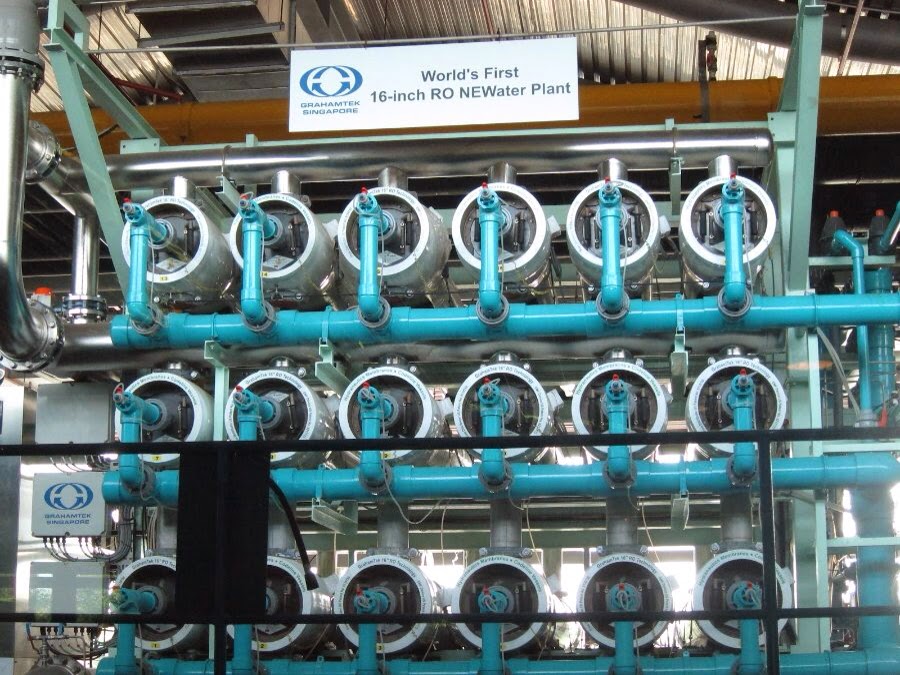
And at this year’s Singapore International Water Week, the Californian Orange County received the highest recognition, for a scheme where perfectly treated wastewater is pumped back into underground aquifers, to be later pumped up again as drinking water. It also serves as a barrier to seawater intrusion.

These two examples, especially Singapore, are probably the most far-reaching examples I know of achievement in water recycling.

Places like San Diego, hit by a drought, are now re-considering again the idea to follow the Singapore example, despite some opposition from civil society. So, to what extent is it possible to scale up these kinds of activities globally; is there potential for wastewater to contribute in a substantial way to closing the gap of some 300 cubic kilometres between the level of water withdrawals and sustainable supply?

Estimates show close to 300 cubic kilometres of wastewater is generated by municipalities per year (average 2003-12). This is the equivalent of some 50% of global average annual withdrawals for household use.

Part of the other 50% of withdrawals not counted as ‘wastewater’ may well be lost in leakage in pipes (in some countries this accounts for up to 70% of the water withdrawn by the municipal water supply schemes). Another part could be ‘used’ through evapotranspiration in lawns and gardens, etc.

As the table below shows, only about half of this wastewater is actually collected and treated, but less than 10% of the treated wastewater is directly reused.

Table 1: Municipal wastewater generation and treatment data 2003-2012, country groups by income per capita

Source: FAO aquastat


To get an idea of how municipal water could contribute to closing the gap between withdrawals and sustainable supply, let me go through the water supply chain.

The first step would require a better understanding of what happens with the 50% of municipal water apparently ‘disappearing’. Where this is down to leakage, governments have to set the right incentives so municipal water authorities address the issue.

One way proposed by the 2030 Water Resources Group (2030 WRG) in South Africa, which has been implemented by the government there, is to measure both water delivery and water intake, and to pay a premium to the schemes where the difference (i.e., water unaccounted for) gets smaller.

According to 2030 WRG cost-curve estimates, the cost savings would by far exceed the necessary spending to reduce the leakage.

As part of my proposals for targets within the water goal for post-2015 sustainable development, I suggest primary treatment of all wastewater by 2030 – an idea I will come back to in a later post.

So, what happens with 285 km³ of estimated wastewater generated, and what needs to be done? We will first have to increase collection, particularly in economically deprived areas, to make sure wastewater is collected and available for proper treatment.

Actually, only 36% of the world’s population has a sewage connection; this leaves 4.6 billion people unconnected. According to a WHO study, initial investment to set up a sewer connection is about USD 170 per capita; so the investment cost to connect them would be somewhere close to USD 800 billion. The annual cost of capital, repayment and operating cost is estimated at USD 1 per m³.

Next: treatment of both the up-to-now untreated collected – and the newly collected – wastewater. Estimates amount to USD 0.35 per m³. A big part of this cost is energy, an often forgotten link in the water-food-energy nexus framework.

And last but not least: less than 10% of treated wastewater is used directly. This can and must be increased. Direct use is, for instance, the Singapore approach, bringing treated water back to consumers as so-called ‘NEWater’.

Another example is Australia: around 1.4 cubic kilometers of municipal wastewater are treated, of which 0.4 cubic kilometers are used directly, mostly in agriculture.

At Nestlé we have a similar approach. All our factories treat wastewater (in fact the first wastewater treatment plant in the group was built in the 1930s, so we understood the need for this very early) and as much of this treated wastewater as possible is used directly.

At the same time, we should keep in mind indirect use, even though it’s often difficult to measure. Treated wastewater is returned to rivers and then often withdrawn again and treated further for human consumption.

One might, for instance, assume that a significant part of the water in the River Thames, once it reaches London, is treated wastewater from communities further up the river. Increasing the share of direct use of wastewater should clearly be encouraged – in a form accepted by local communities.

So, all in all there are some significant opportunities to use treated wastewater as a resource, helping to close the gap between freshwater withdrawals and sustainable supply. But these opportunities need to be carefully evaluated, to make sure they are fully accepted, but also cost and energy effective when compared to other solutions. Via Peter Brabeck-Letmathe – Linkedin More


John Perkins Speaks Out On Public Sector Privatization

An Economic Hit Man Speaks Out: John Perkins on How Greece Has Fallen Victim to “Economic Hit Men”

John Perkins

“My sin was ripping off people around the world,” said John Perkins, author of “Confessions of an Economic Hit Man,” at Transitions Bookplace in Chicago, on February 3, 2006. (Photo: Peter Thompson / The New York Times)John Perkins, author of Confessions of an Economic Hit Man, discusses how Greece and other eurozone countries have become the new victims of “economic hit men.”

John Perkins is no stranger to making confessions. His well-known book, Confessions of an Economic Hit Man, revealed how international organizations such as the International Monetary Fund (IMF) and the World Bank, while publicly professing to “save” suffering countries and economies, instead pull a bait-and-switch on their governments: promising startling growth, gleaming new infrastructure projects and a future of economic prosperity – all of which would occur if those countries borrow huge loans from those organizations. Far from achieving runaway economic growth and success, however, these countries instead fall victim to a crippling and unsustainable debt burden.

“That's part of the game: convince people that they're wrong, that they're inferior. The corporatocracy is incredibly good at that.”

That's where the “economic hit men” come in: seemingly ordinary men, with ordinary backgrounds, who travel to these countries and impose the harsh austerity policies prescribed by the IMF and World Bank as “solutions” to the economic hardship they are now experiencing. Men like Perkins were trained to squeeze every last drop of wealth and resources from these sputtering economies, and continue to do so to this day. In this interview, which aired on Dialogos Radio, Perkins talks about how Greece and the eurozone have become the new victims of such “economic hit men.”

Michael Nevradakis: In your book, you write about how you were, for many years, a so-called “economic hit man.” Who are these economic hit men, and what do they do?

John Perkins: Essentially, my job was to identify countries that had resources that our corporations want, and that could be things like oil – or it could be markets – it could be transportation systems. There're so many different things. Once we identified these countries, we arranged huge loans to them, but the money would never actually go to the countries; instead it would go to our own corporations to build infrastructure projects in those countries, things like power plants and highways that benefitted a few wealthy people as well as our own corporations, but not the majority of people who couldn't afford to buy into these things, and yet they were left holding a huge debt, very much like what Greece has today, a phenomenal debt.

“[Indebted countries] become servants to what I call the corporatocracy … today we have a global empire, and it's not an American empire. It's not a national empire … It's a corporate empire, and the big corporations rule.”

And once [they were] bound by that debt, we would go back, usually in the form of the IMF – and in the case of Greece today, it's the IMF and the EU [European Union] – and make tremendous demands on the country: increase taxes, cut back on spending, sell public sector utilities to private companies, things like power companies and water systems, transportation systems, privatize those, and basically become a slave to us, to the corporations, to the IMF, in your case to the EU, and basically, organizations like the World Bank, the IMF, the EU, are tools of the big corporations, what I call the “corporatocracy.”

And before turning specifically to the case of Greece, let's talk a little bit more about the manner in which these economic hit men and these organizations like the IMF operate. You mentioned, of course, how they go in and they work to get these countries into massive debt, that money goes in and then goes straight back out. You also mentioned in your book these overly optimistic growth forecasts that are sold to the politicians of these countries but which really have no resemblance to reality.

Exactly, we'd show that if these investments were made in things like electric energy systems that the economy would grow at phenomenally high rates. The fact of the matter is, when you invest in these big infrastructure projects, you do see economic growth, however, most of that growth reflects the wealthy getting wealthier and wealthier; it doesn't reflect the majority of the people, and we're seeing that in the United States today.

“In the case of Greece, my reaction was that 'Greece is being hit.' There's no question about it.”

For example, where we can show economic growth, growth in the GDP, but at the same time unemployment may be going up or staying level, and foreclosures on houses may be going up or staying stable. These numbers tend to reflect the very wealthy, since they have a huge percentage of the economy, statistically speaking. Nevertheless, we would show that when you invest in these infrastructure projects, your economy does grow, and yet, we would even show it growing much faster than it ever conceivably would, and that was only used to justify these horrendous, incredibly debilitating loans.

Is there a common theme with respect to the countries typically targeted? Are they, for instance, rich in resources or do they typically possess some other strategic importance to the powers that be?

Yes, all of those. Resources can take many different forms: One is the material resources like minerals or oil; another resource is strategic location; another resource is a big marketplace or cheap labor. So, different countries make different requirements. I think what we're seeing in Europe today isn't any different, and that includes Greece.

What happens once these countries that are targeted are indebted? How do these major powers, these economic hit men, these international organizations come back and get their “pound of flesh,” if you will, from the countries that are heavily in debt?

By insisting that the countries adopt policies that will sell their publicly owned utility companies, water and sewage systems, maybe schools, transportation systems, even jails, to the big corporations. Privatize, privatize. Allow us to build military bases on their soil. Many things can be done, but basically, they become servants to what I call the corporatocracy. You have to remember that today we have a global empire, and it's not an American empire. It's not a national empire. It doesn't help the American people very much. It's a corporate empire, and the big corporations rule. They control the politics of the United States, and to a large degree they control a great deal of the policies of countries like China, around the world.

John, looking specifically now at the case of Greece, of course you mentioned your belief that the country has become the victim of economic hit men and these international organizations . . . what was your reaction when you first heard about the crisis in Greece and the measures that were to be implemented in the country?

I've been following Greece for a long time. I was on Greek television. A Greek film company did a documentary called “Apology of an Economic Hit Man,” and I also spent a lot of time in Iceland and in Ireland. I was invited to Iceland to help encourage the people there to vote on a referendum not to repay their debts, and I did that and encouraged them not to, and they did vote no, and as a result, Iceland is doing quite well now economically compared to the rest of Europe. Ireland, on the other hand: I tried to do the same thing there, but the Irish people apparently voted against the referendum, though there's been many reports that there was a lot of corruption.

“That's part of the game: convince people that they're wrong, that they're inferior. The corporatocracy is incredibly good at that.”

In the case of Greece, my reaction was that “Greece is being hit.” There's no question about it. Sure, Greece made mistakes, your leaders made some mistakes, but the people didn't really make the mistakes, and now the people are being asked to pay for the mistakes made by their leaders, often in cahoots with the big banks. So, people make tremendous amounts of money off of these so-called “mistakes,” and now, the people who didn't make the mistakes are being asked to pay the price. That's consistent around the world: We've seen it in Latin America. We've seen it in Asia. We've seen it in so many places around the world. More

The Cayman Islands must be very discriminating as to what pieces of the public sector get sold off. Some sectors, such as water production and distribution, if sold, and without well thought policies, could well have a negative effect on certain sectors of our population, as recent events in Detroit have proved. Editor


Ongoing drought in Brazil brings rising tensions

The western USA is not the only place suffering from lack of rain, Latin America’s economic powerhouse has been struck hard by a powerful and ongoing water crisis.

The worst drought since records began 84 years ago has constrained the Brazillian economy in many ways, particularly coffee production, agriculture and hydroelectric power generation, which accounted for 80% of electricity generation. This power fuels the economic development on which millions are counting to rise out of poverty, and the loss has slowed the entire economy, due to the need to import expensive fossil fuels in order to keep the lights on and water pumps running (costing $6 billion extra so far this year, while increasing the country’s greenhouse gas emissions).


Water rationing has been imposed in many parts of the country for months, but the situation is approaching a critical point. Nineteen large cities are under water rationing rules, and the water catchment capacity feeding the megalopolis of Sao Paolo (20 million inhabitants and the economic capital of the entire continent) is down to 10%. Carefully husbanded, and tapping water usually deemed of inferior quality, there is enough left to squeeze out of the system for a hundred days consumption. States are now squabbling over allocation of the remaining water resources, and fighting has erupted sporadically in some rural areas.

In Sao Paolo itself, financial incentives to reduce consumption have been accompanied by cutting water pressure at night, effectively cutting off all the poorer areas of the city which sit on hills. In nearby Gaurulhos residents of some neighbourhoods are getting water one day in three. Balancing the competing needs of drinking water and power generation is also having societal consequences, exacerbating general social tension, and helping fuel reactions such as the protests and riots back in June.

The drought may be linked to climate change, since the rains that normally come south from evaporation in the Amazon basin failed to arrive, a potentially very worrying symptom. It also reveals some of the likely types of economic cost and societal tension that will arise and worsen as the world warms further and the consequences begin to bite. Some early spring rains appeared in Brazil this week, enough at least to halt the fall in Sao Paolo’s reserves, but the prognosis for the coming rainy season is still very uncertain.

Via Facebook –The Earth Story

Image credit: Reuters/Nacho Doce

http://www.theguardian.com/weather/2014/sep/05/brazil-drought-crisis-rationing
http://www.reuters.com/article/2014/02/12/us-brazil-economy-fiscal-idUSBREA1B1CY20140212
http://phys.org/news/2012-05-worst-drought-years-toll-northern.html


Drought apocalypse begins in California as wells run dry

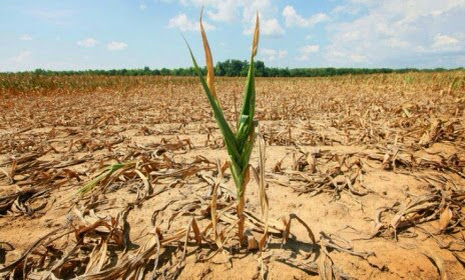
(NaturalNews) Water wells in central California have begun to run dry, reports the LA Times. (1) “Extreme drought conditions have become so harsh for the Central Valley community of East Porterville [that] many of its residents dependent on their own wells have run out of water.”

Tulare County has confirmed their wells have run out of water, and so far hundreds of homes have no running water.

According to the LA Times, rumors are also spreading that Child Protective Services officials will begin taking children away from families who have no running water, although the county claims the rumor is false.

It begins: the collapse of California's water aquifers

With this news, it is now official that the collapse of California's water aquifers has begun. With each passing month and year, more and more wells will run dry across the state as California plummets into the desert conditions from which it once sprang.

Extreme drought now covers 82% of California, according to the National Drought Mitigation Center. (2) Fifty-eight percent of the state is in “exceptional drought.”

During the unfolding of this drought, California farmers and cities have siphoned unprecedented volumes of water out of the state's underground aquifers. This is called “fossil water” and it can take centuries to regenerate. Once this fossil water is used up, it's gone.

35-year “megadrought” may be on the way

“The southwestern United States has fifty percent change of suffering a 'megadrought' that lasts 35 years,” reports the Daily Mail. (3)

“They say global warming has meant the chance of a decade long drought is at least 50 percent, and the chances of a 'megadrought' – one that lasts up to 35 years – ranges from 20 to 50 percent over the next century.”

One scientist is quoted in the story as saying, “This will be worse than anything seen during the last 2,000 years and would pose unprecedented challenges to water resources in the region.”

Unless politicians become magical wizards and figure out a way to create water out of nothing, what all this really means is that cities of the American southwest will not be able to support present-day populations. A mass migration (evacuation) out of the cities will be necessary sooner or later.

California's water deficit will lead to ecological and economic collapse

In an almost perfect reflection of California's state budget deficits, the state is also running an unsustainable water deficit. It is a mathematical certainty that when you remove far more water from the aquifers than is being replenished, the amount of water remaining in those aquifers will eventually reach zero.

This “zero day” water reality is still psychologically denied by most Californians. If the reality of this situation were widely recognized, California would be experiencing a glut of real estate inventory as millions of homeowners tried to sell their properties and evacuate the state. The fact that the real estate market has not yet collapsed in California tells us that Californians are still living in a state of denial about the future of their water supply.

Even as California's water supply collapses by the day, local farmers and towns have few options other than drilling for more water. “Drill! Drill! Drill!” is the mantra of the day, creating an 18-month backlog for well drilling companies. Each new well that's drilled must seek to go deeper than the previous wells which are running dry. It's a literal race to the bottom which can only end in catastrophe.

Then again, a willful acceleration toward catastrophe is merely a sign of the times when it comes to human civilization. There is almost no area in which humans have ever achieved balance: not in fossil fuels, metals mining, fossil water exploitation, debt creation, industrial chemical contamination, ecological exploitation or even global population. It's almost as if the human race is determined to destroy itself while racing to see who can achieve self destruction first. More


ISIS and Our Times – Noam Chomsky

It is not pleasant to contemplate the thoughts that must be passing through the mind of the Owl of Minerva as the dusk falls and she undertakes the task of interpreting the era of human civilization, which may now be approaching its inglorious end.

Bajid Kandala refugee cam, Iraq

The era opened almost 10,000 years ago in the Fertile Crescent, stretching from the lands of the Tigris and Euphrates, through Phoenicia on the eastern coast of the Mediterranean to the Nile Valley, and from there to Greece and beyond. What is happening in this region provides painful lessons on the depths to which the species can descend.

The land of the Tigris and Euphrates has been the scene of unspeakable horrors in recent years. The George W. Bush-Tony Blair aggression in 2003, which many Iraqis compared to the Mongol invasions of the 13th century, was yet another lethal blow. It destroyed much of what survived the Bill Clinton-driven UN sanctions on Iraq, condemned as “genocidal” by the distinguished diplomats Denis Halliday and Hans von Sponeck, who administered them before resigning in protest. Halliday and von Sponeck's devastating reports received the usual treatment accorded to unwanted facts.

One dreadful consequence of the US-UK invasion is depicted in a New York Times “visual guide to the crisis in Iraq and Syria”: the radical change of Baghdad from mixed neighborhoods in 2003 to today's sectarian enclaves trapped in bitter hatred. The conflicts ignited by the invasion have spread beyond and are now tearing the entire region to shreds.

Much of the Tigris-Euphrates area is in the hands of ISIS and its self-proclaimed Islamic State, a grim caricature of the extremist form of radical Islam that has its home in Saudi Arabia. Patrick Cockburn, a Middle East correspondent for The Independent and one of the best-informed analysts of ISIS, describes it as “a very horrible, in many ways fascist organization, very sectarian, kills anybody who doesn't believe in their particular rigorous brand of Islam.”

Cockburn also points out the contradiction in the Western reaction to the emergence of ISIS: efforts to stem its advance in Iraq along with others to undermine the group's major opponent in Syria, the brutal Bashar Assad regime. Meanwhile a major barrier to the spread of the ISIS plague to Lebanon is Hezbollah, a hated enemy of the US and its Israeli ally. And to complicate the situation further, the US and Iran now share a justified concern about the rise of the Islamic State, as do others in this highly conflicted region.

Egypt has plunged into some of its darkest days under a military dictatorship that continues to receive US support. Egypt's fate was not written in the stars. For centuries, alternative paths have been quite feasible, and not infrequently, a heavy imperial hand has barred the way.

After the renewed horrors of the past few weeks it should be unnecessary to comment on what emanates from Jerusalem, in remote history considered a moral center.

Eighty years ago, Martin Heidegger extolled Nazi Germany as providing the best hope for rescuing the glorious civilization of the Greeks from the barbarians of the East and West. Today, German bankers are crushing Greece under an economic regime designed to maintain their wealth and power.

The likely end of the era of civilization is foreshadowed in a new draft report by the Intergovernmental Panel on Climate Change, the generally conservative monitor of what is happening to the physical world.

The report concludes that increasing greenhouse gas emissions risk “severe, pervasive and irreversible impacts for people and ecosystems” over the coming decades. The world is nearing the temperature when loss of the vast ice sheet over Greenland will be unstoppable. Along with melting Antarctic ice, that could raise sea levels to inundate major cities as well as coastal plains.

The era of civilization coincides closely with the geological epoch of the Holocene, beginning over 11,000 years ago. The previous Pleistocene epoch lasted 2.5 million years. Scientists now suggest that a new epoch began about 250 years ago, the Anthropocene, the period when human activity has had a dramatic impact on the physical world. The rate of change of geological epochs is hard to ignore.

One index of human impact is the extinction of species, now estimated to be at about the same rate as it was 65 million years ago when an asteroid hit the Earth. That is the presumed cause for the ending of the age of the dinosaurs, which opened the way for small mammals to proliferate, and ultimately modern humans. Today, it is humans who are the asteroid, condemning much of life to extinction.

The IPCC report reaffirms that the “vast majority” of known fuel reserves must be left in the ground to avert intolerable risks to future generations. Meanwhile the major energy corporations make no secret of their goal of exploiting these reserves and discovering new ones.

A day before its summary of the IPCC conclusions, The New York Times reported that huge Midwestern grain stocks are rotting so that the products of the North Dakota oil boom can be shipped by rail to Asia and Europe.

One of the most feared consequences of anthropogenic global warming is the thawing of permafrost regions. A study in Science magazine warns that “even slightly warmer temperatures [less than anticipated in coming years] could start melting permafrost, which in turn threatens to trigger the release of huge amounts of greenhouse gases trapped in ice,” with possible “fatal consequences” for the global climate.

Arundhati Roy suggests that the “most appropriate metaphor for the insanity of our times” is the Siachen Glacier, where Indian and Pakistani soldiers have killed each other on the highest battlefield in the world. The glacier is now melting and revealing “thousands of empty artillery shells, empty fuel drums, ice axes, old boots, tents and every other kind of waste that thousands of warring human beings generate” in meaningless conflict. And as the glaciers melt, India and Pakistan face indescribable disaster.

Sad species. Poor Owl.

© 2014 Noam Chomsky
Distributed by The New York Times Syndicate


Karachi thirsts for a water supply

KARACHI: On the outskirts of the slums of Pakistan’s biggest city, protesters burning tires and throwing stones have what sounds like a simple demand: They want water at least once a week.

In Karachi people go days without getting water from city trucks, sometimes forcing them to use groundwater contaminated with salt. A recent drought has only made the problem worse. And as the city of roughly 18 million people rapidly grows, the water shortages are only expected to get worse.

“During the last three months they haven’t supplied a single drop of water in my neighbourhood,” protester Yasmeen Islam said. “It doesn’t make us happy to come on the roads to protest but we have no choice anymore.”

Karachi gets most of its water from the Indus River — about 550 million gallons per day — and another 100 million gallons from the Hub Dam that is supplied by water from neighbouring Balochistan province. But in recent years, drought has hurt the city’s supply.

Misbah Fareed, a senior official with the Karachi Water and Sewerage Board that runs the city’s water supplies, said that only meets about half the city’s needs — 1.2 billion gallons a day.

Karachi’s water distribution network has exacerbated the problem by forcing much of the city to get its water through tankers instead of directly from pipes. The Karachi Water and Sewerage Board operates 12 water hydrants around the city where tankers fill up and then distribute. Even people in the richest areas of the city get their water through tankers that come a few times a week to fill up underground cisterns.

But criminals have illegally tapped into the city’s water pipes and set up their own distribution points where they siphon off water and sell it.

“I personally know some people previously associated with drug mafias who now switched to the water tanker business,” Fareed said. “Just imagine how lucrative the business is.”

Other areas of Pakistan pump massive amounts of groundwater. But in the coastal city of Karachi, the underground water is too salty to drink. Many people have pumps but they use the water for things such as showering or washing clothes.

The water shortage is exacerbated by Karachi’s massive population. Pakistani military operations and American drone strikes in the northern tribal regions, as well as natural disasters such as flooding and earthquakes, have pushed people toward a city long seen as the economic heart of Pakistan.

The city is trying to increase the amount of water it gets from the Indus River by building another canal — dubbed the K4 project. But even if they were to get political approval from the capital to take more water from the river, it would take a minimum of four years to build.

But analysts say supply isn’t the only problem. Farhan Anwar, who runs an organisation called Sustainable Initiatives in Karachi, said the Karachi Water and Sewerage Board is horribly overstaffed and many of those are political appointees. The cost for water is also very low and the agency doesn’t collect all that it’s due, Anwar said. That’s made it difficult to upgrade the ageing pipes the system does have, meaning contamination and leakages are common.

Meanwhile, Karachi residents have to spend more money or walk further and further to get water. One elderly resident Aisha Saleem said in recent months even the little water they get from the water board is salty.

“Women and kids have to go miles by foot and carry drinking water every day,” she said More


How extensive is California’s drought?

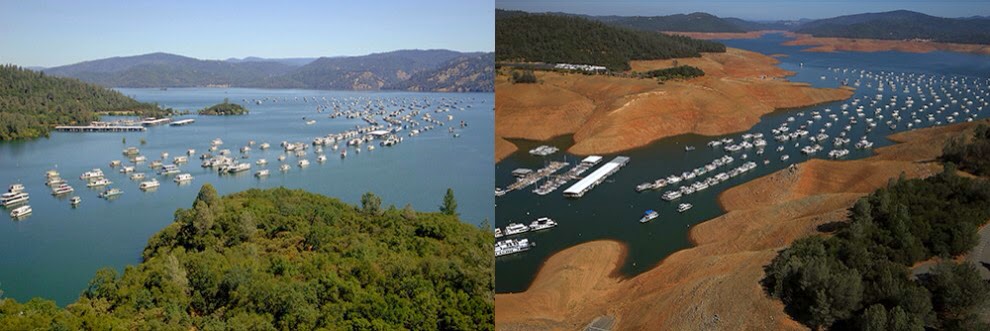
A snake-like trickle of water flows underneath Lake Oroville's Enterprise Bridge — just one striking example of how much California's chronic drought is affecting the state's lakes and reservoirs.

Situated at the foot of the Sierra Nevadas in Butte County, Lake Oroville is one of the largest reservoirs in California, second only to Shasta Lake. After enduring three straight years of drought, the lake is currently only filled to 32 percent of its capacity.

In any case, the drought in California is getting serious. Phase 2 of Los Angeles' mandatory water conservation ordinance is now in effect, which means a team of water-use inspectors are tasked with enforcing water restrictions and fining water wasters. If the drought continues through fall and winter, the ordinance will move to Phase 3, which entails even stricter rules and some prohibitions.

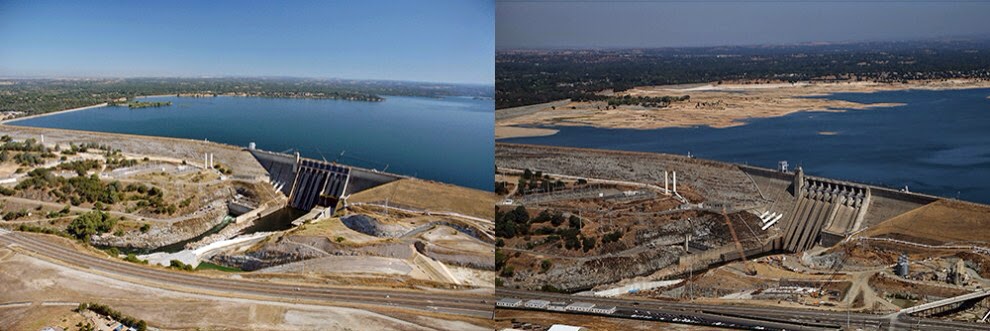
To get a better idea of the dire situation in the Golden State, continue below for a photo comparison of water levels taken in 2011 and 2014, looking at Lake Oroville and Folsom Lake, another major California reservoir located in Sacramento County that is now filled at 40 percent of its capacity.

Bidwell Marina, Lake Oroville

Folsam Dam, Folsom Lake

Enterprise Bridge, Lake Oroville


Leonardo DiCaprio Narrates Climate Change Films Urging Shift From Fossil Fuels to Renewables

Production company Tree Media, whose mission is to inspire positive social action, has just released the first of four films in the Green World Rising series focusing on solutions to the climate crisis.

The eight-minute film, CARBON, narrated by actor and dedicated environmentalist Leonardo DiCaprio, was created with support from the Leonardo DiCaprio Foundation and in collaboration with Thom Hartmann. The film’s goal is to draw attention to how some governments are already putting a price on carbon through carbon taxes and carbon trading to encourage polluters to shift from dirty energy sources to renewables prior to the UN Climate Summit in New York on Sep. 23. All four films will be released in the next month leading up to the summit.

“97% of climate scientists agree: climate change is happening now—and humans are responsible,” said DiCaprio. “We cannot sit idly by and watch the fossil fuel industry make billions at our collective expense. We must put a price on carbon—now.”

“We need serious action to address the most pressing issue of our time,” said Hartmann. “Communities across the world have taken action in the most direct and effective way possible by taxing and trading carbon. For us to beat this crisis, many more need to join.”

The film explains what a carbon tax and carbon trading are, how they can help us stop “using the atmosphere as a sewer,” as Joseph Romm of the Center for American Progress says in the film, and what ordinary people can do to push elected officials to act. More

Carbon


Published on Aug 20, 201 4 • CARBON is the first film in the Green World Rising Series, http:// www.greenworldrising.org “Carbon” is narrated by Leonardo DiCaprio, presented by Thorn Hartmann and directed by Leila Conners. Executive Producers are George DiCaprio, Earl Katz and Roee Sharon Peled. Carbon is produced by

Mathew Schmid and was written by Thorn Hartmann, Sam Sacks, Leila Conners and Mathew Schmid. Music is composed and performed by Jean-Pascal Beintus and intro drone by Francesco Lupica. Carbon is produced by Tree Media with the support of the Leonardo DiCaprio Foundation.

Facing Rising Ocean, Pacific Island Town Must Relocate

In an unprecedented move that illustrates the dramatic impacts of planetary global warming, one community in the South Pacific has decided it has no choice but to pick itself up entirely and flee for higher ground.

All too aware of their vulnerability to the effects of climate change — such as rising sea levels and extreme weather events — communities in the Pacific Islands have long acknowledged that their very existence isthreatened by global warming.

But now, authorities in a town on Taro Island, a coral atoll off Choiseul in the Solomon Islands that sits less than seven feet above sea level, have decided to relocate to the mainland in response to increasing coastal hazards including tsunamis, storm surges, and erosion. The exodus from Choiseul Bay Township, the provincial capital that's currently home to about 500 people, will take place over many years. It is the first such official migration — of people, services, and facilities — in the Pacific Islands.

According to Reuters, “the groups behind the Choiseul adaptation plan said it is being hailed by the Solomon Islands national government as a model for other provinces across the nation and more broadly across the Pacific.”

The plan comes out of Choiseul Bay Township's consultation with a team of engineers, scientists and planners, funded by the Australian government, on how best to adapt to the impact of climate change. Extensive community input was solicited, Choiseul Province premier Jackson Kiloe said in a statement Friday.

“Relocation is the only option available that will keep the community safe and will allow for future growth and prosperity of the capital and the province,” said Philip Haines, project manager at BMT, an engineering firm that worked on the plan.

Land to build a new, larger settlement that could accommodate up to 5,000 inhabitants has already been acquired, Haines told Reuters. The town will essentially have to be built up from scratch, with a hospital and school expected to be constructed within five years. In the meantime, the plan prescribes detailed actions to increase the community’s resilience to climate change, including the preparation of a tsunami response plan, and the handover of a hand-wound siren to alert the local communities of a tsunami warning.

The Solomon Islands government would be looking for climate change funding from international donors to finance the relocation, Reuters reports.

Some of that funding could come from the U.S., which has millions invested in Asia-Pacific climate change adaptation, as U.S. Secretary of State John Kerry pointed out when he visited the Solomon Islands just last week.

In remarks delivered in Honolulu last week, Kerry said:

I just came from the Solomon Islands yesterday, a thousand islands, some of which could be wiped out if we don’t make the right choices. The Pacific Islands across the entire Pacific are vulnerable to climate change. And just yesterday, I saw with my own eyes what sea level rise would do to parts of it: It would be devastating — entire habitats destroyed, entire populations displaced from their homes, in some cases entire cultures wiped out. They just had flash flooding in Guadalcanal — unprecedented amounts of rainfall. And that’s what’s happened with climate change — unprecedented storms, unprecedented typhoons, unprecedented hurricanes, unprecedented droughts, unprecedented fires, major damage, billions and billions of dollars of damage being done that we’re paying for instead of investing those billions of dollars in avoiding this in the first place. More


Central America braces for drought-linked food crisis

Low rainfall linked to the El Nino weather phenomenon has led to drought in parts of Central America, causing widespread damage to crops, shortages and rising prices of food, and worsening hunger among the region’s poor.

An unusually hot season and extended dry spells have brought drought to areas in eastern and western Guatemala and El Salvador, southern Honduras and northern and central Nicaragua, destroying swathes of bean and maize crops, the region’s staple foods, and putting pressure on subsistence farmers and food prices.

“Extremely poor households across large areas of Guatemala, Nicaragua, Honduras, and El Salvador will experience a rapid deterioration in their food security in early 2015.

“Atypically high levels of humanitarian assistance, possibly the highest since Hurricane Mitch in 1998, will likely be required in order to avoid a food crisis,” said a recent report by the Famine Early Warning Systems Network (FEWS NET), run by the US Agency for International Development (USAID).

Thousands of families in the region have become too poor to buy enough food for survival because poor harvests are pushing up prices of staple foods while coffee producers are hiring fewer seasonal coffee pickers and paying lower wages because of a coffee leaf rust or roya epidemic across Central America.

In Nicaragua and Honduras, red bean prices rose by up to 129 percent between January and June 2014, according to FEWS NET.

Other livelihoods in Central America, including fishing and livestock breeding, have also been hard hit by the recent drought and the El Nino weather phenomenon, FEWS NET said.

El Nino, which can last more than a year, significantly raises surface temperatures in the central and eastern areas of the tropical Pacific Ocean, a phenomenon linked to major climate fluctuations around the world.

In response to the drought, the Guatemalan government has said it will begin distributing 4,000 tonnes of food aid to more than 170,000 families affected by the drought from early October, using government and United Nations World Food Programme (WFP) food reserves.

One of the poorest countries in Central America, Guatemala already struggles to feed its population, particularly those impoverished indigenous communities living in rural areas.

Around half Guatemala’s population of 15 million lives in poverty and the country has the world’s fourth highest rate of chronic malnutrition, which affects almost half the children under five, according to the WFP.

In neighboring Honduras, the government is distributing food, including rice, beans and flour, and vitamin supplements to 76,000 families, many subsistence farmers, affected by the drought.

First Blogged on http://robinwestenra.blogspot.com/