The morning after Lailat al-Qadr, the death toll in Gaza was approaching its first thousand.
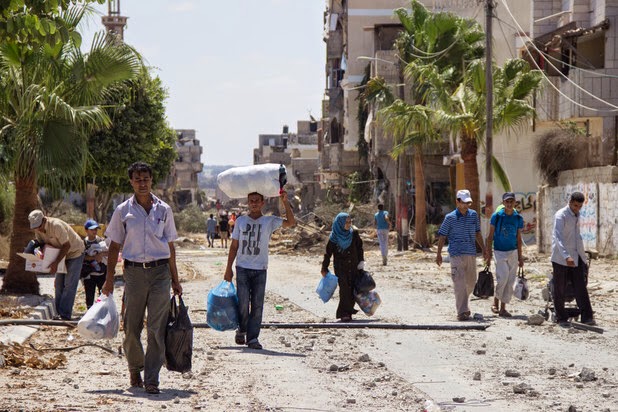
Palestinians recover belongings from the Khuzaa neighborhood of Khan Younis
Al-Qadr — the night before the last Friday in the holy month of Ramadan — is believed to be the night when the Quran was revealed to the prophet Muhammad. I spent this special night with friends in the occupied West Bank city of Ramallah after participating in the “48K March” for Gaza.
The march began in Ramallah and went to Qalandiya checkpoint. What began as a peaceful event with families bringing their children and even babies in strollers, ended with young Palestinians with gunshot wounds being rushed in ambulances to the local hospital.
Qalandiya crossing was fortified and air-tight, and the Israeli soldiers stationed on top were shooting live ammunition at the crowd.
As the ambulances were speeding through the crowd, I couldn’t help but wonder why there is no hospital between Qalandiya and Ramallah, a good distance which includes the municipalities of Jerusalem, al-Bireh and Ramallah.
The following night I was scheduled to leave Palestine to return to the United States. But Israeli forces sealed all the roads from Ramallah to Jerusalem for the night, and they were likely to be sealed the following day as well.
At the crack of dawn, when things had quietened down, my friend Samer drove me to a checkpoint that he suspected would be open. It was open, albeit for Israelis only, and from there I made my way back to Jerusalem.
That evening, as I was preparing to leave for Ben Gurion airport near Tel Aviv, people around me were trying to calm me down. “Don’t aggravate them, cooperate and they will be nice,” they said. “Why go through all this unnecessary inconvenience?”
They were talking about the “Smiling Gestapo,” Israeli security officers at Tel Aviv airport that go by the squeaky clean name of the Airport Security Division.
Non-cooperation and resistance
Listening to this, I was reminded of Jewish communities under the Nazi regime who believed that if they cooperated and showed they were good citizens then all would be well. But the road from cooperation to the concentration camps and then the gas chambers was a direct one.
The policies of racist discrimination and humiliation at Ben Gurion airport, and the policies of ethnic cleansing and murder of Palestinians in Gaza, emanate from the same Zionist ideology.
As we have seen over the past seven decades, cooperation and laying low do not make things ok.
Cooperation with the Israeli authorities might lead to short-term relief but it also validates Israel’s “right” to terrorize and humiliate Palestinians with our consent, “we” being all people of conscience. Whether we are Palestinian or not, the call of the hour is non-cooperation and resistance against injustice.
Today, Israel and its supporters lay the blame for the violence in Gaza on Hamas. But Israel did not start its assaults on the Gaza Strip when Hamas was established in the late 1980s. Israel began attacking Gaza when the Strip was populated with the first generation refugees in the early 1950s.
Palestinians, particularly in Gaza, are not faced with an option to resist and be killed or live in peace. They are presented with the options of being killed standing up and fighting or being killed sleeping in their beds.
“Sea of hatred”
Gaza is being punished because Gaza is a constant reminder to Israel and the world of the original sin of the ethnic cleansing of Palestine and the creation of a so-called Jewish state. Even though Palestinian resistance has never presented a military threat to Israel, it has always been portrayed as an existential threat to the state.
Moshe Dayan, the famed Israeli general with the eyepatch, described this in a speech in April 1956. He spoke in Kibbutz Nahal Oz, an Israeli settlement on the boundary of the Gaza Strip where Israeli tanks park each time there is a ground invasion of Gaza.
“Beyond the furrow of this border, there surges a sea of hatred and revenge,” Dayansaid then. Ironically, when six months later Israel had occupied Gaza and my father was appointed its military governor, he said that he saw “no hatred or desire for vengeance but a people eager to live and work together for a better future.”
Still, today, Israeli commanders and politicians say pretty much the same: Israel is destined to live by the sword and must strike Gaza whenever possible. Never mind the fact that Palestinians have never posed a military challenge, much less a threat to Israel.
After all, Palestinians have never possessed as much as a tank, a warship or a fighter jet, not to say a regular army.
So why the fear? Why the constant, six-decade-long campaign against Gaza? Because Palestinians in Gaza, more so than anywhere else, pose a threat to Israel’s legitimacy.
Israel is an illegitimate creation brought about by a union between racism and colonialism. The refugees who make up the majority of the population in the Gaza Strip are a constant reminder of this.
They are a reminder of the crime of ethnic cleansing upon which Israel was established. The poverty, lack of resources and lack of freedom stand in stark contrast to the abundance, freedom and power that exist in Israel and that rightfully belongs to Palestinians.
Generous offer
Back at Ben Gurion airport that night, I was told that if I cooperate and plead with the shift supervisor it would make the security screening go faster. When I declined this generous offer, I was told they “did not like my attitude.”
They proceeded to paste a sticker with the same bar code on my luggage and give me the same treatment Palestinians receive.
As I write these words, the number of Palestinians murdered by Israel in Gaza has exceeded two thousand. Ending the insufferable, brutal and racist regime that was created by the Zionists in Palestine is the call of our time.
Criticizing Palestinian resistance is unconscionable. Israel must be subjected toboycott, divestment and sanctions. Israeli diplomats must be sent home in shame. Israeli leaders, and Israeli commanders traveling abroad, must fear prosecution.
And these measures are to be combined with disobedience, non-cooperation and uncompromising resistance. This and only this will show mothers, fathers and children in Gaza that the world cares and that “never again” is more than an empty promise. More
Is the Ferguson Movement the begining of a Nationwide Movement driven by Racism and Economic Disparity?
In the eight days since Michael Brown, an eighteen-year-old, was killed by a police officer named Darren Wilson in Ferguson, Missouri, what began as an impromptu vigil evolved into a sustained protest; it is now beginning to look like a movement. The local QuikTrip, a gas station and convenience store that was looted and burned on the second night of the protests, has now been repurposed as the epicenter for gatherings and the exchange of information. The front of the lot bears an improvised graffiti sign identifying the area as the “QT People’s Park.” With the exception of a few stretches, such as Thursday afternoon, when it was veiled in clouds of tear gas, protesters have been a constant presence in the lot. On Sunday afternoon the area was populated by members of local churches, black fraternity and sorority groups, Amnesty International, the Outcast Motorcycle Club, and twenty or so white supporters from the surrounding area. On the north side of the station, a group of volunteers with a mobile grill served free hot dogs and water, and a man stood on a crate, handing out bright yellow T-shirts with the logo of the National Action Network, the group led by Al Sharpton.
The conversation here has shifted from the immediate reaction to Michael Brown’s death and toward the underlying social dynamics. Two men I spoke with pointed to the disparity in education funding for Ferguson and more affluent municipalities nearby. Another talked about being pulled over by an officer who claimed to smell marijuana in the car as a pretense for searching him. “I’m in the United States Navy,” he told me. “We have to take drug tests in the military so I had proof that there were no drugs in my system. But other people can’t do that.” Six black men I spoke to, nearly consecutively, pointed to Missouri’s felon-disfranchisement laws as part of the equation. “If you’re a student in one of the black schools here and you get into a fight you’ll probably get arrested and charged with assault. We have kids here who are barred from voting before they’re even old enough to register,” one said. Ferguson’s elected officials did not look much different than they had years earlier, when it was a largely white community.
Ferguson had, instead, recently seen two highly visible African-American public officials lose their jobs. Two weeks before Brown was shot, Charles Dooley, an African-American who has served as St. Louis County Executive for a decade, lost a bitter primary election to Steve Stenger, a white county councilman, in a race that, whatever the merits of the candidates, was seen as racially divisive. Stenger lobbed allegations of financial mismanagement and incompetence, and worse. Bob McCulloch, the county prosecutor appeared in an ad for Stenger, associating Dooley with corruption; McCulloch would also be responsible for determining whether to charge Darren Wilson. In December, the largely white Ferguson-Florissant school board fired Art McCoy, the superintendent, who is African-American. Those who were gathered at the QuikTrip parking lot on Saturday were as inclined to talk about the underlying political issues as they were about the hail of bullets that ended Brown’s life.
When word came that afternoon that the governor had announced a curfew, to take effect at midnight, the mood shifted to defiance and disbelief. Few thought that the curfew would do much practical good; many thought it was counterproductive, a move back to militarized police response earlier in the week. Curfew or no, the protesters felt that, with the exception of last Thursday, when Captain Ron Johnson of the Missouri State Highway Patrol, a black Ferguson native, took charge of operations, the amalgam of county and local law enforcement rolling through Ferguson had tried to clear the streets each day at dusk.
On Johnson’s first night in charge, the police presence in the neighborhood was hardly visible; officers withdrew to the perimeter and removed a roadblock that had cut off Florissant Road, which runs just south of the QuikTrip. The protests that night had a giddy quality. Cars drove up and down the strip, the sounds of honking horns accompanying shouts of Brown’s name and “Hands Up, Don’t Shoot,” which has emerged as the signature slogan here.
But as early as Friday morning people began to wonder if Johnson really was in charge, in any meaningful way. Ferguson Police Chief Thomas Jackson began the day by releasing Officer Wilson’s name, which had been kept from the public until then. He undercut that gesture by simultaneously releasing a video that appeared to show Brown menacing a local store owner soon before his encounter with Wilson—thus suggesting that Wilson had been pursuing Brown as a suspect. It took a few hours, and a second press conference, for Jackson to acknowledge that Wilson hadn’t stopped Brown because he thought he was a robber but because Brown was walking in the street and not, as Wilson believed he should, on the sidewalk.
Ron Johnson had to concede that he had not even known that the video would be released; he saw it on television just as everyone else had. (“I would like to have been consulted,” he said at his own press conference.) After sporadic looting on Saturday night—halted largely by other protestors who rushed to protect the establishments being vandalized—Governor Jay Nixon declared a curfew, further undercutting Johnson’s authority. In the span of twenty-four hours, Johnson had gone, in the community’s eyes, from empowered native son to black token. One of the local activists I’d met in Feguson sent me a text message after the curfew announcement saying, “Johnson has good intentions but no power. This is beyond him.”On Sunday, Johnson stepped into the pulpit at Greater Grace Church, the site of a rally, and apologized to Brown’s family, saying, “I wear this uniform and I feel like that needs to be said.” With that, he implicitly condemned the Ferguson Police Department for their failure to do so. Johnson had promised not to use tear gas in the streets of Ferguson but, during a skirmish with looters on Saturdaynight, police tear-gassed the crowd. Johnson’s address at the church carried the message that his allegiances were, nonetheless, with the people of Ferguson. James Baldwin remarked that black leaders chronically find themselves in a position of asking white people to hurry up while pleading with black people to wait. Johnson finds himself asking black people to remain calm while imploring white police officers not to shoot. The problem here is that few people in Ferguson believe that the former is any guarantee of the latter.
Brown remains unburied. His family, whose faith evaporated early on, refused to simply trust the autopsy performed by local authorities and held out for a second post mortem, by federal authorities. Attorney Eric Holder granted that request late Sunday morning. It might produce a definitive answer to some of the basic questions—like how many times Brown was shot, and whether any of the bullets hit him in the back—that, a week later, remain murky. From the outset, the overlapping bureaucracies in Ferguson handled the case in ways that suggested ineptitude. Yet subsequent developments—the stonewalling followed by contradictory statements, the detention of reporters, the clumsy deployment of sophisticated military equipment—all point not to a department too inept to handle this investigation objectively but one too inept to cloak the fact that they never intended to do so. One protestor held a sign that said, “Ferguson Police Need Better Scriptwriters.” More
In an article by Alex Kane entitled 11 Eye-Opening Facts About America’s Militarized Police Forces the author writing in AlterNet states; The “war on terror” has come home — and it’s wreaking havoc on innocent American lives. The culprit is the militarization of the police.
The weapons that destroyed Afghanistan and Iraq have made their way to local law enforcement. While police forces across the country began a process of militarization — complete with SWAT teams and flash-bang grenades — when President Reagan intensified the “war on drugs,” the post-9/11 “war on terror” has added fuel to the fire.
Through laws and regulations like a provision in defense budgets that authorizes the Pentagon to transfer surplus military gear to police forces, local law enforcement agencies are using weapons found on the battlefields of South Asia and the Middle East.
A recent New York Times article by Matt Apuzzo reported that in the Obama era, “police departments have received tens of thousands of machine guns; nearly 200,000 ammunition magazines; thousands of pieces of camouflage and night-vision equipment; and hundreds of silencers, armored cars and aircraft.” The result is that police agencies around the nation possess military-grade equipment, turning officers who are supposed to fight crime and protect communities into what looks like an invading army. And military-style police raids have increased in recent years, with one count putting the number at 80,000 such raids last year.
In June, the American Civil Liberties Union (ACLU) brought more attention to police militarization when it issued a comprehensive, nearly 100-page report titled, War Comes Home: The Excessive Militarization of American Policing. Based on public records requests to more than 260 law enforcement agencies in 26 states, the ACLU concluded that this police militarization “unfairly impacts people of color and undermines individual liberties, and it has been allowed to happen in the absence of any meaningful public discussion.”
The information contained in the ACLU report — and in other investigations into the phenomenon — is sobering. From the killing of innocent people to the almost complete lack of debate on these policies, police militarization has turned into a key issue for Americans. It is harming civil liberties, ramping up the “war on drugs,” impacting the most marginalized members of society and transforming neighborhoods into war zones. Here are 11 important — and horrifying — things you should know about the militarization of police. More
One has to question the reason for militatising the police departments in the United States and where this is leading? Is the government expecting insurrection or invasion? Are their citizens now enemies of the state? Editor
The Northern Great Plains has become the epicenter of new oil development in the United States. New production techniques have set off an oil boom there reminiscent of the chaotic conditions over a century ago when the prospect of black gold drew developers to Texas.
Water impacts were not remotely a consideration back then. But now, unprecedented levels of drilling in this huge oil basin require the implementation of careful water management practices to protect regional resources.
Drilling takes place throughout the Great Plains’ Williston oil basin, home to the Bakken, Three Forks, and Tyler formations, reaching into the U.S. states of North Dakota, South Dakota,1 and Montana as well as Canada’s provinces of Saskatchewan and Alberta. With an estimated 7.4 billion barrels of technically recoverable oil in the United States (plus an additional 1.6 billion barrels in Canada), the Williston basin is the largest continuous oil accumulation in the country.
It is also one of the world’s most rapidly and densely developed oil plays with about 8,000 still-active wells drilled between 2006 and 2014. The United States Geological Survey (USGS) estimates that five times that number will be needed to access the total technically recoverable oil. But plans to continue producing at this rate will pose severe oil-water risks in the area.
The region’s geology and history convey unique water challenges, quite different from those in other U.S. shale formations. The sheer number of wells needed to produce the Williston creates a huge demand on freshwater for drilling, hydraulic fracturing, and maintenance. Along with oil, produced water (wastewater produced as a byproduct during oil production) is brought to the surface through these wells. Produced water yields are correlated to oil yields, so as the Williston basin’s oil production increases, produced water quantities and the associated contamination risks and disposal needs will accumulate. Further complicating the freshwater quantity demands and wastewater contamination concerns, a mosaic of state, national, and tribal borders provides potential for irregular data reporting, insufficient regulatory oversight, inconsistent rules, and inadequate contamination cleanup.
If the Williston basin is going to help supply America’s oil needs over the long term, the Northern Great Plains’ oil-water challenges must be adequately controlled and safely managed.
Continuous, Complex Geology
The Williston’s shale is relatively easy to navigate. Overlapping formations allow oil companies to extract the oil with great speed and success.
The Bakken, while it has limited amounts of conventionally pooled oil, is almost completely an unconventional shale oil play. It is comprised of three informal layers: the upper, middle,and lower. Directly beneath the Bakken lies the Three Forks formation.2 Three Forks 1, the shallowest of the formation’s four main layers, has been produced in conjunction with the Bakken for many years. Recently, however, oil companies have begun to explore some of the deeper layers, allowing them to produce at multiple depths from the same plot of land, gaining access to more oil without acquiring more land. The Tyler formation, which is much shallower than the Bakken and Three Forks formations, is located farther south, and its unconventional oil potential is just beginning to be explored.
The Bakken formation was first identified in the early 1950s, though production was initially quite slow. That changed with the advent of hydraulic fracturing—the process of injecting a high-pressure slurry of chemicals, water, and propping agents to break apart shale and allow hydrocarbons to flow out of rock formations. Innovations in this technique transformed North Dakota’s oil operations.
Since 2006, oil production has expanded exponentially into the Bakken, Three Forks, and Tyler formations along with other smaller, lesser-known formations in the area (see map). Recently, drilling horizontally to produce oil in the Tyler formation has begun though it is still uncertain if the Tyler formation will be able to transition from a somewhat successful conventional play (accessed by vertical drilling) into a strong continuous play, produced by replicating new techniques used in the Bakken.
Companies aim to further reduce the space between wells to maximize access to oils at different depths from the same acreage. Leases that had only one well before may now have up to eight. As seen in Kodiak Oil & Gas Corp’s, Continental Resources Inc.’s, and other companies’ plans, there could be 14–34 wells per 1,280 acre lease.5 Wells are drilled and fracked more quickly and more cheaply as technology advances allowing companies to expand and increase their water demands rapidly.
The drilling process demands some water, but the hydraulic fracturing process and the water used to clean the well over its lifetime account for most of the water consumed during oil extraction. A single well fracking in the Williston averages 2 million gallons of water. Refracking wells two to three times, which is now common practice in the Williston, demands proportionately more freshwater than one-time fracking seen in other basins. And while some of the water used to clean wells can be reused as the base fluid for new fracking projects, new freshwater is required for each maintenance flush.
Getting to the Water Sources
With so much freshwater required to boost oil production, the question is: Where will the water come from? A range of resources can be found in the Northern Great Plains’ geology, including bedrock aquifers at many depths, glacial aquifers, the Missouri River winding through Montana and North Dakota, and Lake Sakakawea, a reservoir on the Missouri. These water resources vary markedly, and their characteristics must be used to determine how much water and which water the states can afford to permit oil companies to acquire, directly and indirectly.6
Making the situation more complicated, while the area may have ample water supplies, many rural citizens do not have secure access to them. The region currently struggles with fresh groundwater scarcity, low precipitation, minimal water infrastructure making transporting water extremely difficult, and federal restrictions regarding the use of the Missouri River and Lake Sakakawea as surface water sources.
Overdrawn Aquifers
Confined bedrock aquifers of varying water quality underlie the Williston basin, some of which are artesian aquifers that flow to the surface without the need for electrical pumps, a boon in remote locations that must be protected.
The slightly saline Fox Hills–Hell Creek aquifer (noted with diagonal orange lines on the map) is the only groundwater source capable of consistently producing large amounts of freshwater. As a result, it is overdrawn. Although rarely a drinking water source because of its relatively high concentration of total dissolved solids, (2,500 milligrams per liter), it is a major source for industrial, livestock, and residential use.7
Overuse has caused rapid long-term reduction in aquifer pressure by 1 to 2 feet per year. As a result, some of the artesian wells drawing from the Fox Hills–Hell Creek aquifer have stopped flowing and more will dry up in the future. Using this aquifer solely for domestic and livestock purposes and forcing industry to find other sources of water has been discussed, but stronger action may be needed.
Difficult-to-Manage Aquifers
Glacial aquifers, formed as glaciers melted and receded leaving permeable sediment behind, can be found in drainage system patterns throughout North Dakota and Montana. These aquifers, usually less than a few hundred feet deep, can be much more productive than bedrock aquifers, often with lower total dissolved solids concentrations. Their high flow rates mean water spends shorter times within the aquifer dissolving and accumulating salts and minerals. Thus, these aquifers often tend to be the only source of irrigation-quality groundwater in the area. High flow rates, however, lead to difficulty managing the resource, as discharge can happen quickly while recharge rates are variable and uncertain.
Tapping Lakes and Rivers
The most reliable sources of surface water in the area are the Missouri River and its reservoir, Lake Sakakawea. Much of the water currently used for hydraulic fracturing in North Dakota and Montana comes from the Missouri River.
Without depending on water withdrawal from lakes and rivers, it will be impossible to meet the upward trend of oil production without harming the Northern Great Plains’ aquifers and tributary streams. So, as industry demands rise, oil companies are pushing back on the U.S. Corps of Engineers’ (USCOE) 2010 moratorium that prevents lake-water access permits. North Dakota law makes the state water commission responsible for issuing permits for Lake Sakakawea water use, but the USCOE is the only power that can grant permission to access the lake for water diversion. The moratorium was put in place temporarily while the USCOE determined what price to charge for Missouri River water stored behind its dam. Over time, however, the moratorium has morphed into a 100,000 acre foot per year temporary permitting limit, with no storage fee applicable until the USCOE approves a water price.
The oil industry would benefit from permanent access to Lake Sakakawea at little or no cost, but such an arrangement would not be durable. The millions of gallons each well uses over its lifetime would necessitate many new infrastructure investments to transport Lake Sakakawea’s water throughout the basin. These oil-water commitments would also impact local residents’ future higher-priority needs.
Oil companies in eastern Montana do not currently have access to Lake Sakakawea, instead depending on the Missouri River as a surface water resource, even though many of its tributaries are over-appropriated. The Yellowstone River, which cuts through parts of the Williston basin, is also a potential water source for the oil industry; however, some stretches are closed off to new appropriations, and temporal variation in flow causes the river to be over-appropriated at times. While finding cheap and accessible water may be difficult in Montana, the oil industry’s surface water (and groundwater) needs there pale in comparison to the struggles facing North Dakota, where the majority of drilling occurs.
The Salt Problem
All this is particularly problematic because the Northern Great Plains contains large volumes of highly saline water. This water—up to ten times the salinity of ocean water—is housed in the same rocks that trap oil in the Williston basin. When pumped out with the oil, this produced water must be treated as waste.
Once production begins, a well operator begins pumping out the fluid used to frack the well along with highly saline produced water and oil. This continues through the well’s lifetime—with volumes of these three fluids changing dramatically over the lifetime of the well, the amount of fracking fluid recovered at the surface dropping off dramatically in the days following fracking, and the ratio of produced water to oil increasing as the well ages. Produced water from the Bakken formation also contains toxic metals and radioactive substances and can measure up to 300,000 milligrams per liter of total dissolved solids.
Most of the produced water in the Williston is transported to Class II injection wells (see blue dots on map) for disposal. Injecting this water deep underground can prevent ground and surface water contamination, if done properly. Proper disposal is important because spills and contamination in the Williston basin are far more damaging than mishandlings of less saline produced waters from other U.S. basins.
One possibility for contamination in the Northern Great Plains arises during produced water transport—by truck and underground pipeline—to its injection site. With trucks and pipelines covering long distances between the producing well and the Class II injection well, the potential to spill oil and produced water arises. Truck spills may be obvious, but pipeline spills may go unnoticed as any evidence remains underground for some time.
Contamination of water resources can also be caused by spilling oil or produced water through operator error, illegal dumping, well blowouts, and flooding (sometimes caused by ice jams or heavy rains). Produced water spills are a far greater concern than oil spills because they spread much more rapidly and salts disperse quickly through surface or ground water. Spills’ boundaries are rarely well defined and oil and produced water can saturate any permeable soil near the spill, including by migrating beyond state or reservation borders.
Glacial aquifers in particular, with their fast recharge rates, can be quickly contaminated by surface spills, especially from produced water. Successful management of glacial aquifers is vital to protect one of the Williston’s only sources of high quality groundwater.
The Williston basin region has experienced sizeable spills since the oil industry boomed in the mid-2000s. North Dakota’s largest and most damaging saltwater spill occurred in 2006 when a Zenergy pipeline failed, releasing more than 1 million gallons of saltwater into Charbonneau Creek (a Yellowstone River tributary). The pipeline didn’t have a monitoring system to record the pressure drop or the differential between input and output quantity that would have quickly notified the company of the leak. Eight years later, Zenergy is still remediating, and efforts are expected to continue into the future.8
Problems also stem from practices long past. The Northern Great Plains is just now seeing the effects of contamination from oil production that began over fifty years ago. According to a USGS report, the city of Poplar in the Fort Peck Reservation has never been able to pinpoint the precise source(s) of contamination on its territory (beyond linking it to oil field contamination) that has damaged upwards of 37 billion gallons of water in its shallow aquifers. Three thousand residents depend on these aquifers as their sole sources of water. The EPA reached an agreementwith the three oil companies they deemed responsible, and these companies must now monitor Poplar’s public water supply monthly, provide treatment or an alternate water source for any degraded water quality, and cover the city’s $320,000 cost to identify safer water sources and relocate public water infrastructure. It has taken a half-century since initial contamination for stakeholders to experience its consequences because of the slow speed at which contamination travels in the subsurface. This contamination acts as a warning that the negative effects of oil production may take many years to come to light.
Beyond contamination, the high concentrations of salt in Williston produced water routinely builds up on equipment, damaging it and restricting oil flow. To prevent this salt buildup, oil companies use maintenance water—freshwater treated with biocides—to flush wells. Over a well’s thirty-year lifetime, almost 9 million gallonsof additional water may be used to remove the oil-restricting salt buildup.
Oil-production-related water contamination plagues all oil fields but, because of the Williston basin’s high salt content, water spills in eastern Montana and western North Dakota are especially dangerous to the environment and the people dependent on local water for their drinking, domestic, irrigation, and livestock water needs. Comprehensive regulations could help mitigate the risks, but protecting water resources in this area will be an ongoing challenge in the Williston basin.
Reporting Issues and Regulatory Confusion
Data on oil production in the Williston basin are extensive, but underreporting is a growing concern. Some counties do not report any produced water despite highly productive oil wells, and it remains unclear as to whether the Fort Peck Reservation reports its produced water. There are also loopholes in reporting spills and contamination events. Accuracy varies depending on the regulator and extent of regulatory oversight.9
A new online tool helps navigate oilfield-related spills in North Dakota, of which, until now, the public was rarely informed. But companies can report “no” water spilled when the actual amount discharged is unknown. Wells can be listed as confidentialfor up to six months after drilling begins, reporting no spill information to the public except in rare cases. Montana does not even maintain an electronic database, and the state government records spill information only on paper, making spill and contamination research more difficult. This means that rural residents do not have easy access to the history of contamination and the presence of spills in the area in which they live.
Russia’s decision to go ahead with the sale of Mi-35 attack helicopters to Pakistan, even in the face of official Indian concerns, is being seen by some quarters as evidence of a “major” regional re-alignment in the wake of the American drawdown in Afghanistan.
In fact, the Russia-Pakistan dialogue for regional integration has been underway for some time now and beyond security cooperation, it is more fundamentally driven by Moscow’s push towards ‘southern” markets and Pakistan’s need for a capable yet politically “manageable” strategic sector trade and investment partner. The Mi-35 sale (if it does materialize) reflects the fact that the geo-economic stakes for both sides are now high enough for them to make a concerted push towards a long term compartmentalized working relationship in a manner not dissimilar to the way in which their more traditional partners – India for Russia and America for Pakistan – deal with each other. Indeed, in a world characterized by both competition and cooperation the heady rhetoric of “strategic partnership” means little and it is the transactional content that weighs on any relationship. Far more than cooperation in counter-terrorism, Russia and Pakistan will have to move forward quickly on Putin’s commitment to invest in the latter’s energy and metallurgy sectors for their relationship to be meaningful.
Mi-35
It could be argued that it was actually America’s entry into the region a decade ago that ultimately accentuated the circumstances that impel Russia and Pakistan closer to each other. Pakistan’s counter-terrorism cooperation with America salved with military aid has been toxic for domestic stability, as the situation in FATA and Waziristan reveal. As the tempo of internal stability operations has increased, Pakistan is keen to diversify away from America for certain classes of weaponry to a source that can supply cheaper and more rugged alternatives with a much smaller political price on the domestic front. The Mi-35 fits that bill and is likely to prove useful for Pakistani operations against the Tehrik-i-Taliban Pakistan (TTP) in mountainous areas, given its pedigree from the Afghan theater. At the moment Pakistan is using AH-1 Cobra Gunships that were originally obtained from America for use against Indian armoured formations in the plains and are proving expensive to use in operations against the TTP. Pakistan may not wish to be saddled with too much expensive American equipment that it can”t afford without generous aid.
Russia until recently was “reluctant” to transfer equipment that could be labelled as offensive in nature such as the Mi-35, and was holding back probably with an eye on a number of Indian military procurement tenders such as the multi-billion dollar medium multirole combat aircraft (MMRCA) competition. In 2010, Russia’s UAC, which was participating in the tender, even made noises about blocking the re-export of 150 KlimovRD-93 turbofans from China for Pakistan Air force’s future mainstay, the JF-17, on the grounds that it would compete with the Russian Mig-29 in international markets. By 2013, however, with Russia having lost out on the MMRCA tender and other Indian competitions, the Russians reiterated their commitment to continue supplies of the RD-93 and the JF-17 Block II commenced production in late 2013. So while much is being made of the Mi-35 sale, the fact is the Pakistanis seem set to rely on Russian engines for a majority of their fleet in the coming decades. When seen along with the fact that Russia supplied IL-78 MP refuelling tankers to Pakistan between 2009 and 2012, it is clear that comfort levels on both sides have been growing for quite a while now.
However, Russia is now willing to supply tactical equipment to Pakistan, especially in categories such as attack helicopters, where India either has domestic projects or may buy American. In many of these categories, though Pakistani spending ability given relatively cheaper Russian equipment is not insignificant, the pull for the Russians also comes from securing greater Pakistani willingness to help the Russians maintain security over energy infrastructure transiting areas like Eastern Afghanistan.
Once again, the American push to set up energy transit corridors from Central Asia to India such as the Turkmenistan-Afghanistan-Pakistan-India (TAPI) gas pipeline has created a situation of Russia-Pakistan commonality. Russia has for some time expressed an interest in joining the TAPI project and is now pushing decisively for it even while proposing new oil pipelines next to it. Russia is also eager to partner in the Iran-Pakistan-India pipeline project, opposed by the Americans, but with clear potential if Pakistan agrees to guarantee delivery of gas to the India border. Of course, besides military supplies, Russia can also offer Pakistan a lot of useful intelligence in the latter’s fight against the TTP given that group’s link with various Central Asian terrorist organizations.
For Pakistan, the opening of Russia as a source for weapons greatly increases Pakistan’s leg room vis-à-vis American pressure at the strategic level. Moreover while Pakistan is certainly eager to get involved in trilateral military projects with Russia and China like the JF-17 (which may now even be exported to Myanmar), direct Russian weapon sales are also coveted since the Pakistani military does not want to field only Chinese weapons either.
In fact, as terrorist activities in Xingjiang increase and Pakistan’s internal security situation worsens, the Chinese have been rather selective in their Pakistani investments. For instance, Pakistan’s decrepit railways have actually had to turn to India for help and are looking to lease up to 50 diesel engines as rolling stock. While Indian industry has been making overtures to Nawaz Sharif’s government to open up to cross border investment, the Pakistani military is still looking to a politically less sensitive prospect to shore up the flagging core sectors of the Pakistani economy clearly in need of reliable foreign capital.
Of course, if former Pakistani Army Chief General Kayani’s views are anything to go by, the military understands that there can be no Pakistan without a viable economy. While in uniform, it was Kayani who made a couple of visits to Russia and today the Russians are being wooed as a source for investment in Pakistan’s flagship Thar Coal Project as well as a strategic partner for upgrading the South Asian country’s moribund steel industry. Chechnya it seems is more distant than Kashmir or even Xingjiang and Russia could yet prove a politically acceptable partner for meeting an energy crisis ridden Pakistan’s requirements in quite a few sectors.
For Russia the benefits of succeeding in Pakistan are worth the risk, since it could leverage influence over Af-Pak to reach Indian shores. Indeed, even Pakistan’s Gwadar port, much touted as a Chinese “pearl” could actually host a LNG liquefaction facility that could send cheaper gas supplies than Qatar to import terminals in South India. However, both Russia and Pakistan will have to work quicker to remove long-standing trade disputes for a more conducive environment.
India will of course watch closely to see whether the Russians are indeed able to use the dependencies they are creating in Pakistan for closer regional energy integration. That the Russians are increasing strategic options for their neighbor when even the Saudis are handing over Lashkar-e-Taiba terrorists will obviously be of concern to New Delhi. That is especially so since the Pakistanis themselves are masters at selective counterterrorism at a time when many jihadists in Syria and Afghanistan may soon be looking for a re-direct.
Saurav Jha is a commentator on energy and security. Follow him on twitter @SJha1618.
The government stands accused of seeking to conceal Britain’s role in extraordinary rendition, ahead of the release of a declassified intelligence report that exposes the use of torture at US secret prisons around the world.
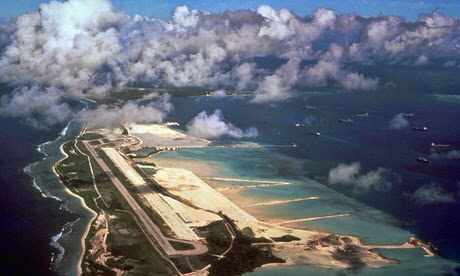
Diego Garcia
The Senate report on the CIA’s interrogation programme, due to be released in days, will confirm that the US tortured terrorist suspects after 9/11. In advance of the release, Barack Obama admitted on Friday: “We tortured some folks. We did some things that were contrary to our values.”
Now, in a letter to the human rights group Reprieve, former foreign secretary William Hague has confirmed that the UK government has held discussions with the US about what it intends to reveal in the report which, according to al-Jazeera, acknowledges that the British territory of Diego Garcia was used for extraordinary rendition.
“We have made representations to seek assurances that ordinary procedures for clearance of UK material will be followed in the event that UK material provide[d] to the Senate committee were to be disclosed,” Hague wrote.
Cori Crider, a director at Reprieve, accused the UK government of seeking to redact embarrassing information: “This shows that the UK government is attempting to censor the US Senate’s torture report. In plain English, it is a request to the US to keep Britain’s role in rendition out of the public domain.”
Lawyers representing a number of terrorist suspects held at Guantánamo Bay believe their clients were rendered via Diego Garcia. Papers found in Libya indicated that the US planned to transport Abdul-Hakim Belhaj, an opponent of Muammar Gaddafi, and his wife via the territory, an atoll in the Indian Ocean leased by Britain to the US. The government has denied Belhaj was rendered via Diego Garcia, but there are suspicions that others were held on the atoll.
Crider said the UK’s attempts to lobby the US into redacting parts of the report “turns the government’s defence in the Libyan renditions case of Abdul-Hakim Belhaj and his wife entirely on its head”.
The government has consistently sought to block Belhaj from bringing a case against it.
“The government protested America would be angered if this kidnap case ever went to trial – and now we learn the British government is leaning on the Americans not to air Britain’s dirty laundry. It exposes their litigation stance as mere posturing,” she added.
Confirmation that a British territory was involved in extraordinary rendition could leave the government vulnerable to legal action. Last month the European court of human rights ruled that the Polish government actively assisted the CIA’s European “black site” programme, which saw detainees interrogated in secret prisons across the continent.
The court concluded it was “established beyond reasonable doubt” that Abu Zubaydah, a Guantánamo detainee the US mistakenly believed to be a senior member of al-Qaida, was flown from a secret site in Thailand to another CIA prison in Stare Kiejkuty in northern Poland.
The judges concluded that not only was Poland “informed of and involved in the preparation and execution of the [High Value Detainee] Programme on its territory”, but also “for all practical purposes, facilitated the whole process, created the conditions for it to happen and made no attempt to prevent it”, prompting lawyers to ask what else it has been used for since. More
The United Nations's top human rights official has suggested that the United States should abandon its efforts to prosecute Edward Snowden, saying his revelations of massive state surveillance had been in the public interest.
Navi Pillay
The UN high commissioner for human rights, Navi Pillay, credited Snowden, a former US National Security Agency contractor, with opening a global debate that has led to calls for the curtailing of state powers to snoop on citizens online and store their data.
“Those who disclose human rights violations should be protected: we need them,” Pillay told a news conference.
“I see some of it here in the case of Snowden, because his revelations go to the core of what we are saying about the need for transparency, the need for consultation,” she said. “We owe a great deal to him for revealing this kind of information.”
The United States has filed espionage charges against Snowden, charging him with theft of government property, unauthorised communication of national defence information and wilful communication of classified communications intelligence to an unauthorised person.
Pillay declined to be drawn on whether President Barack Obama should pardon Snowden, saying he had not yet been convicted. “As a former judge I know that if he is facing judicial proceedings we should wait for that outcome,” she said. But she added that Snowden should be seen as a “human rights defender”.
“I am raising right here some very important arguments that could be raised on his behalf so that these criminal proceedings are averted,” she said.
Revelations of mass US surveillance based on documents leaked by Snowden sparked outrage among American allies including Germany, Brazil and Mexico. He has sought asylum in Russia.
The leaked documents revealed massive programmes run by the NSA that gathered information on emails, phone calls and internet use by hundreds of millions of Americans.
Mona Rishmawi, head of the rule of law branch of Pillay's office, said: “In this particular case, the way we see the situation of Snowden is he really revealed information which is very, very important for human rights. We would like this to be taken into account in assessing his situation.”
All branches of government must be involved in the oversight of surveillance programmes, and completely independent civilian institutions must also monitor surveillance, Pillay says in her report. Checks on government must also be clearly understandable by the public.
The report, which will be debated at the UN general assembly later this year, says any collection of communications data or metadata is potentially a breach of privacy.
Governments often force internet and telecoms firms to store metadata about their customers, which was neither necessary nor proportionate, Pillay said, adding that companies should always be ready to challenge government requests.
“This can mean interpreting government demands as narrowly as possible or seeking clarification from a government with regard to the scope and legal foundation for the demand; requiring a court order before meeting government requests for data; and communicating transparently with users about risks and compliance with government demands,” she told reporters.
She added: “I would say there are serious questions over the extent to which consumers are truly aware of what data they are sharing, how, and with whom, and to what use they will be put.
“And for how long is this data going to be out there? I would say that the same rights that people have offline must be protected online.”
An emergency data collection law being rushed through the British parliament may not address concerns raised by the European Court of Justice and is difficult to justify, Pillay said. More
Many people in Germany, Belgium, and the Netherlands wonder why there are still US tactical nuclear weapons on their soil. These B-61 nuclear gravity bombs were stationed in Europe during the Cold War to deter the Soviet threat, but while this may (or may not) have once made sense, most pundits nowadays agree that at least from a military point of view, the weapons are irrelevant. More
Editorial
Given the tremendous damage the we humans have already done to the Earth, our home planet, the use of nuclear weapons in a conflict would be beyond insane.
We have already gone a long way to poisoning our atmosphere, making our oceans, one of the major sources of food, so acidic that we may be at a tipping point that will wipe out the shellfish and crustaceans that compose a large part of the ocean food chain. Fish stocks are in many areas depleted leading the FAO to suggest banning commercial fishing in some areas of some oceans.
We also have to face global heating which may bring with it changing rainfall patterns, which may lead to water and food shortages. Many inhabitants of our world are already living on barely enough food and water to keep them alive. Furthermore, the planetary population is growing and heading for nine billion by mid-century. Experts are questioning whether or not we will be able to feed this many.
We have to keep in mind that we have only this small fragile planet. A planet in a backwater of our local galaxy. There are no inhabitable worlds to go to nor the transport to get there on. If we do not take care and preserve our world, which will take a global effort to accomplish, the human race may perish. Think of your children and family members,your friends and colleagues If we use nuclear weapons all will certainly perish.
Chernobyl and Fukushima and all the nuclear testing carried out by the UN's P5 have spread more than enough nuclear pollution through the planet. A nuclear conflict would seal our fate.
Pope Francis said recently, “Even today we raise our hand against our brother… We have perfected our weapons, our conscience has fallen asleep, and we have sharpened our ideas to justify ourselves as if it were normal we continue to sow destruction, pain, death. Violence and war lead only to death”.
As H.H. 14th Dalai Lama said, “Peace does not mean an absence of conflicts; differences will always be there. Peace means solving these differences through peaceful means; through dialogue, education, knowledge; and through humane ways.” Editor
I write this letter on the 10th anniversary of the Iraq War on behalf of my fellow Iraq War veterans. I write this letter on behalf of the 4,488 soldiers and Marines who died in Iraq. I write this letter on behalf of the hundreds of thousands of veterans who have been wounded and on behalf of those whose wounds, physical and psychological, have destroyed their lives. I am one of those gravely wounded. I was paralyzed in an insurgent ambush in 2004 in Sadr City. My life is coming to an end. I am living under hospice care.
I write this letter on behalf of husbands and wives who have lost spouses, on behalf of children who have lost a parent, on behalf of the fathers and mothers who have lost sons and daughters and on behalf of those who care for the many thousands of my fellow veterans who have brain injuries. I write this letter on behalf of those veterans whose trauma and self-revulsion for what they have witnessed, endured and done in Iraq have led to suicide and on behalf of the active-duty soldiers and Marines who commit, on average, a suicide a day. I write this letter on behalf of the some 1 million Iraqi dead and on behalf of the countless Iraqi wounded. I write this letter on behalf of us all—the human detritus your war has left behind, those who will spend their lives in unending pain and grief.
I write this letter, my last letter, to you, Mr. Bush and Mr. Cheney. I write not because I think you grasp the terrible human and moral consequences of your lies, manipulation and thirst for wealth and power. I write this letter because, before my own death, I want to make it clear that I, and hundreds of thousands of my fellow veterans, along with millions of my fellow citizens, along with hundreds of millions more in Iraq and the Middle East, know fully who you are and what you have done. You may evade justice but in our eyes you are each guilty of egregious war crimes, of plunder and, finally, of murder, including the murder of thousands of young Americans—my fellow veterans—whose future you stole.
Your positions of authority, your millions of dollars of personal wealth, your public relations consultants, your privilege and your power cannot mask the hollowness of your character. You sent us to fight and die in Iraq after you, Mr. Cheney, dodged the draft in Vietnam, and you, Mr. Bush, went AWOL from your National Guard unit. Your cowardice and selfishness were established decades ago. You were not willing to risk yourselves for our nation but you sent hundreds of thousands of young men and women to be sacrificed in a senseless war with no more thought than it takes to put out the garbage.
I joined the Army two days after the 9/11 attacks. I joined the Army because our country had been attacked. I wanted to strike back at those who had killed some 3,000 of my fellow citizens. I did not join the Army to go to Iraq, a country that had no part in the September 2001 attacks and did not pose a threat to its neighbors, much less to the United States. I did not join the Army to “liberate” Iraqis or to shut down mythical weapons-of-mass-destruction facilities or to implant what you cynically called “democracy” in Baghdad and the Middle East. I did not join the Army to rebuild Iraq, which at the time you told us could be paid for by Iraq’s oil revenues. Instead, this war has cost the United States over $3 trillion. I especially did not join the Army to carry out pre-emptive war. Pre-emptive war is illegal under international law. And as a soldier in Iraq I was, I now know, abetting your idiocy and your crimes. The Iraq War is the largest strategic blunder in U.S. history. It obliterated the balance of power in the Middle East. It installed a corrupt and brutal pro-Iranian government in Baghdad, one cemented in power through the use of torture, death squads and terror. And it has left Iran as the dominant force in the region. On every level—moral, strategic, military and economic—Iraq was a failure. And it was you, Mr. Bush and Mr. Cheney, who started this war. It is you who should pay the consequences.
I would not be writing this letter if I had been wounded fighting in Afghanistan against those forces that carried out the attacks of 9/11. Had I been wounded there I would still be miserable because of my physical deterioration and imminent death, but I would at least have the comfort of knowing that my injuries were a consequence of my own decision to defend the country I love. I would not have to lie in my bed, my body filled with painkillers, my life ebbing away, and deal with the fact that hundreds of thousands of human beings, including children, including myself, were sacrificed by you for little more than the greed of oil companies, for your alliance with the oil sheiks in Saudi Arabia, and your insane visions of empire.
I have, like many other disabled veterans, suffered from the inadequate and often inept care provided by the Veterans Administration. I have, like many other disabled veterans, come to realize that our mental and physical wounds are of no interest to you, perhaps of no interest to any politician. We were used. We were betrayed. And we have been abandoned. You, Mr. Bush, make much pretense of being a Christian. But isn’t lying a sin? Isn’t murder a sin? Aren’t theft and selfish ambition sins? I am not a Christian. But I believe in the Christian ideal. I believe that what you do to the least of your brothers you finally do to yourself, to your own soul.
My day of reckoning is upon me. Yours will come. I hope you will be put on trial. But mostly I hope, for your sakes, that you find the moral courage to face what you have done to me and to many, many others who deserved to live. I hope that before your time on earth ends, as mine is now ending, you will find the strength of character to stand before the American public and the world, and in particular the Iraqi people, and beg for forgiveness.
I write this letter on the 10th anniversary of the Iraq War on behalf of my fellow Iraq War veterans. I write this letter on behalf of the 4,488 soldiers and Marines who died in Iraq. I write this letter on behalf of the hundreds of thousands of veterans who have been wounded and on behalf of those whose wounds, physical and psychological, have destroyed their lives. I am one of those gravely wounded. I was paralyzed in an insurgent ambush in 2004 in Sadr City. My life is coming to an end. I am living under hospice care.
I write this letter on behalf of husbands and wives who have lost spouses, on behalf of children who have lost a parent, on behalf of the fathers and mothers who have lost sons and daughters and on behalf of those who care for the many thousands of my fellow veterans who have brain injuries. I write this letter on behalf of those veterans whose trauma and self-revulsion for what they have witnessed, endured and done in Iraq have led to suicide and on behalf of the active-duty soldiers and Marines who commit, on average, a suicide a day. I write this letter on behalf of the some 1 million Iraqi dead and on behalf of the countless Iraqi wounded. I write this letter on behalf of us all—the human detritus your war has left behind, those who will spend their lives in unending pain and grief.
Bush and Cheney
I write this letter, my last letter, to you, Mr. Bush and Mr. Cheney. I write not because I think you grasp the terrible human and moral consequences of your lies, manipulation and thirst for wealth and power. I write this letter because, before my own death, I want to make it clear that I, and hundreds of thousands of my fellow veterans, along with millions of my fellow citizens, along with hundreds of millions more in Iraq and the Middle East, know fully who you are and what you have done. You may evade justice but in our eyes you are each guilty of egregious war crimes, of plunder and, finally, of murder, including the murder of thousands of young Americans—my fellow veterans—whose future you stole.
Your positions of authority, your millions of dollars of personal wealth, your public relations consultants, your privilege and your power cannot mask the hollowness of your character. You sent us to fight and die in Iraq after you, Mr. Cheney, dodged the draft in Vietnam, and you, Mr. Bush, went AWOL from your National Guard unit. Your cowardice and selfishness were established decades ago. You were not willing to risk yourselves for our nation but you sent hundreds of thousands of young men and women to be sacrificed in a senseless war with no more thought than it takes to put out the garbage.
I joined the Army two days after the 9/11 attacks. I joined the Army because our country had been attacked. I wanted to strike back at those who had killed some 3,000 of my fellow citizens. I did not join the Army to go to Iraq, a country that had no part in the September 2001 attacks and did not pose a threat to its neighbors, much less to the United States. I did not join the Army to “liberate” Iraqis or to shut down mythical weapons-of-mass-destruction facilities or to implant what you cynically called “democracy” in Baghdad and the Middle East. I did not join the Army to rebuild Iraq, which at the time you told us could be paid for by Iraq’s oil revenues. Instead, this war has cost the United States over $3 trillion. I especially did not join the Army to carry out pre-emptive war. Pre-emptive war is illegal under international law. And as a soldier in Iraq I was, I now know, abetting your idiocy and your crimes. The Iraq War is the largest strategic blunder in U.S. history. It obliterated the balance of power in the Middle East. It installed a corrupt and brutal pro-Iranian government in Baghdad, one cemented in power through the use of torture, death squads and terror. And it has left Iran as the dominant force in the region. On every level—moral, strategic, military and economic—Iraq was a failure. And it was you, Mr. Bush and Mr. Cheney, who started this war. It is you who should pay the consequences.
I would not be writing this letter if I had been wounded fighting in Afghanistan against those forces that carried out the attacks of 9/11. Had I been wounded there I would still be miserable because of my physical deterioration and imminent death, but I would at least have the comfort of knowing that my injuries were a consequence of my own decision to defend the country I love. I would not have to lie in my bed, my body filled with painkillers, my life ebbing away, and deal with the fact that hundreds of thousands of human beings, including children, including myself, were sacrificed by you for little more than the greed of oil companies, for your alliance with the oil sheiks in Saudi Arabia, and your insane visions of empire.
I have, like many other disabled veterans, suffered from the inadequate and often inept care provided by the Veterans Administration. I have, like many other disabled veterans, come to realize that our mental and physical wounds are of no interest to you, perhaps of no interest to any politician. We were used. We were betrayed. And we have been abandoned. You, Mr. Bush, make much pretense of being a Christian. But isn’t lying a sin? Isn’t murder a sin? Aren’t theft and selfish ambition sins? I am not a Christian. But I believe in the Christian ideal. I believe that what you do to the least of your brothers you finally do to yourself, to your own soul.
My day of reckoning is upon me. Yours will come. I hope you will be put on trial. But mostly I hope, for your sakes, that you find the moral courage to face what you have done to me and to many, many others who deserved to live. I hope that before your time on earth ends, as mine is now ending, you will find the strength of character to stand before the American public and the world, and in particular the Iraqi people, and beg for forgiveness.
I’ll bet you didn’t know that June is “torture awareness month” thanks to the fact that, on June 26, 1987, the Convention Against Torture and other Cruel, Inhuman, and Degrading Treatment or Punishment went into effect internationally.
In this country, however, as a recent Amnesty International survey indicated, Americans are essentially living in Torture Unawareness Month, or perhaps even Torture Approval Month, and not just in June 2014 but every month of the year.
One simple fact of the post-9/11 era should make this clear and also boggle the mind, but has had almost no impact here. But for this you need a little background from the early years of what was once called the Global War on Terror. In addition to a stream of international kidnappings (euphemistically called “renditions”) of terror suspects, including completely innocent people the CIA snatched off the streets of global cities, as well as from the backlands of the planet and “rendered” into the hands of well-known torturing regimes (with the help of 54 other countries) and the setting up of a network of “black sites” or offshore prisons where anything went, the CIA tortured up a storm. And it did so at the behest of the top officials of the Bush administration, including the president and vice president who were convinced that it was time for Washington to “take the gloves off.” In those years, torture techniques were reportedly demonstrated in the White House to some of those officials, including the vice president and national security advisor. At the time, they went by the euphemistic, administration-approved term “enhanced interrogation techniques,” which was quickly picked up and used in the U.S. mainstream media in place of the word “torture” — though only when the enhanced interrogators were American, of course. The bad guys out there continued to “torture” in the usual fashion.
In the Obama years, torture was (at least officially) tossed out as a useful tactic. But the torturers themselves were given a pass, every last one of them, by the Justice Department, even two cases in which the CIA’s acts of enhancement had led to death. No charge was ever brought against anyone, including the Justice Department lawyers who wrote the tortured memos endorsing those techniques and redefining torture as only happening when the torturer meant it to, or the officials who green-lighted them. Think of the Obama administration then as Amnesty National. That administration did, however, have the guts to go after one man connected to the torture program, forced a plea deal from him, and sent him to jail for two years. I’m talking about former CIA agent John Kiriakou, the only person since 9/11 convicted of a torture-related crime. To be specific, his criminal act was to blow the whistle on his former employer's torture program to a journalist, revealing in the process the name of a CIA agent. That was considered such an indefensible act — in effect, an act of torture against the American security state — that justice, American-style, was done.
It’s quite a tortuous record when you think about it, not that anyone here does anymore, which is why we need TomDispatch regular Ariel Dorfman, author most recently of Feeding on Dreams: Confessions of an Unrepentant Exile, to remind us of what’s really at stake when one human being tortures another. Tom
How to Forgive Your Torturer
The River Kwai Passes Through Latin America and Washington
According to an Amnesty International Poll released in May, 45% of Americans believe that torture is “sometimes necessary and acceptable” in order to “gain information that may protect the public.” Twenty-nine percent of Britons “strongly or somewhat agreed” that torture was justified when asked the same question.
For someone like me, who has been haunted by the daily existence of torture since the September 11, 1973 coup that overthrew Chilean President Salvador Allende, such percentages couldn’t be more depressing, but perhaps not that surprising. I now live, after all, in the America where Dick Cheney, instead of being indicted as a war criminal, sneeringly (and falsely) claims to anyone who asks him — and he is trotted out over and over again as the resident expert on the subject — that “enhanced interrogations” have been and still are absolutely necessary to keep Americans safe.
As for those Americans and Britons — and so many others around the world — who find such horrors justifiable, I wonder if they have ever met a victim of torture? Or do they think this endless pain is only inflicted on remote and dangerous people caught up in unfathomable wars and savage conflicts? If so, they should think again.
When I read these sorts of statistics a scene comes back to me. I remember a man I met 20 years ago, not in my native Latin America or in faraway lands where torture is endemic, but in the extremely English town of Berwick-upon-Tweed.
Everybody in the room that day was crying, except for the man who had moved us all to tears, the former prisoner of war whom my son Rodrigo and I had traveled thousands of miles to meet. We had hoped to do justice to his story in a biopic, Prisoners in Time, that the BBC wanted to make for television — based on the same autobiographical material used recently in The Railway Man, the film starring Colin Firth and Nicole Kidman now showing in theaters across America.
And what an extraordinary story it was!
Eric Lomax, a British officer in World War II, had been tortured by the Japanese in Thailand while working on the infamous Bangkok-Burma railroad, the one most people know about through another film, The Bridge on the River Kwai. Eric, like so many victims of atrocities, was plagued by the experience, his life destroyed by memories of his agony and the desire for revenge. What differentiated him from so many others persecuted worldwide was not only that, more than 40 years later, he tracked down the man he held responsible for his suffering, the anonymous interpreter at his beatings and waterboardings, but the astounding fact that this tormentor, Takashi Nagase, once found and identified, turned out to be a Buddhist monk. Nagase had spent the postwar decades denouncing his own countrymen for their crimes and trying to atone for his role in the atrocities he had helped commit by caring for innumerable orphans of the Asians who had died building that railroad. The one scorching image from the war he could not escape was that of a brave young British lieutenant over whose torture he had presided and whom he had presumed to be dead. More


 © 2014






 Democracy & Good Governance