Regime Change in Cuba

Normalization of relations with Cuba is not the result of a diplomatic breakthrough or a change of heart on the part of Washington. Normalization is a result of US corporations seeking profit opportunities in Cuba, such as developing broadband Internet markets in Cuba.

Before the American left and the Cuban government find happiness in the normalization, they should consider that with normalization comes American money and a US Embassy. The American money will take over the Cuban economy. The embassy will be a home for CIA operatives to subvert the Cuban government. The embassy will provide a base from which the US can establish NGOs whose gullible members can be called to street protest at the right time, as in Kiev, and the embassy will make it possible for Washington to groom a new set of political leaders.

In short, normalization of relations means regime change in Cuba. Soon Cuba will be another of Washington’s vassal states.

Conservatives and Republicans such as Peggy Noonan and Senator Marco Rubio, have made it clear that Castro is “a bad man who turned an almost-paradise into a floating prison” and that normalizing relations with Cuba will not “grant the Castro regime legitimacy.”

Noonan forgets about Guantanamo, Washington’s offshore torture prison in Cuba where hundreds of innocent people have been held and tortured for a large part of their lives by the exceptional Americans. The Cuban Revolution intended to free Cubans from foreign domination and from exploitation by foreign capitalists. Whatever the likelihood of success, a half century of Washington’s hostility has as much to do with Cuba’s economic problems as communist ideology.

The self-righteousness of Americans is extreme. Noonan is happy. American money is now going to defeat Castro’s life work. And if the money doesn’t do it, the CIA will. The agency has long been waiting to avenge the Bay of Pigs, and normalization of relations brings the opportunity. More


Fearing Bombs That Can Pick Whom to Kill

On a bright fall day last year off the coast of Southern California, an Air Force B-1 bomber launched an experimental missile that may herald the future of warfare.

LRAS Missile launched from B-1 bomber

Initially, pilots aboard the plane directed the missile, but halfway to its destination, it severed communication with its operators. Alone, without human oversight, the missile decided which of three ships to attack, dropping to just above the sea surface and striking a 260-foot unmanned freighter.

Warfare is increasingly guided by software. Today, armed drones can be operated by remote pilots peering into video screens thousands of miles from the battlefield. But now, some scientists say, arms makers have crossed into troubling territory: They are developing weapons that rely on artificial intelligence, not human instruction, to decide what to target and whom to kill.

As these weapons become smarter and nimbler, critics fear they will become increasingly difficult for humans to control — or to defend against. And while pinpoint accuracy could save civilian lives, critics fear weapons without human oversight could make war more likely, as easy as flipping a switch.

Britain, Israel and Norway are already deploying missiles and drones that carry out attacks against enemy radar, tanks or ships without direct human control. After launch, so-called autonomous weapons rely on artificial intelligence and sensors to select targets and to initiate an attack.

Britain’s “fire and forget” Brimstone missiles, for example, can distinguish among tanks and cars and buses without human assistance, and can hunt targets in a predesignated region without oversight. The Brimstones also communicate with one another, sharing their targets.

Armaments with even more advanced self-governance are on the drawing board, although the details usually are kept secret. “An autonomous weapons arms race is already taking place,” said Steve Omohundro, a physicist and artificial intelligence specialist at Self-Aware Systems, a research center in Palo Alto, Calif. “They can respond faster, more efficiently and less predictably.”

Concerned by the prospect of a robotics arms race, representatives from dozens of nations will meet on Thursday in Geneva to consider whether development of these weapons should be restricted by the Convention on Certain Conventional Weapons. Christof Heyns, the United Nations special rapporteur on extrajudicial, summary or arbitrary executions, last year called for a moratorium on the development of these weapons.

The Pentagon has issued a directive requiring high-level authorization for the development of weapons capable of killing without human oversight. But fast-moving technology has already made the directive obsolete, some scientists say.

“Our concern is with how the targets are determined, and more importantly, who determines them,” said Peter Asaro, a co-founder and vice chairman of the International Committee for Robot Arms Control, a group of scientists that advocates restrictions on the use of military robots. “Are these human-designated targets? Or are these systems automatically deciding what is a target?”

Weapons manufacturers in the United States were the first to develop advanced autonomous weapons. An early version of the Tomahawk cruise missile had the ability to hunt for Soviet ships over the horizon without direct human control. It was withdrawn in the early 1990s after a nuclear arms treaty with Russia.

Back in 1988, the Navy test-fired a Harpoon antiship missile that employed an early form of self-guidance. The missile mistook an Indian freighter that had strayed onto the test range for its target. The Harpoon, which did not have a warhead, hit the bridge of the freighter, killing a crew member.

Despite the accident, the Harpoon became a mainstay of naval armaments and remains in wide use.

In recent years, artificial intelligence has begun to supplant human decision-making in a variety of fields, such as high-speed stock trading and medical diagnostics, and even in self-driving cars. But technological advances in three particular areas have made self-governing weapons a real possibility.

New types of radar, laser and infrared sensors are helping missiles and drones better calculate their position and orientation. “Machine vision,” resembling that of humans, identifies patterns in images and helps weapons distinguish important targets. This nuanced sensory information can be quickly interpreted by sophisticated artificial intelligence systems, enabling a missile or drone to carry out its own analysis in flight. And computer hardware hosting it all has become relatively inexpensive — and expendable.

The missile tested off the coast of California, the Long Range Anti-Ship Missile, is under development by Lockheed Martin for the Air Force and Navy. It is intended to fly for hundreds of miles, maneuvering on its own to avoid radar, and out of radio contact with human controllers.

In a directive published in 2012, the Pentagon drew a line between semiautonomous weapons, whose targets are chosen by a human operator, and fully autonomous weapons that can hunt and engage targets without intervention.

Weapons of the future, the directive said, must be “designed to allow commanders and operators to exercise appropriate levels of human judgment over the use of force.”

The Pentagon nonetheless argues that the new antiship missile is only semiautonomous and that humans are sufficiently represented in its targeting and killing decisions. But officials at the Defense Advanced Research Projects Agency, which initially developed the missile, and Lockheed declined to comment on how the weapon decides on targets, saying the information is classified.

“It will be operating autonomously when it searches for the enemy fleet,” said Mark A. Gubrud, a physicist and a member of the International Committee for Robot Arms Control, and an early critic of so-called smart weapons. “This is pretty sophisticated stuff that I would call artificial intelligence outside human control.”

Paul Scharre, a weapons specialist now at the Center for a New American Security who led the working group that wrote the Pentagon directive, said, “It’s valid to ask if this crosses the line.”

Some arms-control specialists say that requiring only “appropriate” human control of these weapons is too vague, speeding the development of new targeting systems that automate killing.

Mr. Heyns, of the United Nations, said that nations with advanced weapons should agree to limit their weapons systems to those with “meaningful” human control over the selection and attack of targets. “It must be similar to the role a commander has over his troops,” Mr. Heyns said.

Systems that permit humans to override the computer’s decisions may not meet that criterion, he added. Weapons that make their own decisions move so quickly that human overseers soon may not be able to keep up. Yet many of them are explicitly designed to permit human operators to step away from controls. Israel’s antiradar missile, the Harpy, loiters in the sky until an enemy radar is turned on. It then attacks and destroys the radar installation on its own.

Norway plans to equip its fleet of advanced jet fighters with the Joint Strike Missile, which can hunt, recognize and detect a target without human intervention. Opponents have called it a “killer robot.”

Military analysts like Mr. Scharre argue that automated weapons like these should be embraced because they may result in fewer mass killings and civilian casualties. Autonomous weapons, they say, do not commit war crimes.

On Sept. 16, 2011, for example, British warplanes fired two dozen Brimstone missiles at a group of Libyan tanks that were shelling civilians. Eight or more of the tanks were destroyed simultaneously, according to a military spokesman, saving the lives of many civilians.

It would have been difficult for human operators to coordinate the swarm of missiles with similar precision.

“Better, smarter weapons are good if they reduce civilian casualties or indiscriminate killing,” Mr. Scharre said. More

Editorial

Professor Samdhong Rinpoche,, a leading Tibetan academic stated recently; “Today the challenges of the modernity pose existential threat to mankind and earth itself, if not tackled adequately and immediately. The first major challenge is of VIOLENCE. Its most visible forms are war and terrorism. Then there is the systematic or system generated violence. We are neither able to see it or understand it, but its scope and spread are frightening. The present situation is such that we have no will to resist violence, unless it directly affects us. This kind of violence is market driven which necessitates perpetuation of war or its possibility. In brief the entire world today is being governed by the market forces, which are described consumeristic system”. Violence, war and terrorism, along with poverty and disease are governance issues, global governance issies.

As Kofi Annan, then secretary-general of the United Nations (UN), told world leaders in 1998: “Good governance is perhaps the single most important factor in eradicating poverty and promoting development.” Governance is the exercise of economic, political, and administrative authority to manage a country’s affairs at all levels. Different definitions of good governance have been proposed by development organizations. The definition offered by the UN Development Programme highlights participation, accountability, transparency, consensus, sustainability, the rule of law, and the inclusion of the poorest and most vulnerable people in making decisions about allocating development resources.

All of the above are issues that we have to technology and resources to alleviate. Doing so would remove the necessity to produce weapons as described above, it could do away for the need for the military as we know it today. The world could be like Costa Rica whose military was abolished on December 1, 1948, by President José Figueres Ferrer. Our world could literally become a Paradise or Garden of Eden where peace reigned as everyones needs were fulfilled. Editor.


Surprise: U.S. drug war in Afghanistan not going well

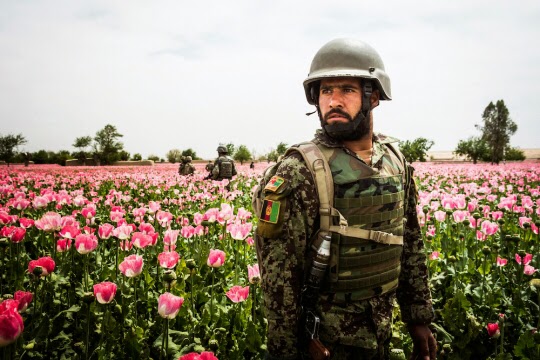
A new report has found the war on drugs in Afghanistan remains colossally expensive, largely ineffective and likely to get worse. This is particularly true in the case of opium production, says the U.S. Office of the Special Inspector General for Afghanistan Reconstruction.

In a damning report released Tuesday, the special inspector general, Justin F. Sopko, writes that “despite spending over $7 billion to combat opium poppy cultivation and to develop the Afghan government’s counternarcotics capacity, opium poppy cultivation levels in Afghanistan hit an all-time high in 2013,” hitting 209,000 hectares, surpassing the prior, 2007 peak of 193,000 hectares. Sopko adds that the number should continue to rise thanks to deteriorating security in rural Afghanistan and weak eradication efforts.

Though the figures it reports are jarring, the inspector general’s investigation highlights drug policy failures in Afghanistan that have been consistently documented for years. Indeed, Sopko himself has been raising concerns over the failing drug war in Afghanistan for some time. In January, he testified before the Senate Caucus on International Narcotics Control and described a series of discouraging conversations with counternarcotics officials from Afghanistan, the U.S., and elsewhere.

“In the opinion of almost everyone I spoke with, the situation in Afghanistan is dire with little prospect for improvement in 2014 or beyond,” Sopko told the lawmakers. “All of the fragile gains we have made over the last 12 years on women’s issues, health, education, rule of law, and governance are now, more than ever, in jeopardy of being wiped out by the narcotics trade which not only supports the insurgency, but also feeds organized crime and corruption.”

While many of the numbers included in the inspector general’s investigation have been made public before, the report serves as a reminder that, in addition to contributing to more than 70,000 deaths in Mexico over eight years, the bloody destabilization of Central America, and the expansion of the largest prison population in history in the United States, the ongoing U.S. effort to eliminate the market for illicit drugs at home and abroad is failing. Afghanistan is still considered the number one producer of opium in the world, responsible for as much as 90 percent of the market, which in turn supports the global heroin trade, even if only a small percentage of heroin from Afghanistan is believed to reach the U.S.

By June of 2014, U.S. departments and agencies — including the Pentagon, the State Department, USAID, the Drug Enforcement Administration and others — had spent a total of $7.6 billion to fight drugs in Afghanistan. Specifically, Sopko notes, the U.S. tax dollars poured into Afghanistan have been intended to support “the development of Afghan government counternarcotics capacity, operational support to Afghan counternarcotics forces; encouragement of alternative livelihoods for Afghan farmers; financial incentives to Afghan authorities to enforce counternarcotics laws; and, in limited instances, counternarcotics operations conducted by U.S. authorities in coordination with their Afghan counterparts.” The results, the inspector general points out, have left something to be desired.

Sopko reports that the resurgence in Afghan poppy cultivation has been driven by the high price of the crop, cheap and mobile labor, and “[a]ffordable deep-well technology,” which “has turned 200,000 hectares of desert in southwestern Afghanistan into arable land over the past decade.” According to figures from the United Nations Office on Drugs and Crime, from 2012 to 2013 the value of opium and the products derived from it increased by 50 percent, from $2 billion to $3 billion.

While U.S. efforts have failed to effectively diminish drug trafficking in Afghanistan, they have succeeded in making a handful of private security companies increasingly rich, a point that is not addressed in the inspector general’s report. In 2009, official responsibility for training Afghan police forces was shifted from the State Department to an obscure branch of the Pentagon known as Counter Narco-Terrorism Program Office (CNTPO), which took over the roughly $1 billion contract. In waging the privatized war on drugs, CNTPO has partnered with such corporate security giants as Raytheon, Lockheed Martin, ARINC, DynCorp and U.S. Training Center, a subsidiary of the firm formerly known as Blackwater.

With the pullout of U.S. forces looming — special operations units notwithstanding — the future of Afghanistan looks grim. Experts at the Afghanistan Analysts Network have noted the expanding power of warlords in Afghanistan’s rural regions. Meanwhile, security agreements between the Afghan government and the U.S. and NATO forces have avoided reining in CIA-backed paramilitaries that have shouldered much of the United States’ dirty work in the last 13 years of war. The rising viability of the opium trade, and the corruption it so often invites, adds yet another layer of complexity to an already fragile situation.

In his report, Sopko encourages the U.S. government and its coalition partners to look back on the years of counternarcotics efforts in Afghanistan and consider what today’s record high levels of poppy cultivation might suggest.

“In past years, surges in opium poppy cultivation have been met by a coordinated response from the U.S. government and coalition partners, which has led to a temporary decline in levels of opium production,” he writes. “However, the recent record-high level of poppy cultivation calls into question the long- term effectiveness and sustainability of those prior efforts.” More

Useful Background Reading


Reality of National Security State Trumps ‘Delusions’ of U.S. Democracy

In the halls of U.S. government, “policy in the national security realm is made by the concealed institutions,” political scientist argues in new book

“I think the American people are deluded.”

So says Tufts University political scientist Michael J. Glennon, whose new book, National Security and Double Government (Oxford University Press), describes a powerful bureaucratic network that's really pulling the strings on key aspects of U.S. foreign policy.

The 'double government' explains why the Obama version of national security is virtually indistinguishable from the one he inherited from President George W. Bush.

The American public believes “that when they vote for a president or member of Congress or succeed in bringing a case before the courts, that policy is going to change,” Glennon told the Boston Globe in an interview published Sunday. “Now, there are many counter-examples in which these branches do affect policy… But the larger picture is still true—policy by and large in the national security realm is made by the concealed institutions.”

Glennon argues that because managers of the military, intelligence, diplomatic, and law enforcement agencies operate largely outside the institutions meant to check or constrain them—the executive branch, the courts, Congress—national security policy changes very little from one administration to the next.

This explains, he says, why the Obama version of national security is virtually indistinguishable from the one he inherited from President George W. Bush. It's also why Guantanamo is still open; why whistleblowers are being prosecuted more; why NSA surveillance has expanded; why drone strikes have increased.

“I was curious why a president such as Barack Obama would embrace the very same national security and counterterrorism policies that he campaigned eloquently against,” Glennon said. Drawing on his own personal experiences as former legal counsel to the Senate Foreign Relations Committee, as well as conversations with dozens of individuals in U.S. military, law enforcement, and intelligence agencies and elected officials, Glennon drew the following conclusion: “National security policy actually bubbles up from within the bureaucracy. Many of the more controversial policies, from the mining of Nicaragua’s harbors to the NSA surveillance program, originated within the bureaucracy.”

To dismantle this so-called “double government”—a phrase coined by British journalist and businessman Walter Bagehot to describe the British government in the 1860s—will be a challenge, Glennon admits. After all, “There is very little profit to be had in learning about, and being active about, problems that you can’t affect, policies that you can’t change.”

But he is not hopeless. “The ultimate problem is the pervasive political ignorance on the part of the American people. And indifference to the threat that is emerging from these concealed institutions. That is where the energy for reform has to come from: the American people,” he said. “The people have to take the bull by the horns.” More

This work is licensed under a Creative Commons Attribution-Share Alike 3.0 License


Perpetual War, Indefinite Detention, And Torture: The U.S. And Israel’s Shared Values

The United States and Israel have “shared values” but not when it comes to upholding democracy and the rule of law. Their shared values are perpetual war, torture, indefinite detention, and military courts.

Israeli soldiers arrest Palestinian
minors in the West Bank city of Jenin

Guantanamo is a perfect example of this. Both states have been in a state of perpetual war for quite some time with Israel against the Palestinians since its founding in 1948 while the U.S. can trace back its war to its founding in 1776 and the colonization of Native American lands. Today’s global war on terror is the latest chapter in that saga. Under perpetual war, the United States and Israel can justify a litany of draconian policies, such as indefinite detention, torture, and extrajudicial killing.

International human rights law prohibits torture and detention without charge or trial. The UN Convention Against Torture strictly forbids torture, even in “exceptional circumstances” like “a state of war or threat of war, internal political instability or any other public emergency.” Meanwhile, article 9 of the International Covenant on Civil and Political Rights states, “No one shall be subjected to arbitrary arrest or detention.” The rights to a fair trial, due process, and to be free from torture and inhumane treatment are basic human rights that governments are obliged to uphold. Yet, both the United States and Israel practice indefinite detention – also known as “administrative detention” in Israel – and torture.

Administrative detention and torture in Israel

Israel has detained thousands of Palestinians in the occupied territories without charge or trial over the years “for periods ranging from several months to several years,” according to Israeli human rights group B’Tselem. B’Tselem figures also report that, “At the end of May 2014, 196 Palestinian administrative detainees were held in facilities run by the Israel Prison Service (IPS).” Israel recently locked up over 250 Palestinians in administrative detention as part of its operation to find the three missing but killed Israeli settlers, putting the current population at around 450.

Three Israeli laws allow and regulate Israel’s administrative detention powers – the Administrative Detention Order, theEmergency Powers (Detention) Law, and the Internment of Unlawful Combatants Law.

The Administrative Detention Order, which applies to the West Bank except East Jerusalem, allows military commanders to detain a person for a maximum of six months “for reasons to do with regional security or public security.” Commanders can repeatedly add six months of administrative detention, since there is no limit on extensions. The 1979 Emergency Powers Law allows the defense minister to detain a person for up to six months, like the Order, and extend the detention repeatedly six months at a time. It applies to Israeli residents, residents living in Israeli occupied territories, and residents of other countries, such as Lebanon. However, this law grants detainees more protections than the Order does. The 2002 Internment of Unlawful Combatants Law allows for the administrative detention of a civilian who directly or indirectly participates in hostilities against Israel or is a member of a force that does so. Under this law, persons can be detained for an unlimited period of time. This law is used to detain Palestinians living in the Gaza Strip.

While the occupation is illegal and unjust, Israel, as an occupying power, has an international legal responsibility to uphold the welfare of Palestinians living under its control. International humanitarian law permitssome internment (or detention without charge or trial) in wartime but only “for imperative reasons of security,” according to Article 78 of the Fourth Geneva Convention. Internment [detention] also has to be done on a case-by-case basis rather than implemented widely.

B’Tselem names the numerous ways in which Israel’s use of administrative detention violates its international legal responsibilities as an occupying power. One is its “[e]xtremely extensive use” in contravention of international law. “Administrative detention has become routine practice, rather than an exceptional measure,” according to B’Tselem. Relatedly, administrative detention is used as “an alternative to criminal proceedings” with authorities using it “as a quick and efficient alternative to criminal trial, primarily when they do not have sufficient evidence to charge the individual, or when they do not want to reveal their evidence.” Administrative detention also lacks due process as detainees “are not provided meaningful information on the reasons for their detention and are not given an opportunity to refute the suspicions against them.” Additionally, detention periods are repeatedly extended, which leaves Palestinians detained for several months to years without charge or trial. Israel has also used administrative detention against political opponents, including non-violent political activists. Finally, many Palestinian administrative detainees are held inside Israel.

In 1999, Israel’s High Court of Justice issued a ruling that prohibited interrogators from using methods of torture as a means of interrogation. Before that ruling, Israeli security forces regularly “tortured thousands of Palestinian detainees each year,” according to the Public Committee Against Torture in Israel. In 1987, an Israeli government commission, headed by former Supreme Court President Moshe Landau, issued a report that provided a framework for Israel’s torture regime. The Landau Commission recommended Shin Bet interrogators utilize torture methods, namely “psychological pressure” and a “moderate degree of physical pressure,” against people suspected of “hostile terrorist activity.” It argued that “an effective interrogation is impossible” without some physical force.

Despite the High Court’s 1999 ban on torture, rights groups like the Public Committee Against Torture in Israel (PCATI) point out that the Israeli intelligence agency Shin Bet and other law enforcement agencies still commit acts of torture. The PCATI largely relied on testimonies from Palestinian prisoners and forensic evaluations. In response, the Shin Bet denies it commits torture and argues that its interrogation methods are not only lawful but save lives.

Methods of torture and ill treatment of Palestinian prisoners since 1999, according to the PCATI, include “sleep deprivation, binding to a chair in painful positions, beatings, slapping, kicking, threats, verbal abuse and degradation,” special methods like “bending the body into painful positions,” “forcing the interrogee to crouch in a frog-like position (‘kambaz’), choking, shaking and other violent and degrading acts (hair-pulling, spitting, etc.),” and psychological torture. Prisoners, some of whom are children, in solitary confinement often face “sleep deprivation, exposure to extreme heat and cold, permanent exposure to artificial light, detention in sub-standard conditions.”

The High Court’s ruling has loopholes for Israeli intelligence to circumvent the torture ban. One is the “necessity defense”, which, according to PCATI, “under certain circumstances, exempts interrogators who employ illegal interrogation techniques, including physical violence, from criminal responsibility.” Another is well-known the “ticking bomb” scenario, where torture is allowed to prevent an imminent threat, such as a bomb about to explode. PCATI argues that the government exploited this loophole to declare more detainees ticking time bombs and overstepping the court’s intended scope. PCATI also accused the Shin Bet “taking advantage of the fact that only sleep deprivation for the sake of deprivation is illegal, not sleep deprivation indirectly caused from an extended interrogation,” according to the Jerusalem Post.

Guantanamo, U.S. global war on terror

The 2001 Authorization for Use of Military Force, passed shortly after 9/11, authorizes the President of the United States “to use all necessary and appropriate force against those nations, organizations, or persons” who “planned, authorized, committed, or aided” the 9/11 terrorist attacks “or harbored such organizations or persons.” This bill gives the United States wide power to wage perpetual war around the world against alleged terrorist groups.

When the Obama administration entered office, it not only kept the AUMF in place, but expanded the bill’s scope to continue the global war on terror. The Obama administration interprets the AUMF to include “associated forces” – essentially co-belligerents – of al-Qaeda, even though the bill does not include those words. Last year, the Washington Post reportedthat Obama administration officials were debating whether the AUMF could be stretched to include “associates of associates” of al-Qaeda, including groups like al-Nusra Front in Syria or Ansar al-Sharia in North Africa. Thus, Obama has shifted the war on terror’s goalposts and continued its perpetuity.

The AUMF is the legal linchpin for the United States’ global war on terror. It justifies the U.S. detention facility at Guantanamo Bay, indefinite detention, kill-or-capture raids, extraordinary rendition, and drone strikes. But it is not the only legal measure for doing so. Last year, a week before President Obama’s national security speech, Obama administration officials told the Senate that even without AUMF, the government could use other laws to continue lethal operations against suspected terrorists, such as self-defense under international law. While both states engage in perpetual war under the language of “fighting terror,” Israel’s battlefield mostly extends to the West Bank and Gaza Strip, while the United States’ is the entire world.

The Guantanamo Bay detention facility was opened in 2002, as the global war on terror began. When the U.S. invaded Afghanistan, it provided bounties to tribal allies and Pakistani security forces to capture anyone believed to be connected with al-Qaeda or the Taliban and send them to American forces. This led to large swaths of low-level fightersand guys at the wrong place at the wrong timegetting snatched up thanks to informants looking for money or scores to settle with their enemies. ASeton Hall study pointed out that only 5 percent of Guantanamo detainees were captured by U.S. forces, while 86 percent were captured by Pakistan or the Northern Alliance and handed to the United States.

Presently, there are 149 men detained in Guantanamo. Of those, 79 are cleared for release, 37 are designated for indefinite detention without charge or trial, 6 currently being tried in military commissions, and 36 who could go to trial. However, Guantanamo chief prosecutor Brig. Gen. Mark Martins told reporters last summer that 20 could be “realistically prosecuted.”

Recently, Defense Secretary Chuck Hagel told Congress that the military intends to release six Guantanamo detainees to Uruguay – four of whom are Syrian, one is Palestinian, and the other is Tunisian. All six have been cleared for release for over four years. This would bring the number of detainees cleared for release down to 73 and total Guantanamo inmate population to 143. Meanwhile, the U.S. government deems the indefinite detainees too difficult to prosecute, as there is little to no admissible evidence against them (some was obtained through torture), but too dangerous to release. According to Martins, these indefinite detainees will remain in Guantanamo “until the end of hostilities” against al-Qaeda, the Taliban, and “associated forces.” Thus making them prisoners of war in an endless war.

In 2012, President Obama signed the National Defense Authorization Act (NDAA), sections of which allow the military to indefinitely detain American citizens on US soil who allegedly “substantially supported al Qaeda, the Taliban, and associated forces.” When Obama stepped into office, he pledged to close the U.S. prison in Guantanamo. But the other half of his plan was less advertised. In order to close Guantanamo, Obama’s original plan was to to move some Guantanamo detainees to an Illinois prison. Moreover, his administration decided, early on, to continue utilizing indefinite detention, much to the chagrin of civil liberties groups. However, Congress, particularly members of the Republican Party, fought against this plan not out of opposition to indefinite detention but because they did not want “terrorists” on American soil. This past May, the Obama administration’s legal team told Congress that if Guantanamo detainees “were relocated to a prison inside the United States, it is unlikely that a court would order their release onto domestic soil,” reported The New York Times.

Despite the fear-mongering of releasing “terrorist” from Guantanamo, according to a New America Foundation study, only 4 percent of released Guantanamo detainees engage in “militant activities against U.S. targets.”

Abuses in Guantanamo, according to a 2006 Center for Constitutional Rights report, include beatings, shackling, solitary confinement, sexual harassment and rape, sleep deprivation, medical abuse, and religious and cultural humiliation. Some Guantanamo detainees were detained in secret CIA prisons before arriving at the U.S. military prison in Cuba. An ICRC report on the treatment of 14 “high value” detainees held in CIA black sites revealed that torture techniques in the secret prisons included sleep and food deprivation, playing of loud music, waterboarding, beatings, stress positions, cold temperatures and water, prolonged shackling, threats, and forced shaving. Around 100 detainees were held in CIA black sites and themajority of them were tortured. More


The West’s Repeated Mistakes Over Eastern Europe

Something very similar is happening now in the countries east of the European Union and west of Russia. As the people of Ukraine’s Euromaidan protest movement showed in January 2014 on Kiev’s Independence Square, they were not going to accept a post–Cold War status quo in which Russia sets the agenda. They wanted to choose their own political path.

It seems that history is repeating itself. This time round, NATO is not prepared to help the countries in Europe’s East, while the EU is divided and weak over how to deal with Russian President Vladimir Putin’s invasion of eastern Ukraine and illegal annexation of Crimea in March.

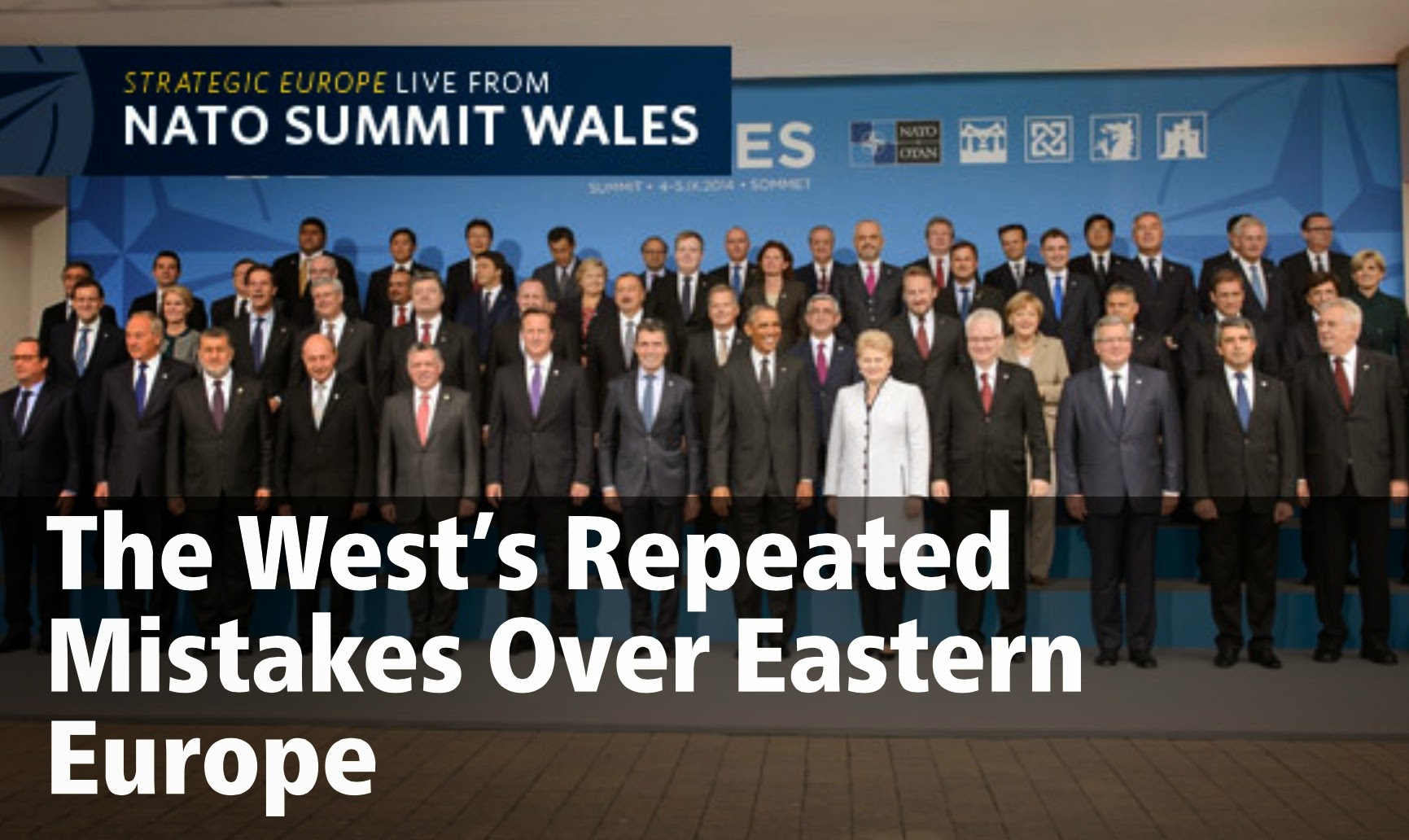
During a press conference with Ukrainian President Petro Poroshenko on September 4 at the NATO summit in Wales, the alliance’s Secretary General Anders Fogh Rasmussen tried to put the best spin on NATO help to Ukraine. Since NATO is not prepared even to consider the idea of Ukraine one day becoming a member of the organization, Rasmussen—and indeed Poroshenko—didn’t mention the “m-word.”

“It is for the Ukrainian people to decide . . . [their] future relationship with NATO,” the secretary general said—as if Putin will allow that to happen.

Rasmussen did say that NATO allies had pledged to provide support to help Ukraine improve its own security. “Our support is concrete and tangible. . . . Ukraine has stood by NATO. Now in these difficult times, NATO stands by Ukraine.”

Rasmussen explained how the allies had established “a comprehensive and tailored package of measures” to help Ukraine. The focus of NATO support would be on four areas: rehabilitation for injured troops, cyberdefense, logistics, and command and control and communications. “And allies will assist Ukraine with around €15 million [$19 million] through NATO,” Rasmussen added. NATO would not be supplying weapons. But that won’t stop individual countries from doing so.

Above all, the NATO chief insisted that an independent, sovereign, and stable Ukraine firmly committed to democracy and the rule of law was key to Euro-Atlantic security. “We stand united in our support of Ukraine’s sovereignty and territorial integrity,” he said.

Actually, the West is only rhetorically united over Ukraine’s sovereignty and territorial integrity. Western nations have no real intentions of matching that statement with deeds to allow Ukraine to regain territory in eastern Ukraine that has been taken over by rebels backed by Russian troops and tanks—let alone Crimea.

As for the EU, it is prepared to impose more sanctions on Russia—but with many misgivings and criticisms from several member states, especially Hungary, Slovakia, and the Czech Republic. That is despite the fact that until twenty-five years ago, these countries were under the Soviet yoke.

The measures undertaken by NATO and the EU are insufficient because they perpetuate the new rules of the game that Putin is writing across Eastern Europe. And because the West’s responses give him no reason to desist, at least for the moment, Western countries are repeating the mistakes they made when Eastern European civil society reared its head during the Communist era. The West is not prepared to stand up to Putin’s Russia.

Instead, willy-nilly, the West is allowing a new cordon sanitaire of countries to take hold between Russia and the EU. But if Putin and European leaders believe that this buffer zone is going to represent a new, stable “post-post–Cold War” status quo, they are seriously mistaken.

The reason is that civil society across these countries, from Belarus to Armenia, will not accept these new demarcation lines on a permanent basis. Just as Poles challenged their country’s Communist regime in 1980, the same will happen across the states in Europe’s East.

That has already happened in Ukraine. And despite the war in eastern Ukraine and the continuing influence of the country’s oligarchs, the supporters of the Euromaidan are not prepared to let this revolution fail. They are not naive enough to believe that the EU and NATO will come to their rescue. Instead, against all the odds, they will continue to struggle for their freedom to choose their own political path. More


Did US intelligence tie Israel to 9/11?

Jonathan Cook

29 AUGUST 2014 Good to have Justin Raimondo at Anti-war.com set out the hugely suppressed but growing indicators that Israeli intelligence knew of the 9/11 attacks but failed to alert the Americans (while the Saudis were probably more directly involved in the attacks).

The definitive evidence is likely to be found in the censored 28 pages of the joint report of the intelligence committees of the two houses of Congress, as Raimondo highlights.

As to the Israeli interests at work in allowing 9/11 to take place, Raimondo misses revealing comments made by the two most senior Israeli intelligence officials at the time, statements I noted in my book “Israel and the Clash of Civilisations” (p. 103):

Israel’s National Security Adviser, General Uzi Dayan, and the head of the Mossad, Ephraim Halevy … reportedly told that year’s Herzliya conference [in 2001] that the 9/11 attacks were a ‘Hanukkah miracle’, offering Israel the chance to sideline and punish its enemies. Halevy spoke of the imminent arrival of ‘a world war different from all its predecessors’ and the emergence after 9/11 of a common perception combining ‘all the elements of Islamic terror into one clear and identifi able format’, creating ‘a genuine dilemma for every ruler and every state in our region. Each one must reach a moment of truth and decide how he will position himself in the campaign.’

Dayan, meanwhile, identified the targets, after Afghanistan, for the next stage of the regional campaign: ‘The Iran, Iraq and Syria triangle, all veteran supporters of terror which are developing weapons of mass destruction.’ He argued: ‘They must be confronted as soon as possible, and that is also understood in the US. Hezbollah and Syria have good reason to worry about the developments in this campaign, and that’s also true for the organizations and other states.’

Sounds like a rather accurate prediction of how things turned out, no?

The Haaretz article on 18 Dec 2001 that quoted the pair, written by Aluf Benn, now the paper’s editor-in-chief, was originally titled “For Israel, September 11 was a Hanukkah miracle”. The version on Haaretz that can now be found has excised all references to “Hanukkah” and “miracles”, and is under the much blander – and misleading – headline “Israel strives to import America’s war on terror“.

More likely, as I explain in my book, Israel tried to export to Washington, care of the neocons, its own “war on terror” – and its long-term designs for breaking up the Middle East into feuding sects and tribes. More

http://original.antiwar.com/justin/2014/08/28/did-certain-foreign-governments-facilitate-the-911-attacks/