2028: The End of the World As We Know It?

“There is nothing radical in what we’re discussing,” journalist and climate change activist Bill McKibben said before a crowd of nearly 1,000 at the University of California Los Angeles last night. “The radicals work for the oil companies.”

Bill McKibben

Taken on its own, a statement like that would likely sound hyperbolic to most Americans—fodder for a sound bite on Fox News. Anyone who saw McKibben’s lecture in full, however, would know he was not exaggerating.

McKibben was in Los Angeles as part of his nationwide “Do the Math” tour. Based on a recent article of his in Rolling Stone, (“The one with Justin Bieber on the cover,” McKibben joked) the event is essentially a lecture circuit based on a single premise: climate change is simple math—and the numbers do not look good. If immediate action isn’t taken by global leaders: “It’s game-over for the planet.”

The math, McKibben explained, works like this. Global leaders recently came to an international agreement based on the scientific understanding that a global temperature raise of 2°C would have “catastrophic” consequences for the future of humanity. In order to raise global temperatures to this catastrophic threshold, the world would have to release 565 gigatons of carbon dioxide into the atmosphere. Here’s the problem: Fossil fuel companies currently have 2,795 gigatons of carbon dioxide in their fuel reserves—and their business model depends on that fuel being sold and burned. At current rates of consumption, the world will have blown through its 565-gigaton threshold in 16 years.

To prevent the end of the world as we know it, it will require no less than the death of the most profitable industry in the history of humankind.

“As of tonight,” McKibben said, “we’re going after the fossil fuel industry.”

Obviously no easy task. The oil industry commands annual profits of $137 billion and the political power to match. As McKibben noted, “Oil companies follow the laws because they get to write them.”

However, there are some numbers on McKibben’s side. Recent polling data shows 74 percent of Americans now believe in climate change, and 68 percent view it as dangerous. The problem environmental activists are facing is in converting those favorable polling numbers into grassroots action.

Enter “Do the Math.”

Using McKibben’s popularity as an author, organizers are turning what would otherwise be a lecture circuit into a political machine. Before rolling into town, Do the Math smartly organizes with local environmental groups. Prior to McKibben’s lecture, these groups are allowed to take the stage and talk about local initiatives that need fighting. Contact information is gathered to keep the audience updated on those efforts. Instead of simply listening to McKibben, as they perhaps intended, the audience has suddenly become part of their local environmental movement.

It’s a smart strategy, and an essential one—because the problem of climate change is almost exclusively a political in nature. Between renewable energy and more efficient engineering, the technology already exists to stave off catastrophic global warming. Though its application is lagging in the United States, it is being employed on a mass scale in other countries. In socially-stratified China, with its billion-plus population and tremendous wealth inequalities, 25 percent of the country still manages to use solar arrays to heat its water. Germany—Europe’s economic powerhouse—in less than a decade, has managed to get upwards of half of its energy from sustainable sources.

The same can happen here in America—provided we have the will to make it happen. McKibben says the key to realizing that goal is to battle the lifeblood of the fossil fuel industry—its bottom line.

To start, he’s calling for an immediate global divestment from fossil fuel companies. “We’re asking that people who believe in the problem of climate change to stop profiting from it. Just like with divestment movement in South Africa over apartheid, we need to eliminate the oil companies veneer of respectability.”

In conjunction with the divestment regimen, continued protests against unsustainable energy projects will also be crucial. McKibben will be in Washington, D.C. on November 18 to lead a mass rally against climate change and the Keystone Pipeline. “We can no longer just assume that President Obama is going to do everything he promised during his campaign. We need to push him.”

“I don’t know if we’re going to win. But I do know we’re going to fight.” More


Time to ask why

Young people have the most to gain from solving the climate crisis — and the sooner the better.

They didn't cause the issue, but they'll have to live with it for decades. And for far too long, they and their interests have been ignored by leaders who refuse to protect the planet.

On September 23, this is going to change when exceptional young people get a chance to put their questions to the world's decision-makers — to speak for their generation at the U.N. Climate Summit in New York City.

Today, we begin searching for the people who will ask their leaders the tough questions about global warming. We're collecting videos of young people ages 13-21 posing tough Why? or Why not? questions about the climate crisis. We'll choose the best to attend the Summit and demand serious answers from the world's leaders.

If you're between the ages of 13 and 21, submit a video. If not, encourage someone you know to submit a video of their own.


Why do we continue burning fossil fuels that cause climate change? Why not switch to clean, renewable energy?

The answers are out there, but we won't get them unless we stand together and demand them — and refuse to be ignored.

Thanks for your continued support,

Al Gore
Founder and Chairman

SUBMIT A VIDEO


Energy Efficiency Simply Makes Sense

What simple tool offers the entire world an extended energy supply, increased energy security, lower carbon emissions, cleaner air and extra time to mitigate climate change? Energy efficiency. What’s more, higher efficiency can avoid infrastructure investment, cut energy bills, improve health, increase competitiveness and enhance consumer welfare — all while more than paying for itself.

Maria van der Hoeven - IEA

The challenge is getting governments, industry and citizens to take the first steps towards making these savings in energy and money.

The International Energy Agency (IEA) has long spearheaded a global move toward improved energy efficiency policy and technology in buildings, appliances, transport and industry, as well as end-use applications such as lighting. That’s because the core of our mandate is energy security — the uninterrupted availability of energy at an affordable price. Greater efficiency is a principal way to strengthen that security: it reduces reliance on energy supply, especially imports, for economic growth; mitigates threats to energy security from climate change; and lessens the global economy’s exposure to disruptions in fossil fuel supply.

In short, energy efficiency makes sense.

In 2006, the IEA presented to the Group of Eight leading industrialized nations its 25 energy efficiency recommendations, which identify best practice and policy approaches to realize the full potential of energy efficiency for our member countries. Every two years, the Agency reports on the gains made by member countries, and today we are working with a growing number of international organizations, including the European Bank for Reconstruction and Development, the Asian Development Bank and the German sustainable development cooperation services provider GIZ.

The opportunities of this “invisible fuel” are many and rich. More than half of the potential savings in industry and a whopping 80 percent of opportunities in the buildings sector worldwide remain untouched. The 25 recommendations, if adopted fully by all 28 IEA members, would save $1 trillion in annual energy costs as well as deliver incalculable security benefits in terms of energy supply and environmental protection.

Achieving even a small fraction of those gains does not require new technological breakthroughs or ruinous capital outlays: the know-how exists, and the investments generate positive returns in fuel savings and increased economic growth. What is required is foresight, patience, changed habits and the removal of the barriers to implementation of measures that are economically viable. For instance, as the World Energy Outlook 2012 demonstrates, investing less than $12 trillion in more energy-efficient technologies would not only quickly pay for itself through reduced energy costs, it would also increase cumulative economic output to 2035 by $18 trillion worldwide.

While current efforts come nowhere close to realizing the full benefits that efficiency offers, some countries are taking big steps forward. Members of the European Union have pledged to cut energy demand by 20 percent by 2020, while Japan plans to trim its electricity consumption 10 percent by 2030. China is committed to reducing the amount of energy needed for each unit of gross domestic product by 16 percent in the next two years. The United States has leaped to the forefront in transportation efficiency standards with new fuel economy rules that could more than double vehicle fuel consumption.

Such transitions entail challenges for policy, and experience shows that government and the private sector must work together to achieve the sustainability goals that societies demand, learning what works and what does not, and following the right path to optimal deployment of technology. Looking forward, energy efficiency will play a vital role in the transition to the secure and sustainable energy future that we all seek. The most secure energy is the barrel or megawatt we never have to use.

Maria van der Hoeven is the Executive Director of the International Energy Agency, an autonomous organization which works to ensure reliable, affordable and clean energy for its 28 member countries and beyond. This commentary appeared first this month in IEA Energy, the Agency’s journal.


The Climate War Room

Climate War Room – Sunday 3rd. August 2014

I have today changed the name of the Cayman Institute's climate change blog to the Climate War Room.

Having collaborated with Sir Richard Branson's Carbon War Room on their Ten Island Challenge, which is a major initiative to mitigate climate change through cutting down the global carbon output, I have realized that a similar initiative is needed to to raise awareness of the necessity for a global war on climate change rather than just carbon output.

Jim Hansen

For more input on the reality of the situation a good place to start would be Makiko Sato & James Hansen's website where they ask 'What Path is the Real World Following'? Jim Hansen was the former director of NASA's Goddard Institute of Space Studies who resigned because the United States Government would not let him speak out on climate change. Assessing ‘‘Dangerous Climate Change'' makes worrying reading.

The world needs to take climate change, or as James Lovelock prefers to call it 'global heating' very seriously. Dr. Lovelock is the founder of the Gaia theory and on of the great thinkers of this century, his Cirriculum Vitae is very interesting and worth reading. Mary Midgley wrote on James Lovelock, published in the New Statesman on 14 July 2003.“Lovelock is an independent scientist. Though fanatically accurate over details, he never isolates those details from a wider, more demanding vision of their background. He thinks big. Preferring, as Darwin did, to work outside the tramlines of an institution, he has supported himself since 1963 through inventions and consultancies.”


We need to take the issue very seriously as a rapidly warming climate will change life as we know it. As Jim Hansen has tried to make us aware our children and grandchildren will effectively living on a different and not very nice planet.

James Lovelock

I implore you to research and read up on this subject. Speak out to your friends and neighbors and contact your political representatives and make your views known to them.

Nicholas Robson – Grand Cayman – Cayman Islands


‘There Will Be No Water’ by 2040? Researchers Urge Global Energy Paradigm Shift

The world risks an “insurmountable” water crisis by 2040 without an immediate and significant overhaul of energy consumption and demand, a research team reported on Wednesday.

“There will be no water by 2040 if we keep doing what we're doing today,” said Professor Benjamin Sovacool of Denmark's Aarhus University, who co-authored two reports on the world's rapidly decreasing sources of freshwater.

Many troubling global trends could worsen these baseline projected shortages. According to the report, water resources around the world are “increasingly strained by economic development, population growth, and climate change.” The World Resources Institute estimates that in India, “water demand will outstrip supply by as much as 50 percent by 2030, a situation worsened further by the country's likely decline of available freshwater due to climate change,” the report states. “[P]ower demand could more than double in northern China, more than triple in India, and increase by almost three-quarters in Texas.”

“If we keep doing business as usual, we are facing an insurmountable water shortage — even if water was free, because it's not a matter of the price,” Sovacool said. “There's no time to waste. We need to act now.”

In addition to an expanding global population, economic development, and an increasing demand for energy, the report also finds that the generation of electricity is one of the biggest sources of water consumption throughout the world, using up more water than even the agricultural industry. Unlike less water-intensive alternative sources of energy like wind and solar systems, fossil fuel-powered and nuclear plants need enormous and continued water inputs to function, both for fueling thermal generators and cooling cycles.

The reports, Capturing Synergies Between Water Conservation and Carbon Dioxide Emissions in the Power Sectorand A Clash of Competing Necessities: Water Adequacy and Electric Reliability in China, India, France, and Texas and published after three years of research by Aarhus University, Vermont Law School and CNA Corporation, show that most power plants do not even log how much water they use to keep the systems going.

“It's a huge problem that the electricity sector do not even realize how much water they actually consume,” Sovacool said. “And together with the fact that we do not have unlimited water resources, it could lead to a serious crisis if nobody acts on it soon.”

Unless water use is drastically minimized, the researchers found that widespread drought will affect between 30 and 40 percent of the planet by 2020, and another two decades after that will see a severe water shortage that would affect the entire planet. The demand for both energy and drinking water would combine to aggressively speed up drought, which in turn could exacerbate large-scale health risks and other global development problems.

“The policy and technology choices made to meet demand will have immense implications for water withdrawals and consumption, and may also have significant economic, human health, and development consequences,” the report states.

The research says that utilizing alternative energy sources like wind and solar systems is vital to mitigating water consumption enough to stave off the crisis. “Unsubsidized wind power costs… are currently lower than coal or nuclear and they are continuing to drop,” the report states. When faced with its worst drought in 2011, Texas got up to 18 of its electricity from wind power and was able to avoid the kind of rolling blackouts that plague parts of China, where existing water shortages prevent power plants from operating.

An equally important step would be to shutter “thirsty” fossil fuel facilities in areas that are already experiencing water shortages, like China and India, where carbon emissions can be significantly more impactful.

“[We] have to decide where we spend our water in the future,” Sovacool said. “Do we want to spend it on keeping the power plants going or as drinking water? We don't have enough water to do both.” More


The Sunswift eVe solar-powered car broke a 26-year-old land speed record for electric vehicles

The Sunswift eVe solar-powered car broke a 26-year-old land speed record for electric vehicles on Wednesday at the Australian Automotive Research Center in Victoria. While the record still has to be ratified by the Fédération Internationale de l’Automobile, it would make eVe the fastest electric car to ever compete a 500 km set distance course by a significant margin, Gizmodo reported. The previous record, set in 1988, was an average speed of 73 kilometers per hour; the Sunswift eVe reached 100 km per hour average over the 500 km course.

Sunswift eVe, designed and built by students at the University of New South Wales, seeks to overcome the traditional obstacles that have impeded solar-powered cars, namely, offering both speed and range in the same vehicle.

“There are many solar cars out there with a long range, and many other solar cars capable of even higher speeds,” Rob Ireland, business team leader at Sunswift, told International Business Times. “However, we’re trying to do something ground-breaking and overcome both.”

The zero-emission solar and battery storage electric vehicle is capable of covering 800 km on a single charge and has a top speed of 140 km per hour (87 miles per hour). The car’s solar panels have an 800-watt output and when the sun isn’t shining, eVe relies on its battery pack, reducing drivers’ range anxiety. The car’s motor, “supplied by Australian national science agency CSIRO, operates at 97 percent efficiency, meaning eVe consumes as much power as a kitchen toaster,” according to IB Times.

For Wednesday’s record attempt, the solar panels on the roof and hood were used to charge the battery, but were covered for the actual run, as the attempt had to be completed on a single charge.

While the Sunswift eVe is not fully road legal, the team believes that isn’t far out of reach, telling Renew Economy they hope to have the vehicle on Australian roads within the year as “a symbol for a new era of sustainable driving.” And Ireland said the practicality of the two-seat, four-wheel car is unmatched among solar-powered vehicles.

In the run-up to their attempt at the land speed record, project director and third-year engineering student Hayden Smith explained to Renew Economy why it was so significant. “Five hundred kilometers is pretty much as far as a normal person would want to drive in a single day,” Smith said. “It’s another demonstration that one day you could be driving our car.” More


Besieged by the rising tides of climate change, Kiribati buys land in Fiji

The people of Kiribati, a group of islands in the Pacific ocean particularly exposed to climate change, now own a possible refuge elsewhere. President Anote Tong has recently finalised the purchase of 20 sq km on Vanua Levu, one of the Fijiislands, about 2,000km away.

Abandoned house affected by sea water

The Church of England has sold a stretch of land mainly covered by dense forest for $8.77m. “We would hope not to put everyone on [this] one piece of land, but if it became absolutely necessary, yes, we could do it,” Tong told the Associated Press. Kiribati has a population of about 110,000 scattered over 33 small, low-lying islands extending over a total area of 3.5m sq km.

In 2009 the Maldives were the first to raise the possibility of purchasing land in another country in anticipation of being gradually submerged. At the time the government looked at options in India and Sri Lanka.

Now Kiribati has taken action. “Kiribati is just the first on a list which could get longer as time passes,” says Ronald Jumeau, Seychelles ambassador at the United Nations, who took part in the international negotiations on climate change in Bonn last month.

In March the Intergovernmental Panel on Climate Change published the volume on adaptation of its fifth assessment report, confirming in starker terms forecasts first outlined by scientists in 1990. Within a few decades, small islands in the Pacific and Indian oceans risk being extensively or even completely submerged. In places the sea level is rising by 1.2cm a year, four times faster than the global average.

The cost of protecting these places against rising sea levels, compared with national income, is among the highest in the world. Kiribati, Tuvalu and the Maldives are among the 10 countries where the financial impact of climate change is the most severe.

For many of these countries, which are represented by the Alliance of Small Island States, the impacts of climate change are “irreparable”, as Tong has often stressed. “Whatever is agreed within the United States today, with China [the two largest sources of CO2 emissions], it will not have a bearing on our future, because already, it's too late for us … And so we are the canary. But hopefully, that experience will send a very strong message that we might be on the frontline today, but others will be on the frontline next,” he said in an interview on CNN last month. This explains why small island states think it is so important to set up an international mechanism for loss and damage, to compensate for the irremediable consequences of global warming.

The international community approved the principle of such a mechanism in November 2013. “When a population is forced to leave its country, it is no longer a matter of adaptation,” Jumeau claims. “Where will these countries find funds? It is up to the industrialised countries, which caused global warming, to shoulder their responsibilities.” He wants to make the loss and damage mechanism a priority for the global deal on climate change slated to be signed in Paris in December 2015.

In the immediate future, the land purchased by Kiribati will above all be used to for agricultural and fish-farming projects to guarantee the nation's food security. With sea water increasingly contaminating the atolls' groundwater and catastrophic coral bleaching – total in some cases such as Phoenix atoll – there are growing food shortages. “Among the small islands, Kiribati is the country that has done most to anticipate its population's future needs,” says François Gemenne, a specialist on migrations at Versailles-Saint Quentin University, France. “The government has launched the 'migration with dignity' policy to allow people to apply for jobs on offer in neighbouring countries such as New Zealand. The aim is to avoid one day having to cope with a humanitarian evacuation.”

Kiribati has long-standing relations with Fiji. In the 1950s families from Banaba island, who had been displaced to make room for a phosphate mine, took refuge there, Gemenne recalls. More


Summer is Coming

Studies such as these help us gaze into the uncertain future and ask if that is what we want for our children. Most of us don’t. A few of us actually try to do something to change it. For the rest, the lag time is comforting. The complexity of non-linear feedback systems gives us an excuse to procrastinate.

Why are zombies so ubiquitous in contemporary popular culture? The HBO mini-series, Game of Thrones, supplies one theory. Unlike in the AMC series, Walking Dead, or in the film, World War Z, the undead are not coming on like a Blitzkrieg hoard. Rather, the White Walkers are building slowly, as a rumor, sometimes killing the messenger and leaving the message undelivered. “Winter is coming” is an expression that hangs in the air, deepening the sense of foreboding.

One reviewer (for The New York Times) observed that “bringing in the White Walkers might be a way to ultimately point up the pettiness of politics — which is to say, no one cares who sits on what throne once zombies start eating people.”Thrones’ first four seasons of “people slicing, stabbing, axing, poisoning, eating, crushing and moon-dooring one another in every possible context,” underscore the point — that the pettiness of politics still rules the day.

Game of Thrones resonates because outside the window is the drama of NATO expansion bumping up against retired Red Army vets in the Ukraine, the unmasking of shadow banks in the U.K. by the Financial Times and shadowing governments by Edward Snowden, or the sniper battle on the U.S. Republican right that is so entertaining to MSNBC and CNN. It is all much ado about nothing. Just North of our popular culture Wall is a climate juggernaut, building momentum.

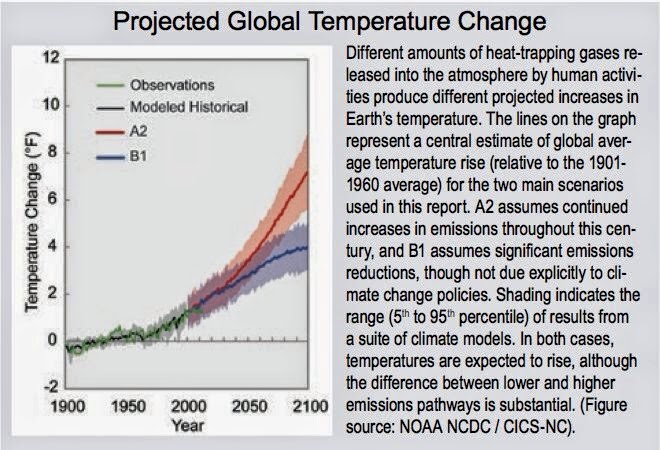
Both scenarios — business as usual and drastic curtailment — produce a temperature and climate regime that would likely be lethal for modern civilization, if not the human race. In the Cancun round of the Committee of Parties in 2010, United Nations high level negotiators produced a general agreement — over the opposition of the USA, Canada, Saudi Arabia, Australia, Israel and other obstructionists — that “recognizing that climate change represents an urgent and potentially irreversible threat to human societies and the planet,” 2°C was the “line in the sand” beyond which global temperatures should not be allowed to climb. In the latest three rounds— Durban, Doha and Warsaw — there has been a strong push from the science and civil sectors to reduce the target to 1.5°C to avert potentially unmanageable risks of tipping points from which no recovery would be possible. Since Warsaw last December some of these points — the inexorable slippage of ice in Antarctica and the release of methane from permafrost to name two — have tipped.

The NCA3 study is saying, essentially, we are in dangerous territory whether we stop emissions tomorrow or not. Summer temperatures in the U.S. have been rising on average 0.4 degrees F per decade since 1970, or about 0.2 C. Average summertime temperature increase has been 1°C overall, but the Southwest and West regions have borne the brunt of those increases, and temperatures have risen an average of 0.4°C, with a few localized areas warming as much as 0.6°C per decade. This is 5 times faster than the Earth as a whole warmed in the 20thcentury. North America, which lags other parts of the planet, is now in an exponential curve of accelerating change

“There are a number of findings in this report that sound an alarm bell signaling the need for action to combat the threats from climate change. For instance, the amount of rain coming down in heavy downpours and deluges across the U.S. is increasing; there’s an increase that’s already occurring in heat waves across the middle of the U.S.; and there are serious observed impacts of sea-level rise occurring in low-lying cities such as Miami, where, during high tides, certain parts of the city flood and seawater seeps up through storm drains. These are phenomena that are already having direct adverse impacts on human well-being in different parts of this country.”

Studies such as these help us gaze into the uncertain future and ask if it is really what we want for our children. Most of us don’t. A few of us actually try to do something to change it. For the rest, the lag time is comforting. The complexity of non-linear feedback systems gives us an excuse to procrastinate. More

Drought in Syria: a Major Cause of the Civil War?

Syria's devastating civil war that began in March 2011 has killed over 200,000 people, displaced at least 4.5 million, and created 3 million refugees.

Figure 1. The highest level of drought,
“Exceptional”, was affecting much of
Western Syria in April 2014, as measured
by the one-year Standardized Precipitation
Index (SPI).
Image credit: NOAA's Global Drought Portal

While the causes of the war are complex, a key contributing factor was the nation's devastating 2006 – 2011 drought, one of the worst in the nation's history, according to new research accepted for publication in the journal Weather, Climate, and Society by water resources expert Dr. Peter Gleick of the Pacific Institute. The drought brought the Fertile Crescent's lowest 4-year rainfall amounts since 1940, and Syria's most severe set of crop failures in recorded history. The worst drought-affected regions were eastern Syria, northern Iraq, and Iran, the major grain-growing areas of the northern Fertile Crescent. In a press release that accompanied the release of the new paper, Dr. Gleick said that as a result of the drought, “the decrease in water availability, water mismanagement, agricultural failures, and related economic deterioration contributed to population dislocations and the migration of rural communities to nearby cities. These factors further contributed to urban unemployment, economic dislocations, food insecurity for more than a million people, and subsequent social unrest.”

More

Solar is here

Solar is here.

That’s right. You know the solutions to the climate crisis are available today; we simply need the public (and political) will to implement them. Clean energy is urgently necessary, abundant, and becoming increasingly more affordable. That’s why on June 21, The Climate Reality Project is joining 12 other organizations in a day of action to support clean-energy solutions and show our commitment to bringing solar power to communities around the world.

If you don’t already have plans to take part on Saturday, don’t despair! Here are a few last minute ways to get involved:

  1. Sign: Send President Obama an email thanking him for putting solar panels on the roof of the White House.
  2. Share: Take your own #PutSolarOnIt photo and share it with your social media network.
  3. Discover: Check out the Mosaic website to find out if solar is right for you.
  4. Participate: Check out OFA’s website to find an event near you, some of which are being hosted by your fellow Climate Reality Leaders.

The reality is this: solar is affordable. It’s clean. And it’s powerful. The cost of solar panels has plummeted 60 percent since early 2011, and the number of installations keeps growing. The United States now has enough installed solar capacity to power more than 2.2 million homes. In several states, solar power is now competitive with other sources of energy without emitting the dangerous greenhouse gases that cause climate change.

Climate Reality Leaders are the first responders to the climate crisis and lead action across the globe. We’re proud so many of you will be participating on Saturday by hosting presentations, organizing events, and informing others about the benefits of solar power.

The Climate Reality Leadership Corps Team

Solar Array at Caledonian Bank, George Town, Cayman Islands