‘There Will Be No Water’ by 2040? Researchers Urge Global Energy Paradigm Shift

The world risks an “insurmountable” water crisis by 2040 without an immediate and significant overhaul of energy consumption and demand, a research team reported on Wednesday.

“There will be no water by 2040 if we keep doing what we're doing today,” said Professor Benjamin Sovacool of Denmark's Aarhus University, who co-authored two reports on the world's rapidly decreasing sources of freshwater.

Many troubling global trends could worsen these baseline projected shortages. According to the report, water resources around the world are “increasingly strained by economic development, population growth, and climate change.” The World Resources Institute estimates that in India, “water demand will outstrip supply by as much as 50 percent by 2030, a situation worsened further by the country's likely decline of available freshwater due to climate change,” the report states. “[P]ower demand could more than double in northern China, more than triple in India, and increase by almost three-quarters in Texas.”

“If we keep doing business as usual, we are facing an insurmountable water shortage — even if water was free, because it's not a matter of the price,” Sovacool said. “There's no time to waste. We need to act now.”

In addition to an expanding global population, economic development, and an increasing demand for energy, the report also finds that the generation of electricity is one of the biggest sources of water consumption throughout the world, using up more water than even the agricultural industry. Unlike less water-intensive alternative sources of energy like wind and solar systems, fossil fuel-powered and nuclear plants need enormous and continued water inputs to function, both for fueling thermal generators and cooling cycles.

The reports, Capturing Synergies Between Water Conservation and Carbon Dioxide Emissions in the Power Sectorand A Clash of Competing Necessities: Water Adequacy and Electric Reliability in China, India, France, and Texas and published after three years of research by Aarhus University, Vermont Law School and CNA Corporation, show that most power plants do not even log how much water they use to keep the systems going.

“It's a huge problem that the electricity sector do not even realize how much water they actually consume,” Sovacool said. “And together with the fact that we do not have unlimited water resources, it could lead to a serious crisis if nobody acts on it soon.”

Unless water use is drastically minimized, the researchers found that widespread drought will affect between 30 and 40 percent of the planet by 2020, and another two decades after that will see a severe water shortage that would affect the entire planet. The demand for both energy and drinking water would combine to aggressively speed up drought, which in turn could exacerbate large-scale health risks and other global development problems.

“The policy and technology choices made to meet demand will have immense implications for water withdrawals and consumption, and may also have significant economic, human health, and development consequences,” the report states.

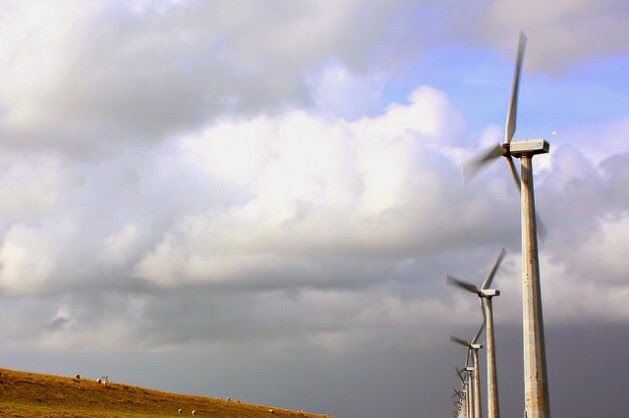
The research says that utilizing alternative energy sources like wind and solar systems is vital to mitigating water consumption enough to stave off the crisis. “Unsubsidized wind power costs… are currently lower than coal or nuclear and they are continuing to drop,” the report states. When faced with its worst drought in 2011, Texas got up to 18 of its electricity from wind power and was able to avoid the kind of rolling blackouts that plague parts of China, where existing water shortages prevent power plants from operating.

An equally important step would be to shutter “thirsty” fossil fuel facilities in areas that are already experiencing water shortages, like China and India, where carbon emissions can be significantly more impactful.

“[We] have to decide where we spend our water in the future,” Sovacool said. “Do we want to spend it on keeping the power plants going or as drinking water? We don't have enough water to do both.” More


The Sunswift eVe solar-powered car broke a 26-year-old land speed record for electric vehicles

The Sunswift eVe solar-powered car broke a 26-year-old land speed record for electric vehicles on Wednesday at the Australian Automotive Research Center in Victoria. While the record still has to be ratified by the Fédération Internationale de l’Automobile, it would make eVe the fastest electric car to ever compete a 500 km set distance course by a significant margin, Gizmodo reported. The previous record, set in 1988, was an average speed of 73 kilometers per hour; the Sunswift eVe reached 100 km per hour average over the 500 km course.

Sunswift eVe, designed and built by students at the University of New South Wales, seeks to overcome the traditional obstacles that have impeded solar-powered cars, namely, offering both speed and range in the same vehicle.

“There are many solar cars out there with a long range, and many other solar cars capable of even higher speeds,” Rob Ireland, business team leader at Sunswift, told International Business Times. “However, we’re trying to do something ground-breaking and overcome both.”

The zero-emission solar and battery storage electric vehicle is capable of covering 800 km on a single charge and has a top speed of 140 km per hour (87 miles per hour). The car’s solar panels have an 800-watt output and when the sun isn’t shining, eVe relies on its battery pack, reducing drivers’ range anxiety. The car’s motor, “supplied by Australian national science agency CSIRO, operates at 97 percent efficiency, meaning eVe consumes as much power as a kitchen toaster,” according to IB Times.

For Wednesday’s record attempt, the solar panels on the roof and hood were used to charge the battery, but were covered for the actual run, as the attempt had to be completed on a single charge.

While the Sunswift eVe is not fully road legal, the team believes that isn’t far out of reach, telling Renew Economy they hope to have the vehicle on Australian roads within the year as “a symbol for a new era of sustainable driving.” And Ireland said the practicality of the two-seat, four-wheel car is unmatched among solar-powered vehicles.

In the run-up to their attempt at the land speed record, project director and third-year engineering student Hayden Smith explained to Renew Economy why it was so significant. “Five hundred kilometers is pretty much as far as a normal person would want to drive in a single day,” Smith said. “It’s another demonstration that one day you could be driving our car.” More


Water Resources Fact Sheet – Earth Policy Institute

JULY 30, 2014 Water scarcity may be the most underrated resource issue the world is facing today.

Seventy percent of world fresh water use is for irrigation.

Each day we drink nearly 4 liters of water, but it takes some 2,000 liters of water—500 times as much—to produce the food we consume.

1,000 tons of water is used to produce 1 ton of grain.

Between 1950 and 2000, the world’s irrigated area tripled to roughly 700 million acres. After several decades of rapid increase, however, the growth has slowed dramatically, expanding only 9 percent from 2000 to 2009. Given that governments are much more likely to report increases than decreases, the recent net growth may be even smaller.

The dramatic loss of momentum in irrigation expansion coupled with the depletion of underground water resources suggests that peak water may now be on our doorstep.

Today some 18 countries, containing half the world’s people, are overpumping their aquifers. Among these are the big three grain producers—China, India, and the United States.

Saudi Arabia is the first country to publicly predict how aquifer depletion will reduce its grain harvest. It will soon be totally dependent on imports from the world market or overseas farming projects for its grain.

While falling water tables are largely hidden, rivers that run dry or are reduced to a trickle before reaching the sea are highly visible. Among this group that has limited outflow during at least part of the year are the Colorado, the major river in the southwestern United States; the Yellow, the largest river in northern China; the Nile, the lifeline of Egypt; the Indus, which supplies most of Pakistan’s irrigation water; and the Ganges in India’s densely populated Gangetic basin.

Many smaller rivers and lakes have disappeared entirely as water demands have increased.

Overseas “land grabs” for farming are also water grabs. Among the prime targets for overseas land acquisitions are Ethiopia and the Sudans, which together occupy three-fourths of the Nile River Basin, adding to the competition with Egypt for the river’s water.

It is often said that future wars will more likely be fought over water than oil, but in reality the competition for water is taking place in world grain markets. The countries that are financially the strongest, not necessarily those that are militarily the strongest, will fare best in this competition.

Climate change is hydrological change. Higher global average temperatures will mean more droughts in some areas, more flooding in others, and less predictability overall.

Data and additional resources available at www.earth-policy.org

Research Contact: Janet Larsen (202) 496-9290 ex. 14 or jlarsen (at) earth-policy.org

Water Resources Fact Sheet
JULY 30, 2014

Water scarcity may be the most underrated resource issue the world is facing today.

Seventy percent of world fresh water use is for irrigation.

Each day we drink nearly 4 liters of water, but it takes some 2,000 liters of water—500 times as much—to produce the food we consume.

1,000 tons of water is used to produce 1 ton of grain.

Between 1950 and 2000, the world’s irrigated area tripled to roughly 700 million acres. After several decades of rapid increase, however, the growth has slowed dramatically, expanding only 9 percent from 2000 to 2009. Given that governments are much more likely to report increases than decreases, the recent net growth may be even smaller.

The dramatic loss of momentum in irrigation expansion coupled with the depletion of underground water resources suggests that peak water may now be on our doorstep.

Today some 18 countries, containing half the world’s people, are overpumping their aquifers. Among these are the big three grain producers—China, India, and the United States.

Saudi Arabia is the first country to publicly predict how aquifer depletion will reduce its grain harvest. It will soon be totally dependent on imports from the world market or overseas farming projects for its grain.

While falling water tables are largely hidden, rivers that run dry or are reduced to a trickle before reaching the sea are highly visible. Among this group that has limited outflow during at least part of the year are the Colorado, the major river in the southwestern United States; the Yellow, the largest river in northern China; the Nile, the lifeline of Egypt; the Indus, which supplies most of Pakistan’s irrigation water; and the Ganges in India’s densely populated Gangetic basin.

Many smaller rivers and lakes have disappeared entirely as water demands have increased.

Overseas “land grabs” for farming are also water grabs. Among the prime targets for overseas land acquisitions are Ethiopia and the Sudans, which together occupy three-fourths of the Nile River Basin, adding to the competition with Egypt for the river’s water.

It is often said that future wars will more likely be fought over water than oil, but in reality the competition for water is taking place in world grain markets. The countries that are financially the strongest, not necessarily those that are militarily the strongest, will fare best in this competition.

Climate change is hydrological change. Higher global average temperatures will mean more droughts in some areas, more flooding in others, and less predictability overall.

(PDF version)

Data and additional resources available at www.earth-policy.org
Research Contact: Janet Larsen (202) 496-9290 ex. 14 or jlarsen (at) earth-policy.org


Climate Criminality’: Australia OKs Biggest Coal Mine

In a decision criticized as “climate criminality,” Australia's federal government announced Monday that it has given the OK to the country's biggest coal mine.

The announcement comes less than three months after the state of Queensland gave its approval to the project.

“With this decision,” wrote Ben Pearson, head of programs for Greenpeace Australia Pacific, “the political system failed to protect the Great Barrier Reef, the global climate and our national interest.”

“Off the back of repealing effective action on climate change,” stated Australian Greens environment spokesperson Senator Larissa Waters, referring to the scrapping of the carbon tax, “the Abbott Government has ticked off on a proposal for Australia’s biggest coal mine to cook the planet and turn our Reef into a super highway for coal ships.”

Adani Mining expects its Carmichael Coal Mine and Rail Project in Queensland's Galilee Basin to produce up to 60 million tonnes of coal a year, most of which will be sent to India. A rail line will be created from the mine to a new coal port terminal, an expansion which means up to 3 million meters of dredging waste will be dumped in the area of the World Heritage-listed Reef.

UNESCO “noted with concern” (pdf) in April the prospect of additional dredging that would negatively impact the Reef and warned that the site could be added to the List of World Heritage in Danger.

The approval for the Carmichael project came from Federal Environment Minister Greg Hunt with “36 strict conditions”—conditions that did nothing to allay the environmental fears raised by critics.

Felicity Wishart, Great Barrier Reef Campaign Manager for the Australian Marine Conservation Society, stated that the conditions would be “laughable, if they weren’t so serious.”

Wishart also accused the Queensland and federal government of “watering down environmental protections and fast-tracking approvals for new ports and LNG plants on the Great Barrier Reef.”

“The Federal government has fast-tracked industrialization along the Reef because it is too close to the mining industry,” she stated.

Pearson also admonished the close ties, saying in a statement, “The Federal Environment Minister has laid out the red carpet for a coal company with a shocking track record to dig up the outback, dump on the Great Barrier Reef and fuel climate change.”

Amongst Greenpeace's list of why the project shouldn't go ahead is that

[t]he mine would steal precious water. The mine requires 12 gigaliters (12 billion liters) of water each year from local rivers and underground aquifers. That’s enough drinking water for every Queenslander for three years. Even ten kilometers away, water tables are expected to drop by over one meter.

In addition to the dangers of dredging up the sea-bed, the list adds:

The burning of coal from Carmichael mine would produce four times the fossil fuel emissions of New Zealand. It is a catastrophe for the climate.

“History will look back on the Abbott Government’s decision today as an act of climate criminality,” Waters stated. More


Greenpeace Australia Pacific created this infographic to highlight what the group sees as risks the Carmichael mine poses:


Major Companies Push for More, Easier Renewable Energy

Some of the largest companies in the United States have banded together to call for a substantial increase in the production of renewable electricity, as well as for more simplicity in purchasing large blocs of green energy.

A dozen U.S-based companies, most of which operate globally, say they want to significantly step up the amount of renewable energy they use, but warn that production levels remain too low and procurement remains too complex. The 12 companies have now put forward a set of principles aimed at helping to “facilitate progress on these challenges” and lead to a broader shift in the market.

“We would like our efforts to result in new renewable power generation,” the Corporate Renewable Energy Buyers’ Principles, released Friday, state. The companies note “our desire to promote new projects, ensure our purchases add new capacity to the system, and that we buy the most cost-competitive renewable energy products.”

The principles consist of six broad reforms, aimed at broadening and strengthening the renewable energy marketplace. Companies want more choice in their procurement options, greater cost competitiveness between renewable and traditional power sources, and “simplified processes, contracts and financing” around the long-term purchase of renewables.

Founding signatories to the principles, which were shepherded by civil society, include manufacturers and consumer goods companies (General Motors, Johnson & Johnson, Mars, Proctor & Gamble), tech giants (Facebook, HP, Intel, Sprint) and major retailers (Walmart, the outdoor-goods store REI).

These 12 companies combined have renewable energy consumption targets of more than eight million megawatt hours of energy through the end of this decade, according to organisers. Yet the new principles, meant to guide policy discussions, have come about due to frustration over the inability of the U.S. renewables market to keep up with spiking demand.

“The problem these companies are seeing is that they’re paying too much, even though they know that cost-effective renewable energy is available. These companies are used to having choices,” Marty Spitzer, director of U.S. climate policy at the World Wildlife Fund (WWF), a conservation and advocacy group that helped to spearhead the principles, told IPS.

WWF was joined in the initiative by the World Resources Institute and the Rocky Mountain Institute, both think tanks that focus on issues of energy and sustainability.

“The companies have also recognised that it’s often very difficult to procure renewables and bring them to their facilities,” Spitzer continues. “While most of them didn’t think of it this way at first, they’ve now realised that they have been experiencing a lot of the same problems.”

‘Too difficult’

In recent years, nearly two-thirds of big U.S. businesses have created explicit policies around climate goals and renewable energy usage, according to WWF. While there is increasing political and public compunction behind these new policies, a primary goal remains simple cost-cutting and long-term efficiencies.

“A significant part of the value to us from renewable energy is the ability to lock in energy price certainty and avoid fuel price volatility,” the principles note.

In part due to political deadlock in Washington, particularly around issues of climate and energy, renewable production in the United States remains too low to keep up with this corporate demand. According to the U.S. government, only around 13 percent of domestic energy production last year was from renewable sources.

Accessing even that small portion of the market remains unwieldy.

“We know cost-competitive renewable energy exists but the problem is that it is way too difficult for most companies to buy,” Amy Hargroves, director of corporate responsibility and sustainability for Sprint, a telecommunications company, said in a statement.

“Very few companies have the knowledge and resources to purchase renewable energy given today’s very limited and complex options. Our hope is that by identifying the commonalities among large buyers, the principles will catalyse market changes that will help make renewables more affordable and accessible for all companies.”

One of the most far-reaching sustainability commitments has come from the world’s largest retailer, Walmart. A decade ago, the company set an “aspirational” goal for itself, to be supplied completely by renewable energy.

Last year, it created a more specific goal aimed at helping to grow the global market for renewables, pledging to drive the production or procurement of seven billion kilowatt hours of renewable energy globally by the end of 2020, a sixfold increase over 2010. (The company is also working to increase the energy efficiency of its stores by 20 percent over this timeframe.)

While the company has since become a leader in terms of installing solar and wind projects at its stores and properties, it has experienced frustrations in trying to make long-term bulk purchases of renewable electricity from U.S. utilities.

“The way we finance is important … cost-competitiveness is very important, as is access to longer-term contracts,” David Ozment, senior director of energy at Walmart, told IPS. “We like to use power-purchase agreements to finance our renewable energy projects, but currently only around half of the states in the U.S. allow for these arrangements.”

Given Walmart’s size and scale, Ozment says the company is regularly asked by suppliers, regulators and utilities about what it is looking for in power procurement. The new principles, he says, offer a strong answer, providing direction as well as flexibility for whatever compulsion is driving a particular company’s energy choices, whether “efficiency, conservation or greenhouse gas impact”.

“We’ve seen the price of solar drop dramatically over the past five years, and we hope our participation helped in that,” he says. “Now, these new principles will hopefully create the scale to continue to drop the cost of renewables and make them more affordable for everyone.”

Internationally applicable

Ozment is also clear that the new principles need not apply only to U.S. operations, noting that the principles “dovetail” with what Walmart is already doing internationally.

In an e-mail, a representative for Intel, the computer chip manufacturer, likewise told IPS that the company is “interested in promoting renewables markets in countries where we have significant operations … at a high level, the need to make renewables both more abundant and easier to access applies outside the U.S.”

For his part, WWF’s Spitzer says that just one of the principles is specific to the U.S. regulatory context.

“Many other countries have their own instruments on renewable production,” he says, “but five out of these six principles are relevant and perfectly appropriate internationally.”

Meanwhile, both the principles and their signatories remain open-ended. Spitzer says that just since Friday he’s heard from additional companies interested in adding their support. More


The Unity of Water

MOSCOW – In May, Vietnam became the 35th and decisive signatory of the 1997 United Nations Convention on the Law of the Non-Navigational Uses of International Watercourses. As a result, 90 days later, on August 17, the convention will enter into force.

The fact that it took almost 50 years to draft and finally achieve the necessary ratification threshold demonstrates that something is very wrong with the modern system of multilateralism. Regardless of longstanding disagreements over how cross-border freshwater resources should be allocated and managed, and understandable preferences by governments and water professionals to rely on basin agreements rather than on international legal instruments, that half-century wait can be explained only by a lack of political leadership. So, though the world may celebrate the convention’s long-awaited adoption, we cannot rest on our laurels.

Roughly 60% of all freshwater runs within cross-border basins; only an estimated 40% of those basins, however, are governed by some sort of basin agreement. In an increasingly water-stressed world, shared water resources are becoming an instrument of power, fostering competition within and between countries. The struggle for water is heightening political tensions and exacerbating impacts on ecosystems.

But the really bad news is that water consumption is growing faster than population – indeed, in the twentieth century it grew at twice the rate. As a result, several UN agencies forecast that, by 2025, 1.8 billion people will be living in regions stricken with absolute water scarcity, implying a lack of access to adequate quantities for human and environmental uses. Moreover, two-thirds of the world’s population will face water-stress conditions, meaning a scarcity of renewable freshwater.

Without resolute counter-measures, demand for water will overstretch many societies’ adaptive capacities. This could result in massive migration, economic stagnation, destabilization, and violence, posing a new threat to national and international security.

The UN Watercourses Convention must not become just another ignored international agreement, filed away in a drawer. The stakes are too high. In today’s context of climate change, rising demand, population growth, increasing pollution, and overexploited resources, everything must be done to consolidate the legal framework for managing the world’s watersheds. Our environmental security, economic development, and political stability directly depend on it.

The convention will soon apply to all of the cross-border rivers of its signatories’ territories, not just the biggest basins. It will complement the gaps and shortcomings of existing agreements and provide legal coverage to the numerous cross-border rivers that are under increasing pressure.

Worldwide, there are 276 cross-border freshwater basins and about as many cross-border aquifers. Backed by adequate financing, political will, and the engagement of stakeholders, the convention can help address the water challenges that we are all facing. But will it?

An ambitious agenda should be adopted now, at a time when the international community is negotiating the contents of the Sustainable Development Goals (SDGs), the successor to the UN Millennium Development Goals, which will expire in 2015. We at Green Cross hope that the new goals, which are to be achieved by 2030, will include a stand-alone target that addresses water-resources management.

Moreover, the international community will soon have to agree on a climate-change framework to replace the Kyoto Protocol. Climate change directly affects the hydrological cycle, which means that all of the efforts that are undertaken to contain greenhouse-gas emissions will help to stabilize rainfall patterns and mitigate the extreme water events that so many regions are already experiencing.

But the UN Watercourses Convention’s entry into force raises as many new questions as existed in the period before its ratification. What will its implementation mean in practice? How will countries apply its mandates within their borders and in relation to riparian neighbors? How will the American and Asian countries that have largely ignored ratification respond?

Furthermore, how will the convention relate to the Convention on the Protection and Use of Transboundary Watercourses and International Lakes, which is already in force in most European and Central Asian countries and, since February 2013, has aimed to open its membership to the rest of the world? Similarly, how will the convention’s implementation affect existing regional and local cross-border freshwater agreements?

The countries that ratified the UN Watercourses Convention are expected to engage in its implementation and to go further in their efforts to protect and sustainably use their cross-border waters. What instruments, including financial, will the convention provide to them?

Several legal instruments can be implemented jointly and synergistically: the Ramsar Convention on Wetlands, the UN Convention to Combat Desertification, and the UN Framework Convention on Climate Change, to name just a few. The UN Watercourses Convention’s long-delayed enactment should be viewed as an opportunity for signatory states to encourage those that are not yet party to cooperative agreements to work seriously on these issues.

Clearly, politicians and diplomats alone cannot respond effectively to the challenges that the world faces. What the world needs is the engagement of political, business, and civil-society leaders; effective implementation of the UN Watercourses Convention is impossible without it.

This is too often overlooked, but it constitutes the key to the long-term success of cooperation that generates benefits for all. Inclusive participation by stakeholders (including the affected communities), and the development of the capacity to identify, value, and share the benefits of cross-border water resources, should be an integral part of any strategy to achieve effective multilateral collaboration. More


IEA says ‘peak oil demand’ could hit as early as 2020

Little more that a year after the International Energy Agency added its voice to the chorus chiming that peak oil was dead, a new report from the uconservative adviser to industrialised nations suggests it has changed its tune. Only this time it is not peak supply that is on its radar, but peak demand.

The IEA’s Medium-Term Oil Market Report 2014 has predicted that global growth in oil demand may start to slow down as soon as the end of this decade, due to environmental concerns and cheaper alternatives, and despite boosting its 2014 forecast of global demand by 960,000 barrels per day.

While supply is forecast to remain strong – thanks largely to the unconventional, or “tight” oil revolution currently underway in north America – the IEA says it expects the global market to hit an “inflexion point”, by the end of 2019, “after which demand growth may start to decelerate due to high oil prices, environmental concerns and cheaper fuel alternatives.”

These factors, says the report, will lead to fuel-switching away from oil, as well as overall fuel savings. In short, it says, “while ‘peak demand’ for oil – other than in mature economies – may still be years away, and while there are regional differences, peak oil demand growth for the market as a whole is already in sight.”

It’s worrying news for the over-invested and under-prepared; not least of all oil importing nations, to which, as Samuel Alexander noted in this article last September, the economic costs of peak oil are especially significant.

“When oil gets expensive, everything dependent on oil gets more expensive: transport, mechanised labour, industrial food production, plastics, etc,” he wrote. “This pricing dynamic sucks discretionary expenditure and investment away from the rest of the economy, causing debt defaults, economic stagnation, recessions, or even longer-term depressions. That seems to be what we are seeing around the world today, with the risk of worse things to come.”

This then adds to the peak oil cycle, increasing governments’ motivation to decarbonise their economies – better late than never – “not only because oil has become painfully expensive, but also because the oil we are burning is environmentally unaffordable.”

This view has been echoed in numerous recent reports. US investment banks Sanford Bernstein raised the prospect of “energy price deflation”, caused by the plunging cost of solar and the taking up of market share by that technology as it displaced diesel, gas and oil in various economies. It predicted that could trigger a massive shift in capital.

Analyst Mark Fulton last month also questioned the wisdom of the private-sector investing over $1 trillion to develop new sources of high-cost oil production. While Mark Lewis, of French broking firm, suggested that $US19 trillion in revenuescould be lost from the oil industry if the world takes action to address climate change, cleans up pollution and moves to decarbonise the global energy system.

The IEA report also includes an updated forecast of product supply, which draws out the consequences of the shifts in demand, feedstock supply and refining capacity.

“Given planned refinery construction and the growth in supply that bypasses the refining sector, such as NGLs and biofuels, the refining industry faces a new cycle of weak margins and a glut of light distillates like gasoline and naphtha as a by-product of needed diesel and jet fuel,” it says.

It also predicts that “the unconventional supply revolution that has redrawn the global oil map” will expand beyond North America before the end of the decade, just as OPEC supplies face headwinds, and regional imbalances in gasoline and diesel markets broaden.

The report projects that by 2019, tight oil supply outside the United States could reach 650 000 barrels per day (650 kb/d), including 390 kb/d from Canada, 100 kb/d from Russia and 90 kb/d from Argentina. US LTO output is forecast to roughly double from 2013 levels to 5.0 million barrels per day (mb/d) by 2019.

“We are continuing to see unprecedented production growth from North America, and the United States in particular. By the end of the decade, North America will have the capacity to become a net exporter of oil liquids,” IEA Executive Director Maria van der Hoeven said as she launched the report in Paris. “At the same time, while OPEC remains a vital supplier to the market, it faces significant headwinds in expanding capacity.”

Beyond ageing fields, the major hurdle facing OPEC producers is the escalation in “above-ground woes,” as security concerns become a growing issue in producers like Iraq, and investment risks deter investment and exploration.

The report notes that as much as three-fifths of OPEC’s expected growth in capacity by 2019 is set to come from Iraq. The projected addition of 1.28 mb/d to Iraqi production by 2019, a conservative forecast made before the launch last week of a military campaign by insurgents that subsequently claimed several key cities in northern and central Iraq, faces considerable downside risk. More


Besieged by the rising tides of climate change, Kiribati buys land in Fiji

The people of Kiribati, a group of islands in the Pacific ocean particularly exposed to climate change, now own a possible refuge elsewhere. President Anote Tong has recently finalised the purchase of 20 sq km on Vanua Levu, one of the Fijiislands, about 2,000km away.

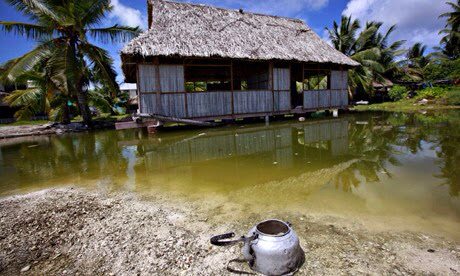
Abandoned house affected by sea water

The Church of England has sold a stretch of land mainly covered by dense forest for $8.77m. “We would hope not to put everyone on [this] one piece of land, but if it became absolutely necessary, yes, we could do it,” Tong told the Associated Press. Kiribati has a population of about 110,000 scattered over 33 small, low-lying islands extending over a total area of 3.5m sq km.

In 2009 the Maldives were the first to raise the possibility of purchasing land in another country in anticipation of being gradually submerged. At the time the government looked at options in India and Sri Lanka.

Now Kiribati has taken action. “Kiribati is just the first on a list which could get longer as time passes,” says Ronald Jumeau, Seychelles ambassador at the United Nations, who took part in the international negotiations on climate change in Bonn last month.

In March the Intergovernmental Panel on Climate Change published the volume on adaptation of its fifth assessment report, confirming in starker terms forecasts first outlined by scientists in 1990. Within a few decades, small islands in the Pacific and Indian oceans risk being extensively or even completely submerged. In places the sea level is rising by 1.2cm a year, four times faster than the global average.

The cost of protecting these places against rising sea levels, compared with national income, is among the highest in the world. Kiribati, Tuvalu and the Maldives are among the 10 countries where the financial impact of climate change is the most severe.

For many of these countries, which are represented by the Alliance of Small Island States, the impacts of climate change are “irreparable”, as Tong has often stressed. “Whatever is agreed within the United States today, with China [the two largest sources of CO2 emissions], it will not have a bearing on our future, because already, it's too late for us … And so we are the canary. But hopefully, that experience will send a very strong message that we might be on the frontline today, but others will be on the frontline next,” he said in an interview on CNN last month. This explains why small island states think it is so important to set up an international mechanism for loss and damage, to compensate for the irremediable consequences of global warming.

The international community approved the principle of such a mechanism in November 2013. “When a population is forced to leave its country, it is no longer a matter of adaptation,” Jumeau claims. “Where will these countries find funds? It is up to the industrialised countries, which caused global warming, to shoulder their responsibilities.” He wants to make the loss and damage mechanism a priority for the global deal on climate change slated to be signed in Paris in December 2015.

In the immediate future, the land purchased by Kiribati will above all be used to for agricultural and fish-farming projects to guarantee the nation's food security. With sea water increasingly contaminating the atolls' groundwater and catastrophic coral bleaching – total in some cases such as Phoenix atoll – there are growing food shortages. “Among the small islands, Kiribati is the country that has done most to anticipate its population's future needs,” says François Gemenne, a specialist on migrations at Versailles-Saint Quentin University, France. “The government has launched the 'migration with dignity' policy to allow people to apply for jobs on offer in neighbouring countries such as New Zealand. The aim is to avoid one day having to cope with a humanitarian evacuation.”

Kiribati has long-standing relations with Fiji. In the 1950s families from Banaba island, who had been displaced to make room for a phosphate mine, took refuge there, Gemenne recalls. More


China Experiment in Permaculture Offers World Hope

China is the most populous and possibly one of the most diverse nations on the planet, with a population of over 1.3 billion people and 56 ethnic groups.

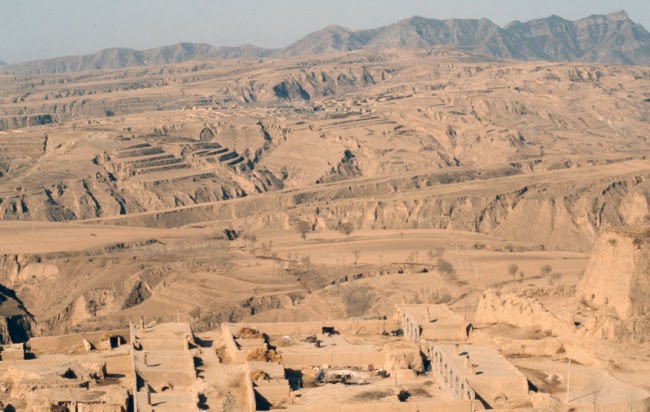
What each one of those people shares with the rest of the world, regardless of political, linguistic, economic, and existential differences, is the complete and utter dependence on the ability to find food. In China’s Loess Plateau, sustained generational farming had depleted the soil, leaving in its wake a textured landscape of dust. When winds came, the dust blew into cities, compromising air quality. In the rains, it washed down the valley, depositing more of the silt that gives the Yellow River its name. In 1995, scientists and engineers surveyed the land of the Loess Plateau in an attempt to determine what was causing the once fertile belt to be a thorn in the country’s. The results of their study led to an experiment in permaculture in China that offers hope to the world.

John D. Liu, Chinese American ecologist and documentary film-maker, documented the project in an award-winning film called Hope in a Changing Climate. In the film that Liu narrates, he reports that the first thing that the scientists discovered was a causal relationship between ecosystem destruction and human poverty. Where environmental degradation is severe, the population becomes trapped in a downward spiral. Because they needed to eat to survive, generational subsistence farming had stripped the land bare in the Loess Plateau. In search of food for themselves and their flocks, farmers and their families continued to deplete the fertility of the surrounding ecosystem, further impoverishing themselves.

When scientists developed the plan to restore the ecosystem in China’s Loess Plateau, generational farmers had to be convinced that not farming was critical for their families’ long-term survival. To get buy in from the locals who did not understand how their families would eat if they were not allowed to farm, the government subsidized them and taught them how to do the work that would restore their land from a scarce dirt pit to a thriving ecosystem.

Around the world, populations are living a scarce subsistence lifestyle similar to the one that the citizens of China’s Loess Plateau used to live. The United Nations High Commissioner for Refugees (UNHCR) states that besides fleeing for personal safety, the basic need for food and shelter is the primary motivation for people leaving their homes and becoming displaced. If there were a stable food supply and supportive ecosystem, then the motivation for the world’s most vulnerable populations to move, would decrease. The UNHCR reports that competition for scarce resources triggers violence. If there were a way to restore resources so that people had food and a sense of power in their lives, the fuel for much of the world’s violence would be spent.

The permaculture experiment in China indeed offers hope to the world. Working with scientists, the local population terraced slopes, they planted trees, and they penned their herds so that the trees could grow without being eaten. Soon they found that their hillsides were green. Instead of letting the rains sheet off the mountains, the terraces collected the water and fed the delicate new roots systems, transforming the arid land into a booming garden. Liu reports that since he first visited the area in 1995, the people have seen a threefold increase in income and a profound sense of hope and empowerment. More


Ukraine shows uselessness of NATO nukes in Europe

Many people in Germany, Belgium, and the Netherlands wonder why there are still US tactical nuclear weapons on their soil. These B-61 nuclear gravity bombs were stationed in Europe during the Cold War to deter the Soviet threat, but while this may (or may not) have once made sense, most pundits nowadays agree that at least from a military point of view, the weapons are irrelevant. More

Editorial

Given the tremendous damage the we humans have already done to the Earth, our home planet, the use of nuclear weapons in a conflict would be beyond insane.

We have already gone a long way to poisoning our atmosphere, making our oceans, one of the major sources of food, so acidic that we may be at a tipping point that will wipe out the shellfish and crustaceans that compose a large part of the ocean food chain. Fish stocks are in many areas depleted leading the FAO to suggest banning commercial fishing in some areas of some oceans.

We also have to face global heating which may bring with it changing rainfall patterns, which may lead to water and food shortages. Many inhabitants of our world are already living on barely enough food and water to keep them alive. Furthermore, the planetary population is growing and heading for nine billion by mid-century. Experts are questioning whether or not we will be able to feed this many.

We have to keep in mind that we have only this small fragile planet. A planet in a backwater of our local galaxy. There are no inhabitable worlds to go to nor the transport to get there on. If we do not take care and preserve our world, which will take a global effort to accomplish, the human race may perish. Think of your children and family members,your friends and colleagues If we use nuclear weapons all will certainly perish.

Chernobyl and Fukushima and all the nuclear testing carried out by the UN's P5 have spread more than enough nuclear pollution through the planet. A nuclear conflict would seal our fate.

Pope Francis said recently, “Even today we raise our hand against our brother… We have perfected our weapons, our conscience has fallen asleep, and we have sharpened our ideas to justify ourselves as if it were normal we continue to sow destruction, pain, death. Violence and war lead only to death”.

As H.H. 14th Dalai Lama said, “Peace does not mean an absence of conflicts; differences will always be there. Peace means solving these differences through peaceful means; through dialogue, education, knowledge; and through humane ways.” Editor