DIARIES: LIVE FROM PALESTINE “A clumsy army beating Palestinians into submission”: TIME correspondent’s Nablus diary from 1990

An excerpt from the unpublished memoirs of the former TIME journalist Murray J. Gart describing the occupied West Bank city of Nablus at the height of the first intifada, or uprising, could have been written today.

Murray J. Gart interviews Yasser
Arafat on a plane en route to
Baghdad on 25 October 1988

Closure under the pretext of “security,” tear gas and lethal fire against unarmed protesters was what Gart observed in the city in 1990.

Gart’s granddaughter, Brooke DeNisco, says of her grandfather that “the Middle East was his passion and he spent years living and traveling there.”

When he retired from TIME, the publication with which he spent most of his career, Gart “began working on a book about the Middle East peace process, but died in 2004 before its completion. I inherited some of the notes and drafts for the book, including a narrative of five weeks he spent living in the West Bank,” DeNisco explains.

“My grandfather was proudly Jewish and enjoyed traveling often to Israel,” she adds. “He voted for Ronald Reagan and was a member of George Bush Sr.’s Council on Foreign Affairs.”

The following “is a small excerpt from his pages of notes about his experiences in Nablus, forty miles north of Jerusalem in the occupied West Bank,” DeNisco told The Electronic Intifada. “He wrote on the manuscript that this is a draft and had not been thoroughly fact-checked.”

The excerpt from Murray J. Gart’s memoirs follows.

Nablus, occupied West Bank, 1990

Though I was there only five weeks, it was long enough for a good look at Nablus life.

I had to remind myself of the baggage I carried, limitations of culture, sense of history, background and language. But, after twenty years of visits to Israel, I was also aware that my experiences and preparations for the trip, including long interviews for TIME with Ariel Sharon and Yasser Arafat would help to shield me from being unfair.

I had tried to reach Nablus the previous year but was turned away by Israeli soldiers who said the city was a closed “security zone.” An invitation to consult at An-Najah National University got me into the West Bank’s most active cultural and political center. But when I arrived, the university’s campus was as closed as a tomb and prohibited from opening or operating.

By the end of the week I became accustomed to bursts of Israeli gunfire, exploding gas and other disturbing noises of daily urban warfare.

Distracted

One of my first mornings in Nablus I was distracted by heavy gunfire. When I leaned out my open first-floor window, I saw fires in my street at the corner of a walled schoolyard, teenage boys running and teachers shouting.

The yard filled with smoke, driving students into the school directly opposite my window. I could see cannisters landing, exploding and spewing out more smoke. In seconds, the gas got my face and forced me to fall back and grope my way blindly to the bathroom for a wet towel. When I was able to look out the window again, perhaps ten minutes later, there wasn’t a person in sight outdoors. Later the ashes and rubble were cleaned up. The job was done by Palestinians rousted from passing cars and made to do it by soldiers pointing guns.

The Israelis had turned the most vital center of Palestinian life into something resembling a vast, maximum security prison. That at least, was how it felt from the inside.

Armed troops did all the work of police, tightly controlled every life in the city and dispensed summary justice. They guarded entry and exit roads like prison gates and enforced Israel’s iron-fist occupation rules, which in practice meant repressive martial-law measures like collective punishment and preventive detention.

They used force to suppress the slightest hint of civil resistance, and responded to nonviolent protest with the force of lethal arms. To conceal these conditions to the world, the city was almost always a “closed military zone” which barred entry by the press, diplomats, clergy and anyone else the army chose to keep out.

There was no one to witness the real conditions of the Nablus lockup. Twenty-four hours a day every day of their lives, residents saw soldiers, as I did, close by on foot and in vehicles keeping relentless house-to-house pressure on every neighborhood. They broke into private homes, mosques and even hospital operating rooms, leaving a tornado-like aftermath.

A lot of residents have died. Doctors in Nablus said the number of wounded or dead was probably ten to twenty times more than reported. Injuries from beatings and stonings, illnesses made worse by gas, including the loss of human fetuses ran into the thousands.

Dozens of Nabulsis were dragged off daily for interrogations, beatings, jailing or imprisonment, without trial, for terms that can last years. On walks or from my window, it was common to see people carted off in military vehicles. A command car drove past me with two feet in white sneakers sticking out the rear. Inside, the prisoner’s face was being smashed into the floor by an Israeli soldier’s boot.

No safety

In Nablus I met old and young people, activists, businessmen, doctors, writers, lawyers and students. Not one of them felt safe or secure anywhere in town, and I came to understand why. Thousands of violent incidents, few of them ever reported, had touched the life of every person in town.

They stated their views respectfully, but asked me heated questions about American policy. The bitterness they felt toward the US for supporting Israel against the Palestinians poured out. They saw the American-Israeli alliance as hostile and directed against them.

A tall fellow about twenty put it this way: “Americans send bullets and gas for Israelis to shoot at us. Why do you hate us too?” When asked, I stated frankly the unwelcome opinion that the US will not, as Palestinians I met almost universally hope it will, punish Israel if it does not leave the West Bank and Gaza.

My biggest discovery was that there was no big discoveries to be made about the conflict beyond its awesome scope and pervasiveness, and the degree to which Israel had come to rely on brute force dealt out by a clumsy army to beat Palestinians into submission.

I saw what I already knew, but somehow had refused to believe could be happening in the same Jewish state meant to shelter an oppressed people. It was why the Palestinians in lands Israel rules under martial law so passionately oppose occupation, why they hate Israelis and why they feel so strongly that their struggle must continue, whatever the cost. They do believe they have little left to lose. Murray J. Gart, 1990 More


The Historical Perspective of the 2014 Gaza Massacre

August 23, 2014ICH” – “PIPR” – – People in Gaza and elsewhere in Palestine feel disappointed at the lack of any significant international reaction to the carnage and destruction the Israeli assault has so far left behind it in the Strip.

The inability, or unwillingness, to act seems to be first and foremost an acceptance of the Israeli narrative and argumentation for the crisis in Gaza. Israel has developed a very clear narrative about the present carnage in Gaza.

It is a tragedy caused by an unprovoked Hamas missile attack on the Jewish State, to which Israel had to react in self-defence. While mainstream western media, academia and politicians may have reservations about the proportionality of the force used by Israel, they accept the gist of this argument. This Israeli narrative is totally rejected in the world of cyber activism and alternative media. There it seems the condemnation of the Israeli action as a war crime is widespread and consensual.

The main difference between the two analyses from above and from below is the willingness of activists to study deeper and in a more profound way the ideological and historical context of the present Israeli action in Gaza. This tendency should be enhanced even further and this piece is just a modest attempt to contribute towards this direction.

Ad Hoc Slaughter?

An historical evaluation and contextualization of the present Israeli assault on Gaza and that of the previous three ones since 2006 expose clearly the Israeli genocidal policy there. An incremental policy of massive killing that is less a product of a callous intention as it is the inevitable outcome of Israel’s overall strategy towards Palestine in general and the areas it occupied in 1967, in particular.

This context should be insisted upon, since the Israeli propaganda machine attempts again and again to narrate its policies as out of context and turns the pretext it found for every new wave of destruction into the main justification for another spree of indiscriminate slaughter in the killing fields of Palestine.

The Israeli strategy of branding its brutal policies as an ad hoc response to this or that Palestinian action is as old as the Zionist presence in Palestine itself. It was used repeatedly as a justification for implementing the Zionist vision of a future Palestine that has in it very few, if any, native Palestinians. The means for achieving this goal changed with the years, but the formula has remained the same: whatever the Zionist vision of a Jewish State might be, it can only materialize without any significant number of Palestinians in it. And nowadays the vision is of an Israel stretching over almost the whole of historic Palestine where millions of Palestinians still live.

This vision ran into trouble once territorial greed led Israel to try and keep the West Bank and the Gaza Strip within its rule and control ever since June 1967. Israel searched for a way to keep the territories it occupied that year without incorporating their population into its rights-bearing citizenry. All the while it participated in a ‘peace process’ charade to cover up or buy time for its unilateral colonization policies on the ground.

With the decades, Israel differentiated between areas it wished to control directly and those it would manage indirectly, with the aim in the long run of downsizing the Palestinian population to a minimum with, among other means, ethnic cleansing and economic and geographic strangulation. Thus the West Bank was in effect divided into a ‘Jewish’ and a ‘Palestinian’ zones – a reality most Israelis can live with provided the Palestinian Bantustans are content with their incarceration within these mega prisons. The geopolitical location of the West Bank creates the impression in Israel, at least, that it is possible to achieve this without anticipating a third uprising or too much international condemnation.

The Gaza Strip, due to its unique geopolitical location, did not lend itself that easily to such a strategy. Ever since 1994, and even more so when Ariel Sharon came to power as prime minister in the early 2000s, the strategy there was to ghettoize Gaza and somehow hope that the people there — 1.8 million as of today — would be dropped into eternal oblivion.

But the Ghetto proved to be rebellious and unwilling to live under conditions of strangulation, isolation, starvation and economic collapse. There was no way it would be annexed to Egypt, neither in 1948 nor in 2014. In 1948, Israel pushed into the Gaza area (before it became a strip) hundreds of thousands of refugees it expelled from the northern Naqab and southern coast who, so they hoped, would move even farther away from Palestine.

For a while after 1967, it wanted to keep as a township which provided unskilled labour but without any human and civil rights. When the occupied people resisted the continued oppression in two intifadas, the West Bank was bisected into small Bantustans encircled by Jewish colonies, but it did not work in the too small and too dense Gaza Strip. The Israelis were unable to ‘West Bank’ the Strip, so to speak. So they cordoned it as a Ghetto and when it resisted the army was allowed to use its most formidable and lethal weapons to crash it. The inevitable result of an accumulative reaction of this kind was genocidal.

Incremental Genocide

The killing of three Israeli teenagers, two of them minors, abducted in the occupied West Bank in June, which was mainly a reprisal for killings of Palestinian children in May, provided the pretext first and foremost for destroying the delicate unity Hamas and Fatah have formed in that month. A unity that followed a decision by the Palestinian Authority to forsake the ‘peace process’ and appeal to international organizations to judge Israel according to a human and civil rights’ yardstick. Both developments were viewed as alarming in Israel.

The pretext determined the timing – but the viciousness of the assault was the outcome of Israel’s inability to formulate a clear policy towards the Strip it created in 1948. The only clear feature of that policy is the deep conviction that wiping out the Hamas from the Gaza Strip would domicile the Ghetto there.

Since 1994, even before the rise of Hamas to power in the Gaza Strip, the very particular geopolitical location of the Strip made it clear that any collective punitive action, such as the one inflicted now, could only be an operation of massive killings and destruction. In other words: an incremental genocide.

This recognition never inhibited the generals who give the orders to bomb the people from the air, the sea and the ground. Downsizing the number of Palestinians all over historic Palestine is still the Zionist vision; an ideal that requires the dehumanisation of the Palestinians. In Gaza, this attitude and vision takes its most inhuman form.

The particular timing of this wave is determined, as in the past, by additional considerations. The domestic social unrest of 2011 is still simmering and for a while there was a public demand to cut military expenditures and move money from the inflated ‘defence’ budget to social services. The army branded this possibility as suicidal. There is nothing like a military operation to stifle any voices calling on the government to cut its military expenses.

Typical hallmarks of the previous stages in this incremental genocide reappear in this wave as well. As in the first operation against Gaza, ‘First Rains’ in 2006, and those which followed in 2009, ‘Cast Lead’, and 2012, ‘Pillar of Smoke’, one can witness again consensual Israeli Jewish support for the massacre of civilians in the Gaza Strip, without one significant voice of dissent. The Academia, as always, becomes part of the machinery. Various universities offered the state its student bodies to help and battle for the Israeli narrative in the cyberspace and alternative media.

The Israeli media, as well, toed loyally the government’s line, showing no pictures of the human catastrophe Israel has wreaked and informing its public that this time, ‘the world understands us and is behind us’. That statement is valid to a point as the political elites in the West continue to provide the old immunity to the Jewish state. The recent appeal by Western governments to the prosecutor in the international court of Justice in The Hague not to look into Israel’s crimes in Gaza is a case in point. Wide sections of the Western media followed suit and justified by and large Israel’s actions.

This distorted coverage is also fed by a sense among Western journalist that what happens in Gaza pales in comparison to the atrocities in Iraq and Syria. Comparisons like this are usually provided without a wider historical perspective. A longer view on the history of the Palestinians would be a much more appropriate way to evaluate their suffering vis-à-vis the carnage elsewhere.

Conclusion: Confronting Double-Standards

But not only historical view is needed for a better understanding of the massacre in Gaza. A dialectical approach that identifies the connection between Israel’s immunity and the horrific developments elsewhere is required as well. The dehumanization in Iraq and Syria is widespread and terrifying, as it is in Gaza. But there is one crucial difference between these cases and the Israeli brutality: the former are condemned as barbarous and inhuman worldwide, while those committed by Israel are still publicly licensed and approved by the president of the United States, the leaders of the EU and Israel’s other friends in the world.

The only chance for a successful struggle against Zionism in Palestine is the one based on a human and civil rights agenda that does not differentiate between one violation and the other and yet identifies clearly the victim and the victimizers. Those who commit atrocities in the Arab world against oppressed minorities and helpless communities, as well as the Israelis who commit these crimes against the Palestinian people, should all be judged by the same moral and ethical standards. They are all war criminals, though in the case of Palestine they have been at work longer than anyone else. It does not really matter what the religious identity is of the people who commit the atrocities or in the name of which religion they purport to speak. Whether they call themselves jihadists, Judaists or Zionists, they should be treated in the same way. More


We Are Above the Law Declares County Attorney

August 20, 2014 “ICH” – Habersham County, Georgia, the jurisdiction that allowed intentionally or through negligence a SWAT team to break into a home with violent force in the middle of the night and throw a stun grenade into a baby’s face sending him to a hospital for weeks where he was in life support, has ruled that it would be illegal for the county to pay the baby’s medical bills. http://www.wsbtv.com/news/news/local/lawyer-county-refuses-pay-medical-bills-toddler-hu/ng3s9/

The negligence of the police, and thereby the county, is a triple dose. It was the wrong house. A SWAT team was unnecessary in order to exercise a search warrant for a drug suspect. There was no excuse for throwing a stun grenade into a baby’s crib.

But the county attorney has ruled that the county is not liable for these massive incidences of unbridled negligence.

However, the unjustifiable SWAT team assault on the family in the home was legal.

As the saying goes, “a fish rots from the head.” The rot in government accountability that began in Washington has now reached the local level. More

Dr. Paul Craig Roberts was Assistant Secretary of the Treasury for Economic Policy and associate editor of the Wall Street Journal. He was columnist for Business Week, Scripps Howard News Service, and Creators Syndicate. He has had many university appointments. His internet columns have attracted a worldwide following. Roberts' latest books are The Failure of Laissez Faire Capitalism and Economic Dissolution of the West and How America Was Lost.


Beware, fellow plutocrats, the pitchforks are coming

Nick Hanauer: Beware, fellow plutocrats, the pitchforks are coming

Published on Aug 12, 2014 • Nick Hanauer is a rich guy, an unrepentant capitalist — and he has something to say to his fellow plutocrats: Wake up! Growing inequality is about to push our societies into conditions resembling prerevolutionary France. Hear his argument about why a dramatic increase in minimum wage could grow the middle class, deliver economic prosperity … and prevent a revolution.

TEDTalks is a daily video podcast of the best talks and performances from the TED Conference, where the world's leading thinkers and doers give the talk of their lives in 18 minutes (or less). Look for talks on Technology, Entertainment and Design – plus science, business, global issues, the arts and much more.

Find closed captions and translated subtitles in many languages at http://www.ted.com/translate

Follow TED news on Twitter: http://www.twitter.com/tednews

Like TED on Facebook: https ://www.facebook.com/TE D

Subscribe to our channel: http://www.youtube.com/user/TEDtalksDirector

A Movement Grows in Ferguson

Is the Ferguson Movement the begining of a Nationwide Movement driven by Racism and Economic Disparity?

In the eight days since Michael Brown, an eighteen-year-old, was killed by a police officer named Darren Wilson in Ferguson, Missouri, what began as an impromptu vigil evolved into a sustained protest; it is now beginning to look like a movement. The local QuikTrip, a gas station and convenience store that was looted and burned on the second night of the protests, has now been repurposed as the epicenter for gatherings and the exchange of information. The front of the lot bears an improvised graffiti sign identifying the area as the “QT People’s Park.” With the exception of a few stretches, such as Thursday afternoon, when it was veiled in clouds of tear gas, protesters have been a constant presence in the lot. On Sunday afternoon the area was populated by members of local churches, black fraternity and sorority groups, Amnesty International, the Outcast Motorcycle Club, and twenty or so white supporters from the surrounding area. On the north side of the station, a group of volunteers with a mobile grill served free hot dogs and water, and a man stood on a crate, handing out bright yellow T-shirts with the logo of the National Action Network, the group led by Al Sharpton.

The conversation here has shifted from the immediate reaction to Michael Brown’s death and toward the underlying social dynamics. Two men I spoke with pointed to the disparity in education funding for Ferguson and more affluent municipalities nearby. Another talked about being pulled over by an officer who claimed to smell marijuana in the car as a pretense for searching him. “I’m in the United States Navy,” he told me. “We have to take drug tests in the military so I had proof that there were no drugs in my system. But other people can’t do that.” Six black men I spoke to, nearly consecutively, pointed to Missouri’s felon-disfranchisement laws as part of the equation. “If you’re a student in one of the black schools here and you get into a fight you’ll probably get arrested and charged with assault. We have kids here who are barred from voting before they’re even old enough to register,” one said. Ferguson’s elected officials did not look much different than they had years earlier, when it was a largely white community.

Ferguson had, instead, recently seen two highly visible African-American public officials lose their jobs. Two weeks before Brown was shot, Charles Dooley, an African-American who has served as St. Louis County Executive for a decade, lost a bitter primary election to Steve Stenger, a white county councilman, in a race that, whatever the merits of the candidates, was seen as racially divisive. Stenger lobbed allegations of financial mismanagement and incompetence, and worse. Bob McCulloch, the county prosecutor appeared in an ad for Stenger, associating Dooley with corruption; McCulloch would also be responsible for determining whether to charge Darren Wilson. In December, the largely white Ferguson-Florissant school board fired Art McCoy, the superintendent, who is African-American. Those who were gathered at the QuikTrip parking lot on Saturday were as inclined to talk about the underlying political issues as they were about the hail of bullets that ended Brown’s life.

When word came that afternoon that the governor had announced a curfew, to take effect at midnight, the mood shifted to defiance and disbelief. Few thought that the curfew would do much practical good; many thought it was counterproductive, a move back to militarized police response earlier in the week. Curfew or no, the protesters felt that, with the exception of last Thursday, when Captain Ron Johnson of the Missouri State Highway Patrol, a black Ferguson native, took charge of operations, the amalgam of county and local law enforcement rolling through Ferguson had tried to clear the streets each day at dusk.

On Johnson’s first night in charge, the police presence in the neighborhood was hardly visible; officers withdrew to the perimeter and removed a roadblock that had cut off Florissant Road, which runs just south of the QuikTrip. The protests that night had a giddy quality. Cars drove up and down the strip, the sounds of honking horns accompanying shouts of Brown’s name and “Hands Up, Don’t Shoot,” which has emerged as the signature slogan here.

But as early as Friday morning people began to wonder if Johnson really was in charge, in any meaningful way. Ferguson Police Chief Thomas Jackson began the day by releasing Officer Wilson’s name, which had been kept from the public until then. He undercut that gesture by simultaneously releasing a video that appeared to show Brown menacing a local store owner soon before his encounter with Wilson—thus suggesting that Wilson had been pursuing Brown as a suspect. It took a few hours, and a second press conference, for Jackson to acknowledge that Wilson hadn’t stopped Brown because he thought he was a robber but because Brown was walking in the street and not, as Wilson believed he should, on the sidewalk.

Ron Johnson had to concede that he had not even known that the video would be released; he saw it on television just as everyone else had. (“I would like to have been consulted,” he said at his own press conference.) After sporadic looting on Saturday night—halted largely by other protestors who rushed to protect the establishments being vandalized—Governor Jay Nixon declared a curfew, further undercutting Johnson’s authority. In the span of twenty-four hours, Johnson had gone, in the community’s eyes, from empowered native son to black token. One of the local activists I’d met in Feguson sent me a text message after the curfew announcement saying, “Johnson has good intentions but no power. This is beyond him.”On Sunday, Johnson stepped into the pulpit at Greater Grace Church, the site of a rally, and apologized to Brown’s family, saying, “I wear this uniform and I feel like that needs to be said.” With that, he implicitly condemned the Ferguson Police Department for their failure to do so. Johnson had promised not to use tear gas in the streets of Ferguson but, during a skirmish with looters on Saturday night, police tear-gassed the crowd. Johnson’s address at the church carried the message that his allegiances were, nonetheless, with the people of Ferguson. James Baldwin remarked that black leaders chronically find themselves in a position of asking white people to hurry up while pleading with black people to wait. Johnson finds himself asking black people to remain calm while imploring white police officers not to shoot. The problem here is that few people in Ferguson believe that the former is any guarantee of the latter.

Brown remains unburied. His family, whose faith evaporated early on, refused to simply trust the autopsy performed by local authorities and held out for a second post mortem, by federal authorities. Attorney Eric Holder granted that request late Sunday morning. It might produce a definitive answer to some of the basic questions—like how many times Brown was shot, and whether any of the bullets hit him in the back—that, a week later, remain murky. From the outset, the overlapping bureaucracies in Ferguson handled the case in ways that suggested ineptitude. Yet subsequent developments—the stonewalling followed by contradictory statements, the detention of reporters, the clumsy deployment of sophisticated military equipment—all point not to a department too inept to handle this investigation objectively but one too inept to cloak the fact that they never intended to do so. One protestor held a sign that said, “Ferguson Police Need Better Scriptwriters.” More


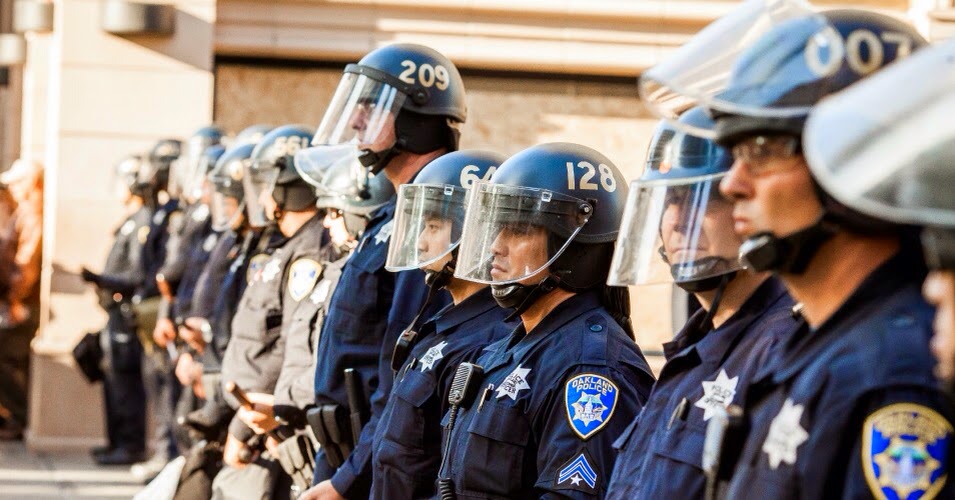
In an article by Alex Kane entitled 11 Eye-Opening Facts About America’s Militarized Police Forces the author writing in AlterNet states; The “war on terror” has come home — and it’s wreaking havoc on innocent American lives. The culprit is the militarization of the police.

The weapons that destroyed Afghanistan and Iraq have made their way to local law enforcement. While police forces across the country began a process of militarization — complete with SWAT teams and flash-bang grenades — when President Reagan intensified the “war on drugs,” the post-9/11 “war on terror” has added fuel to the fire.

Through laws and regulations like a provision in defense budgets that authorizes the Pentagon to transfer surplus military gear to police forces, local law enforcement agencies are using weapons found on the battlefields of South Asia and the Middle East.

A recent New York Times article by Matt Apuzzo reported that in the Obama era, “police departments have received tens of thousands of machine guns; nearly 200,000 ammunition magazines; thousands of pieces of camouflage and night-vision equipment; and hundreds of silencers, armored cars and aircraft.” The result is that police agencies around the nation possess military-grade equipment, turning officers who are supposed to fight crime and protect communities into what looks like an invading army. And military-style police raids have increased in recent years, with one count putting the number at 80,000 such raids last year.

In June, the American Civil Liberties Union (ACLU) brought more attention to police militarization when it issued a comprehensive, nearly 100-page report titled, War Comes Home: The Excessive Militarization of American Policing. Based on public records requests to more than 260 law enforcement agencies in 26 states, the ACLU concluded that this police militarization “unfairly impacts people of color and undermines individual liberties, and it has been allowed to happen in the absence of any meaningful public discussion.”

The information contained in the ACLU report — and in other investigations into the phenomenon — is sobering. From the killing of innocent people to the almost complete lack of debate on these policies, police militarization has turned into a key issue for Americans. It is harming civil liberties, ramping up the “war on drugs,” impacting the most marginalized members of society and transforming neighborhoods into war zones. Here are 11 important — and horrifying — things you should know about the militarization of police. More

One has to question the reason for militatising the police departments in the United States and where this is leading? Is the government expecting insurrection or invasion? Are their citizens now enemies of the state? Editor


Hague court under western pressure not to open Gaza war crimes inquiry

The international criminal court has persistently avoided opening an investigation into alleged war crimesin Gaza as a result of US and other western pressure, former court officials and lawyers claim.

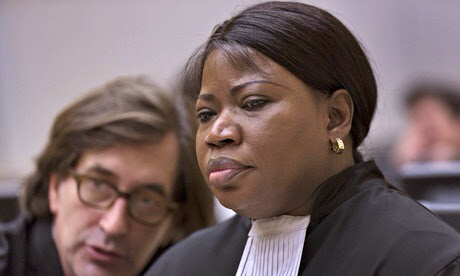
Fatou Bensouda, the international criminal court prosecutor

In recent days, a potential ICC investigation into the actions of both the Israel Defence Forces and Hamas in Gaza has become a fraught political battlefield and a key negotiating issue at ceasefire talks in Cairo. But the question of whether the ICC could or should mount an investigation has also divided the Hague-based court itself.

An ICC investigation could have a far-reaching impact. It would not just examine alleged war crimes by the Israeli military, Hamas and other Islamist militants in the course of recent fighting in Gaza that left about 2,000 people dead, including women and children. It could also address the issue of Israeli settlements in the Palestinian territories, for which the Israeli leadership would be responsible.

The ICC’s founding charter, the 1998 Rome statute (pdf), describes as a war crime “the transfer, directly or indirectly, by the occupying power of parts of its own civilian population into the territory it occupies”.

Also at stake is the future of the ICC itself, an experiment in international justice that occupies a fragile position with no superpower backing. Russia, China and India have refused to sign up to it. The US and Israel signed the accord in 2000 but later withdrew.

Some international lawyers argue that by trying to duck an investigation, the ICC is not living up to the ideals expressed in the Rome statute that “the most serious crimes of concern to the international community as a whole must not go unpunished”.

John Dugard, a professor of international law at the University of Leiden, in the Netherlands, and a longstanding critic of Israel’s human rights record, said: “I think the prosecutor could easily exercise jurisdiction. Law is a choice. There are competing legal arguments, but she should look at the preamble to the ICC statute which says the purpose of the court is to prevent impunity.”

In an exchange of letters in the last few days, lawyers for the Palestinians have insisted that the ICC prosecutor, Fatou Bensouda, has all the legal authority she needs to launch an investigation, based on a Palestinian request in 2009. However, Bensouda is insisting on a new Palestinian declaration, which would require achieving elusive consensus among political factions such as Hamas, who would face scrutiny themselves alongside the Israeli government. There is strong US and Israeli pressure on the Palestinian leader, Mahmoud Abbas, not to pursue an ICC investigation.

Western pressure on the ICC to stay away from the issue has caused deep rifts within the prosecutor’s office. Some former officials say the Palestinians were misled in 2009 into thinking their request for a war crimes investigation – in the wake of an earlier Israeli offensive on Gaza, named Cast Lead – would remain open pending confirmation of statehood. That confirmation came in November 2012 when the UN general assembly (UNGA) voted to award Palestine the status of non-member observer state, but no investigation was launched.

Bensouda initially appeared open to reviewing the standing Palestinian request, but the following year issued a controversial statement (pdf) saying the UNGA vote made no difference to the “legal invalidity” of the 2009 request.

Luis Moreno Ocampo, who was prosecutor at the time of the Palestinian 2009 declaration, backed Bensouda, saying in an email to the Guardian: “If Palestine wants to accept jurisdiction, it has to submit a new declaration.”

But another former official from the ICC prosecutor’s office who dealt with the Palestinian declaration strongly disagreed. “They are trying to hiding behind legal jargon to disguise what is a political decision, to rule out competence and not get involved,” the official said.

Dugard said Bensouda was under heavy pressure from the US and its European allies. “For her it’s a hard choice and she’s not prepared to make it,” he argued. “But this affects the credibility of the ICC. Africans complain that she doesn’t hesitate to open an investigation on their continent.”

Moreno Ocampo took three years to make a decision on the status of the 2009 Palestinian request for an investigation, during which time he was lobbied by the US and Israel to keep away. According to a book on the ICC published this year, American officials warned the prosecutor that the future of the court was in the balance.

According to the book, Rough Justice: the International Criminal Court in a World of Power Politics, by David Bosco, the Americans suggested that a Palestine investigation “might be too much political weight for the institution to bear. They made clear that proceeding with the case would be a major blow to the institution.”

Although the US does not provide funding for the ICC, “Washington’s enormous diplomatic, economic and military power can be a huge boon for the court when it periodically deployed in support of the court’s work,” writes Bosco, an assistant professor of international politics at American University.

In his book, Bosco reports that Israeli officials held several unpublicised meetings with Moreno Ocampo in The Hague, including a dinner at the Israeli ambassador’s residence, to lobby against an investigation.

A former ICC official who was involved in the Palestinian dossier said: “It was clear from the beginning that Moreno Ocampo did not want to get involved. He said that the Palestinians were not really willing to launch the investigation, but it was clear they were serious. They sent a delegation with two ministers and supporting lawyers in August 2010 who stayed for two days to discuss their request. But Moreno Ocampo was aware that any involvement would spoil his efforts to get closer to the US.”

Moreno Ocampo denied that he had been influenced by US pressure. “I was very firm on treating this issue impartially, but at the same time respecting the legal limits,” he said in an email on Sunday. “I heard all the arguments. I received different Oxford professors who were explaining the different and many times opposing arguments, and I concluded that the process should … go first to the UN. They should decide what entity should be considered a state.”

He added: “Palestine was using the threat to accept jurisdiction to negotiate with Israel. Someone said that if you have nine enemies surrounding you and one bullet, you don’t shoot, you try to use your bullet to create leverage.”

A spokeswoman for his successor, Fatou Bensouda, rejected allegations of bias in the prosecutor’s choice of investigations. “The ICC is guided by the Rome statute and nothing else,” she said. “Strict rules about jurisdiction, about where and when ICC can intervene should be not be deliberately misrepresented … Geographical and political consideration will thus never form part of any decision making by the office.”

The French lawyer representing the Palestinians, Gilles Devers, argued that it was for the court’s preliminary chamber, not the ICC’s prosecutor, to decide on the court’s jurisdiction in the Palestinian territories. Devers said negotiations were continuing among the Palestinian parties on whether to file a new request for an investigation, even though he believed it to be unnecessary in legal terms. Ultimately, he said, the outcome would be determinedly politically.

“There is enormous pressure not to proceed with an investigation. This pressure has been exerted on Fatah and Hamas, but also on the office of the prosecutor,” Devers said. “In both cases, it takes the form of threats to the financial subsidies, to Palestine and to the international criminal court.”

Among the biggest contributors to the ICC budget are the UK and France, which have both sought to persuade the Palestinians to forego a war crimes investigation. More


76 Year old Najiba Mansoor an Assyirian IDP displaced by the war with ISIS


ERBIL IRAQ KURDISTAN: 76 Year old Najiba Mansoor an Assyirian displaced by the war with ISIS and Peshmaga fighters sleeps on her makeshift bed in an abandoned construction site in the Iraqi Kurdish capital Erbil. I showed Najiba this image on the back of my camera and she burst into tears

“Is that all I have left now a filthy mattress and my broken wheel chair, no no no how did this happen”

Image Copyright: Sebastian Rich / AII rights reserved


To Terrify and Occupy

Jason Westcott was afraid. One night last fall, he discovered via Facebook that a friend of a friend was planning with some co-conspirators to break in to his home. They were intent on stealing Wescott’s handgun and a couple of TV sets. According to the Facebook message, the suspect was planning on “burning” Westcott, who promptly called the Tampa Bay police and reported the plot.

According to the Tampa Bay Times, the investigating officers responding to Westcott’s call had a simple message for him: “If anyone breaks into this house, grab your gun and shoot to kill.”

Around 7:30 pm on May 27th, the intruders arrived. Westcott followed the officers’ advice, grabbed his gun to defend his home, and died pointing it at the intruders. They used a semiautomatic shotgun and handgun to shoot down the 29-year-old motorcycle mechanic. He was hit three times, once in the arm and twice in his side, and pronounced dead upon arrival at the hospital.

The intruders, however, weren’t small-time crooks looking to make a small score. Rather they were members of the Tampa Bay Police Department’s SWAT team, which was executing a search warrant on suspicion that Westcott and his partner were marijuana dealers. They had been tipped off by a confidential informant, whom they drove to Westcott’s home four times between February and May to purchase small amounts of marijuana, at $20-$60 a pop. The informer notified police that he saw two handguns in the home, which was why the Tampa Bay police deployed a SWAT team to execute the search warrant.

In the end, the same police department that told Westcott to protect his home with defensive force killed him when he did. After searching his small rental, the cops indeed found weed, two dollars’ worth, and one legal handgun — the one he was clutching when the bullets ripped into him.

Welcome to a new era of American policing, where cops increasingly see themselves as soldiers occupying enemy territory, often with the help of Uncle Sam’s armory, and where even nonviolent crimes are met with overwhelming force and brutality.

The War on Your Doorstep

The cancer of militarized policing has long been metastasizing in the body politic. It has been growing ever stronger since the first Special Weapons and Tactics (SWAT) teams were born in the 1960s in response to that decade’s turbulent mix of riots, disturbances, and senseless violence like Charles Whitman’s infamous clock-tower rampage in Austin, Texas.

Every year now, there are approximately 50,000 SWAT raids in the United States

While SWAT isn’t the only indicator that the militarization of American policing is increasing, it is the most recognizable. The proliferation of SWAT teams across the country and their paramilitary tactics have spread a violent form of policing designed for the extraordinary but in these years made ordinary. When the concept of SWAT arose out of the Philadelphia and Los Angeles Police Departments, it was quickly picked up by big city police officials nationwide. Initially, however, it was an elite force reserved for uniquely dangerous incidents, such as active shooters, hostage situations, or large-scale disturbances.

Nearly a half-century later, that’s no longer true.

In 1984, according to Radley Balko’s Rise of the Warrior Cop, about 26% of towns with populations between 25,000 and 50,000 had SWAT teams. By 2005, that number had soared to 80% and it’s still rising, though SWAT statistics are notoriously hard to come by.

As the number of SWAT teams has grown nationwide, so have the raids. Every year now, there are approximately 50,000 SWAT raids in the United States, according to Professor Pete Kraska of Eastern Kentucky University’s School of Justice Studies. In other words, roughly 137 times a day a SWAT team assaults a home and plunges its inhabitants and the surrounding community into terror.

Upping the Racial Profiling Ante

In a recently released report, “War Comes Home,” the American Civil Liberties Union (my employer) discovered that nearly 80% of all SWAT raids it reviewed between 2011 and 2012 were deployed to execute a search warrant.

Pause here a moment and consider that these violent home invasions are routinely used against people who are only suspected of a crime. Up-armored paramilitary teams now regularly bash down doors in search of evidence of a possible crime. In other words, police departments increasingly choose a tactic that often results in injury and property damage as its first option, not the one of last resort. In more than 60% of the raids the ACLU investigated, SWAT members rammed down doors in search of possible drugs, not to save a hostage, respond to a barricade situation, or neutralize an active shooter.

On the other side of that broken-down door, more often than not, are blacks and Latinos. When the ACLU could identify the race of the person or people whose home was being broken into, 68% of the SWAT raids against minorities were for the purpose of executing a warrant in search of drugs. When it came to whites, that figure dropped to 38%, despite the well-known fact that blacks, whites, and Latinos all use drugs at roughly the same rates. SWAT teams, it seems, have a disturbing record of disproportionately applying their specialized skill set within communities of color.

Think of this as racial profiling on steroids in which the humiliation of stop and frisk is raised to a terrifying new level.

Everyday Militarization

Don’t think, however, that the military mentality and equipment associated with SWAT operations are confined to those elite units. Increasingly, they’re permeating all forms of policing.

As Karl Bickel, a senior policy analyst with the Justice Department’s Community Policing Services office, observes, police across America are being trained in a way that emphasizes force and aggression. He notes that recruit training favors a stress-based regimen that’s modeled on military boot camp rather than on the more relaxed academic setting a minority of police departments still employ. The result, he suggests, is young officers who believe policing is about kicking ass rather than working with the community to make neighborhoods safer. Or as comedian Bill Maher reminded officers recently: “The words on your car, ‘protect and serve,’ refer to us, not you.”

This authoritarian streak runs counter to the core philosophy that supposedly dominates twenty-first-century American thinking: community policing. Its emphasis is on a mission of “keeping the peace” by creating and maintaining partnerships of trust with and in the communities served. Under the community model, which happens to be the official policing philosophy of the U.S. government, officers are protectors but also problem solvers who are supposed to care, first and foremost, about how their communities see them. They don’t command respect, the theory goes: they earn it. Fear isn’t supposed to be their currency. Trust is.

Nevertheless, police recruiting videos, as in those from California’s Newport Beach Police Department and New Mexico’s Hobbs Police Department, actively play up not the community angle but militarization as a way of attracting young men with the promise of Army-style adventure and high-tech toys. Policing, according to recruiting videos like these, isn’t about calmly solving problems; it’s about you and your boys breaking down doors in the middle of the night.

SWAT’s influence reaches well beyond that. Take the increasing adoption of battle-dress uniforms (BDUs) for patrol officers. These militaristic, often black, jumpsuits, Bickel fears, make them less approachable and possibly also more aggressive in their interactions with the citizens they’re supposed to protect.

A small project at Johns Hopkins University seemed to bear this out. People were shown pictures of police officers in their traditional uniforms and in BDUs. Respondents, the survey indicated, would much rather have a police officer show up in traditional dress blues. Summarizing its findings, Bickel writes, “The more militaristic look of the BDUs, much like what is seen in news stories of our military in war zones, gives rise to the notion of our police being an occupying force in some inner city neighborhoods, instead of trusted community protectors.”

Where Do They Get Those Wonderful Toys?

“I wonder if I can get in trouble for doing this,” the young man says to his buddy in the passenger seat as they film the Saginaw County Sheriff Office’s new toy: a Mine Resistant Ambush Protected (MRAP) vehicle. As they film the MRAP from behind, their amateur video has a Red Dawn-esque feel, as if an occupying military were now patrolling this Michigan county’s streets. “This is getting ready for f**king crazy times, dude,” one young man comments. “Why,” his friend replies, “has our city gotten that f**king bad?”

In fact, nothing happening in Saginaw County warranted the deployment of an armored vehicle capable of withstanding bullets and the sort of improvised explosive devices that insurgent forces have regularly planted along roads in America’s recent war zones. Sheriff William Federspiel, however, fears the worst. “As sheriff of the county, I have to put ourselves in the best position to protect our citizens and protect our property,” he tolda reporter. “I have to prepare for something disastrous.”

Lucky for Federspiel, his exercise in paranoid disaster preparedness didn’t cost his office a penny. That $425,000 MRAP came as a gift, courtesy of Uncle Sam, from one of our far-flung counterinsurgency wars. The nasty little secret of policing’s militarization is that taxpayers are subsidizing it through programs overseen by the Pentagon, the Department of Homeland Security, and the Justice Department.

Take the 1033 program. The Defense Logistics Agency (DLA) may be an obscure agency within the Department of Defense, but through the 1033 program, which it oversees, it’s one of the core enablers of American policing’s excessive militarization. Beginning in 1990, Congressauthorized the Pentagon to transfer its surplus property free of charge to federal, state, and local police departments to wage the war on drugs. In 1997, Congress expanded the purpose of the program to include counterterrorism in section 1033 of the defense authorization bill. In one single page of a 450-page law, Congress helped sow the seeds of today’s warrior cops.

The amount of military hardware transferred through the program has grown astronomically over the years. In 1990, the Pentagon gave $1 million worth of equipment to U.S. law enforcement. That number had jumped to nearly $450 million in 2013. Overall, the program has shipped off more than $4.3 billion worth of materiel to state and local cops, according to the DLA.

In its recent report, the ACLU found a disturbing range of military gear being transferred to civilian police departments nationwide. Police in North Little Rock, Arkansas, for instance, received 34 automatic and semi-automatic rifles, two robots that can be armed, military helmets, and a Mamba tactical vehicle. Police in Gwinnet County, Georgia, received 57 semi-automatic rifles, mostly M-16s and M-14s. The Utah Highway Patrol, according to a Salt Lake City Tribune investigation, got an MRAP from the 1033 program, and Utah police received 1,230 rifles and four grenade launchers. After South Carolina’s Columbia Police Department received its very own MRAP worth $658,000, its SWAT Commander Captain E.M. Marsh noted that 500 similar vehicles had been distributed to law enforcement organizations across the country. More


How Israel’s lies are used to justify mass slaughter of civilians in Gaza

Israel's lies make it clear to the Palestinians that it will continue to wage a campaign of state terror and will never admit its atrocities or its intentions.


ALL GOVERNMENTS lie, including Israel and Hamas. But Israel engages in the kinds of jaw-dropping lies that characterize despotic and totalitarian regimes.


It does not deform the truth; it inverts it. It routinely paints a picture for the outside world that is diametrically opposed to reality. And all of us reporters who have covered the occupied territories have run into Israel's Alice-in-Wonderland narratives, which we dutifully insert into our stories — required under the rules of American journalism — although we know they are untrue.


I saw small boys baited and killed by Israeli soldiers in the Gaza refugee camp of Khan Younis. The soldiers swore at the boys in Arabic over the loudspeakers of their armored jeep. The boys, about 10 years old, then threw stones at an Israeli vehicle and the soldiers opened fire, killing some, wounding others. I was present more than once as Israeli troops drew out and shot Palestinian children in this way.


Such incidents, in the Israeli lexicon, become children caught in crossfire.


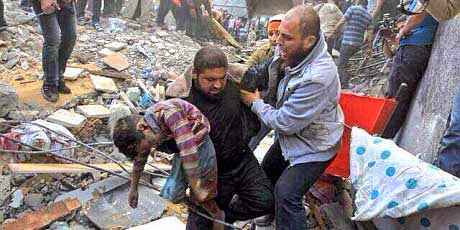
I was in Gaza when F-16 attack jets dropped 1,000-pound iron fragmentation bombs on overcrowded hovels in Gaza City. I saw the corpses of the victims, including children. This became a surgical strike on a bomb-making factory.


I have watched Israel demolish homes and entire apartment blocks to create wide buffer zones between the Palestinians and the Israeli troops that ring Gaza. I have interviewed the destitute and homeless families, some camped out in crude shelters erected in the rubble. The destruction becomes the demolition of the homes of terrorists.


I have stood in the remains of schools — Israel struck two United Nations schools in the last six days, causing at least 10 fatalities at one in Rafah on Sunday and at least 19 at one in the Jebaliya refugee camp Wednesday — as well as medical clinics and mosques. I have heard Israel claim that errant rockets or mortar fire from the Palestinians caused these and other deaths, or that the attacked spots were being used as arms depots or launching sites.


I, along with every other reporter I know who has worked in Gaza, have never seen any evidence that Hamas uses civilians as “human shields.”


There is a perverted logic to Israel's repeated use of the Big Lie — the lie favored by tyrants from Josef Stalin to Saddam Hussein. The Big Lie feeds the two reactions Israel seeks to elicit — racism among its supporters and terror among its victims.


By painting a picture of an army that never attacks civilians, that indeed goes out of its way to protect them, the Big Lie says Israelis are civilized and humane, and their Palestinian opponents are inhuman monsters.


The Big Lie serves the idea that the slaughter in Gaza is a clash of civilizations, a war between democracy, decency and honor on one side and Islamic barbarism on the other. And in the uncommon cases when news of atrocities penetrates to the wider public, Israel blames the destruction and casualties on Hamas.


George Orwell in his novel “Nineteen Eighty-Four” called this form of propaganda doublethink. Doublethink uses “logic against logic” and “repudiate[s] morality while laying claim to it.”


The Big Lie does not allow for the nuances and contradictions that can plague conscience. It is a state-orchestrated response to the dilemma of cognitive dissonance. The Big Lie permits no gray zones. The world is black and white, good and evil, righteous and unrighteous.


The Big Lie allows believers to take comfort — a comfort they are desperately seeking — in their own moral superiority at the very moment they have abrogated all morality.


The Big Lie, as the father of American public relations, Edward Bernays, wrote, is limited only by the propagandist's capacity to fathom and harness the undercurrents of individual and mass psychology. And since most supporters of Israel do not have a desire to know the truth, a truth that would force them to examine their own racism and self-delusions about Zionist and Western moral superiority, like packs of famished dogs they lap up the lies fed to them by the Israeli government.


But the Big Lie is also consciously designed to send a chilling message to Gaza's Palestinians, who have lost large numbers of their dwellings, clinics, mosques, and power, water and sewage facilities, along with schools and hospitals, who have suffered some 1,850 deaths since this assault began — most of the victims women and children — and who have seen 400,000 people displaced from their homes.


The Big Lie makes it clear to the Palestinians that Israel will continue to wage a campaign of state terror and will never admit its atrocities or its intentions. The vast disparity between what Israel says and what Israel does tells the Palestinians that there is no hope. Israel will do and say whatever it wants. International law, like the truth, will always be irrelevant. There will never, the Palestinians understand from the Big Lie, be an acknowledgement of reality by the Israeli leadership.


The Israel Defense Forces website is replete with this black propaganda. “Hamas exploits the IDF's sensitivity towards protecting civilian structures, particularly holy sites, by hiding command centers, weapons caches and tunnel entrances in mosques,” the IDF site reads. “In Hamas' world, hospitals are command centers, ambulances are transport vehicles, and medics are human shields,” the site insists.


“… [Israeli] officers are tasked with an enormous responsibility: to protect Palestinian civilians on the ground, no matter how difficult that may be,” the site assures its viewers. And the IDF site provides this quote from a drone operator identified as Lt. Or. “I have personally seen rockets fired at Israel from hospitals and schools, but we couldn't strike back because of civilians nearby. In one instance, we acquired a target but we saw that there were children in the area. We waited around, and when they didn't leave we were forced to abort a strike on an important target.”


Israel's ambassador to the United States, Ron Dermer, in a Big Lie of his own, said last month at a conference of Christians United for Israel that the Israeli army should be given the “Nobel Peace Prize … a Nobel Peace Prize for fighting with unimaginable restraint.”


The Big Lie destroys any possibility of history and therefore any hope for a dialogue between antagonistic parties that can be grounded in truth and reality.


And when facts no longer matter, when there is no shared history grounded in the truth, when people foolishly believe their own lies, there can be no useful exchange of information.


The Big Lie, used like a bludgeon by Israel, as perhaps it is designed to be, ultimately reduces all problems in the world to the brutish language of violence. And when oppressed people are addressed only through violence they will answer only through violence. More


Time to ask why

Young people have the most to gain from solving the climate crisis — and the sooner the better.

They didn't cause the issue, but they'll have to live with it for decades. And for far too long, they and their interests have been ignored by leaders who refuse to protect the planet.

On September 23, this is going to change when exceptional young people get a chance to put their questions to the world's decision-makers — to speak for their generation at the U.N. Climate Summit in New York City.

Today, we begin searching for the people who will ask their leaders the tough questions about global warming. We're collecting videos of young people ages 13-21 posing tough Why? or Why not? questions about the climate crisis. We'll choose the best to attend the Summit and demand serious answers from the world's leaders.

If you're between the ages of 13 and 21, submit a video. If not, encourage someone you know to submit a video of their own.


Why do we continue burning fossil fuels that cause climate change? Why not switch to clean, renewable energy?

The answers are out there, but we won't get them unless we stand together and demand them — and refuse to be ignored.

Thanks for your continued support,

Al Gore
Founder and Chairman

SUBMIT A VIDEO