Water Power In The Andes

Going to work these days is always a bit of a thrill for me–often more than I care for. It means crossing a 15,000 foot (4,570 m) pass over the Bolivian Andes and snaking down a muddy one lane road carved into the face of immense cliffs. The Most Dangerous Road in the World was the title of an old National Geographic article…

World's Largest Solar Machine

Actually I'm entering the world's biggest solar energy machine-the Amazon basin. Towering glacier-topped 20,000 foot (6,100 m) mountains are clearly visible from our tropical water power demonstration site. This mountainous east-facing wall so thoroughly captures the Amazon moisture that the western side-the Atacama desert-is the driest place in the world. Sometimes rain only falls there a few times during an entire lifetime.

But on this side, it's just the opposite. Uncounted streams and waterfalls abound, some falling hundreds of feet directly onto the roadway! About 80 people die yearly on this short section of road, since it is very narrow and slippery. Vehicles that slip off the road can simply disappear into dense vegetation a thousand feet (300 m) below. It's incredible to think that this is the only road into a tropical part of Bolivia that's the size of Texas.

It's a relief to arrive in the lovely 5,500 foot (1676 m) high town of Coroico, near our demo site. Green hillsides are covered with coffee, citrus, and bananas. This also happens to be the home of Bolivia's traditional coca leaf production, so the area is much affected by the U.S. “War on Drugs.”

Campo Nuevo – Meeting People's Needs

Our family-sized appropriate technology organization, Campo Nuevo, was started to better the lives of Bolivia's rural poor. We teach them how to use their local natural resources for energy. We show them how easy it is to employ the abundant small local sources of water power to improve their lives. This can help make it possible for them to remain on their land and in their own communities.
We are working with Aymara speaking native Americans, one of the largest and most intact indigenous cultures in the Western Hemisphere. Notable for having withstood the Incan conquest, and later the Spaniards, the Aymaras are now succumbing to the pressures of modern global economics. Like rural people all over the “third world,” they are being forced to relocate simply to survive. They usually migrate to a desolate l3,000 foot (3,960 m) suburb of La Paz, in order to compete for unskilled, low paying, and often temporary jobs.

A New/Old Solution

Although they may not realize it, what visitors to our demonstration site see is not actually new. It's actually a revival of the now nearly forgotten traditional use of water power. For thousands of years before the invention of centrally-generated electricity, water power was employed to directly run machines, something it does very well.

What is new is the development of a modern low-cost turbine specifically for this purpose-a “motor” driven by water power. We call it the “Watermotor.” It can provide the energy to drive a variety of machines, replacing the mid-sized electric motors upon which nearly all modern production depends.

Lester Pelton, who invented the pelton wheel, produced a variety of these water powered motors and they were in use before l900. They were used to power individual machines – he even used one to run a sewing machine! The direct drive hydro units were replaced by electric motors after the popularization of centrally produced electricity.

Few people realize how closely rural poverty is related to the lack of machines necessary for local production and services. In the third world, the power grid is usually confined to cities and large towns. Rural people still use muscle power as everyone did in the past, and they do without electric lights. The need to generate cash to buy anything they don't produce themselves causes a focus on cash crops. This further reduces their self-sufficiency, encouraging a downward spiral towards dependency on a system that cannot be depended upon!

Demo Site
At our new Campo Nuevo demonstration site, we are featuring practical machines, directly powered by water. There are woodworking tools, air compressors, grain mills and an auto alternator to charge batteries and provide lighting. This is switched on when mechanical power is not being used, run by the same belt drive that powers the tools.

The main attraction at our site is our Campo Nuevo Watermotor driving a multipurpose woodworking unit. The machine is suitable for producing doors, window frames and furniture-necessities usually purchased from the city. It processes locally produced lumber instead of wood carried up from the Amazon forest.

The Watermotor at our demonstration site is provided with power from a water source located 60 feet (18.3 m) above the machine by 160 feet (50m.) of lightweight 4″ plastic pipe.

We get 1.3 h.p at 1850 r.p.m.s using 115 gal. (440 l.) per minute with the Watermotor Model 90 , and 2.5 h.p. at 1000 r.p.m.s with Model 150 using about 225 gal. (850 l.) per minute.

At the heart of our Watermotor turbine is a Swedish designed 4 jet Turgo wheel and a patented Turgo control system which provides the same instant on/off power control as an electric motor.

Unlike an electric motor, the Watermotor costs nothing to operate and can't be “burned out” from hard use.

It's Not Easy

Not much of this area is served by roads or the power grid. The U.S. owned (and U.S. priced) power generating system has little incentive to provide long distance lines to a widely scattered and typically impoverished rural population. Water power is the sole available practical source of energy to run machines. There is not a good wind resource in the mountain valleys and PV is just not economical, compared to the abundant water power here.

There are major obstacles to the introduction of unfamiliar technology to an indigenous population that has traditionally used no machines of any kind. These people have little money to invest in anything that does not promise a practical return. In addition to this, the Aymaras are unlikely to be reached by advertising in the newspapers from La Paz. This is why we felt that a local demonstration site was necessary.

Other problems are encountered when machines, however useful, need to be “professionally” installed, maintained or repaired. Such services are frequently unreliable, hard to come by in rural areas, and expensive when available.

Keep It Simple

In designing the Watermotor system, we have tried to overcome these obstacles as much as possible. It is designed to be user-installed, maintained, and repaired because of the difficulties in finding competent, honest and reliable technical services in rural areas of Bolivia. Because the Watermotor is locally produced from common materials, most parts can be easily replaced.

The efficiency of direct drive water power is a big advantage. A surprisingly small amount of water falling a short distance can produce the 0.5 to 5 h.p. of mechanical power required by most common machines. This means that many potential water power sites are available, and a minimum of civil engineering is required.

Of course the power output of the Watermotor depends on the fall and the amount of water that one uses to run it. Here are some examples of other possible installations and the energy output that they would produce:

A Watermotor Model 90 would produce:
1.5 h.p.at 2365 r.p.m.s with a 100 ft. (30.5 m.) fall and 75 gal.(284 l.) per minute
3 h.p. at 2900 r.p.m.s with 150 ft (46 m.) fall and 100 gal.(378 l.) per minute

A Model 150 will produce:
2 h.p. at 865 r.p.m.s with a 40 ft. (12.2 m.) fall and 250 gal. (950 l.) per minute
3 h.p. at 950 r.p.m.s with a 75 ft. fall (23 m.) and 200 gal.(750 l.) per minute
5 h.p. at 1366 r.p.m.s with a 100 ft.(30.5 m.) fall and 250 gal.(950 l.) per minute

The Watermotor itself is very simple to operate, and maintain. It functions efficiently in a variety of water power situations. By merely experimenting with easily changed water jets of different sizes, it is possible to vary maximum power output. This also allows the turbine to maintain efficient output over seasonal water flow variations. A single control handle diverts water away from the Turgo wheel, instantly cutting power.

The Watermotor can be used to drive most stationary machines normally driven by an externally-mounted electric motor or small gasoline engine in the 0.5 to 4 horsepower range.

Machines being driven by the Watermotor can be mounted directly on the turbine housing or beside the turbine. The tools are connected to the Watermotor by a standard belt, which limits the distance between the two parts of the system.

Make the Comparison

How does the Watermotor stack up against the competition? I asked a couple of renewable energy experts to give me the rough cost of a wind or photovoltaic system capable of producing 2 1/2 hp of mechanical energy 24 hours a day, including installation in rural Bolivia and technical expertise for maintenance and repair.

Richard Perez of Home Power said, “Well, the photovoltaic panels alone will cost about US$35,000. And the requirement for 24 hour power at that level means a very large battery bank which will bring the system cost up to around US$70,000. And we still need to add small stuff like racks, inverter, and controls. Overall, I'd say about US$80,000. It really points out how cheap hydro is.

Mick Sagrillo, North American wind power guru, said, “My guess, using off the shelf equipment, would be that you'd need a Bergey Excel. While it's larger than what's needed, it's cheaper than putting up several smaller turbines. Cost for genny and controls is about US$19,000, less tower, wiring, batteries, and balance of systems components. Total system cost would be roughly US$35,000. The one message I always deliver at my wind power workshops is that if anyone has a good hydro site, they're in the wrong workshop. While wind is cheaper than PV, it's no comparison for a hydro site with a 100 percent capacity factor.”

Now, this is not a scientific comparison, and these are admittedly rough figures. But the Watermotor can do this-produce 2 1/2 hp continuous-with a system cost of less than US$2,000. It's user installable and maintainable (two lube points), and easily repairable. It has only one moving part and is immune to damage from hard use. Consider also the sources of PV and wind equipment (all imported) and the possibility of damage from misuse or poor maintenance.

Watermotor type designs were abandoned about l00 years ago in the developed world in favor of electric motors. To the best of my knowledge, there are no machines equivalent to the Watermotor being produced today. Generally, very few products, no matter how useful, are produced with the aim of promoting self-sufficiency among the rural poor.

Making It Available

The best advertisement for our water driven machines is for them to be seen hard at work by the many people passing the demo site daily. Woodworking and grain milling machines in particular have a substantial per-hour cash value. Because the Watermotor is immune to damage from hard use, it is suitable to rent or lease. At current rates, the entire cost of a Watermotor installation should be recovered in only a few months.

We expect visitors to our demonstration site to have their own ideas about how they can use the Watermotor. The success of this site will provide us with knowledge and incentive to build similar sites in other parts of Bolivia.

While Bolivia is especially rich in water power resources, many other parts of the world have similar conditions, and similar needs. We would like to see this clean, self-renewing, and easy to use natural resource made available to all.

Access

Author: Ron Davis, Campo Nuevo, Casilla 4365 La Paz, Bolivia *
Mobile: +591 2 71527700 * contact@watermotor.net

Campo Nuevo is a California registered 50l(c)3 non-profit organization founded over fifteen years ago by Ron Davis and Diane Bellomy to bring simple technology to Bolivia's indigenous people.

SPREP, Talihau Community Implement Beach Restoration Strategies


11 November 2014: An innovative approach to coastal erosion has been developed over the past two years as part of the coastal Ecosystem-based Adaptation project, which is implemented by the Secretariat of the Pacific Regional Environment Programme (SPREP) and funded by the Australian Government.


The approach, which aims to strengthen and rehabilitate beaches in the Pacific island region, has now been tested in the Talihau community in Vava'u, Tonga.


The beach rehabilitation guidelines and strategies have already been tested in Kiribati, Samoa and Vanuatu. They are designed to limit and, where possible, halt erosion on beaches in the region, and will, hopefully, be able to reverse the damage that has already occurred and increase coastal resilience to the impacts of sea-level rise.


The interventions are intended to be cost-effective, achievable and easily managed by local communities. In Vava'u, for example, representatives from all levels of government worked with community members to protect the degraded Talihau Paradise Beach from further erosion. The community of Talihau will continue to oversee the maintenance of the beach with assistance from the Tongan Ministry of Environment and the Vava'u Environmental Protection Association.


SPREP's Paul Anderson said that an assessment of the beach confirmed that human impacts were negatively impacting on the beach, with only six mature trees and no evidence of new growth, an indication of degradation caused by trampling from humans and animals. He discussed specific interventions, including fencing to prevent livestock from damaging beachside vegetation, preventing the mooring of boats on degraded areas, and talking to the community about the damaging impact of sand mining. Other interventions included replanting coastal vegetation and creating brush protection mats to build up the volume of sand. [SPREP News] More


IPCC’s Fifth Assessment Report on Climate Change. What does it mean for the Caribbean?IPCC’s Fifth Assessment Report on Climate Change. What does it mean for the Caribbean?

The Caribbean’s response to Climate Change is grounded in a firm regional commitment, policy and strategy. Our three foundation documents – The Liliendaal Declaration (July 2009), The Regional Framework for Achieving Development Resilient to Climate Change (July 2009) and its Implementation Plan (March 2012) – are the basis for climate action in the region.

The Fifth Assessment Report (AR5) of the United Nations Intergovernmental Panel on Climate Change (IPCC) underscores the importance, scientific rigour and utility of these landmark documents. The IPCC’s latest assessment confirms the Caribbean Community’s longstanding call to limit global temperature rise to 1.5 degrees celsius as outlined in the Liliendaal Declaration. At the Nations Nation Framework Convention on Climate Change (UNFCCC) Conference of the Parties (COP) Meeting in 2009, which took place in Copenhagen, Denmark, the Caribbean Community indicated to the world community that a global temperature rise above 1.50C would seriously affect the survival of the community.

In 2010 at the UNFCCC COP Meeting in Cancun, governments agreed that emissions ought to be kept at a level that would ensure global temperature increases would be limited to below 20C. At that time, the Alliance of Small Island States (AOSIS), which includes the Caribbean, re-iterated that any rise in temperature above 1.50C would seriously affect their survival and compromise their development agenda. The United Nations Human Development Report (2008) and the State of the World Report (2009) of The Worldwatch Institute supports this position and have identified 20C as the threshold above which irreversible and dangerous Climate Change will become unavoidable.

Accordingly, the Caribbean welcomes the IPCC’s Fifth Assessment Report prepared by over 2000 eminent scientists. It verifies observations in the Caribbean that temperatures are rising, extreme weather events are occurring more frequently, sea levels are rising, and there are more incidences of coral bleaching. These climatic changes will further exacerbate the limited availability of fresh water, agricultural productivity, result in more erosion and inundation, and increase the migration of fish from the Caribbean to cooler waters and more hospitable habitats. The cumulative effect is reduced food security, malnutrition, and productivity, thus increasing the challenges to achieving poverty reduction and socio-economic development.

The report notes that greenhouse gases emissions, the cause of Climate Change, continues to rise at an ever increasing rate. Unless this trend is arrested and rectified by 2050, global temperatures could rise by at least 4°C by 2100. This would be catastrophic for the Caribbean. However, the report is not all gloom and doom. More than half of the new energy plants for electricity are from renewable resources, a trend that must accelerate substantially if the goal of limiting global warming to below 2°C by 2100 is to remain feasible.

The IPCC AR5 Report should therefore serve as a further wake up call to our region that we cannot continue on a business as usual trajectory. It is an imperative that Climate Change be integrated in every aspect of the region’s development agenda, as well as its short, medium and long-term planning. The region must also continue to aggressively engage its partners at the bilateral and multilateral levels to reduce their emissions. The best form of adaptation is reduction in emissions level.

Dr Kenrick Leslie

The IPCC will adopt the Synthesis Report of the AR5 in Copenhagen, Denmark in late October 2014. Caribbean negotiators are already preparing to ensure that the most important information from the report are captured in the Synthesis Report.

See the highlights of the Caribbean Launch of the UN IPCC AR5 Report in this video:

Learn more about the implications of the IPCC AR5 Report via http://www.caribbeanclimate.bz and @CaribbeanClimate.

* Dr Kenrick Leslie is the Executive Director of the Caribbean Community Climate Change Centre, the regional focal point for Climate Change.

Micropower’s Quiet Takeover

In a cover story and article 14 years ago about the emergent disruption of utilities, The Economist’s Vijay Vaitheeswaran coined the umbrella term “micropower” to mean sources of electricity that are relatively small, modular, mass-producible, quick-to-deploy, and hence rapidly scalable—the opposite of cathedral-like power plants that cost billions of dollars and take about a decade to license and build.

His term combined two kinds of micropower: renewables other than big hydroelectric dams, and cogeneration of electricity together with useful heat in factories or buildings (also known as combined-heat-and-power, or CHP).

Besides being cost-competitive and rapidly scalable, why does micropower matter? First, as explained below, its operation releases little or no carbon.[1] Second, micropower enables individuals, communities, building owners, and factory operators to generate electricity, displacing dependence on centralized, inefficient, dirty generators. This democratizes energy choices, promotes competition, speeds learning and innovation, and can further accelerate deployment—because “vernacular” technologies accessible to many diverse market actors, even if individually small, tend to deploy faster in sum than a few big units requiring specialized institutions, complex approvals, intricate logistics, and hence long lead times.

Thanks to Bloomberg New Energy Finance, which tracks investments and generating capacity, and the global expert network REN21.net, which tracks capacity and (where known) electrical output, global progress in renewables has become rather transparent. Starting in 2005 and updated with a fifth edition in July 2014, RMI’s Micropower Database added a third source: industry sales data for cogeneration equipment. Tracking renewables, minus big hydro, plus cogeneration, this database documents the global progress of distributed, rapidly scalable, and (as we’ll see) no- or low-carbon generators.

The update’s most astonishing finding: micropower now produces about one-fourth of the world’s total electricity (Fig. 1).

MICROPOWER’S CLIMATE IMPLICATIONS

Operating modern renewables is essentially carbon-free, except for minor subsets fueled by biomass grown using unsustainable practices that gradually deplete soil carbon.[2] Of the estimated 3–5 percent of cogeneration fueled by biomass, most is in the forest products industry, whose biomass wastes produce most of its electricity and process heat.

Cogeneration in refineries often burns waste fuels that would otherwise be uselessly flared. Similarly, much industrial cogeneration harnesses waste heat previously thrown away. Where extra fuel is burned to make electricity as well as heat, typically far less is burned than when making them separately. If cogeneration also produces cooling and other services, it can convert as much as 93 percent of fuel energy into useful work, both in industry and in buildings. Moreover, the natural gas that fuels most cogeneration is only about half as carbon-intensive as the coal-fired power-only generation it often displaces.[3]

Big hydroelectric dams and nuclear power are also carbon-free in operation. Thus in 2013, nearly half of the world’s electricity was produced with little or no carbon release: 8.4 percent by modern renewables [4], 10.2 percent by nuclear power (set to be overtaken by modern renewables in 2015), 15.5 percent by cogeneration [5], and 13.5 percent by big hydroelectric dams (excluding the 2.8 percent small hydro classified under modern renewables).

The other half came from power-only plants, burning mainly coal. Those plants cost more to build, and often more just to run, than their competitors, so their orders are fading, their operations are dwindling, and over decades, they’ll retire in favor of cleaner, cheaper substitutes—both micropower and efficient use.

WINNERS AND LOSERS

Far from recognizing that they’re being rapidly overtaken, many advocates of coal or nuclear power stations don’t even acknowledge micropower as an important competitor—even as it grabs their markets and destroys their sales. In 2009, a senior strategic planner for a major nuclear vendor told me micropower was trivial—having failed to find it in official databases of utility-owned central power stations, without understanding the difference. And even at minor market share, micropower can have major effects. The solar 4.7 percent of Germany’s 2013 generation destroyed the incumbent utilities’ business model and wiped a half-trillion Euros off their market cap. More


Belize Fights to Save a Crucial Barrier Reef

BELIZE CITY, Oct 20 2014 (IPS) Home to the second longest barrier reef in the world and the largest in the Western Hemisphere, which provides jobs in fishing, tourism and other industries which feed the lifeblood of the economy, Belize has long been acutely aware of the need to protect its marine resources from both human and natural activities.

However, there has been a recent decline in the production and export of marine products including conch, lobster, and fish, even as tourism figures continue to increase.

“What happens on the land will eventually reach the sea, via our rivers.” — Dr. Kenrick Leslie

The decline is not helped by overfishing and the harvest of immature conch and lobster outside of the standard fishing season. But the primary reason for less conch and lobster in Belize’s waters, according to local experts, is excess ocean acidity which is making it difficult for popular crustacean species such as conch and lobster, which depend on their hard, spiny shells to survive, to grow and mature.

According to the executive director of the Caribbean Community Climate Change Center (CCCCC), Dr. Kenrick Leslie, acidification is as important and as detrimental to the sustainability of the Barrier Reef and the ocean generally as warming of the atmosphere and other factors generally associated with climate change.

Carbon dioxide which is emitted in the atmosphere from greenhouse gases is absorbed into the ocean as carbonic acid, which interacts with the calcium present in the shells of conch and lobster to form calcium carbonate, dissolving those shells and reducing their numbers. Belize also faces continuous difficulties with coral bleaching, which has attacked several key sections of the reef in recent years.

Dr. Leslie told IPS that activities on Belize’s terrestrial land mass are also contributing to the problems under Belize’s waters. “What happens on the land will eventually reach the sea, via our rivers,” he noted.

To fight these new problems, there is need for more research and accurate, up to the minute data.

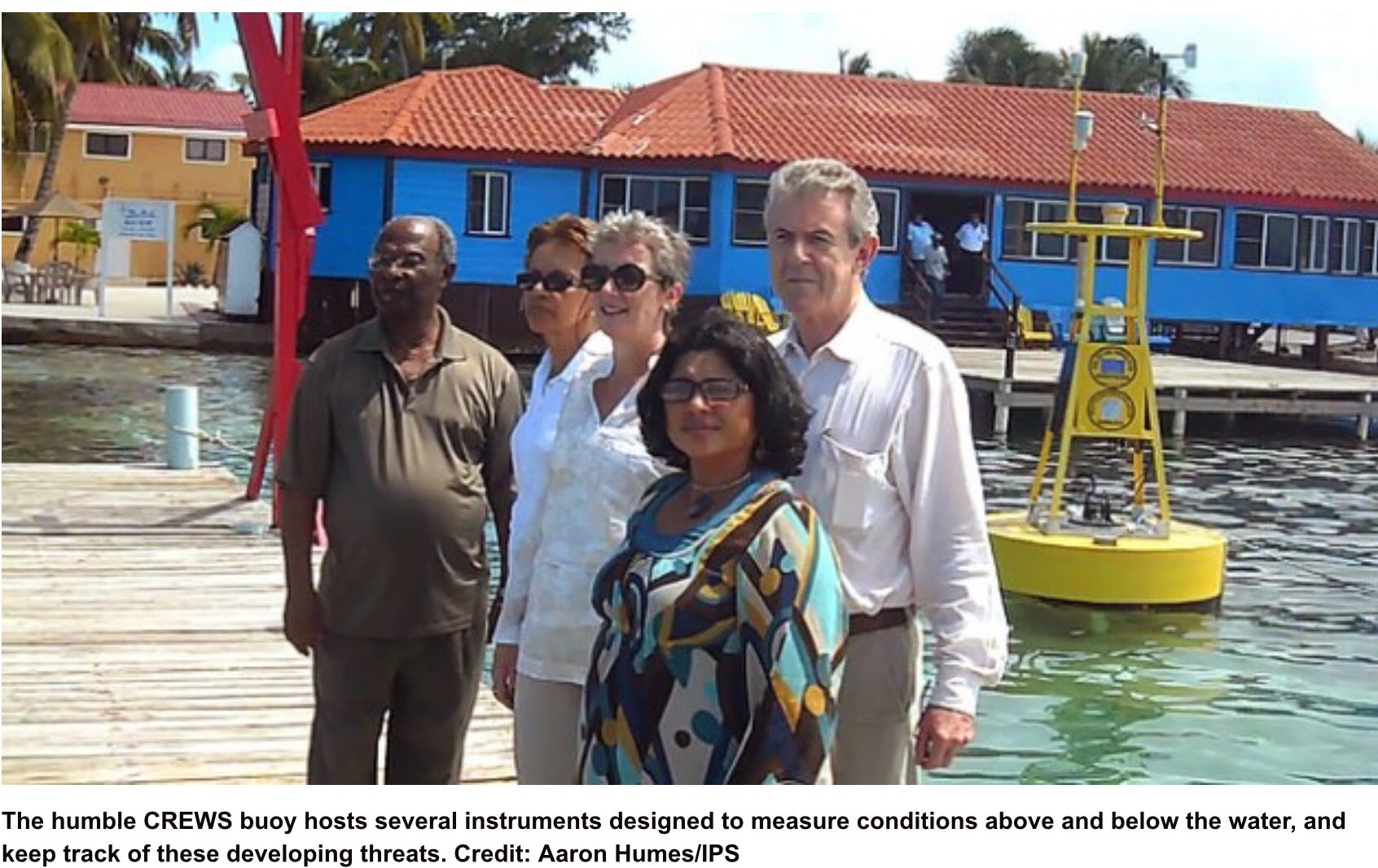
Last month, the European Union (EU), as part of its Global Climate Change Alliance Caribbean Support Project handed over to the government of Belize and specifically the Ministry of Forestry, Fisheries and Sustainable Development for its continued usage a Coral Reef Early Warning System (CREWS) buoy based at South Water Caye off the Stann Creek District in southern Belize. More


UNGA General Debate 2014 Addresses Climate Agreement, Financing, SIDS


United Nations27 September 2014: During days three and four of the UN General Assembly (UNGA) General Debate 2014, many speakers addressed climate change. Speakers focused on international and national action, including transitions to renewable energy, and financing. Small island developing States (SIDS) particularly urged action, emphasizing they are already experiencing adverse effects on food and water security, biodiversity and oceans.


“Some members have criticized us for focusing too much on climate change and sea level rise, but these issues influence our every decision and affect every aspect of life on our islands,” said Christopher J. Loeak, President of the Marshall Islands, stressing that small island countries cannot afford to speak of climate change as a future threat. Tuilaepa Sailele Malielegaoi, Prime Minister of Samoa, underscored that apportioning blame serves no useful purpose, saying “those who exploit the traditional divide between developed and developing countries and ideological and political differences do so conveniently to mask their unwillingness to be part of the solution to an impending global catastrophe.” He suggested viewing the world as a single constituency where everyone must work together within the limits of their capacity and capability to address climate change. Charles Angelo Savarin, President of Dominica, Anote Tong, President of Kiribati, and Malielegaoi emphasized climate change is not an event in the future but an issue SIDS are already experiencing.


Several speakers commended the Climate Summit, welcoming its political momentum. Tong, Ikililou Dhoinine, President of the Comoros, Enele Sosene Sopoga, Prime Minister of Tuvalu, and Carlos Raúl Morales, Minister for Foreign Affairs of Guatemala, called for translating Summit commitments into action. Malielegaoi said the Summit underscored that the world is focusing more on symptoms of climate change than on the root causes.


Many supported a global, legally binding agreement on climate change by 2015, including Donald Rabindranauth Ramotar, President of Guyana, Tomislav Nikolić, President of Serbia, Alpha Condé, President of Guinea, Lubomír Zaorálek, Minister for Foreign Affairs of the Czech Republic, Salva Kiir, President of South Sudan, Frank-Walter Steinmeier, Minister for Foreign Affairs of Germany, Tong and Savarin. Malielegaoi said the agreement should be ambitious, effective, binding and capable of swift implementation. Hifikepunye Pohamba, President of Namibia, supported a coordinated global agreement. Denis Sassou Nguesso, President of the Republic of Congo, supported a binding agreement that included adaptation. Sopoga said a new protocol must: curb greenhouse gas (GHG) emissions; keep average temperature well below 1.5 degrees Celsius; include loss and damage and insurance mechanisms for SIDS; and provide adequate and accessible financing for SIDS' adaption support.


Noting Luxembourg will assume the Presidency of the Council of the EU in the second semester of 2015, Xavier Bettel, Prime Minister of Luxembourg, said his country would “spare no effort” to find an international agreement on climate, applicable to all countries, with the objective of keeping global warming below two degrees.


Sushil Koirala, Prime Minister of Nepal, supported a binding agreement on climate change with long-term and comprehensive global commitment based on common but differentiated responsibilities (CBDR), equity and respective capabilities. King Tupou VI of Tonga emphasized CBDR and equity principles.


Catherine Samba-Panza, President of the Transitional Government of the Central African Republic, urged ratification of the Doha amendment to the Kyoto Protocol.


Several speakers outlined national action on climate change, including Pohamba, Gjorge Ivanov, President of Macedonia, and Erlan A. Idrissov, Minister for Foreign Affairs of Kazakhstan. Bettel said the EU will present additional contributions to reduce GHG emissions and mitigate climate change, in accordance with the timetable agreed in Warsaw, Poland. At the national level, Bettel said Luxembourg is supporting carbon pricing.


Tong, Loeak and Tupou highlighted national action on adaptation and integrated disaster risk management (DRM). Tong said Kiribati's ‘migration with dignity' strategy is an investment in youth education to allow them to develop employable skills so that they can migrate to other countries voluntarily.


Several countries mentioned renewable energy efforts as part of contributions to addressing climate change, including Steinmeier, Sopoga, Nicos Anastasiades, President of Cyprus, Tomislav Nikolić, President of Serbia, and Morales. Savarin and Loeak described their efforts to increase renewable energy, including through SIDS DOCK, a platform for the development of sustainable energy in SIDS. Erlan A. Idrissov, Minister for Foreign Affairs of Kazakhstan, highlighted the promotion of best practices in sustainable energy, noting it is launching a project on the installation of biogas systems in nine Pacific SIDS. Sheikh Abdullah Bin Zayed Al Nahyan, Minister for Foreign Affairs of the United Arab Emirates (UAE), described his country's efforts and investments in renewable energy throughout the world. Muhammad Nawaz Sharif, Prime Minister of Pakistan, said his country's goals are aligned with the Sustainable Energy for All (SE4ALL) Initiative.


Emanuel Mori, President, Federated States of Micronesia, described its proposal to amend the Montreal Protocol to phase down the production and consumption of hydrofluorocarbons (HFCs), which are GHGs, to prevent temperature increases. He stressed success with the Montreal Protocol over the next six months is “our ticket to a successful outcome in Paris” and urged adoption of the HFC amendment.


On climate financing, Loeak urged the full capitalization of the Green Climate Fund (GCF) and other financial mechanisms to address climate change and support the post-2015 agenda. He applauded nations who have pledged specific amounts and urged delivery of real money by major economic powers who he said are also major polluters. Sopoga stressed adequate resources for the GCF, particularly access for SIDS. Nguesso identified innovative financing, technology transfer and capitalization of the GCF as critical. Koirala, Bangladesh and Serbia stressed financing for adaptation, with Koirala saying there should be special provisions for addressing least developed countries (LDCs) and SIDS mitigation and adaptation needs in additional to regular official development assistance (ODA). Bangladesh also recommended adequate, predictable and additional climate finance, support for capacity and institution building and access to locally adaptable technologies.


Bettel highlighted Luxembourg's contribution of 5 million Euros to the GCF, which is new and additional to its ODA. Steinmeier stated Germany's commitment of US$1 billion to the GCF.


Climate change should be included in the post-2015 agenda, according to Savarin and Morales. Sopoga supported a standalone Sustainable Development Goal (SDG) on climate change. Idrissov and San Marino highlighted links between climate change and sustainable development. Bangladesh reiterated the need to integrate the UNFCCC, DRR and SDG processes.


Tupou and Sopoga underscored the link between climate change and peace and security, with Tupou advocating for Ban to appoint a Special Representative on Climate and Security and Sopoga supporting addressing climate change and security through the UN Security Council. More


[UNGA General Debate 26 September 2014] [UNGA General Debate 27 September 2014] [UN Press Release on SIDS]


UNGA General Debate 2014 Addresses Climate Agreement, Financing, SIDS


United Nations27 September 2014: During days three and four of the UN General Assembly (UNGA) General Debate 2014, many speakers addressed climate change. Speakers focused on international and national action, including transitions to renewable energy, and financing. Small island developing States (SIDS) particularly urged action, emphasizing they are already experiencing adverse effects on food and water security, biodiversity and oceans.


“Some members have criticized us for focusing too much on climate change and sea level rise, but these issues influence our every decision and affect every aspect of life on our islands,” said Christopher J. Loeak, President of the Marshall Islands, stressing that small island countries cannot afford to speak of climate change as a future threat. Tuilaepa Sailele Malielegaoi, Prime Minister of Samoa, underscored that apportioning blame serves no useful purpose, saying “those who exploit the traditional divide between developed and developing countries and ideological and political differences do so conveniently to mask their unwillingness to be part of the solution to an impending global catastrophe.” He suggested viewing the world as a single constituency where everyone must work together within the limits of their capacity and capability to address climate change. Charles Angelo Savarin, President of Dominica, Anote Tong, President of Kiribati, and Malielegaoi emphasized climate change is not an event in the future but an issue SIDS are already experiencing.


Several speakers commended the Climate Summit, welcoming its political momentum. Tong, Ikililou Dhoinine, President of the Comoros, Enele Sosene Sopoga, Prime Minister of Tuvalu, and Carlos Raúl Morales, Minister for Foreign Affairs of Guatemala, called for translating Summit commitments into action. Malielegaoi said the Summit underscored that the world is focusing more on symptoms of climate change than on the root causes.


Many supported a global, legally binding agreement on climate change by 2015, including Donald Rabindranauth Ramotar, President of Guyana, Tomislav Nikolić, President of Serbia, Alpha Condé, President of Guinea, Lubomír Zaorálek, Minister for Foreign Affairs of the Czech Republic, Salva Kiir, President of South Sudan, Frank-Walter Steinmeier, Minister for Foreign Affairs of Germany, Tong and Savarin. Malielegaoi said the agreement should be ambitious, effective, binding and capable of swift implementation. Hifikepunye Pohamba, President of Namibia, supported a coordinated global agreement. Denis Sassou Nguesso, President of the Republic of Congo, supported a binding agreement that included adaptation. Sopoga said a new protocol must: curb greenhouse gas (GHG) emissions; keep average temperature well below 1.5 degrees Celsius; include loss and damage and insurance mechanisms for SIDS; and provide adequate and accessible financing for SIDS' adaption support.


Noting Luxembourg will assume the Presidency of the Council of the EU in the second semester of 2015, Xavier Bettel, Prime Minister of Luxembourg, said his country would “spare no effort” to find an international agreement on climate, applicable to all countries, with the objective of keeping global warming below two degrees.


Sushil Koirala, Prime Minister of Nepal, supported a binding agreement on climate change with long-term and comprehensive global commitment based on common but differentiated responsibilities (CBDR), equity and respective capabilities. King Tupou VI of Tonga emphasized CBDR and equity principles.


Catherine Samba-Panza, President of the Transitional Government of the Central African Republic, urged ratification of the Doha amendment to the Kyoto Protocol.


Several speakers outlined national action on climate change, including Pohamba, Gjorge Ivanov, President of Macedonia, and Erlan A. Idrissov, Minister for Foreign Affairs of Kazakhstan. Bettel said the EU will present additional contributions to reduce GHG emissions and mitigate climate change, in accordance with the timetable agreed in Warsaw, Poland. At the national level, Bettel said Luxembourg is supporting carbon pricing.


Tong, Loeak and Tupou highlighted national action on adaptation and integrated disaster risk management (DRM). Tong said Kiribati's ‘migration with dignity' strategy is an investment in youth education to allow them to develop employable skills so that they can migrate to other countries voluntarily.


Several countries mentioned renewable energy efforts as part of contributions to addressing climate change, including Steinmeier, Sopoga, Nicos Anastasiades, President of Cyprus, Tomislav Nikolić, President of Serbia, and Morales. Savarin and Loeak described their efforts to increase renewable energy, including through SIDS DOCK, a platform for the development of sustainable energy in SIDS. Erlan A. Idrissov, Minister for Foreign Affairs of Kazakhstan, highlighted the promotion of best practices in sustainable energy, noting it is launching a project on the installation of biogas systems in nine Pacific SIDS. Sheikh Abdullah Bin Zayed Al Nahyan, Minister for Foreign Affairs of the United Arab Emirates (UAE), described his country's efforts and investments in renewable energy throughout the world. Muhammad Nawaz Sharif, Prime Minister of Pakistan, said his country's goals are aligned with the Sustainable Energy for All (SE4ALL) Initiative.


Emanuel Mori, President, Federated States of Micronesia, described its proposal to amend the Montreal Protocol to phase down the production and consumption of hydrofluorocarbons (HFCs), which are GHGs, to prevent temperature increases. He stressed success with the Montreal Protocol over the next six months is “our ticket to a successful outcome in Paris” and urged adoption of the HFC amendment.


On climate financing, Loeak urged the full capitalization of the Green Climate Fund (GCF) and other financial mechanisms to address climate change and support the post-2015 agenda. He applauded nations who have pledged specific amounts and urged delivery of real money by major economic powers who he said are also major polluters. Sopoga stressed adequate resources for the GCF, particularly access for SIDS. Nguesso identified innovative financing, technology transfer and capitalization of the GCF as critical. Koirala, Bangladesh and Serbia stressed financing for adaptation, with Koirala saying there should be special provisions for addressing least developed countries (LDCs) and SIDS mitigation and adaptation needs in additional to regular official development assistance (ODA). Bangladesh also recommended adequate, predictable and additional climate finance, support for capacity and institution building and access to locally adaptable technologies.


Bettel highlighted Luxembourg's contribution of 5 million Euros to the GCF, which is new and additional to its ODA. Steinmeier stated Germany's commitment of US$1 billion to the GCF.


Climate change should be included in the post-2015 agenda, according to Savarin and Morales. Sopoga supported a standalone Sustainable Development Goal (SDG) on climate change. Idrissov and San Marino highlighted links between climate change and sustainable development. Bangladesh reiterated the need to integrate the UNFCCC, DRR and SDG processes.


Tupou and Sopoga underscored the link between climate change and peace and security, with Tupou advocating for Ban to appoint a Special Representative on Climate and Security and Sopoga supporting addressing climate change and security through the UN Security Council. More


[UNGA General Debate 26 September 2014] [UNGA General Debate 27 September 2014] [UN Press Release on SIDS]


Latin America And Caribbean Region Expected To Install 9 GW Of Solar In 5 Years

That solar photovoltaic (PV) technology is poised to become a dominant energy generation technology throughout the world is of no surprise to most, but the sheer wealth of possibility being forecast throughout the middle and southern hemispheres begins to give an idea of just how prevalent the technology will be by the end of the decade.

Figures published by NPD Solarbuzz have so far predicted that several of the major Asia Pacific nations will account for 60% of solar PV demand in 2014, while being primary drivers of growth over the next several years, at the same time as the Middle East and Africa region currently has close to 12 GW of solar demand in the pipeline.

So it should really come as no surprise that NPD Solarbuzz’s recent figures show that the Latin America and Caribbean region is set to install 9 GW of solar PV over the next five years.

Latin America and Caribbean Five-Year Cumulative Demand Forecast by Project Status

“Solar PV is now starting to emerge as a preferred energy technology for Latin American and Caribbean countries,” said Michael Barker, senior analyst at NPD Solarbuzz. “The region has high electricity prices and it also benefits from strong solar irradiation, which makes it a good candidate for solar PV deployment. As a result, experienced global solar PV developers are seeing strong solar PV growth potential in the region.”

NPD Solarbuzz’s Emerging PV Markets Report: Latin America and Caribbean shows that the total PV project pipeline now exceeds 22 GW of projects across all stages of development — with 1 GW of projects already under construction, and another 5 GW of projects have received the appropriate approval to proceed.

The Latin America and Caribbean region was previously home to many small-scale and off-grid solar PV applications, however governments are now looking to solar PV to address large-scale utility power requrements — specifically in Brazil, Chile, and Mexico.

“Many countries across the LAC region have the potential to develop into major solar PV markets in the future,” added Barker. “While project pipelines vary by country, there is a strong contribution from early-stage developments that have yet to finalize supply deals or find end-users to purchase the generated electricity, which presents both risks and opportunities for industry players.”

A number of countries throughout the developing and second-world countries are turning to renewable energy technologies to develop strong, future-proof, and economically efficient energy generation. Such a trend is being backed by major manufacturing companies who are focusing their efforts on these regions, hoping to increase their own profits while fulfilling renewable energy demand. More


Why Greenland’s “Dark Snow” Should Worry You

Jason Box’s research into Greenland’s dark snow raises more concerns about climate change.

Jason Box knows ice. That’s why what’s happened this year concerns him so much. Box just returned from a trip to Greenland. Right now, the ice there is … black:

The ice in Greenland this year isn’t just a little dark—it’s record-setting dark. Box says he’s never seen anything like it. I spoke to Box by phone earlier this month, just days after he returned from his summer field research campaign.

“I was just stunned, really,” Box told me.

The photos he took this summer in Greenland are frightening. But their implications are even more so. Just like black cars are hotter to the touch than white ones on sunny summer days, dark ice melts much more quickly.

As a member of the Geological Survey of Denmark and Greenland, Box travels to Greenland from his home in Copenhagen to track down the source of the soot that’s speeding up the glaciers’ disappearance. He aptly calls his crowdfunded scientific survey Dark Snow.

There are several potential explanations for what’s going on here. The most likely is that some combination of increasingly infrequent summer snowstorms, wind-blown dust, microbial activity, and forest fire soot led to this year’s exceptionally dark ice. A more ominous possibility is that what we’re seeing is the start of a cascading feedback loop tied to global warming. Box mentions this summer’s mysterious Siberian holes and offshore methane bubbles as evidence that the Arctic can quickly change in unpredictable ways.

This year, Greenland’s ice sheet was the darkest Box (or anyone else) has ever measured. Box gives the stunning stats: “In 2014 the ice sheet is precisely 5.6 percent darker, producing an additional absorption of energy equivalent with roughly twice the US annual electricity consumption.”

Perhaps coincidentally, 2014 will also be the year with the highest number of forest fires ever measured in Arctic.

Box ran these numbers exclusively for Slate, and what he found shocked him. Since comprehensive satellite measurements began in 2000, never before have Arctic wildfires been as powerful as this year. In fact, over the last two or three years, Box calculated that Arctic fires have been burning at a rate that’s double that of just a decade ago. Box felt this finding was so important that he didn’t want to wait for peer review, and instead decided to publish first on Slate. He’s planning on submitting these and other recent findings to a formal scientific journal later this year.

Box’s findings are in line with recent research that shows the Arctic is in the midst of dramatic change.

A recent study has found that, as the Arctic warms, forests there are turning to flame at rates unprecedented in the last 10,000 years. This year, those fires produced volumes of smoke and soot that Box says drifted over to Greenland.

In total, more than 3.3 million hectares burned in Canada’s Northwest Territories alone this year—nearly 9 times the long term average—resulting in a charred area bigger than the states of Connecticut and Massachusetts combined. That figure includes the massive Birch Creek Complex, which could end up being the biggest wildfire in modern Canadian history. In July, it spread a smoke plume all the way to Portugal.

In an interview with Canada’s National Post earlier this year, NASA scientist Douglas Morton said, “It’s a major event in the life of the earth system to have a huge set of fires like what you are seeing in Western Canada.”

Box says the real challenge is to rank what fraction of the soot he finds on the Greenland ice is from forest fires, and what is from other sources, like factories. Box says the decline of snow cover in other parts of the Arctic (like Canada) is also exposing more dirt to the air, which can then be more easily transported by the wind. Regardless of their ultimate darkening effect on Greenland, this year’s vast Arctic fires have become a major new source of greenhouse gas emissions from the thawing Arctic. Last year, NASA scientists found “amazing” levels of carbon dioxide and methane emanating from Alaskan permafrost.

Earlier this year, Box made headlines for a strongly worded statement along these lines:

That tweet landed Box in a bit of hot water with his department, which he said now has to approve his media appearances. Still, Box’s sentiment is inspiring millions. His “f’d” quote is serving as the centerpiece of a massive petition (with nearly 2 million signatures at last count) that the activist organization Avaaz will deliver to “national, local, and international leaders” at this month’s global warming rally in New York City on Sept. 21. More


Nation-building policies in Timor-Leste: disaster risk reduction, including climate change adaptation

“Nation building policies in Timor-Leste: disaster risk reduction, including climate change adaptation”.

Few studies have explored the relationships between nation-building, disaster risk reduction and climate change adaptation. Focusing on small island developing states, this paper examines nation-building in Timor-Leste, a small island developing state that recently achieved independence. Nation-building in Timor-Leste is explored in the context of disaster risk reduction, which necessarily includes climate change adaptation. The study presents a synopsis of Timor-Leste's history and its nation-building efforts as well as an overview of the state of knowledge of disaster risk reduction including climate change adaptation. It also offers an analysis of significant gaps and challenges in terms of vertical and horizontal governance, large donor presence, data availability and the integration of disaster risk reduction and climate change adaptation for nation-building in Timor-Leste. Relevant and applicable lessons are provided from other small island developing states to assist Timor-Leste in identifying its own trajectory out of underdevelopment while it builds on existing strengths.

  1. Jessica Mercer1,*,
  2. Ilan Kelman2,3,
  3. Francisco do Rosario4,
  4. Abilio de Deus de Jesus Lima5,
  5. Augusto da Silva6,
  6. Anna-Maija Beloff7 and
  7. Alex McClean8

Article first published online: 5 SEP 2014

DOI: 10.1111/disa.12082


http://onlinelibrary.wiley.com/doi/10.1111/disa.12082/abstract