
Innovators Under 35: Leslie Dewan, Chief Science Officer, Transatomic Power
Published on Nov 7, 201 3 • What if we could build a nuclear reactor that costs half as much, consumes nuclear waste, and will never melt down? Trans Atomic Power

Innovators Under 35: Leslie Dewan, Chief Science Officer, Transatomic Power
Published on Nov 7, 201 3 • What if we could build a nuclear reactor that costs half as much, consumes nuclear waste, and will never melt down? Trans Atomic Power

New York, October 16,2014— Tlirks & Caicos fTCI) deepened its commitment to advancing renewable energy by joining the Carbon War Room’s Ten Island Challenge today.
The Premier of Turks and Caicos, the Honorable Doctor Rufus Ewing, and Carbon War Room Operation Director, Justin Locke, signed a Memorandum of Understanding, committing to work together to reduce the island’s dependence on fossil fuels through increased renewable energy production and improved energy efficiency.
“With the addition of Turks & Caicos, the Ten Island Challenge continues to expand its efforts to transform Caribbean economies and help the region achieve independence from fossil fuels.”Sir Richard Branson, Founder of Carbon War Room
The Ten Island Challenge, driven by partners Carbon War Room and Rocky Mountain Institute, provides the Government of TCI the opportunity and platform to define and realize its own vision of a clean economy. In order to achieve this vision, the Carbon War Room and Rocky Mountain Institute will provide a range of technical, project management, communications, and business advisory support services.
The MOU signing builds on a commitment made by the Governor of Turks and Caicos, Peter Beckingham at the Creating Climate Wealth Islands Summit in February 2014, when Turks & Caicos expressed interest in joining the Challenge.

Governor Peter Beckingham
The Ten Island Challenge
The Ten Island Challenge works to accelerate the transition of Caribbean island economies from a heavy dependence on fossil fuels to renewable resources. Caribbean economies suffer from some of the highest electricity prices in the world—contributing to their national debts, and slowing efforts toward sustainable development. Despite an abundance of sun and wind, Caribbean islands have implemented relatively low amounts of renewables to date. The Ten Island Challenge is tackling this by identifying the technical and commercial solutions that can facilitate low-carbon energy use in the Caribbean.
In 2013, Sir Richard Branson committed his home of Necker Island in the British Virgin Islands to serve as a ‘demo’ island in the Challenge, and, in February of this year, US energy giant NRG Energy was awarded the contract to transition the island to renewables. More
That solar photovoltaic (PV) technology is poised to become a dominant energy generation technology throughout the world is of no surprise to most, but the sheer wealth of possibility being forecast throughout the middle and southern hemispheres begins to give an idea of just how prevalent the technology will be by the end of the decade.
Figures published by NPD Solarbuzz have so far predicted that several of the major Asia Pacific nations will account for 60% of solar PV demand in 2014, while being primary drivers of growth over the next several years, at the same time as the Middle East and Africa region currently has close to 12 GW of solar demand in the pipeline.
So it should really come as no surprise that NPD Solarbuzz’s recent figures show that the Latin America and Caribbean region is set to install 9 GW of solar PV over the next five years.
Latin America and Caribbean Five-Year Cumulative Demand Forecast by Project Status

“Solar PV is now starting to emerge as a preferred energy technology for Latin American and Caribbean countries,” said Michael Barker, senior analyst at NPD Solarbuzz. “The region has high electricity prices and it also benefits from strong solar irradiation, which makes it a good candidate for solar PV deployment. As a result, experienced global solar PV developers are seeing strong solar PV growth potential in the region.”
NPD Solarbuzz’s Emerging PV Markets Report: Latin America and Caribbean shows that the total PV project pipeline now exceeds 22 GW of projects across all stages of development — with 1 GW of projects already under construction, and another 5 GW of projects have received the appropriate approval to proceed.
The Latin America and Caribbean region was previously home to many small-scale and off-grid solar PV applications, however governments are now looking to solar PV to address large-scale utility power requrements — specifically in Brazil, Chile, and Mexico.
“Many countries across the LAC region have the potential to develop into major solar PV markets in the future,” added Barker. “While project pipelines vary by country, there is a strong contribution from early-stage developments that have yet to finalize supply deals or find end-users to purchase the generated electricity, which presents both risks and opportunities for industry players.”
A number of countries throughout the developing and second-world countries are turning to renewable energy technologies to develop strong, future-proof, and economically efficient energy generation. Such a trend is being backed by major manufacturing companies who are focusing their efforts on these regions, hoping to increase their own profits while fulfilling renewable energy demand. More
Computer giant IBM last week revealed the prototype of its advanced solar electricity generators: a 30ft-high concrete “sunflower” fitted with wafer-thin aluminium mirrors and a maze of tiny tubes for carrying coolant through the heart of each device.

The machines, which will be built in conjunction with the Swiss company Airlight Energy, can convert 80% of the sun’s radiation into electricity and hot water, it is claimed, with each generating 12 kilowatts of electricity and 20kW of heat on a sunny day, enough to supply several homes.
At the device’s official unveiling in Zurich, executives for both companies said they hoped that by 2017, when their sunflower generators should be ready for the market, they could be manufactured for half to one-third of the cost of comparable solar converters today. According to IBM, the machine’s secret lies with the microscopic tubes that carry water through the cluster of photovoltaic chips at the heart of each device. This system has already been adopted by IBM to cool its high-performance supercomputers. “We were inspired by the branched blood supply of the human body,” said Bruno Michel, from the IBM Research laboratories in Zurich.
The sunflower operates by tracking the sun so that it always points in the best direction for collecting its rays; these are then focused on to a cluster of photovoltaic cells that are mounted on a raised platform. The cells convert solar radiation into electricity. However, without the microchannel cooling system, which carries distilled water through the chips, temperatures would reach more than 1,000C. With the microcooling system, which carries water to within a few millimetres of the back of each chip, temperatures are kept down to 90C – a far safer, and far more efficient, operating level. Electricity is generated while the system also produces large amounts of hot water from the cooling system. “That hot water is a game changer,” added Michel. “Electricity is obviously vitally useful but so is the heat – for we can use it for desalinating water.”
At present, about 1.3 billion people have no access to electricity. However, that figure is dwarfed by the number – 2.5 billion – who have no access to proper sanitation. And according to figures supplied by Airlight Energy, that latter number is currently increasing at a rate of 9% a year. However, the IBM-Airlight sunflower is designed to tackle both problems. The electricity will have numerous uses while the hot water can be pumped through desalinators that use porous membranes to boil salt water and distil the result into pure, drinkable water. A large installation made up of several generators could provide enough fresh water for an entire town, it was claimed at last week’s launch.
Apart from sites in Africa, the Middle East and Australia, it is hoped the sunflower system will be used for remote hospitals, hotels and holiday resorts. IBM says it will instal its first two devices for free in 2016 and has asked towns around the world to put their names forward to be the first to have a solar sunflower erected on their land. More
The first ten kilograms of the mixed-oxide fuel (MOX) – a mixture of plutonium and uranium dioxides (UO2 and PuO2), have been industrially produced by Russia’s nuclear monopoly, Rosatom, at the Mining & Chemical Combine (GKhK) in the Krasnoyarsk region.

Mixed-oxide fuel (MOX
A world first, tablets of the fuel of the future have been put on serial production and are destined for Russia’s next generation BN-800 breeder reactor (880 megawatts), currently undergoing tests at the Beloyarskaya nuclear power plant.
The production line, now undergoing start-up and adjustment, was assembled in a mine 200 meters underground and will become fully operational by the end of 2014.
Fast fission reactors solve the problem of depleted uranium nuclear fuel on the planet. They can ‘burn’ not only ‘classic’ uranium-235, (scarce and already coming to an end), but also uranium-238, which is abundant, and expands the world’s nuclear fuel capacity by an estimated 50 times.
Fuel for breeder reactors could even be made from nuclear waste, which from an ecological point of view is a priceless advantage.
The GKhK facility will be equipped with a unique dissolvent reactor that will break down nuclear waste containing plutonium and extract plutonium dioxide to be used in MOX-fuel production.
Also, while producing electric energy, breeder reactors actually generate more fissile material, and that one also can be used as nuclear fuel.
The GKhK plant is Russia’s leading full nuclear fuel cycle complex, processing nuclear waste from power generating nuclear reactors to establish future nuclear fuel ring closure.
MOX-fuel for previous versions of fast breeder reactors in the USSR and Russia had limited production at Russia’s oldest Mayak nuclear processing facility.
Starting from 2016, industrial-level MOX-fuel production in Russia will run at full capacity.
“Produced MOX-fuel tablets fully conform to the technical specifications,” Rosatom’s statement said, adding that the fuel will now be thoroughly tested.
Humankind has already produced so much nuclear waste that it would take decades, if not hundreds of years to process and recycle it. As of now, the only light at the end of the tunnel is fast-neutron reactor technology.
The fast-neutron nuclear – or breeder – reactors use technology that enables the use of a wider range of radioactive elements as fuel, thus considerably enlarging the potential stock of nuclear fuel for electric power generation.
Russia is the only country that operates fast neutron reactors industrially.
After decades of research, practically all breeder reactor projects around the world, including in the US, France, Japan and several other countries possessing nuclear energy technologies, were closed down. The only country that currently has operating breeder reactor power generation is Russia.
Over the last 50 years the USSR, then Russia, introduced a number of industrial and research fast neutron reactors. One of them, the BN-600 (600 megawatt), running at the Beloyarskaya nuclear power plant since 1980, is the only fast neutron reactor in the world that generates electricity on an industrial scale. The BN-600 is also the most powerful operable fast neutron reactor in the world.
The Beloyarskaya nuclear power plant is in Zarechny, some 45 kilometers from the regional center of Yekaterinburg, in the Urals region.
This year a new BN-800 breeder reactor will become operable at the Beloyarskaya plant.
The service life of the BN-800 breeder reactor is expected to be 45 years. Every month it will produce 475 million kilowatt hours of electricity, enough to ensure constant supply to 3.15 million families (the average monthly consumption of a family of three is 150 kilowatt hours).
The BN-800 uses liquid metal sodium (Na) as a coolant heat transfer agent. Commercial operation of the new reactor is planned to start in early 2015.
Russian physicists have already elaborated the next step for the revolutionary technology: a BN-1200 breeder reactor that is set to be assembled at the same Beloyarskaya nuclear power plant by 2020.
Overall, eight BN-1200 breeder reactors are expected to be constructed by 2030, which means that Russia is the only nation that is entering a new era of nuclear energy power generation – the closed nuclear fuel cycle, in other words truly clean and practically unlimited nuclear power generation. More
Ten years ago peak oil was assumed to be a rather straight forward, transparent process. What was then thought of as “oil” production was going to stop growing around the middle of the last decade.

Shortages were going to occur; prices were going to rise; demand was going to drop; economies would falter; and eventually a major economic depression was going to occur. Fortunately or not, depending on your point of view, the last ten years have turned out to a lot more complicated than expected. Production of what is now known as “conventional” oil did indeed peak back around 2005, and many of the phenomena that were expected to result did occur and continue to this day.
Oil prices have climbed several-fold from where they were in the early years of the last decade – surging upwards from $20 a barrel to circa $100. This rapid jump in energy costs did slow many nations’ economies, cut oil consumption, and with some other factors set off a “great” recession. Real economic hardships have not yet occurred
What is so interesting about all this is that a temporary surge in what was heretofore a little known source of oil in the U.S. is masking the larger story of what is taking place in the global oil situation
Much of this is due to the reaction that set in from high oil prices and increased government intervention into the economy. In the case of the U.S., Washington turned on the modern day equivalent of the printing presses and began handing out money that was used to develop expensive sources of oil and gas. The high selling price per barrel, coupled with cheap money led to a boom in U.S. oil production where fortuitous geological conditions in North Dakota and South Texas allowed the production of shale oil at money-making prices provided oil prices stay high.
U.S. unconventional oil production soared by some 3.3 million barrels a day (b/d) in the last four years, and, if the US Energy Information Administration is correct, is due to climb by another million b/d or so in 2015. While this jump in production was unexpected by most, it was just another phenomenon resulting from unprecedentedly high oil prices, which in turn resulted from the lack of adequate “conventional” oil production. As is well known, economic development can have major reactions and feedbacks
What is so interesting about all this is that a temporary surge in what was heretofore a little known source of oil in the U.S. is masking the larger story of what is taking place in the global oil situation. The simple answer is that except for the U.S. shale oil surge almost no increase in oil production is taking place around the world. No other country as yet has gotten significant amounts of shale oil or gas into production. Russia’s conventional oil production seems to be peaking at present, and its Arctic oil production is still many years, or perhaps even decades, away. Brazilian production is going nowhere at the minute, deepwater production in the Gulf of Mexico is stagnating and the Middle East is busy killing itself. On top of all this, global demand for oil continues to increase by some million b/d each year – most of which is going to Asia.
If we step back and acknowledge that the shale oil phenomenon will be over in a couple of years and that oil production is dropping in the rest of the world, then we have to expect that the remainder of the peak oil story will play out shortly. The impact of shrinking global oil production, which is been on hold for nearly a decade, will appear. Prices will go much higher, this time with lowered expectations that more oil will be produced as prices go higher. The great recession, which has never really gone away for most, will return with renewed vigor and all that it implies.
An additional factor which has grown considerably worse in the last ten years is climate change, largely brought about by the combustion of fossil fuels. We are already seeing global weather anomalies with record high and low temperatures and record floods as well as droughts. This too will take its toll on economic development as mitigating this change will soon become enormously expensive. We are already seeing migrations of restive peoples. Thousands are dying in efforts to get from the Middle East and Africa into the EU. Millions are already homeless across the Middle East and recent developments foretell hundreds of thousands if not millions more being added to ranks of refugees as decades and even centuries-old political arrangements collapse.
All this is telling us that the peak oil crisis we have been watching for the last ten years has not gone away, but is turning out to be a more prolonged event than previous believed. Many do not believe that peak oil is really happening as they read daily of surging oil production and falling oil prices. Rarely do they hear that another shoe has yet to drop and that much worse in terms of oil shortages, higher prices and interrupted economic growth is just ahead.
We are sitting in the eye of the peak oil crisis and few recognize it. Five years from now, it should be apparent to all. More
After the report on mountaineering and my experiences on the ascent to Mount Aconcagua, I return to the subject of water, and the opportunities and challenges in recycling it.

In earlier posts here I wrote about a very sophisticated system of wastewater recycling in Singapore, which turns it back into drinking water.
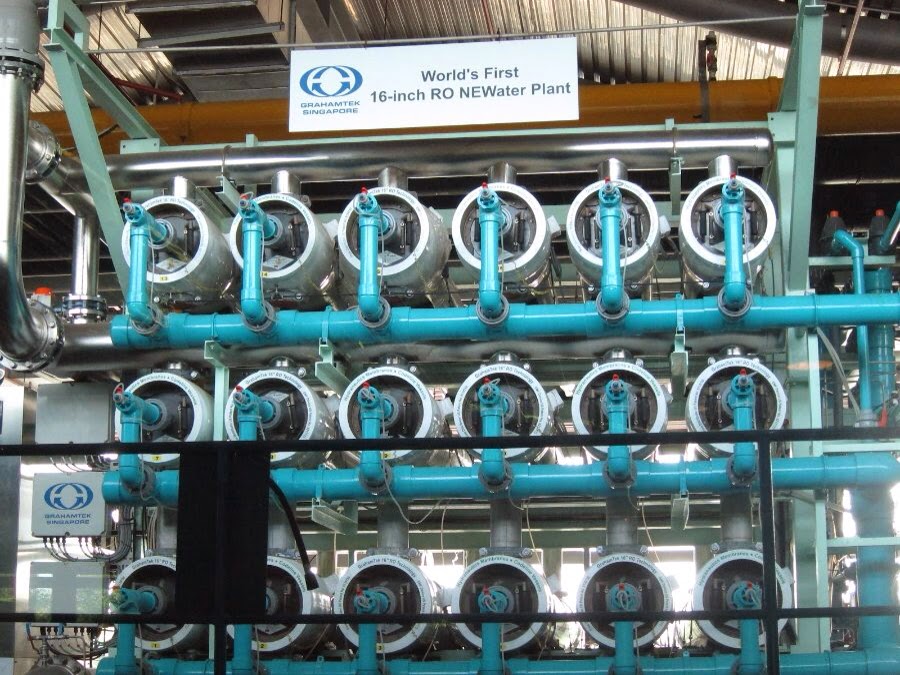
And at this year’s Singapore International Water Week, the Californian Orange County received the highest recognition, for a scheme where perfectly treated wastewater is pumped back into underground aquifers, to be later pumped up again as drinking water. It also serves as a barrier to seawater intrusion.
These two examples, especially Singapore, are probably the most far-reaching examples I know of achievement in water recycling.
Places like San Diego, hit by a drought, are now re-considering again the idea to follow the Singapore example, despite some opposition from civil society. So, to what extent is it possible to scale up these kinds of activities globally; is there potential for wastewater to contribute in a substantial way to closing the gap of some 300 cubic kilometres between the level of water withdrawals and sustainable supply?
Estimates show close to 300 cubic kilometres of wastewater is generated by municipalities per year (average 2003-12). This is the equivalent of some 50% of global average annual withdrawals for household use.
Part of the other 50% of withdrawals not counted as ‘wastewater’ may well be lost in leakage in pipes (in some countries this accounts for up to 70% of the water withdrawn by the municipal water supply schemes). Another part could be ‘used’ through evapotranspiration in lawns and gardens, etc.
As the table below shows, only about half of this wastewater is actually collected and treated, but less than 10% of the treated wastewater is directly reused.
Table 1: Municipal wastewater generation and treatment data 2003-2012, country groups by income per capita

Source: FAO aquastat
To get an idea of how municipal water could contribute to closing the gap between withdrawals and sustainable supply, let me go through the water supply chain.
The first step would require a better understanding of what happens with the 50% of municipal water apparently ‘disappearing’. Where this is down to leakage, governments have to set the right incentives so municipal water authorities address the issue.
One way proposed by the 2030 Water Resources Group (2030 WRG) in South Africa, which has been implemented by the government there, is to measure both water delivery and water intake, and to pay a premium to the schemes where the difference (i.e., water unaccounted for) gets smaller.
According to 2030 WRG cost-curve estimates, the cost savings would by far exceed the necessary spending to reduce the leakage.
As part of my proposals for targets within the water goal for post-2015 sustainable development, I suggest primary treatment of all wastewater by 2030 – an idea I will come back to in a later post.
So, what happens with 285 km³ of estimated wastewater generated, and what needs to be done? We will first have to increase collection, particularly in economically deprived areas, to make sure wastewater is collected and available for proper treatment.
Actually, only 36% of the world’s population has a sewage connection; this leaves 4.6 billion people unconnected. According to a WHO study, initial investment to set up a sewer connection is about USD 170 per capita; so the investment cost to connect them would be somewhere close to USD 800 billion. The annual cost of capital, repayment and operating cost is estimated at USD 1 per m³.
Next: treatment of both the up-to-now untreated collected – and the newly collected – wastewater. Estimates amount to USD 0.35 per m³. A big part of this cost is energy, an often forgotten link in the water-food-energy nexus framework.
And last but not least: less than 10% of treated wastewater is used directly. This can and must be increased. Direct use is, for instance, the Singapore approach, bringing treated water back to consumers as so-called ‘NEWater’.
Another example is Australia: around 1.4 cubic kilometers of municipal wastewater are treated, of which 0.4 cubic kilometers are used directly, mostly in agriculture.
At Nestlé we have a similar approach. All our factories treat wastewater (in fact the first wastewater treatment plant in the group was built in the 1930s, so we understood the need for this very early) and as much of this treated wastewater as possible is used directly.
At the same time, we should keep in mind indirect use, even though it’s often difficult to measure. Treated wastewater is returned to rivers and then often withdrawn again and treated further for human consumption.
One might, for instance, assume that a significant part of the water in the River Thames, once it reaches London, is treated wastewater from communities further up the river. Increasing the share of direct use of wastewater should clearly be encouraged – in a form accepted by local communities.
So, all in all there are some significant opportunities to use treated wastewater as a resource, helping to close the gap between freshwater withdrawals and sustainable supply. But these opportunities need to be carefully evaluated, to make sure they are fully accepted, but also cost and energy effective when compared to other solutions. Via Peter Brabeck-Letmathe – Linkedin More
20 August 2014: A regional workshop organized by the Organization of American States (OAS) discussed how to improve donor interventions regarding sustainable energy projects in the Caribbean.

The workshop, titled 'Development of Sustainable Energy Projects: Experiences, Strategies and Implementation,' took place on 19 August 2014 in Saint Lucia. The event brought together major donors for Caribbean energy projects with country representatives to: examine current and planned sustainable energy projects; discuss local barriers to commercialization of sustainable energy; identify Caribbean country project priorities and gaps in current assistance; and look at ways to foster collaboration and complementarity between projects.
During the opening session, OAS consultant Christina Becker-Birck provided an overview of the 80+ energy initiatives in the region, amounting since 2004 to around US$129 million in technical assistance and grants, about US$108 million in loans and lines of credit, with at least US$100 million pending and planned.
Philipp Blechinger, Reiner Lemoine Institut, outlined the results of a survey on barriers to the development of renewable energy technologies for power generation on Caribbean island States. Carolina Peña, OAS Sustainable Development Department (DSD), outlined OAS energy interventions in the region.
During a roundtable discussion on learning from success stories and failures, the Organization of Eastern Caribbean States (OECS) detailed its Sustainable Energy Programme on technical assistance and energy labeling. The Carbon War Room discussed its 10 Island Challenge to catalyze private investment and produce a Ten Island Renewable Roadmap/Blueprint. The Caribbean Development Bank outlined the proposed Sustainable Energy for the Eastern Caribbean (SEEC) and Geothermal Drill Risk Facility projects. The EU provided an overview of its support for energy projects in the region, and the Clean Energy Solutions Center (CESC) outlined its technical support.
The workshop was organized by the OAS DSD in the framework of the Sustainable Energy Capacity Building Initiative (SECBI) of the Energy and Climate Change Partnership of the Americas (ECPA). More
It is not pleasant to contemplate the thoughts that must be passing through the mind of the Owl of Minerva as the dusk falls and she undertakes the task of interpreting the era of human civilization, which may now be approaching its inglorious end.

Bajid Kandala refugee cam, Iraq
The era opened almost 10,000 years ago in the Fertile Crescent, stretching from the lands of the Tigris and Euphrates, through Phoenicia on the eastern coast of the Mediterranean to the Nile Valley, and from there to Greece and beyond. What is happening in this region provides painful lessons on the depths to which the species can descend.
The land of the Tigris and Euphrates has been the scene of unspeakable horrors in recent years. The George W. Bush-Tony Blair aggression in 2003, which many Iraqis compared to the Mongol invasions of the 13th century, was yet another lethal blow. It destroyed much of what survived the Bill Clinton-driven UN sanctions on Iraq, condemned as “genocidal” by the distinguished diplomats Denis Halliday and Hans von Sponeck, who administered them before resigning in protest. Halliday and von Sponeck's devastating reports received the usual treatment accorded to unwanted facts.
One dreadful consequence of the US-UK invasion is depicted in a New York Times “visual guide to the crisis in Iraq and Syria”: the radical change of Baghdad from mixed neighborhoods in 2003 to today's sectarian enclaves trapped in bitter hatred. The conflicts ignited by the invasion have spread beyond and are now tearing the entire region to shreds.
Much of the Tigris-Euphrates area is in the hands of ISIS and its self-proclaimed Islamic State, a grim caricature of the extremist form of radical Islam that has its home in Saudi Arabia. Patrick Cockburn, a Middle East correspondent for The Independent and one of the best-informed analysts of ISIS, describes it as “a very horrible, in many ways fascist organization, very sectarian, kills anybody who doesn't believe in their particular rigorous brand of Islam.”
Cockburn also points out the contradiction in the Western reaction to the emergence of ISIS: efforts to stem its advance in Iraq along with others to undermine the group's major opponent in Syria, the brutal Bashar Assad regime. Meanwhile a major barrier to the spread of the ISIS plague to Lebanon is Hezbollah, a hated enemy of the US and its Israeli ally. And to complicate the situation further, the US and Iran now share a justified concern about the rise of the Islamic State, as do others in this highly conflicted region.
Egypt has plunged into some of its darkest days under a military dictatorship that continues to receive US support. Egypt's fate was not written in the stars. For centuries, alternative paths have been quite feasible, and not infrequently, a heavy imperial hand has barred the way.
After the renewed horrors of the past few weeks it should be unnecessary to comment on what emanates from Jerusalem, in remote history considered a moral center.
Eighty years ago, Martin Heidegger extolled Nazi Germany as providing the best hope for rescuing the glorious civilization of the Greeks from the barbarians of the East and West. Today, German bankers are crushing Greece under an economic regime designed to maintain their wealth and power.
The likely end of the era of civilization is foreshadowed in a new draft report by the Intergovernmental Panel on Climate Change, the generally conservative monitor of what is happening to the physical world.
The report concludes that increasing greenhouse gas emissions risk “severe, pervasive and irreversible impacts for people and ecosystems” over the coming decades. The world is nearing the temperature when loss of the vast ice sheet over Greenland will be unstoppable. Along with melting Antarctic ice, that could raise sea levels to inundate major cities as well as coastal plains.
The era of civilization coincides closely with the geological epoch of the Holocene, beginning over 11,000 years ago. The previous Pleistocene epoch lasted 2.5 million years. Scientists now suggest that a new epoch began about 250 years ago, the Anthropocene, the period when human activity has had a dramatic impact on the physical world. The rate of change of geological epochs is hard to ignore.
One index of human impact is the extinction of species, now estimated to be at about the same rate as it was 65 million years ago when an asteroid hit the Earth. That is the presumed cause for the ending of the age of the dinosaurs, which opened the way for small mammals to proliferate, and ultimately modern humans. Today, it is humans who are the asteroid, condemning much of life to extinction.
The IPCC report reaffirms that the “vast majority” of known fuel reserves must be left in the ground to avert intolerable risks to future generations. Meanwhile the major energy corporations make no secret of their goal of exploiting these reserves and discovering new ones.
A day before its summary of the IPCC conclusions, The New York Times reported that huge Midwestern grain stocks are rotting so that the products of the North Dakota oil boom can be shipped by rail to Asia and Europe.
One of the most feared consequences of anthropogenic global warming is the thawing of permafrost regions. A study in Science magazine warns that “even slightly warmer temperatures [less than anticipated in coming years] could start melting permafrost, which in turn threatens to trigger the release of huge amounts of greenhouse gases trapped in ice,” with possible “fatal consequences” for the global climate.
Arundhati Roy suggests that the “most appropriate metaphor for the insanity of our times” is the Siachen Glacier, where Indian and Pakistani soldiers have killed each other on the highest battlefield in the world. The glacier is now melting and revealing “thousands of empty artillery shells, empty fuel drums, ice axes, old boots, tents and every other kind of waste that thousands of warring human beings generate” in meaningless conflict. And as the glaciers melt, India and Pakistan face indescribable disaster.
Sad species. Poor Owl.
© 2014 Noam Chomsky
Distributed by The New York Times Syndicate
1 September 2014: Participants recognized sustainable energy for all as a tool for eradicating poverty, combating climate change, creating economic opportunities and achieving sustainable development for all small island developing States (SIDS), at a high-level side event, titled ‘Linking SIDS and Sustainable Energy for All (SE4ALL): From Barbados to Samoa, and Beyond.' The event took place on the sidelines of the Third International Conference on SIDS, in Apia, Samoa, on 1 September 2014.

The SE4ALL side event aimed to build on commitments from the UN Conference on Sustainable Development (UNCSD, or Rio+20+) and the Barbados SIDS High-Level Conference on SE4ALL, to take stock of progress since these events and chart the way forward to ensure sustainable energy for all SIDS.
Speaking at the event, UN Secretary-General Ban Ki-moon said achieving the three targets of the SE4ALL initiative is an important part of putting the world on a pathway for keeping temperature rise below two degrees Celsius. He outlined the need for a new energy paradigm, particularly for SIDS, who he said are particularly vulnerable to climate change and faced inflated energy costs due to their remoteness, and he welcomed the proposal of a dedicated Sustainable Development Goal (SDG) on sustainable energy for all with a focus on access, efficiency and renewables. Ban encouraged all leaders to “bring bold actions and ideas and strong political vision and political will” to the UN Climate Summit.
“SIDS are creating opportunities and examples that, if replicated worldwide, could lead the transition from fossil fuel energy to renewable and sustainable energy,” said UN General Assembly President John Ashe in his remarks.
The panel was moderated by Helen Clark, UN Development Programme (UNDP) Administrator, and featured: Adnan Amin, Director-General, International Renewable Energy Agency (IRENA); Camillo Gonsalves, Foreign Minister of Saint Vincent and the Grenadines; Salvatore Bernabei, General Manager, Enel Green Power Chile and Andean Countries; Naoko Ishii, CEO and Chairperson of the Global Environment Facility (GEF); and Reginald Burke, Caribbean Policy Development Centre. Key messages included the importance of reducing risk to catalyze private investment, the leadership being taken by SIDS, and various SIDS initiatives on sustainable energy, such as SIDS Dock and IRENA's SIDS Lighthouse project.
Participants highlighted: energy costs and energy security; climate change; and challenges and vulnerabilities faced by SIDS, including their small size and the high costs of importing fossil fuels. They stressed SIDS' renewable energy potential and the importance of addressing energy access and efficiency, highlighting the role of partnerships to address these issues. [UN Press Release] [UN Secretary-General Statement] [UNDP Administrator Remarks] [IISD RS Meeting Coverage, 1 September] [IISD RS Sources]
read more: http://energy-l.iisd.org/news/high-level-event-discusses-renewable-energy-in-sids/
 © 2014


 Democracy & Good Governance