Israelis rattled by search for truth about the Nakba

First ‘truth commission’ avoids issue of reconciliation as veteran Israeli fighters due to confess to 1948 war crimes

Middle East Eye – 9 December 2014

The first-ever “truth commission” in Israel, to be held on Wednesday, will feature confessions from veteran Israeli fighters of the 1948 war who are expected to admit to perpetrating war crimes as hundreds of thousands of Palestinians were expelled from their homes.

The commission is the culmination of more than decade of antagonistic confrontations between a small group of activists called Zochrot, the Hebrew word for Remembering, and the Israeli authorities as well as much of the Jewish public.

Founded in 2002, Zochrot is dedicated to educating Israeli Jews about what Palestinians call the Nakba, Arabic for catastrophe, referring to Israel’s creation on the ruins of their homeland more than six decades ago. The group also campaigns for the right of return for Palestinian refugees to Israel, probably the biggest taboo in Israeli society.

The commission, which has no official standing, could be the first of several such events around Israel, to investigate atrocities and war crimes committed in different localities, said Liat Rosenberg, Zochrot’s director.

“We have looked to other such commissions around the world as models, most obviously in South Africa,” she said. “But unlike the one there, ours does not include the element of reconciliation because the conflict here has yet to be resolved.

“We cannot talk about reconciliation when the Nakba is ongoing. We are still in a situation where there is apartheid, constant violations of human rights and 70 percent of the Palestinian community are refugees.”

The commission is likely to provoke outrage from the Israeli government, which passed the so-called Nakba Law in 2011 to try to make it harder to commemorate Palestinian suffering. The impact of the law is being widely felt. Just last month, the culture ministry vowed to block a government grant to a Tel Aviv cultural centre that hosted a Zochrot film festival on the Nakba.

Names kept secret

Rosenberg said Israeli veteran fighters and Palestinian witnesses participating in the truth commission had asked for their names to be kept secret until the hearings for fear that friends and family would put pressure on them to withdraw.

The commission is being held in the city of Beersheva, a once-Bedouin town that was ethnically cleansed in 1948 and is today the largest Jewish city in the Negev region in southern Israel.

Zochrot said it had chosen the city to host the first event event because forced expulsions of Bedouin from the Negev had taken place not only in 1948, but had continued on a large scale, out of view of observers, for many years afterwards.

The commission is the latest project by Zochrot that discredits a traditional Israeli narrative that some 750,000 Palestinians left under orders from Arab leaders and that Israel’s army acted only in self-defence. Such beliefs have fed into the common assumption from the Israeli public that Israel’s army is the “most moral in the world”.

“This is not just about researching the truth,” said Rosenberg. “The truth of the Nakba is to a large degree known, but the task is to expose the truth to the Israeli Jewish public – both so that it is forced to take responsibility for what happened and so there can be accountability.”

The commission is the direct result of a project launched by Zochrot two years ago to create an alternative archive of the Nakba, based on filmed testimonies from Palestinian refugees and Israeli veterans. Activists fear that, as the generation of refugees and fighters dies off, they will take their secrets to the grave.

Israeli military archives relating to the 1948 war began being opened to academics in the late 1980s. This led to a group of so-called “new historians” overturning the traditional accounts of that period and unearthing written evidence of massacres and ethnic cleansing operations for the first time.

Archives closed

However, historians have reported in recent years that the Israeli authorities have become more reluctant to open files and many of the more controversial episodes of the 1948 war are still unclear.

Rosenberg hopes the commission will begin to fill some of the gaps.

According to Rosenberg, three Israeli fighters and three Palestinian witnesses will testify before a panel of six commissioners. The commissioners will then question them further about events and make follow up recommendations.

The hearings are due to be streamed online.

One veteran of the fighting in the Negev, Amnon Neumann, has already gone on record in testimony that can be seen in Zochrot’s film archive.

He has said the Bedouin in the Negev – contrary to popular Israeli perception – put up almost no resistance to advancing Jewish forces because they lacked “a military capacity” and “had no weapons”. Nonetheless, he said, the Israeli army terrified the Bedouin villagers out of their homes by shooting either at them, or above their heads.

“We drove them out. Women and children went to Gaza. … By the morning there was nobody there. We burnt their houses,” Neumann said.

When villagers tried to sneak back to tend crops or vineyards under the cover of night, he recounted, the soldiers opened fire. “We would shoot and kill them. This was part of the horrible things we did.”

In other filmed testimony, Mordechai Bar-On, an officer in 1948 with the Givati Brigade, confirmed that orders were to shoot “infiltrators” – a reference to refugees who tried to return to their villages. “Even if there were women and children. I remember I told myself that we would do it. … There was an order to kill, not even catch them,” Bar-On said.

For the most part, the Israeli veterans are coming forward now out of a feeling of guilt.

“At that time I did not see anything wrong with what we were doing,” Neumann said. “If I was told to do things that I do not want to mention [here], I did them with no doubts at all. … Not now. It is already 50, 60 years that I am filled with regret.”

But challenges remain, and despite veterans coming forward, piecing together events can still be difficult.

Rosenberg said many of those giving filmed testimony, including Neumann, have been reluctant to go into details of the war crimes they participated in. It is now hoped that the questioning by the commissioners will encourage participants to be even more forthcoming.

Put on trucks to Gaza

The commission will also move beyond the 1948 period and examine expulsions in the semi-desert Negev region, comprising nearly two-thirds of Israel’s landmass, for the 12 years following the war.

Isolated from the rest of the new state of Israel, the Negev was largely unmonitored as the Israeli military carried out expulsions of Bedouin throughout the 1950s, said Raneen Jeries, a Zochrot organiser.

More than 2,000 Palestinian inhabitants of al-Majdal, which later became the Jewish city of Ashkelon, were put on trucks and shipped to Gaza nearly two years after the war ended, according to Nur Masalha, a Palestinian historian and expert on Israeli “transfer” policies.

Jeries said the legacy of the events of 1948 was being felt to this day, with policies of expulsion continuing in the Negev and the occupied territories.

Haaretz reporter Amira Hass revealed three months ago that the Israeli military was planning to forcibly relocate for a second time the Jahalin tribe. The tribe was driven out of the Negev in 1948 and fled to the safety of the West Bank, then under Jordanian control. However, Israel occupied the land after the 1967 war, and it seems that Israeli authorities now want to expel some 12,500 Jahalin tribes people, this time to a site near Jericho.

Zochrot had been successful in forcing Israelis to recognise the Nakba and a darker side to the 1948 war, said Neve Gordon, a politics professor at Ben Gurion University in Beersheva, where the truth commission is to be held.

“A decade ago, if I mentioned the Nakba in a class of 150 students, hardly any of them would have known what I meant. Now 80 or 90 per cent would know,” Gordon told MEE.

Gordon also attributed the change both to Zochrot’s activities and statements by Arab legislators representing Israel’s large Palestinian minority, comprising a fifth of the total population.

Law against commemoration

But as the issue of the Nakba has become more visible in Israel, sensitivity about it has only grown. Ahead of Nakba Day last May, Prime Minister Benjamin Netanyahu lashed out at the Palestinian Authority for commemorating the day, saying: “They are standing silent to mark the tragedy of the establishment of Israel, the state of the Jewish people.”

Palestinians were educating their children with “endless propaganda” calling for the disappearance of Israel, he said.

Economy Minister Naftali Bennett went further, saying: “We need not tolerate Israeli Arabs who promote Nakba Day.”

The government has backed up its rhetoric with legislation, passing a Nakba Law in 2011 that denies public funds to institutions and organisations that commemorate the Palestinians’ dispossession. The measure is partly seen as a reaction to Zochrot’s growing success.

The original legislation, which would have criminalised any commemoration of the Nakba – making many of Zochrot’s activities illegal – was water-downed after Israel came under strong international pressure.

In Zochrot’s early years, its main efforts were directed at escorting Israeli Jews and Palestinian refugees to some of the more than 500 Palestinian villages that Israel destroyed during and after the 1948 war. The villages were razed to prevent refugees from returning home.

The remnants of most of the villages are now barely traceable, hidden under forests planted by a charity called the Jewish National Fund or lost within gated communities in which only Jews can live.

Zochrot has continued such visits, placing signposts to remind the new Jewish inhabitants that their communities are built on the ruins of Palestinian homes, often belonging to neighbours living a short distance away. A large proportion of Israel’s Palestinian minority were internally displaced by the 1948 war and live close to their original homes but are barred from returning.

Backlash on campuses

Eitan Bronstein, who founded Zochrot, said the current challenge was how to change Israeli Jews’ perception of the Nakba.

“They now recognise the word but what does it mean to them? Many, it seems, think it is simply a negative label Palestinians have attached to Israel’s establishment. We have an Independence Day that they call their Nakba,” Bronstein said.

“We need to educate them about the events of the Nakba, what occurred and our responsibility for it. They have to stop thinking of it as just propaganda against Israel.”

The right wing, including the government of Benjamin Netanyahu, has grown increasingly rattled by Zochrot’s agenda-setting programme of events.

The popularity of a far-right youth movement, Im Tirtzu, has grown rapidly on Israeli university campuses over the past few years, in part as a backlash to commemorations of the Nakba by Zochrot and Palestinian students.

Last month, when Zochrot held its second Nakba and Right of Return Film Festival in Tel Aviv, the culture minister, Limor Livnat, immediately threatened to pull a government grant worth more than $450,000 from the cinema that hosted it.

“The state cannot bear the cost of funding of an entity that encourages debate over what the Palestinians call ‘the right of return’,” Livnat said in a statement. She was reported to have based her decision on her reading of the Nakba Law.

“The antagonism towards Zochrot and the idea of the Nakba is part of the educational process,” said Bronstein. “It is a necessary phase Israel needs to pass through if we are to get to a point of reconciliation.”

Unfazed by threats

Bronstein and others have faced angry opposition from the Israeli public and police as they have tried to stage Nakba commemorations – most notably in Tel Aviv in 2012, when they were surrounded by riot police for four hours. Three Zochrot activists were arrested.

Yet Zochrot’s organisers, whose members include both Jewish and Palestinian citizens, seem largely unfazed by the threats and hostility their group generates.

Last year Zochrot arranged a conference that for the first time examined not just the principle of the right of return but practical ways to implement it.

This year the group launched a phone app, called iNakba, in three languages, which provides users with detailed maps and information on the destroyed villages.

Jeries said it had had thousands of downloads, giving Israelis for the first time the chance to peel away the subsequent layers of construction and forestation to see what was destroyed, often on their doorstep. More

Tagged as: Bedouin, destroyed villages, Nakba


Wrong Priorities in Ferguson and Beyond: We Must Invest in Communities, Not Violence

In the lead-up to the grand jury outcome in the Michael Brown murder the St. Louis and Ferguson-area police have ramped up their preparation with stockpiles of more weapons and rhetoric that contributes to the public frenzy.

Demonstrators outside Ferguson
Police Department 11/19/14

While I understand the need for security, does the narrow-minded focus on military and weapons actually make us more secure? Human security and peace economists understand that increased weaponization makes us more insecure.

Researchers for some time now have been able to understand how freedom from violence and the threat of violence, community-based economic development, authentic democratic processes and transparency increase human security. Violence and security have often been linked; human security research suggests they are mutually exclusive. Choosing violence to attain security precludes that very security for anyone who critiques violence, as thousands have learned in Ferguson. Clanging claims that we live in a great democracy that protects everyone’s rights sound awfully hollow to an unarmed protestor who has just been injured and arrested by a jack-up cop strapped with an official lethal sidearm and a legal system that affords him every benefit of every doubt.

Democracy is not just a system of voting but an approach to governing that recognizes obstacles to participation and development and listens, trying to hear what communities need. It is not ever envisioned as a system where the majority can vote itself immunity and vote the minority vulnerable to brutality committed by agents of the state. That sort of system is a false democracy. We want a real one.

Communities don’t want handouts—people want to work to determine their own futures. But many young people question the very concept of future. In the immediate aftermath of the murder of unarmed Michael Brown last August, St. Louis City police gunned down another African American youth, Kejeme Powell across the street from my parents’ home. He had a little knife and was simply depressed and told the police, “Shoot me.” They were exceedingly unprofessional and lacking even a whit of compassion as they did just that—at least six shots each. Where is the hope?

The current state of affairs concerning the outcome of the grand jury is extremely disconcerting, contributing to an increased sense of insecurity. Governor Nixon needs to appoint an independent prosecutor to avoid the perception of injustice. A real involvement of the community in plans for any grand jury outcome as hands up united suggested, or focusing on all of the positive efforts the community in Ferguson and Beyond are doing to teach nonviolence would be actions that ease the air of panic of the entire region.

People of color in the US, in general, don’t trust the legal system to bring justice. Fixing that might seem like a daunting task, but democratic theorists point out that even the smallest communities must have their needs addressed if we as a society are to maintain the promise of democracy.

The lack of real understanding of the protestors, beyond the sense that they are a nuisance, is part of the continuing failure of local and national officials. Their response continues to point out the deep racial divide and necessity of deep conversation and action. For instance, there was a demonstrationfor second amendment rights in downtown St. Louis in October where demonstrators carried guns openly. Some had three or four weapons including automatic assault weapons. This gathering of an all white crowd was not met with riot gear, but only a few police with luminescent vests. In San Franciso, exuberant Giants fans set fires broke windows and destroyed property. While police arrested some- where was the rethoric around violent whites or even the call for the national guard? Fans were excited, expressing joy, although a bit much, but Whites are allowed to be angry, express emotions. But don’t protestors, who are rightly angered over police killings of Blacks, have the same humanity to express their frustration?

I reiterate the need for dialogue, for listening to people’s truth so they can move forward. This is not just desirable, but actually required for reconciliation. If that is not what our society is about, then there needs to be a conversation about who we really are as Americans. But as it stands, the assertion by our elected leadership is that this is a democratic nation concerned with all of its citizens. My message to government officials is that all of the preparation for the violence following the grand jury; the cost of increased overtime for police, money spent on weapons and security with the threat of violence does not provide authentic security, but instead exacerbates the root causes of the protests- the inattention to the dignity of already marginalized. Governor Nixon, you and Ferguson area officials are bracing for a storm you helped to create. More


Duty to Refuse’: Top Medical Groups Back Nurse Who Said ‘No’ to Force-Feeding Guantanamo Hunger Strikers

Force-feeding a competent person is not the practice of medicine; it is aggravated assault.'

Leading medical groups are speaking out in support of a U.S. Navy nurse who refused on ethical grounds to force-feed hunger strikers held captive at Guantanamo Bay.

The American Nurses Association announced Wednesday that they have penned letters to U.S. government and military officials strongly urging against any punishment or retaliation for the act of refusal, which occurred in July. The military is planning to try the unidentified nurse, who is an officer, before a Board of Inquiry, which could result in a dishonorable discharge that strips him of his veterans benefits.

“The ANA Code of Ethics for Nurses clearly supports the ethical right of a professional nurse to make an independent judgment about whether he or she should participate in this or any other such activity,” reads an October 17 letter (pdf) to Secretary of Defense Chuck Hagel from Pamela Cipriano, ANA president. “The military setting does not change the nurse’s ethical commitments or standards.”

Doctor Vincent Iacopino, senior medical adviser for Physicians for Human Rights, told Common Dreams that his organization strongly supports the nurse's refusal to take part in the force-feeding of competent adults, which is banned by the World Medical Association and the American Medical Association and has been condemned by the office of the United Nations high commissioner for human rights as torture and a violation of international law.

“Force feedings are being done without informed consent, against people's wishes,” said Iacopino. “We have codes of conduct that prohibit us from conducting therapeutic interventions or diagnostic procedures that people do not consent to.”

“The government is claiming it is doing this to save people's lives,” Iacopino continued. “The reality is that people are on hunger strike, protesting something: indefinite detention, often without charges. Any health professional under those circumstances has a duty to refuse. This is ill treatment with no respect for autonomy.”

This is not the first time medical professionals have called for non-participation in the Guantanamo Bay force-feedings.

In op-ed published in the New England Journal of Medicine in July, a time of doctors writes, “Force-feeding a competent person is not the practice of medicine; it is aggravated assault. Using a physician to assault prisoners no more changes the nature of the act than using physicians to 'monitor' torture makes torture a medical procedure. Military physicians are no more entitled to betray medical ethics than military lawyers are to betray the Constitution or military chaplains are to betray their religion.”

Furthermore, the American Medical Association also penned a letter to Hagel in April declaring, “Every competent patient has the right to refuse medical intervention, including life-sustaining interventions.”

The nurse's act of refusal was originally revealed by Abu Wa'el Dhiab, a Syrian man and father of four who currently held in Guantanamo Bay despite being cleared for release since 2009. Dhiab told his lawyers at Reprieve that he heard the nurse, described as an approximately 40 year-old Latino man, state, “I have come to the decision that I refuse to participate in this criminal act.”

“Before we came here, we were told a different story,” the nurse reportedly added. “The story we were told was completely the opposite of what I saw.”

The U.S. military has been broadly criticized for its treatment of hunger strikers. In response, the U.S. has imposed secrecy on its procedures and practices, including a media blackout on the number of people participating in the protest.

One hundred forty eight men remain incarcerated at Guantanamo Bay without charges or fair trial. More

This work is licensed under a Creative Commons Attribution-Share Alike 3.0 License

If this brave and honourable nurse is going to be tried, then so should President Obama and the Joint Chief of Staff. Editor


Why is a Colorado firm selling apartments in Israel’s illegal settlements?

The Colorado-based real estate firm RE/MAX is profiting from Israel’s relentless theft of Palestinian land.

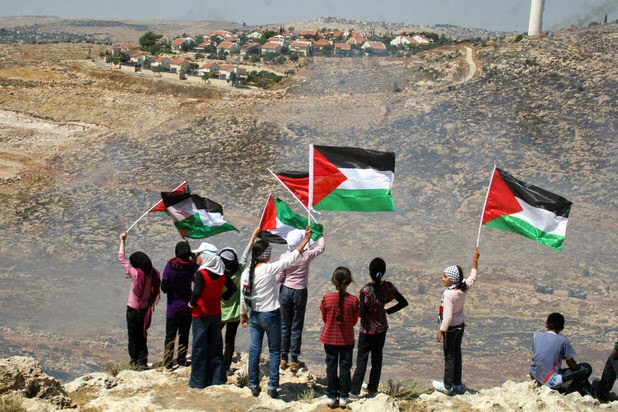
Palestinians protesting Illegal settlements

Active in the Israeli market since 1995, RE/MAX sells and rents houses and apartments in colonies reserved exclusively for Jews in the occupied West Bank, including East Jerusalem. Much of that work is coordinated in an office that the Israeli subsidiary of RE/MAX runs in Maale Adumim, a major settlement in the West Bank.

A United Nations report published last year suggested that the firm’s parent company in the US could be “held accountable” for assisting Israel’s crimes. RE/MAX International, which is headquartered in Denver, “has constant interaction and influence” over its franchises around the world. The company also provides “brand name affiliation,” training and other services, according to Richard Falk, the report’s author, who was then the UN special rapporteur for the West Bank and Gaza.

“Closet space” for settlers

On its website, RE/MAX offers properties in a number of settlement colonies in East Jerusalem, which has been under Israeli occupation since 1967. A four-room apartment with “lots of closet space” can be rented for 4,400 shekels ($1,100) per month. Among the apartment’s attractions listed by RE/MAX are proximity to the light rail system which links Israeli settlements in East Jerusalem to the city center.

Screen grab from RE/MAX Israel’s website

Such settlements violate the Fourth Geneva Convention, which forbids an occupying power from transfering its civilian population into a territory that it occupies.

Proespective settlers with a larger budget were recently offered what RE/MAX describes as “a beautiful old Arab house” in the Abu Tor neighborhood for 7 million shekels ($1.8 million).

Posing as a prospective buyer, an Electronic Intifada reporter phoned Orly Raz, a RE/MAX agent for East Jerusalem. Raz said that “we have just sold everything” that the firm was handling in Abu Tor.

Claiming that he would be moving to Jerusalem in early 2015, the reporter enquired if there would be any legal difficulties in buying a house or an apartment that previously belonged to Palestinians. “You don’t have to worry about these things,” Raz replied. “All our properties legally belong to Jewish owners. They didn’t take them from anyone.”

“Of course, if you are worried about the ‘67 border line, this is not a good area to buy property,” she added.

“Check very carefully”

Raz then asked: “Are you Jewish?” When the reporter responded that he was not, she said: “You have to check the properties — if their owners say they can sell an apartment to non-Jewish people.” She added, however, that such conditions are not mentioned on the firm’s website.

When the reporter feigned surprise that a real estate firm might discriminate based on religion or ethnicity, Raz said: “I’m just saying this is an issue to check very carefully.”

Ateret Cohanim, a Zionist organization, has been known to buy Palestinian homes in Abu Tor, so that they can be passed on to Israeli settlers.

Abu Tor has also witnessed considerable brutality by Israeli forces against its Palestinian residents lately. In late October, Israeli police officers broke into a house of a Palestinian living in Abu Tor, shooting him dead.

And in the first week of November, two Palestinian buildings were demolished in Abu Tor at the instruction of the Israeli authorities.

RE/MAX has enjoyed fawning coverage in the Israeli press. In 2004, the newspaper Haaretz published a profile of Bernard Raskin, the chief executive of RE/MAX Israel. Zimbabwean-born Raskin claimed that his firm had become a leading player in the Israeli property market because its competitors had “no professionalism.”

During a 2013 real estate conference in South Africa, Raskin noted that the Israeli economy has not suffered as severely as many others during the recession of recent years. One problem he identified was that “there is generally a shortage of stock.”

He added, however, that “more and more building is taking place outside of Tel Aviv, where property is expensive.”

Money from crime

The Israeli authorities have ensured that RE/MAX will have new business, thanks to the ongoing expansion of Jewish-only settlements in East Jerusalem and the wider West Bank. Earlier this month, the Israeli-controlled Jerusalem municipality announced that it had rubber-stamped the construction of new housing units in Ramot, a settlement in East Jerusalem. RE/MAX is already active in Ramot.

Although the US government says it is opposed to the construction of Israeli settlements, it has refused to impose sanctions on Israel. Because of that refusal, RE/MAX can continue turning violations of international law into a money-making opportunity.

The Colorado headquarters of RE/MAX International did not respond to requests for comment.

While the company’s Israeli operations may have some autonomy, RE/MAX International cannot claim that these matters have nothing to do with it. As the UN made clear in its aforementioned 2013 report, RE/MAX wields considerable influence over its franchises around the world.

The Palestinian-led boycott, divestment and sanctions movement has succeeded in putting the spotlight on how corporations like Veolia and G4S aid the Israeli occupation. Given that RE/MAX is so directly involved in the settlements that are central to that occupation, there is a strong case for putting the firm under the same kind of pressure. More


Amnesty: US Human Rights Abuses on Display in Ferguson

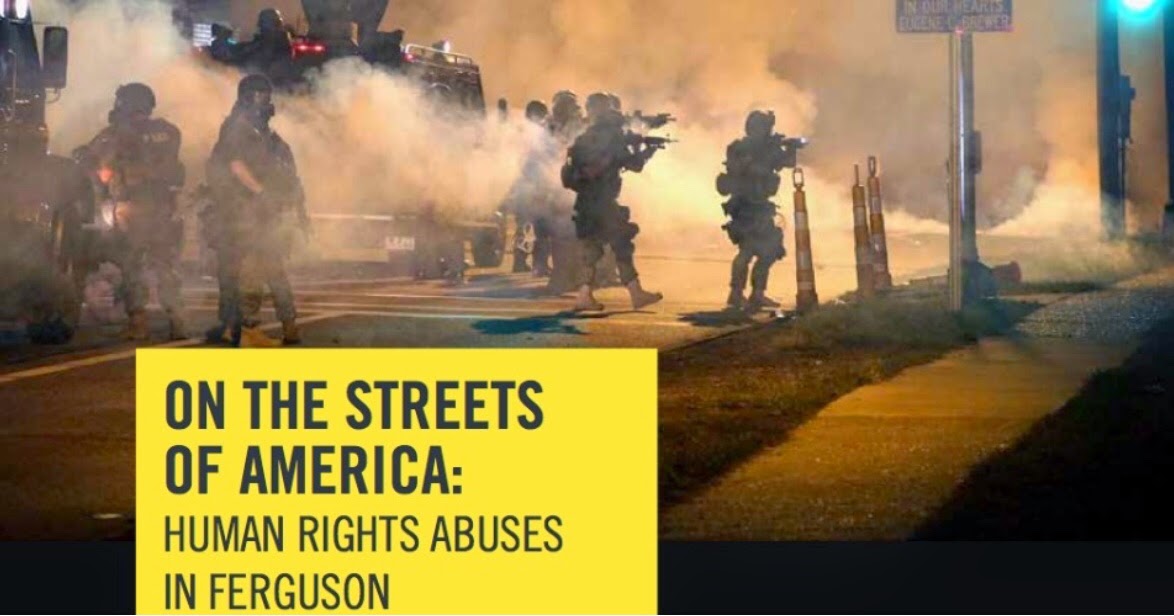
In a report released on Friday, Amnesty International roundly condemns the excessive force used by local law enforcement agencies in Ferguson, Missouri earlier this year and called for ‘accountability and systemic change’ in order to curb the kinds of human rights abuses increasingly seen in U.S. communities when it comes to regulating street protests and use of force by police.

The report—entitled On the Streets of America: Human Rights Abuses in Ferguson (pdf)—documents the human rights concerns witnessed first-hand by Amnesty investigators dispatched to Ferguson following initial protests in the city spurred by the shooting death of an unarmed African American teenager, Michael Brown, by a police officer Darren Wilson on August 9. The Amnesty team arrived and documented public protest and the behavior of local law enforcement from August 14 to August 22.

Amnesty’s report makes takes no position or determination on the killing of Brown, but says the shooting and his death “highlighted on a national level the persistent and widespread pattern of racially discriminatory treatment by law enforcement officers across the United States, including unjustified stops and searches, ill treatment and excessive, and sometimes lethal, use of force.”

Focused on both the community response to Brown’s death and the subsequent police reaction to protests, the report’s authors present what they witnessed first-hand in Ferguson in order to highlight some of the national trends of human rights abuses that often, though with less attention, take place in U.S. communities.

“What Amnesty International witnessed in Missouri on the ground this summer underscored that human rights abuses do not just happen across borders and oceans,” said Steven W. Hawkins, executive director of Amnesty International USA. “No matter where you live in the world, everyone is entitled to the same basic rights as a human being – and one of those rights is the freedom to peacefully protest. Standing on W. Florissant Avenue with my colleagues, I saw a police force, armed to the teeth, with military-grade weapons. I saw a crowd that included the elderly and young children fighting the effects of tear gas. There must be accountability and systemic change that follows this excessive force.”

According to the report:

The rights of peaceful assembly, freedom of association and freedom of expression are basic human rights. These rights are also guaranteed under the Constitution of the United States and the laws of the state of Missouri. The vast majority of those participating in the demonstrations in Ferguson that spontaneously grew in the days and weeks following the shooting Michael Brown have been peaceful – as noted by government officials such as the President of the United States, the Governor of Missouri and Attorney General along with the Missouri Highway Patrol. However, the responses by state officials and law enforcement to the violent actions of a limited number of protestors have impacted the rights of all participating in peaceful protests.

Overall, said Hawkins, “This is about accountability.”

“The events in Ferguson sparked a much-needed and long-overdue conversation on race and policing in America,” he said. “That conversation cannot stop. In order to restore justice to Ferguson, and every community afflicted by police brutality, we must both document the injustices committed and fight to prevent them from happening again. There is a path forward, but it requires substantive actions on the local, state and federal levels.”

In addition to documenting the abuses witnessed in Ferguson, the Amnesty report also puts forth a series of recommendations for local, state, and national agencies that include: better policies on use of force: calling for a thorough and transparent investigation into Brown’s death; improved policing standards of public protests; and a plea to end the unnecessay militarization of local police departments. More


Mismanaging Climate Change

Pakistan’s extreme vulnerability to climate change is not a scientific secret but is, in fact, a logical certainty owing to its geographic location, inclined elevation, as well as demographics.

Former Minister Malik Amin Aslam Khan

The issue directly impacts upon the country’s already volatile water dynamics driven by the northern glaciers and the seasonal monsoon rains and, if not managed properly, could burden our economy to the tune of $6-14 billion per year (United Nations Framework Convention on Climate Change NEEDS study 2010). In response to this challenge, Pakistan’s National Climate Change Policy has laid out a comprehensive ‘to do’ list for the government, which was approved by the government but, unfortunately, has not been acted upon by the authorities. Oblivious to this apathy and inaction, Pakistan continues to face a mammoth challenge to not only climate-proof its future development path, but also take steps to cope with an issue, which is here to stay. These steps include establishing early warning systems, effective flood plain management, improving weather forecasting with cross-border data exchange and enhancing the disaster preparedness, as well as emergency response capabilities to deal with predicted climate-induced natural disasters.

To their credit, previous governments did begin to take concrete institutional building measures, such as establishing a very high-level Prime Minister’s Cabinet Committee on Climate Change, setting up a dedicated Ministry of Climate Change built on the debris of a misguidedly devolved Environment Ministry and creating a focused climate research centre i.e., the Global Change Impact Studies Centre. However, in one stroke of convenient denial, the present government has undone and dismantled all those measures by downgrading the ministry to a division level, drastically cutting the funds for the division, leaving it headless without an appointed minister and also drying up all finances for the climate research centre. It is, thus, not surprising, that the country received a rude wake-up call when, during the recent floods, the forces of nature once again caught it totally off guard and institutionally ill-prepared to deal with a situation, which had been predicted and forewarned time and again by climate experts.

The 2014 flood came in two surges. The first surge occurred due to exceptionally high rainfall in the rivers Jhelum, Chenab, Ravi and their catchments. It is a recorded fact that the Pakistan meteorological office gave clear warnings about this enhanced rainfall activity, which were not heeded to in a timely manner. The result of this negligence was that the Mangla Dam remained filled to the brim, while storm waters gathered upstream and, subsequently, the floodgates were forced open at the worst possible time when water levels were already dangerously peaking downstream. Had the water been incrementally released, as advised, the massive flood surge that eventually occurred could have been effectively prevented. Dams remain a double-edged sword — if used intelligently, they can be the best tool for controlling and regulating floods, but if used improperly, as they were on this occasion, they can quickly convert floods into mega human disasters.

This first human-induced deluge was followed by the second flood surge that occurred due to the unpredictably high ‘cloud-burst’ in Indian-held Kashmir. The information about this second surge was also received hours in advance as the water roared down River Chenab. Again, our own meteorological office issued a timely flood peak warning, but again, the reaction time and response measures of our government were found severely lacking.

The floods were triggered by climate-induced cloud-bursts and monsoonal shifts, but the human tragedy and destruction got multiplied due to poor government planning, human negligence and a criminal mixture of absence and apathy of relevant institutional response mechanisms.

Climate related calamities, including more flooding and an enhanced frequency of freak natural events are, unequivocally, predicted for Pakistan and it is time to take these warnings seriously, and for the government to heed to them by planning to deal with the consequences, limiting the damage and adapting to this shifting scenario. The recent floods, which are surely not the last one, have also rudely exposed the human, economic and environmental costs to be paid for our politically motivated aversion to building large dams, as well as the suicidal trend of encroaching upon flood plains and continuing to challenge the flood water boundaries.

Pakistan lies at the geographic crossroads of melting glaciers, shifting monsoons and enhanced disaster activity. This locational risk cannot be changed, but how we deal with this looming catastrophe can certainly be changed. What it requires is better responsive measures and heeding to technical advice and scientifically based warnings with timely decisions.

The political optics of wading through floodwaters and post disaster bear hugs with destitute and frustrated victims is beginning to lose its vote-gathering lustre. As we haplessly subject millions to avoidable disasters, it is time to face up to reality. Climate-proofing of infrastructure, conserving the yearly deluge of water that is callously flushed into the Arabian Sea and effectively enforced flood plains management needs to get the priority it deserves. The politics of underpasses and overpasses has to give way to the politics of common sense, based on what Pakistan’s real challenges are and what it is predicted to face up to in the near future. Governing with confused priorities and institutional mismanagement will continue to worsen the responses forced upon us as we face up to the unpredictability of climate change. More

Published in The Express Tribune, October 19th, 2014.


Israel’s very own history of eugenics

This hour-long documentary, the Ringworm Children, raises so many disturbing questions about Israel and its relationship with the US that one hardly knows where to begin.

In the 1950s, waves of new immigrants swept into Israel. To the dismay of the country’s Ashkenazi leaders (those originating from Europe and the US), the great majority were from Arab countries. Levi Eshkol, a later prime minister, expressed a common sentiment when he called them “human rubbish”. Israel, deprived of “good-quality” Jews, was being forced to bring to its shores Arab Jews, seen as just as primitive and dirty as the Palestinians whom Israel had recently succeeded in ethnically cleansing.

Into this deeply racist atmosphere stepped Dr Chaim Sheba, a eugenicist, who believed that the Arabs Jews were bringing along with them diseases that threatened the Ashkenazi Jews. His obsession was ringworm, an innocuous childhood disease that affects the scalp. He went to the US, collected old military X-ray equipment and zapped tens of thousands of these children’s heads with potentially lethal doses of radiation. The survivors tell of their horrifying experiences during and after the treatment, and of the brothers and sisters they lost at a young age.

But this isn’t just a history lesson exploring an unusual aspect of Israel’s racist underpinnings. The documentary exposes a massive cover-up by the state: many of the children’s medical files – long thought to have been lost – were actually held by one of the doctors involved. Even after this disclosure, the state has continued to refuse the victims access to the files, despite the fact that such access may be vital in helping them receive the correct life-saving treatment, as well as proper compensation.

The final shocking twist is the discovery that all these experiments cost the equivalent of hundreds of millions of dollars in today’s terms – in fact, more than Israel’s entire annual budget at the time. How could Israel have afforded it?

The documentary suggests persuasively that the US, with its own long fascination with eugenics, most likely sub-contracted these experiments to Israel as a way to bypass the increasing domestic legal impediments it faced. The US presumably footed the huge bill.

There are a couple of troubling omissions in the documentary itself. The first is that Dr Sheba did not carry out these experiments on Arab Jews only. He also exposed many Palestinian children in Israel to the same huge doses, for the same racist reasons.

The other is that Dr Sheba is still venerated to this day in Israel and has one of the country’s most famous hospitals, the Chaim Sheba Medical Center, named after him. As the documentary makes clear, there was plenty of evidence by the 1950s of the extremely dangerous effects of radiation on humans. What Dr Sheba did was a form of genocide. That he is still honoured in Israel is, to my mind, no different from Germany naming a hospital in Berlin the Josef Mengele Medical Center.

But keeping Dr Sheba’s reputation unblemished is, I suspect, important to those who wish to prevent other, even more unseemly skeletons being unearthed over this affair.

(UPDATE BELOW)

The documentary, from 2003, is in five 10-min parts: More

UPDATE:

I often talk about “hasbara” (what Israelis translate as “explanation” but really means “propaganda”) but rarely have I found an example of it quite as blatant as the entry on the Ringworm Affair on Wikipedia. By the look of it, this entry has been written by an Israeli government hasbara team. One can almost hear the indignation in the text dismissing the documentary’s claims. But interestingly there is no attempt to refute the two accusations at the heart of the film: that the medical files are still being withheld from the victims, and that the sum needed for the experiments was astronomical and way beyond Israel’s means. So who paid for them and why?