Commentary: Christopher Jorebon Loeak – President of the Republic of the Marshall Islands


This is the transcript of a video “address to the world” released by President Loeak on 18 September 2014 ahead of the UN Secretary-General's Climate Summit. The full video can be viewed here.https://www.youtube.com/watch?v=i8t7ElMPS_8

Out here in the middle of the Pacific Ocean, climate change has arrived.

In the last year alone, my country has suffered through unprecedented droughts in the north, and the biggest ever king tides in the south; and we have watched the most devastating typhoons in history leave a trail of death and destruction across the region.

Lying just two meters above sea level, my atoll nation stands at the frontline in the battle against climate change. The beaches of Buoj where I use to fish as a boy are already under water, and the fresh water we need to grow our food gets saltier every day. As scientists had predicted, some of our islands have already completely disappeared, gone forever under the ever-rising waves. For the Marshall Islands and our friends in the Pacific, this is already a full-blown climate emergency.

Some tell us that we should begin planning to leave. But how can we? And why should we? These islands are our home. They hold our history, our heritage and our hopes for the future. Are the world's polluters asking us to give up our language, our culture, and our national identity? We are not prepared to do that – we will stay and fight. If the water comes, it comes.

Brick by brick, I built the seawall behind me with my own hands. But even this is barely enough to protect my family from the encroaching waves. Last year, after returning from a visit to the United Nations in New York, I was so shocked by the damage from the rising tides that I added another foot of bricks to the wall.

In the Marshall Islands we have a saying – “Wa kuk wa jimer”. It means that we are all in the same boat together. What is happening here is a mere preview of the havoc that awaits if we continue with our polluting ways. If my country goes, others will surely follow. We are the canary in the coalmine.

The climate crisis is forcing us to take matters into our own hands, both at home and on the international stage. Last year the Marshall Islands hosted the largest-ever Pacific Islands Forum Leaders' meeting in Majuro and it remains one of the proudest moments of my Presidency.

The big outcome was the Majuro Declaration for Climate Leadership, a powerful message from the world's most vulnerable countries to the big emitters that surround us that the time for talk is over, and the time for action is now. Our efforts had an impact with the United States, the European Union, the United Kingdom, Mexico and Japan all committing to be climate leaders, and to do more to tackle climate change. At this time last year, I presented the Declaration to UN Secretary-General Ban Ki-moon, and promised to bring the spirit of Majuro to his Climate Change Leaders' Summit in New York, which is now less than a week away.

The Summit comes not a moment too soon. It is the first gathering of world leaders on climate change in nearly five years, and just over a year before our deadline to sign a new global treaty on climate change in Paris at the end of 2015.

Paris cannot be another Copenhagen. The world has changed too much. The science is more alarming, the impacts more severe, the economics more compelling, and the politics more potent. Even the world's two biggest polluters – China and the United States – are working together to find a pathway to a new global agreement.

But there are still some that seek to slow us down.

To my fellow world leaders I say “next week's Summit is a chance for all of us to be the leaders we were elected to be”. We must send a strong and united message to the world – and to the people that we represent – that we are ready to do a deal next year. And to avoid the worst impacts of a warmer world, this new deal must capture a vision for a carbon-free world by the middle of the century. Without it, no seawall will be high enough to save my country. Together, we must find the courage to rise to this challenge. It is time to build the greatest climate change alliance the world has ever seen.

My people are counting on it, as is all of humanity.

Christopher J. Loeak is the President of the Republic of the Marshall Islands


Whether We Engage or Do Nothing… This Changes Everything

The following is an excerpt taken from the introduction of Naomi Klein's newly published book, This Changes Everything: Capitalism vs. the Climate, and appears at Common Dreams with permission from the book's publisher Simon & Shuster. All rights reserved.

“Most projections of climate change presume that future changes—greenhouse gas emissions, temperature increases and effects such as sea level rise—will happen incrementally. A given amount of emission will lead to a given amount of temperature increase that will lead to a given amount of smooth incremental sea level rise. However, the geological record for the climate reflects instances where a relatively small change in one element of climate led to abrupt changes in the system as a whole. In other words, pushing global temperatures past certain thresholds could trigger abrupt, unpredictable and potentially irreversible changes that have massively disruptive and large-scale impacts. At that point, even if we do not add any additional CO2 to the atmosphere, potentially unstoppable processes are set in motion. We can think of this as sudden climate brake and steering failure where the problem and its consequences are no longer something we can control.” —Report by the American Association for the Advancement of Science, the world’s largest general scientific society, 2014

“I love that smell of the emissions.” — Sarah Palin, 2011

I denied climate change for longer than I care to admit. I knew it was happening, sure. Not like Donald Trump and the Tea Partiers going on about how the continued existence of winter proves it’s all a hoax. But I stayed pretty hazy on the details and only skimmed most of the news stories, especially the really scary ones. I told myself the science was too complicated and that the environmentalists were dealing with it. And I continued to behave as if there was nothing wrong with the shiny card in my wallet attesting to my “elite” frequent flyer status

Climate change is… hard to keep it in your head for very long. We engage in this odd form of on-again-off-again ecological amnesia for perfectly rational reasons. We deny because we fear that letting in the full reality of this crisis will change everything. And we are right.”

A great many of us engage in this kind of climate change denial. We look for a split second and then we look away. Or we look but then turn it into a joke (“more signs of the Apocalypse!”). Which is another way of looking away.

Or we look but tell ourselves comforting stories about how humans are clever and will come up with a technological miracle that will safely suck the carbon out of the skies or magically turn down the heat of the sun. Which, I was to discover while researching this book, is yet another way of looking away.

“Climate change is… hard to keep it in your head for very long. We engage in this odd form of on-again-off-again ecological amnesia for perfectly rational reasons. We deny because we fear that letting in the full reality of this crisis will change everything. And we are right.”

Or we look but try to be hyper-rational about it (“dollar for dollar it’s more efficient to focus on economic development than climate change, since wealth is the best protection from weather extremes”)—as if having a few more dollars will make much difference when your city is underwater. Which is a way of looking away if you happen to be a policy wonk. Or we look but tell ourselves we are too busy to care about something so distant and abstract—even though we saw the water in the subways in New York City, and the people on their rooftops in New Orleans, and know that no one is safe, the most vulnerable least of all. And though perfectly understandable, this too is a way of looking away.

Or we look but tell ourselves that all we can do is focus on ourselves. Meditate and shop at farmers’ markets and stop driving—but forget trying to actually change the systems that are making the crisis inevitable because that’s too much “bad energy” and it will never work. And at first it may appear as if we are looking, because many of these lifestyle changes are indeed part of the solution, but we still have one eye tightly shut.

Or maybe we do look—really look—but then, inevitably, we seem to forget. Remember and then forget again. Climate change is like that; it’s hard to keep it in your head for very long. We engage in this odd form of on-again-off-again ecological amnesia for perfectly rational reasons. We deny because we fear that letting in the full reality of this crisis will change everything. And we are right.

We know that if we continue on our current path of allowing emissions to rise year after year, climate change will change everything about our world. Major cities will very likely drown, ancient cultures will be swallowed by the seas, and there is a very high chance that our children will spend a great deal of their lives fleeing and recovering from vicious storms and extreme droughts. And we don’t have to do anything to bring about this future. All we have to do is nothing. Just continue to do what we are doing now, whether it’s counting on a techno-fix or tending to our gardens or telling ourselves we’re unfortunately too busy to deal with it.

All we have to do is not react as if this is a full-blown crisis. All we have to do is keep on denying how frightened we actually are. And then, bit by bit, we will have arrived at the place we most fear, the thing from which we have been averting our eyes. No additional effort required.

There are ways of preventing this grim future, or at least making it a lot less dire. But the catch is that these also involve changing everything. For us high consumers, it involves changing how we live, how our economies function, even the stories we tell about our place on earth. The good news is that many of these changes are distinctly un-catastrophic. Many are downright exciting. But I didn’t discover this for a long while.

“All we have to do is not react as if this is a full-blown crisis. All we have to do is keep on denying how frightened we actually are. And then, bit by bit, we will have arrived at the place we most fear, the thing from which we have been averting our eyes. No additional effort required.”

I remember the precise moment when I stopped averting my eyes to the reality of climate change, or at least when I first allowed my eyes to rest there for a good while. It was in Geneva, in April 2009, and I was meeting with Bolivia’s ambassador to the World Trade Organization (WTO), who was then a surprisingly young woman named Angélica Navarro Llanos. Bolivia being a poor country with a small international budget, Navarro Llanos had recently taken on the climate portfolio in addition to her trade responsibilities. Over lunch in an empty Chinese restaurant, she explained to me (using chopsticks as props to make a graph of the global emission trajectory) that she saw climate change both as a terrible threat to her people—but also an opportunity.

A threat for the obvious reasons: Bolivia is extraordinarily dependent on glaciers for its drinking and irrigation water and those white-capped mountains that tower over its capital were turning gray and brown at an alarming rate. The opportunity, Navarro Llanos said, was that since countries like hers had done almost nothing to send emissions soaring, they were in a position to declare themselves “climate creditors,” owed money and technology support from the large emitters to defray the hefty costs of coping with more climate-related disasters, as well as to help them develop on a green energy path.

She had recently given a speech at a United Nations climate conference in which she laid out the case for these kinds of wealth transfers, and she gave me a copy. “Millions of people,” it read, “in small islands, least developed countries, landlocked countries as well as vulnerable communities in Brazil, India and China, and all around the world—are suffering from the effects of a problem to which they did not contribute. . . . If we are to curb emissions in the next decade, we need a massive mobilization larger than any in history. We need a Marshall Plan for the Earth. This plan must mobilize financing and technology transfer on scales never seen before. It must get technology onto the ground in every country to ensure we reduce emissions while raising people’s quality of life. We have only a decade.” More


At Climate March in New York, a Clarion Call for Action

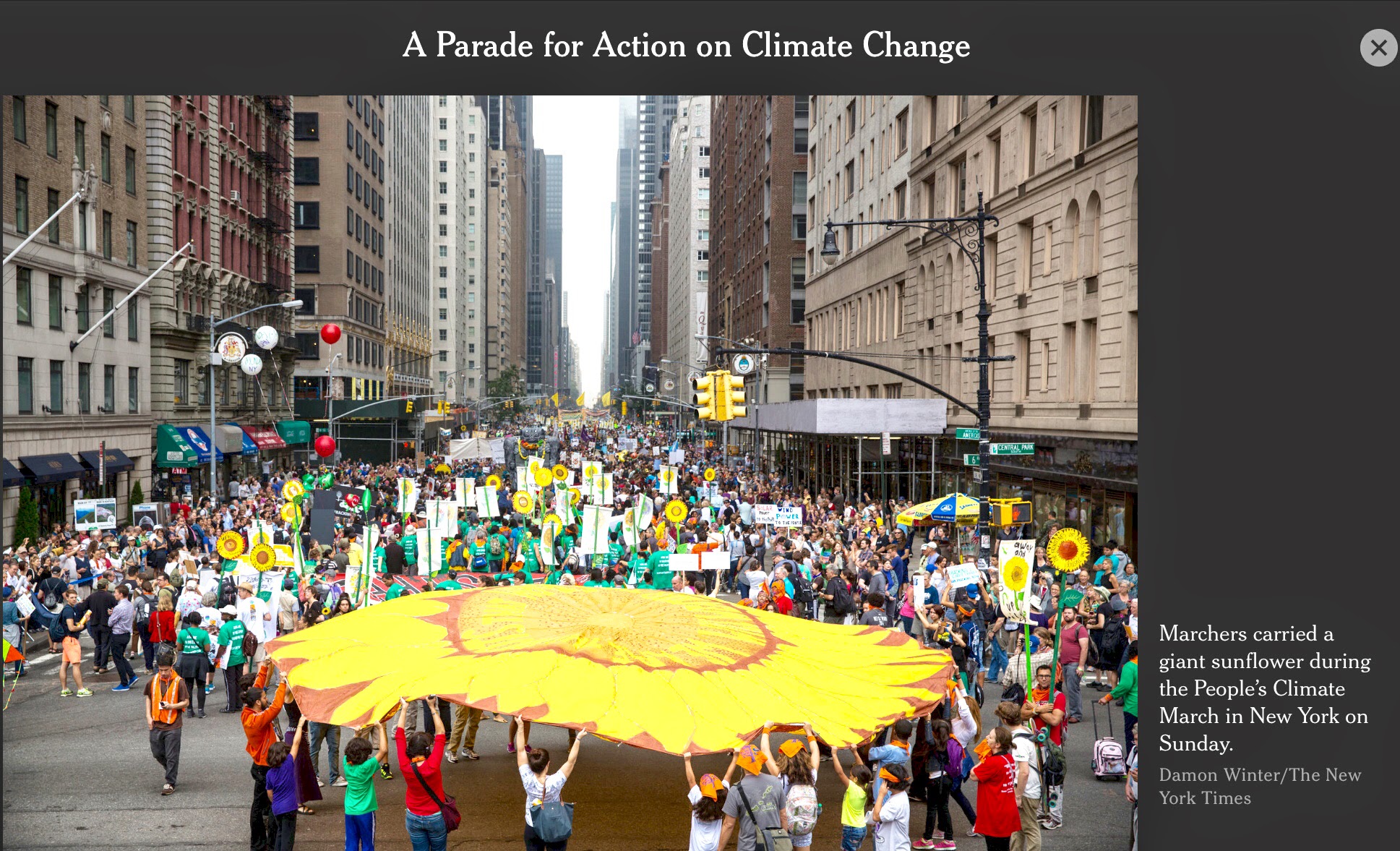
After months of planning, the People’s Climate March began rolling through a large swath of Midtown Manhattan on Sunday, taking public frustration over stalled efforts to curb carbon emissions to the streets in a noisy, vivid display of unity.

At 11:30 a.m., the march began moving east along 59th Street from Columbus Circle, proceeding along a circuitous, two-mile route, and drawing labor and immigrant groups, students and politicians, scientists and religious leaders. The march will turn south on Avenue of the Americas, head west on 42nd Street to 11th Avenue and finish at 34th Street.

The protest comes two days before a climate summit at the United Nations, which will be attended by President Obama. The meeting is expected to create a framework for a potential global agreement on emissions late next year in Paris.

The timing of the march is significant in another regard. Last week, meteorologists at the National Oceanic and Atmospheric Administration announced that this summer — the months of June, July and August — was the hottest on record for the globe, and that 2014 was on track to break the record for the hottest year, set in 2010.

“Climate change is no longer an environmental issue; it’s an everybody issue,” Sam Barratt, a campaign director for the online advocacy group Avaaz, which helped plan the march, said on Friday.

“The number of natural disasters has increased and the science is so much more clear,” he added. “This march has many messages, but the one that we’re seeing and hearing is the call for a renewable revolution.”

Mayor Bill de Blasio of New York, whose administration announced this weekend a sweeping plan to overhaul energy efficiency standards in all city-owned buildings, is among the high-profile participants expected to join the march, including the United Nations secretary general, Ban Ki-moon; former Vice President Al Gore; the actors Leonardo DiCaprio and Mark Ruffalo; at least two United States senators; and one-third of the New York City Council.

Additionally, nearly 2,700 climate events are planned in more than 150 countries to coincide with the march, considered the centerpiece of the international protest. They range from a small rally in Tanzania, to major demonstrations from Berlin to Bogata.

On Sunday morning, participants from across the country began to arrive at the staging area near the American Museum of Natural History. Rosemary Snow, 75, stretched her legs after a nearly 14-hour bus drive from Georgia.

“I thought we’d have a lot of younger people on the bus,” said Ms. Snow, who made the trip with her grandson. “There’s a really great mix of people.”

Ms. Snow had traveled with dozens of others who came from different parts of the state, including Valdosta, Savannah and Atlanta.

A professor at the University of Georgia, Chris Cuomo, from Decatur, Ga., said the group was organized by the Georgia Climate Change Coalition.

She said she hoped their presence at the rally would “let the rest of the world know that people from small-town America, urban America, rural America care about climate change.”

Nearby, Ahni Rocheleau of Santa Fe, N.M., was seated while eating a breakfast of organic yogurt and buckwheat pancakes. She is a member of the Great March for Climate Action, a cross-country walk to raise awareness for alternative and sustainable energy practices.

“We hope the heart and mind of the people will be awakened,” she said. “Coal is not the way to go.”

The march was expected to tie up traffic across a broad area of Manhattan, from the Upper West Side through Midtown. In a traffic advisory, the police braced the public for the closing of dozens of streets along the route. A lane for emergency vehicles, however, was kept open.

Nearly 500 buses have been bringing marchers from South Carolina, Kansas, Minnesota and Canada, while a “climate train” transported participants from California.

Marchers assembled before 11:30 a.m. north of Columbus Circle, specifically along Central Park West between 65th and 86th Streets, which the police planned to use as a staging area. A number of pre-march events were planned in the vicinity of Columbus Circle, including a labor event on Broadway, an interfaith religious service on West 58th Street and a rally by scientists outside the Hayden Planetarium on West 81st Street.

At 12:58 p.m., a moment of silence will be followed by a blare of noise — a symbolic sounding of the alarm on climate change — from horns, whistles and cellphone alarms. More than 20 marching bands and tolling church bells will contribute to the cacophony.

There will be no speeches, but the march will end with a block party on 11th Avenue between 34th and 38th Streets. There, participants can get a closer look at many of the floats and other artwork created for the march, including a 30-foot inflatable life preserver, 100 sunflowers and a model of the New York City skyline with bicyclists powering its lights.

New York’s political establishment was set to come out in force. On Friday, Mayor de Blasio announced on Twitter his intention to join the protest. “Proud to walk in #PeoplesClimate March on Sunday,” he wrote. “It’s everyone’s responsibility to leave a livable planet for the next generation.”

At least 17 council members planned to march. In a nod to the event, the Council announced a related package of bills on Friday aimed at reducing the city’s carbon footprint by connecting unemployed New Yorkers to green jobs, making buildings more energy-efficient and promoting low-carbon transportation. The legislation seeks an 80 percent reduction in the city’s greenhouse gas emissions by 2050.

With its bands and colorful floats, the march offers a festive atmosphere, but organizers said that the underlying message was somber. “We are trying to celebrate our lives and this planet in order to show that this is what we are fighting for,” said Leslie Cagan, the logistics coordinator for People’s Climate March. “It’s the human spirit — and everything else on this planet — that is in danger.”

The march was organized by a dozen environmental, labor and social justice groups, including the Sierra Club, Avaaz, New York City Environmental Justice Alliance, 350.org, the Transport Workers Union Local 100 and 1199 S.E.I.U. In addition, more than 1,570 “partner organizations” have signed on to march.

Organizers were hoping that the warm weather forecast for the day would yield a large turnout.

“Our biggest problem is the financial power of the fossil fuel industry,” said Bill McKibben, co-founder of 350.org and author of “The End of Nature.”

“We can’t match that money,” he said. “So we have to work in the currency of movements — passion, spirit, creativity and bodies — and it will all be on display on Sunday.” More


Curbing climate change: The deepest cuts

ON SEPTEMBER 23rd 120-odd presidents and prime ministers will gather in New York for a UN meeting on climate change. It is the first time the subject has brought so many leaders together since the ill-fated Copenhagen summit of 2009.


Now, as then, they will assert that reining in global warming is a political priority. Some may commit their governments to policies aimed at reducing greenhouse-gas emissions. What few will say is how many tonnes of carbon dioxide these will save—because they almost never do.

According to scientists, cutting carbon-dioxide emissions is an essential part of reducing catastrophic risks from climate change. Yet governments are persistently averse to providing estimates of how much carbon a policy saves. That may be because, in countries where climate change is controversial, it makes more sense to talk about the other benefits a scheme offers rather than its effect on carbon. Or it may be that, in countries which are enthusiastic about renewable energy, pointing out that it may not save that much carbon is seen as unhelpful. Or perhaps governments think climate change is so serious that all measures must be taken, regardless of cost (though their overall lacklustre record suggests this is not the case).

Whatever the reason, the end result is that while the world’s governments have hundreds of policies for tackling climate change, some of them very expensive—China, America and the European Union spend $140 billion a year on subsidising renewable energy—it is hard to say which policies are having the greatest effect.

So The Economist has made a stab at a global comparison of carbon-mitigation efforts. Chart 1 is the result. It ranks 20 policies and courses of action according to how much they have done to reduce the atmosphere’s stock of greenhouse gases. We have used figures from governments, the EU and UN agencies. As far as we know, this exercise has not been carried out before.

Apples, meet oranges

First, a health warning: the policies and actions on our list are not strictly comparable. Some are global, some regional and some national. Some are long-standing; some new. A couple are not policies at all, such as the collapse of the Soviet Union, which led to the closure of polluting factories and to inefficient state farms reverting to grassland, locking up carbon.

And the numbers almost all come with caveats. It is fairly easy to estimate how much carbon a new field full of solar cells or a nuclear-power plant saves by looking at the amount of electricity it produces in a year and how much carbon would have been emitted if fossil fuels had been used instead, based on the local mix of coal, gas and oil. But as Paul Joskow of the Massachusetts Institute of Technology has pointed out, the standard “levelised” calculations, which divide the total amount of power a plant will produce over its lifetime by its total lifetime cost, are a poor way to compare fossil fuels and renewable energy.

Other measures have problems, too. Take the effects of fuel-efficiency standards. Would companies have curtailed their cars’ emissions anyway to sell more of them to cost- and mileage-conscious drivers? And how much has better fuel efficiency encouraged drivers to drive farther?

A further complication is that many policies have benefits beyond—or indeed closer to hand than—those they offer in terms of climate. Burning less coal saves lives in the near future as well as reducing climate risks in decades to come. Saving forests preserves wildlife, not just carbon.

So our table should be treated with caution. It is only safe to say that one policy is better than another in climate terms if it beats it by a wide margin.

As it happens, though, there are some very wide margins to be found. One policy stands head and shoulders above all others. And it is one that few people other than climate-policy specialists will have thought of in this context: the Montreal protocol, a 1987 agreement to phase out substances such as chlorofluorocarbons (CFCs) used in air conditioners, refrigerators and so on. It was enacted to limit the damage such substances were doing to the ozone layer, a goal which it has achieved.

Like carbon dioxide and many other gases emitted by industry and agriculture—methane and nitrous oxide, for example—CFCs are greenhouse gases. And they are extremely potent ones, causing thousands of times more warming per molecule than carbon dioxide does. That means stopping CFC production, which was in the range of millions of tonnes a year, delivered a climate benefit equivalent to cutting carbon-dioxide emissions by billions of tonnes.

Collateral benefits

Guus Velders of the Dutch National Institute for Public Health and the Environment has compared the warming effect that would have come about if the emissions of such chemicals had continued to grow at the rate they were growing before the protocol with what has come about thanks to their banning. The net effect is equivalent to that of a whopping 135 billion tonnes of carbon dioxide. That is more than twice today’s total annual greenhouse-gas emissions, which are equivalent to about 50 billion tonnes of carbon dioxide (carbon dioxide itself makes up about three-quarters of that, with methane, nitrous oxide and some gases used in industry making up the rest). Durwood Zaelke of the Institute for Governance and Sustainable Development, a think-tank, says that if CFCs were uncontrolled the annual figure would be 8 billion tonnes higher. The Montreal protocol has had nearly as big an effect as all the rest of our list put together.

Trailing some way behind the Montreal protocol is a small group of measures—not really climate policies—that have been responsible for avoiding between 4% and 7% of greenhouse-gas emissions. According to the International Atomic Energy Agency, nuclear power avoided the production of 2.2 billion tonnes of carbon dioxide in 2010—that is, emissions would have been 2.2 billion tonnes higher if the same amount of electricity had been produced by non-nuclear plants. Energy from dams and other hydroelectric sources avoided 2.8 billion tonnes (though emissions of methane from the reservoirs behind some of those dams mean the net effects were less than that). Between them they generated 6,000 terawatt-hours of electricity in 2011, compared with 450TWhrs for wind and less than 60TWhrs for solar. The high rate at which new wind and solar capacity is being built will eat into this lead, but it will take some time to overturn it.

The other item in this group is something of a cheat. In 2007 Su Wei of China’s foreign ministry said that his country’s one-child policy, by reducing the number of births between the late 1970s and the mid-2000s by 300m, had reduced carbon emissions by 1.3 billion tonnes in 2005 (because there were fewer people to consume goods which generated greenhouse gases in their production). Taking this argument further, one could say that the fall in global fertility since 1960 cut emissions even more. That is not exactly a climate policy. But it is a reminder that greenhouse gases are powerfully influenced by factors far beyond the scope of climate-change policies.

Three other lessons emerge. First, policies to slow or reverse deforestation are more important than one might expect. Trees absorb carbon as they grow and release it when they are cut down. According to a recent study in Science, declining deforestation in Brazil meant that the country produced 3.2 billion tonnes less atmospheric carbon dioxide between 2005 and 2013 than it would have if the tree-felling had continued unabated. That is 400m tonnes a year. The slowdown in deforestation in tropical countries is one of the reasons that the conversion of forests to farmland now accounts for only 11% of greenhouse-gas emissions globally, much less than 20 years ago.

The other reason for deforestation’s dramatically reduced share of total emissions, though, is that industrial emissions of carbon dioxide have continued to grow rapidly. The rise is not as fast as it might have been. Rules that make vehicles more efficient and improve the energy efficiency of buildings and appliances have done more than might be expected. America has been setting standards for vehicle greenhouse-gas emissions and fuel efficiency since the mid 1970s; the current rules are forecast to reduce carbon-dioxide emissions by 6 billion tonnes in 2012-25, meaning by about 460m tonnes a year. America’s Department of Transportation reckons that overall such rules have reduced carbon-dioxide emissions by a cumulative 14 billion tonnes. Europe’s equivalent regulations for passenger cars and light trucks do less (European vehicles were more efficient to start with) but are still respectable; being adopted by overseas manufacturers who want to sell cars in Europe gives them an unquantified extra clout. More


It’s clear that prosperity and climate change action can go hand in hand

The UK has been at the forefront of integrating climate change action into economic decision-making

The link between economic growth and action to reduce the risks of climate change is the focus of the New Climate Economy report issued on Tuesday.

Its credentials are impressive and its findings emphatic.

Released by a global commission of 24 global economic leaders from government, business, finance and academia, led by former president of Mexico Felipe Calderón, the year-long study has involved individuals from over 100 organisations across every continent and advised by a panel of world-leading economists chaired by Lord Nicholas Stern.

It has come to a clear conclusion – action on climate change can improve economic performance.

This report provides compelling further evidence that firmly supports the UK’s vision for a global climate deal in Paris 2015 that I launched last week in the city of London – which was clear that prosperity and climate action can go hand in hand.

The reason, the New Climate Economy report concluded, is that raising resource efficiency, stimulating innovation and new investment in infrastructure are making it possible to tackle climate change at the same time as improving economic performance.

That means new opportunities to improve growth, create jobs, boost company profits and spur innovation for all countries that take action now.

The report finds that over the next 15 years, trillions of pounds could be saved by building low-carbon into the key sectors of the global economy that include our cities, agriculture and energy. This could include better connected and more compact cities, through to restoring degraded lands and focusing on a transition to clean energy to improve economic performance and quality of life with lower emissions.

And we are putting this into action. The UK has been at the forefront of developing the climate change policy architecture that can ensure climate action is integrated into economic decision making.

This includes the 2008 Climate Change Act, which was the world’s first long-term, legally-binding national framework for reducing emissions, through our innovative carbon budgets regime. This means that our five year carbon budgets – that will eventually reach out to 2050 – are now being looked at as a potential model in other countries and we have already delivered on our first budget, which has seen a reduction in UK emissions by 24% between 1990 and 2012.

The 2013 Energy Act, for example, is creating the world’s first low-carbon electricity market and we are attracting record amounts of investment in renewables and our low carbon business sector is booming. In renewables, almost £29bn of investment delivered since 2010 and 2013, was a record year – with £8bn invested across the range of renewables technologies.

Electricity generation from renewable sources has doubled since 2010 and now supplies over 15% of the UK’s electricity.

We’re now a world leader in offshore wind – with more installed offshore wind capacity than the rest of the world combined, and supporting 18,300 jobs in the UK.

It has required UK business and international investors to recognise the costs of failure and the benefits of change and it has been sustained by a strong, vocal and committed network of NGOs, pressure groups and activists who have been instrumental in sustaining political will and public acceptance.

Last year, the world’s leading climate scientists, under the IPCC, reaffirmed that the Earth’s climate is indisputably changing, that human activity is the dominant cause – and the longer we leave action, the more difficult and costly it will be to avoid the worst effects. We now have the economics confirming that not only is climate action required to reduce climate risks, but that it is vital to building long-term, sustainable economic growth.

In the run up to the UN climate meeting in Paris next year I am determined that we continue to build on our success at home and expend every effort, and work with determination across government, across the parties, in partnership with business and civil society to reach a global, comprehensive, legally binding climate change deal. More


Why We March

On Sunday, September 21st, a huge crowd will march through the middle of Manhattan. It will almost certainly be the largest rally about climate change in human history, and one of the largest political protests in many years in New York.

More than 1,000 groups are coordinating the march — environmental justice groups, faith groups, labor groups — which means there’s no one policy ask. Instead, it’s designed to serve as a loud and pointed reminder to our leaders, gathering that week at the United Nations to discuss global warming, that the next great movement of the planet’s citizens centers on our survival and their pathetic inaction.

As a few of the march’s organizers, though, we can give some sense of why we, at least, are marching, words we think represent many of those who will gather at Columbus Circle for the walk through midtown Manhattan.

We march because the world has left the Holocene behind: scientists tell us that we’ve already raised the planet’s temperature almost one degree Celsius, and are on track for four or five by century’s end. We march because Hurricane Sandy filled the New York City subway system with salt water, reminding us that even one of the most powerful cities in the world is already vulnerable to slowly rising ocean levels.

We march because we know that climate change affects everyone, but its impacts are not equally felt: those who have contributed the least to causing the crisis are hit hardest, here and around the world. Communities on the frontlines of global warming are already paying a heavy price, in some cases losing the very land on which they live. This isn’t just about polar bears any more.

And we march for generations yet to come, our children, grandchildren and their children, whose lives will be systematically impoverished and degraded. It’s the first time one century has wrecked the prospects of the millennia to come, and it makes us mad enough to march.

We march with hope, too. We see a few great examples around the world of how quickly we could make the transition to renewable energy. We know that if there were days this summer when Germany generated nearly 75% of its power from renewable sources of energy, the rest of us could, too — especially in poorer nations around the equator that desperately need more energy. And we know that labor-intensive renewables would provide far more jobs than capital-intensive coal, gas and oil.

And we march with some frustration: why haven’t our societies responded to 25 years of dire warnings from scientists? We’re not naïve; we know that the fossil fuel industry is the 1% of the 1%. But sometimes we think we shouldn’t have to march. If our system worked the way it should, the world would long ago have taken the obvious actions economists and policy gurus have recommended — from taxing carbon to reflect the damage it causes to funding a massive World War II-scale transition to clean energy.

Marching is not all, or even most, of what we do. We advocate; we work to install solar panels; we push for sustainable transit. We know, though, that history shows marching is usually required, that reason rarely prevails on its own. (And we know that sometimes even marching isn’t enough; we’ve been to jail and we’ll likely be back.)

We’re tired of winning the argument and losing the fight. And so we march. We march for the beaches and the barrios. We march for summers when the cool breeze still comes down in the evening. We march because Exxon spends $100 million every day looking for more hydrocarbons, even though scientists tell us we already have far more in our reserves than we can safely burn. We march for those too weak from dengue fever and malaria to make the journey. We march because California has lost 63 trillion gallons of groundwater to the fierce drought that won’t end, and because the glaciers at the roof of Asia are disappearing. We march because researchers told the world in April that the West Antarctic ice sheet has begun to melt “irrevocably”; Greenland’s ice shield may soon follow suit; and the waters from those, as rising seas, will sooner or later drown the world’s coastlines and many of its great cities.

We don’t march because there’s any guarantee it will work. If you were a betting person, perhaps you’d say we have only modest hope of beating the financial might of the oil and gas barons and the governments in their thrall. It’s obviously too late to stop global warming entirely, but not too late to slow it down — and it’s not too late, either, to simply pay witness to what we’re losing, a world of great beauty and complexity and stability that has nurtured humanity for thousands of years.

There’s a world to march for — and a future, too. The only real question is why anyone wouldn’t march. More


Ongoing drought in Brazil brings rising tensions

The western USA is not the only place suffering from lack of rain, Latin America’s economic powerhouse has been struck hard by a powerful and ongoing water crisis.

The worst drought since records began 84 years ago has constrained the Brazillian economy in many ways, particularly coffee production, agriculture and hydroelectric power generation, which accounted for 80% of electricity generation. This power fuels the economic development on which millions are counting to rise out of poverty, and the loss has slowed the entire economy, due to the need to import expensive fossil fuels in order to keep the lights on and water pumps running (costing $6 billion extra so far this year, while increasing the country’s greenhouse gas emissions).


Water rationing has been imposed in many parts of the country for months, but the situation is approaching a critical point. Nineteen large cities are under water rationing rules, and the water catchment capacity feeding the megalopolis of Sao Paolo (20 million inhabitants and the economic capital of the entire continent) is down to 10%. Carefully husbanded, and tapping water usually deemed of inferior quality, there is enough left to squeeze out of the system for a hundred days consumption. States are now squabbling over allocation of the remaining water resources, and fighting has erupted sporadically in some rural areas.

In Sao Paolo itself, financial incentives to reduce consumption have been accompanied by cutting water pressure at night, effectively cutting off all the poorer areas of the city which sit on hills. In nearby Gaurulhos residents of some neighbourhoods are getting water one day in three. Balancing the competing needs of drinking water and power generation is also having societal consequences, exacerbating general social tension, and helping fuel reactions such as the protests and riots back in June.

The drought may be linked to climate change, since the rains that normally come south from evaporation in the Amazon basin failed to arrive, a potentially very worrying symptom. It also reveals some of the likely types of economic cost and societal tension that will arise and worsen as the world warms further and the consequences begin to bite. Some early spring rains appeared in Brazil this week, enough at least to halt the fall in Sao Paolo’s reserves, but the prognosis for the coming rainy season is still very uncertain.

Via Facebook –The Earth Story

Image credit: Reuters/Nacho Doce

http://www.theguardian.com/weather/2014/sep/05/brazil-drought-crisis-rationing
http://www.reuters.com/article/2014/02/12/us-brazil-economy-fiscal-idUSBREA1B1CY20140212
http://phys.org/news/2012-05-worst-drought-years-toll-northern.html


ECLAC, CARICOM Highlight Vulnerabilities, Opportunities in Caribbean SIDS

3 September 2014: During a side event at the Third International Conference on Small Island Developing States (SIDS), representatives of Caribbean SIDS and the UN discussed critical factors that underpin the vulnerability of Caribbean SIDS.


‘The vulnerability of Caribbean SIDS revisited – it's all about size' took place in Apia, Samoa, on 3 September 2014, and was organized by the Economic Commission for Latin America and the Caribbean (ECLAC) in collaboration with the Caribbean Community (CARICOM) Secretariat.


Speakers discussed trade and finance, governance and institutional capacity, disaster management, regional integration and opportunities arising from the small size of SIDS, as well as the fact that the majority of Caribbean SIDS are classified as middle-income countries, based on gross domestic product (GDP).


Raúl García-Buchaca, ECLAC, said middle-income status based on GDP fails to consider inequalities at the national level. John Ashe, President of the UN General Assembly (UNGA), focused on the particular vulnerabilities of Caribbean SIDS, and suggested mainstreaming them into the post-2015 development agenda. Winston Dookeran, Minister of Foreign Affairs, Trinidad and Tobago, called for working with development partners and international financial institutions to build buffers to external shocks, and declared that “Size may well be an opportunity rather than a limitation.”


Carolyn Rodrigues-Birkett, Minister of Foreign Affairs, Guyana, said the Caribbean would require over 7% growth to be sustainable, and mentioned the challenge in diversifying Caribbean economies within the new global economic order. Camillo Gonsalves, Minister of Foreign Affairs, Saint Vincent and the Grenadines, said that because of their small GDP, SIDS are unable to finance adaptation and recovery from natural disasters, and recommended regional integration, development financing, preferential trade, and debt relief and restructuring to assist in this regard.


Participants also introduced a vulnerability-resilience profile for arriving at an index, said the SIDS resilience fund could be a good measure in this regard, and underscored that the human capital must be recognized, public policy revolutionized, and political structure transformed. [ECLAC Press Release] [Statement of UNGA President] More


UN Climate Summit 2014

Climate change is not a far-off problem. It is happening now and is having very real consequences on people’s lives. Climate change is disrupting national economies, costing us dearly today and even more tomorrow. But there is a growing recognition that affordable, scalable solutions are available now that will enable us all to leapfrog to cleaner, more resilient economies.UN Climate Summit 2014

There is a sense that change is in the air. UN Secretary-General Ban Ki-moon has invited world leaders, from government, finance, business, and civil society to Climate Summit 2014 this 23 September to galvanize and catalyze climate action. He has asked these leaders to bring bold announcements and actions to the Summit that will reduce emissions, strengthen climate resilience, and mobilize political will for a meaningful legal agreement in 2015. Climate Summit 2014 provides a unique opportunity for leaders to champion an ambitious vision, anchored in action that will enable a meaningful, global agreement in Paris in 2015. More


UN Special Envoy Highlights Urgency of Climate Agreement

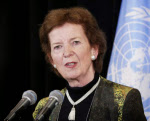
2 September 2014: Small island developing States (SIDS) leaders “really want a climate agreement,” according to Mary Robinson, the UN Special Envoy for Climate Change. Speaking on the margins of the Third International Conference on SIDS, Robinson stressed the urgent need to build climate resilient communities and reduce greenhouse gas (GHG) emissions.

Mary Robinson UN Special Envoy

Robinson has been meeting with SIDS leaders, UN officials and donors to discuss climate change impacts at the Conference. She stated that, while SIDS leaders are engaged in actions to establish and expand partnerships, build capacity and increase financing, they also support an agreement on climate change.

Noting that climate change has traditionally been a focus for ministers of environment and energy, Robinson underscored the importance for Heads of State to address climate change. “Once you have a Head of State focused [on climate change], it becomes a holistic issue,” according to Robinson.

Looking forward, Robinson highlighted the UN Secretary-General's Climate Summit, which will take place on 23 September 2014, in New York, US. She said her role will be to “encourage the importance of the urgency of getting a climate agreement” and called for Heads of State to say what their country will do to address climate change. Robinson underscored the importance of engaging with civil society and the private sector on climate negotiations to ensure a “good, robust, fair climate agreement.” More