Brazil Vows Water Supply Is Under Control as Basins Dry

The state of Sao Paulo is facing its worst drought in eight decades, threatening the water supplies for 20 million people — but you wouldn’t know that by asking Brazil’s elected officials.

Sao Paulo Governor Geraldo Alckmin, who is seeking re-election in October, has been minimizing the crisis for the region, which includes South America’s largest city. The reaction is a far cry from the response in drought-stricken California, where Governor Jerry Brown has declared a state of emergency and residents are being fined for watering their lawns.

Sao Paulo state is already rationing water for more than 2 million people in 18 cities. The capital city’s main reservoir is now at only 12 percent of capacity, according to the water utility Cia. de Saneamento Basico do Estado de Sao Paulo, known as Sabesp. While the utility received a warning at the end of July that it risks running out of drinking water in 100 days, officials vow the situation is under control.

“Sao Paulo is denying this crisis because we are in the middle of the political campaign,” said Joao Simanke, a hydrogeologist consultant who worked for Sabesp for more than two decades. “The crisis is already in place and it is getting worse, but until now it has been possible to mask it.”

Blaming unusual weather in a city traditionally known as “drizzly Sao Paulo,” Alckmin denied last week he was slow to respond to the drop in the city’s main reservoir, which began in May 2013, because of the political cost of rationing.

“The situation in Sao Paulo is serious, but it is under control,” Mauro Arce, water resources secretary for the state, said in a telephone interview.

Reduced Flow

While Brazil’s largest city isn’t rationing water, thousands of residents are already complaining of reduced flow from their taps in the past two months.

In February, Sabesp began offering 30 percent discounts to customers who cut consumption by at least 20 percent of their 12-month average. The utility is spending money on special equipment to pull water known as “dead volume” from the very bottom of the Cantareira reservoir and to get supplies from other reservoirs.

In California, an estimated 82 percent of the state is experiencing extreme drought. Most of its major reservoirs are at less than half of capacity, state records show, as residents face restrictions on car washes and restaurants only serve water to customers who request it.

Spring Rains

Relief may be slow to come before more Sao Paulo residents have to contend with water limits. According to weather forecaster Climatempo, the spring season that starts in September will bring rains at or below historical averages — not enough to refill basins. The drenching El Nino rains that caused floods in southern Brazil won’t travel far enough north to help refill reservoirs in Sao Paulo.

Sao Paulo’s water situation is “scary,” given the historical humid weather condition of the region, said Benedito Braga, president of World Water Council, an international organization that promotes awareness of water issues.

“Sao Paulo’s situation is not devastating such as the California’s situation, because the American state has experienced droughts many times,” he said. “We have never seen anything similar in Sao Paulo, so we are in an uncomfortable situation.”

Sao Paulo should be already adopting more measures in an attempt to reduce water usage, such as a progressive water rate in which consumers pay more for exceeding a certain level of water consumption, said Braga, who was on the board of Brazil’s national water agency from 2001 to 2009.

‘Serious’ Situation

Sao Paulo’s water resources secretary said there’s no need to adopt more measures to reduce demand and pressure on the city’s water reservoirs. The government isn’t minimizing the crisis and it’s reaching out to increase awareness of the issue, Arce said. Irrigation in the upper reaches of rivers is already being limited, he said.

“The situation is serious and we are dealing with it with the seriousness it deserves,” Arce said. Sabesp says its voluntary demand reduction programs are working and some, including Gesner Oliveira, a consultant who served as Sabesp’s president from 2007 to 2010, agree.

“The set of measures adopted were correct to manage the situation of water scarcity,” said Oliveira.

But reductions in demand haven’t held steady. In July, water consumption in Sao Paulo rose as tourists filled the city for the World Cup soccer tournament and fewer people joined the consumption reduction program, Sabesp executives said on an Aug. 19 conference call.

Water Fines?

“The water saving campaign is not enough to avoid a bigger problem and people don’t exactly know what is going on,” said Samuel Barreto, a coordinator with the Nature Conservancy. “The government must better inform the population.”

Sao Paulo’s governor press office didn’t respond to a phone call seeking comment.

Marco Antonio Barros, superintendent of water production of Sabesp, downplayed the possibility the company would fine customers for excessive water use, saying such penalties took a long time to be established in California. Limiting secondary uses of water, for washing cars and other non-drinking consumption, is possible, he said.

According to a July report by Citigroup Inc., if the water flow remains below average for the remainder of the year, the Cantareira reservoir “will dry up by December in spite of the use of dead-storage volume.”

Sabesp expects to be able to supply water until the rainy season ends in March and says the chance of rationing in the capital by the end of the year is zero. Recovery of its reservoirs in the first months of the next season is unlikely “even if it rains a lot,” Sabesp Chief Financial Officer Rui Affonso said on the conference call. “The constancy of the rains is what matters.” More

To contact the reporter on this story: Vanessa Dezem in Sao Paulo at vdezem@bloomberg.net

To contact the editors responsible for this story: Reed Landberg at landberg@bloomberg.net Tina Davis, Randall Hackley


DIARIES: LIVE FROM PALESTINE “A clumsy army beating Palestinians into submission”: TIME correspondent’s Nablus diary from 1990

An excerpt from the unpublished memoirs of the former TIME journalist Murray J. Gart describing the occupied West Bank city of Nablus at the height of the first intifada, or uprising, could have been written today.

Murray J. Gart interviews Yasser
Arafat on a plane en route to
Baghdad on 25 October 1988

Closure under the pretext of “security,” tear gas and lethal fire against unarmed protesters was what Gart observed in the city in 1990.

Gart’s granddaughter, Brooke DeNisco, says of her grandfather that “the Middle East was his passion and he spent years living and traveling there.”

When he retired from TIME, the publication with which he spent most of his career, Gart “began working on a book about the Middle East peace process, but died in 2004 before its completion. I inherited some of the notes and drafts for the book, including a narrative of five weeks he spent living in the West Bank,” DeNisco explains.

“My grandfather was proudly Jewish and enjoyed traveling often to Israel,” she adds. “He voted for Ronald Reagan and was a member of George Bush Sr.’s Council on Foreign Affairs.”

The following “is a small excerpt from his pages of notes about his experiences in Nablus, forty miles north of Jerusalem in the occupied West Bank,” DeNisco told The Electronic Intifada. “He wrote on the manuscript that this is a draft and had not been thoroughly fact-checked.”

The excerpt from Murray J. Gart’s memoirs follows.

Nablus, occupied West Bank, 1990

Though I was there only five weeks, it was long enough for a good look at Nablus life.

I had to remind myself of the baggage I carried, limitations of culture, sense of history, background and language. But, after twenty years of visits to Israel, I was also aware that my experiences and preparations for the trip, including long interviews for TIME with Ariel Sharon and Yasser Arafat would help to shield me from being unfair.

I had tried to reach Nablus the previous year but was turned away by Israeli soldiers who said the city was a closed “security zone.” An invitation to consult at An-Najah National University got me into the West Bank’s most active cultural and political center. But when I arrived, the university’s campus was as closed as a tomb and prohibited from opening or operating.

By the end of the week I became accustomed to bursts of Israeli gunfire, exploding gas and other disturbing noises of daily urban warfare.

Distracted

One of my first mornings in Nablus I was distracted by heavy gunfire. When I leaned out my open first-floor window, I saw fires in my street at the corner of a walled schoolyard, teenage boys running and teachers shouting.

The yard filled with smoke, driving students into the school directly opposite my window. I could see cannisters landing, exploding and spewing out more smoke. In seconds, the gas got my face and forced me to fall back and grope my way blindly to the bathroom for a wet towel. When I was able to look out the window again, perhaps ten minutes later, there wasn’t a person in sight outdoors. Later the ashes and rubble were cleaned up. The job was done by Palestinians rousted from passing cars and made to do it by soldiers pointing guns.

The Israelis had turned the most vital center of Palestinian life into something resembling a vast, maximum security prison. That at least, was how it felt from the inside.

Armed troops did all the work of police, tightly controlled every life in the city and dispensed summary justice. They guarded entry and exit roads like prison gates and enforced Israel’s iron-fist occupation rules, which in practice meant repressive martial-law measures like collective punishment and preventive detention.

They used force to suppress the slightest hint of civil resistance, and responded to nonviolent protest with the force of lethal arms. To conceal these conditions to the world, the city was almost always a “closed military zone” which barred entry by the press, diplomats, clergy and anyone else the army chose to keep out.

There was no one to witness the real conditions of the Nablus lockup. Twenty-four hours a day every day of their lives, residents saw soldiers, as I did, close by on foot and in vehicles keeping relentless house-to-house pressure on every neighborhood. They broke into private homes, mosques and even hospital operating rooms, leaving a tornado-like aftermath.

A lot of residents have died. Doctors in Nablus said the number of wounded or dead was probably ten to twenty times more than reported. Injuries from beatings and stonings, illnesses made worse by gas, including the loss of human fetuses ran into the thousands.

Dozens of Nabulsis were dragged off daily for interrogations, beatings, jailing or imprisonment, without trial, for terms that can last years. On walks or from my window, it was common to see people carted off in military vehicles. A command car drove past me with two feet in white sneakers sticking out the rear. Inside, the prisoner’s face was being smashed into the floor by an Israeli soldier’s boot.

No safety

In Nablus I met old and young people, activists, businessmen, doctors, writers, lawyers and students. Not one of them felt safe or secure anywhere in town, and I came to understand why. Thousands of violent incidents, few of them ever reported, had touched the life of every person in town.

They stated their views respectfully, but asked me heated questions about American policy. The bitterness they felt toward the US for supporting Israel against the Palestinians poured out. They saw the American-Israeli alliance as hostile and directed against them.

A tall fellow about twenty put it this way: “Americans send bullets and gas for Israelis to shoot at us. Why do you hate us too?” When asked, I stated frankly the unwelcome opinion that the US will not, as Palestinians I met almost universally hope it will, punish Israel if it does not leave the West Bank and Gaza.

My biggest discovery was that there was no big discoveries to be made about the conflict beyond its awesome scope and pervasiveness, and the degree to which Israel had come to rely on brute force dealt out by a clumsy army to beat Palestinians into submission.

I saw what I already knew, but somehow had refused to believe could be happening in the same Jewish state meant to shelter an oppressed people. It was why the Palestinians in lands Israel rules under martial law so passionately oppose occupation, why they hate Israelis and why they feel so strongly that their struggle must continue, whatever the cost. They do believe they have little left to lose. Murray J. Gart, 1990 More


Small islands to sign historic treaty in Samoa

Small islands to sign historic treaty in Samoa, to help finance climate change adaptation

Representatives from 31 small islands and low lying countries that are members of the Alliance of Small Island States (AOSIS) will reaffirm their commitment to the Small Island Developing States (SIDS) Sustainable Energy mechanism – SIDS DOCK – at an Official Ceremony for the Opening of Signature for the Statute Establishing the SIDS DOCK, on 1 September 2014, during the upcoming United Nations (UN) Third International Conference on SIDS, in Apia, Samoa, from 1-4 September. The opening for signature of this historic SIDS-SIDS Treaty is a significant highlight and outcome of the Conference, and a major step toward the treaty’s entry into force.

Representatives scheduled to attend the ceremony confirmed their continuing support for, and preparation to sign the Statute as soon as possible, and reiterated their resolve to continue cooperating to achieve its prompt entry into force and to support the SIDS DOCK goal of 25-50-25 by 2033: Island Energy For Island Life. SIDS need to mobilize and facilitate in excess of USD 20 billion by 2033, about USD 1 billion per year, to help finance the transformation of the SIDS energy sector in order to achieve a 25 percent (from the 2005 baseline) increase in energy efficiency, generation of a minimum of 50 percent of electric power from renewable sources, and a 25 percent decrease in conventional transportation fuel use, in order to significantly increase financial resources to enable climate change adaptation in SIDS.

The Hon. Roosevelt Skerrit, Prime Minister and Minister of Foreign Affairs and Finance, for the Commonwealth of Dominica, and acting in his country’s capacity as Chair of the SIDS DOCK Steering Committee, said that SIDS DOCK represents a significant achievement in solidifying SIDS-SIDS relationships and cooperation and is, “an extraordinary lesson learned of what can happen when a genuine partner takes ‘a chance’ on a new and innovative idea that has the potential to help SIDS adapt and become more resilient to the changing climate and sea level rise.” Recognising that the lives of more than 20 million people in small islands and low lying states are at high risk, the majority of them young people, the Government of Denmark was the first country to provide support for SIDS DOCK start-up activities with a grant of USD 14.5 million in 2010, during climate talks in Copenhagen, Denmark. This gesture and demonstration of support was followed by a grant of USD 15 million, over two years in 2011, from the Government of Japan during climate talks in Cancun, Mexico.

In March 2014, in partnership with the United Nations Industrial and Development Organization (UNIDO), the Government of Austria extended support under a Memorandum of Understanding, with a grant of 1 million euros, for start-up activities for Centres for Renewable Energy and Energy Efficiency in the Caribbean (CCREEE), the Pacific (PCREEE), and support to African SIDS through the Economic Community of West African States (ECOWAS) ECREEE in Cabo Verde, and at a later date, support for a centre in the Indian Ocean region (IOCREEE). The new centres will also act as SE4ALL Hubs, assisting SIDS to translate commitments to actions. SIDS DOCK is highly complementary to the work being done under the Sustainable Energy For All (SE4All) Initiative, a personal initiative of the UN Secretary-General, Ban Ki-moon, that has SIDS as the largest group of signatories and with the highest ambitions.

During the Third International Conference on SIDS, the Government of Samoa and its people will host hundreds of representatives from small islands and low lying states, donors, investors and civil society groups, to what is expected to be the most important conference on SIDS to date, and one that is expected to define SIDS in a Post-2015 world, with genuine partnerships at the core of the agenda. SIDS DOCK is well-positioned to participate in the SIDS Post-2015 Agenda with its partners, the Governments of Denmark, Japan and Austria; the United Nations Development Programme (UNDP) and the United Nations Industrial and Development Organization (UNIDO); The World Bank; and The Clinton Foundation – Clinton Climate Initiative (CCI).

During the Signing Ceremony on September 1, the Dominican Prime Minister will invite other members of the AOSIS to consider joining the organisation. The Statute will remain open for signature in Apia, Samoa until September 5, and will re-open for signature in Belmopan, Belize, from September 6, 2014 until it enters into force. Belize is the host country for SIDS DOCK, with Samoa designated as the location for the Pacific regional office. More


USA-Israel vs. Arab-Muslim Worlds: What Happens? – by Johan Galtung

25 Aug 2014

Nothing good. But let us have a look at it in the standard peace studies way: Diagnosis-analyzing, Prognosis- forecasting, and Therapy–remedies, even solutions.

Johan Galtung

“Israel-Palestine” is the discourse Tel Aviv-Washington prefers. They have all the strong cards: overwhelming military power, political veto in the United Nations Security Council, the economic upper hand in interlocking economies–not just oil cash from Saudi Arabia-Qatar–and the idea of working for a solution with Washington as “mediator”–only USA can bring the two together, gently or roughly–toward a sustainable peace.

It is needed a great distance from reality to believe in that spin. USA and Israel are interlocked by a much deeper tie: they came into being in the same way; flagging a divine mandate for a land without a people for a people without a land. Goes one goes the other.

Palestine is also part of something much bigger than itself: the Arab people with its tortured history of 500 years of colonialism and imperialism, and the religion of Islam. Two nationalisms, carried by Fatah and Hamas in Palestine, both potentially giving rise to a much bigger state, Arabia (not only Saudi), and to a region, the Islamic Umma, beyond an organization of the Islamic Community (of states).

USA is co-responsible for the current Israeli genocide in Gaza and seen as such by most of the world. Hate one hate the other.

Israeli expansion implies conflict with neighbors and their neighbors into the Arab-Muslim worlds. Your problems are my problems say the USA. So far. But one layer deeper is the US hyphenation of Judaism and Christianity to Judaeo-Christianity, leaving out the third Abrahamic religion. The stark reality is three religions hating and killing each other through millennia–but the hyphen, like in Israel-USA, calls for an alliance of 2 against 1. A political program.

Add to this the three imperialisms suffered by the Arab nation. Four centuries Ottoman Empire; four decades English-French imperialism from Sykes-Picot to Nasser; US-Israeli imperialism to make the Middle East region safe for Israel and democracy. However, democracy is rule by the consent of the ruled, not colonialism-imperialism by the consent–so far–of the demos in the rulers, USA and Israel.

The collisions are massive, involving ever more of the huge Muslim part of the world beyond the Arab part. How will this evolve?

More fear, more hatred; more terrorism, more state terrorism. USA-Israel will probably keep the military superiority for some time. But much else is happening. Both are heading downhill in the sense of losing the support they had. USA is losing its world hegemony–even within NATO where Germany de facto is siding more with Russia than with the USA over Ukraine–and Israel by its fall from the moral high grounds into the immoral abyss even among the many deeply touched by the shoa. Israel aggravates its own situation by gluing the etiquette “anti-Semitic” to its increasingly numerous and powerful critics.

But where are the Arab and Muslim worlds heading? Not downhill.

The Ottoman Empire was a relatively benign Sunni “family of nations” with a caliphate also centered in Istanbul. No effort to recreate an Arabia ruled by Turkey is acceptable to the Arab nation. But also unacceptable is Sykes-Picot Western colonialism with four colonies or “mandates”; Iraq-Palestine, Syria-Lebanon. Blindness, ignorance or stupidity is needed to be surprised at the Islamic State (IS). Sykes-Picot could not stand, but the US invasion from 2003 reified those artificial creations, one of them in the meantime divided by the UK into Israel-rump Palestine-Jordan. IS was highly predictable: extremist brutality bred by oppression, and a vision: An ottoman empire with a caliphate without a special role for Turkey.

Without Sykes-Picot no Balfour, without Balfour no Israel. The Ottoman Empire had no Israel. A problem of USA-Israel’s own making.

Patrick Cockburn in the London Review of Books 21 Aug 2014 points to a third of Syria and a quarter of Iraq, with a population beyond Denmark, quickly conquered, heading for Baghdad and Damascus–the capitals of two major Islamic dynasties. Assad may fall, so may al-Maliki’s successor(s). Al Qaeda will join IS. Their problem is Iran and the Kurds, possibly with US-engineered wars that may unravel as such. We will soon see. Imagine IS conquering Baghdad, what happens to the megalomaniac US embassy? IS uses Saddam Hussein assets like the Tikrit clan and his military. But Saddam reified Sykes-Picot as Iraq’s ruler installed by the USA till he turned against them in 1988 in the Arab-Persian Gulf.

Anyhow, stop the present IS and a new will emerge out of the same Arab nation holism and dialectic; much stronger forces in the longer run than USA-Israel on a downhill slope with the USA possibly heading for racist fascism at home and abroad. But how about Islam?

Two major factors in its favor. The counter-cyclical pendulum between Christian and Islamic dominance–up for one means down for the other being so similar–is moving from the Christian-secular toward the Islamic pole. One factor is Islam’s message of togetherness and sharing, very attractive to the victims of egocentrism, greed and inequality in the Western world. Add to that something similar to the IS factor: the long term move toward an Islamic umma, not a state system ruled by kings-emirs-sultans, even against theshahada.

And who created so much of that state system? The West, through its colonialism. What we witness today is not only IS but all over Muslim youth trying to be the umma, uniting across even colonial borders, between Iraq and Syria–like the Tutsi bridge between anglophone, francophone and afrophone Africa. Be the future you want.

Solutions beyond USA-Israel going down and the Arab-Muslim worlds up? Yes: dialogue, searching together for how all four could become masters in their own house and only that. The challenge of the century.

__________________________________

Johan Galtung, a professor of peace studies, dr hc mult, is rector of the TRANSCEND Peace University-TPU. He is author of over 150 books on peace and related issues, including ‘50 Years-100 Peace and Conflict Perspectives,’ published by the TRANSCEND University Press-TUP.

Editorials and articles originated on TMS may be freely reprinted, disseminated, translated and used as background material, provided an acknowledgement and link to the source, TRANSCEND Media Service-TMS, is included. Thank you.

Click here to download this article as a PDF file.

This article originally appeared on Transcend Media Service (TMS) on 25 August 2014.

This work is licensed under a CC BY-NC 3.0 United States License.


Geothermal Power Approaches 12,000 Megawatts Worldwide

In 2013, world geothermal electricity-generating capacity grew 3 percent to top 11,700 megawatts across 24 countries. Although some other renewable energy technologies are seeing much faster growth—wind power has expanded 21 percent per year since 2008, for example, while solar power has grown at a blistering 53 percent annual rate—this was geothermal’s best year since the 2007-08 financial crisis.

Geothermal power’s relatively slower growth is not due to a paucity of energy to tap. On the contrary, the upper six miles of the earth’s crust holds 50,000 times the energy embodied in the world’s oil and gas reserves. But unlike the relative ease of measuring wind speed and solar radiation, test-drilling to assess deep heat resources prior to building a geothermal power plant is uncertain and costly. The developer may spend 15 percent of the project's capital cost during test-drilling, with no guarantee of finding a viable site.

Once built, however, a geothermal power plant can generate electricity 24 hours a day with low operation and maintenance costs—importantly because there is zero fuel cost. Over the life of the generator, geothermal plants are often cost-competitive with all other power sources, including fossil fuel and nuclear plants. This is true even without considering the many indirect costs of fossil- and nuclear-generated electricity that are not reflected in customers’ monthly bills.

The top three countries in installed geothermal power capacity—the United States, the Philippines, and Indonesia—account for more than half the world total. California hosts nearly 80 percent of the 3,440 megawatts of U.S. geothermal capacity; another 16 percent is found in Nevada.

Despite having installed more geothermal power capacity than any other country, the United States currently generates less than 1 percent of its electricity from the earth’s heat. Iceland holds the top spot in that category, using geothermal power for 29 percent of its electricity. Close behind is El Salvador, where one quarter of electricity comes from geothermal plants. Kenya follows at 19 percent. Next are the Philippines and Costa Rica, both at 15 percent, and New Zealand, at 14 percent.

Indonesia has the most ambitious geothermal capacity target. It is looking to develop 10,000 megawatts by 2025. Having only gained 150 megawatts in the last four years, this will be a steep climb. But a new law passed by the government in late August 2014 should help move industry activity in that direction: it increases the per-kilowatt-hour purchase price guaranteed to geothermal producers and ends geothermal power’s classification as mining activity. (Much of Indonesia’s untapped geothermal resource lies in forested areas where mining is illegal.) Even before the new law took effect, geothermal company Ormat began construction on the world’s largest single geothermal power plant, a 330-megawatt project in North Sumatra, in June 2014. The plant should generate its first electricity in 2018.

Indonesia is just one of about 40 countries that could get all their electricity from indigenous geothermal power—a list that includes Ecuador, Ethiopia, Iceland, Kenya, Papua New Guinea, Peru, the Philippines, and Tanzania. Nearly all of them are developing countries, where the high up-front costs of geothermal development are often prohibitive.

To help address this mismatch of geothermal resources and funds, the World Bank launched its Global Geothermal Development Plan in March 2013. By December, donors had come up with $115 million of the initial $500 million target to identify and fund test-drilling for promising geothermal projects in the developing world. The Bank hopes that the experience gained from these projects will lead to lower costs for the geothermal industry overall. This would be good news on many fronts—simultaneously reducing energy poverty, air pollution, carbon emissions, and costly fossil fuel imports. More


Why Island Wisdom Is Crucial to Help the World Adapt and Prepare for the Im

For decades, small island countries have been warning the world about the consequences of climate change. While many countries have been debating whether climate change is even happening or who is to blame, small islands have just had to deal with its impact, from extreme weather to rising sea levels and increasing environmental vulnerability.

Major storms have always been a fact of life for small islands. But in recent years they have intensified in their destructive capabilities. In 2004, Hurricane Ivan struck the Caribbean island of Grenada, causing widespread destruction. The financial cost of the disaster was estimated at more than $900 million – more than twice the country’s gross domestic product (GDP). Only 10 months later, the country was hit again, this time by Hurricane Emily, which caused another $50 million in damage.

In the Caribbean, changes in hurricane intensity and frequency could eventually result in additional annual losses of $450 million, largely due to disruption of a key source of revenue and jobs: tourism. Limited diversification and small market size means that small island economies are not resilient to disaster loss. This is true not just in the Caribbean, but the world over.

According to global risk models developed by the UN Office for Disaster Risk Reduction (UNISDR), six of the top 10 countries with the greatest proportion of resources at risk during hurricanes or cyclones are small islands. These losses will only increase due to sea-level rise, water scarcity, drought, and other factors.

The 38 small island developing states, which spread across the Caribbean, the Pacific and Indian Oceans, are not sitting and waiting for the next storm to hit. They have been taking measures to adapt to and manage the risks posed by climate change.

Several Caribbean islands came together seven years ago to create an insurance pool of easy-to-access disaster funding. Spreading the risk across countries reduces premiums and provides contributors with a safety net which can fund vital services when disaster strikes. Since 2007, more than $30 million has been paid out by the 16 participating countries. A similar initiative is under way in the Pacific region where the memories of the massive human toll and devastation due to Typhoon Haiyan that claimed more than 6,000 lives in the Philippines last November are still all too vivid.

Ideas and actions for reducing the risk from disasters will be at the forefront of the United Nations Conference on Small Island Developing States, to be held in Samoa from 1-4 September. The Conference will be a showcase for those living on the frontlines of climate change and could have a lasting and positive influence on the post-2015 development agenda.

The Conference is an acknowledgement by all the countries of the world of the unique circumstances that small island developing countries face. Their size, combined with their remoteness, and economies of scale, have made it that much more difficult for small islands to implement measures to become resilient. This is compounded by the impacts of climate change, a problem that is hardly of their own making as they collectively contribute less than 1 per cent of total greenhouse gas emissions. In fact, many are striving to become carbon neutral by using renewable energy, improving energy efficiency, and offsetting their greenhouse gas emissions.

Next week’s conference in Samoa is the first of two critical global gatherings. Just a few weeks later, on 23 September in New York, UN Secretary-General will host heads of State, CEOs and civil society leaders at the Climate Summit. The Summit aims to spur accelerated and ambitious actions to reduce emissions and build resilience to climate change worldwide, from the largest countries to the smallest island States. It’s about turning promises into performance.

With international attention on small islands, climate change and the post-2015 framework for disaster risk reduction, there has never been a better chance to turn the tide. Now is the time to listen, support and partner with those who have seen first-hand what climate change can do to your economy and your community. It would be one of the greatest tragedies of our time to continue to ignore the warnings from small islands; their issues will soon become our own. More

_________________

Han Seung-soo is the UN Secretary-General’s Special Envoy for Disaster Risk Reduction and Water and former Prime Minister of the Republic of Korea


UN Outlines Expectations for SIDS Conference


21 August 2014: The UN announced key outcomes that are expected from the Third International Conference on Small Island Developing States (SIDS) taking place in Apia, Samoa, on 1-4 September, including over 300 new, SIDS-focused partnerships that will be monitored for their achievements.


Wu Hongbo, Secretary-General of the SIDS Conference and UN Under-Secretary-General for Economic and Social Affairs, highlighted that the preparatory process leading to the Conference has already produced an agreed outcome document, called the SIDS Accelerated Modalities of Action Pathway, or ‘SAMOA Pathway.' He said the early agreement on the outcome document clears the way for the Conference itself to focus on developing partnerships that will support ‘concrete and focused actions' to tackle the specific development issues faced by SIDS.


The document outlines agreed actions in the areas of economic growth, decent work, climate change, and health and non-communicable diseases (NCDs). Wu stressed that governments alone will not be able to deliver sustainable development, and that partnerships with the private sector and civil society will be needed.


A UN press release said that heads of 21 UN agencies will attend the Samoa conference, and that the UN Department of Economic and Social Affairs (DESA) will continue to maintain a SIDS partnerships platform, and will monitor the implementation of SIDS-focused initiatives. More


IISD Reporting Services will be providing daily coverage of the four pre-conference fora, the conference plenary sessions and six Partnership Dialogues, and selected side events. [UN Press Release] [SAMOA Pathway] [SIDS Conference Website] [IISD RS Meeting Coverage]


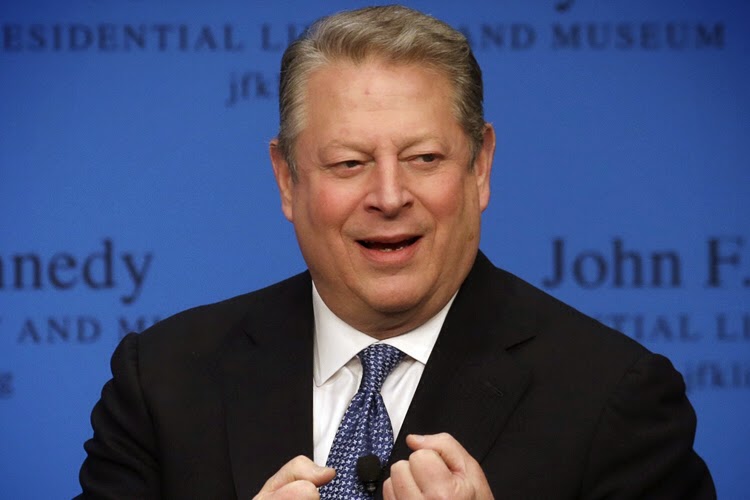
Al Gore’s “Turning Point”

Eight years after Al Gore wrote a book and made a movie to impress upon us the “planetary emergency of global warming” (his subtitle for An Inconvenient Truth), he wrote an article with a more optimistic feel- ing in the 18 June 2014 issue of Rolling Stone. He begins “The Turning Point: New Hope for Climate” as follows:

Al Gore - Climate Reality Leadership Corp

In the struggle to solve the climate crisis, a powerful, largely unnoticed shift is taking place. The forward journey for human civilization will be difficult and dangerous, but it is now clear that we will ultimately prevail. The only question is how quickly we can accelerate and com- plete the transition to a low-carbon civilization.

The “surprising – even shocking – good news” is “our ability to convert sunshine into usable energy . . . much cheaper far more rapidly than anyone had predicted,” Gore writes: the cost of photovoltaic electricity is competitive with that from other sources in at least 79 countries, and the 43% decrease in cost of wind- generated electricity since 2009 has made it cheaper than coal-generated electricity. By 2020 more than 80% of world population will live where photovoltaic electricity is competi- tive with other sources.

As evidence of this “largely unnoticed shift,” he notes that Germany now generates 37% of its electricity from wind and solar, a percentage expected to reach 50% by 2020, and that nine of ten European coal and gas plants are losing money. Worldwide, capacity for 17 gi- gawatts of solar electricity was installed in 2010, for 39 in 2003, with expectations of 55 in 2014. China claims it will have a capacity of 70 solar gigawatts by 2017. (A gigawatt is the power generating capacity of a standard electric power plant.)

Gore states that in the U.S. 166 coal-fired plants have closed or announced closings in the last 4.5 years, and 183 proposed coal-fired plants have been canceled since 2005. He acknowledges that some of this shift from coal is to natural gas obtained by hydrofracturing (“fracking”) but focuses on the emergence of “on-site and grid battery storage and microgrids,” noting that the Edison Electric Institute (the U.S. utility trade group) has labeled this trend as the “largest near-term threat” to the present elec- tric utility system. He likens this threat to that posed by cell phones to the landline telephone system. He cites Citigroup’s recognition of the decreased cost of solar and wind electricity and battery storage (long seen as a barrier to intermittent energy from renewable). In addition, he notes a reduction of 49% in energy intensity (energy in- put per dollar output in gross domestic product) since 1980.

Gore observes that the Koch brothers have led the fight against rooftop solar electricity and for keeping the present fossil-fueled electric plants, one of their arguments being that net metering allows producers of solar electricity to benefit from the grid without paying for it. Al- though Gore neglects to mention that in net metering the utility pays the generator only the wholesale price for the surplus generation, he does note that solar electricity gen- eration has the advantage of peaking with electricity de- mand, thereby saving utilities from having to install new peak generation capacity (a point also made by keynoter Perez at the kickoff to develop the solar lessons for School Power Naturally, reported in our Winter 2003 issue).

Gore likens global warming to a fever for planet Earth and notes that the presently-gathering El Niño is expected to result in a pronounced global temperature increase. (Coverage in our Winter 2010 issue of a talk to the American Physical Society and the American Association of Physics Teachers on 15 February 2010 by Judith Lean of the Naval Research Laboratory attributes this to the phase of the 22-year solar cycle.) He correlates the de- struction from Supertyphoon Haiyan and Superstorm Sandy with greater surface water temperature (5.4oF for the former, 9oF for the latter). He notes that higher water temperatures also mean higher sea level and disruption of water supplies that depend on snowmelt. And he adds that even more severe catastrophes are in the offing, like the irreversible collapse of a portion of the West Antarc- tic ice sheet. In addition to heightened sea level, warmer climate also means an atmosphere capable of holding more water vapor and delivering more severe storms, as have been seen in Pensacola (FL), and Nashville (TN). At the same time, global warming will exacerbate the dryness of the drier parts of the Earth through greater evaporation of what little water there is in the ground. Gore also observes that climate change brings concern to the military for both the safety of its bases and the new types of world conflict it will have to deal with.

Gore concedes that these many “knock-on consequences of the climate crisis” are enough to cause anyone to despair. But, as he writes in his opening paragraph, “we will have to take care to guard against despair,” lest we become deterred from the action we must pursue. Though there be light at the end of the tunnel, he points out that we are in the tunnel. Among the things he says we need are “a price on carbon in our markets” and “green banks” to finance “green” projects.

“Damage has been done, and the period of consequences will continue for some time to come, but there is still time to avoid the catastrophes that most threaten our future.”

Though U.S. greenhouse gas emissions had decreased from 2008 to 2012, due to recovery from the recession, they increased 2.4% in 2013. Gore calls for the U.S. to match the European Union’s commitment to reduce carbon dioxide emissions 40% by 2030.

Gore’s concluding reasons for optimism are that “Rapid technological advancements in renewable energy are stranding carbon investments; grassroots movements are building opposition to the holding of such assets; and new legal restrictions on collateral flows of pollution . . . are further reducing the value of coal, tar sands, and oil and gas assets.” “Damage has been done,” he adds, “and the period of consequences will continue for some time to come, but there is still time to avoid the catastrophes that most threaten our future.”


Karachi thirsts for a water supply

KARACHI: On the outskirts of the slums of Pakistan’s biggest city, protesters burning tires and throwing stones have what sounds like a simple demand: They want water at least once a week.

In Karachi people go days without getting water from city trucks, sometimes forcing them to use groundwater contaminated with salt. A recent drought has only made the problem worse. And as the city of roughly 18 million people rapidly grows, the water shortages are only expected to get worse.

“During the last three months they haven’t supplied a single drop of water in my neighbourhood,” protester Yasmeen Islam said. “It doesn’t make us happy to come on the roads to protest but we have no choice anymore.”

Karachi gets most of its water from the Indus River — about 550 million gallons per day — and another 100 million gallons from the Hub Dam that is supplied by water from neighbouring Balochistan province. But in recent years, drought has hurt the city’s supply.

Misbah Fareed, a senior official with the Karachi Water and Sewerage Board that runs the city’s water supplies, said that only meets about half the city’s needs — 1.2 billion gallons a day.

Karachi’s water distribution network has exacerbated the problem by forcing much of the city to get its water through tankers instead of directly from pipes. The Karachi Water and Sewerage Board operates 12 water hydrants around the city where tankers fill up and then distribute. Even people in the richest areas of the city get their water through tankers that come a few times a week to fill up underground cisterns.

But criminals have illegally tapped into the city’s water pipes and set up their own distribution points where they siphon off water and sell it.

“I personally know some people previously associated with drug mafias who now switched to the water tanker business,” Fareed said. “Just imagine how lucrative the business is.”

Other areas of Pakistan pump massive amounts of groundwater. But in the coastal city of Karachi, the underground water is too salty to drink. Many people have pumps but they use the water for things such as showering or washing clothes.

The water shortage is exacerbated by Karachi’s massive population. Pakistani military operations and American drone strikes in the northern tribal regions, as well as natural disasters such as flooding and earthquakes, have pushed people toward a city long seen as the economic heart of Pakistan.

The city is trying to increase the amount of water it gets from the Indus River by building another canal — dubbed the K4 project. But even if they were to get political approval from the capital to take more water from the river, it would take a minimum of four years to build.

But analysts say supply isn’t the only problem. Farhan Anwar, who runs an organisation called Sustainable Initiatives in Karachi, said the Karachi Water and Sewerage Board is horribly overstaffed and many of those are political appointees. The cost for water is also very low and the agency doesn’t collect all that it’s due, Anwar said. That’s made it difficult to upgrade the ageing pipes the system does have, meaning contamination and leakages are common.

Meanwhile, Karachi residents have to spend more money or walk further and further to get water. One elderly resident Aisha Saleem said in recent months even the little water they get from the water board is salty.

“Women and kids have to go miles by foot and carry drinking water every day,” she said More