Egypt refuses Renaissance Dam storage capacity

Egypt rejected the current the Grand Ethiopian Renaissance Dam’s (GERD) high storage capacity, as studies showed it will affect its national water security

Grand Ethiopian Renaissance Dam’

Egypt rejected the current the Grand Ethiopian Renaissance Dam’s (GERD) high storage capacity, as studies showed it will affect its national water security, reported state-owned Middle East News Agency (MENA) Sunday.

The dam’s storage capacity reaches 74bn cubic meters. Calling such capacity “unjustified and technically unacceptable”, Egypt asked Ethiopia to reduce it to what was agreed before the start of negotiations over the years-of-filling and operation of the dam.

Egypt, Ethiopia, and Sudan, the three countries involved, are facing difficulties in technical negotiations, said Alaa Yassin, Advisor to the Egyptian Minister of Water Resources and Irrigation and spokesman for the GERD file, according to state news agency MENA.

Yassin hopes that all parties adhere to the August agreements that took place in Sudan“without procrastination and time-wasting”, while the three countries are trying to overcome these difficulties.

“Egypt’s share in the historic Nile River water red line cannot be crossed,” Yassin told MENA.

Ethiopia began constructing the dam in 2011, and since then Egypt and Ethiopia have been locked in a diplomatic dispute, which reached a peak in 2013. Egypt, which utilises more Nile water than any other country, fears the dispute will have a detrimental effect on its share of Nile water.

As per agreements signed in 1929 and 1959, Egypt annually receives 55.5bn cubic metres of the estimated total 84bn cubic metres of Nile water produced each year, with Sudan receiving 18.5bn cubic metres. More


On a tropical island, fossils reveal past — and possible future — of polar ice

The balmy islands of Seychelles couldn’t feel farther from Antarctica, but their fossil corals could reveal much about the fate of polar ice sheets.

About 125,000 years ago, the average global temperature was only slightly warmer, but sea levels rose high enough to submerge the locations of many of today’s coastal cities. Understanding what caused seas to rise then could shed light on how to protect those cities today.

The balmy islands of Seychelles couldn’t feel farther from Antarctica, but their fossil corals could reveal much about the fate of polar ice sheets.

About 125,000 years ago, the average global temperature was only slightly warmer, but sea levels rose high enough to submerge the locations of many of today’s coastal cities. Understanding what caused seas to rise then could shed light on how to protect those cities today.

By examining fossil corals found on the Indian Ocean islands, University of Florida geochemist Andrea Dutton found evidence that global mean sea level during that period peaked at 20 to 30 feet above current levels. Dutton’s team of international researchers concluded that rapid retreat of an unstable part of the Antarctic ice sheet was a major contributor to that sea-level rise.

“This occurred during a time when the average global temperature was only slightly warmer than at present,” Dutton said.

Dutton evaluated fossil corals in Seychelles because sea level in that region closely matches that of global mean sea level. Local patterns of sea-level change can differ from global trends because of variations in Earth’s surface and gravity fields that occur when ice sheets grow and shrink.

In an article published in the January 2015 issue of Quaternary Science Reviews, the researchers concluded that while sea-level rise in the Last Interglacial period was driven by the same processes active today — thermal expansion of seawater, melting mountain glaciers and melting polar ice sheets in Greenland and Antarctica — most was driven by polar ice sheet melt. Their study, partially funded by the National Science Foundation, also suggests the Antarctic ice sheet partially collapsed early in that period.

“Following a rapid transition to high sea levels when the last interglacial period began, sea level continued rising steadily,” Dutton said. “The collapse of Antarctic ice occurred when the polar regions were a few degrees warmer than they are now — temperatures that we are likely to reach within a matter of decades.”

Several recent studies by other researchers suggest that process may have already started.

“We could be poised for another partial collapse of the Antarctic ice sheet,” Dutton said. More

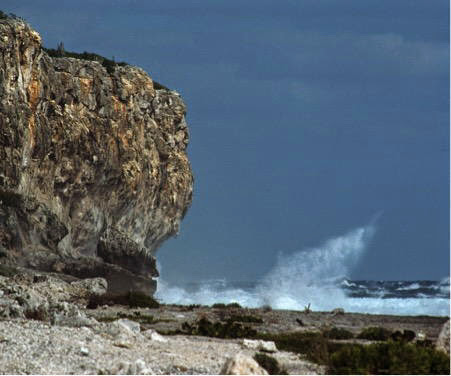
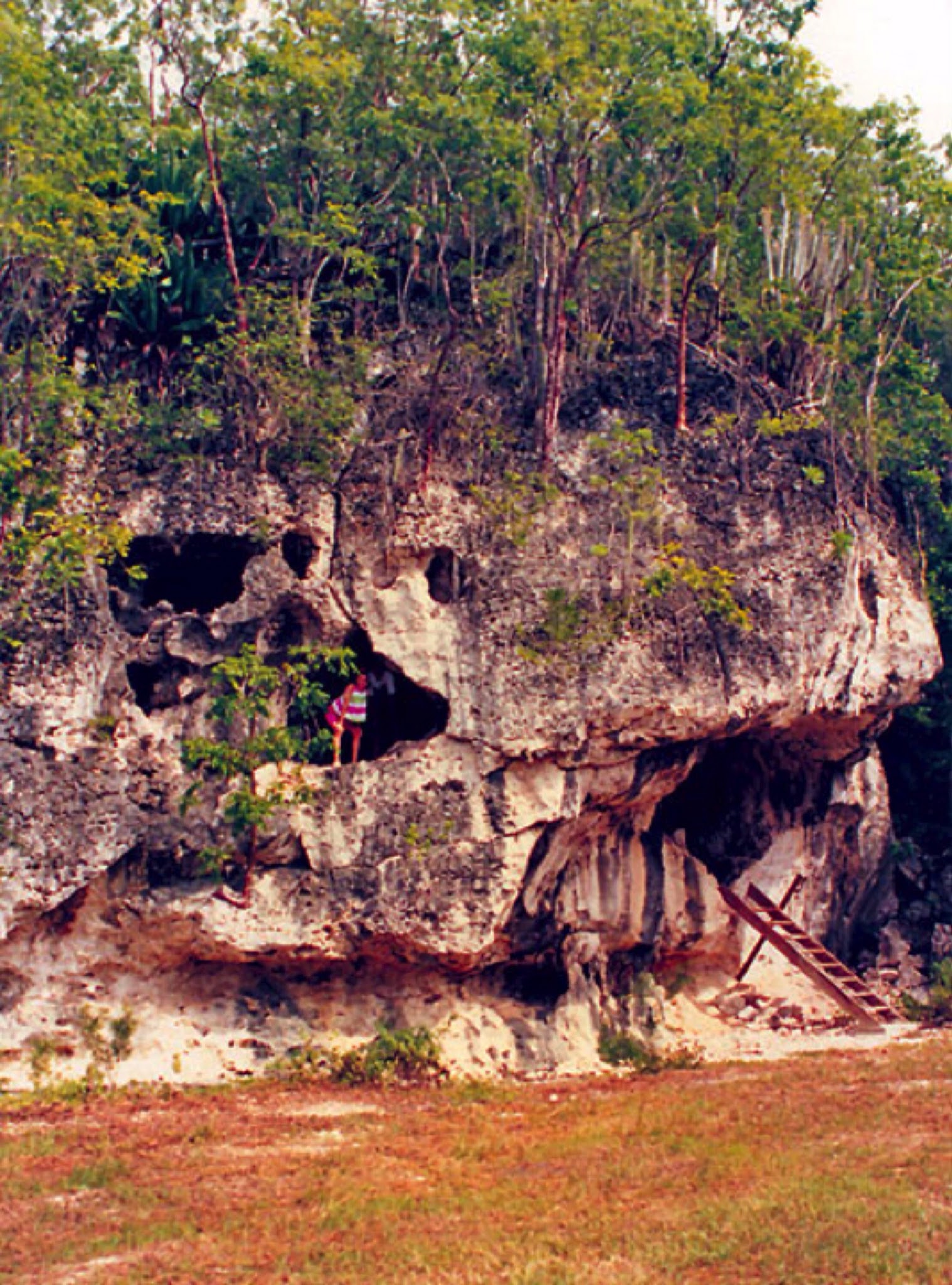
Photos above from Cayman Brac, Cayman Islands.


Amendment/Revision of Expressions of Interest: Coastal Protection for Climate Change Adaptation in the Small Island States in the Caribbean Project No. 2012.9762.1

caribbeanclimate's avatarcaribbeanclimate

The Caribbean Community Climate Change Centre (CCCCC) is seeking Expressions of Interest (EoI) for Consulting Services for the Implementation Consultant (IC) to assist the Caribbean Community Climate Change Centre (CCCCC) in the implementation of the Coastal Protection for Climate Change Adaptation in the Small Island States in the Caribbean Project. Qualified Independent Consultants are invited to submit a pre-qualification document. Funds have been earmarked for this Project by the German bilateral Financial Cooperation, provided through KfW Development Bank.

Ref-No: BZM 201297621

Project-No: 2012.9762.1

Deadline for submission of EoI is at 2:00 pm January 30, 2015, Belize Time.  Late submissions will not be accepted.

Peruse the official EoI request here.

EoIs should be submitted in one original and three copies to:

Project Manager
Caribbean Community Climate Change Centre
Attn: Ms. Dorett Tennyson, Procurement and Administrative Officer
Second Floor Lawrence Nicholas Building
Ring Road
P. O. Box 563
Belmopan…

View original post 41 more words

LA Imports Nearly 85 Percent of Its Water—Can It Change That by Gathering Rain?

The urban drainage-ways of Los Angeles can never quite look like wild creeks, but restoring some of their capacity to store, slow, and filter water fixes many problems at once.

Walk the glaring streets of Los Angeles’ San Fernando Valley on a sun-soaked afternoon in a drought year, the dry, brush-covered mountains rising behind you, and it can be easy to feel that you’re in arid country. “Beneath this building, beneath every street, there’s a desert,” said the fictional mayor in the Oscar-winning 1974 movie Chinatown. “Without water the dust will rise up and cover us as though we’d never existed!”

It’s an apocryphal idea. L.A. is not the Mojave but, climatically, more like Athens. Artesian springs, fed by rain in the mountains and hills, used to bubble up around Los Angeles, and farmers and Spanish missionaries grew fruit and olives in the Valley starting in the 18th and 19th centuries.

But the city has a history of treating its own raindrops and rivers as if they were more problematic than valuable. The L.A. River was prone to catastrophic floods in heavy rains, and, in the 20th century, engineers buried, straightened, and paved sections of the riverbed, flushing the water through concrete drainage channels to the Pacific Ocean. Then, to quench the thirst of its growing population, Los Angeles undertook a series of engineering feats that pumped water from the eastern Sierra Nevada Mountains, Northern California, and the Colorado River via hundreds of miles of pipes and reservoirs. Now the city typically imports more than 85 percent of its water from afar. And it’s as if the waters of Los Angeles disappeared from the consciousness of locals: Many Angelenos will tell you, mistakenly, that they live in a desert.

Now that story is changing again.

In the past decade and a half, a few local environmentalists have been collaborating with city and county officials to rewrite the plan for water here, driven by more and more urgent necessity. As winter temperatures rise in an era of climate change, the city’s distant water sources, fed by mountain snowmelt, are becoming less reliable. And drought years and battles over water allocation are adding to the difficulties. The State Water Project, which transfers water from the north to southern California, announced this year it would supply only five percent of the amount of water requested by agencies around the state (including the Metropolitan Water District of Southern California, which supplies parts of Los Angeles), because of the drought. Court rulings to protect endangered species have limited the amount of water L.A. and other cities can take from the Sacramento-San Joaquin Delta.

There’s no easy way for L.A. to get more water from distant sources, but new research from UCLA suggests that rainfall in the Los Angeles region is likely to stay the same on average in decades ahead.

Urban drainage in L.A. can never look like wild creeks, but restoring some capacity to store, slow, and filter water fixes many problems.

The city will need to become more water self-reliant to survive the rest of this century, and capturing local rain looks much more desirable than in the past. “There’s been a refocus on the value of local stormwater as a resource, not as a nuisance,” says Kerjon Lee, public affairs manager for the Los Angeles County Department of Public Works.

During the 1990s, in the flat landscape of Sun Valley, a San Fernando Valley neighborhood at the foot of the Verdugo Mountains, Los Angeles engineers and bureaucrats began re-imagining what one could do with raindrops.

Sun Valley never stopped acting as a tributary of the Los Angeles River, even as many of its lots filled, over the past several decades, with sand and gravel pits, auto body shops, junkyards, metals recycling plants, and miscellaneous blue-collar industries. Now two-thirds of the land here is covered with what engineers call an “impervious surface,” like concrete or asphalt, which water cannot penetrate. The more such surfaces there are in a neighborhood, the more rainwater tends to puddle up and flood. Heavy rain can make many of Sun Valley’s streets impassable. In one of the worst storms, about a decade ago, a sinkhole swallowed up part of a major street that used to be a riverbed, and a city engineer tumbled in and died.

Sun Valley is one of a few areas of L.A. not served by the massive drainage system that sends stormwater either to San Pedro or Santa Monica Bay. In the 1990s, the county planned to build a series of storm drains throughout the neighborhood—until a local environmentalist and gadfly named Andy Lipkis stepped in and asked them to reconsider.

Lipkis founded an organization called TreePeople in the mid-1970s, when he was just a teenager. The organization eventually made its headquarters on the site of an old fire station in Coldwater Canyon Park, on the high ridgeline along Mulholland Drive, named after the famous engineer who designed the first system to import water to the city on a large scale. There, among the breezy, fragrant slopes of oak and bay trees, you can see what Lipkis has been trying to tell locals his whole life: Much of Los Angeles is part forest and part river.

In 1998, Lipkis rigged a south L.A. house with water cisterns and rain gardens, gathered a group of local officials, and staged a deluge, aiming fire hoses at the roof. The group watched with amazement as the lot soaked up thousands of gallons of water.

He convinced them to consider what, at the time, was a more experimental and costly approach to managing water in Sun Valley, which overlies the San Fernando Valley Groundwater Basin, an aquifer that supplies about 13 percent of L.A.’s water. Lipkis argued that the county and city could begin to revive some of the features of a natural watershed. The urban drainage-ways of Los Angeles can never quite look like wild creeks, but restoring some of their capacity to store, slow, and filter water fixes many problems at once. When stormwater gushes across pavement, it picks up debris and contamination; when it soaks into soil and enters an aquifer, it is cleaner. Conventional storm drains would have only cost about $40 million, while TreePeople says its recommendations were nearly five times as expensive. But the organization’s own analysis suggested that the latter would return at least $300 million in benefits to the city.

“There’s been a refocus on the value of local stormwater as a resource, not as a nuisance.”

Water managers brought the options to stakeholders and residents in the mostly Latino, working-class neighborhood. They chose Lipkis’ approach. “The community didn’t want more concrete,” says Lee.

Alicia Gonzales moved to Sun Valley in 1985, as a nine-year-old, after her parents “fell in love with the house” on Elmer Avenue. Then she and her family watched as the rains poured through her yard, turning it from grass to mud. She remembers how the rain would form a torrent in the alley near her family’s house. “Trash and shopping carts would get stuck there,” she says.

She moved out as a young adult, then returned several years ago to help her father, who was struggling with severe diabetes and kidney disease and needed regular dialysis.

When the streets flooded, many kids in the neighborhood stayed home. Gonzales often wouldn’t drive her daughters to school on rainy days. “My car would get stuck,” she said.

Though Lipkis had sowed the ideas for a new way to manage water here, years passed before anyone found the funding and wherewithal to solve Elmer Avenue’s flooding problems. In 2004, L.A. County finalized a new stormwater plan for Sun Valley. Two years later, the county finished its first project. Under a baseball and soccer field in Sun Valley Park, a tree-lined oasis in the middle of an industrial district, engineers installed a retention tank that collects runoff from the surrounding streets. In 2007, the county Flood Control District spent nearly $4 million to build drains, catch basins, and a tiny corner park at an intersection that used to turn into a deep lagoon in heavy rain—and was a favorite location for news crews to shoot dramatic footage of local storms.

About eight years ago, employees of TreePeople appeared on Gonzales’ block. They said that her street was part of a watershed, and stormwater from the mountains was pouring into her backyard. (When Gonzales first met Andy Lipkis, she says he rhapsodized about her parents’ olive tree, nearly the only landscaping that had survived the flood damage.) An organization called the Council for Watershed Health had partnered with TreePeople to renovate her street.

“There’s been a refocus on the value of local stormwater as a resource, not as a nuisance.”

The Council for Watershed Health led the effort to pull apart the street and put in rain barrels, rain gardens, underground water tanks, and water-permeable walkways and driveways. Gonzales got one of a few special grants to replant her muddy yard, and volunteers showed up at her house to help with the landscaping. The alley became a pedestrian walkway that the project organizers dubbed The Paseo, a meandering sidewalk lined with native plants between concrete-block walls, painted with the words, “Water is the driving force of life.” In rainstorms now, the water runs through the landscaping, and kids walk the path to school. Neighbors water their drought-tolerant plants with rain barrels, but most of the rain soaks in under the street.

As small as these three projects were—a single city block, a corner park, and a soccer field—they have gotten the attention of the entire region: two Southern California regional water districts, several Los Angeles city and county agencies, the federal Bureau of Reclamation, and a number of state agencies got involved and provided funding for Elmer Avenue. These projects have become test cases for a much larger strategy to boost the water supply every time it rains across the entire region.

In Sun Valley, the county plans ultimately to capture nearly all of the rainwater that pours through the neighborhood. Next to Sun Valley Park, the city and county are planning to convert what is now a gravel pit and concrete plant into a 46-acre park that will collect in an average year about enough water to supply 4,000 Angelenos.

Their findings come at a crucial time. Crumbling infrastructure and a new court ruling are forcing the hands of local officials: A federal court has ordered the county to clean up the Los Angeles and San Gabriel Rivers, currently fouled by the dirt, grime, and toxins that wash from streets into storm drains. Meanwhile, billions of dollars worth of city water infrastructure is falling apart and has to be replaced before it breaks down.

The city of Santa Monica has set a goal to use only local water by 2020.

The city needs to both clean up its stormwater problem and find more water to drink. TreePeople says it could do both at once and is working with the City of Los Angeles to rewrite its entire stormwater management plan by next year. The county has undertaken a study, in partnership with the Bureau of Reclamation, to predict how climate change will affect local hydrology and what it can do to better capture stormwater. Water districts throughout the region are following suit: The Water Replenishment District of Southern California, which manages groundwater for parts of the region, has set a goal to wean itself off imported water altogether by treating and recycling wastewater and collecting more stormwater. The Council for Watershed Health released a study in 2012 estimating that the district could capture 5.5 billion gallons of water per year through more projects like Elmer Avenue.

The city of Santa Monica has set a goal to use only local water by 2020. The Los Angeles Department of Water and Power estimates that by 2035, it will import just over half of its water (down from 85 percent), meet 9 percent of its water needs by conserving more, and supply 28 percent by using local groundwater, capturing stormwater, and recycling water from sewage. Water recycling and stormwater projects aren’t cheap, but they’re typically less costly than building high-energy desalination plants that distill water from the ocean. A new desalination plant is going up in Carlsbad, south of Los Angeles. But if groups like TreePeople and the Council succeed, southern California may not need to build many more facilities like this.

“We’re looking at how we could shift the amount of water we currently squander.” says Edith de Guzman, a researcher at TreePeople. More

Madeline Ostrander wrote this article for Cities Are Now, the Winter 2015 issue of YES! Magazine. Ostrander is a contributing editor to YES! and a 2014 National Health Journalism Fellow. She lives in Seattle and writes about the environment and climate change.


Declassified Memo of Rumsfeld’s Post-9/11 Middle East Visit Highlights Logistical Challenges; Unwavering Belief in WMD

Lauren Harper's avatarUNREDACTED: The National Security Archive Blog

No stranger to the region, Rumsfeld served as Middle East envoy under President Reagan. Here Iraqi President Saddam Hussein greets  Rumsfeld in Baghdad on December 20, 1983. No stranger to the region, Rumsfeld served as Middle East envoy under President Reagan. Here Iraqi President Saddam Hussein greets Rumsfeld in Baghdad on December 20, 1983.

Less than one month after the September 11 attacks, Donald Rumsfeld embarked on a coalition building trip to the Middle East, his first visit to the region while serving as Secretary of Defense. Rumsfeld notes in his 2011 memoir Known and Unknown that at the time of his whirlwind October 3-5 visit to Saudi Arabia, Oman, Egypt, Uzbekistan, and Turkey, he knew that CENTCOM commander General Tommy Franks was planning to insert special operations teams into Afghanistan on the nights of October 6 and 7.1 Rumsfeld’s tour was therefore intended to shore up support for the U.S.’ nascent war on terror from the countries surrounding Afghanistan, and to assuage fears that U.S. military action in the region would be a “flash…

View original post 1,244 more words

Abu Dhabi summit to discuss water security challenges

More than 32,000 global leaders from 170 countries representing government, industry, investment and research to Abu Dhabi, will provide an upfront look at affordable technologies to enable sustainable water resource management to help meet the Middle East’s rising demand for water.

Hosted by Masdar, Abu Dhabi’s renewable energy company, ADSW is a yearly platform that addresses the interconnected challenges of energy and water security, climate risk and sustainable development.

Running from January 17 to 24, ADSW includes the World Future Energy Summit (WFES), the world’s foremost event dedicated to the advancement of renewable energy, energy efficiency and clean technology; and the International Water Summit (IWS), which provides a business approach to addressing water scarcity, sustainable growth and economic development in arid regions.

“The Mena region is in a truly unique position to solve the challenge of water security,” remarked Raed Bkayrat, vice president of development for Saudi Arabia at First Solar, which is participating in WFES.

“While the region is quite arid, it also has one of the highest solar irradiances of any region in the world, and much of the population has ready access to seawater. Accordingly, solar photovoltaic projects are proving to be sustainable means of powering water desalination in the region, ensuring that the supply of clean water will keep up with the region’s increasing demand for it,” he noted.

Masdar took a major step by launching a pilot project to test energy-efficient desalination technologies – such as reverse osmosis and forward osmosis – powered by renewable energy.

The company awarded contracts to Abengoa, Degremont, Sidem/Veolia and Trevi Systems to build the desalination plants, which are expected to enable the implementation of cost-competitive desalination plants powered by renewable energy in the UAE and abroad.

“Engaging different sectors of the industry is really crucial to bring forward innovative solutions, as well as pilot projects that demonstrate to governments the value of new integrated systems,” Bkayrat added.

Both WFES and IWS will offer numerous keynote addresses, panel discussions and workshops as well as exhibitors introducing affordable technologies to enable sustainable water resource management.

Along with WFES and IWS, ADSW will include the second EcoWaste and the seventh Zayed Future Energy Prize Award Ceremony; it also coincides with the Fifth General Assembly of the International Renewable Energy Agency.-TradeArabia News Service More


The ‘Land of the Free’ supports one of the most repressive states in the world

Crimes against humanity in Gaza: is it really a 'buffer zone' – or a bigger plan

The international community and states parties to the United Nations should hang their heads in shame

Late last week, the White House decried Israel’s attack on a UN school in Gaza as “totally unacceptable” and “totally indefensible”, then proceeded to approve $225m in funding for its Iron Dome. On Monday, the US state department went further, calling the airstrikes upon a UN school “disgraceful” – and yet America provides Israel with more than $3.1bn every year, restocking the ability of the Israel Defense Force (IDF) to hit more schools, and to wage total war against an imprisoned people, because of their nationality.

American taxpayers should not be paying for this. And the western world should stop rejecting serious inquiries about Israel’s moral inconsistencies, or allow it to benefit from cognitive dissonance and information overload amid the current crisis in Gaza.

There is a land grab going on. The Israeli prime minister, Binjamin Netanyahu, has shrunk Gaza’s habitable land mass by 44%, with an edict establishing a 3km (1.8-mile) buffer zone, a “no-go” zone for Palestinians – and that’s quite significant, because a good part of Gaza is only 3 to 4 miles wide. Over 250,000 Palestinians within this zone must leave their homes, or be bombed. As their territorial space collapses, 1.8m Gazans now living in 147 square miles will be compressed into 82 square miles.

Gaza’s entire social and physical infrastructure of housing, hospitals, places of worship, more than 130 of its schools, plus markets, water systems, sewer systems and roads are being destroyed. Under constant attack, without access to water, sanitary facilities, food and medical care, Gazans face an IDF-scripted apocalypse.

With Gaza’s land mass shrinking due to Israeli military action, it’s about time someone asked: What is the end game? Three weeks ago, Moshe Feiglin, deputy speaker of the Knesset, called for Gaza to “become part of sovereign Israel and will be populated by Jews. This will also serve to ease the housing crisis in Israel.”

Israel has a housing crisis? After the “no-go” buffer zone is evacuated, there will be 21,951 Palestinians per square mile in Gaza, while Israel’s population density stands at 964 persons per square mile.

Deputy Speaker Feiglin wants the Palestinians in Gaza to lose all of their land. One must not assume that Mr Feiglin or his Likud faction speak for the main government actors like Prime Minister Netanyahu. After all, Knesset politics are complex and divergent. But since Gaza has just lost control of that 44% of its land, it may also be time to ask: does the establishment of that 3km zone represent the unfolding of a larger plan? Is that the end game?

At the very point where an aroused public becomes aghast at the slaughter of Gazans, the western world becomes inured to the violence, hypnotized by the media’s cadence of body counts. The intolerable becomes normalized, and later ignored as old news. Which would seem a perfect time to leave in place the 3km zone – for security purposes, of course – and then advance the proposal that Palestinians crammed into the remaining 56% of Gaza simply … leave.

I assume the IDF acts with deliberation, under orders from the Netanyahu government. And I think the extraordinary and illegal forced relocation of over 250,000 Palestinians from 44% of Gazan land is a crime against humanity under the guise of establishing a “buffer zone” for security purposes.

Look at the region’s maps from recent history. Look at the steady erosion of Palestinian land and the acquisition of land by Israel, and you can understand that the present attack on Gaza is not about solely about Hamas. It’s about land. It isn’t just about Hamas’s rockets. It’s about land. It isn’t just about Hamas’s tunnels. It’s about land. It isn’t about kidnappings. It is about land. It isn’t even about meeting a housing crisis in Israel. It is about grabbing land from the Palestinians in Gaza and the natural resources that go with the land, upon the occasion of Israel’s military invasion of Gaza.

Yes, Hamas’s attacks on Israel are illegal and should be condemned, and those who ordered the attacks should be held accountable under law. All policies and practices which refuse to recognize Israel’s right to exist should be condemned. Israel has a right to exist. But Israel’s right to exist is impaired when Israel decides Palestinians have no right to exist on their own land. It’s time for us to stop paying for Israel’s dubious, destructive self-righteousness. And it’s time for the solipsism syndrome afflicting Israel’s leaders to get a day of discussion in the International Criminal Court concerning their attacks on Gaza – and especially their new 3km “buffer zone”. More


Citing Next Generations, Lawsuits Demand Courts Recognize ‘Mind-Blowing’ Climate Impacts

By caving to industry pressures, environmental regulatory agencies are failing to uphold their obligation to future generations, declared Mary Christina Wood, the author pushing a new legal framework to fight global warming, on the final episode of Moyers & Company.

Wood, a University of Oregon law professor who wrote Nature's Trust: Environmental Law for a New Ecological Age (2013; Cambridge University Press), advocates an idea called “atmospheric trust litigation,” which takes the fate of the Earth into the courts, arguing that the planet’s atmosphere—its air, water, land, plants, and animals—are the responsibility of government, held in its trust to insure the survival of all generations to come.

“If this nation relies on a stable climate system, and the very habitability of this nation and all of the liberties of young people and their survival interests are at stake the courts need to force the agencies and the legislatures to simply do their job.”
—Mary Christina Wood, University of Oregon Law School

“The heart of the approach is the public trust doctrine,” she told her host, longtime journalist and political commentator Bill Moyers. “And it says that government is a trustee of the resources that support our public welfare and survival. And so a trust means that one entity or person manages a certain wealth, an endowment, so to speak, for the benefit of others. And in the case of the public trust, the beneficiaries are the present and future generations of citizens.”

The theory underpins lawsuits filed by Our Children's Trust, which ask for the courts to order state and local governments and agencies to act more aggressively to bring down carbon emissions.

“[I]f this nation relies on a stable climate system, and the very habitability of this nation and all of the liberties of young people and their survival interests are at stake the courts need to force the agencies and the legislatures to simply do their job,” Wood explained.

Environmental laws passed in the 1970s “held a lot of promise” decades ago, she said but they've lost what little power they once possessed. Wood continued:

Americans thought they had solved the problem by getting these laws passed. What they didn't realize was that industries got inside the agencies through various means, through campaign contributions, through pressure on the system over and over again. And so one thing we have to keep in mind is we're nearing the end of our resources. And there are laws of nature that we have to comply with.

And those laws are supreme. And they determine whether we will survive on this planet. And they will determine the future conditions for our children. And so right now, our environmental laws are out of whack with the laws of nature. They are allowing destruction, whereas they should be structuring society to create a balance with the natural systems that support our lives.

And Wood disagreed with those who argue that climate change is a political issue to be dealt with outside the courts.

“Climate is not just an environmental issue,” she said. “This is a civilizational issue. This is the biggest case that courts will get in terms of the potential harm in front of them, the population affected by that harm, and in terms of the urgency. Climate is mind-blowing. It can't be categorized any longer as an environmental issue.”

In a related feature earlier this year, Moyers spoke to a member of the next generation who is a co-plaintiff in one of the atmosphere trust litigation lawsuits being spearheaded by Our Children’s Trust.

“Public trust states that the government is a trustee to protect these natural resources that every living species, including humans, rely upon for our survival, for our well-being,” 18-year-old Kelsey Juliana told Moyers at the time. “And so the public trust says, government, we hold you, we trust you to put these resources, air, water, land, you know, to protect them for this generation and for many generations down the line.” More


A New Canal Through Central America Could Have Devastating Consequences

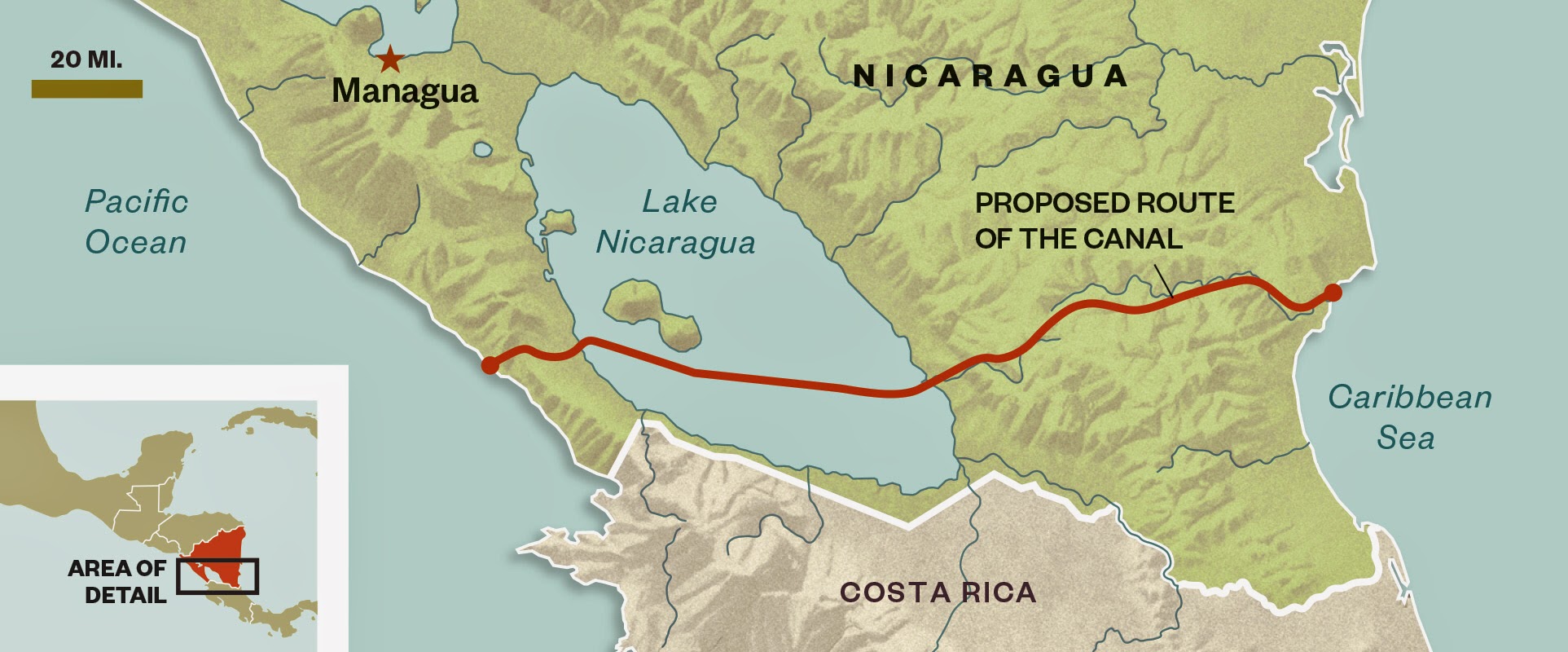
When construction crews begin digging a new canal this month across Nicaragua, connecting the Pacific and Atlantic, it’ll be a boon to global shipping and, the government says, to the economy of the second-poorest nation in the Americas.

But activists, scientists and others are increasingly alarmed by the environmental impact of a 173-mile artificial waterway—wider, deeper and three and a half times the length of the Panama Canal.

Developed by Wang Jing, an enigmatic Chinese industrialist with ties to China’s ruling party, the Grand Nicaragua Canal will cost an estimated $40 billion and take five years to build. At 90 feet deep and 1,706 feet across at its widest, the channel will accommodate the newest cargo supertankers, which are longer than the Empire State Building is tall and carry 18,000 shipping containers. The vessels are too big to pass through the Panama Canal (even after a $5 billion expansion is completed) or to dock in any U.S. port.

The new canal and its infrastructure, from roads to pipelines to power plants, will destroy or alter nearly one million acres of rainforest and wetlands. And that doesn’t include Lake Nicaragua, a beloved 3,191-square-mile inland reservoir that provides most Nicaraguans with drinking water. The canal cuts through the lake, and critics say ship traffic will pollute the water with industrial chemicals and introduce destructive invasive plants and animals.

Plus, the canal route lies in the middle of a hurricane belt, says Robert Stallard, a research hydrologist with the U.S. Geological Survey and the Smithsonian Tropical Research Institute. “You’re likely going to be looking at hurricanes vastly more powerful than anything that ever hit Panama, and ever will,” Stallard says. A storm like Hurricane Mitch, which killed 3,800 people in Nicaragua in 1998, would probably cause the canal to flood, triggering mudslides that would breach locks and dams. Communities, homes, roads and power lines would be swamped.

The Nicaraguan government has yet to release promised analyses of the canal’s likely environmental impacts, and has even dodged neighboring Costa Rica’s request to share disaster plans. “We’ve got a lack of information and a potentially big threat to the environment,” says Jorge A. Huete-Pérez, vice president of the Academy of Sciences of Nicaragua. “The government just wants to rush the thing through.” The canal’s true benefits can’t be calculated, Huete-Pérez and others argue, as long as the costs to Nicaragua’s forests, waterways and wildlife remain hidden. More