Several weather records were broken Wednesday after 13.27 inches of rain fell at Islip Town's Long Island MacArthur Airport in what the Northeast Regional Climate Center calls a 24-hour 200-year storm event.
That means that “rainfall of this magnitude is only expected to occur once in a 200-year period,” according to the center's website.
At play was a complex weather system that the National Weather Service had been monitoring for days, warning of the threat of flash flooding, in which an upper level disturbance, a low pressure area at the surface and very moist environment all combined over the area, said Tim Morrin, weather service meteorologist in Upton.
The “bull's-eye” of the heaviest rainfall that deluged an area of western Suffolk was right near MacArthur Airport, he said.
“A very small micro-scale event took place” in that area, one that is yet to be explained, he said, but that will likely be researched extensively, with follow-up papers written. Such a phenomenon is “impossible to forecast,” he said, as “there's not enough skill in the computer models to pinpoint that kind of extreme” on such a small scale.
As for hourly rainfall, 5.34 inches fell from 5 to 6 a.m. Wednesday at the airport in Ronkonkoma, followed by another 4.37 inches from 6 to 7 a.m., according to the Climate Center. They may have come back-to-back, but each is considered a 500-year event, said Jessica Spaccio, a climatologist with the center, which is at Cornell University.
Records were also broken, and, “when we break a state record, that's pretty exciting,” Spaccio said
According to a preliminary report from the weather service, the previous New York State record for precipitation in a 24-hour period was broken. That was set Aug. 27 to 28, 2011, in Tannersville when 11.6 inches fell during what the service referred to as Hurricane/Tropical Storm Irene.
With half the month still to go, Wednesday's rainfall also resulted in a record for the month of August, previously 13.78 inches set in 1990, the weather service said. The airport's August rainfall now stands at 13.88 inches, said the weather service, which has maintained official records for the airport for the past 30 years.
While Long Island has been considered “abnormally dry” this year by the U.S. Drought Monitor, the 13.27 inches at the airport in just about one day exceeded normal rainfall for June, July and August combined — 11.68 inches — based on precipitation records from 1981 to 2010, according to the Climate Center.
Wednesday's rainfall also broke the airport's all-time daily rainfall record, which was 6.74 inches set Aug. 24, 1990, Spaccio said.
And as for the record rainfall for Aug. 13 — beating that was a piece of cake, with the previous record for that day 0.91 inches, set in 2013, the weather service said.
As for hourly rainfall amounts — top honors now go to Wednesday from 5 to 6 a.m. when 5.34 inches fell at the airport, followed by 4.37 inches the very next hour, Spaccio said. The highest previous amount was 2.64 inches, which fell in one hour on July 18, 2007. That's based on data maintained since July 1996, she said. More
Jason Westcott was afraid. One night last fall, he discovered via Facebook that a friend of a friend was planning with some co-conspirators to break in to his home. They were intent on stealing Wescott’s handgun and a couple of TV sets. According to the Facebook message, the suspect was planning on “burning” Westcott, who promptly called the Tampa Bay police and reported the plot.
According to the Tampa Bay Times, the investigating officers responding to Westcott’s call had a simple message for him: “If anyone breaks into this house, grab your gun and shoot to kill.”
Around 7:30 pm on May 27th, the intruders arrived. Westcott followed the officers’ advice, grabbed his gun to defend his home, and died pointing it at the intruders. They used a semiautomatic shotgun and handgun to shoot down the 29-year-old motorcycle mechanic. He was hit three times, once in the arm and twice in his side, and pronounced dead upon arrival at the hospital.
The intruders, however, weren’t small-time crooks looking to make a small score. Rather they were members of the Tampa Bay Police Department’s SWAT team, which was executing a search warrant on suspicion that Westcott and his partner were marijuana dealers. They had been tipped off by a confidential informant, whom they drove to Westcott’s home four times between February and May to purchase small amounts of marijuana, at $20-$60 a pop. The informer notified police that he saw two handguns in the home, which was why the Tampa Bay police deployed a SWAT team to execute the search warrant.
In the end, the same police department that told Westcott to protect his home with defensive force killed him when he did. After searching his small rental, the cops indeed found weed, two dollars’ worth, and one legal handgun — the one he was clutching when the bullets ripped into him.
Welcome to a new era of American policing, where cops increasingly see themselves as soldiers occupying enemy territory, often with the help of Uncle Sam’s armory, and where even nonviolent crimes are met with overwhelming force and brutality.
The War on Your Doorstep
The cancer of militarized policing has long been metastasizing in the body politic. It has been growing ever stronger since the first Special Weapons and Tactics (SWAT) teams were born in the 1960s in response to that decade’s turbulent mix of riots, disturbances, and senseless violence like Charles Whitman’s infamous clock-tower rampage in Austin, Texas.
Every year now, there are approximately 50,000 SWAT raids in the United States
While SWAT isn’t the only indicator that the militarization of American policing is increasing, it is the most recognizable. The proliferation of SWAT teams across the country and their paramilitary tactics have spread a violent form of policing designed for the extraordinary but in these years made ordinary. When the concept of SWAT arose out of the Philadelphia and Los Angeles Police Departments, it was quickly picked up by big city police officials nationwide. Initially, however, it was an elite force reserved for uniquely dangerous incidents, such as active shooters, hostage situations, or large-scale disturbances.
Nearly a half-century later, that’s no longer true.
In 1984, according to Radley Balko’s Rise of the Warrior Cop, about 26% of towns with populations between 25,000 and 50,000 had SWAT teams. By 2005, that number had soared to 80% and it’s still rising, though SWAT statistics are notoriously hard to come by.
As the number of SWAT teams has grown nationwide, so have the raids. Every year now, there are approximately 50,000 SWAT raids in the United States, according to Professor Pete Kraska of Eastern Kentucky University’s School of Justice Studies. In other words, roughly 137 times a day a SWAT team assaults a home and plunges its inhabitants and the surrounding community into terror.
Upping the Racial Profiling Ante
In a recently released report, “War Comes Home,” the American Civil Liberties Union (my employer) discovered that nearly 80% of all SWAT raids it reviewed between 2011 and 2012 were deployed to execute a search warrant.
Pause here a moment and consider that these violent home invasions are routinely used against people who are only suspected of a crime. Up-armored paramilitary teams now regularly bash down doors in search of evidence of a possible crime. In other words, police departments increasingly choose a tactic that often results in injury and property damage as its first option, not the one of last resort. In more than 60% of the raids the ACLU investigated, SWAT members rammed down doors in search of possible drugs, not to save a hostage, respond to a barricade situation, or neutralize an active shooter.
On the other side of that broken-down door, more often than not, are blacks and Latinos. When the ACLU could identify the race of the person or people whose home was being broken into, 68% of the SWAT raids against minorities were for the purpose of executing a warrant in search of drugs. When it came to whites, that figure dropped to 38%, despite the well-known fact that blacks, whites, and Latinos all use drugs at roughly the same rates. SWAT teams, it seems, have a disturbing record of disproportionately applying their specialized skill set within communities of color.
Think of this as racial profiling on steroids in which the humiliation of stop and frisk is raised to a terrifying new level.
Everyday Militarization
Don’t think, however, that the military mentality and equipment associated with SWAT operations are confined to those elite units. Increasingly, they’re permeating all forms of policing.
As Karl Bickel, a senior policy analyst with the Justice Department’s Community Policing Services office, observes, police across America are being trained in a way that emphasizes force and aggression. He notes that recruit training favors a stress-based regimen that’s modeled on military boot camp rather than on the more relaxed academic setting a minority of police departments still employ. The result, he suggests, is young officers who believe policing is about kicking ass rather than working with the community to make neighborhoods safer. Or as comedian Bill Maher reminded officers recently: “The words on your car, ‘protect and serve,’ refer to us, not you.”
This authoritarian streak runs counter to the core philosophy that supposedly dominates twenty-first-century American thinking: community policing. Its emphasis is on a mission of “keeping the peace” by creating and maintaining partnerships of trust with and in the communities served. Under the community model, which happens to be the official policing philosophy of the U.S. government, officers are protectors but also problem solvers who are supposed to care, first and foremost, about how their communities see them. They don’t command respect, the theory goes: they earn it. Fear isn’t supposed to be their currency. Trust is.
Nevertheless, police recruiting videos, as in those from California’s Newport Beach Police Department and New Mexico’s Hobbs Police Department, actively play up not the community angle but militarization as a way of attracting young men with the promise of Army-style adventure and high-tech toys. Policing, according to recruiting videos like these, isn’t about calmly solving problems; it’s about you and your boys breaking down doors in the middle of the night.
SWAT’s influence reaches well beyond that. Take the increasing adoption of battle-dress uniforms (BDUs) for patrol officers. These militaristic, often black, jumpsuits, Bickel fears, make them less approachable and possibly also more aggressive in their interactions with the citizens they’re supposed to protect.
A small project at Johns Hopkins University seemed to bear this out. People were shown pictures of police officers in their traditional uniforms and in BDUs. Respondents, the survey indicated, would much rather have a police officer show up in traditional dress blues. Summarizing its findings, Bickel writes, “The more militaristic look of the BDUs, much like what is seen in news stories of our military in war zones, gives rise to the notion of our police being an occupying force in some inner city neighborhoods, instead of trusted community protectors.”
Where Do They Get Those Wonderful Toys?
“I wonder if I can get in trouble for doing this,” the young man says to his buddy in the passenger seat as they film the Saginaw County Sheriff Office’s new toy: a Mine Resistant Ambush Protected (MRAP) vehicle. As they film the MRAP from behind, their amateur video has a Red Dawn-esque feel, as if an occupying military were now patrolling this Michigan county’s streets. “This is getting ready for f**king crazy times, dude,” one young man comments. “Why,” his friend replies, “has our city gotten that f**king bad?”
In fact, nothing happening in Saginaw County warranted the deployment of an armored vehicle capable of withstanding bullets and the sort of improvised explosive devices that insurgent forces have regularly planted along roads in America’s recent war zones. Sheriff William Federspiel, however, fears the worst. “As sheriff of the county, I have to put ourselves in the best position to protect our citizens and protect our property,” he tolda reporter. “I have to prepare for something disastrous.”
Lucky for Federspiel, his exercise in paranoid disaster preparedness didn’t cost his office a penny. That $425,000 MRAP came as a gift, courtesy of Uncle Sam, from one of our far-flung counterinsurgency wars. The nasty little secret of policing’s militarization is that taxpayers are subsidizing it through programs overseen by the Pentagon, the Department of Homeland Security, and the Justice Department.
Take the 1033 program. The Defense Logistics Agency (DLA) may be an obscure agency within the Department of Defense, but through the 1033 program, which it oversees, it’s one of the core enablers of American policing’s excessive militarization. Beginning in 1990, Congressauthorized the Pentagon to transfer its surplus property free of charge to federal, state, and local police departments to wage the war on drugs. In 1997, Congress expanded the purpose of the program to include counterterrorism in section 1033 of the defense authorization bill. In one single page of a 450-page law, Congress helped sow the seeds of today’s warrior cops.
The amount of military hardware transferred through the program has grown astronomically over the years. In 1990, the Pentagon gave $1 million worth of equipment to U.S. law enforcement. That number had jumped to nearly $450 million in 2013. Overall, the program has shipped off more than $4.3 billion worth of materiel to state and local cops, according to the DLA.
In its recent report, the ACLU found a disturbing range of military gear being transferred to civilian police departments nationwide. Police in North Little Rock, Arkansas, for instance, received 34 automatic and semi-automatic rifles, two robots that can be armed, military helmets, and a Mamba tactical vehicle. Police in Gwinnet County, Georgia, received 57 semi-automatic rifles, mostly M-16s and M-14s. The Utah Highway Patrol, according to a Salt Lake City Tribuneinvestigation, got an MRAP from the 1033 program, and Utah police received 1,230 rifles and four grenade launchers. After South Carolina’s Columbia Police Department received its very own MRAP worth $658,000, its SWAT Commander Captain E.M. Marsh noted that 500 similar vehicles had been distributed to law enforcement organizations across the country. More
GEORGE TOWN, Cayman Islands — The NCB group in the Cayman Islands has purchased the very first new all-electric Nissan LEAF in the Caribbean, reinforcing its commitment to environmental sustainability.
“NCB Group is proud to be a part of the innovative movement towards electric cars in the Cayman Islands,” said Matthew Wight, managing director.
Considered the premier residential developer in the Cayman Islands, the NCB group is seeking to further reduce its ecological footprint in an effort to protect the Caribbean and the planet from harmful greenhouse gasses.
Wight said that he drives electric vehicles because he knows that he is helping the environment.
“As a company, we strive to employ sustainable and green technologies when we build our residential and commercial projects and we wanted to carry this mission through to the vehicles we drive,” he explained.
Driving a Nissan LEAF – a 100% electric car — has been extremely rewarding “in the sense that the LEAF does not use a single drop of gas. It has no tailpipe, no fumes and produces zero emissions,” he said.
“As we build with Cayman’s future in mind we are also looking to alternative energy sources in everything we do with the goal to be as eco-conscious as possible,” Wight added.
For nearly a decade John Felder, president and CEO of Cayman Automotive Leasing, has been at the forefront of the burgeoning electric vehicle industry in the Caribbean.
His hope is to see electric vehicles being driven in every country in the Caribbean and eventually the world in years to come.
“I applaud Mr Matthew Wight and NCB for investing in the future for a cleaner and healthier environment. The energy generated to power the Nissan LEAF and the energy to move the car is 97% cleaner in terms of noxious pollutants,” Felder said.
The Nissan LEAF boasts one of the quietest and smoothest rides ever experienced. The vehicle does not have a gas tank and drivers will never have to pay at the pumps again. The motor is powered by an advanced lithium-ion battery, which is half the weight and twice the power of the nickel-metal hydride batteries used in hybrids, and can easily be charged at home, or at any solar panel charging station in Grand Cayman.
Felder is certain that electric cars are the cleanest, most efficient, and most cost effective form of transportation around.
“Electric cars are high performance vehicles that will continue to meet new challenges in the future,” he said. More
“There is nothing radical in what we’re discussing,” journalist and climate change activist Bill McKibben said before a crowd of nearly 1,000 at the University of California Los Angeles last night. “The radicals work for the oil companies.”
Bill McKibben
Taken on its own, a statement like that would likely sound hyperbolic to most Americans—fodder for a sound bite on Fox News. Anyone who saw McKibben’s lecture in full, however, would know he was not exaggerating.
McKibben was in Los Angeles as part of his nationwide “Do the Math” tour. Based on a recent article of his in Rolling Stone, (“The one with Justin Bieber on the cover,” McKibben joked) the event is essentially a lecture circuit based on a single premise: climate change is simple math—and the numbers do not look good. If immediate action isn’t taken by global leaders: “It’s game-over for the planet.”
The math, McKibben explained, works like this. Global leaders recently came to an international agreement based on the scientific understanding that a global temperature raise of 2°C would have “catastrophic” consequences for the future of humanity. In order to raise global temperatures to this catastrophic threshold, the world would have to release 565 gigatons of carbon dioxide into the atmosphere. Here’s the problem: Fossil fuel companies currently have 2,795 gigatons of carbon dioxide in their fuel reserves—and their business model depends on that fuel being sold and burned. At current rates of consumption, the world will have blown through its 565-gigaton threshold in 16 years.
To prevent the end of the world as we know it, it will require no less than the death of the most profitable industry in the history of humankind.
“As of tonight,” McKibben said, “we’re going after the fossil fuel industry.”
Obviously no easy task. The oil industry commands annual profits of $137 billion and the political power to match. As McKibben noted, “Oil companies follow the laws because they get to write them.”
However, there are some numbers on McKibben’s side. Recent polling data shows 74 percent of Americans now believe in climate change, and 68 percent view it as dangerous. The problem environmental activists are facing is in converting those favorable polling numbers into grassroots action.
Enter “Do the Math.”
Using McKibben’s popularity as an author, organizers are turning what would otherwise be a lecture circuit into a political machine. Before rolling into town, Do the Math smartly organizes with local environmental groups. Prior to McKibben’s lecture, these groups are allowed to take the stage and talk about local initiatives that need fighting. Contact information is gathered to keep the audience updated on those efforts. Instead of simply listening to McKibben, as they perhaps intended, the audience has suddenly become part of their local environmental movement.
It’s a smart strategy, and an essential one—because the problem of climate change is almost exclusively a political in nature. Between renewable energy and more efficient engineering, the technology already exists to stave off catastrophic global warming. Though its application is lagging in the United States, it is being employed on a mass scale in other countries. In socially-stratified China, with its billion-plus population and tremendous wealth inequalities, 25 percent of the country still manages to use solar arrays to heat its water. Germany—Europe’s economic powerhouse—in less than a decade, has managed to get upwards of half of its energy from sustainable sources.
The same can happen here in America—provided we have the will to make it happen. McKibben says the key to realizing that goal is to battle the lifeblood of the fossil fuel industry—its bottom line.
To start, he’s calling for an immediate global divestment from fossil fuel companies. “We’re asking that people who believe in the problem of climate change to stop profiting from it. Just like with divestment movement in South Africa over apartheid, we need to eliminate the oil companies veneer of respectability.”
In conjunction with the divestment regimen, continued protests against unsustainable energy projects will also be crucial. McKibben will be in Washington, D.C. on November 18 to lead a mass rally against climate change and the Keystone Pipeline. “We can no longer just assume that President Obama is going to do everything he promised during his campaign. We need to push him.”
“I don’t know if we’re going to win. But I do know we’re going to fight.” More
On August 12th, Barbuda Council signed into law a sweeping set of new ocean management regulations that zone their coastal waters, strengthen fisheries management, and establish a network of marine sanctuaries.
This comes after seventeen months of extensive community consultation and scientific research supported by the Waitt Institute. With these new policies, the small island of Barbuda has become a Caribbean ocean conservation leader and global role model. The regulations establish five marine sanctuaries, collectively protecting 33% (139 km2) of the coastal area, to enable fish populations to rebuild and habitats to recover. To restore the coral reefs, catching parrotfish and sea urchins has been completely prohibited, as those herbivores are critical to keeping algae levels on reefs low so coral can thrive. Barbuda is the first Caribbean island to put either of these bold and important measures in place.
“This will definitely benefit the people of Barbuda, and Antigua as well. No part of this is meant to hurt fishers. It’s the reverse – ensuring that they have a livelihood that will last in perpetuity,” said Arthur Nibbs, Chairman of the Barbuda Council and Antigua and Barbuda Minister of Fisheries.
Caribbean-wide, communities are seeing declines in the health of coastal ecosystems and fish populations. This negatively impacts economies, food security, and cultures. Visionary action like that shown in Barbuda is needed to manage the ocean sustainably, profitably, and enjoyably, for this and future generations. The coastal zones and fishing regulations reflect stakeholders’ priorities and are the outcome of a community-driven, science-based, and consensus-seeking process aiming to balance current and future needs to use ocean resources. More
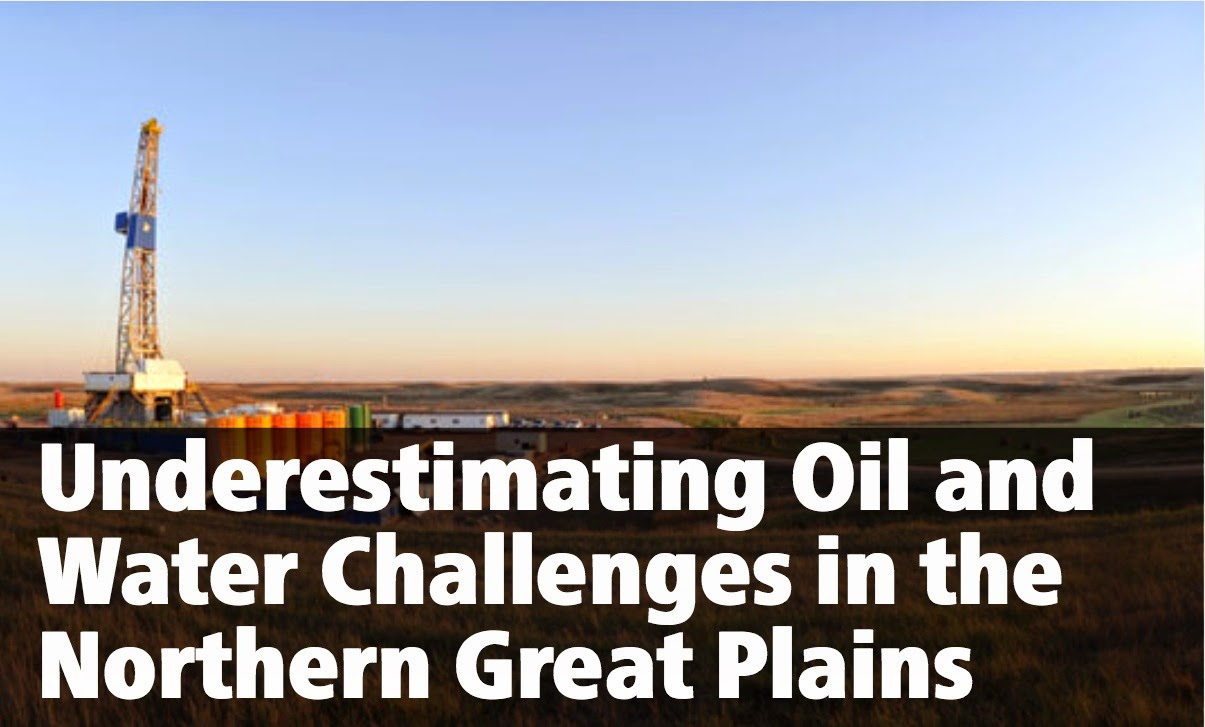
The Northern Great Plains has become the epicenter of new oil development in the United States. New production techniques have set off an oil boom there reminiscent of the chaotic conditions over a century ago when the prospect of black gold drew developers to Texas.
Water impacts were not remotely a consideration back then. But now, unprecedented levels of drilling in this huge oil basin require the implementation of careful water management practices to protect regional resources.
Drilling takes place throughout the Great Plains’ Williston oil basin, home to the Bakken, Three Forks, and Tyler formations, reaching into the U.S. states of North Dakota, South Dakota,1 and Montana as well as Canada’s provinces of Saskatchewan and Alberta. With an estimated 7.4 billion barrels of technically recoverable oil in the United States (plus an additional 1.6 billion barrels in Canada), the Williston basin is the largest continuous oil accumulation in the country.
It is also one of the world’s most rapidly and densely developed oil plays with about 8,000 still-active wells drilled between 2006 and 2014. The United States Geological Survey (USGS) estimates that five times that number will be needed to access the total technically recoverable oil. But plans to continue producing at this rate will pose severe oil-water risks in the area.
The region’s geology and history convey unique water challenges, quite different from those in other U.S. shale formations. The sheer number of wells needed to produce the Williston creates a huge demand on freshwater for drilling, hydraulic fracturing, and maintenance. Along with oil, produced water (wastewater produced as a byproduct during oil production) is brought to the surface through these wells. Produced water yields are correlated to oil yields, so as the Williston basin’s oil production increases, produced water quantities and the associated contamination risks and disposal needs will accumulate. Further complicating the freshwater quantity demands and wastewater contamination concerns, a mosaic of state, national, and tribal borders provides potential for irregular data reporting, insufficient regulatory oversight, inconsistent rules, and inadequate contamination cleanup.
If the Williston basin is going to help supply America’s oil needs over the long term, the Northern Great Plains’ oil-water challenges must be adequately controlled and safely managed.
Continuous, Complex Geology
The Williston’s shale is relatively easy to navigate. Overlapping formations allow oil companies to extract the oil with great speed and success.
The Bakken, while it has limited amounts of conventionally pooled oil, is almost completely an unconventional shale oil play. It is comprised of three informal layers: the upper, middle,and lower. Directly beneath the Bakken lies the Three Forks formation.2 Three Forks 1, the shallowest of the formation’s four main layers, has been produced in conjunction with the Bakken for many years. Recently, however, oil companies have begun to explore some of the deeper layers, allowing them to produce at multiple depths from the same plot of land, gaining access to more oil without acquiring more land. The Tyler formation, which is much shallower than the Bakken and Three Forks formations, is located farther south, and its unconventional oil potential is just beginning to be explored.
The Bakken formation was first identified in the early 1950s, though production was initially quite slow. That changed with the advent of hydraulic fracturing—the process of injecting a high-pressure slurry of chemicals, water, and propping agents to break apart shale and allow hydrocarbons to flow out of rock formations. Innovations in this technique transformed North Dakota’s oil operations.
Since 2006, oil production has expanded exponentially into the Bakken, Three Forks, and Tyler formations along with other smaller, lesser-known formations in the area (see map). Recently, drilling horizontally to produce oil in the Tyler formation has begun though it is still uncertain if the Tyler formation will be able to transition from a somewhat successful conventional play (accessed by vertical drilling) into a strong continuous play, produced by replicating new techniques used in the Bakken.
Companies aim to further reduce the space between wells to maximize access to oils at different depths from the same acreage. Leases that had only one well before may now have up to eight. As seen in Kodiak Oil & Gas Corp’s, Continental Resources Inc.’s, and other companies’ plans, there could be 14–34 wells per 1,280 acre lease.5 Wells are drilled and fracked more quickly and more cheaply as technology advances allowing companies to expand and increase their water demands rapidly.
The drilling process demands some water, but the hydraulic fracturing process and the water used to clean the well over its lifetime account for most of the water consumed during oil extraction. A single well fracking in the Williston averages 2 million gallons of water. Refracking wells two to three times, which is now common practice in the Williston, demands proportionately more freshwater than one-time fracking seen in other basins. And while some of the water used to clean wells can be reused as the base fluid for new fracking projects, new freshwater is required for each maintenance flush.
Getting to the Water Sources
With so much freshwater required to boost oil production, the question is: Where will the water come from? A range of resources can be found in the Northern Great Plains’ geology, including bedrock aquifers at many depths, glacial aquifers, the Missouri River winding through Montana and North Dakota, and Lake Sakakawea, a reservoir on the Missouri. These water resources vary markedly, and their characteristics must be used to determine how much water and which water the states can afford to permit oil companies to acquire, directly and indirectly.6
Making the situation more complicated, while the area may have ample water supplies, many rural citizens do not have secure access to them. The region currently struggles with fresh groundwater scarcity, low precipitation, minimal water infrastructure making transporting water extremely difficult, and federal restrictions regarding the use of the Missouri River and Lake Sakakawea as surface water sources.
Overdrawn Aquifers
Confined bedrock aquifers of varying water quality underlie the Williston basin, some of which are artesian aquifers that flow to the surface without the need for electrical pumps, a boon in remote locations that must be protected.
The slightly saline Fox Hills–Hell Creek aquifer (noted with diagonal orange lines on the map) is the only groundwater source capable of consistently producing large amounts of freshwater. As a result, it is overdrawn. Although rarely a drinking water source because of its relatively high concentration of total dissolved solids, (2,500 milligrams per liter), it is a major source for industrial, livestock, and residential use.7
Overuse has caused rapid long-term reduction in aquifer pressure by 1 to 2 feet per year. As a result, some of the artesian wells drawing from the Fox Hills–Hell Creek aquifer have stopped flowing and more will dry up in the future. Using this aquifer solely for domestic and livestock purposes and forcing industry to find other sources of water has been discussed, but stronger action may be needed.
Difficult-to-Manage Aquifers
Glacial aquifers, formed as glaciers melted and receded leaving permeable sediment behind, can be found in drainage system patterns throughout North Dakota and Montana. These aquifers, usually less than a few hundred feet deep, can be much more productive than bedrock aquifers, often with lower total dissolved solids concentrations. Their high flow rates mean water spends shorter times within the aquifer dissolving and accumulating salts and minerals. Thus, these aquifers often tend to be the only source of irrigation-quality groundwater in the area. High flow rates, however, lead to difficulty managing the resource, as discharge can happen quickly while recharge rates are variable and uncertain.
Tapping Lakes and Rivers
The most reliable sources of surface water in the area are the Missouri River and its reservoir, Lake Sakakawea. Much of the water currently used for hydraulic fracturing in North Dakota and Montana comes from the Missouri River.
Without depending on water withdrawal from lakes and rivers, it will be impossible to meet the upward trend of oil production without harming the Northern Great Plains’ aquifers and tributary streams. So, as industry demands rise, oil companies are pushing back on the U.S. Corps of Engineers’ (USCOE) 2010 moratorium that prevents lake-water access permits. North Dakota law makes the state water commission responsible for issuing permits for Lake Sakakawea water use, but the USCOE is the only power that can grant permission to access the lake for water diversion. The moratorium was put in place temporarily while the USCOE determined what price to charge for Missouri River water stored behind its dam. Over time, however, the moratorium has morphed into a 100,000 acre foot per year temporary permitting limit, with no storage fee applicable until the USCOE approves a water price.
The oil industry would benefit from permanent access to Lake Sakakawea at little or no cost, but such an arrangement would not be durable. The millions of gallons each well uses over its lifetime would necessitate many new infrastructure investments to transport Lake Sakakawea’s water throughout the basin. These oil-water commitments would also impact local residents’ future higher-priority needs.
Oil companies in eastern Montana do not currently have access to Lake Sakakawea, instead depending on the Missouri River as a surface water resource, even though many of its tributaries are over-appropriated. The Yellowstone River, which cuts through parts of the Williston basin, is also a potential water source for the oil industry; however, some stretches are closed off to new appropriations, and temporal variation in flow causes the river to be over-appropriated at times. While finding cheap and accessible water may be difficult in Montana, the oil industry’s surface water (and groundwater) needs there pale in comparison to the struggles facing North Dakota, where the majority of drilling occurs.
The Salt Problem
All this is particularly problematic because the Northern Great Plains contains large volumes of highly saline water. This water—up to ten times the salinity of ocean water—is housed in the same rocks that trap oil in the Williston basin. When pumped out with the oil, this produced water must be treated as waste.
Once production begins, a well operator begins pumping out the fluid used to frack the well along with highly saline produced water and oil. This continues through the well’s lifetime—with volumes of these three fluids changing dramatically over the lifetime of the well, the amount of fracking fluid recovered at the surface dropping off dramatically in the days following fracking, and the ratio of produced water to oil increasing as the well ages. Produced water from the Bakken formation also contains toxic metals and radioactive substances and can measure up to 300,000 milligrams per liter of total dissolved solids.
Most of the produced water in the Williston is transported to Class II injection wells (see blue dots on map) for disposal. Injecting this water deep underground can prevent ground and surface water contamination, if done properly. Proper disposal is important because spills and contamination in the Williston basin are far more damaging than mishandlings of less saline produced waters from other U.S. basins.
One possibility for contamination in the Northern Great Plains arises during produced water transport—by truck and underground pipeline—to its injection site. With trucks and pipelines covering long distances between the producing well and the Class II injection well, the potential to spill oil and produced water arises. Truck spills may be obvious, but pipeline spills may go unnoticed as any evidence remains underground for some time.
Contamination of water resources can also be caused by spilling oil or produced water through operator error, illegal dumping, well blowouts, and flooding (sometimes caused by ice jams or heavy rains). Produced water spills are a far greater concern than oil spills because they spread much more rapidly and salts disperse quickly through surface or ground water. Spills’ boundaries are rarely well defined and oil and produced water can saturate any permeable soil near the spill, including by migrating beyond state or reservation borders.
Glacial aquifers in particular, with their fast recharge rates, can be quickly contaminated by surface spills, especially from produced water. Successful management of glacial aquifers is vital to protect one of the Williston’s only sources of high quality groundwater.
The Williston basin region has experienced sizeable spills since the oil industry boomed in the mid-2000s. North Dakota’s largest and most damaging saltwater spill occurred in 2006 when a Zenergy pipeline failed, releasing more than 1 million gallons of saltwater into Charbonneau Creek (a Yellowstone River tributary). The pipeline didn’t have a monitoring system to record the pressure drop or the differential between input and output quantity that would have quickly notified the company of the leak. Eight years later, Zenergy is still remediating, and efforts are expected to continue into the future.8
Problems also stem from practices long past. The Northern Great Plains is just now seeing the effects of contamination from oil production that began over fifty years ago. According to a USGS report, the city of Poplar in the Fort Peck Reservation has never been able to pinpoint the precise source(s) of contamination on its territory (beyond linking it to oil field contamination) that has damaged upwards of 37 billion gallons of water in its shallow aquifers. Three thousand residents depend on these aquifers as their sole sources of water. The EPA reached an agreementwith the three oil companies they deemed responsible, and these companies must now monitor Poplar’s public water supply monthly, provide treatment or an alternate water source for any degraded water quality, and cover the city’s $320,000 cost to identify safer water sources and relocate public water infrastructure. It has taken a half-century since initial contamination for stakeholders to experience its consequences because of the slow speed at which contamination travels in the subsurface. This contamination acts as a warning that the negative effects of oil production may take many years to come to light.
Beyond contamination, the high concentrations of salt in Williston produced water routinely builds up on equipment, damaging it and restricting oil flow. To prevent this salt buildup, oil companies use maintenance water—freshwater treated with biocides—to flush wells. Over a well’s thirty-year lifetime, almost 9 million gallonsof additional water may be used to remove the oil-restricting salt buildup.
Oil-production-related water contamination plagues all oil fields but, because of the Williston basin’s high salt content, water spills in eastern Montana and western North Dakota are especially dangerous to the environment and the people dependent on local water for their drinking, domestic, irrigation, and livestock water needs. Comprehensive regulations could help mitigate the risks, but protecting water resources in this area will be an ongoing challenge in the Williston basin.
Reporting Issues and Regulatory Confusion
Data on oil production in the Williston basin are extensive, but underreporting is a growing concern. Some counties do not report any produced water despite highly productive oil wells, and it remains unclear as to whether the Fort Peck Reservation reports its produced water. There are also loopholes in reporting spills and contamination events. Accuracy varies depending on the regulator and extent of regulatory oversight.9
A new online tool helps navigate oilfield-related spills in North Dakota, of which, until now, the public was rarely informed. But companies can report “no” water spilled when the actual amount discharged is unknown. Wells can be listed as confidentialfor up to six months after drilling begins, reporting no spill information to the public except in rare cases. Montana does not even maintain an electronic database, and the state government records spill information only on paper, making spill and contamination research more difficult. This means that rural residents do not have easy access to the history of contamination and the presence of spills in the area in which they live.
As the new Indian government settles in, questions arise about the future of the Indian-Pakistani relationship—questions prompted mostly by the new Indian prime minister’s history of Hindu nationalism.
Frederic Grare
But a more revealing lens for analyzing this relationship might be to regard it from the perspective of Pakistan. Pakistan’s “dysfunctional civil-military relations” suggest an uncertain political future, leaving India in an essentially reactive role. That dynamic, may have an even more powerful impact than Narendra Modi’s politics.
Modi’s decision to invite his Pakistani counterpart, Nawaz Sharif, to his swearing-in ceremony together with all the other heads of state or government from the South Asian Association for Regional Cooperation, was considered a positive gesture on both sides of the border. The meeting between the two prime ministers was cordial and frank but—to no one’s surprise—not groundbreaking.
While Pakistani leaders are unanimous and sincere in welcoming warmer relations with India, civilians and military officials have opposing long-term objectives. It is doubtful that the Pakistani military supports such a change for any reasons beyond the narrowly tactical, and in fact will fight fiercely against such a change affecting its territorial claims. Sharif is pursuing an opposite strategy—trying to turn a tactical rapprochement into a more permanent arrangement.
India is likely to adopt a “wait and see” attitude. While the election of a new government may have elevated resolve to punish Pakistan in case of a terrorist attack, it has not increased India’s capacity to coerce its neighbor into any specific outcome. New Delhi will have to walk a fine line between ignoring Pakistan, which it can’t control and does not need economically, and keeping the door to better relations open enough to provide a real incentive for Islamabad to adopt meaningful new policies—all without making unilateral concessions to Pakistan.
Most-Favored-Nation Status
A year ago, then-candidate Sharif made the normalization of relations with India a central plank of his platform. Hopes were high, therefore, that Pakistan would finally extend India Most-Favored-Nation (MFN) status, removing tariff and other trade barriers. Sharif did not spell out any preconditions. But, twelve months later, the issue is still pending. Pakistan is now stipulating that the MFN status will be attributed to India only if New Delhi reopens the composite dialogue, a stalled executive-level negotiation process.
Awarding the MFN status to India is important in its own right. A substantial part of the business community, in particular small- and medium-sized enterprises, seem to fear being overwhelmed by a massive arrival of cheaper Indian products on the Pakistani market. Nontariff barriers to India’s market have also been invoked as a justification for Pakistan’s hesitations. Yet, the Pakistani government continues to insist on the need to facilitate bilateral trade between the two countries. It blames several Indian lobbies (the automobile, textile and pharmaceutical industries as well as the agricultural lobbies) for obstructing the negotiations and maintains that awarding India MFN status would benefit Pakistan.
However, the MFN issue provides clues to a larger domestic political dynamic in Pakistan. The main political parties support Sharif’s policy. Jihadi organizations, on the contrary, oppose any trade deals with New Delhi as long as Kashmir remains under Indian control. Here, as elsewhere, the jihadis are joined by the military—whose opposition Sharif seems to have underestimated. The nomination of Raheel Sharif as replacement for Ashfaq Parvez Kayani as Chief of Army Staff (COAS) did not usher a more receptive posture in Rawalpindi. It was the military that insisted that the government take the small- and medium-sized enterprises’ objections to heart. It also lent its explicit support to their cause, warning the Sharif brothers “against making rapid concessions, particularly in the run-up to India’s general election.” In February 2014, Shabaz Sharif, the prime minister’s brother, obliquely accused the military of obstructing trade normalization.
Awarding the MFN status to India would thus serve the interests of the civilian government, not to mention the country, whose economy would benefit from free trade with India. But such a move would only partly benefit the military. This relative convergence opens some diplomatic and political space that the government can exploit, providing it can keep its relations with the military under control. Yet, a spectacular advance in trade relations between India and Pakistan is unlikely. In the delay, Pakistan, whose economy is in shambles, has much more to lose than India does. New Delhi can afford patience. Its economic future lies in its integration in the global economy, not in any specific trade relation with its South Asian neighbors. More
Israel's lies make it clear to the Palestinians that it will continue to wage a campaign of state terror and will never admit its atrocities or its intentions.
ALL GOVERNMENTS lie, including Israel and Hamas. But Israel engages in the kinds of jaw-dropping lies that characterize despotic and totalitarian regimes.
It does not deform the truth; it inverts it. It routinely paints a picture for the outside world that is diametrically opposed to reality. And all of us reporters who have covered the occupied territories have run into Israel's Alice-in-Wonderland narratives, which we dutifully insert into our stories — required under the rules of American journalism — although we know they are untrue.
I saw small boys baited and killed by Israeli soldiers in the Gaza refugee camp of Khan Younis. The soldiers swore at the boys in Arabic over the loudspeakers of their armored jeep. The boys, about 10 years old, then threw stones at an Israeli vehicle and the soldiers opened fire, killing some, wounding others. I was present more than once as Israeli troops drew out and shot Palestinian children in this way.
Such incidents, in the Israeli lexicon, become children caught in crossfire.
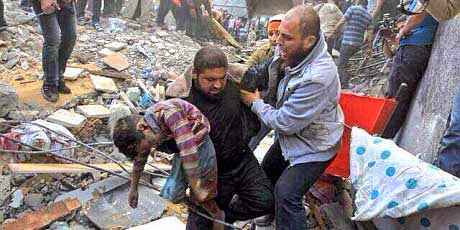
I was in Gaza when F-16 attack jets dropped 1,000-pound iron fragmentation bombs on overcrowded hovels in Gaza City. I saw the corpses of the victims, including children. This became a surgical strike on a bomb-making factory.
I have watched Israel demolish homes and entire apartment blocks to create wide buffer zones between the Palestinians and the Israeli troops that ring Gaza. I have interviewed the destitute and homeless families, some camped out in crude shelters erected in the rubble. The destruction becomes the demolition of the homes of terrorists.
I have stood in the remains of schools — Israel struck two United Nations schools in the last six days, causing at least 10 fatalities at one in Rafah on Sunday and at least 19 at one in the Jebaliya refugee camp Wednesday — as well as medical clinics and mosques. I have heard Israel claim that errant rockets or mortar fire from the Palestinians caused these and other deaths, or that the attacked spots were being used as arms depots or launching sites.
I, along with every other reporter I know who has worked in Gaza, have never seen any evidence that Hamas uses civilians as “human shields.”
There is a perverted logic to Israel's repeated use of the Big Lie — the lie favored by tyrants from Josef Stalin to Saddam Hussein. The Big Lie feeds the two reactions Israel seeks to elicit — racism among its supporters and terror among its victims.
By painting a picture of an army that never attacks civilians, that indeed goes out of its way to protect them, the Big Lie says Israelis are civilized and humane, and their Palestinian opponents are inhuman monsters.
The Big Lie serves the idea that the slaughter in Gaza is a clash of civilizations, a war between democracy, decency and honor on one side and Islamic barbarism on the other. And in the uncommon cases when news of atrocities penetrates to the wider public, Israel blames the destruction and casualties on Hamas.
George Orwell in his novel “Nineteen Eighty-Four” called this form of propaganda doublethink. Doublethink uses “logic against logic” and “repudiate[s] morality while laying claim to it.”
The Big Lie does not allow for the nuances and contradictions that can plague conscience. It is a state-orchestrated response to the dilemma of cognitive dissonance. The Big Lie permits no gray zones. The world is black and white, good and evil, righteous and unrighteous.
The Big Lie allows believers to take comfort — a comfort they are desperately seeking — in their own moral superiority at the very moment they have abrogated all morality.
The Big Lie, as the father of American public relations, Edward Bernays, wrote, is limited only by the propagandist's capacity to fathom and harness the undercurrents of individual and mass psychology. And since most supporters of Israel do not have a desire to know the truth, a truth that would force them to examine their own racism and self-delusions about Zionist and Western moral superiority, like packs of famished dogs they lap up the lies fed to them by the Israeli government.
But the Big Lie is also consciously designed to send a chilling message to Gaza's Palestinians, who have lost large numbers of their dwellings, clinics, mosques, and power, water and sewage facilities, along with schools and hospitals, who have suffered some 1,850 deaths since this assault began — most of the victims women and children — and who have seen 400,000 people displaced from their homes.
The Big Lie makes it clear to the Palestinians that Israel will continue to wage a campaign of state terror and will never admit its atrocities or its intentions. The vast disparity between what Israel says and what Israel does tells the Palestinians that there is no hope. Israel will do and say whatever it wants. International law, like the truth, will always be irrelevant. There will never, the Palestinians understand from the Big Lie, be an acknowledgement of reality by the Israeli leadership.
The Israel Defense Forces website is replete with this black propaganda. “Hamas exploits the IDF's sensitivity towards protecting civilian structures, particularly holy sites, by hiding command centers, weapons caches and tunnel entrances in mosques,” the IDF site reads. “In Hamas' world, hospitals are command centers, ambulances are transport vehicles, and medics are human shields,” the site insists.
“… [Israeli] officers are tasked with an enormous responsibility: to protect Palestinian civilians on the ground, no matter how difficult that may be,” the site assures its viewers. And the IDF site provides this quote from a drone operator identified as Lt. Or. “I have personally seen rockets fired at Israel from hospitals and schools, but we couldn't strike back because of civilians nearby. In one instance, we acquired a target but we saw that there were children in the area. We waited around, and when they didn't leave we were forced to abort a strike on an important target.”
Israel's ambassador to the United States, Ron Dermer, in a Big Lie of his own, said last month at a conference of Christians United for Israel that the Israeli army should be given the “Nobel Peace Prize … a Nobel Peace Prize for fighting with unimaginable restraint.”
The Big Lie destroys any possibility of history and therefore any hope for a dialogue between antagonistic parties that can be grounded in truth and reality.
And when facts no longer matter, when there is no shared history grounded in the truth, when people foolishly believe their own lies, there can be no useful exchange of information.
The Big Lie, used like a bludgeon by Israel, as perhaps it is designed to be, ultimately reduces all problems in the world to the brutish language of violence. And when oppressed people are addressed only through violence they will answer only through violence. More
PHILIPSBURG, St. Maarten, Jul 2 2014 (IPS) – As the costs of climate change continue to mount, officials with the Commonwealth grouping say it is vital that Small Island Developing States (SIDS) stick together on issues such as per capita income classification.
Seawall in Dominica
Deputy Commonwealth Secretary General (Economic and Social Development) Deodat Maharaj told IPS the classification affects the ability of countries like Antigua and Barbuda, Grenada and others to access financing from the international financial institutions.
“To my mind, the international system has to take special consideration of countries such as Antigua and Barbuda, Grenada and others,” he said.
“The example I like to use is the example of Grenada. You would recall Hurricane Ivan about 10 years ago. It damaged about 70 percent of the housing stock in Grenada. It cost a billion U.S. dollars in damages, equivalent to two years GDP.
“So the countries in the Caribbean can move from high income or middle income to almost zero income with an economic shock or natural disaster,” Maharaj added.
Maharaj, whose appointment took effect earlier this year, said the Commonwealth is preparing “an analytical framework based on research, a case, so that countries such as Grenada when there is a natural disaster their international debt obligation for a particular period of time will be suspended so that they don’t have to continue to pay their debt when it is that they have suffered a natural disaster.”
On the issue of collaboration, one of only three female prime ministers in the Caribbean has reaffirmed her country’s commitment to dealing with climate change and all the issues associated with the global phenomena.
“I would like to reaffirm my strong belief in collaboration with other nations,” Sarah Wescot-Williams, the prime minister of St. Maarten, told IPS.
“Economic issues have forced us to look at ways and means of getting together and we are working collaboratively with other Caribbean nations to mitigate the effects of climate change as well as social issues of unemployment, crime and health.”
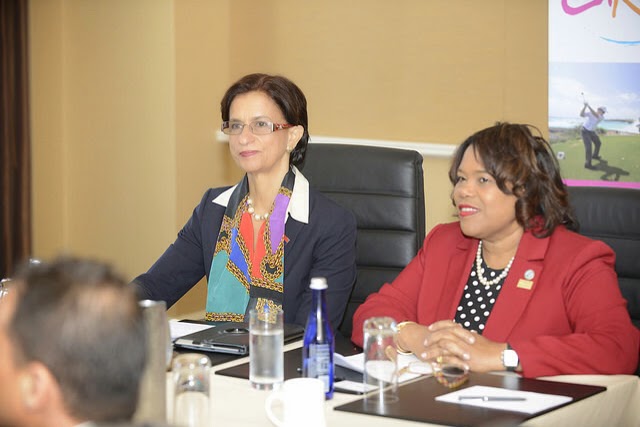
Prime Minister of St. Maarten Sarah Wescot-Williams (left)
St. Maarten recently developed and approved its National Energy Policy “and as such we have very specific goals and objectives to reach by 2020 in terms of reduction and promoting alternative, new green ideas, new green products,” Wescot-Williams explained.
She reiterated a point made while addressing regional leaders recently. “I told them we should not only look out for the bigger impacts of climate change or look at those developments as something that is far from us, far from our homes, but look at small things like beach erosion, something that St. Maarten is seeing.
“A report has been issued not very long ago indicating that unless specific measures are taken, a great part of what is now land will no longer be as far as the smaller islands, including St. Maarten, are concerned.”
How they are ranked by financial institutions such as the International Monetary Fund (IMF) and World Bank is a major issue for Caribbean countries.
Camillo Gonsalves, a former ambassador to the United Nations, says it affects these countries’ ability to secure the required funding to effectively deal with climate change.
He noted that most Caribbean countries are ranked as middle-income countries, and using that metric alone makes his country, St. Vincent and the Grenadines, with its one-billion-dollar Gross Domestic Product (GDP), “richer than China”.
“If that is the metric by which we determine economic health and access to concessionary financing, and our ability to borrow ourselves out of a crisis or to spend ourselves out of a crisis, it is clearly a flawed measure,” he said.
He noted that within three hours last Christmas Eve, a trough system left damage and loss in St. Vincent equal to 17 percent of GDP, while the country also suffered natural disasters in 2010, and 2011 – the loss and damage from each of which was in double digits.
This, however, is the measure by which the World Bank, the IMF determine the economic strength of Caribbean countries, Gonsalves said, adding that these international institutions do not consider the region’s vulnerabilities.
“The Caribbean small island developing states are among the most heavily indebted states in the world,” Gonsalves said, noting that the debt-to-GDP ratio in the region ranges from 20 percent in Haiti – which received significant debt forgiveness after the 2010 earthquake – to 139 percent in Jamaica, with St. Kitts and Nevis and Grenada at 105 and 115 per cent, respectively, even as the European Union has set itself a debt-to-GDP ratio of 65 per cent.
“If your debt-to-GDP ratio is 139 percent and you are struck by a natural disaster… how do you borrow yourself out of that crisis? Where do you find money immediately to build your roads, your houses, your bridges, your hospitals that have been damaged? How can you set money aside in preparation for the next climate event if you have a debt to GDP ratio of over 100 per cent or approaching 100 per cent, and your debt servicing charges are that high?” Gonsalves said.
Agreeing with Wescot-Williams and Maharaj that there is strength in unity, Gonsalves, who serves as foreign affairs minister for St. Vincent and the Grenadines, said the upcoming Third United Nations Conference on Small Island Developing States (SIDS) in Samoa is an ideal opportunity for regional countries to do more than just talk about collaboration.
“The issue of how we are ranked and classified has to be rectified – not addressed, not flagged, not considered. It has to be rectified in Samoa. That has to be one of our prime objectives going into this conference,” he said.
The Samoa conference will be held from Sep. 1-4 under the theme “The Sustainable Development of Small Island States Through Genuine and Durable Partnerships”.
It will seek to assess progress and remaining gaps; renew political commitment by focusing on practical and pragmatic actions for further implementation; identify new and emerging challenges and opportunities for the sustainable development of SIDS and means of addressing them; and identify priorities for the sustainable development of SIDS to be considered in the elaboration of the post-2015 U.N. development agenda.
Maharaj said “one big challenge” for his organisation is the advancement of the interest of small states.
“When I think about the Caribbean and I think about development…we need to think about development not only in terms of five years, 10 years or 15 years,” he said.
“I would like to think about and imagine what will the Caribbean be in the year 2050 at the time when our grand- and great-grandchildren will be around and many of us won’t be here,” Maharaj added. More
August 2014: The World Meteorological Organization (WMO) has launched a small island developing States (SIDS) website to highlight its work with SIDS, given that they are low-lying and vulnerable to weather- and climate-related hazards, such as tropical cyclones, floods and droughts.
The website features: a media corner, highlighting the most recent information on SIDS; links to WMO SIDS publications, including ‘Saving Paradise: Ensuring Sustainable Development' and ‘The SIDS Caribbean Project: Preparedness to Climate Variability and Global Change in SIDS of the Caribbean Region;' and information on WMO side events to be convened at the Third International Conference on SIDS, taking place in Apia, Samoa, from 1-4 September 2014.
WMO supports SIDS in developing: adequate structures and building capacity to ensure that information is available in a timely manner to address issues such as coastal zone management, energy, environmental degradation, tourism and climate change; and scientifically sound and culturally sensitive early warning systems. It further supports national meteorological and hydrological services (NMHSs) in SIDS to help access the most sophisticated products in real-time and forecasts of extreme weather events several days in advance. [WMO SIDS Website]


 © 2014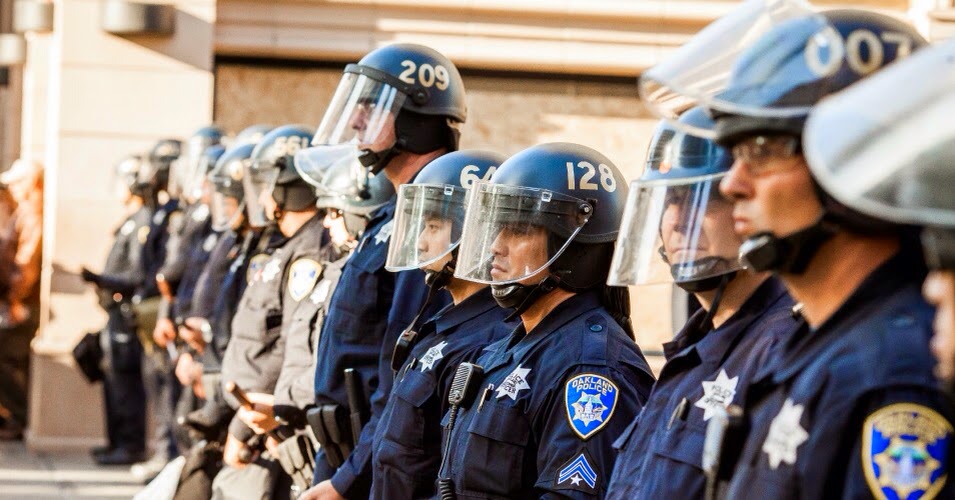







 Democracy & Good Governance