Israel intensifies bombardment on Gaza

Gilgit-Baltistan Times's avatarGilgit-Baltistan Times

Palestinians told to evacuate their homes as the Israeli offensive claims more than 200 people and injures 1500 others.


Residents Zeitoun were seen walking in the streets, carrying their belongings as they tried to evacuate [AP]
Gaza City – The Israeli army intensified its bombing of Gaza on Wednesday, hitting the homes of senior Hamas leaders and carrying out more than 50 airstrikes in a heavily-populated area in the northern strip.

The death toll climbed to 220 people, according to Palestinian medical officials, including 47 children. On Wednesday, four children were killed by naval shelling on a beach.

More than 1,500 people have been injured. One in five of those killed so far have been children, the NGO Save the Children said on Wednesday, and the vast majority were civilians, according to the United Nations.

The army also bombed the houses of several senior Hamas leaders, including Mahmoud al-Zahar.

Some…

View original post 628 more words

Water is the Deal

dannyheim's avatarEvolve Now

Drought-low-pond

No, I ain’t no kinda expert. But a little study and some everyday observation of the news can tell you a plenty. Let‘s go ahead and start of with some facts about water. These are from an organization called Changing the Present.

One sixth of the worlds population does not have access to safe drinking water.

 2.6 billion people worldwide do not have access to adequate sanitation.

 The number of people living in a water-stressed country is projected to climb from 470 million to three billion by 2050.

 2.2 million people in developing countries, most of them children, die every year from diseases associated with lack of access to safe drinking water, inadequate sanitation and poor hygiene.

 A child dies every 15 seconds from water-related diseases.

 World population has doubled since 1950. Our water consumption has increased six-fold.

 The average person in the developing world uses less than 3…

View original post 1,956 more words

They call us now.

A Facebook friend shared the following remarkable poem by Lena Khalaf Tuffaha, who is a co-founder of the Institute for Middle East Understanding based in Seattle. It catches the nightmarish absurdity of the latest invasion of Gaza.

They call us now.

Before they drop the bombs.

The phone rings

and someone who knows my first name

calls and says in perfect Arabic

“This is David.”

And in my stupor of sonic booms and glass shattering symphonies

still smashing around in my head

I think “Do I know any Davids in Gaza?”

They call us now to say

Run.

You have 58 seconds from the end of this message.

Your house is next.

They think of it as some kind of

war time courtesy.

It doesn’t matter that

there is nowhere to run to.

It means nothing that the borders are closed

and your papers are worthless

and mark you only for a life sentence

in this prison by the sea

and the alleyways are narrow

and there are more human lives

packed one against the other

more than any other place on earth

Just run.

We aren’t trying to kill you.

It doesn’t matter that

you can’t call us back to tell us

the people we claim to want aren’t in your house

that there’s no one here

except you and your children

who were cheering for Argentina

sharing the last loaf of bread for this week

counting candles left in case the power goes out.

It doesn’t matter that you have children.

You live in the wrong place

and now is your chance to run

to nowhere.

It doesn’t matter

that 58 seconds isn’t long enough

to find your wedding album

or your son’s favorite blanket

or your daughter’s almost completed college application

or your shoes

or to gather everyone in the house.

It doesn’t matter what you had planned.

It doesn’t matter who you are

Prove you’re human.

Prove you stand on two legs.

Run.

– Running Orders, by Lena Khalaf Tuffaha


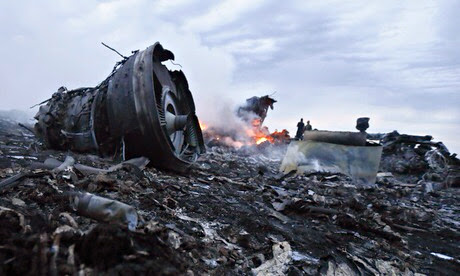
Sifting through the wreckage of MH17, searching for sense amid the horror

Any journalist should hesitate before saying this, but news can be bad for you. You don’t have to agree with the analyst who reckons “news is to the mind what sugar is to the body” to see that reading of horror and foreboding hour by hour, day after day, can sap the soul.

This week ended with a double dose, administered within the space of a few hours: Israel’s ground incursion into Gaza and, more shocking because entirely unexpected, the downing of Malaysia Airlines flight MH17 over Ukraine, killing all 298 on board.

So in Gaza we look at the wildly lopsided death tolls – nearly 300 Palestinians and two Israelis killed these past nine days.

The different responses these events stir in those of us who are distant, and the strategies we devise to cope with them, say much about our behaviour as consumers of news. But they also go some way to determining our reaction as citizens, as constituent members of the amorphous body we call public, or even world, opinion.

As I write, 18 of the 20 most-read articles on the Guardian website are about MH17. The entry into Gaza by Israeli forces stands at number 21. It’s not hard to fathom why the Malaysian jet strikes the louder chord. As the preacher might put it, “There but for the grace of God go I.” Stated baldly, most of us will never live in Gaza, but we know it could have been us boarding that plane in Amsterdam.

Which is why there is a morbid fascination with tales of the passenger who changed flights at the last minute, thereby cheating death, or with the crew member who made the opposite move, hastily switching to MH17 at the final moment, taking a decision that would have seemed so trivial at the time but which cost him his life. When we read about the debris – the holiday guidebooks strewn over the Ukrainian countryside, the man found next to an iPhone, the boy with his seatbelt still on – our imaginations put us on that flight. Of course we have sympathy for the victims and their families. But our fear is for ourselves.

It’s quite true that if the US truly decided that Israel’s 47-year occupation of Palestinian territory was no longer acceptable, that would bring change.

The reports from Gaza stir a different feeling. When we read the Guardian’s Peter Beaumont describe the sights he saw driving around the strip on Friday morningthree Palestinian siblings killed by an Israeli artillery shell that crashed into their bedroom, a father putting the remains of his two-year-old son into a plastic shopping bag – we are shaken by a different kind of horror. It is compassion for another human being, someone in a situation utterly different to ours. We don’t worry that this might happen to us, as we now might when we contemplate an international flight over a war zone. Our reaction is directed not inward, but outward. More

There is an interesting article by Chris Hedges entitled It's NOT going to be OK on the current economic disparity which, he believes could lead to a drastic decline in democracy as states respond to social protests. The question I ask is what can be done to slow or erradicate this process? Editor


CIA Station Chief Ordered out of Berlin, DOJ Declining to Investigate CIA Complaints that Senate Staff Hacked into Agency Computers while Completing Contentious Torture Report, and More: FRINFORMSUM 7/17/2014

Lauren Harper's avatarUNREDACTED: The National Security Archive Blog

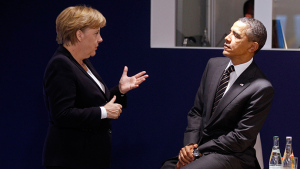
Germany's Chancellor Angela Merkel and President Barack Obama (Reuters / Kevin Lamarque) Germany’s Chancellor Angela Merkel and President Barack Obama (Reuters / Kevin Lamarque)

Berlin has ordered the CIA chief of station to leave Germany by the end of the week amid a growing espionage scandal, according to German newspapers. The German Foreign Office did not verify a timeline for departure, but did reiterate the German government’s expectation that the intelligence representative leave “promptly.” Chancellor Angela Merkel demanded the station chief’s departure last week after a year-long spying dispute, triggered by revelations that the National Security Agency (NSA) monitored Merkel’s cell phone, culminated with reports that a German intelligence official was spying for the CIA.

Maj. James Weirick, the Marine Corps whistleblower who accused a senior general and his staff of wrongdoing during the trial of Marines implicated in a video depicting US personnel urinating on dead Afghani insurgents, has been transferred. Weirick, who previously served as a staff judge advocate at…

View original post 977 more words

The Peak Oil Crisis: Better Than Fire

In addition to following the twists and turn of the world’s energy situation, I have been tracking the reporting on developments concerning several “exotic” and therefore controversial energy sources whose proponents say would be far more cost-effective than current alternatives to fossil fuels such as wind, solar and nuclear.
The reason for this interest is that if one believes global warming is caused by carbon emissions, then it certainly looks like there will not be much left of human civilization in a century or so. While the use of “conventional” alternatives is growing, the demand for energy to fuel economic growth is so great that it seems likely that, unless some outside force intervenes, mankind is going to burn fossil fuels until it is no longer economically possible to do so.
What is clearly necessary is some source of energy that is so cheap and easy to produce and so environmentally clean that everyone on earth will want to use the new energy source as soon as possible.
Fortunately, there are a handful of people out there who really are a few steps ahead of academia, government officials, and the mainstream media in the effort to save mankind from what is shaping up to be a many millennia-long disaster. In the past I have written about cold fusion or in the current jargon, low energy nuclear reactions (LENR). This technology is still alive, well, and seems destined to produce some commercially viable prototypes in the near future.
However, last week a company up in New Jersey call BlackLight Power and its founder announced a breakthrough which could be just what the world sorely needs in addition to touching off a new era in the history of mankind. I stress could for all the evidence is not in yet and useful prototypes have yet to be built, but BlackLight’s founder and inventor of the technology, Randall Mills, seems unusually forthright in his claims that there has indeed been a breakthrough on the exotic energy front. For those of the “its too good to be true” bent, keep in mind that discoveries do happen from time to time – electricity, internal combustion, and smart phones to name a few.
About 20 years ago Randall Mills announced that a more compact form of the hydrogen atom existed in the universe which he termed a hydrino. This form of hydrogen had its electron circling its proton at about 1/4th the distance from the nucleus as in a conventional hydrogen atom and therefore had much less energy. Mills went on to say he believed that the dark matter which makes up the bulk of the universe was composed of these compact hydrogen atoms which neither absorb nor emit light making them very difficult to detect. At the cosmological scale dark matter is only known to exist because of its gravitational pull on other mass. As most of the visible universe is composed of hydrogen, it seems to make sense that the invisible part is hydrogen too.
When Mills announced his hypothesis in 1991, it was, of course, denounced by the scientific establishment as ridiculous for if another form of hydrogen existed, we surely would have discovered it decades ago. To make the ensuing controversy still worse, Mills claimed that the accepted version of quantum mechanics had it wrong in its description of just what an electron is and that the classical physics of Newton and Maxwell works at the atomic as well as the cosmic scale. Such a claim is heresy of the first order in the land of the scientists so Mills and his hydrinos were quickly forgotten.
From mankind’s perspective, however, the interesting feature about the existence of two forms of hydrogen is that in converting the conventional hydrogen atom to a hydrino a spectacular amount of energy is released – on the order of 200 times as much as when hydrogen is joined with oxygen to form H2O. Thus began the 20-year search for the Holy Grail of our civilization – a way to transform hydrogen into hydrinos and release lots of energy.
As with the Wright brothers, all Mills had to do was to build a machine that took in water and send commerical amounts of energy out, then his thesis would have to be accepted. It took 20+ years to develop the theoretical basis for such a machine, but for the last six months Mills has been demonstrating crude prototypes to selected audiences. Fortunately for the rest of us, these demonstrations and considerable information on what is taking place have been appearing regularly on the internet. Although some remain skeptical, the length of time Mills has been working on this project, the size of his organization, the scale of his financial backing and the verification of his science by external laboratories strongly suggests that his claims are valid.
Mills’ machines are remarkably simple. After 20 years of research he has developed a metallic powder that will also absorb moisture (hydrogen) from the humidity in the air. A tiny amount of this damp powder is subjected to a low voltage, high amperage current and the hydrogen in the powder is zapped, for want of a better word, into hydrinos with a blinding flash of light. The hydrogen-depleted powder can then absorb more moisture from the atmosphere and be reused indefinitely.
While the mini-explosions that take place in Mills’ device are spectacular, they certainly were a long ways from a technology that might save the world until two weeks ago when he announced that the energy emitted from these “explosions” is mostly white light. The white light emitted is at least 50,000 times brighter than that of sunlight as it reaches the earth’s surface and given the latest in solar cell technology, can easily be converted into prodigious amounts of electricity using only the humidity in the air as the fuel. One design is anticipating that a one-foot cubic device will be able to produce 10 million watts of electric power.
To quote Mills, “nature has just given us the best gift that we have ever had, this is better than fire.” More


India and Pakistan at Odds Over Shrinking Indus River

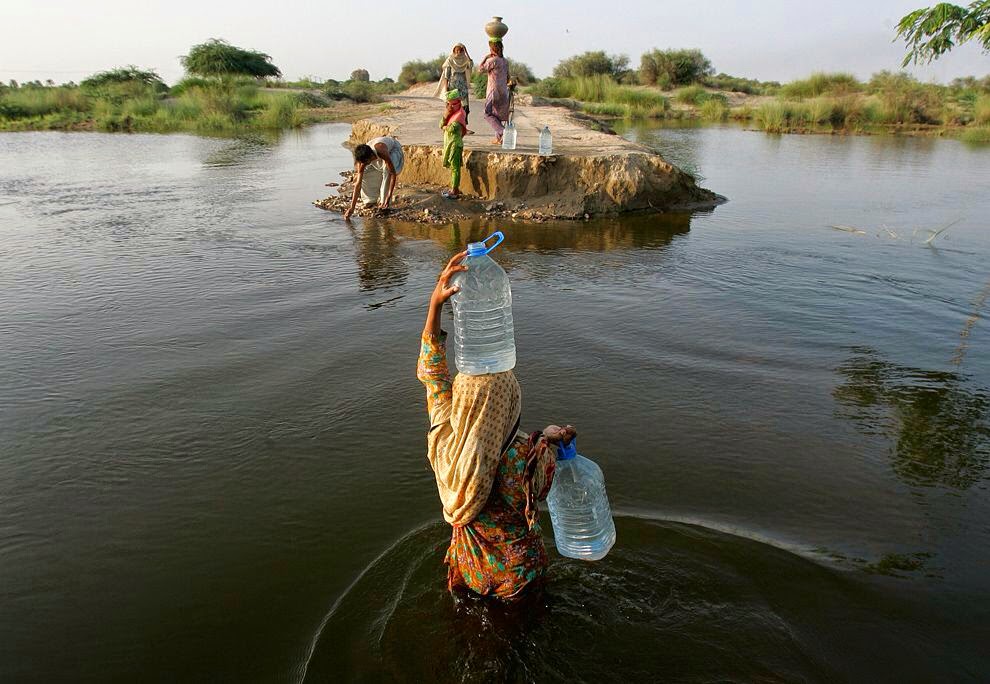
Nearly 30 percent of the world's cotton supply comes from India and Pakistan, much of that from the Indus River Valley. On average, about 737 billion gallons are withdrawn from the Indus River annually to grow cotton—enough to provide Delhi residents with household water for more than two years. (See a map of the region.)

Baseera Pakistan Aug 2010

“Pakistan's entire economy is driven by the textile industry,” said Michael Kugelman, a South Asia expert at the Woodrow Wilson International Center for Scholars. “The problem with Pakistan's economy is that most of the major industries use a ton of water—textiles, sugar, wheat—and there's a tremendous amount of water that's not only used, but wasted,” he added.

The same is true for India.

That impact is an important part of a complex water equation in countries already under strain from booming populations. More people means more demand for water to irrigate crops, cool machinery, and power cities. The Indus River, which begins in Indian-controlled Kashmir and flows through Pakistan on its way to the sea, is Pakistan's primary freshwater sourceon which 90 percent of its agriculture dependsand a critical outlet of hydropower generation for both countries.

(Related: “See the Global Water Footprint of Key Crops“)

Downstream provinces are already feeling the strain, with some dried-out areas being abandoned by fishermen and farmers forced to move to cities. That increases competition between urban and rural communities for water. “In areas where you used to have raging rivers, you have, essentially, streams or even puddles and not much else,” said Kugelman.

In years past, the coastal districts that lost their shares of the Indus' flows have become “economically orphaned,” the poorest districts in the country, according to Pakistani water activist Mustafa Talpur. Because Pakistani civil society is weak, he says, corruption and deteriorating water distribution tend to go hand in hand.

In the port city of Karachi, which depends for its water on the Indus, water theftin which public water is stolen from the pipes and sold from tankers in slums and around the citymay be a $500-million annual industry.

In the balance is the fate not only of people, but important aquatic species like the Indus River dolphin, which is now threatened to extinction by agricultural pollution and dams, among other pressures. Scientists estimate that fewer than 100 individuals remain.

Threat to Peace?

One of the potentially catastrophic consequences of the region's fragile water balance is the effect on political tensions.

In India, competition for water has a history of provoking conflict between communities. In Pakistan, water shortages have triggered food and energy crises that ignited riots and protests in some cities. Most troubling, Islamabad's diversions of water to upstream communities with ties to the government are inflaming sectarian loyalties and stoking unrest in the lower downstream region of Sindh.

But the issue also threatens the fragile peace that holds between the nations of India and Pakistan, two nuclear-armed rivals. Water has long been seen as a core strategic interest in the dispute over the Kashmir region, home to the Indus' headwaters. Since 1960, a delicate political accord called the Indus Waters Treaty has governed the sharing of the river's resources. But dwindling river flows will be harder to share as the populations in both countries grow and the per-capita water supply plummets.

Some growth models predict that by 2025, India's population will grow to triple what it wasand Pakistan's population to six times what it waswhen the Indus treaty was signed. Lurking in the background are fears that climate change is speeding up the melting of the glaciers that feed the river.

Mountain glaciers in Kashmir play a central role in regulating the river's flows, acting as a natural water storage tank that freezes precipitation in winter and releases it as meltwater in the summer. The Indus is dependent on glacial melting for as much as half of its flow. So its fate is uniquely tied to the health of the Himalayas. In the short term, higher glacial melt is expected to bring more intense flooding, like last year's devastating deluge.

Both countries are also racing to complete large hydroelectric dams along their respective stretches of the Kashmir river system, elevating tensions. India's projects are of a size and scope that many Pakistanis fear could be used to disrupt their hydropower efforts, as well as the timing of the flows on which Pakistani crops rely.

(Related: “Seven Simple Ways to Save Water“)

“Many in Pakistan are worried that, being in control of upstream waters, India can easily run Pakistan dry either by diverting the flow of water by building storage dams or using up all the water through hydroelectric power schemes,” said Pakistani security analyst Rifaat Hussain.

For years, Pakistani politicians have claimed India is responsible for Pakistan's water troubles. More recently, militant groups have picked up their rhetoric. Hafiz Saeed, the founder of the Pakistani militant group allegedly responsible for the 2008 terror attack in Mumbai, even accused India of “water terrorism.”

Hope for the Future

In the past few months, however, the situation has improved, according to Kugelman. “We've been hearing nearly unprecedented statements from very high-level Pakistani officials who have essentially acknowledged that India is not stealing Pakistan's water, and that Pakistan's water problems are essentially a function of internal mismanagement issues,” he said. Militants are still griping, he said, “but not as shrilly.”

This may be because the two countries are cooperating on water and other issues better than before, and because militants are now focusing less on their archenemy in India and more on coalition forces in Afghanistan.

“But I imagine this is momentary,” said Kugelman. “The facts on the ground—the water constraints in both India and Pakistan—have not abated. They're both still very serious and getting worse.”

What's needed, he says, is more conservation and adaptation—a smarter way of doing business. More

This Article is part the National Geographic Society’s freshwater initiative and is a multiyear global effort to inspire and empower individuals and communities to conserve freshwater and preserve the extraordinary diversity of life that rivers, lakes, and wetlands sustain.


How Saudi Arabia Helped Isis Take Over the North of Iraq

How far is Saudi Arabia complicit in the Isis takeover of much of northern Iraq, and is it stoking an escalating Sunni-Shia conflict across the Islamic world?

Some time before 9/11, Prince Bandar bin Sultan, once the powerful Saudi ambassador in Washington and head of Saudi intelligence until a few months ago, had a revealing and ominous conversation with the head of the British Secret Intelligence Service, MI6, Sir Richard Dearlove. Prince Bandar told him: “The time is not far off in the Middle East, Richard, when it will be literally ‘God help the Shia’. More than a billion Sunnis have simply had enough of them.”

The fatal moment predicted by Prince Bandar may now have come for many Shia, with Saudi Arabia playing an important role in bringing it about by supporting the anti-Shia jihad in Iraq and Syria. Since the capture of Mosul by the Islamic State of Iraq and the Levant (Isis) on 10 June, Shia women and children have been killed in villages south of Kirkuk, and Shia air force cadets machine-gunned and buried in mass graves near Tikrit.

In Mosul, Shia shrines and mosques have been blown up, and in the nearby Shia Turkoman city of Tal Afar 4,000 houses have been taken over by Isis fighters as “spoils of war”. Simply to be identified as Shia or a related sect, such as the Alawites, in Sunni rebel-held parts of Iraq and Syria today, has become as dangerous as being a Jew was in Nazi-controlled parts of Europe in 1940.

There is no doubt about the accuracy of the quote by Prince Bandar, secretary-general of the Saudi National Security Council from 2005 and head of General Intelligence between 2012 and 2014, the crucial two years when al-Qa’ida-type jihadis took over the Sunni-armed opposition in Iraq and Syria. Speaking at the Royal United Services Institute last week, Dearlove, who headed MI6 from 1999 to 2004, emphasised the significance of Prince Bandar’s words, saying that they constituted “a chilling comment that I remember very well indeed”.

He does not doubt that substantial and sustained funding from private donors in Saudi Arabia and Qatar, to which the authorities may have turned a blind eye, has played a central role in the Isis surge into Sunni areas of Iraq. He said: “Such things simply do not happen spontaneously.” This sounds realistic since the tribal and communal leadership in Sunni majority provinces is much beholden to Saudi and Gulf paymasters, and would be unlikely to cooperate with Isis without their consent.

Dearlove’s explosive revelation about the prediction of a day of reckoning for the Shia by Prince Bandar, and the former head of MI6′s view that Saudi Arabia is involved in the Isis-led Sunni rebellion, has attracted surprisingly little attention. Coverage of Dearlove’s speech focused instead on his main theme that the threat from Isis to the West is being exaggerated because, unlike Bin Laden’s al-Qa’ida, it is absorbed in a new conflict that “is essentially Muslim on Muslim”. Unfortunately, Christians in areas captured by Isis are finding this is not true, as their churches are desecrated and they are forced to flee. A difference between al-Qa’ida and Isis is that the latter is much better organised; if it does attack Western targets the results are likely to be devastating.

The forecast by Prince Bandar, who was at the heart of Saudi security policy for more than three decades, that the 100 million Shia in the Middle East face disaster at the hands of the Sunni majority, will convince many Shia that they are the victims of a Saudi-led campaign to crush them. “The Shia in general are getting very frightened after what happened in northern Iraq,” said an Iraqi commentator, who did not want his name published. Shia see the threat as not only military but stemming from the expanded influence over mainstream Sunni Islam of Wahhabism, the puritanical and intolerant version of Islam espoused by Saudi Arabia that condemns Shia and other Islamic sects as non-Muslim apostates and polytheists.

Dearlove says that he has no inside knowledge obtained since he retired as head of MI6 10 years ago to become Master of Pembroke College in Cambridge. But, drawing on past experience, he sees Saudi strategic thinking as being shaped by two deep-seated beliefs or attitudes. First, they are convinced that there “can be no legitimate or admissible challenge to the Islamic purity of their Wahhabi credentials as guardians of Islam’s holiest shrines”. But, perhaps more significantly given the deepening Sunni-Shia confrontation, the Saudi belief that they possess a monopoly of Islamic truth leads them to be “deeply attracted towards any militancy which can effectively challenge Shia-dom”.

Western governments traditionally play down the connection between Saudi Arabia and its Wahhabist faith, on the one hand, and jihadism, whether of the variety espoused by Osama bin Laden and al-Qa’ida or by Abu Bakr al-Baghdadi’s Isis. There is nothing conspiratorial or secret about these links: 15 out of 19 of the 9/11 hijackers were Saudis, as was Bin Laden and most of the private donors who funded the operation.

The difference between al-Qa’ida and Isis can be overstated: when Bin Laden was killed by United States forces in 2011, al-Baghdadi released a statement eulogising him, and Isis pledged to launch 100 attacks in revenge for his death.

But there has always been a second theme to Saudi policy towards al-Qa’ida type jihadis, contradicting Prince Bandar’s approach and seeing jihadis as a mortal threat to the Kingdom. Dearlove illustrates this attitude by relating how, soon after 9/11, he visited the Saudi capital Riyadh with Tony Blair.

He remembers the then head of Saudi General Intelligence “literally shouting at me across his office: ’9/11 is a mere pinprick on the West. In the medium term, it is nothing more than a series of personal tragedies. What these terrorists want is to destroy the House of Saud and remake the Middle East.’” In the event, Saudi Arabia adopted both policies, encouraging the jihadis as a useful tool of Saudi anti-Shia influence abroad but suppressing them at home as a threat to the status quo. It is this dual policy that has fallen apart over the last year.

Saudi sympathy for anti-Shia “militancy” is identified in leaked US official documents. The then US Secretary of State Hillary Clinton wrote in December 2009 in a cable released by Wikileaks that “Saudi Arabia remains a critical financial support base for al-Qa’ida, the Taliban, LeT [Lashkar-e-Taiba in Pakistan] and other terrorist groups.” She said that, in so far as Saudi Arabia did act against al-Qa’ida, it was as a domestic threat and not because of its activities abroad. This policy may now be changing with the dismissal of Prince Bandar as head of intelligence this year. But the change is very recent, still ambivalent and may be too late: it was only last week that a Saudi prince said he would no longer fund a satellite television station notorious for its anti-Shia bias based in Egypt.

The problem for the Saudis is that their attempts since Bandar lost his job to create an anti-Maliki and anti-Assad Sunni constituency which is simultaneously against al-Qa’ida and its clones have failed.

By seeking to weaken Maliki and Assad in the interest of a more moderate Sunni faction, Saudi Arabia and its allies are in practice playing into the hands of Isis which is swiftly gaining full control of the Sunni opposition in Syria and Iraq. In Mosul, as happened previously in its Syrian capital Raqqa, potential critics and opponents are disarmed, forced to swear allegiance to the new caliphate and killed if they resist.

The West may have to pay a price for its alliance with Saudi Arabia and the Gulf monarchies, which have always found Sunni jihadism more attractive than democracy. A striking example of double standards by the western powers was the Saudi-backed suppression of peaceful democratic protests by the Shia majority in Bahrain in March 2011. Some 1,500 Saudi troops were sent across the causeway to the island kingdom as the demonstrations were ended with great brutality and Shia mosques and shrines were destroyed.

An alibi used by the US and Britain is that the Sunni al-Khalifa royal family in Bahrain is pursuing dialogue and reform. But this excuse looked thin last week as Bahrain expelled a top US diplomat, the assistant secretary of state for human rights Tom Malinowksi, for meeting leaders of the main Shia opposition party al-Wifaq. Mr Malinowski tweeted that the Bahrain government’s action was “not about me but about undermining dialogue”.

Western powers and their regional allies have largely escaped criticism for their role in reigniting the war in Iraq. Publicly and privately, they have blamed the Iraqi Prime Minister Nouri al-Maliki for persecuting and marginalising the Sunni minority, so provoking them into supporting the Isis-led revolt. There is much truth in this, but it is by no means the whole story. Maliki did enough to enrage the Sunni, partly because he wanted to frighten Shia voters into supporting him in the 30 April election by claiming to be the Shia community’s protector against Sunni counter-revolution.

But for all his gargantuan mistakes, Maliki’s failings are not the reason why the Iraqi state is disintegrating. What destabilised Iraq from 2011 on was the revolt of the Sunni in Syria and the takeover of that revolt by jihadis, who were often sponsored by donors in Saudi Arabia, Qatar, Kuwait and United Arab Emirates. Again and again Iraqi politicians warned that by not seeking to close down the civil war in Syria, Western leaders were making it inevitable that the conflict in Iraq would restart. “I guess they just didn’t believe us and were fixated on getting rid of [President Bashar al-] Assad,” said an Iraqi leader in Baghdad last week.

Of course, US and British politicians and diplomats would argue that they were in no position to bring an end to the Syrian conflict. But this is misleading. By insisting that peace negotiations must be about the departure of Assad from power, something that was never going to happen since Assad held most of the cities in the country and his troops were advancing, the US and Britain made sure the war would continue.

The chief beneficiary is Isis which over the last two weeks has been mopping up the last opposition to its rule in eastern Syria. The Kurds in the north and the official al-Qa’ida representative, Jabhat al-Nusra, are faltering under the impact of Isis forces high in morale and using tanks and artillery captured from the Iraqi army. It is also, without the rest of the world taking notice, taking over many of the Syrian oil wells that it did not already control.

Saudi Arabia has created a Frankenstein’s monster over which it is rapidly losing control. The same is true of its allies such as Turkey which has been a vital back-base for Isis and Jabhat al-Nusra by keeping the 510-mile-long Turkish-Syrian border open. As Kurdish-held border crossings fall to Isis, Turkey will find it has a new neighbour of extraordinary violence, and one deeply ungrateful for past favours from the Turkish intelligence service.

As for Saudi Arabia, it may come to regret its support for the Sunni revolts in Syria and Iraq as jihadi social media begins to speak of the House of Saud as its next target. It is the unnamed head of Saudi General Intelligence quoted by Dearlove after 9/11 who is turning out to have analysed the potential threat to Saudi Arabia correctly and not Prince Bandar, which may explain why the latter was sacked earlier this year.

Nor is this the only point on which Prince Bandar was dangerously mistaken. The rise of Isis is bad news for the Shia of Iraq but it is worse news for the Sunni whose leadership has been ceded to a pathologically bloodthirsty and intolerant movement, a sort of Islamic Khmer Rouge, which has no aim but war without end.

The Sunni caliphate rules a large, impoverished and isolated area from which people are fleeing. Several million Sunni in and around Baghdad are vulnerable to attack and 255 Sunni prisoners have already been massacred. In the long term, Isis cannot win, but its mix of fanaticism and good organisation makes it difficult to dislodge.

“God help the Shia,” said Prince Bandar, but, partly thanks to him, the shattered Sunni communities of Iraq and Syria may need divine help even more than the Shia. More


How US and Blair plotted ‘ceasefire’ scam

We now have confirmation from the Israeli daily Haaretz of what we should have suspected: that the idea for the so-called Egyptian “ceasefire proposal” was actually hatched in Washington, the messenger boy was arch-war criminal Tony Blair, and the terms were drafted by Israel.

Click to Enlarge


The intention was either to corner Hamas into surrendering – and thereby keep the savage blockade of Gaza in place – or force Hamas to reject the proposal and confirm the Israeli narrative that it is a terrorist organisation with which Israel cannot make peace.

According to Haaretz, Blair secretly initiated his “ceasefire” activity after “coordinating” with US Secretary of State John Kerry. On Saturday he headed off to Cairo to meet with the US-backed Egyptian dictator Abdel Fattah al-Sisi to persuade him to put his name to the proposal.

Immediately afterwards, he travelled to Israel to meet Benjamin Netanyahu on Saturday afternoon. Sisi and Netanyahu were then supposed to thrash out the details. When they failed to do so, Blair intervened again on behalf of the Americans and the pair spoke by phone on Saturday evening.

Here’s the key paragraph from Haaretz:

Senior Israeli officials and Western diplomats said the reason the Egyptian cease-fire initiative was so short-lived is that it was prepared hastily and was not coordinated with all the relevant parties, particularly Hamas.

Wonderful that throw-away last line. In all this activity, it never occurred to the US, Blair, Sisi or Netanyahu – and no doubt Mahmoud Abbas, who is strangely absent from this account – that it might be necessary to sound out Hamas on the terms of a ceasefire it would need to abide by.

Now it seems Kerry is using US muscle to get Egypt, Qatar and Turkey to strong-arm Hamas into surrendering.


It’s depressingly predictable that the corporate media have swallowed the line of Israel accepting the “ceasefire proposal” and Hamas rejecting it. What Hamas did was reject a US-Israeli diktat to sign away the rights of the people of Gaza to end a siege that cuts them off from the rest of the world.

But there is a long pedigree to such deceptions. It is reminiscent of a hasbara favourite: that the Jews accepted the UN partition plan of 1947 while the Palestinians rejected it. The reality – then, as now – is that the the colonial powers sought to strip the Palestinians of their rights and their homeland without even consulting them.


www.haaretz.com/news/diplomacy-defense/.premium-1.605499

– See more at: http://www.jonathan-cook.net/blog/2014-07-16/how-us-and-blair-plotted-ceasefire-scam/#sthash.ZXcEXokj.dpuf


Edward Snowden should not face trial, says UN human rights commissioner

The United Nations's top human rights official has suggested that the United States should abandon its efforts to prosecute Edward Snowden, saying his revelations of massive state surveillance had been in the public interest.

Navi Pillay

The UN high commissioner for human rights, Navi Pillay, credited Snowden, a former US National Security Agency contractor, with opening a global debate that has led to calls for the curtailing of state powers to snoop on citizens online and store their data.

“Those who disclose human rights violations should be protected: we need them,” Pillay told a news conference.

“I see some of it here in the case of Snowden, because his revelations go to the core of what we are saying about the need for transparency, the need for consultation,” she said. “We owe a great deal to him for revealing this kind of information.”

The United States has filed espionage charges against Snowden, charging him with theft of government property, unauthorised communication of national defence information and wilful communication of classified communications intelligence to an unauthorised person.

Pillay declined to be drawn on whether President Barack Obama should pardon Snowden, saying he had not yet been convicted. “As a former judge I know that if he is facing judicial proceedings we should wait for that outcome,” she said. But she added that Snowden should be seen as a “human rights defender”.

“I am raising right here some very important arguments that could be raised on his behalf so that these criminal proceedings are averted,” she said.

Pillay was speaking after issuing a report on government surveillance, The Right to Privacy in the Digital Age (pdf), which says governments must accept stronger checks on their data surveillance powers and companies must do more to stand up to the state's demands for data.

Revelations of mass US surveillance based on documents leaked by Snowden sparked outrage among American allies including Germany, Brazil and Mexico. He has sought asylum in Russia.

The leaked documents revealed massive programmes run by the NSA that gathered information on emails, phone calls and internet use by hundreds of millions of Americans.

Mona Rishmawi, head of the rule of law branch of Pillay's office, said: “In this particular case, the way we see the situation of Snowden is he really revealed information which is very, very important for human rights. We would like this to be taken into account in assessing his situation.”

All branches of government must be involved in the oversight of surveillance programmes, and completely independent civilian institutions must also monitor surveillance, Pillay says in her report. Checks on government must also be clearly understandable by the public.

The report, which will be debated at the UN general assembly later this year, says any collection of communications data or metadata is potentially a breach of privacy.

Governments often force internet and telecoms firms to store metadata about their customers, which was neither necessary nor proportionate, Pillay said, adding that companies should always be ready to challenge government requests.

“This can mean interpreting government demands as narrowly as possible or seeking clarification from a government with regard to the scope and legal foundation for the demand; requiring a court order before meeting government requests for data; and communicating transparently with users about risks and compliance with government demands,” she told reporters.

She added: “I would say there are serious questions over the extent to which consumers are truly aware of what data they are sharing, how, and with whom, and to what use they will be put.

“And for how long is this data going to be out there? I would say that the same rights that people have offline must be protected online.”

An emergency data collection law being rushed through the British parliament may not address concerns raised by the European Court of Justice and is difficult to justify, Pillay said. More