UNGA General Debate 2014 Addresses Climate Agreement, Financing, SIDS


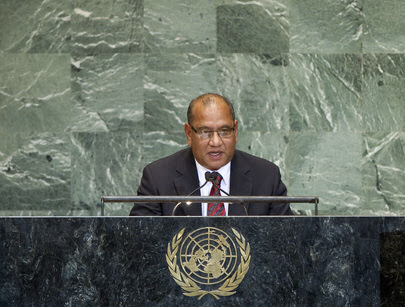
United Nations27 September 2014: During days three and four of the UN General Assembly (UNGA) General Debate 2014, many speakers addressed climate change. Speakers focused on international and national action, including transitions to renewable energy, and financing. Small island developing States (SIDS) particularly urged action, emphasizing they are already experiencing adverse effects on food and water security, biodiversity and oceans.


“Some members have criticized us for focusing too much on climate change and sea level rise, but these issues influence our every decision and affect every aspect of life on our islands,” said Christopher J. Loeak, President of the Marshall Islands, stressing that small island countries cannot afford to speak of climate change as a future threat. Tuilaepa Sailele Malielegaoi, Prime Minister of Samoa, underscored that apportioning blame serves no useful purpose, saying “those who exploit the traditional divide between developed and developing countries and ideological and political differences do so conveniently to mask their unwillingness to be part of the solution to an impending global catastrophe.” He suggested viewing the world as a single constituency where everyone must work together within the limits of their capacity and capability to address climate change. Charles Angelo Savarin, President of Dominica, Anote Tong, President of Kiribati, and Malielegaoi emphasized climate change is not an event in the future but an issue SIDS are already experiencing.


Several speakers commended the Climate Summit, welcoming its political momentum. Tong, Ikililou Dhoinine, President of the Comoros, Enele Sosene Sopoga, Prime Minister of Tuvalu, and Carlos Raúl Morales, Minister for Foreign Affairs of Guatemala, called for translating Summit commitments into action. Malielegaoi said the Summit underscored that the world is focusing more on symptoms of climate change than on the root causes.


Many supported a global, legally binding agreement on climate change by 2015, including Donald Rabindranauth Ramotar, President of Guyana, Tomislav Nikolić, President of Serbia, Alpha Condé, President of Guinea, Lubomír Zaorálek, Minister for Foreign Affairs of the Czech Republic, Salva Kiir, President of South Sudan, Frank-Walter Steinmeier, Minister for Foreign Affairs of Germany, Tong and Savarin. Malielegaoi said the agreement should be ambitious, effective, binding and capable of swift implementation. Hifikepunye Pohamba, President of Namibia, supported a coordinated global agreement. Denis Sassou Nguesso, President of the Republic of Congo, supported a binding agreement that included adaptation. Sopoga said a new protocol must: curb greenhouse gas (GHG) emissions; keep average temperature well below 1.5 degrees Celsius; include loss and damage and insurance mechanisms for SIDS; and provide adequate and accessible financing for SIDS' adaption support.


Noting Luxembourg will assume the Presidency of the Council of the EU in the second semester of 2015, Xavier Bettel, Prime Minister of Luxembourg, said his country would “spare no effort” to find an international agreement on climate, applicable to all countries, with the objective of keeping global warming below two degrees.


Sushil Koirala, Prime Minister of Nepal, supported a binding agreement on climate change with long-term and comprehensive global commitment based on common but differentiated responsibilities (CBDR), equity and respective capabilities. King Tupou VI of Tonga emphasized CBDR and equity principles.


Catherine Samba-Panza, President of the Transitional Government of the Central African Republic, urged ratification of the Doha amendment to the Kyoto Protocol.


Several speakers outlined national action on climate change, including Pohamba, Gjorge Ivanov, President of Macedonia, and Erlan A. Idrissov, Minister for Foreign Affairs of Kazakhstan. Bettel said the EU will present additional contributions to reduce GHG emissions and mitigate climate change, in accordance with the timetable agreed in Warsaw, Poland. At the national level, Bettel said Luxembourg is supporting carbon pricing.


Tong, Loeak and Tupou highlighted national action on adaptation and integrated disaster risk management (DRM). Tong said Kiribati's ‘migration with dignity' strategy is an investment in youth education to allow them to develop employable skills so that they can migrate to other countries voluntarily.


Several countries mentioned renewable energy efforts as part of contributions to addressing climate change, including Steinmeier, Sopoga, Nicos Anastasiades, President of Cyprus, Tomislav Nikolić, President of Serbia, and Morales. Savarin and Loeak described their efforts to increase renewable energy, including through SIDS DOCK, a platform for the development of sustainable energy in SIDS. Erlan A. Idrissov, Minister for Foreign Affairs of Kazakhstan, highlighted the promotion of best practices in sustainable energy, noting it is launching a project on the installation of biogas systems in nine Pacific SIDS. Sheikh Abdullah Bin Zayed Al Nahyan, Minister for Foreign Affairs of the United Arab Emirates (UAE), described his country's efforts and investments in renewable energy throughout the world. Muhammad Nawaz Sharif, Prime Minister of Pakistan, said his country's goals are aligned with the Sustainable Energy for All (SE4ALL) Initiative.


Emanuel Mori, President, Federated States of Micronesia, described its proposal to amend the Montreal Protocol to phase down the production and consumption of hydrofluorocarbons (HFCs), which are GHGs, to prevent temperature increases. He stressed success with the Montreal Protocol over the next six months is “our ticket to a successful outcome in Paris” and urged adoption of the HFC amendment.


On climate financing, Loeak urged the full capitalization of the Green Climate Fund (GCF) and other financial mechanisms to address climate change and support the post-2015 agenda. He applauded nations who have pledged specific amounts and urged delivery of real money by major economic powers who he said are also major polluters. Sopoga stressed adequate resources for the GCF, particularly access for SIDS. Nguesso identified innovative financing, technology transfer and capitalization of the GCF as critical. Koirala, Bangladesh and Serbia stressed financing for adaptation, with Koirala saying there should be special provisions for addressing least developed countries (LDCs) and SIDS mitigation and adaptation needs in additional to regular official development assistance (ODA). Bangladesh also recommended adequate, predictable and additional climate finance, support for capacity and institution building and access to locally adaptable technologies.


Bettel highlighted Luxembourg's contribution of 5 million Euros to the GCF, which is new and additional to its ODA. Steinmeier stated Germany's commitment of US$1 billion to the GCF.


Climate change should be included in the post-2015 agenda, according to Savarin and Morales. Sopoga supported a standalone Sustainable Development Goal (SDG) on climate change. Idrissov and San Marino highlighted links between climate change and sustainable development. Bangladesh reiterated the need to integrate the UNFCCC, DRR and SDG processes.


Tupou and Sopoga underscored the link between climate change and peace and security, with Tupou advocating for Ban to appoint a Special Representative on Climate and Security and Sopoga supporting addressing climate change and security through the UN Security Council. More


[UNGA General Debate 26 September 2014] [UNGA General Debate 27 September 2014] [UN Press Release on SIDS]


UNGA General Debate 2014 Addresses Climate Agreement, Financing, SIDS


United Nations27 September 2014: During days three and four of the UN General Assembly (UNGA) General Debate 2014, many speakers addressed climate change. Speakers focused on international and national action, including transitions to renewable energy, and financing. Small island developing States (SIDS) particularly urged action, emphasizing they are already experiencing adverse effects on food and water security, biodiversity and oceans.


“Some members have criticized us for focusing too much on climate change and sea level rise, but these issues influence our every decision and affect every aspect of life on our islands,” said Christopher J. Loeak, President of the Marshall Islands, stressing that small island countries cannot afford to speak of climate change as a future threat. Tuilaepa Sailele Malielegaoi, Prime Minister of Samoa, underscored that apportioning blame serves no useful purpose, saying “those who exploit the traditional divide between developed and developing countries and ideological and political differences do so conveniently to mask their unwillingness to be part of the solution to an impending global catastrophe.” He suggested viewing the world as a single constituency where everyone must work together within the limits of their capacity and capability to address climate change. Charles Angelo Savarin, President of Dominica, Anote Tong, President of Kiribati, and Malielegaoi emphasized climate change is not an event in the future but an issue SIDS are already experiencing.


Several speakers commended the Climate Summit, welcoming its political momentum. Tong, Ikililou Dhoinine, President of the Comoros, Enele Sosene Sopoga, Prime Minister of Tuvalu, and Carlos Raúl Morales, Minister for Foreign Affairs of Guatemala, called for translating Summit commitments into action. Malielegaoi said the Summit underscored that the world is focusing more on symptoms of climate change than on the root causes.


Many supported a global, legally binding agreement on climate change by 2015, including Donald Rabindranauth Ramotar, President of Guyana, Tomislav Nikolić, President of Serbia, Alpha Condé, President of Guinea, Lubomír Zaorálek, Minister for Foreign Affairs of the Czech Republic, Salva Kiir, President of South Sudan, Frank-Walter Steinmeier, Minister for Foreign Affairs of Germany, Tong and Savarin. Malielegaoi said the agreement should be ambitious, effective, binding and capable of swift implementation. Hifikepunye Pohamba, President of Namibia, supported a coordinated global agreement. Denis Sassou Nguesso, President of the Republic of Congo, supported a binding agreement that included adaptation. Sopoga said a new protocol must: curb greenhouse gas (GHG) emissions; keep average temperature well below 1.5 degrees Celsius; include loss and damage and insurance mechanisms for SIDS; and provide adequate and accessible financing for SIDS' adaption support.


Noting Luxembourg will assume the Presidency of the Council of the EU in the second semester of 2015, Xavier Bettel, Prime Minister of Luxembourg, said his country would “spare no effort” to find an international agreement on climate, applicable to all countries, with the objective of keeping global warming below two degrees.


Sushil Koirala, Prime Minister of Nepal, supported a binding agreement on climate change with long-term and comprehensive global commitment based on common but differentiated responsibilities (CBDR), equity and respective capabilities. King Tupou VI of Tonga emphasized CBDR and equity principles.


Catherine Samba-Panza, President of the Transitional Government of the Central African Republic, urged ratification of the Doha amendment to the Kyoto Protocol.


Several speakers outlined national action on climate change, including Pohamba, Gjorge Ivanov, President of Macedonia, and Erlan A. Idrissov, Minister for Foreign Affairs of Kazakhstan. Bettel said the EU will present additional contributions to reduce GHG emissions and mitigate climate change, in accordance with the timetable agreed in Warsaw, Poland. At the national level, Bettel said Luxembourg is supporting carbon pricing.


Tong, Loeak and Tupou highlighted national action on adaptation and integrated disaster risk management (DRM). Tong said Kiribati's ‘migration with dignity' strategy is an investment in youth education to allow them to develop employable skills so that they can migrate to other countries voluntarily.


Several countries mentioned renewable energy efforts as part of contributions to addressing climate change, including Steinmeier, Sopoga, Nicos Anastasiades, President of Cyprus, Tomislav Nikolić, President of Serbia, and Morales. Savarin and Loeak described their efforts to increase renewable energy, including through SIDS DOCK, a platform for the development of sustainable energy in SIDS. Erlan A. Idrissov, Minister for Foreign Affairs of Kazakhstan, highlighted the promotion of best practices in sustainable energy, noting it is launching a project on the installation of biogas systems in nine Pacific SIDS. Sheikh Abdullah Bin Zayed Al Nahyan, Minister for Foreign Affairs of the United Arab Emirates (UAE), described his country's efforts and investments in renewable energy throughout the world. Muhammad Nawaz Sharif, Prime Minister of Pakistan, said his country's goals are aligned with the Sustainable Energy for All (SE4ALL) Initiative.


Emanuel Mori, President, Federated States of Micronesia, described its proposal to amend the Montreal Protocol to phase down the production and consumption of hydrofluorocarbons (HFCs), which are GHGs, to prevent temperature increases. He stressed success with the Montreal Protocol over the next six months is “our ticket to a successful outcome in Paris” and urged adoption of the HFC amendment.


On climate financing, Loeak urged the full capitalization of the Green Climate Fund (GCF) and other financial mechanisms to address climate change and support the post-2015 agenda. He applauded nations who have pledged specific amounts and urged delivery of real money by major economic powers who he said are also major polluters. Sopoga stressed adequate resources for the GCF, particularly access for SIDS. Nguesso identified innovative financing, technology transfer and capitalization of the GCF as critical. Koirala, Bangladesh and Serbia stressed financing for adaptation, with Koirala saying there should be special provisions for addressing least developed countries (LDCs) and SIDS mitigation and adaptation needs in additional to regular official development assistance (ODA). Bangladesh also recommended adequate, predictable and additional climate finance, support for capacity and institution building and access to locally adaptable technologies.


Bettel highlighted Luxembourg's contribution of 5 million Euros to the GCF, which is new and additional to its ODA. Steinmeier stated Germany's commitment of US$1 billion to the GCF.


Climate change should be included in the post-2015 agenda, according to Savarin and Morales. Sopoga supported a standalone Sustainable Development Goal (SDG) on climate change. Idrissov and San Marino highlighted links between climate change and sustainable development. Bangladesh reiterated the need to integrate the UNFCCC, DRR and SDG processes.


Tupou and Sopoga underscored the link between climate change and peace and security, with Tupou advocating for Ban to appoint a Special Representative on Climate and Security and Sopoga supporting addressing climate change and security through the UN Security Council. More


[UNGA General Debate 26 September 2014] [UNGA General Debate 27 September 2014] [UN Press Release on SIDS]


WHAT’S POSSIBLE: The U.N. Climate Summit Film

WHAT'S POSSIBLE: The U.N. Climate Summit Film

Published on Sep 23, 2014 • Presented to world leaders at the United Nations Climate Summit in New York, this short inspirational film shows that climate change is solvable. We have the technology to harness nature sustainably for a clean, prosperous energy future, but only if we act now. Narrated by Morgan Freeman, it calls on the people of the world to insist leaders get on the path of a livable climate and future for humankind.

Learn more about climate change and take action at takepart.com/climate.

WHAT'S POSSIBLE was created by director Louie Schwartzberg, writer Scott Z. Burns, Moving Art Studio, and Lyn

Davis Lear and the Lear Family Foundation.

SEQUEL ALERT! Sign up at MovingArt.com to be the first to hear about the launch of the sequel to WHAT'S

POSSIBLE: movingart.com/un/

Directed by Louie Schwartzberg

Written by Scott Z. Burns

Produced by Lyn Davis Lear

Narrated by Morgan Freeman

Music by Hans Zimmer


Climate Injustice – Excerpt from Disruption

‘When it comes to climate change, why do we do so little when we know so much?’

Through a relentless investigation to find the answer, Disruption takes an unflinching look at the devastating consequences of our inaction.

The exploration lays bare the terrifying science, the shattered political process, the unrelenting industry special interests and the civic stasis that have brought us to this social, moral and ecological crossroads.The film also takes us behind-the-scenes of the efforts to organize the largest climate rally in the history of the planet during the UN world climate summit.

This is the story of our unique moment in history. We are living through an age of tipping points and rapid social and planetary change. We’re the first generation to feel the impacts of climate disruption, and the last generation that can do something about it. The film enlarges the issue beyond climate impacts and makes a compelling call for bold action that is strong enough to tip the balance to build a clean energy future. More


The Pale Blue Dot


THE SAGAN SERIES – The Pale Blue Dot

Published on Oct 21, 2013 • Facebook – http://www.facebook.com/thesaganseries

Twitter – http://twitter.com/reidgower

G+ – http://bit.lyA/pHzQh


The Sagan Series is an educational project working in the hopes of promoting scientific literacy in the general population. Created by ©ReidGower http://twitter.com/reidgower

Copyright Disclaimer Under Section 1 07 of the Copyright Act 1976, allowance is made for “fair use” for purposes such as criticism, comment, news reporting, teaching, scholarship, and research. Fair use is a use permitted by copyright statute that might otherwise be infringing. Non-profit, educational or personal use tips the balance in favor of fair use. All copyrighted materials contained herein belong to their respective copyright holders, I do not claim ownership over any of these materials. I realize no profit, monetary or otherwise, from the exhibition of these videos.


Leaders sign historic sustainable energy & climate resilient treaty

September 2: Over 150 delegates and members of the international development community from more than 45 countries were stunned to see leader after leader approach the podium to sign a historic sustainable energy and climate resilient treaty that will significantly change the lives and destiny of over 20 million small islanders, for the better.

Led by the Deputy Prime Minister of Samoa, Hon. Fonotoe Nuafesili Pierre Lauofo, multiple leaders from the Pacific, Caribbean and African, Indian Ocean and Mediterranean Sea (AIMS) regions, forcefully raised their voices in unison and accepted responsibility for fulfilling the commitment to the Small Island Developing States (SIDS) Sustainable Energy mechanism – SIDS DOCK. The opening for signature of this historic SIDS DOCK Treaty – a SIDS-SIDS Initiative – was a major highlight of the first day of the United Nations (UN) Third International Conference on SIDS, taking place in Apia, Samoa, from 1-4 September.

The unprecedented and unexpected number of Heads of State and Government present, sent a strong signal to the standing room only audience, the SIDS population and the international community, demonstrating how deeply committed SIDS leaders are and that they all firmly believe that SIDS must, have and will take responsibility for charting the future of their countries towards a path that would see a total transformation of the SIDS economy away from fossil fuels, to that of one driven by low carbon technologies. The event was considered so important to the Republic of Cabo Verde, that the Prime Minister, Hon. José Maria Neves, excused himself and his entire delegation from the Plenary Hall, to ensure that Cabo Verde, a SIDS DOCK Founding Member was well-represented at the signing – the Cabo Verde Government has one of the most ambitious plans in SIDS, that aims to achieve 100 penetration of renewable energies in Cabo Verde, by 2020.

More than half the members of the Alliance of Small Island States (AOSIS) were present for the signing of the historic treaty, witnessed by the SIDS DOCK partners Denmark, Japan and Austria, whose kind and generous support facilitated SIDS DOCK start -up activities; also present were SIDS DOCK partners, the United Nations Development Programme (UNDP), the World Bank, the United Nations Industrial Development Organization (UNIDO) and the Clinton

Foundation. The treaty was signed by the governments of Barbados, Belize, Bahamas (Commonwealth of the), Dominica (Commonwealth of), Cabo Verde (Republic of), Cook Islands, Dominican Republic, Fiji (Republic of), Grenada, Guinea Bissau, Kiribati (Republic of), Niue, Palau (Republic of), Saint Kitts and Nevis, Saint Vincent and the Grenadines, Samoa (Independent State of), Seychelles (Republic of), and Tuvalu.

The Statute will remain open for signature in Apia, Samoa until September 5, and will reopen for signature in Belmopan, Belize, from September 6, 2014 until it enters into force. Belize is the host country for SIDS DOCK, with Samoa designated as the location for the Pacific regional office. More


Why Island Wisdom Is Crucial to Help the World Adapt and Prepare for the Im

For decades, small island countries have been warning the world about the consequences of climate change. While many countries have been debating whether climate change is even happening or who is to blame, small islands have just had to deal with its impact, from extreme weather to rising sea levels and increasing environmental vulnerability.

Major storms have always been a fact of life for small islands. But in recent years they have intensified in their destructive capabilities. In 2004, Hurricane Ivan struck the Caribbean island of Grenada, causing widespread destruction. The financial cost of the disaster was estimated at more than $900 million – more than twice the country’s gross domestic product (GDP). Only 10 months later, the country was hit again, this time by Hurricane Emily, which caused another $50 million in damage.

In the Caribbean, changes in hurricane intensity and frequency could eventually result in additional annual losses of $450 million, largely due to disruption of a key source of revenue and jobs: tourism. Limited diversification and small market size means that small island economies are not resilient to disaster loss. This is true not just in the Caribbean, but the world over.

According to global risk models developed by the UN Office for Disaster Risk Reduction (UNISDR), six of the top 10 countries with the greatest proportion of resources at risk during hurricanes or cyclones are small islands. These losses will only increase due to sea-level rise, water scarcity, drought, and other factors.

The 38 small island developing states, which spread across the Caribbean, the Pacific and Indian Oceans, are not sitting and waiting for the next storm to hit. They have been taking measures to adapt to and manage the risks posed by climate change.

Several Caribbean islands came together seven years ago to create an insurance pool of easy-to-access disaster funding. Spreading the risk across countries reduces premiums and provides contributors with a safety net which can fund vital services when disaster strikes. Since 2007, more than $30 million has been paid out by the 16 participating countries. A similar initiative is under way in the Pacific region where the memories of the massive human toll and devastation due to Typhoon Haiyan that claimed more than 6,000 lives in the Philippines last November are still all too vivid.

Ideas and actions for reducing the risk from disasters will be at the forefront of the United Nations Conference on Small Island Developing States, to be held in Samoa from 1-4 September. The Conference will be a showcase for those living on the frontlines of climate change and could have a lasting and positive influence on the post-2015 development agenda.

The Conference is an acknowledgement by all the countries of the world of the unique circumstances that small island developing countries face. Their size, combined with their remoteness, and economies of scale, have made it that much more difficult for small islands to implement measures to become resilient. This is compounded by the impacts of climate change, a problem that is hardly of their own making as they collectively contribute less than 1 per cent of total greenhouse gas emissions. In fact, many are striving to become carbon neutral by using renewable energy, improving energy efficiency, and offsetting their greenhouse gas emissions.

Next week’s conference in Samoa is the first of two critical global gatherings. Just a few weeks later, on 23 September in New York, UN Secretary-General will host heads of State, CEOs and civil society leaders at the Climate Summit. The Summit aims to spur accelerated and ambitious actions to reduce emissions and build resilience to climate change worldwide, from the largest countries to the smallest island States. It’s about turning promises into performance.

With international attention on small islands, climate change and the post-2015 framework for disaster risk reduction, there has never been a better chance to turn the tide. Now is the time to listen, support and partner with those who have seen first-hand what climate change can do to your economy and your community. It would be one of the greatest tragedies of our time to continue to ignore the warnings from small islands; their issues will soon become our own. More

_________________

Han Seung-soo is the UN Secretary-General’s Special Envoy for Disaster Risk Reduction and Water and former Prime Minister of the Republic of Korea


Al Gore’s “Turning Point”

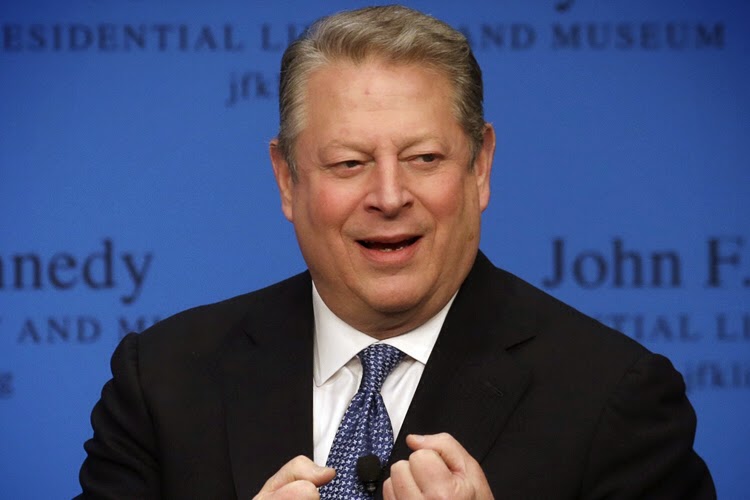
Eight years after Al Gore wrote a book and made a movie to impress upon us the “planetary emergency of global warming” (his subtitle for An Inconvenient Truth), he wrote an article with a more optimistic feel- ing in the 18 June 2014 issue of Rolling Stone. He begins “The Turning Point: New Hope for Climate” as follows:

Al Gore - Climate Reality Leadership Corp

In the struggle to solve the climate crisis, a powerful, largely unnoticed shift is taking place. The forward journey for human civilization will be difficult and dangerous, but it is now clear that we will ultimately prevail. The only question is how quickly we can accelerate and com- plete the transition to a low-carbon civilization.

The “surprising – even shocking – good news” is “our ability to convert sunshine into usable energy . . . much cheaper far more rapidly than anyone had predicted,” Gore writes: the cost of photovoltaic electricity is competitive with that from other sources in at least 79 countries, and the 43% decrease in cost of wind- generated electricity since 2009 has made it cheaper than coal-generated electricity. By 2020 more than 80% of world population will live where photovoltaic electricity is competi- tive with other sources.

As evidence of this “largely unnoticed shift,” he notes that Germany now generates 37% of its electricity from wind and solar, a percentage expected to reach 50% by 2020, and that nine of ten European coal and gas plants are losing money. Worldwide, capacity for 17 gi- gawatts of solar electricity was installed in 2010, for 39 in 2003, with expectations of 55 in 2014. China claims it will have a capacity of 70 solar gigawatts by 2017. (A gigawatt is the power generating capacity of a standard electric power plant.)

Gore states that in the U.S. 166 coal-fired plants have closed or announced closings in the last 4.5 years, and 183 proposed coal-fired plants have been canceled since 2005. He acknowledges that some of this shift from coal is to natural gas obtained by hydrofracturing (“fracking”) but focuses on the emergence of “on-site and grid battery storage and microgrids,” noting that the Edison Electric Institute (the U.S. utility trade group) has labeled this trend as the “largest near-term threat” to the present elec- tric utility system. He likens this threat to that posed by cell phones to the landline telephone system. He cites Citigroup’s recognition of the decreased cost of solar and wind electricity and battery storage (long seen as a barrier to intermittent energy from renewable). In addition, he notes a reduction of 49% in energy intensity (energy in- put per dollar output in gross domestic product) since 1980.

Gore observes that the Koch brothers have led the fight against rooftop solar electricity and for keeping the present fossil-fueled electric plants, one of their arguments being that net metering allows producers of solar electricity to benefit from the grid without paying for it. Al- though Gore neglects to mention that in net metering the utility pays the generator only the wholesale price for the surplus generation, he does note that solar electricity gen- eration has the advantage of peaking with electricity de- mand, thereby saving utilities from having to install new peak generation capacity (a point also made by keynoter Perez at the kickoff to develop the solar lessons for School Power Naturally, reported in our Winter 2003 issue).

Gore likens global warming to a fever for planet Earth and notes that the presently-gathering El Niño is expected to result in a pronounced global temperature increase. (Coverage in our Winter 2010 issue of a talk to the American Physical Society and the American Association of Physics Teachers on 15 February 2010 by Judith Lean of the Naval Research Laboratory attributes this to the phase of the 22-year solar cycle.) He correlates the de- struction from Supertyphoon Haiyan and Superstorm Sandy with greater surface water temperature (5.4oF for the former, 9oF for the latter). He notes that higher water temperatures also mean higher sea level and disruption of water supplies that depend on snowmelt. And he adds that even more severe catastrophes are in the offing, like the irreversible collapse of a portion of the West Antarc- tic ice sheet. In addition to heightened sea level, warmer climate also means an atmosphere capable of holding more water vapor and delivering more severe storms, as have been seen in Pensacola (FL), and Nashville (TN). At the same time, global warming will exacerbate the dryness of the drier parts of the Earth through greater evaporation of what little water there is in the ground. Gore also observes that climate change brings concern to the military for both the safety of its bases and the new types of world conflict it will have to deal with.

Gore concedes that these many “knock-on consequences of the climate crisis” are enough to cause anyone to despair. But, as he writes in his opening paragraph, “we will have to take care to guard against despair,” lest we become deterred from the action we must pursue. Though there be light at the end of the tunnel, he points out that we are in the tunnel. Among the things he says we need are “a price on carbon in our markets” and “green banks” to finance “green” projects.

“Damage has been done, and the period of consequences will continue for some time to come, but there is still time to avoid the catastrophes that most threaten our future.”

Though U.S. greenhouse gas emissions had decreased from 2008 to 2012, due to recovery from the recession, they increased 2.4% in 2013. Gore calls for the U.S. to match the European Union’s commitment to reduce carbon dioxide emissions 40% by 2030.

Gore’s concluding reasons for optimism are that “Rapid technological advancements in renewable energy are stranding carbon investments; grassroots movements are building opposition to the holding of such assets; and new legal restrictions on collateral flows of pollution . . . are further reducing the value of coal, tar sands, and oil and gas assets.” “Damage has been done,” he adds, “and the period of consequences will continue for some time to come, but there is still time to avoid the catastrophes that most threaten our future.”


Global campaign launched to improve weather & climate services for small island developing states (SIDS)

A global campaign to improve weather and climate services for all small island developing states was launched today with the support of the World Meteorological Organisation (WMO), the Secretariat of the Pacific Regional Environment Programme (SPREP) and Digicel Pacific.

The Small Islands, Weather Together campaign (www.weathertogether.org) aims to show how the small island developing states of the world can work together to improve their vital weather and climate services.

In the Pacific region alone, extreme weather already accounts for 76% of all disasters with 50% directly related to cyclones. The increase in extreme weather events is also hampering the sustainable development of many small island developing states. For example, when Cyclone Evan hit Samoa in December 2012 it resulted in the loss of one third of the country’s entire annual economic output.

WMO Secretary-General Michel Jarraud stresses that small island developing states need greater investment to further strengthen their vital weather and climate services and to ensure that efforts towards sustainable development are not wasted.

“If we don’t invest in stronger weather and climate services for small island developing states then extreme weather events could simply wipe out years of development effort if they are not well prepared. It is much more cost-effective to invest in early preparedness and prevention than to focus only on rehabilitation and post-disaster action,” he asserted.

Climate change is increasing the frequency and intensity of weather and climate events – cyclones, typhoons, drought, flash floods – in many small island developing states. But many of their Meteorological Services still lack the basic infrastructure, technology and expertise they need to protect vulnerable island communities and economies.

For Mr. Jarraud, there is an urgent need to enhance the quality of early warnings for extreme weather. He pointed out that the formulation and dissemination of these warnings also need to be improved so that they can be understood and used by the island communities and government agencies.

In the Pacific islands, SPREP and other partners are working to improve communication of this type of information in partnership with national meteorological services, the media, including broadcast stations and communities.

“SPREP recognises that weather forecasts and warnings such as those given during tropical cyclones do not have a shelf life, they must be disseminated rapidly to the public or else they are useless,” says SPREP Acting Director General Kosi Latu.

He further noted, “We can improve the quality of the forecasts and warnings so that countries and communities have more lead time to take action. But we can also improve the way climate information is used over longer time scales by farmers, fishermen and by decision-makers across government. For example, when planning new infrastructure, we can say ‘this place has a high risk of tsunami, flooding or storm surge, so don’t build things here’.”

Mr. Jarraud recalls that the small developing island states stand to suffer more and more if the global community fails to agree to a limit in greenhouse gas emissions, the main human cause of climate change and global warming.

“Greenhouse gas emissions are still on the rise. We need to reach a peak of emission over the next 15–20 years, then to decrease dramatically to zero equivalent emission in about 50–60 years from now.

“This is a huge challenge. We must act now. The more we wait, the more difficult it will be, and, therefore, the more expensive it will be for countries to adapt to climate change. If we do not act now, we are agreeing to leave the small island developing states in a situation which may no longer be manageable,” he warned.

The Small Islands, Weather Together campaign was launched specifically to coincide with the lead up to the United Nations Third International Conference on Small Island Developing States, which will be held in Apia, Samoa, from 1–4 September, 2014.

For more information visit: www.weathertogether.org