John Perkins Speaks Out On Public Sector Privatization

An Economic Hit Man Speaks Out: John Perkins on How Greece Has Fallen Victim to “Economic Hit Men”

John Perkins

“My sin was ripping off people around the world,” said John Perkins, author of “Confessions of an Economic Hit Man,” at Transitions Bookplace in Chicago, on February 3, 2006. (Photo: Peter Thompson / The New York Times)John Perkins, author of Confessions of an Economic Hit Man, discusses how Greece and other eurozone countries have become the new victims of “economic hit men.”

John Perkins is no stranger to making confessions. His well-known book, Confessions of an Economic Hit Man, revealed how international organizations such as the International Monetary Fund (IMF) and the World Bank, while publicly professing to “save” suffering countries and economies, instead pull a bait-and-switch on their governments: promising startling growth, gleaming new infrastructure projects and a future of economic prosperity – all of which would occur if those countries borrow huge loans from those organizations. Far from achieving runaway economic growth and success, however, these countries instead fall victim to a crippling and unsustainable debt burden.

“That's part of the game: convince people that they're wrong, that they're inferior. The corporatocracy is incredibly good at that.”

That's where the “economic hit men” come in: seemingly ordinary men, with ordinary backgrounds, who travel to these countries and impose the harsh austerity policies prescribed by the IMF and World Bank as “solutions” to the economic hardship they are now experiencing. Men like Perkins were trained to squeeze every last drop of wealth and resources from these sputtering economies, and continue to do so to this day. In this interview, which aired on Dialogos Radio, Perkins talks about how Greece and the eurozone have become the new victims of such “economic hit men.”

Michael Nevradakis: In your book, you write about how you were, for many years, a so-called “economic hit man.” Who are these economic hit men, and what do they do?

John Perkins: Essentially, my job was to identify countries that had resources that our corporations want, and that could be things like oil – or it could be markets – it could be transportation systems. There're so many different things. Once we identified these countries, we arranged huge loans to them, but the money would never actually go to the countries; instead it would go to our own corporations to build infrastructure projects in those countries, things like power plants and highways that benefitted a few wealthy people as well as our own corporations, but not the majority of people who couldn't afford to buy into these things, and yet they were left holding a huge debt, very much like what Greece has today, a phenomenal debt.

“[Indebted countries] become servants to what I call the corporatocracy … today we have a global empire, and it's not an American empire. It's not a national empire … It's a corporate empire, and the big corporations rule.”

And once [they were] bound by that debt, we would go back, usually in the form of the IMF – and in the case of Greece today, it's the IMF and the EU [European Union] – and make tremendous demands on the country: increase taxes, cut back on spending, sell public sector utilities to private companies, things like power companies and water systems, transportation systems, privatize those, and basically become a slave to us, to the corporations, to the IMF, in your case to the EU, and basically, organizations like the World Bank, the IMF, the EU, are tools of the big corporations, what I call the “corporatocracy.”

And before turning specifically to the case of Greece, let's talk a little bit more about the manner in which these economic hit men and these organizations like the IMF operate. You mentioned, of course, how they go in and they work to get these countries into massive debt, that money goes in and then goes straight back out. You also mentioned in your book these overly optimistic growth forecasts that are sold to the politicians of these countries but which really have no resemblance to reality.

Exactly, we'd show that if these investments were made in things like electric energy systems that the economy would grow at phenomenally high rates. The fact of the matter is, when you invest in these big infrastructure projects, you do see economic growth, however, most of that growth reflects the wealthy getting wealthier and wealthier; it doesn't reflect the majority of the people, and we're seeing that in the United States today.

“In the case of Greece, my reaction was that 'Greece is being hit.' There's no question about it.”

For example, where we can show economic growth, growth in the GDP, but at the same time unemployment may be going up or staying level, and foreclosures on houses may be going up or staying stable. These numbers tend to reflect the very wealthy, since they have a huge percentage of the economy, statistically speaking. Nevertheless, we would show that when you invest in these infrastructure projects, your economy does grow, and yet, we would even show it growing much faster than it ever conceivably would, and that was only used to justify these horrendous, incredibly debilitating loans.

Is there a common theme with respect to the countries typically targeted? Are they, for instance, rich in resources or do they typically possess some other strategic importance to the powers that be?

Yes, all of those. Resources can take many different forms: One is the material resources like minerals or oil; another resource is strategic location; another resource is a big marketplace or cheap labor. So, different countries make different requirements. I think what we're seeing in Europe today isn't any different, and that includes Greece.

What happens once these countries that are targeted are indebted? How do these major powers, these economic hit men, these international organizations come back and get their “pound of flesh,” if you will, from the countries that are heavily in debt?

By insisting that the countries adopt policies that will sell their publicly owned utility companies, water and sewage systems, maybe schools, transportation systems, even jails, to the big corporations. Privatize, privatize. Allow us to build military bases on their soil. Many things can be done, but basically, they become servants to what I call the corporatocracy. You have to remember that today we have a global empire, and it's not an American empire. It's not a national empire. It doesn't help the American people very much. It's a corporate empire, and the big corporations rule. They control the politics of the United States, and to a large degree they control a great deal of the policies of countries like China, around the world.

John, looking specifically now at the case of Greece, of course you mentioned your belief that the country has become the victim of economic hit men and these international organizations . . . what was your reaction when you first heard about the crisis in Greece and the measures that were to be implemented in the country?

I've been following Greece for a long time. I was on Greek television. A Greek film company did a documentary called “Apology of an Economic Hit Man,” and I also spent a lot of time in Iceland and in Ireland. I was invited to Iceland to help encourage the people there to vote on a referendum not to repay their debts, and I did that and encouraged them not to, and they did vote no, and as a result, Iceland is doing quite well now economically compared to the rest of Europe. Ireland, on the other hand: I tried to do the same thing there, but the Irish people apparently voted against the referendum, though there's been many reports that there was a lot of corruption.

“That's part of the game: convince people that they're wrong, that they're inferior. The corporatocracy is incredibly good at that.”

In the case of Greece, my reaction was that “Greece is being hit.” There's no question about it. Sure, Greece made mistakes, your leaders made some mistakes, but the people didn't really make the mistakes, and now the people are being asked to pay for the mistakes made by their leaders, often in cahoots with the big banks. So, people make tremendous amounts of money off of these so-called “mistakes,” and now, the people who didn't make the mistakes are being asked to pay the price. That's consistent around the world: We've seen it in Latin America. We've seen it in Asia. We've seen it in so many places around the world. More

The Cayman Islands must be very discriminating as to what pieces of the public sector get sold off. Some sectors, such as water production and distribution, if sold, and without well thought policies, could well have a negative effect on certain sectors of our population, as recent events in Detroit have proved. Editor


9/11 Firefighter Blows WTC 7 Cover-Up Wide Open

Rudy Dent is a Vietnam War veteran, a four year member of the NYPD and spent thirty-two years as a NYC firefighter.

He was at Ground Zero as a firefighter on 9/11 and was there when Building 7 came down. In this interview Infowars reporter Lee Ann McAdoo talks to Rudy Dent tabout his incredible first hand experience of the lies surrounding WTC 7.

Ongoing drought in Brazil brings rising tensions

The western USA is not the only place suffering from lack of rain, Latin America’s economic powerhouse has been struck hard by a powerful and ongoing water crisis.

The worst drought since records began 84 years ago has constrained the Brazillian economy in many ways, particularly coffee production, agriculture and hydroelectric power generation, which accounted for 80% of electricity generation. This power fuels the economic development on which millions are counting to rise out of poverty, and the loss has slowed the entire economy, due to the need to import expensive fossil fuels in order to keep the lights on and water pumps running (costing $6 billion extra so far this year, while increasing the country’s greenhouse gas emissions).


Water rationing has been imposed in many parts of the country for months, but the situation is approaching a critical point. Nineteen large cities are under water rationing rules, and the water catchment capacity feeding the megalopolis of Sao Paolo (20 million inhabitants and the economic capital of the entire continent) is down to 10%. Carefully husbanded, and tapping water usually deemed of inferior quality, there is enough left to squeeze out of the system for a hundred days consumption. States are now squabbling over allocation of the remaining water resources, and fighting has erupted sporadically in some rural areas.

In Sao Paolo itself, financial incentives to reduce consumption have been accompanied by cutting water pressure at night, effectively cutting off all the poorer areas of the city which sit on hills. In nearby Gaurulhos residents of some neighbourhoods are getting water one day in three. Balancing the competing needs of drinking water and power generation is also having societal consequences, exacerbating general social tension, and helping fuel reactions such as the protests and riots back in June.

The drought may be linked to climate change, since the rains that normally come south from evaporation in the Amazon basin failed to arrive, a potentially very worrying symptom. It also reveals some of the likely types of economic cost and societal tension that will arise and worsen as the world warms further and the consequences begin to bite. Some early spring rains appeared in Brazil this week, enough at least to halt the fall in Sao Paolo’s reserves, but the prognosis for the coming rainy season is still very uncertain.

Via Facebook –The Earth Story

Image credit: Reuters/Nacho Doce

http://www.theguardian.com/weather/2014/sep/05/brazil-drought-crisis-rationing
http://www.reuters.com/article/2014/02/12/us-brazil-economy-fiscal-idUSBREA1B1CY20140212
http://phys.org/news/2012-05-worst-drought-years-toll-northern.html


NOTICE OF INTENT TO FINALIZE THE TERMS OF REFERENCE FOR THE PROPOSED OCEAN THERMAL ENERGY CONVERSION PROJECT

REQUEST FOR COMMENTS AND NOTICE OF PUBLIC MEETING

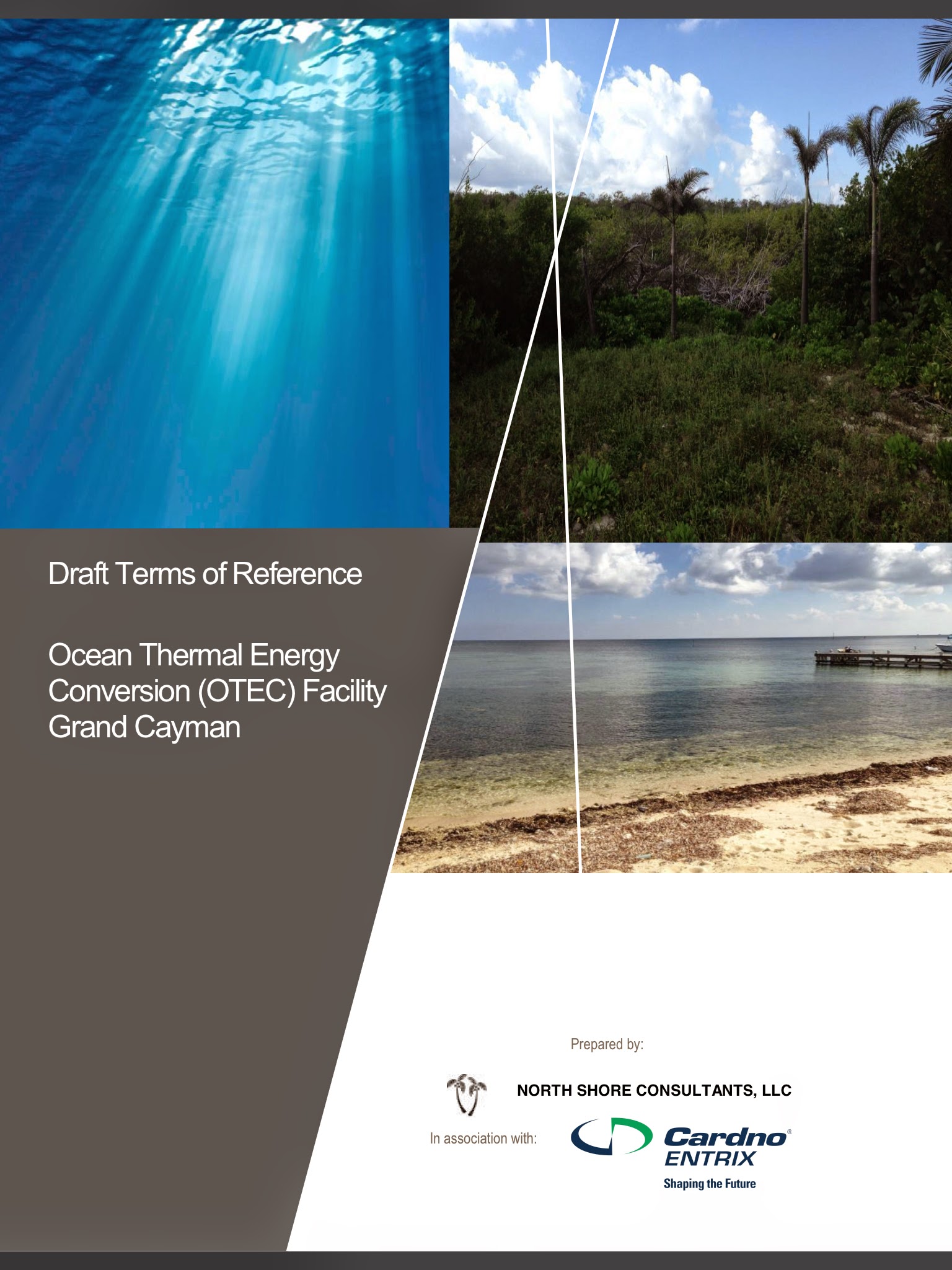
The Environmental Assessment Board (EAB) is providing Notice to the Public of the publication of the Draft Terms of Reference (ToR) for the Environmental Impact Assessment (EIA) for a proposed Ocean Thermal Energy Conversion (OTEC) Project on the north shore of Grand Cayman. The public is invited to review and comment on the To R which has been developed in collaboration with the EAB, which includes representatives from the Department of Environment, Planning Authority. Port Authority, and the Electricity Regulatory Authority.

The prolect Proponent. OTEC international. LLC (OTI) ie undertaking an EIA for its proposed phased installation of 25 megawatts (MWe) of power. The Initial phase would be a 6.25Mwe floating power platform (FPP). The result of the ElA will be an Environmental Statement (ES) which will help to inform the decision-making process. Download PDF

Yo u r input will be considered in the finalization of the To R document which is available oniine at www.doe.ky or hard copies can be reviewed at the following locations:

1. Government Administration Building. 133 Elgin Avenue, George Town

2. George Town Public Library. 68 Edward Street

3. North Side Post Office. 896 North Side Road

Comments on the draft TOR may be submitted:

1) in writing during the public meeting.

2) electronically via e-mail to doe@gov.ky

3) mailed to Department of Environment, P.0. Box 10202. Grand Cayman, KY1-1002

4) hand delivered, in writing, to Department of Environment, Environmental Centre, 580 North Sound Road, George Town , Grand Cayman.

A public meeting will be held on Tuesday 23 September 2014 at the North Side Civic

centre to provide an opportunity for OTI and the EIA Consultant to outline the project and to invite comments and questions from the Public on the draft ToR. Representatives from OTI, the EIA Consultant and the EAB will be available to provide information and receive comments concerning the ToR . The presentation will commence at 7:30 p.m. and will be followed by a question and answer session at 8:00 p.m.

The period for written comments on the draft ToR opens on Friday 12 September for a duration of 21 days and will officially close at midnight on Friday 3 October 2014.


Israeli officer admits ordering lethal strike on own soldier during Gaza massacre

The civilian population in Gaza is “a partner of terror” that “gets what they choose,” the top commander of the Israeli army’s Givati Brigade told the Israeli press recently, after orchestrating some of the deadliest episodes of butchery visited upon the Gaza Strip this summer.

Colonel Ofer Winter

Colonel Ofer Winter also admitted to ordering the mass-bombardment of an area where an Israeli soldier was know to be in order to prevent his capture alive by Palestinian resistance fighters — an army policy known as the Hannibal Directive.

These are just two of the many incriminating comments made by Winter in a lengthy and candid interview published in a paper-only edition of the Hebrew-language Israeli newspaper Yediot Ahronot on 15 August.

The interview took place near the end of Israel’s 51-day bombing campaign which killed more than 2,100 people in Gaza, the vast majority of them civilians — including more than 500 children. Israel expert Dena Shunra translated the interview for The Electronic Intifada.

In addition to justifying the mass killing of civilians in Gaza, Winter applauded the carpet bombing he ordered in Rafah as a necessary punishment and repeatedly invoked religious supremacy as a leading factor in what he views as a Jewish victory in Gaza.

Rafah massacre

Just as a temporary three-day humanitarian ceasefire negotiated by Egypt and the United States went into effect on the morning of Friday 1 August, a unit of soldiers from the Israeli army’s Givati Brigade conducted a tunnel incursion in Rafah, provoking fire from Palestinian resistance fighters.

Two Israeli soldiers were killed in the ensuing firefight and another, Hadar Goldin, went missing. It was later determined that Goldin died in the battle, but in the immediate aftermath the Israeli army operated under the assumption that he had been captured.

Ofer Winter was napping when he woke up to news of Goldin’s possible capture. He told Yediot Ahronot’sYossi Yehoshua:

At 9 am, half an hour after I put my head down, the Deputy Brigade Commander woke me up: “come quickly, it’s best you be here.” We asked for a snapshot, we wanted information. We didn’t think there was an abduction yet. While inquiring if everyone was there, I commanded Sagiv, the Armored Forces Commander operating under my orders, to start moving from Hirbat Hiza’a, which was where he was, toward Rafah. Just then I got the message “it’s not green in our eyes” – in other words, not everyone had been found. We were missing a soldier. At 9:36, after inquiries with the battalion commander on site, I announced on the communication system the word that no one wants to say – “Hannibal.” In other words, there had been an abduction. I instructed all the forces to move forward, to occupy space, so the abductors would not be able to move.

The Hannibal Directive is an unwritten Israeli military protocol for executing captured Israeli soldiers to avoid politically painful prisoner swaps. Although its existence has been reported in the Israeli press since the 1980s, this interview with Winter appears to be the most frank acknowledgement of its use.

The idea is to prevent the captors from taking the soldier alive, effectively denying Palestinian or other Arab resistance groups a bargaining chip down the line and relieving Israeli leaders of the political fallout from having to make concessions (such as prisoner swaps) to secure the soldier’s release.

Executing their own

According to blogger Richard Silverstein, the Israeli army has implemented the Hannibal Directive on at least three occasions during this latest war on Gaza, deploying massive firepower with the intention of executing three of their own.

For the following several hours, residents of Rafah, many having just returned to their homes for what they were told would be a three-day ceasefire, were subjected to a carpet bombing campaign that left the town in ruins and 190 people dead.

An Israeli army officer told the Associated Press that soldiers pounded Rafah with 500 artillery shells in just eight hours and launched an estimated 100 airstrikes within two days.

Acting on Winter’s “Hannibal” order, the Israeli army sealed off Rafah to prevent the alleged captors from escaping with Goldin alive. Homes were flattened on top of families sheltering inside. Civilians who attempted to flee the inferno were torn to shreds by artillery. Vehicles trying desperately to evacuate the wounded were fired upon.

By 2 August, the Israeli army had killed 190 Palestinians in Rafah, including 55 children. With the morgues full to capacity, medical workers were forced to store corpses in vegetable refrigerators to accommodate the high volume of dead bodies.

As Israel laid waste to Rafah, the Obama administration called the alleged capture of Goldin, an invading Israeli soldier engaged in armed hostilities against Gaza, a “barbaric” and “outrageous” act.

“They messed with the wrong brigade”

“A lot of criticism was heard about the force you employed in Rafah, directly after the abduction,” said interviewer Yossi Yehoshua to Winter.

“Everything we did was from the understanding that we could return Hadar Goldin alive,” responded Winter. “Stop the abduction event. Come from above to the places he could come out of. That’s what we employed all the force for,” he insisted.

These claims are totally inconsistent with the reality on the ground, where the only possible intended outcome of bombing everything was to kill Goldin and his captors while collectively punishing the surrounding population in the process.

Winter continued with an even more contradictory remark, hinting that the response in Rafah was partly an act of retribution. “Anyone who abducts should know that he will pay a price. This was not revenge. They simply messed with the wrong brigade,” he said.

Then, in a stunning display of hypocrisy, Winter (who relies on airstrikes and indiscriminate artillery fire to avoid face to face confrontations with the supposed enemy and who had to be woken up from a nap to be informed that his soldiers were killed in Rafah) tried to portray Palestinian resistance fighters as cowards.

“We fought against two Hamas brigades. Where were their brigade commanders?” he asked indignantly. “I hoped they would come face to face with us, but they chickened out. They sent their men forward, causing more evil and killing. That’s not combat. There were very few places where there were fighting retreats. They left everything and escaped.”

Divine intervention

As an orthodox Jew firmly in Israel’s religious nationalist camp, Winter is making a career of mixing his brand of messianic Zionism with military aggression.

As a graduate of Bnei David, a religious pre-military academy located in Eli, an illegal Jewish-only settlement in the occupied West Bank, Winter epitomizes the mainstreaming of religiously motivated brutalityin the Israeli army. Bnei David’s goal is to replace Israel’s largely secular military elite with religious Zionists, like Winter.

On the eve of Israel’s ground invasion, Winter declared in a letter to his troops that they were fighting a Jewish holy war to punish the blasphemous Palestinians of Gaza.

Responding to criticism of the letter, Winter doubled down, telling Yediot Ahronot, “if I had to do so, I would write the same letter again, without batting an eyelid.”

The impact of Winter’s fanaticism on Palestinians in Gaza was nothing short of catastrophic.

Soldiers from the Givati Brigade under Winter’s command made up the majority of ground troops that thundered into Khuzaa, a farming community near the Israeli boundary line. With massive artillery shelling accompanied by airstrikes, the Israeli army reduced all of Khuzaa to rubble to secure a path for columns of invading tanks, jeeps and soldiers.

Cut off from the outside world for days, the residents of Khuzaa were at the mercy of Winter’s religiously-guided soldiers who carried out summary executions of both fighters and civilians and mowed down anyone trying to flee, including a wheelchair-using 16-year-old girl with epilepsy and a wounded elderly women crawling on the ground desperate for help.

Speaking about his brigade’s reign of terror in Khuzaa, Winter is cited by Yediot Ahronot as telling the ultra-Orthodox weekly newspaper Mishpacha that as the sun rose during the ground invasion, the movement of his troops remained hidden by “clouds of divine honor.”

“It was only when the homes that were supposed to be exploded were exploded and there was no longer any danger to our lives, the fog suddenly dispersed,” said Winter, insisting that the clouds were a direct intervention from God to protect the Jewish people.

Winter offered further religious explanations for his “victory” in Gaza to Yediot Ahronot.

Noting that the ground invasion coincided with “The Between the Straits Days” — a three-week mourning period observed by orthodox Jews to commemorate the ancient siege on Jerusalem and the loss of Jewish statehood — Winter opined that the overlap “was not just a coincidence.”

The Between the Straits Days end on the 9th of Av, also known as Tisha B’Av [observed on 5 August of this year], the very day that the fighting ended. It was especially on this day, a day of national mourning, that the decision was made: the IDF [Israeli military], the Nation of Israel – they won. We proved that we are a unified, determined nation and that we will not be beaten. Unitedness won. No ill words were spoken. Even the ultra-orthodox public – which cannot be taken for granted – fought with all its might from the place where it stands [meaning they prayed very hard]. I received lots of messages during the war. This is a tikun – repair – for what our ancestors have hurt. It enhanced the victory.

“The terrorists are the children” of Gaza

Despite the Palestinian blood on his hands, or more likely because of it, Winter has emerged as a hero in Israel, completely revered within the military and adored by the public.

Asked about his earlier complaints that the political and military establishment was holding him back from finishing the job in Gaza, Winter told Yediot Ahronot that he is ultimately satisfied with the outcome of the onslaught and then proceeded to brag about the carnage.

“There are hundreds of terrorists who were killed,” he boasted. “That is the message – no matter what we do, we’ll go in wherever we want to go. It is important that the enemy know this.”

“We shredded them. We can do it much worse, and it’s best for them that we not do it,” added Winter. “We gave them a much stronger beating than in Cast Lead.”

“When the Palestinians return to their home they will understand the scope of the damage Hamas has inflicted on them. Hamas used them,” he said.

Winter clarified that the enemy is not just Hamas but all of Gaza.

“This population is a hostage, but I think it is also a partner. I don’t exonerate them of responsibility so quickly,” said Winter of the 1.8 million Palestinians who inhabit the besieged coastal enclave, half of whom are children.

“True, there are some pitiable people there, but in many cases the terrorists are the children or relatives of the people who live there. In almost every home there is a son or other relative that is a partner in terror. How do you raise children in a home with explosives? In the end, everyone gets what they choose.”

“Forces of darkness”

He went on to call the Israeli assault “A just war against a cruel enemy. We, who sanctify life, fought against an enemy who sanctifies death. The forces of light against the forces of darkness.”

“This is an important statement due to the absolutism of it,” explains Israel expert Dena Shunra, who translated the article for The Electronic Intifada. “If Hamas (or Gaza as a whole) are the forces of darkness, any action is absolved. It is a Manichean sentiment similar to what we hear from the US military, and does not leave any room for ending hostilities – a war to the death.”

Winter’s warped vision of a civilian population in Gaza complicit in the “forces of darkness” essentially justifies killing them en masse, which is exactly what he did in Rafah and Khuzaa.

As a result, “[Winter] cannot walk around today without being halted, hugged, asked for a photo opportunity,” according to Yediot.

In a final address to his troops following the Gaza slaughter, Winter alluded to the next round of massacres.

“I am proud of you for everything that you have done. It is all thanks to you,” he told the soldiers. “I cannot promise you, like the song does, that this will be the last war, but I promise that this war, which is so just, will push the next war a good few years away.” More


Ex-reporter: Media tool of misinformation

It takes a professional trauma, I suspect, for a journalist to awaken from the slumber that is their role as news entertainer. Then, like Neo in the Matrix finally seeing the binary code that is the basis of what he assumes to be reality, the reasons for the media’s dismal performance become unavoidably clear.

Andrew MacGregor Marshall has grounds to be disillusioned. Despite a long and successful career, including a stretch covering Iraq as bureau chief, he was abandoned by the Reuters news agency in 2011 when he took possession of classified documents about the Thai monarchy. Reuters showed what a news organisation does when one of its reporters provokes the fury of a US ally: it quickly loses its backbone and sides with the power elites against its own reporter.

Only a few journalists find themselves coming up against their news organisation in such dramatic fashion. And of those, an even smaller number decide to act on principle and resign. An even tinier number choose to speak out, based on their own experiences, about the failures of journalism. Doing so is likely to be a form of career suicide. So bravo to Marshall for this interview with RT that offers many great insights into the role of journalists.

Highlights:

I came to believe that what we’d done in Iraq had been fairly useless, because we covered the day-to-day bloodshed and killing, but we failed to give the proper context that would allow readers to understand what was going on. It was almost like bloodthirsty entertainment. It makes headlines, but I don’t think mainstream media coverage of these conflicts really produces understanding. In fact I say it does the opposite, it prevents understanding. There is a focus on blood and gore and there is no attempt to really explain what the geopolitical forces behind it are. …

Nobody ever told me that I should lie, and if they ever had I would refuse. I think most of my colleagues in the mainstream media are similar.

But what was interesting is that it’s more insidious than that. There is a certain discourse that becomes normalized, in which certain views are acceptable and others not. And if you make obvious statements, you know, like about the role of banks or global superpowers, and about the disaster that’s befallen the world in many areas in recent years, you are often marginalized as some sort of loony figure. And there is a “cult of moderation,” of being “neutral”’ in the media. Being neutral is normally held to be that if there is a crazy right-winger or left-winger, you are somewhere in the middle. But obviously, truth is not always in the middle. …

I think it is through this process that the mainstream media basically becomes a tool of misinforming people, rather than informing people. It’s not so much deliberate lies, although some clearly do engage in deliberate lies, but it’s just the sense that there are some things that are safe to say that we become conditioned that they are safe to say, and there are other things that we probably know them to be true, but if we say them we are mocked or delegitimised. …

We have seen Guantanamo, Abu-Ghraib and Bagram, and many other US detention centers. We have seen torture, and sexual torture became normalized. But when I was trying to report any story like this for Reuters, my editors would demand enormous evidence. I had to jump over innumerable hurdles to prove that my staff had been tortured. And I knew these men very well and I knew they were telling me the truth.

But if we wanted to report on atrocities by a militant group in Baqubah or Fallujah, we would just write “that it had been reported,” and there would be no attempt to ask us to prove what happened, because it was just assumed that this is what the militants do – they do bad things, and the Westerners do good things. …

I think that there is tendency for the Western media to claim that it is neutral and unbiased, when in fact it’s clearly propagating a one-sided, quiet nationalistic and selfish view of its own interventions in these countries. If I’d ever been told by any of my bosses to lie, I would have quit. And I ended up quitting, because I was told to lie about Thailand. But it’s done more subtly. If you want to accuse the US military of an atrocity, you have to make sure that every last element of your story is absolutely accurate, because if you make one mistake, you will be vilified and your career will be over. And we have seen that happen to some people in recent years. But if you want to say that some group of militants in Yemen or Afghanistan or Iraq have committed an atrocity, your story might be completely wrong, but nobody will vilify you and nobody will ever really check it out….

I think it is our responsibility to dig deeper and talk about causes. Why are these conflicts happening? So rather than focus on the froth and the atrocities, and the horror on the top, which are important, we have to also try and provide the framework that allows people to understand why this is happening. More


Hothouse Rains for Kashmir: Worst Flooding in More Than 60 Years Puts 450 Villages Under Water

robertscribbler's avatarrobertscribbler

Kasmir Floods September 5

(The hurricane over land like signature that has become all-too-common during recent years as the Earth has continued to warm is plainly visible over the Kashmir region on September 5 of 2014. A multi-day flooding event that is now the worst for this Central Asian state in more than 60 years. Image source: LANCE-MODIS.)

On Tuesday, a bank of thunderstorms fed by an atmospheric river of moisture off the Arabian Sea exploded into a mountain of cloud over Kashmir in Central Asia. The rains swept in and continued through Wednesday, Thursday, Friday and Saturday. A terrible flooding rain that has now killed 160 people, forced the evacuation of 2,500 villages and buried more than 450 villages under waters rising high enough to cover the hills.

River flooding has been so intense that flood level gauges have simply been buried, with towns and cities throughout the region facing catastrophic damage…

View original post 385 more words

Replacing the peace process with a civil rights struggle

What would happen if Israeli progressives and their supporters demanded an end to the military court system, or called for freedom of movement for Palestinians? The answer: a lot.

The two-state solution has long become a means (to solving the problem of the occupation) to an end. As I wrote here in the past, this change has had severe consequences as far as the Israeli political opposition is concerned. Those range from a de-facto acceptance of the status quo to a political alliance with the Right and support for all the latest rounds of violence. The excuses are always the same – that we are on the road to the two-state solution and “this is the only game in town.”

The truth is that we aren’t on the road to two states or to one state. We are deep in the status-quo solution. Israel directly controls the lives of some 4 million Palestinians (and indirectly almost two more million in Gaza), and only a minority of them have the rights of full citizens, and even then only formally. The debate over the correct term for this state of affairs (‘occupation’ or ‘apartheid’ or ‘status quo’) is not half as important as recognizing this reality itself, which is stable, institutionalized and not going to change in the foreseeable future.

As a matter of fact, a final status agreement seems as far off as I can remember. The two-state solution is highly unlikely to take place in the coming years, and there is no way of knowing what the more distant future holds. Regional events along with internal developments in Israeli society serve those who oppose an agreement. The occupation empowers those who support it.

The common wisdom in Israel today is that every territory that is evacuated will eventually become another hub for Middle Eastern anarchy. The security establishment believes that only the IDF can prevent forces such as Islamic State from crossing the Jordan River. Israel would also like to make sure that Hamas doesn’t take over the West Bank. In other words, even if a Palestinian “state” is formed, it won’t have even the minimal degree of independence. No credible Palestinian leadership can be expected to agree to that.

I also don’t see any form of international pressure that would force the two-state solution on Israel. Much of the international community is clearly unhappy with Israel’s policies of the last decade, but this is nowhere near the mobilization against South Africa in the 1980s or, more recently, Iran. In both cases the tipping point was the U.S. decision to support and impose sanctions. And while the U.S. might end up distancing itself from Jerusalem, it will continue to use its power to prevent sanctions against it. The EU is also unlikely to expend its measures beyond some steps against the settlements. So there is truly no end in sight.

Facing this new reality, Israeli progressives that supported the peace process are turning to one of a few options: There are those who join the Right in maintaining the status quo; those who continue to believe that some recent events – the war, the ceasefire, American elections, the lack of American elections, etc. – opened a “window of opportunity for peace;” while in fact there is no window, not even a crack. And there are also those who are crying, not without some perverse pleasure, that “all is lost.”

On a more positive note, I believe there is renewed recognition in Israel of the dominance of the occupation on all other political problems, in the long-term threat it presents before Israeli society. I used to hear people say that the Left should focus on social issues and leave the Palestinian problem aside, but not anymore. You even see conservatives voicing some concern over the failure to solve the Palestinian issue. In other words, there is some new recognition of the problem, but there is no political strategy to accompany it among progressives, except for continuing to bang one’s head against the peace process wall.

***

The solution is to replace the diplomatic process with a civil rights struggle, to break the occupation into pieces, and deal with each one of them: The fact that Palestinians do not enjoy freedom of movement. The fact that they have been tried in military courts for almost half a century. The limits on their freedom of speech and their right to freely assemble. The lack of proper detainee rights (including minors). The disrespect for their property rights, and, of course, their lack of political rights.

A civil rights struggle doesn’t necessarily mean a single-state solution, nor two states. Civilian rights for Palestinians can lead to any final status agreement. As I wrote here last week, there is little point in debating solutions right now.

A civil rights struggle is not a new idea, and many Palestinians have been engaging in it for a long time. But Israeli progressives and peaceniks have always placed it second only to the diplomatic process. In other words, instead of the Palestinian state becoming a means for the fulfillment of Palestinian rights, it was made the only desired political object; those rights no longer bared value once they were separated from the idea of statehood – as if because the Palestinians have no state they don’t deserve freedom of movement or a fair trial. Thus, progressives find themselves justifying an authoritarian regime in Ramallah in the name of Palestinians rights, and many other absurdities.

On a tactical level, a civil rights struggle opens the door for Arab-Jewish cooperation on both sides of the Green Line, and leaves aside the questions of statehood and historical narratives that people love to debate. Instead, it focuses on the lives of real people under occupation.

The equal rights of all men and women is such a simple and broadly accepted notion that it’s easy to explain and for everyone to understand. Israelis have adopted all sorts of revisionist readings of the conflict in recent years; for example the idea that the territories aren’t occupied because they were never claimed by any other state. But the most important problem with the occupation is the millions of people held under a military regime for decades, and not just the legal status of the land.

The target of a civil rights struggle is not the settlers, or any other Israeli community, but the state and its practices. It might not make progressives more popular with the Israeli public, but it could make their work more effective.

What could such a struggle look like? It should raise specific political demands that touch the basic liberties and rights of human beings; such as the right to a fair trial, to equality before the law, and to political representation.

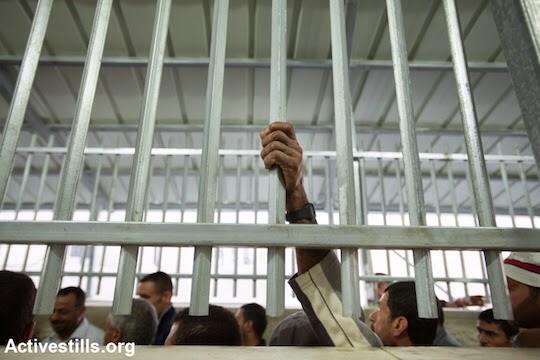
The military court system is a good place to start. Military tribunals could be accepted in very specific contexts and for a limited period of time. They aren’t meant – nor could they be used – to run the lives of a civilian population for decades, as Israel does.

There is no way to justify military commanders ruling over civilian issues for half a century, the way they do in the West Bank. There is no way to justify administrative detentions. What prevents a “pro-peace” party or organization – say, Meretz or Labor or J Street – from right now demanding an end to the military court system, regardless of diplomatic developments? The fact that such an idea is not even debated demonstrates the degree to which even the “pro-peace” camp has adopted the mentality of the occupation.

What about freedom of movement? The Palestinians are held like Israel’s prisoners, not only in the West Bank but also in Gaza. It takes a permit from a military commander to allow a Palestinian to visit his or her family in Jordan. Why not demand turning this policy on its head, right now, and have the security authorities state who they forbid from traveling, and allow everybody else free passage? Surely this is a reasonable enough request?

Human rights groups have been monitoring and discussing these issues for decades, but they have yet to enter progressive politics, which is still chained to the endless peace process. Imagine what would happen if mobilization by the international community around Israeli relations with the PA or its settlement policies was directed at the rights of Palestinians.

To some this might seem like back-door annexation by Israel – an idea that most Israelis and Palestinians still oppose. But the fact of the matter is that de-facto annexation has already taken place, only without allowing the civilian population their basic human and civil rights. Recent cries over the appropriation of some 1,000 acres of land by Israel sound hollow compared to the massive human rights violations that have been taking place for decades. I actually believe that even if Israel was to hand the Palestinians full voting rights in the Knesset tomorrow we could end up with some version of a two-state solution or a confederative model, because both people here are interested in national sovereignty.

Make no mistake: Keeping the Palestinians without rights is not some temporary holding pattern on the way to a final status solution (or peace). For Israel, this is the solution. And giving Palestinians their rights will not postpone an agreement – quite the opposite. It would force Israelis to really think about the kind of future they want, alongside the Palestinians. More


OAS Workshop Seeks to Improve Caribbean Sustainable Energy Projects

20 August 2014: A regional workshop organized by the Organization of American States (OAS) discussed how to improve donor interventions regarding sustainable energy projects in the Caribbean.

The workshop, titled 'Development of Sustainable Energy Projects: Experiences, Strategies and Implementation,' took place on 19 August 2014 in Saint Lucia. The event brought together major donors for Caribbean energy projects with country representatives to: examine current and planned sustainable energy projects; discuss local barriers to commercialization of sustainable energy; identify Caribbean country project priorities and gaps in current assistance; and look at ways to foster collaboration and complementarity between projects.

During the opening session, OAS consultant Christina Becker-Birck provided an overview of the 80+ energy initiatives in the region, amounting since 2004 to around US$129 million in technical assistance and grants, about US$108 million in loans and lines of credit, with at least US$100 million pending and planned.

Philipp Blechinger, Reiner Lemoine Institut, outlined the results of a survey on barriers to the development of renewable energy technologies for power generation on Caribbean island States. Carolina Peña, OAS Sustainable Development Department (DSD), outlined OAS energy interventions in the region.

During a roundtable discussion on learning from success stories and failures, the Organization of Eastern Caribbean States (OECS) detailed its Sustainable Energy Programme on technical assistance and energy labeling. The Carbon War Room discussed its 10 Island Challenge to catalyze private investment and produce a Ten Island Renewable Roadmap/Blueprint. The Caribbean Development Bank outlined the proposed Sustainable Energy for the Eastern Caribbean (SEEC) and Geothermal Drill Risk Facility projects. The EU provided an overview of its support for energy projects in the region, and the Clean Energy Solutions Center (CESC) outlined its technical support.

The workshop was organized by the OAS DSD in the framework of the Sustainable Energy Capacity Building Initiative (SECBI) of the Energy and Climate Change Partnership of the Americas (ECPA). More


ECLAC, CARICOM Highlight Vulnerabilities, Opportunities in Caribbean SIDS

3 September 2014: During a side event at the Third International Conference on Small Island Developing States (SIDS), representatives of Caribbean SIDS and the UN discussed critical factors that underpin the vulnerability of Caribbean SIDS.


‘The vulnerability of Caribbean SIDS revisited – it's all about size' took place in Apia, Samoa, on 3 September 2014, and was organized by the Economic Commission for Latin America and the Caribbean (ECLAC) in collaboration with the Caribbean Community (CARICOM) Secretariat.


Speakers discussed trade and finance, governance and institutional capacity, disaster management, regional integration and opportunities arising from the small size of SIDS, as well as the fact that the majority of Caribbean SIDS are classified as middle-income countries, based on gross domestic product (GDP).


Raúl García-Buchaca, ECLAC, said middle-income status based on GDP fails to consider inequalities at the national level. John Ashe, President of the UN General Assembly (UNGA), focused on the particular vulnerabilities of Caribbean SIDS, and suggested mainstreaming them into the post-2015 development agenda. Winston Dookeran, Minister of Foreign Affairs, Trinidad and Tobago, called for working with development partners and international financial institutions to build buffers to external shocks, and declared that “Size may well be an opportunity rather than a limitation.”


Carolyn Rodrigues-Birkett, Minister of Foreign Affairs, Guyana, said the Caribbean would require over 7% growth to be sustainable, and mentioned the challenge in diversifying Caribbean economies within the new global economic order. Camillo Gonsalves, Minister of Foreign Affairs, Saint Vincent and the Grenadines, said that because of their small GDP, SIDS are unable to finance adaptation and recovery from natural disasters, and recommended regional integration, development financing, preferential trade, and debt relief and restructuring to assist in this regard.


Participants also introduced a vulnerability-resilience profile for arriving at an index, said the SIDS resilience fund could be a good measure in this regard, and underscored that the human capital must be recognized, public policy revolutionized, and political structure transformed. [ECLAC Press Release] [Statement of UNGA President] More