Jamaican’s Cautioned Against False Sense Of Water Security

THE RAINS have returned, bringing with them relief from drought conditions that plagued the island during the summer, but Jamaicans must guard against a false sense of water security.

Hope River in dry season

So says Director of the Climate Studies Group Mona Dr Michael Taylor, who is supported in his caution by Herbert Thomas, deputy managing director of the Water Resources Authority.

Taylor, a physicist, urges Jamaicans to be mindful not only of the El Niño phenomenon that promises a return to the dry spell towards the end of this year and into next year. They need, too, he warned, to be cognisant of climate change, which will see the island experiencing longer and more severe dry spells over the long term, as well as flooding incidents.

“As El Niño peaks, we might revert to dry conditions somewhere between the end of the year and early next year, but as it declines, we are susceptible to the reverse, which is flooding, when the early rainfall season kicks in,” he said.

“So the point is, we have to figure out how to be resilient to these swings in extremes from drought to flood within the course of a year, and these kinds of swings will become more and more the norm under climate change,” the scientist posited.

This is borne out by research done over the last two to three years by the Climate Studies Group for the Planning Institute of Jamaica.

That research, Taylor said, looks at climate scenarios up to 2040, with a focus on projections for temperature and rainfall.

“The temperature will continue increasing about one degree up to 2040, and that is further from where we are now. We have warmed by about one degree over the last 50 years. What that really translates into is, the number of really hot days is increasing every year and the number of really hot nights is also increasing and will continue to increase,” he said.

“Rainfall will continue with this form of variability, which is a yearly swing between drought and flood conditions, but by 2040 will show the beginning of an overall long-term drying trend. This means that, from 2040 onward, even though we will get rain, we will get less overall rain,” added Taylor.

The solution, he said, is a comprehensive look at water security, something Government is attempting to tackle, with work ongoing on a new water policy that takes account of climate impacts.

“We need to be concerned about water capture, water storage, water access, conservation, efficiency, and using science to help us to better plan for these kinds of extreme variations,” the head of the physics department at the University of the West Indies said.

Thomas agreed, noting that the island’s long-term water security will depend on a comprehensive plan, informed by the new water policy now nearing completion, and with both private citizens and Government working in concert.

“Some people like to stand under the shower and sing. Cutting out things like those [is important]; you would be surprised to know the amount of water you waste that way,” he told The Gleaner recently.

Retrofitting for conservation

In addition, Thomas said Jamaicans might have to look at retrofitting their homes and offices to include features such as low-flush toilets and faucets that use less water for showers. This, while the island looks at alternative energy sources in order to reduce the overall cost of getting water to the areas where it is needed.

Checks with communications manager at the National Water Commission, Charles Buchanan, revealed that current electricity cost for water stands at some of $500 million monthly.

Beyond that, Thomas said there is the need to look at rainwater harvesting and the comprehensive use of wastewater, to which the water policy also gives attention.

“For example, the treated sewage out at Soapberry, there is the thinking that some of the water could be used in St Catherine areas for agriculture and, therefore, the water normally used for agriculture could be freed up for domestic use in Kingston,” he noted.

“And there are other things … . You might have to consider a double-plumbing system so you separate grey water (water from bathroom sinks, tubs and washing machines, etc) from black water. Grey water you can use to flush toilets and water lawns,” Thomas added. More


The Peak Oil Crisis: It‘s All Around Us

Ten years ago peak oil was assumed to be a rather straight forward, transparent process. What was then thought of as “oil” production was going to stop growing around the middle of the last decade.


Shortages were going to occur; prices were going to rise; demand was going to drop; economies would falter; and eventually a major economic depression was going to occur. Fortunately or not, depending on your point of view, the last ten years have turned out to a lot more complicated than expected. Production of what is now known as “conventional” oil did indeed peak back around 2005, and many of the phenomena that were expected to result did occur and continue to this day.

Oil prices have climbed several-fold from where they were in the early years of the last decade – surging upwards from $20 a barrel to circa $100. This rapid jump in energy costs did slow many nations’ economies, cut oil consumption, and with some other factors set off a “great” recession. Real economic hardships have not yet occurred

What is so interesting about all this is that a temporary surge in what was heretofore a little known source of oil in the U.S. is masking the larger story of what is taking place in the global oil situation

Much of this is due to the reaction that set in from high oil prices and increased government intervention into the economy. In the case of the U.S., Washington turned on the modern day equivalent of the printing presses and began handing out money that was used to develop expensive sources of oil and gas. The high selling price per barrel, coupled with cheap money led to a boom in U.S. oil production where fortuitous geological conditions in North Dakota and South Texas allowed the production of shale oil at money-making prices provided oil prices stay high.

U.S. unconventional oil production soared by some 3.3 million barrels a day (b/d) in the last four years, and, if the US Energy Information Administration is correct, is due to climb by another million b/d or so in 2015. While this jump in production was unexpected by most, it was just another phenomenon resulting from unprecedentedly high oil prices, which in turn resulted from the lack of adequate “conventional” oil production. As is well known, economic development can have major reactions and feedbacks

What is so interesting about all this is that a temporary surge in what was heretofore a little known source of oil in the U.S. is masking the larger story of what is taking place in the global oil situation. The simple answer is that except for the U.S. shale oil surge almost no increase in oil production is taking place around the world. No other country as yet has gotten significant amounts of shale oil or gas into production. Russia’s conventional oil production seems to be peaking at present, and its Arctic oil production is still many years, or perhaps even decades, away. Brazilian production is going nowhere at the minute, deepwater production in the Gulf of Mexico is stagnating and the Middle East is busy killing itself. On top of all this, global demand for oil continues to increase by some million b/d each year – most of which is going to Asia.

If we step back and acknowledge that the shale oil phenomenon will be over in a couple of years and that oil production is dropping in the rest of the world, then we have to expect that the remainder of the peak oil story will play out shortly. The impact of shrinking global oil production, which is been on hold for nearly a decade, will appear. Prices will go much higher, this time with lowered expectations that more oil will be produced as prices go higher. The great recession, which has never really gone away for most, will return with renewed vigor and all that it implies.

An additional factor which has grown considerably worse in the last ten years is climate change, largely brought about by the combustion of fossil fuels. We are already seeing global weather anomalies with record high and low temperatures and record floods as well as droughts. This too will take its toll on economic development as mitigating this change will soon become enormously expensive. We are already seeing migrations of restive peoples. Thousands are dying in efforts to get from the Middle East and Africa into the EU. Millions are already homeless across the Middle East and recent developments foretell hundreds of thousands if not millions more being added to ranks of refugees as decades and even centuries-old political arrangements collapse.

All this is telling us that the peak oil crisis we have been watching for the last ten years has not gone away, but is turning out to be a more prolonged event than previous believed. Many do not believe that peak oil is really happening as they read daily of surging oil production and falling oil prices. Rarely do they hear that another shoe has yet to drop and that much worse in terms of oil shortages, higher prices and interrupted economic growth is just ahead.

We are sitting in the eye of the peak oil crisis and few recognize it. Five years from now, it should be apparent to all. More


The Real Weapons of Mass Destruction: Methane, Propaganda & the Architects of Genocide | Part I

Cory Morningstar's avatarFrom the NonProfit Industrial Complex with Love

An investigative report. [Part 1: http://bit.ly/fV8slf | Part II: http://bit.ly/gMITca | Part III: http://bit.ly/gMrxw9 | Part IV: http://bit.ly/g9xbFN]

By Cory Morningstar

Part I

World Marches to Methane Annihilation

“[T]he question is not will this methane be released, but when.” – Robert C. Hendricks, NASA, November 2007

The architects of death: The Real Weapons of Mass Destruction are the melting permafrost, the destabilizing methane hydrates and the corporations such as Halliburton, ChevronTexaco, BP, Shell, Exxon Mobil and the banking and investment industry who, hand in hand with the US Department of Energy and the US Department of Defense, have been planning and waiting to exploit methane hydrates for decades. Methane hydrates are considered the ultimate in climate wealth opportunity because the control of these hydrocarbons could literally shift the balance of global power (US Department of Defense). It is clear that nothing has been done to prevent catastrophic climate change –…

View original post 7,022 more words

Why Greenland’s “Dark Snow” Should Worry You

Jason Box’s research into Greenland’s dark snow raises more concerns about climate change.

Jason Box knows ice. That’s why what’s happened this year concerns him so much. Box just returned from a trip to Greenland. Right now, the ice there is … black:

The ice in Greenland this year isn’t just a little dark—it’s record-setting dark. Box says he’s never seen anything like it. I spoke to Box by phone earlier this month, just days after he returned from his summer field research campaign.

“I was just stunned, really,” Box told me.

The photos he took this summer in Greenland are frightening. But their implications are even more so. Just like black cars are hotter to the touch than white ones on sunny summer days, dark ice melts much more quickly.

As a member of the Geological Survey of Denmark and Greenland, Box travels to Greenland from his home in Copenhagen to track down the source of the soot that’s speeding up the glaciers’ disappearance. He aptly calls his crowdfunded scientific survey Dark Snow.

There are several potential explanations for what’s going on here. The most likely is that some combination of increasingly infrequent summer snowstorms, wind-blown dust, microbial activity, and forest fire soot led to this year’s exceptionally dark ice. A more ominous possibility is that what we’re seeing is the start of a cascading feedback loop tied to global warming. Box mentions this summer’s mysterious Siberian holes and offshore methane bubbles as evidence that the Arctic can quickly change in unpredictable ways.

This year, Greenland’s ice sheet was the darkest Box (or anyone else) has ever measured. Box gives the stunning stats: “In 2014 the ice sheet is precisely 5.6 percent darker, producing an additional absorption of energy equivalent with roughly twice the US annual electricity consumption.”

Perhaps coincidentally, 2014 will also be the year with the highest number of forest fires ever measured in Arctic.

Box ran these numbers exclusively for Slate, and what he found shocked him. Since comprehensive satellite measurements began in 2000, never before have Arctic wildfires been as powerful as this year. In fact, over the last two or three years, Box calculated that Arctic fires have been burning at a rate that’s double that of just a decade ago. Box felt this finding was so important that he didn’t want to wait for peer review, and instead decided to publish first on Slate. He’s planning on submitting these and other recent findings to a formal scientific journal later this year.

Box’s findings are in line with recent research that shows the Arctic is in the midst of dramatic change.

A recent study has found that, as the Arctic warms, forests there are turning to flame at rates unprecedented in the last 10,000 years. This year, those fires produced volumes of smoke and soot that Box says drifted over to Greenland.

In total, more than 3.3 million hectares burned in Canada’s Northwest Territories alone this year—nearly 9 times the long term average—resulting in a charred area bigger than the states of Connecticut and Massachusetts combined. That figure includes the massive Birch Creek Complex, which could end up being the biggest wildfire in modern Canadian history. In July, it spread a smoke plume all the way to Portugal.

In an interview with Canada’s National Post earlier this year, NASA scientist Douglas Morton said, “It’s a major event in the life of the earth system to have a huge set of fires like what you are seeing in Western Canada.”

Box says the real challenge is to rank what fraction of the soot he finds on the Greenland ice is from forest fires, and what is from other sources, like factories. Box says the decline of snow cover in other parts of the Arctic (like Canada) is also exposing more dirt to the air, which can then be more easily transported by the wind. Regardless of their ultimate darkening effect on Greenland, this year’s vast Arctic fires have become a major new source of greenhouse gas emissions from the thawing Arctic. Last year, NASA scientists found “amazing” levels of carbon dioxide and methane emanating from Alaskan permafrost.

Earlier this year, Box made headlines for a strongly worded statement along these lines:

That tweet landed Box in a bit of hot water with his department, which he said now has to approve his media appearances. Still, Box’s sentiment is inspiring millions. His “f’d” quote is serving as the centerpiece of a massive petition (with nearly 2 million signatures at last count) that the activist organization Avaaz will deliver to “national, local, and international leaders” at this month’s global warming rally in New York City on Sept. 21. More


Wastewater recycling, part of the solution to water shortage?

After the report on mountaineering and my experiences on the ascent to Mount Aconcagua, I return to the subject of water, and the opportunities and challenges in recycling it.

In earlier posts here I wrote about a very sophisticated system of wastewater recycling in Singapore, which turns it back into drinking water.

And at this year’s Singapore International Water Week, the Californian Orange County received the highest recognition, for a scheme where perfectly treated wastewater is pumped back into underground aquifers, to be later pumped up again as drinking water. It also serves as a barrier to seawater intrusion.

These two examples, especially Singapore, are probably the most far-reaching examples I know of achievement in water recycling.

Places like San Diego, hit by a drought, are now re-considering again the idea to follow the Singapore example, despite some opposition from civil society. So, to what extent is it possible to scale up these kinds of activities globally; is there potential for wastewater to contribute in a substantial way to closing the gap of some 300 cubic kilometres between the level of water withdrawals and sustainable supply?

Estimates show close to 300 cubic kilometres of wastewater is generated by municipalities per year (average 2003-12). This is the equivalent of some 50% of global average annual withdrawals for household use.

Part of the other 50% of withdrawals not counted as ‘wastewater’ may well be lost in leakage in pipes (in some countries this accounts for up to 70% of the water withdrawn by the municipal water supply schemes). Another part could be ‘used’ through evapotranspiration in lawns and gardens, etc.

As the table below shows, only about half of this wastewater is actually collected and treated, but less than 10% of the treated wastewater is directly reused.

Table 1: Municipal wastewater generation and treatment data 2003-2012, country groups by income per capita

Source: FAO aquastat


To get an idea of how municipal water could contribute to closing the gap between withdrawals and sustainable supply, let me go through the water supply chain.

The first step would require a better understanding of what happens with the 50% of municipal water apparently ‘disappearing’. Where this is down to leakage, governments have to set the right incentives so municipal water authorities address the issue.

One way proposed by the 2030 Water Resources Group (2030 WRG) in South Africa, which has been implemented by the government there, is to measure both water delivery and water intake, and to pay a premium to the schemes where the difference (i.e., water unaccounted for) gets smaller.

According to 2030 WRG cost-curve estimates, the cost savings would by far exceed the necessary spending to reduce the leakage.

As part of my proposals for targets within the water goal for post-2015 sustainable development, I suggest primary treatment of all wastewater by 2030 – an idea I will come back to in a later post.

So, what happens with 285 km³ of estimated wastewater generated, and what needs to be done? We will first have to increase collection, particularly in economically deprived areas, to make sure wastewater is collected and available for proper treatment.

Actually, only 36% of the world’s population has a sewage connection; this leaves 4.6 billion people unconnected. According to a WHO study, initial investment to set up a sewer connection is about USD 170 per capita; so the investment cost to connect them would be somewhere close to USD 800 billion. The annual cost of capital, repayment and operating cost is estimated at USD 1 per m³.

Next: treatment of both the up-to-now untreated collected – and the newly collected – wastewater. Estimates amount to USD 0.35 per m³. A big part of this cost is energy, an often forgotten link in the water-food-energy nexus framework.

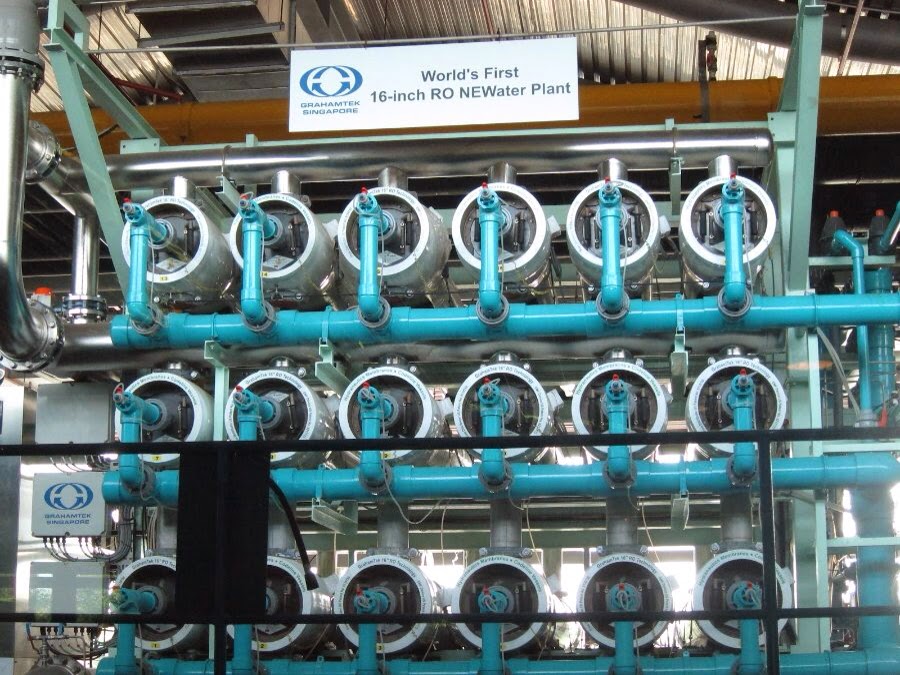
And last but not least: less than 10% of treated wastewater is used directly. This can and must be increased. Direct use is, for instance, the Singapore approach, bringing treated water back to consumers as so-called ‘NEWater’.

Another example is Australia: around 1.4 cubic kilometers of municipal wastewater are treated, of which 0.4 cubic kilometers are used directly, mostly in agriculture.

At Nestlé we have a similar approach. All our factories treat wastewater (in fact the first wastewater treatment plant in the group was built in the 1930s, so we understood the need for this very early) and as much of this treated wastewater as possible is used directly.

At the same time, we should keep in mind indirect use, even though it’s often difficult to measure. Treated wastewater is returned to rivers and then often withdrawn again and treated further for human consumption.

One might, for instance, assume that a significant part of the water in the River Thames, once it reaches London, is treated wastewater from communities further up the river. Increasing the share of direct use of wastewater should clearly be encouraged – in a form accepted by local communities.

So, all in all there are some significant opportunities to use treated wastewater as a resource, helping to close the gap between freshwater withdrawals and sustainable supply. But these opportunities need to be carefully evaluated, to make sure they are fully accepted, but also cost and energy effective when compared to other solutions. Via Peter Brabeck-Letmathe – Linkedin More


It’s clear that prosperity and climate change action can go hand in hand

The UK has been at the forefront of integrating climate change action into economic decision-making

The link between economic growth and action to reduce the risks of climate change is the focus of the New Climate Economy report issued on Tuesday.

Its credentials are impressive and its findings emphatic.

Released by a global commission of 24 global economic leaders from government, business, finance and academia, led by former president of Mexico Felipe Calderón, the year-long study has involved individuals from over 100 organisations across every continent and advised by a panel of world-leading economists chaired by Lord Nicholas Stern.

It has come to a clear conclusion – action on climate change can improve economic performance.

This report provides compelling further evidence that firmly supports the UK’s vision for a global climate deal in Paris 2015 that I launched last week in the city of London – which was clear that prosperity and climate action can go hand in hand.

The reason, the New Climate Economy report concluded, is that raising resource efficiency, stimulating innovation and new investment in infrastructure are making it possible to tackle climate change at the same time as improving economic performance.

That means new opportunities to improve growth, create jobs, boost company profits and spur innovation for all countries that take action now.

The report finds that over the next 15 years, trillions of pounds could be saved by building low-carbon into the key sectors of the global economy that include our cities, agriculture and energy. This could include better connected and more compact cities, through to restoring degraded lands and focusing on a transition to clean energy to improve economic performance and quality of life with lower emissions.

And we are putting this into action. The UK has been at the forefront of developing the climate change policy architecture that can ensure climate action is integrated into economic decision making.

This includes the 2008 Climate Change Act, which was the world’s first long-term, legally-binding national framework for reducing emissions, through our innovative carbon budgets regime. This means that our five year carbon budgets – that will eventually reach out to 2050 – are now being looked at as a potential model in other countries and we have already delivered on our first budget, which has seen a reduction in UK emissions by 24% between 1990 and 2012.

The 2013 Energy Act, for example, is creating the world’s first low-carbon electricity market and we are attracting record amounts of investment in renewables and our low carbon business sector is booming. In renewables, almost £29bn of investment delivered since 2010 and 2013, was a record year – with £8bn invested across the range of renewables technologies.

Electricity generation from renewable sources has doubled since 2010 and now supplies over 15% of the UK’s electricity.

We’re now a world leader in offshore wind – with more installed offshore wind capacity than the rest of the world combined, and supporting 18,300 jobs in the UK.

It has required UK business and international investors to recognise the costs of failure and the benefits of change and it has been sustained by a strong, vocal and committed network of NGOs, pressure groups and activists who have been instrumental in sustaining political will and public acceptance.

Last year, the world’s leading climate scientists, under the IPCC, reaffirmed that the Earth’s climate is indisputably changing, that human activity is the dominant cause – and the longer we leave action, the more difficult and costly it will be to avoid the worst effects. We now have the economics confirming that not only is climate action required to reduce climate risks, but that it is vital to building long-term, sustainable economic growth.

In the run up to the UN climate meeting in Paris next year I am determined that we continue to build on our success at home and expend every effort, and work with determination across government, across the parties, in partnership with business and civil society to reach a global, comprehensive, legally binding climate change deal. More


Why We March

On Sunday, September 21st, a huge crowd will march through the middle of Manhattan. It will almost certainly be the largest rally about climate change in human history, and one of the largest political protests in many years in New York.

More than 1,000 groups are coordinating the march — environmental justice groups, faith groups, labor groups — which means there’s no one policy ask. Instead, it’s designed to serve as a loud and pointed reminder to our leaders, gathering that week at the United Nations to discuss global warming, that the next great movement of the planet’s citizens centers on our survival and their pathetic inaction.

As a few of the march’s organizers, though, we can give some sense of why we, at least, are marching, words we think represent many of those who will gather at Columbus Circle for the walk through midtown Manhattan.

We march because the world has left the Holocene behind: scientists tell us that we’ve already raised the planet’s temperature almost one degree Celsius, and are on track for four or five by century’s end. We march because Hurricane Sandy filled the New York City subway system with salt water, reminding us that even one of the most powerful cities in the world is already vulnerable to slowly rising ocean levels.

We march because we know that climate change affects everyone, but its impacts are not equally felt: those who have contributed the least to causing the crisis are hit hardest, here and around the world. Communities on the frontlines of global warming are already paying a heavy price, in some cases losing the very land on which they live. This isn’t just about polar bears any more.

And we march for generations yet to come, our children, grandchildren and their children, whose lives will be systematically impoverished and degraded. It’s the first time one century has wrecked the prospects of the millennia to come, and it makes us mad enough to march.

We march with hope, too. We see a few great examples around the world of how quickly we could make the transition to renewable energy. We know that if there were days this summer when Germany generated nearly 75% of its power from renewable sources of energy, the rest of us could, too — especially in poorer nations around the equator that desperately need more energy. And we know that labor-intensive renewables would provide far more jobs than capital-intensive coal, gas and oil.

And we march with some frustration: why haven’t our societies responded to 25 years of dire warnings from scientists? We’re not naïve; we know that the fossil fuel industry is the 1% of the 1%. But sometimes we think we shouldn’t have to march. If our system worked the way it should, the world would long ago have taken the obvious actions economists and policy gurus have recommended — from taxing carbon to reflect the damage it causes to funding a massive World War II-scale transition to clean energy.

Marching is not all, or even most, of what we do. We advocate; we work to install solar panels; we push for sustainable transit. We know, though, that history shows marching is usually required, that reason rarely prevails on its own. (And we know that sometimes even marching isn’t enough; we’ve been to jail and we’ll likely be back.)

We’re tired of winning the argument and losing the fight. And so we march. We march for the beaches and the barrios. We march for summers when the cool breeze still comes down in the evening. We march because Exxon spends $100 million every day looking for more hydrocarbons, even though scientists tell us we already have far more in our reserves than we can safely burn. We march for those too weak from dengue fever and malaria to make the journey. We march because California has lost 63 trillion gallons of groundwater to the fierce drought that won’t end, and because the glaciers at the roof of Asia are disappearing. We march because researchers told the world in April that the West Antarctic ice sheet has begun to melt “irrevocably”; Greenland’s ice shield may soon follow suit; and the waters from those, as rising seas, will sooner or later drown the world’s coastlines and many of its great cities.

We don’t march because there’s any guarantee it will work. If you were a betting person, perhaps you’d say we have only modest hope of beating the financial might of the oil and gas barons and the governments in their thrall. It’s obviously too late to stop global warming entirely, but not too late to slow it down — and it’s not too late, either, to simply pay witness to what we’re losing, a world of great beauty and complexity and stability that has nurtured humanity for thousands of years.

There’s a world to march for — and a future, too. The only real question is why anyone wouldn’t march. More


The Role of Education in Climate Change Risk Management

caribbeanclimate's avatarcaribbeanclimate

We need a “multi-faceted approach for educating the children and adults vulnerable to climate change […] to reduce the adverse impacts of climate change,” according to Dr. Leslie A. North, Assistant Professor in the Department of Geography and Geology at the Western Kentucky University , and Mr. Kianoosh Ebrahimi, Center for Water Resource Studies, Western Kentucky University in an  exclusive guest post to Caribbean Climate.

Credit: The 5Cs Credit: The 5Cs

Communities of scientists acknowledge that global climate change is happening, and is predominantly the result of human activities (IPCC, 2014). Yet, despite the wealth of information about the potentially catastrophic impacts of climate change, there are many persons still skeptical about the importance of understanding and responding to climate change risk. There are equally as many people simply unaware of how to minimize the impacts of climate change (Alejandro et al., 2012). Generally speaking, as climate change is typically perceived as remote and distant…

View original post 749 more words

Why Peak Oil Refuses To Die

Perhaps you’ve seen one of the recent barrage of articles claiming that fears of an imminent peak and decline in world oil production have either been dispelled (because we actually have plenty of oil) or are misplaced (because climate change is the only environmental problem we should be concerned with). I’m not buying either argument.

Richard Heinberg

Why? Let’s start with the common assertion that oil supplies are sufficiently abundant so that a peak in production is many years or decades away. Everyone agrees that planet Earth still holds plenty of petroleum or petroleum-like resources: that’s the kernel of truth at the heart of most attempted peak-oil debunkery. However, extracting and delivering those resources at an affordable price is becoming a bigger challenge year by year. For the oil industry, costs of production have rocketed; they’re currently soaring at a rate of about 10 percent annually. Producers need very high oil prices to justify going after the resources that remain—tight oil from source rocks, Arctic oil, ultra-deepwater oil, and bitumen. But oil prices have already risen to the point where many users of petroleum just can’t afford to pay more. The US economyhas a habit of responding to oil price hikes by swooning into recession, and during the shift from $20 per barrel oil to $100 per barrel oil (which occurred between 2002 and 2011), the economies of most industrialized countries began to shudder and stall. What would be their response to a sustained oil price of $150 or $200? We may never know: it remains to be seen whether the world can afford to pay what will be required for oil producers to continue wresting liquid hydrocarbons from the ground at current rates. While industry apologists who choose to focus only on the abundance of remaining petroleum resources claim that peak oil is rubbish, the market is telling Houston we have a problem.

Meanwhile some environmentalists have abandoned the subject of peak oil because they believe it’s just not relevant. For them, climate change is the only thing that matters. Society must deal with its collective carbon habit by going cold turkey on all fossil fuels. We can make the needed energy transition through the strategies of substitution and efficiency. Develop low-carbon energy sources (solar and wind, possibly nuclear), and use energy smarter! Electrify transport with battery-powered cars! Get with the program and stop wasting time on side issues!

Like the abundant-resource argument, this line of thinking proceeds from an unassailable premise. Anthropogenic climate change is indeed the nastiest, gnarliest environmental issue humanity has ever faced. The potential consequences stretch centuries or millennia into the future and imperil not just humanity, but thousands or millions of other species. But peak oil won’t go away just because it’s an inconvenient distraction from addressing that gargantuan issue. In fact, the two problems are closely linked and society will need to address both by way of a realistic, comprehensive strategy. I’ll get back to that point toward the end of this essay.

Is the necessary transition to renewable energy a simple matter of politics and regulation, as many climate campaigners seem to suggest? Hardly. Transitioning the electricity sector is a huge task in itself (the variability of wind and solar power implies soaring costs for energy storage, capacity redundancy, and grid upgrades once these sources start to provide a substantial portion of total electrical energy consumed). But liquid fuels pose an even bigger hurdle. Even the most advanced batteries do a poor job of storing energy when compared to oil; that’s why we’re unlikely ever to see electric airplanes, tractors, ships, 18-wheel trucks, or bulldozers. Some energy pundits tout compressed natural gas as a viable bridge fuel for transport, but that assumes sufficient availability and continued affordability of fracked shale gas—a prospect that seems highly unlikely in view of the results of Post Carbon Institute’s ongoing research into possible shale gas drilling locations and per-well production profiles. Hydrogen could be a niche fuel in some instances, but conversion from other energy sources (electricity or natural gas) to hydrogen implies energy losses, as does hydrogen storage. Further, if we were to make lots of H2 from water, using electricity, in order to fuel much of the transport sector, this would place an enormous extra burden on solar and wind, which already face a daunting job replacing coal and natural gas in the power generation sector.

How about energy efficiency? Good idea! We need to cut energy waste, and the folks at Rocky Mountain Institute have proposed many good ways of doing that. But, at the end of the day, efficiency is subject to the law of diminishing returns; so, while the tie between energy consumption and economic output is somewhat elastic, it cannot be severed. Specifically regarding oil: yes, many nations have reduced petroleum consumption in the last few years as a way of adapting to higher prices. But the fact that their economies have weakened suggests that efficiency gains have tended to lag behind oil price increases. Average vehicle fuel economy has improved, but not fast enough—so our main “efficiency” strategy has in reality simply been to travel less, and then deal with the withdrawal of economic benefits that cheap transport formerly provided.

None of this is trivial: oil is essential to the functioning of the modern industrial world. We use it for just about all transportation, which is key to trade. It’s also the fuel for construction, resource extraction (mining, fishing, forestry), and agriculture. Together, these sectors form the backbone of the real, physical economy of industrialized nations.

Again: the costs of oil production are rising and oil is stubbornly hard to substitute. As I argued in a recent book, this effectively spells the end of the historic period of rapid economic growth that began shortly after World War II. There is no way out; inevitably, society will become less mobile and—this should be cause for much greater concern—it will either produce less food or produce it in more labor-intensive ways.

Of course, peak oil and climate change aren’t the only looming challenges we should be concerned about. Economists rightly worry that the world is mired in far too much debt. Ecologists warn us about biodiversity loss, pervasive chemical pollution, and human overpopulation. Food system analysts try (usually in vain) to direct public attention toward the predicaments of topsoil degradation and depletion of aquifers from over-irrigation. Public health professionals caution us about the specter of pandemics as antibiotics lose effectiveness due to rapid microbial evolution. For city managers, the crumbling of water, sewerage, bridge, gas, and electricity grid infrastructure implies countless disasters just waiting to happen. I could go on. It’s all so overwhelming! Perhaps the only way to avoid crisis fatigue these days is simply to stop paying attention. But amid all these priorities and problems, peak oil refuses to die.

Those of us who insist on paying attention sooner or later get around to doing a form of mental triage. What are the worst crises that humanity faces over the long run? Which are the worst in the short term? What are the deeper issues, of which many problems are mere symptoms? This sorting process has led many systems thinkers to the conclusion that our species, in essence, faces an ecological dilemma of overpopulation, resource depletion, and environmental degradation resulting from a relatively brief period of rapid expansion enabled by a huge but temporary energy subsidy in the form of fossil fuels. We discovered buried treasure and went on a spending binge, adopting a way of life that cannot be supported long-term. Peak oil, climate change, mineral depletion, soil degradation, species loss, and the rest are justwords that blind men use to describe an elephant.

What we must do now is treat symptoms while keeping in mind the root disease, seeing why and how various crises are related. I have a couple of suggestions in this regard. One is that we begin to speak of peak oil and climate change as two sides of the same coin. The coin itself represents our reliance on fossil fuels and their unique energetic benefits. Both side-problems (the declining economic value of fossil fuels as they deplete, on one side, and the increasing environmental cost of burning them, on the other) demand that we reduce our fossil fuel dependency as rapidly as possible, even though that means sacrificing benefits we have come to depend on. If we maintain this holistic view of the situation, we’re more likely to understand that there is no way to keep eating our cake while having it too, either by continuing to burn fossil fuels of declining quality or by relying on new technology to fix what is actually an ecological problem. We can’t frack our way back to economic prosperity; nor can we unplug a coal plant, plug in a solar panel, and go on expanding population and consumption. We will have to adapt to the quantities and qualities of energy that are actually available from renewable sources alone, and that will mean changing the way we do just about everything.

Which brings me to the second, related suggestion. The constellation of challenges before us ensures that economic growth, as we have known it, is over, finished, kaput. That’s a terrible thing, in that the end of growth will almost certainly entail financial and political turbulence with real human casualties. But from the standpoint of diagnosis and treatment, it simplifies everything marvelously. If our impending crises stem from fossil-fueled expansion of population and consumption, their resolution surely starts with a coordinated, planned, and managed program of decarbonization and degrowth. We must reduce population and energy consumption from fossil fuels, while minimizing the human and environmental impacts of both past growth and the process of contraction. Easily said, not so easily done. But if civilization is to maintain itself in any recognizable form, this is what’s necessary. It would really help if those of us working at treating the various symptoms of the global meta-crisistogether acknowledged that growth is a core part of the underlying problem, not a solution, and that it is effectively over in any case.

Ignore peak oil (this could equally be said of climate change), and our view of the global problem-set immediately becomes distorted. We grasp at apparent solutions that turn out to be a useless waste of effort, or worse. Peak oil helps us understand what we’re faced with, and what we must do. It’s a gift wrapped in a curse. And it refuses to go away no matter how often it is pronounced dead.

By. Richard Heinberg