Water woes in Lima: A glimpse of our future?

As UN negotiators meet in Lima to work out a plan for dealing with rising temperatures, Matt McGrath visited a community paying a high price for water supplies threatened by climate change and increasing demand. Is Peru’s experience a sign of things to come?

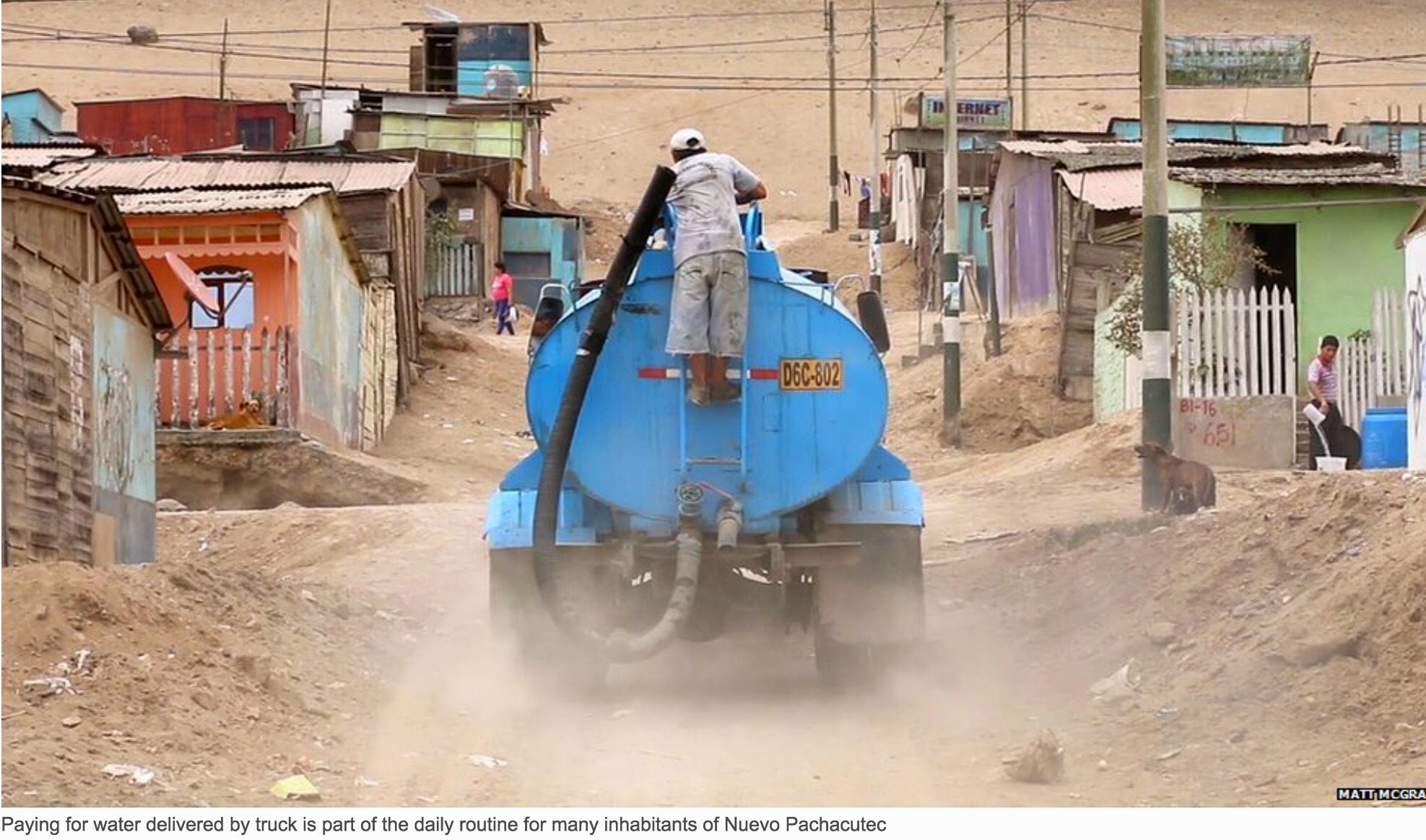
Snarling and screeching, the bouncing water truck speeds backwards down the steep hill, in a cloud of coarse dust.

It halts with a judder and a wild eyed, sweaty man jumps from the cab, grabs a large plastic pipe on the back and starts to fill a series of plastic containers on the ground, with little care.

Dressed in bright pink, a woman looks on nonchalantly.

The man runs up to her and holds out his hand. She drops some coins and away he goes, jumping onto the running board of his vehicle, already snorting its way to the next stop.

This is daily routine for tens of thousands of people who live in this sprawling hillside settlement that looks down on the Pacific Ocean, less than an hour north of Lima, Peru.

Water in Nuevo Pachacutec is not just the vital substance for life, it is a measure of social status and progress.

People first came to these hazy hills in the 1980s, in response to politicians who promised them land in return for votes.

When they first arrived the women said their feet would just sink in the sand. That’s all that was here.

The politicians allowed them to take the ground – but most of the 160,000 people here do not have legal title. They are “possessors of the land” but not the owners.

And land is too grand a word. This is really a desert. After Cairo, Lima is said to be the world’s second biggest city built in one. Rainfall here amounts to just 50mm of water per year.

A river runs through it

A few kilometres south of Nuevo Pachacutec, a miserable, dirty stream meanders under a motorway.

Bags of rubbish sit alongside the ubiquitous tractor tyres.

This is the Chillon river, the sole water source for around two million people in northern Lima.

The waters of the Chillon are fed by glaciers in the Andes. And this is a source of concern.

“We are worried here in Peru because climate change is already having a huge impact on our access to water,” says Armando Mendoza a research officer with Oxfam in the country.

“In the last 40 years, the glacial coverage has retreated by 40% more or less, because of the increase in global warming.

“The predictions are that in the future access to water will become even more difficult and the ones who are most vulnerable to this are the poor.”

These longer term water issues with glaciers are not the immediate priority in Nuevo Pachacutec.

As well as the speeding tuktuks, the sandy roads are festooned with signs for car washes, even private schools.

Despite the fact that 80% of the homes are made of wood, incomes and aspirations are rising here.

Access to water is critical in this development, as it is in developing nations all over the world.

With funding from the German government, a green group called Alternativa has helped build networks of white water tanks, connected by underground tubes that bring water directly to the houses.

They have also installed 900 outside water points in this sprawling settlement.

Their efforts to date have brought the vital liquid to 9,000 households.

In this community, water is more than just a key ingredient for life, it is a reflection of harsh social divisions.

The blue barrels

Despite the fact that 80% of the homes are made of wood, incomes and aspirations are rising here.

Access to water is critical in this development, as it is in developing nations all over the world.

With funding from the German government, a green group called Alternativa has helped build networks of white water tanks, connected by underground tubes that bring water directly to the houses.

They have also installed 900 outside water points in this sprawling settlement.

Their efforts to date have brought the vital liquid to 9,000 households.

In this community, water is more than just a key ingredient for life, it is a reflection of harsh social divisions.

Radios and children play loudly on the street where Daniza Cruz Navarro lives.

The homes on this stretch are known as the “casas azules” – the blue houses.

Outside many sit blue plastic barrels, some with lids, some without, that hold the water residents get from the trucks that constantly career about the local roads.

Dogs lap from the open containers. Mosquitoes lay their eggs in the water.

“You can see the effects of the way the water is being stored in the kids’ health,” says Daniza.

“They often get sick, there is often misuse and mismanagement of the water here.”

She has moved on from the blue barrel and is now the owner of a more effective and efficient water tank that she has bought through the efforts of Alternativa.

However, as she still gets water directly from the delivery trucks, she has to pay significantly more than her neighbours.

Daniza says she pays 120 Nuevo Soles (£26; $40) per month for the precious water. This is about 10% of her household income.

Those who are connected to the main water grid pay just 6-12 Soles per month.

These are big sums of money and the differences can be a source of friction between neighbours.

Despite these problems, those who work with the people in Nuevo Pachacutec say progress is being made. It’s really a story of local self-empowerment.

“Even if they are not perfect, they have bettered considerably,” says engineer Osvaldo Caceres who works with Alternativa.

“This infrastructure is managed by them, for them. The local population know what they want, but they know and understand they have to participate to get it.

Plug and pay


“When we first got here it was all desert – there were no roads, it was pure sand,” says Ycella Bonilla a resident of Nuevo Pachacutec.

She stands proudly in the doorway of her recently built bathroom cum laundry room, completed with the help of microfinance.

Ycella calls it her “unit of dignity”.

Despite this advance, Ycella and her family are still paying heavily for water. She has a hose and a key that allows her family to plug into a water point. For this she pays 80 Nuevo Soles a month (£18; $27) a month.

Despite the gripes over cost, Ycella recognises that water is the bedrock of development for the community.

“We have roads, we have schools, we have a lot of the basic necessities now, including water.”

The struggle for development and the need to have resources like water to empower that development is not just on the minds of those in Nuevo Pachacutec.

An hour down the road in Lima itself, UN climate negotiators are struggling with that same dilemma. How to balance the burgeoning needs of a growing population, with the need to limit those same enriching activities because they threaten the future of the planet.

Osvaldo Caceres says that as in solving the water stresses of Nuevo Pachacutec, the climate battle can be won, by everyone playing their part now. It’s no use passing the buck down the generations.

“Every actor in this chain must take responsibility for what they have to do,” he says.

“The governments, the authorities, and obviously the people, they all need to act.” “There is no other way.” More


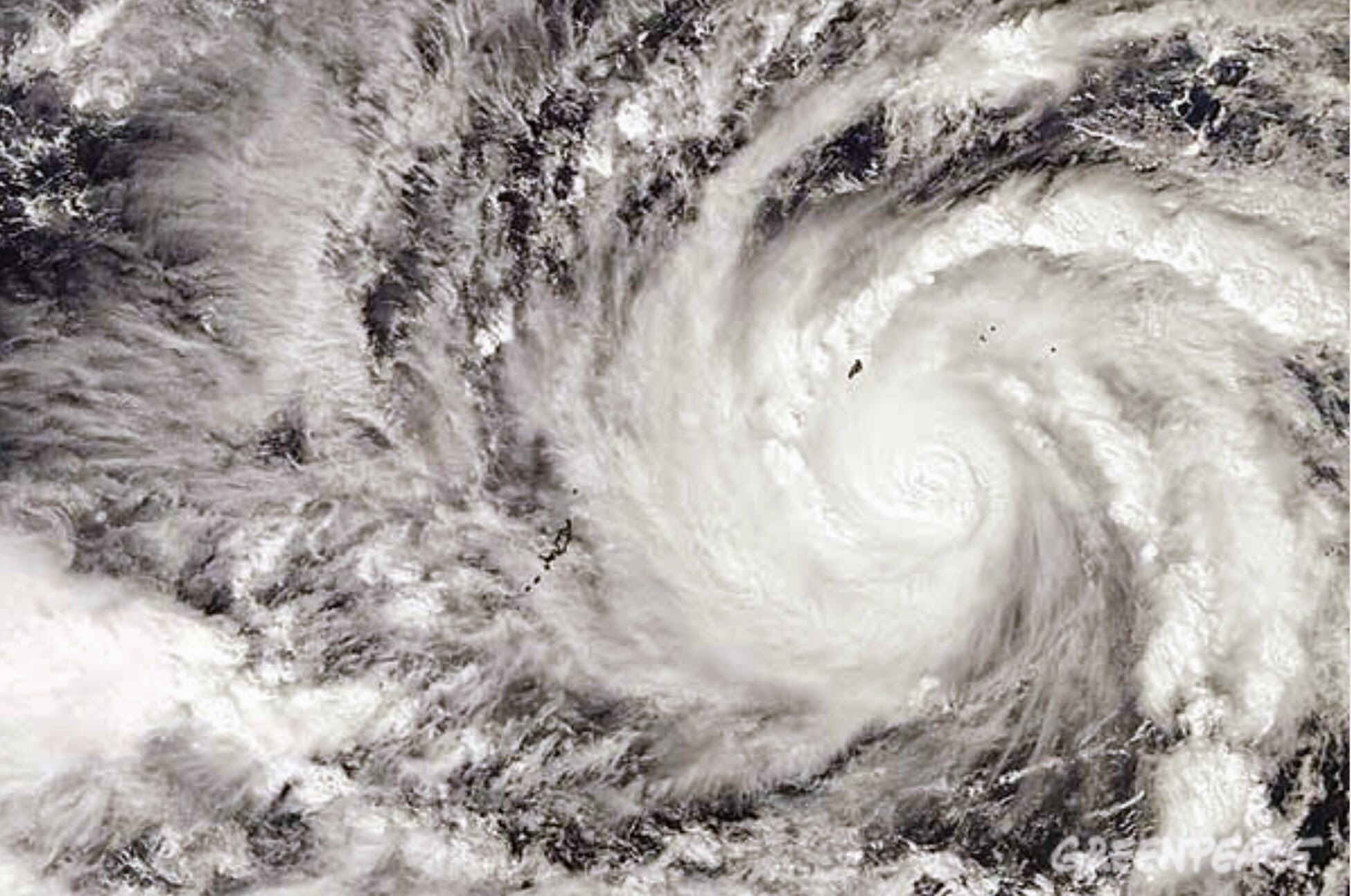
Typhoon Hagupit Hits Philippines: Climate Catastrophe Is Here Now! by Kumi Naidoo

As Typhoon Hagupit hits the Philippines, one of the biggest peacetime evacuations in history has been launched to prevent a repeat of the massive loss of life which devastated communities when Super Typhoon Haiyan hit the same area just over a year ago.

Typhoon Hagupit

“One of the biggest evacuations in peacetime” strikes a sickening chord. Is this peacetime or are we at war with nature?

I was about to head to Lima, when I got a call to come to the Philippines to support our office and its work around Typhoon Hagupit (which means lash). In Lima another round of the UN climate talks are underway to negotiate a global treaty to prevent catastrophic climate change. A truce of sorts with nature.

But these negotiations have been going on far too long, with insufficient urgency and too much behind the scenes, and not so much behind the scenes, interference from the fossil fuel lobby.

This year, like last year and the year before these negotiations take place against a devastating backdrop of a so-called ‘extreme weather event’, something that climate scientists have been warning us about if we don’t take urgent action.

Tragically, we are not taking urgent action. Nature does not negotiate, it responds to our intransigence. For the people of the Philippines, and in many other parts of the world, climate change is already a catastrophe.

Only one year ago, Super Typhoon Haiyan killed thousands, destroyed communities and caused billions of dollars in damage. Many survivors who are still displaced have this week had to evacuate the tents they have been living in as Typhoon Hagupit carves a path across the country as I write.

It’s too early to assess the impact so far—we are all hoping early indications will spare the Philippines of the same pain that was experienced after Haiyan.

Here in Manila, we prepare to travel to the impacted areas in the wake of Typhoon Hagupit, or Ruby, as it has been named. We will offer what minor assistance we can.

We will stand in solidarity with the Filipino people and we will call out those who are responsible for climate change, those who are responsible for the devastation and who should be helping pay for the clean up and for adaptation to a world in which our weather is an increasing source of mass destruction.

With heavy hearts we prepare to bear witness. We challenge those in Lima to turn their attention from the lethargy and process of the negotiations and pay attention to what is happening in the real world.

We call on them to understand that climate change is not a future threat to be negotiated but a clear and present danger that requires urgent action now!

Each year, the people of the Philippines learn the hard way what inaction on emissions mean. They might be slightly better prepared and more resilient, but they are also rightly more aghast that each year—at the same time—the climate meetings seem to continue in a vacuum, not prepared to take meaningful action, not able to respond to the urgency of our time and not holding accountable the Big Polluters that are causing the climate to change with ferocious pace.

Before leaving for Manila I also received a message from Yeb Saño, climate commissioner for the Philippines: “I hope you can join us as we bear witness to the impact of this new super typhoon. Your help would be very valuable in delivering a message to Lima loud and clear.”

Yeb was the Filipino chief negotiator for three years at the UN climate talks and recently visited the Arctic on a Greenpeace ship to witness the Arctic sea ice minimum. Two years ago in Doha, as Typhoon Pablo took the lives of many he broke through the normally reserved language of dispassionate diplomacy that dominates UN climate treaty talks:

“Please … let 2012 be remembered as the year the world found the courage to … take responsibility for the future we want. I ask of all of us here, if not us, then who? If not now, then when? If not here, then where?”

I am joining Greenpeace Philippines and Yeb to visit the worst hit areas, document the devastation and send a clear message from climate change ground zero to Lima and the rest of the world that the ones that are responsible for the majority of emissions will be held accountable by the communities that are suffering the impacts of extreme weather events linked to climate change.

We will call on the heads of the fossil fuel companies who are culpable for the unfolding tragedy to examine their consciences and accept their historic responsibility. They say the truth is the first casualty of war, in this war against nature, the truth of climate science is unquestionable.

Please join us. Please add your voice by signing our petition calling on Big Polluters to be held legally and morally accountable for climate damages. After signing the petition you will be redirected to a site where you can make a donation to the relief efforts of partner organizations. More


Announcing “Disastersand Ecosystems: Resilience in a Changing Climate”

Announcing “Disastersand Ecosystems: Resilience in a Changing Climate”, a new Massive Open OnlineCourse (MOOC) to be launched on 12 January, 2015

What we all know is that disasters are increasing worldwide. Population growth,environmental degradation and climate change will likely exacerbate disasterimpacts in many regions of the world. What role do ecosystems play in reducingdisaster risks and adapting to climate change? This is the topic of an exciting new Massive Open Online Course thatwill go live in January 2015. It was developedjointly by the United Nations Environment Programme (UNEP), the Center for NaturalResources and Development (CNRD) and the Cologne University of Applied Sciences(CUAS), Germany. This is UNEP’s first MOOC, developed through its engagement with universities worldwide including the Global Universities Partnership on Environment for Sustainability (GUPES).

The MOOC covers a broad range of topics from disastermanagement, climate change, ecosystem management and community resilience. Howthese issues are linked and how well-managed ecosystems enhance resilience to naturaldisasters and climate change impacts are the core theme of the course.
The MOOC is designed at two levels: the leadership track, with the first 6 units providing generalintroduction to the fundamental concepts, which is suitable for people from allbackgrounds who wish to have a basic undertaking of the topic. The second level, or expert track comprises 15 units with more in depth learning on thevarious tools of ecosystem-based disaster risk reduction and climate changeadaptation.
The course is delivered by both scientists and practitioners.In addition there are guest lectures from global leaders and experts, such as Achim Steiner, the Executive Director of the United Nations Environment Programme, Julia Marton-Lefèvre, former Director General of the International Union for the Conservationof Nature (IUCN), Rajendra Pachauri of Teri University and Margareta Wahlströmof the UN International Strategy on Disaster Reduction (UNISDR).

Students will have the opportunity to enhance their knowledgethrough quizzes, real life and fictitious problem-solving exercises, additionalreading materials, videos and a discussion forum. An Expert-of-the-Week will be available torespond to questions and interact with students. Students will receive weeklynewsletters with up-to-date news on ecosystem-based disaster risk reduction andadaptation.
The course is invaluable for universities around the world,where faculty members can use it to update their curriculum and use thelectures and teaching materials for blended learning for their own courses. Atthe same time, the MOOC format also allows those currently outside theuniversity system to learn about the new developments in the area of disastersand climate change, without having to enroll in a university or pay for anonline course. Those who successfully complete the course will be provided witha course certificate.

Visit: www.themooc.net<http://www.themooc.net/>, or enroll directly at:
https://iversity.org/en/courses/disasters-and-ecosystems-resilience-in-a-changing-climate


World Is Locked into ~1.5°C Warming & Risks Are Rising, New Climate Report Finds

World Is Locked into ~1.5°C Warming & Risks Are Rising, New Climate Report Finds

Latin America and the Caribbean

In Latin America and the Caribbean, the report warns of longer droughts, extreme weather, and increasing ocean acidification. In the tropical Andes, rising temperatures will reduce the annual build-up of glacier ice and the spring meltwater that some 50 million people in the low-land farms and cities rely on. Heat and drought stress will substantially increase the risk of large-scale forest loss, affecting Amazon ecosystems and biodiversity, as well as the forests’ ability to store carbon dioxide.

Rising temperatures also affect food security. The oceans, which have absorbed about 30 percent of all human-caused carbon dioxide so far, will continue to acidify and warm, damaging coral ecosystems where sea life thrives and sending fish migrating to cooler waters. The result for the Caribbean could be the loss of up to 50 percent of its current catch volume.

Middle East and North Africa

People in the Middle East and North Africa have been adapting to extreme heat for centuries, but the report warns of unprecedented impact as temperatures continue to rise. Extreme heat will spread across more of the land for longer periods of time, making some regions unlivable and reducing growing areas for agriculture, the report warns. Cities will feel an increasing heat island effect, so that by 4°C warming – possibly as early as the 2080s without action to slow climate change – most capital cities in the Middle East could face four months of exceedingly hot days every year Rising temperatures will put intense pressure on crops and already scarce water resources, potentially increasing migration and the risk of conflict. Climate change is a threat multiplier here – and elsewhere.

Eastern Europe and Central Asia

In Eastern Europe and Central Asia, the report shows how the impact of climate change will vary region to region. Melting glaciers and warming temperatures will shift the growing season and the flow of glacier-fed rivers further into spring in Central Asia, while in the Balkans in Eastern Europe, worsening drought conditions will put crops at risk. Rising temperatures also increase the thawing of permafrost, which releases methane, a potent greenhouse gas many times more powerful than carbon dioxide at trapping heat. By mid-century, if temperatures continue to rise toward 2°C, the release of methane from thawing permafrost is likely to increase 20 to 30 percent in Russia, creating a feedback loop that will drive climate change.

Working to Lower the Risk

“The good news is that there is a growing consensus on what it will take to make changes to the unsustainable path we are currently on,” President Kim said. “Action on climate change does not have to come at the expense of economic growth. At the World Bank, we are investing in energy efficiency and renewable energy to help countries lower their emissions while growing their economies, and in clean transportation that can put fast-growing cities onto more sustainable growth paths. We are also working with governments to design policies that support clean growth, including developing efficiency standards, reducing fossil fuel subsidies, and pricing carbon. It’s clear that the public sector cannot solve the climate challenge alone – private investment and smart business choices are crucial, but business leaders tell us they need governments to provide clear, consistent policy direction that reflects the true costs of emissions. We now screen our projects in 77 countries for climate risk and for opportunities for climate action. We are helping countries find opportunities in climate action and developing financial instruments to increase funding that can help them grow clean and build resilience.

“Our response to the challenge of climate change will define the legacy of our generation,” President Kim said. “The stakes have never been higher.” More


Smart Dedicated Eleven-Year-Old Takes Vow of Silence Demanding Climate Action

Eleven-year-old Itzcuauhtli Roske-Martinez is proving to the world that sometimes the most powerful thing you can say is absolutely nothing.

  • Agree on and implement a Global Climate Recovery Plan to get us back to a safe zone of 350 ppm
  • Massively reforest the planet to help absorb our excess carbon
  • Support renewable energy solutions to replace the dirty fossil fuel industry”

Today marks Day 22 of the indigenous eco-rapper’s silent strike demanding science-based climate action. His T-shirt explains, “I am taking a vow of silence until world leaders take action on climate change.” After classmates suggested that one sixth grader in Colorado couldn’t influence leaders, Itzcuauhtli added, “When I say world leaders, I’m talking about us.”

Accusing “so-called ‘leaders’” of failing, Itzcuauhtli (pronounced “eat-squat-lee”) asks why his generation should “go to school and learn all this stuff if there is not going to be a world worth living in? Maybe it’s up to youth. Maybe each one of us has to be a world leader.”

Judging by the hundreds of thousands of hits his site is getting, kids worldwide agree. Several classmates even tried to join his campaign, only to be forbidden by parents certain it wouldn’t change anything.

“He was so disappointed,” his mother, Tamara Roske, said. “He cried silent tears. It was heartbreaking.” Itzcuauhtli, who will begin homeschooling after Thanksgiving, is bolstered by “overwhelming” international support, especially since actor and father-of-three Mark Ruffalo called the boy’s campaign “brave and thoughtful.”

Itzcuauhtli’s greatest champion, however, is 14-year-old brother Xiuhtezcatl, director of Earth Guardians and a co-plaintiff in a youth climate lawsuit, the Supreme Court will consider Dec. 5. The brothers, raised in the Earth-honoring ceremonies of their father’s Aztec culture, perform a passionate eco-rap and count Trevor Hall, Robert F. Kennedy Jr. and Michael Franti among their fans. They rocked Brazil’s 2012 climate summit and, more recently, were part of the 400,000-strong at the People’s Climate March in New York City.

After the march, though, Itzcuauhtli despaired when people insisted it was too late to avoid an apocalyptic future. On the white board he now communicates with, he writes, “I felt desperate. I had to do something drastic to change the outcome of our future. I decided I wasn’t going to speak again until there was concrete action on climate change.”

He looks hopefully toward the 2015 Paris UN conference, where leaders could agree on meaningful—and binding—recovery plans.

When asked why last week’s historic U.S.-China climate deal didn’t prompt him to resume the boisterous jokes his family misses, Itzcuauhtli responds, “It’s not strong enough. [Former director of NASA’s Goddard Institute] James Hansen says we have to cap carbon in the next year. If we wait another 15 years, which is when China said they would cap carbon, it’s going to be too late.

Itzcuauhtli will resume speaking when he sees “we’re moving together in the right direction.” That means applying a planetary “prescription” written by 18 top climate experts, who outlined a recovery plan based on science, not politics—the same remedy demanded in his brother Xiuhtezcatl’s lawsuits against state and federal governments. To achieve the six percent global carbon cuts necessary for a livable planet, Itzcuauhtli invites children and adults to “join me in this vow until world leaders:

Roske wonders when she’ll hear her “little comedian” talk again. “Next month’s climate gathering in Peru on Dec. 10 would be first day he’d break his silence. As a mom, I prefer he start talking before that.” But, she acknowledges, she may have to wait more than a year. “That 2015 Paris climate summit will determine these guys’ future on some level.”

Itzcuauhtli vows to continue as long as he must, despite calling his strike “the hardest thing I have ever done.” While he still laughs and finds ways to communicate with peers, he expresses special gratitude for friends old and new who support him or, better yet, join his campaign to “amplify the voices of children everywhere.”

“One person alone can start the revolution. It takes all of us to be the revolution.”

Visit ClimateSilenceNow to join Itzcuauhtli’s silence “even for an hour!” More


Wells Dry, Fertile Plains Turn to Dust

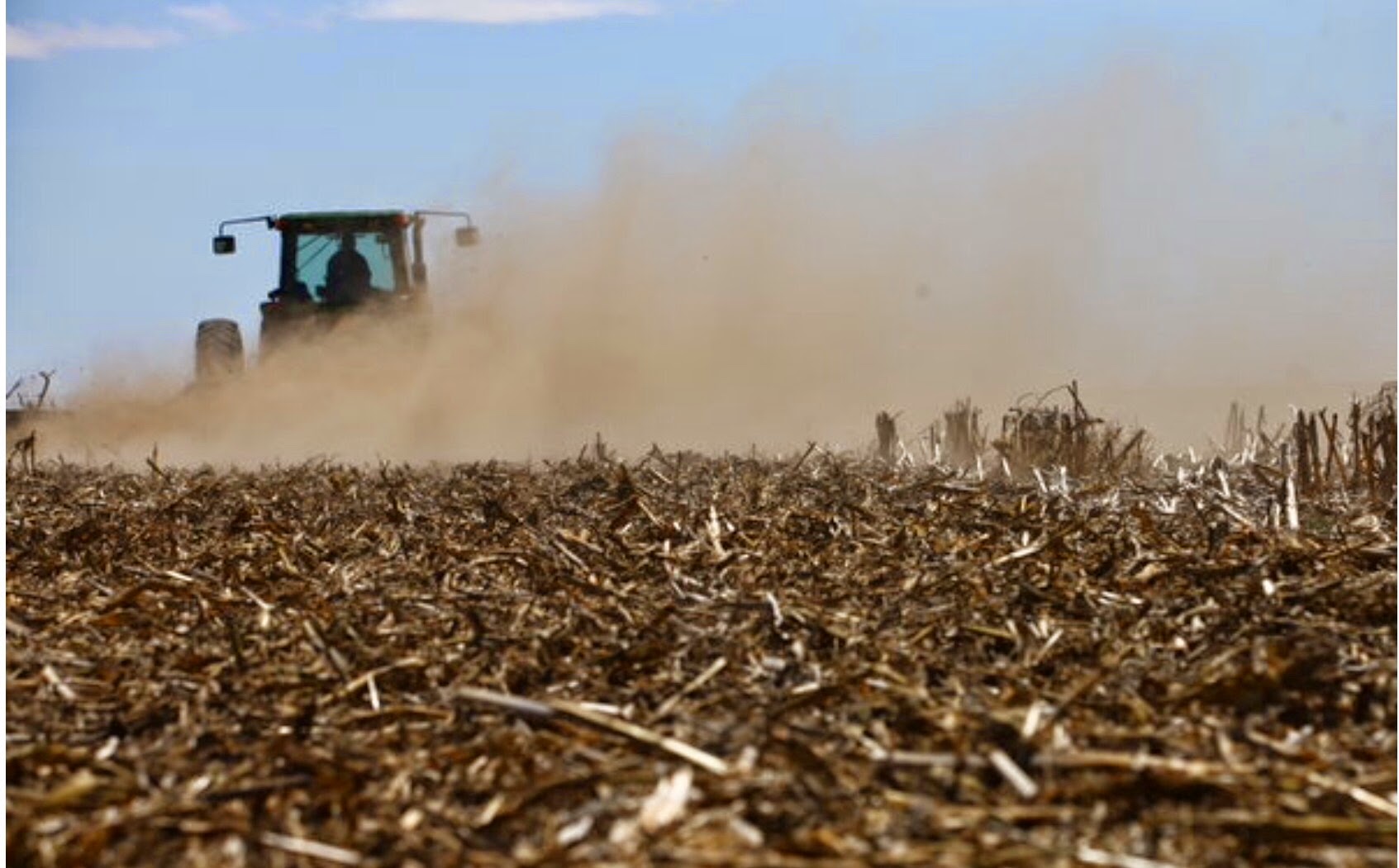
HASKELL COUNTY, Kan. — Forty-nine years ago, Ashley Yost’s grandfather sank a well deep into a half-mile square of rich Kansas farmland. He struck an artery of water so prodigious that he could pump 1,600 gallons to the surface every minute.

Last year, Mr. Yost was coaxing just 300 gallons from the earth, and pumping up sand in order to do it. By harvest time, the grit had robbed him of $20,000 worth of pumps and any hope of returning to the bumper harvests of years past.

“That’s prime land,” he said not long ago, gesturing from his pickup at the stubby remains of last year’s crop. “I’ve raised 294 bushels of corn an acre there before, with water and the Lord’s help.” Now, he said, “it’s over.”

The land, known as Section 35, sits atop the High Plains Aquifer, a waterlogged jumble of sand, clay and gravel that begins beneath Wyoming and South Dakota and stretches clear to the Texas Panhandle. The aquifer’s northern reaches still hold enough water in many places to last hundreds of years. But as one heads south, it is increasingly tapped out, drained by ever more intensive farming and, lately, by drought.

Vast stretches of Texas farmland lying over the aquifer no longer support irrigation. In west-central Kansas, up to a fifth of the irrigated farmland along a 100-mile swath of the aquifer has already gone dry. In many other places, there no longer is enough water to supply farmers’ peak needs during Kansas’ scorching summers.

And when the groundwater runs out, it is gone for good. Refilling the aquifer would require hundreds, if not thousands, of years of rains.

This is in many ways a slow-motion crisis — decades in the making, imminent for some, years or decades away for others, hitting one farm but leaving an adjacent one untouched. But across the rolling plains and tarmac-flat farmland near the Kansas-Colorado border, the effects of depletion are evident everywhere. Highway bridges span arid stream beds. Most of the creeks and rivers that once veined the land have dried up as 60 years of pumping have pulled groundwater levels down by scores and even hundreds of feet.

On some farms, big center-pivot irrigators — the spindly rigs that create the emerald circles of cropland familiar to anyone flying over the region — now are watering only a half-circle. On others, they sit idle altogether.

Two years of extreme drought, during which farmers relied almost completely on groundwater, have brought the seriousness of the problem home. In 2011 and 2012, the Kansas Geological Survey reports, the average water level in the state’s portion of the aquifer dropped 4.25 feet — nearly a third of the total decline since 1996.

And that is merely the average. “I know my staff went out and re-measured a couple of wells because they couldn’t believe it,” said Lane Letourneau, a manager at the State Agriculture Department’s water resources division. “There was a 30-foot decline.”

Kansas agriculture will survive the slow draining of the aquifer — even now, less than a fifth of the state’s farmland is irrigated in any given year — but the economic impact nevertheless will be outsized. In the last federal agriculture census of Kansas, in 2007, an average acre of irrigated land produced nearly twice as many bushels of corn, two-thirds more soybeans and three-fifths more wheat than did dry land.

Farmers will take a hit as well. Raising crops without irrigation is far cheaper, but yields are far lower. Drought is a constant threat: the last two dry-land harvests were all but wiped out by poor rains.

In the end, most farmers will adapt to farming without water, said Bill Golden, an agriculture economist at Kansas State University. “The revenue losses are there,” he said. “But they’re not as tremendously significant as one might think.”

Some already are. A few miles west of Mr. Yost’s farm, Nathan Kells cut back on irrigation when his wells began faltering in the last decade, and shifted his focus to raising dairy heifers — 9,000 on that farm, and thousands more elsewhere. At about 12 gallons a day for a single cow, Mr. Kells can sustain his herd with less water than it takes to grow a single circle of corn.

“The water’s going to flow to where it’s most valuable, whether it be industry or cities or feed yards,” he said. “We said, ‘What’s the higher use of the water?’ and decided that it was the heifer operation.”

The problem, others say, is that when irrigation ends, so do the jobs and added income that sustain rural communities.

“Looking at areas of Texas where the groundwater has really dropped, those towns are just a shell of what they once were,” said Jim Butler, a hydrogeologist and senior scientist at the Kansas Geological Survey.

The villain in this story is in fact the farmers’ savior: the center-pivot irrigator, a quarter- or half-mile of pipe that traces a watery circle around a point in the middle of a field. The center pivots helped start a revolution that raised farming from hardscrabble work to a profitable business.

Since the pivots’ debut some six decades ago, the amount of irrigated cropland in Kansas has grown to nearly three million acres, from a mere 250,000 in 1950. But the pivot irrigators’ thirst for water — hundreds and sometimes thousands of gallons a minute — has sent much of the aquifer on a relentless decline. And while the big pivots have become much more efficient, a University of California study earlier this year concluded that Kansas farmers were using some of their water savings to expand irrigation or grow thirstier crops, not to reduce consumption.

A shift to growing corn, a much thirstier crop than most, has only worsened matters. Driven by demand, speculation and a government mandate to produce biofuels, the price of corn has tripled since 2002, and Kansas farmers have responded by increasing the acreage of irrigated cornfields by nearly a fifth.

At an average 14 inches per acre in a growing season, a corn crop soaks up groundwater like a sponge — in 2010, the State Agriculture Department said, enough to fill a space a mile square and nearly 2,100 feet high.

Sorghum, or milo, gets by on a third less water, Kansas State University researchers say — and it, too, is in demand by biofuel makers. As Kansas’ wells peter out, more farmers are switching to growing milo on dry land or with a comparative sprinkle of irrigation water.

But as long as there is enough water, most farmers will favor corn. “The issue that often drives this is economics,” said David W. Hyndman, who heads Michigan State University’s geological sciences department. “And as long as you’ve got corn that’s $7, then a lot of choices get made on that.”

Of the 800 acres that Ashley Yost farmed last year in Haskell County, about 70 percent was planted in corn, including roughly 125 acres in Section 35. Haskell County’s feedlots — the county is home to 415,000 head of cattle — and ethanol plants in nearby Liberal and Garden City have driven up the price of corn handsomely, he said.

But this year he will grow milo in that section, and hope that by ratcheting down the speed of his pump, he will draw less sand, even if that means less water, too. The economics of irrigation, he said, almost dictate it.

“You’ve got $20,000 of underground pipe,” he said. “You’ve got a $10,000 gas line. You’ve got a $10,000 irrigation motor. You’ve got an $89,000 pivot. And you’re going to let it sit there and rot?

“If you can pump 150 gallons, that’s 150 gallons Mother Nature is not giving us. And if you can keep a milo crop alive, you’re going to do it.”

Mr. Yost’s neighbors have met the prospect of dwindling water in starkly different ways. A brother is farming on pivot half-circles. A brother-in-law moved most of his operations to Iowa. Another farmer is suing his neighbors, accusing them of poaching water from his slice of the aquifer.

A fourth grows corn with an underground irrigation system that does not match the yields of water-wasting center-pivot rigs, but is far thriftier in terms of water use and operating costs.

For his part, Mr. Yost continues to pump. But he also allowed that the day may come when sustaining what is left of the aquifer is preferable to pumping as much as possible.

Sitting in his Ford pickup next to Section 35, he unfolded a sheet of white paper that tracked the decline of his grandfather’s well: from 1,600 gallons a minute in 1964, to 1,200 in 1975, to 750 in 1976.

When the well slumped to 500 gallons in 1991, the Yosts capped it and drilled another nearby. Its output sank, too, from 1,352 gallons to 300 today.

This year, Mr. Yost spent more than $15,000 to drill four test wells in Section 35. The best of them produced 195 gallons a minute — a warning, he said, that looking further for an isolated pocket of water would be costly and probably futile.

“We’re on the last kick,” he said. “The bulk water is gone.” More


Water Resource Management- New Publication 2014

Department of Organic Food Quality and Food Culture, University of Kassel and Department of Archaeology and Heritage Management, Rajarata University, Sri Lanka are pleased to announce about the publication of their new research paper, titled “Water Resource Management in Dry Zonal Paddy Cultivation in Mahaweli River Basin, Sri Lanka: An Analysis of Spatial and Temporal Climate Change Impacts and Traditional Knowledge” in the Special Issue “Changes in precipitation and impacts on regional water resources”, Climate Journal International.

The paper may be accessed at http://www.mdpi.com/2225-1154/2/4/329

Abstract: Lack of attention to spatial and temporal cross-scale dynamics and effects could be understood as one of the lacunas in scholarship on river basin management. Within the water-climate-food-energy nexus, an integrated and inclusive approach that recognizes traditional knowledge about and experiences of climate change and water resource management can provide crucial assistance in confronting problems in megaprojects and multipurpose river basin management projects.

The Mahaweli Development Program (MDP), a megaproject and multipurpose river basin management project, is demonstrating substantial failures with regards to the spatial and temporal impacts of climate change and socioeconomic demands for water allocation and distribution for paddy cultivation in the dry zone area, which was one of the driving goals of the project at the initial stage. This interdisciplinary study explores how spatial and temporal climatic changes and uncertainty n weather conditions impact paddy cultivation in dry zonal areas with competing stakeholders' interest in the Mahaweli River Basin.

In the framework of embedded design in the mixed methods research approach, qualitative data is the primary source while quantitative analyses are used as supportive data. The key findings from the research analysis are as follows: close and in-depth consideration of spatial and temporal changes in climate systems and paddy farmers' socioeconomic demands altered by seasonal changes are important factors. These factors should be considered in the future modification of water allocation, application of distribution technologies, and decision-making with regards to water resource management in the dry zonal paddy cultivation of Sri Lanka. More


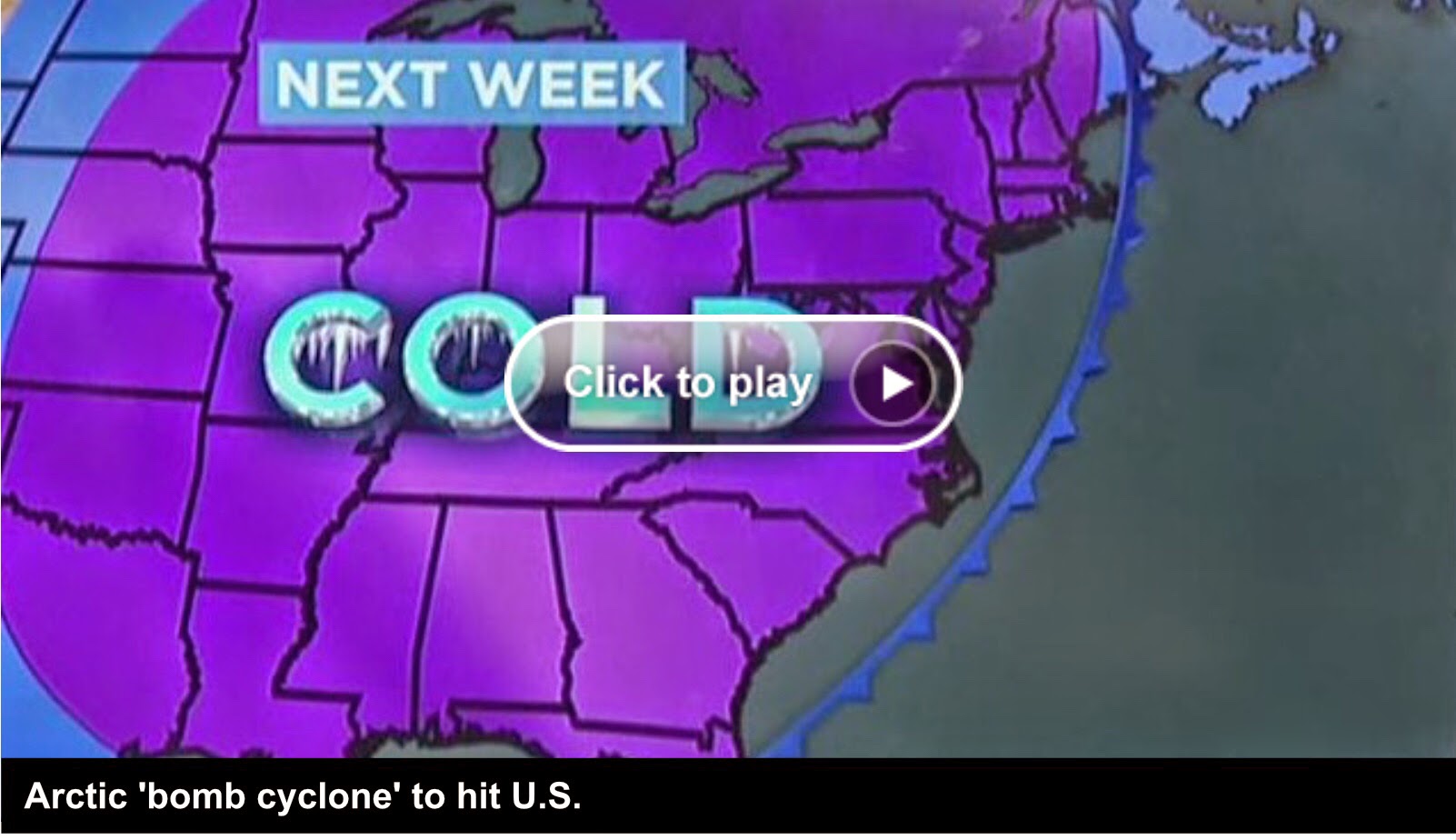
Arctic snap will ice Northern states, whipped down by ‘bomb cyclone’

(CNN)The ice man cometh. And does so early this year, after a former Pacific typhoon flew up toward the Arctic and rammed the jet stream.

The stream has whipped south, dragging down frigid air from Canada over the northern Plains and Mountain States and the Upper Midwest, according to the National Weather Service.

It is already plunging temperatures below freezing there and will hammer them into the teens and single digits in many places by midweek, even lower in others.

Great Falls, Montana, will shiver at 9 below zero on Tuesday night.

It’s the coldest weather of the season, the weather service said.

Minneapolis could soon get a foot of snow, the service said, with the Minnesota city experiencing below-freezing temperatures that could last for eight days.

Let it snow

The snap is forecast to lay down the first broad layer of wintry snow, flurries, sleet or ice — long before winter starts — from Montana down to Nebraska and over to Wisconsin.

It will accumulate in inches in the northern Rockies, northern Plains and Great Lakes.

People farther south will also shiver. “Much of the nation east of the Rockies is expected to see a major pattern change by the beginning of the work week,” the weather service said.

The western Dakotas are also forecast to get significant snow.

Lows will drop to freezing in Kansas City late Monday, then into the 20s a night later. The snap will stop short, leaving much of the Deep South and Southwest in a fall-like warm zone.

Rain is expected to hit Chicago and Milwaukee on Monday and Tuesday, with a few snowflakes mixed in, according to the service on Sunday afternoon.

Courtesy of Nuri

Residents in the northern United States can thank a whopping tropical cyclone in the Pacific Ocean for the wintry blast.

The remnants of super Typhoon Nuri rolled up north over Alaska’s Aleutian Islands on Friday, kicking off the ripple of Arctic air in the other direction.

Nuri is now the strongest known Northern Pacific cyclone on record, according to the National Weather Service Ocean Prediction Center.

Its remnants plowed into cold air adding violent energy as it went north, similar to what Superstorm Sandy did in the Atlantic two years ago. That earned it the weather moniker “bomb cyclone. More


Ocean acidification tops the annual list of important stories ignored by the mainstream media

Our oceans are acidifying — even if the nightly news hasn’t told you yet.

As humanity continues to fill the atmosphere with harmful gases, the planet is becoming less hospitable to life as we know it. The vast oceans absorb much of the carbon dioxide we have produced, from the industrial revolution through the rise of global capitalism. Earth’s self-sacrifice spared the atmosphere nearly 25 percent of humanity’s CO2 emissions, slowing the onslaught of many severe weather consequences.

Although the news media have increasingly covered the climate weirding of global warming — hurricane superstorms, fierce tornado clusters, overwhelming snowstorms, and record-setting global high temperatures — our ocean’s peril has largely stayed submerged below the biggest news stories.

The rising carbon dioxide in our oceans burns up and deforms the smallest, most abundant food at the bottom of the deep blue food chain. One vulnerable population is the tiny shelled swimmers known as the sea butterfly. In only a few short decades, the death and deformation of this fragile and translucent species could endanger predators all along the oceanic food web, scientists warn.

This “butterfly effect,” once unleashed, potentially threatens fisheries that feed over 1 billion people worldwide.

Since ancient times, humans fished the oceans for food. Now, we’re frying ocean life before we even catch it, starving future generations in the process. Largely left out of national news coverage, this dire report was brought to light by a handful of independent-minded journalists: Craig Welch from the Seattle Times, Julia Whitty of Mother Jones, and Eli Kintisch of ScienceNOW.

It is also the top story of Project Censored, an annual book and reporting project that features the year’s most underreported news stories, striving to unmask censorship, self-censorship, and propaganda in corporate-controlled media outlets. The book is set for release in late October.

“Information is the currency of democracy,” Ralph Nader, the prominent consumer advocate and many-time presidential candidate, wrote in his foreword to this year’s Project Censored 2015. But with most mass media owned by narrow corporate interests, “the general public remains uninformed.”

Whereas the mainstream media poke and peck at noteworthy events at single points in time, often devoid of historical context or analysis, Project Censored seeks to clarify understanding of real world issues and focus on what’s important. Context is key, and many of its “top censored” stories highlight deeply entrenched policy issues that require more explanation than a simple sound bite can provide.

Campus and faculty from over two dozen colleges and universities join in this ongoing effort, headquartered at Sonoma State University. Some 260 students and 49 faculty vet thousands of news stories on select criteria: importance, timeliness, quality of sources, and the level of corporate news coverage.

The top 25 finalists are sent to Project Censored’s panel of judges, who then rank the entries, with ocean acidification topping this year’s list.

“There are outlets, regular daily papers, who are independent and they’re out there,” Andy Lee Roth, associate director of Project Censored, told us. Too many news outlets are beholden to corporate interests, but Welch of the Seattle Times bucked the trend, Roth said, by writing some of the deepest coverage yet on ocean acidification.

“There are reporters doing the highest quality of work, as evidenced by being included in our list,” Roth said. “But the challenge is reaching as big an audience as [the story] should.”

Indeed, though Welch’s story was reported in the Seattle Times, a mid-sized daily newspaper, this warning is relevant to the entire world. To understand the impact of ocean acidification, Welch asks readers to “imagine every person on earth tossing a hunk of CO2 as heavy as a bowling ball into the sea. That’s what we do to the oceans every day.”

Computer modeler Isaac Kaplan, at the National Oceanic and Atmospheric Administration office in Seattle, told Welch that his early work predicts significant declines in sharks, skates and rays, some types of flounder and sole, and Pacific whiting, the most frequently caught commercial fish off the coast of Washington, Oregon, and California.

Acidification may also harm fisheries in the farthest corners of the earth: A study by the Arctic Monitoring and Assessment Programme outlines acidification’s threat to the arctic food chain.

“Decreases in seawater pH of about 0.02 per decade have been observed since the late 1960s in the Iceland and Barents Seas,” the study’s authors wrote in the executive summary. And destroying fisheries means wiping out the livelihoods of the native peoples of the Antarctic.

Acidification can even rewire the brains of fish, Welch’s story demonstrated. Studies found rising CO2 levels cause clown fish to gain athleticism, but have their sense of smell redirected. This transforms them into “dumb jocks,” scientists said, swimming faster and more vigorously straight into the mouths of their predators.

These Frankenstein fish were found to be five times more likely to die in the natural world. What a fitting metaphor for humanity, as our outsized consumption propels us towards an equally dangerous fate.

“It’s not as dramatic as say, an asteroid is hitting us from outer space,” Roth said of this slowly unfolding disaster, which is likely why such a looming threat to our food chain escapes much mainstream news coverage.

Journalism tends to be more “action focused,” Roth said, looking to define conflict in everything it sees. A recently top-featured story on CNN focused on President Barack Obama’s “awkward coffee cup salute” to a Marine, which ranks only slightly below around-the-clock coverage of the president’s ugly tan suit as a low point in mainstream media’s focus on the trivial.

As Nader noted, “‘important stories’ are often viewed as dull by reporters and therefore unworthy of coverage.” But mainstream media do cover some serious topics with weight, as it did in the wake of the police officer shooting of Michael Brown in Ferguson, Mo. So what’s the deciding factor?

As Roth tells it, corporate news focuses on “drama, and the most dramatic action is of course violence.”

But the changes caused by ocean acidification are gradual. Sea butterflies are among the most abundant creatures in our oceans, and are increasingly born with shells that look like cauliflower or sandpaper, making this and similar species more susceptible to infection and predators.

“Ocean acidification is changing the chemistry of the world’s water faster than ever before, and faster than the world’s leading scientists predicted,” Welch said, but it’s not getting the attention is deserves. “Combined nationwide spending on acidification research for eight federal agencies, including grants to university scientists by the National Science Foundation, totals about $30 million a year — less than the annual budget for the coastal Washington city of Hoquiam, population 10,000.”

Our oceans may slowly cook our food chain into new forms with potentially catastrophic consequences. Certainly 20 years from now, when communities around the world lose their main source of sustenance, the news will catch on. But will the problem make the front page tomorrow, while there’s still time to act?

Probably not, and that’s why we have Project Censored and its annual list: More