Civil Aviation Unveils Design For New Cayman Air Terminal

The Cayman Islands Airports Authority (CIAA) has unveiled the interior conceptual drawings for the multi-million dollar expansion project at Owen Roberts International Airport (ORIA).

Commenting on the design created by Florida based firm RS&H Group, CIAA’s CEO Albert Anderson said, “The interior design is very impressive and I am confident that once completed the new expanded airport will be a first-class terminal facility

The CI$55 million expansion project should take around three years to complete and will nearly triple the current space at the airport. Construction on the first phase of the project is expected to begin this summer.

Here is the Cayman Islands Government's chance to save money and show their support for alternative energy. Covering the roof and parking lots with solar panels, and using LED lighting would set an example for Caymanians and Caymanian businesses to follow. Editor


Wind of change sweeps through energy policy in the Caribbean

Aruba in the southern Caribbean has 107,000 people, a lot of wind and sun and, until very recently, one very big problem. Despite the trade winds and sunshine, it was spending more than 16% of its economy on importing 6,500 barrels of diesel fuel a day to generate electricity.

People were furious at the tripling of energy prices in 10 years and the resulting spiralling costs of imported water and food.

That changed at the Rio earth summit in 2012, when the prime minister, Mike Eman, announced that the former oil-producing Dutch island close to Venezuela planned to switch to 100% renewables by 2020.

Working with the independent US energy group the Rocky Mountain Institute and the business NGO Carbon War Room, Aruba ditched its old steam turbines for more efficient engines and changed the way it desalinated seawater.

It cost $300m (£183m), says the energy minister and deputy PM Mike D’Emeza, but Aruba immediately halved its fuel consumption and saved itself $85m a year. It then built a 30MW wind farm and cut its diesel consumption a further 50%. Now it is planning another wind farm and a large solar park. By 2020, Aruba will be free from fossil fuels and possibly storing renewable electricity under water or using ice.

The move to energy independence has had dramatic results, says De Meza. Electricity prices, which were US 33c/ KwH in 2009, have dropped 25% and are stable; inflation has been reversed; the island has nearly paid off the $300m it cost to switch out of diesel; the price of drinking water has fallen by almost a third; and the number of people unable to pay their bills has declined drastically.

“We had been grappling with very high energy costs for 15 years. We realised that our dependency on fossil fuels was leading to political and economic instability. We had to act,” De Meza says.

Aruba is already enjoying health and economic benefits. More tourists are keen to visit a green island, he adds, and children are fitter because it costs families less to pay for sports, and there is less illness. “It has been very popular. Instead of energy prices being the top of the political agenda, the debate now is about which is the best renewable energy source Aruba should go for next.”

Many other Caribbean islands are eager to follow Aruba. Some in the region pay more than 42c/ kwh – three or four times the price paid in most of the US and Europe – and up to 25% of their GDP on diesel for electricity.

Many are also locked into long-term contracts with monopolistic US or Canadian utility companies which have negotiated 17% or even higher guaranteed profit margins.

With many states also having to pay off onerous long-term loans to regional banks, the net effect of high power costs is continual misery, says Nicholas Robson, director of the Cayman Institute thinktank. “People are coming to me saying they cannot afford electricity. It costs 42c in the Caymans. It’s approaching a crisis point. People are struggling because of energy prices.”

“We are very concerned about the high cost of energy and how it affects jobs,” BVI prime minister Orlando Smith adds.

“We pay 38c/ KwH,” says James Fletcher, St Lucia’s energy and science minister. “The result is that industries like tourism, which are very heavy electricity users, are not competitive, our agriculture cannot move out of being just primary commodity producers, and our people have no money.”

St Lucia plans over the next 10 years to switch much of its electricity from diesel to renewables, using geothermal, wind and solar power. The government will make it easier for people to generate their own electricity to reduce diesel demand, and changing street lights to LEDs could reduce costs by $11m a year, he explains.

“Renewables will provide new jobs, everyone will have more money in their pockets, transport will be cheaper and companies will be able to expand more easily,” Fletcher says.

“Islands can get prices down to just 12c/ KwH,” says Ed Bosage, a wealthy American financier who bought the small island of Over Yonder Cay and who has switched it to 96% renewables with wind, solar and a tidal generator. “The wind blows at an average of 16 knots. The tidal is extremely reliable. We learned that wind trumps sun by 2:1. We now produce electricity for 12c, the cheapest in the Caribbean, and will get it cheaper. It’s repeatable everywhere,” he says.

Caribbean islands share similar problems to thousands of others in the Pacific and elsewhere. Mostly, they are not on national grids, which makes them vulnerable to high energy costs, fuel has to be imported at extra cost, and they are often reliant on just one utility company and most are too small to benefit from economies of scale.

While some can attract high-spending tourists and offshore finance companies, small island states are often heavily indebted, with weak economies, pockets of intense poverty and often rundown hospitals and schools.

But, says Peter Lilienthal, director of Colorado-based Homer Energy and former US national energy laboratory chief, islands stand to benefit from the renewable revolution more than anyone. “Diesel is now hurting small islands. They are burning money. But the price of solar has plummeted in the last few years. It’s now cost-efficient everywhere. Islands now can be the leaders.”

Jamaica is investing heavily in wind, Barbados in solar power and eight island states – Aruba, British Virgin Islands, Dominica, St Kitts and Nevis, Grenada, St Lucia, Turks and Caicos,and the Colombian islands of Providencia and San Andreas have joined the Carbon War Room’s “10 island challenge”. This gives them access to technological and funding help from the Rocky Mountain Institute and others.

“Renewables have come slowly to the Caribbean and other developing countries but the technology is now cheap enough and diverse enough to make it much easier to install,” says Amory Lovins, chief scientist at the Rocky Mountain Institute. “Small islands can move fast if they have coherent policies. They can be the future.” More


Global carbon dioxide levels break 400ppm milestone

Record carbon dioxide (CO2) concentrations in the atmosphere were reported worldwide in March, in what scientists said marked a significant milestone for global warming.

Figures released by the US science agency Noaa on Wednesday show that for the first time since records began, the parts per million (ppm) of CO2 in the atmosphere were over 400 globally for a month.

The measure is the key indicator of the amount of planet-warming gases man is putting into the atmosphere at record rates, and the current concentrations are unprecedented in millions of years.

The new global record follows the breaking of the 400ppm CO2 threshold in some local areas in 2012 and 2013, and comes nearly three decades after what is considered the ‘safe’ level of 350ppm was passed.

“Reaching 400ppm as a global average is a significant milestone,” said Pieter Tans, lead scientist on Noaa’s greenhouse gas network.

“This marks the fact that humans burning fossil fuels have caused global carbon dioxide concentrations to rise more than 120ppm since pre-industrial times,” added Tans. “Half of that rise has occurred since 1980.”

World leaders are due to meet in Paris for a UN climate summit later this year in an attempt to reach agreement on cutting countries’ carbon emissions to avoid dangerous global warming.

Dr Ed Hawkins, a climate scientist at the University of Reading told the Guardian: “This event is a milestone on a road to unprecedented climate change for the human race. The last time the Earth had this much carbon dioxide in the atmosphere was more than a million years ago, when modern humans hadn’t even evolved yet.

“Reaching 400ppm doesn’t mean much in itself, but the steady increase in atmospheric greenhouse gases should serve as a stark reminder of the task facing politicians as they sit down in Paris later this year.”

Greenhouse gas emissions from power plants stalled for the first time last year without the influence of a strict economic recession, according to the International Energy Agency, an influential thinktank.

Nick Nuttall, a spokesman for the UN Framework Convention on Climate Change (UNFCCC) which oversees the international climate negotiations, said: “These numbers underline the urgency of nations delivering a decisive new universal agreement in Paris in December – one that marks a serious and significant departure from the past.

“The agreement and the decisions surrounding it needs to be a long term development plan providing the policies, pathways and finance for triggering a peaking of global emissions in 10 years’ time followed by a deep, decarbonisation of the global economy by the second half of the century.”

But even if manmade emissions were dramatically cut much deeper than most countries are planning, the concentrations of CO2 in the atmosphere would only stabilise, not fall, scientists said.

James Butler, director of Noaa’s global monitoring division, said: “Elimination of about 80% of fossil fuel emissions would essentially stop the rise in carbon dioxide in the atmosphere, but concentrations of carbon dioxide would not start decreasing until even further reductions are made and then it would only do so slowly.”

Concentrations of CO2 were at 400.83ppm in March compared to 398.10ppm in March 2014, the preliminary Noaa data showed. They are are expected to stay above 400pm during May, when levels peak because of CO2 being taken up by plants growing in the northern hemisphere.

Noaa used air samples taken from 40 sites worldwide, and analysed them at its centre in Boulder, Colorado. The agency added that the average growth rate in concentrations was 2.25ppm per year from 2012-2014, the highest ever recorded for three consecutive years. More


Caribbean “island laboratories” making a case for renewable, says Mazurier

In early March, Stéphane Tromilin, a sustainable energy attaché in the French government, gave a United Nations webinar on the French government’s work on French islands.

In it, he spent most of the time discussing the unique challenges of islands, specifically those in the Caribbean like Guadeloupe, but also noted an island’s value as “laboratories to develop renewable energy solutions.”

Christophe Mazurier, a European financier and climate defender, has seen these laboratories in action, specifically in the Caribbean, where he has a home in the Bahamas. While many of these nations are at greater risk of climate disasters – in the form of devastating hurricanes and other storms – than most other places on earth, many refuse to become victims of the global intransigence on climate change. Instead, many Caribbean nations are taking it upon themselves to be the change they wish to see in their developed-nation counterparts.

Guadeloupe, the overseas French territory mentioned earlier, is getting nearly 30 percent of its energy from solar, a number on par with climate leaders Germany. Aruba gets 20% of its energy from wind, and is aiming to be totally sustainable by 2020. Ten island nations, including the Bahamas, the British Virgin Islands, Grenada, Dominica and more have joined the Ten Island Challenge, launched by Richard Branson as a means to give these Caribbean island clear renewable goals and support them in meeting those goals.

Mazurier says that in many ways, the Caribbean’s move to solar was preordained. Not because they are at the forefront of climate change susceptibility, but because of their incredibly high energy costs. Most Caribbean island nations pay around 33 cents per kWh of energy, while for comparison the United States pays 10 cents per kWh. Even with the price of fuel bottoming out, and energy costs in places like Jamaica being cut in half, Jamaica and others were already well on their way to a renewable future.

In 2013, Jamaica signed a deal that would bring 36 MW of wind power for $63 million, which would help it divest from diesel oil in the long-term. By investing heavily in renewables now, the islands can avoid paying for diesel in the future… No matter how the price fluctuates. Mazurier says that this is the key for these Caribbean island nations, who don’t have multimillion dollar climate budgets. These nations cannot just throw money at the problem in hopes that they can play a role in the ultimate cooling of the climate. Their emissions are negligible in the grand scheme of things. The only aspect that can get these nations to buy in if they know they will ultimately pay less for energy than they do now. The positives for the overall climate and the state of the planet are simply a secondary byproduct of these finance-driven deals.

Whichever way it breaks out, says Mazurier, the Caribbean turn toward renewable energy is a refreshing and encouraging sign. The question now becomes: Can the larger nations take note of their island peers? More


Elon Musk debuts the Tesla Powerwall

Why Tesla’s announcement is such a big deal: The coming revolution in energy storage

Tesla CEO Elon Musk presented his new Powerwall solar batteries on April 30, 2015. Musk says the batteries could dramatically reduce the use of fossil fuels by replacing use of the power grid. (AP)

Late Thursday, the glitzy electric car company Tesla Motors, run by billionaire Elon Musk, ceased to be just a car company. As was widely expected, Tesla announced that it is offering a home battery product, which people can use to store energy from their solar panels or to backstop their homes against blackouts, and also larger scale versions that could perform similar roles for companies or even parts of the grid.

The anticipation leading up to the announcement has been intense — words like “zeitgeist” are being used — which itself is one reason why the moment for “energy storage,” as energy wonks put it to describe batteries and other technologies that save energy for later use, may finally be arriving. Prices for batteries have already been dropping, but if Tesla adds a “coolness factor” to the equation, people might even be willing to stretch their finances to buy one.

The truth, though, is Tesla isn’t the only company in the battery game, and whatever happens with Tesla, this market is expected to grow. A study by GTM Research and the Energy Storage Association earlier this year found that while storage remains relatively niche — the market was sized at just $128 million in 2014 — it also grew 40 percent last year, and three times as many installations are expected this year.

By 2019, GTM Research forecasts, the overall market will have reached a size of $ 1.5 billion.

“The trend is more and more players being interested in the storage market,” says GTM Research’s Ravi Manghani. Tesla, he says, has two unique advantages — it is building a massive battery-making “gigafactory” which should drive down prices, and it is partnered with solar installer Solar City (Musk is Solar City’s chairman), which “gives Tesla access to a bigger pool of customers, both residential and commercial, who are looking to deploy storage with or without solar.”

The major upshot of more and cheaper batteries and much more widespread energy storage could, in the long term, be a true energy revolution — as well as a much greener planet. Here are just a few ways that storage can dramatically change — and green — the way we get power:

Almost everybody focusing the Tesla story has homed in on home batteries – but in truth, the biggest impact of storage could occur at the level of the electricity grid as a whole. Indeed, GTM Research’s survey of the storage market found that 90 percent of deployments are currently at the utility scale, rather than in homes and businesses.

That’s probably just the beginning: A late 2014 study by the Brattle Group, prepared for mega-Texas utility Oncor, found that energy storage “appears to be on the verge of becoming quite economically attractive” and that the benefits of deploying storage across Texas would “significantly exceed costs” thanks to improved energy grid reliability. Oncor has proposed spending as much as $ 5.2 billion on storage investments in the state. California, too, has directed state utilities to start developing storage capacity – for specifically environmental reasons.

For more power storage doesn’t just hold out the promise of a more reliable grid — it means one that can rely less on fossil fuels and more on renewable energy sources like wind and, especially, solar, which vary based on the time of day or the weather. Or as a 2013 Department of Energy report put it, “storage can ‘smooth’ the delivery of power generated from wind and solar technologies, in effect, increasing the value of renewable power.”

“Storage is a game changer,” said Tom Kimbis, vice president of executive affairs at the Solar Energy Industries Association, in a statement. That’s for many reasons, according to Kimbis, but one of them is that “grid-tied storage helps system operators manage shifting peak loads, renewable integration, and grid operations.” (In fairness, the wind industry questions how much storage will be needed to add more wind onto the grid.)

Consider how this might work using the example of California, a state that currently ramps up natural gas plants when power demand increases at peak times, explains Gavin Purchas, head of the Environmental Defense Fund’s California clean energy program.

In California, “renewable energy creates a load of energy in the day, then it drops off in the evening, and that leaves you with a big gap that you need to fill,” says Purchas. “If you had a plenitude of storage devices, way down the road, then you essentially would be able to charge up those storage devices during the day, and then dispatch them during the night, when the sun goes down. Essentially it allows you to defer when the solar power is used.”

This will be appealing to power companies, notes Purchas, because “gas is very quick to respond, but it’s not anywhere near as quick as battery, which can be done in seconds, as opposed to minutes with gas.” The consequences of adding large amounts of storage to the grid, then, could be not only a lot fewer greenhouse gas emissions, but also better performance.

2. Greening suburban homes and, maybe, their electric cars, too.

Shifting away from the grid to the home, batteries or other forms of storage have an equally profound potential, especially when paired with rooftop solar panels.

Currently, rooftop solar users are able to draw power during the day and, under net metering arrangements, return some of it to the grid and thus lower their bills. This has led to a great boom in individual solar installations, but there’s the same problem here as there is with the grid as a whole: Solar tapers off with the sun, but you still need a lot of power throughout the evening and overnight.

But storing excess solar power with batteries, and then switching them on once the solar panels stop drawing from the sun, makes a dramatic difference. Homes could shift even further away from reliance on the grid, while also using much more green power.

Moreover, they’d also be using it at a time of day when its environmental impact is greater. “If you think about solar, when it’s producing in the middle of the day, the environmental footprint is relatively modest,” explains Dartmouth College business professor Erin Mansur. That’s because at this time of day, Mansur explains, solar is more likely to be displacing electricity generated from less carbon intensive natural gas. “But if you can shift some of that to the evening … if you can save some to the middle of the night, it’s more likely to be displacing coal,” says Mansur.

Some day, perhaps, some of the sun-sourced and power could even be widely used to recharge electric vehicles like Teslas — which would solve another problem. According to a much discussed 2012 paper by Mansur and two colleagues, electric vehicles can have a surprisingly high energy footprint despite their lack of tailpipe emissions because they are often charged over night, a time when the power provided to the grid (said to be “on the margin”) often comes from coal.

But if electric vehicles could be charged overnight using stored power from the sun, that problem also goes away.

All of which contributes to a larger vision outlined recently by a team of researchers at the University of California at Los Angeles’s Institute of the Environment and Sustainability in which suburban homeowners, who can install rooftop solar combined with batteries and drive electric vehicles, start to dramatically reduce their carbon footprints — which have long tended to be bigger in suburbia, due in part to the need for long commutes — and also their home energy bills.

Granted, it’s still a vision right now, rather than a reality for the overwhelming number of suburbanites — but energy storage is a key part of that vision.

3. Helping adjust to smart energy pricing

And there’s another factor to add into the equation, which shows how energy storage could further help homeowners save money.

For a long time, economists have said that we need “smart” or “dynamic” electricity pricing — that people should be charged more for power at times of high energy demand, such as in the afternoon and early evening, when the actual electricity itself costs more on wholesale markets. This would lead to lower prices overall, but higher prices during peak periods. And slowly, such smart pricing schemes are being introduced to the grid (largely on a voluntary basis).

But if you combine “smart” pricing with solar and energy storage, then homeowners have another potential benefit, explains Ravi Manghani of GTM Research. They could store excess power from their solar panels during the day, and then actually use it in the evening when prices for electricity go up — and avoid the higher cost. “There’s an economic case to store the excess solar generation and use it during evening hours,” explains Manghani by email. (For more explanation, see here.)

Notably, if there are future reductions in how much money solar panel owners can make selling excess power back to the grid — and that’s one thing the current pushback against net metering wants to achieve — then energy storage comes in and gives panel owners a new way for using that power.

“Storage increases the options,” explains Sean Gallagher, vice president of state affairs at the Solar Energy Industries Association. “It’s an enabling technology for solar. It allows customers to meet more scenarios economically.”

So in sum — cheaper, more easily available energy storage helps at the scale of the power grid, and also at the level of our homes, to further advantage cleaner, renewable energy. So if the economics of storage are finally starting to line up — and its business side to ramp up — that can only be good news for the planet. More


UNEP Report Proposes Pooling Facilities as Solution to Micro-grid Financing

April 2015: The UN Environment Programme (UNEP) has launched a study on mini-grids that proposes ‘Mini-grid Pooling Facilities (MPFs)’ as a solution to overcoming key investment barriers. Presenting mini-grids as a critical solution for improving energy access globally, the study examines the challenges of associated investment risks and transaction costs, and proposes addressing these through project and capital pooling.

The report, titled ‘Increasing Private Capital Investment into Energy Access: The Case for Mini-grid Pooling Facilities’: provides an overview of mini-grids, including ownership models; identifies and examines two key investment barriers, namely risks to investment in emerging markets and project costs in developing economies; assesses the benefits and drawbacks of project pooling facilities; and explores MPF structures and stakeholders.


On risks, the study notes that mini-grids in emerging markets present a complex risk profile. In addition to discussing perceived risks, such as political or fuel cost volatility, the study examines risks to investment in mini-grids during the development, construction and operation phases, as well as across phases. The study also identifies high transaction costs in developing countries in the areas of project identification, evaluation and diligence, and platform development.


According to some estimates, achieving universal electricity access by 2030 will require mini-grids to serve over 65% of off-grid populations globally. Arguing for the need to develop new financing models to reach such levels of deployment, the report presents MPF as conceptual framework for private-sector financing that pools projects and capital to support the development of mini-grids internationally. According to the study, MPFs can diversify risk and increase capital requirements by strategic selection of projects into portfolios.


The report suggests that MPFs can also help: lower transaction costs through centralizing fixed expenses; decrease technology costs; attract previously unavailable capital; and leverage philanthropic investment, among others. The study stresses the need for developers, investors and researchers to work jointly, conducting proper analyses and determining the appropriate structures for each working context. [UNEP Publications Webpage] [Publication: Increasing Private Capital Investment into Energy Access] More


Branson urges students to lobby leaders for clean energy

Cayman could be ‘carbon neutral’ in six years, says entrepreneur

Sir Richard Branson told Cayman Islands students they need to lobby their government to go green. He said the island could save money and be “carbon neutral” within six years if leaders committed to clean energy.

Sir Richard Branson

Speaking at a forum for students at Camana Bay on Friday, Sir Richard sounded a dire warning for the world’s coral reefs, saying it may already be too late to save marine ecosystems from the impact of global warming.

But he said more could be done to move toward clean energy and lessen the impact of carbon emissions on the environment.

And he said young people would need to lead the campaign for more environmentally friendly policies from their governments.

“If a group of you, just the people here, put placards above your head and went to the government, you’ve got a force to be reckoned with,” he said.

“The Cayman Islands could be carbon neutral in five or six years and save themselves a lot of money, but it needs absolute determination from the government to get you there.”

Sir Richard acknowledged it is difficult to get governments to think beyond the short term. But he said he is optimistic that international leaders would put the necessary policies in place to achieve total clean energy across the globe within the next 50 years.

The billionaire businessman, who owns his own Caribbean island powered completely from renewable sources, believes the energy revolution can start in the region.

He has launched a “10-island challenge,” starting in Aruba, to assist small islands in moving toward 100 percent renewable energy.

“It would be great if we could get the Cayman Islands to join and make it the 11-island challenge,” he said.

“I’ll be bending the arm of your prime minister [sic] later today to see if we can get him on board.”

Sir Richard believes the Caribbean can be a hot house of innovation in the clean energy sector, and he told the students there would be many opportunities for scientists and entrepreneurs to tackle the world’s problems.

“If we move forward to when you are 50 or 60, I hope the world will be powered completely by clean energy. It is definitely doable,” he added. More


Caribbean Energy Summit 2015: US Announce Investments in Energy Security for Caribbean Countries During First-Ever DC Summit

The Obama administration recently hosted the first Caribbean Energy Security Summit to support the region's improved governance, access to finance and increased donor coordination for the energy sector.

Vice President Joe Biden has led the issue of Caribbean energy security and said the Obama administration considers the topic as a primary issue.

“This is extremely important to us. It's overwhelmingly in the interest of the United States of America that we get it right, and that this relationship changes for the better across the board,” Biden said.

Biden added that the low oil prices have given little breathing room for governments, but there are alternatives. He mentioned renewable energy as an affordable source in addition to developing wind and solar energy.

“Meanwhile, we're in the midst of a seismic shift in the global economy: the ascendancy of the Americas as the epicenter of energy production in the world,” Biden said. “We have more oil and gas rigs running in the United States, than all the rest of the world combined. Mexico, Canada and the United States is the new epicenter of energy — not the Arabian Peninsula. It is the new epicenter of energy in the 21st century.”

The vice president called for an integrated North America to promote energy security since the U.S. wants Caribbean countries to “succeed as prosperous, secure, energy-independent neighbors — not a world apart, but an integral part of the hemisphere, where every nation is middle class, democratic and secure.”

Biden further stressed the purpose of the summit is not to “put up another solar panel or sign another gas contract” but to help countries establish protocol to attract private-sector investment. The vice president, however, acknowledged that countries have to confront corruption by having clear and transparent rules.

The U.S. created the Overseas Private Investment Corporation (OPIC), which will focus on developing energy projects for the Caribbean. Biden announced $90 million from the OPIC will be funded to Jamaica for wind projects.

The Caribbean Energy Security Summit is a “key component” to Biden's Caribbean Energy Security Initiative, which he announced in June 2014.

A joint statement on Monday had participating countries and regional and international organization agreeing for the Caribbean to make “necessary and specific reforms” that include efforts for sustainable and clean energy technologies. The participants also stated their commitment to exchange data and energy information.

The Jan. 26 summit from Washington, D.C. included governments from Antigua and Barbuda, Aruba, Bahamas, Barbados, Belize, Canada, Colombia, Curacao, Dominica, Dominican Republic, France, Germany, Grenada, Guyana, Haiti, Jamaica, Mexico, New Zealand, Spain, St. Kitts and Nevis, St. Lucia, St. Vincent and the Grenadines, Suriname, Trinidad and Tobago and the United Kingdom. The Caribbean Community (CARICOM) Secretariat, Caribbean Development Bank, European Union, Inter-American Development Bank Group, International Renewable Energy Agency, Organization of American States and the World Bank Group also participated. More


Water Power In The Andes

Going to work these days is always a bit of a thrill for me–often more than I care for. It means crossing a 15,000 foot (4,570 m) pass over the Bolivian Andes and snaking down a muddy one lane road carved into the face of immense cliffs. The Most Dangerous Road in the World was the title of an old National Geographic article…

World's Largest Solar Machine

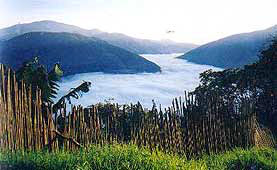
Actually I'm entering the world's biggest solar energy machine-the Amazon basin. Towering glacier-topped 20,000 foot (6,100 m) mountains are clearly visible from our tropical water power demonstration site. This mountainous east-facing wall so thoroughly captures the Amazon moisture that the western side-the Atacama desert-is the driest place in the world. Sometimes rain only falls there a few times during an entire lifetime.

But on this side, it's just the opposite. Uncounted streams and waterfalls abound, some falling hundreds of feet directly onto the roadway! About 80 people die yearly on this short section of road, since it is very narrow and slippery. Vehicles that slip off the road can simply disappear into dense vegetation a thousand feet (300 m) below. It's incredible to think that this is the only road into a tropical part of Bolivia that's the size of Texas.

It's a relief to arrive in the lovely 5,500 foot (1676 m) high town of Coroico, near our demo site. Green hillsides are covered with coffee, citrus, and bananas. This also happens to be the home of Bolivia's traditional coca leaf production, so the area is much affected by the U.S. “War on Drugs.”

Campo Nuevo – Meeting People's Needs

Our family-sized appropriate technology organization, Campo Nuevo, was started to better the lives of Bolivia's rural poor. We teach them how to use their local natural resources for energy. We show them how easy it is to employ the abundant small local sources of water power to improve their lives. This can help make it possible for them to remain on their land and in their own communities.

We are working with Aymara speaking native Americans, one of the largest and most intact indigenous cultures in the Western Hemisphere. Notable for having withstood the Incan conquest, and later the Spaniards, the Aymaras are now succumbing to the pressures of modern global economics. Like rural people all over the “third world,” they are being forced to relocate simply to survive. They usually migrate to a desolate l3,000 foot (3,960 m) suburb of La Paz, in order to compete for unskilled, low paying, and often temporary jobs.

A New/Old Solution

Although they may not realize it, what visitors to our demonstration site see is not actually new. It's actually a revival of the now nearly forgotten traditional use of water power. For thousands of years before the invention of centrally-generated electricity, water power was employed to directly run machines, something it does very well.

What is new is the development of a modern low-cost turbine specifically for this purpose-a “motor” driven by water power. We call it the “Watermotor.” It can provide the energy to drive a variety of machines, replacing the mid-sized electric motors upon which nearly all modern production depends.

Lester Pelton, who invented the pelton wheel, produced a variety of these water powered motors and they were in use before l900. They were used to power individual machines – he even used one to run a sewing machine! The direct drive hydro units were replaced by electric motors after the popularization of centrally produced electricity.

Few people realize how closely rural poverty is related to the lack of machines necessary for local production and services. In the third world, the power grid is usually confined to cities and large towns. Rural people still use muscle power as everyone did in the past, and they do without electric lights. The need to generate cash to buy anything they don't produce themselves causes a focus on cash crops. This further reduces their self-sufficiency, encouraging a downward spiral towards dependency on a system that cannot be depended upon!

Demo Site
At our new Campo Nuevo demonstration site, we are featuring practical machines, directly powered by water. There are woodworking tools, air compressors, grain mills and an auto alternator to charge batteries and provide lighting. This is switched on when mechanical power is not being used, run by the same belt drive that powers the tools.

The main attraction at our site is our Campo Nuevo Watermotor driving a multipurpose woodworking unit. The machine is suitable for producing doors, window frames and furniture-necessities usually purchased from the city. It processes locally produced lumber instead of wood carried up from the Amazon forest.

The Watermotor at our demonstration site is provided with power from a water source located 60 feet (18.3 m) above the machine by 160 feet (50m.) of lightweight 4″ plastic pipe.

We get 1.3 h.p at 1850 r.p.m.s using 115 gal. (440 l.) per minute with the Watermotor Model 90 , and 2.5 h.p. at 1000 r.p.m.s with Model 150 using about 225 gal. (850 l.) per minute.

At the heart of our Watermotor turbine is a Swedish designed 4 jet Turgo wheel and a patented Turgo control system which provides the same instant on/off power control as an electric motor.

Unlike an electric motor, the Watermotor costs nothing to operate and can't be “burned out” from hard use.

It's Not Easy

Not much of this area is served by roads or the power grid. The U.S. owned (and U.S. priced) power generating system has little incentive to provide long distance lines to a widely scattered and typically impoverished rural population. Water power is the sole available practical source of energy to run machines. There is not a good wind resource in the mountain valleys and PV is just not economical, compared to the abundant water power here.

There are major obstacles to the introduction of unfamiliar technology to an indigenous population that has traditionally used no machines of any kind. These people have little money to invest in anything that does not promise a practical return. In addition to this, the Aymaras are unlikely to be reached by advertising in the newspapers from La Paz. This is why we felt that a local demonstration site was necessary.

Other problems are encountered when machines, however useful, need to be “professionally” installed, maintained or repaired. Such services are frequently unreliable, hard to come by in rural areas, and expensive when available.

Keep It Simple

In designing the Watermotor system, we have tried to overcome these obstacles as much as possible. It is designed to be user-installed, maintained, and repaired because of the difficulties in finding competent, honest and reliable technical services in rural areas of Bolivia. Because the Watermotor is locally produced from common materials, most parts can be easily replaced.

The efficiency of direct drive water power is a big advantage. A surprisingly small amount of water falling a short distance can produce the 0.5 to 5 h.p. of mechanical power required by most common machines. This means that many potential water power sites are available, and a minimum of civil engineering is required.

Of course the power output of the Watermotor depends on the fall and the amount of water that one uses to run it. Here are some examples of other possible installations and the energy output that they would produce:

A Watermotor Model 90 would produce:
1.5 h.p.at 2365 r.p.m.s with a 100 ft. (30.5 m.) fall and 75 gal.(284 l.) per minute
3 h.p. at 2900 r.p.m.s with 150 ft (46 m.) fall and 100 gal.(378 l.) per minute

A Model 150 will produce:
2 h.p. at 865 r.p.m.s with a 40 ft. (12.2 m.) fall and 250 gal. (950 l.) per minute
3 h.p. at 950 r.p.m.s with a 75 ft. fall (23 m.) and 200 gal.(750 l.) per minute
5 h.p. at 1366 r.p.m.s with a 100 ft.(30.5 m.) fall and 250 gal.(950 l.) per minute

The Watermotor itself is very simple to operate, and maintain. It functions efficiently in a variety of water power situations. By merely experimenting with easily changed water jets of different sizes, it is possible to vary maximum power output. This also allows the turbine to maintain efficient output over seasonal water flow variations. A single control handle diverts water away from the Turgo wheel, instantly cutting power.

The Watermotor can be used to drive most stationary machines normally driven by an externally-mounted electric motor or small gasoline engine in the 0.5 to 4 horsepower range.

Machines being driven by the Watermotor can be mounted directly on the turbine housing or beside the turbine. The tools are connected to the Watermotor by a standard belt, which limits the distance between the two parts of the system.

Make the Comparison

How does the Watermotor stack up against the competition? I asked a couple of renewable energy experts to give me the rough cost of a wind or photovoltaic system capable of producing 2 1/2 hp of mechanical energy 24 hours a day, including installation in rural Bolivia and technical expertise for maintenance and repair.

Richard Perez of Home Power said, “Well, the photovoltaic panels alone will cost about US$35,000. And the requirement for 24 hour power at that level means a very large battery bank which will bring the system cost up to around US$70,000. And we still need to add small stuff like racks, inverter, and controls. Overall, I'd say about US$80,000. It really points out how cheap hydro is.

Mick Sagrillo, North American wind power guru, said, “My guess, using off the shelf equipment, would be that you'd need a Bergey Excel. While it's larger than what's needed, it's cheaper than putting up several smaller turbines. Cost for genny and controls is about US$19,000, less tower, wiring, batteries, and balance of systems components. Total system cost would be roughly US$35,000. The one message I always deliver at my wind power workshops is that if anyone has a good hydro site, they're in the wrong workshop. While wind is cheaper than PV, it's no comparison for a hydro site with a 100 percent capacity factor.”

Now, this is not a scientific comparison, and these are admittedly rough figures. But the Watermotor can do this-produce 2 1/2 hp continuous-with a system cost of less than US$2,000. It's user installable and maintainable (two lube points), and easily repairable. It has only one moving part and is immune to damage from hard use. Consider also the sources of PV and wind equipment (all imported) and the possibility of damage from misuse or poor maintenance.

Watermotor type designs were abandoned about l00 years ago in the developed world in favor of electric motors. To the best of my knowledge, there are no machines equivalent to the Watermotor being produced today. Generally, very few products, no matter how useful, are produced with the aim of promoting self-sufficiency among the rural poor.

Making It Available

The best advertisement for our water driven machines is for them to be seen hard at work by the many people passing the demo site daily. Woodworking and grain milling machines in particular have a substantial per-hour cash value. Because the Watermotor is immune to damage from hard use, it is suitable to rent or lease. At current rates, the entire cost of a Watermotor installation should be recovered in only a few months.

We expect visitors to our demonstration site to have their own ideas about how they can use the Watermotor. The success of this site will provide us with knowledge and incentive to build similar sites in other parts of Bolivia.

While Bolivia is especially rich in water power resources, many other parts of the world have similar conditions, and similar needs. We would like to see this clean, self-renewing, and easy to use natural resource made available to all.

Access

Author: Ron Davis, Campo Nuevo, Casilla 4365 La Paz, Bolivia *
Mobile: +591 2 71527700 * contact@watermotor.net

Campo Nuevo is a California registered 50l(c)3 non-profit organization founded over fifteen years ago by Ron Davis and Diane Bellomy to bring simple technology to Bolivia's indigenous people.