Climate Criminality’: Australia OKs Biggest Coal Mine

In a decision criticized as “climate criminality,” Australia's federal government announced Monday that it has given the OK to the country's biggest coal mine.

The announcement comes less than three months after the state of Queensland gave its approval to the project.

“With this decision,” wrote Ben Pearson, head of programs for Greenpeace Australia Pacific, “the political system failed to protect the Great Barrier Reef, the global climate and our national interest.”

“Off the back of repealing effective action on climate change,” stated Australian Greens environment spokesperson Senator Larissa Waters, referring to the scrapping of the carbon tax, “the Abbott Government has ticked off on a proposal for Australia’s biggest coal mine to cook the planet and turn our Reef into a super highway for coal ships.”

Adani Mining expects its Carmichael Coal Mine and Rail Project in Queensland's Galilee Basin to produce up to 60 million tonnes of coal a year, most of which will be sent to India. A rail line will be created from the mine to a new coal port terminal, an expansion which means up to 3 million meters of dredging waste will be dumped in the area of the World Heritage-listed Reef.

UNESCO “noted with concern” (pdf) in April the prospect of additional dredging that would negatively impact the Reef and warned that the site could be added to the List of World Heritage in Danger.

The approval for the Carmichael project came from Federal Environment Minister Greg Hunt with “36 strict conditions”—conditions that did nothing to allay the environmental fears raised by critics.

Felicity Wishart, Great Barrier Reef Campaign Manager for the Australian Marine Conservation Society, stated that the conditions would be “laughable, if they weren’t so serious.”

Wishart also accused the Queensland and federal government of “watering down environmental protections and fast-tracking approvals for new ports and LNG plants on the Great Barrier Reef.”

“The Federal government has fast-tracked industrialization along the Reef because it is too close to the mining industry,” she stated.

Pearson also admonished the close ties, saying in a statement, “The Federal Environment Minister has laid out the red carpet for a coal company with a shocking track record to dig up the outback, dump on the Great Barrier Reef and fuel climate change.”

Amongst Greenpeace's list of why the project shouldn't go ahead is that

[t]he mine would steal precious water. The mine requires 12 gigaliters (12 billion liters) of water each year from local rivers and underground aquifers. That’s enough drinking water for every Queenslander for three years. Even ten kilometers away, water tables are expected to drop by over one meter.

In addition to the dangers of dredging up the sea-bed, the list adds:

The burning of coal from Carmichael mine would produce four times the fossil fuel emissions of New Zealand. It is a catastrophe for the climate.

“History will look back on the Abbott Government’s decision today as an act of climate criminality,” Waters stated. More


Greenpeace Australia Pacific created this infographic to highlight what the group sees as risks the Carmichael mine poses:


Caribbean Energy Experts Recommend Creation Of New Caribbean Centre For Renewable Energy And Energy Efficiency

Caribbean energy experts recommend creation of new Caribbean Centre for Renewable Energy and Energy Efficiency (CCREEE) – A Centre of Excellence to Promote Inclusive and Sustainable Energy Industries and SE4ALL

The technical design and institutional set-up of the Caribbean Centre for Renewable Energy and Energy Efficiency (CCREEE) was successfully validated by energy experts and specialists of CARICOM Member States in a regional workshop, held from 21 to 22 July 2014 in Roseau, Dominica. The event was co-organized by theSmall Island Developing States (SIDS) Sustainable Energy Initiative – SIDS DOCK, the United Nations Industrial Development Organization (UNIDO) and the Government of Dominica, with financial support of the Austrian Development Cooperation (ADC).

The workshop follows-up on the official request of SIDS DOCK to UNIDO in August 2013, to assist the small island developing states in the Caribbean, Pacific, Indian Ocean and Africa, in the creation of a SIDS network of regional sustainable energy centres. With technical assistance from UNIDO, a consultative preparatory process for the Caribbean centre was launched in close coordination with the Energy Unit of the CARICOM Secretariat. The process included the development of a needs assessment and project document on the technical and institutional design of the centre. With the inputs received at the regional workshop, the needs assessment and the project document on the technical and institutional design of the centre will be finalized.

It was recommended to create CCREEE under the umbrella of the existing institutional framework of CARICOM. It was agreed to submit the final CCREEE project document for consideration by the next Ministerial Council for Trade and Economic Development (COTED) of CARICOM. It was suggested to launch a competitive selection process for the host country of the Secretariat of CCREEE.

Prime Minister of Dominica, Hon. Roosevelt Skerrit, endorsed the establishment of the CCREEE, and announced Dominica’s interest in hosting the centre. “Dominica has the highest percentage of renewable energy (RE) in its energy mix among the Caribbean countries, therefore, Dominica would be the ideal location,” he said. By 2017, Dominica will become the only Small Island Developing State to export electricity. A partnership between the Government of Dominica and a French Consortium will develop a geothermal power plant for export and subsea transmission lines to French neighbours – Guadeloupe to the north, and Martinique to the south.

Ambassador Vince Henderson, Permanent Representative of the Commonwealth of Dominica to the United Nations, and Chair of the SIDS DOCK Steering Committee, who spearheaded the initiative for the establishment of regional RE and EE centres, expressed gratitude on behalf of the small island developing states to the government of Austria for providing the funding for the establishment of the regional centres in the Pacific and the Caribbean and the support to African SIDS through the ECREEE. “The establishment of regional centres for RE and EE is one of the most progressive steps that UNIDO, SIDS DOCK and our governments can take towards the transitioning from fossil fuels to RE, and CCREEE will work with regional institutions, like the OECS, CARICOM, CREDP and CDB, to pool human and financial resources to transform the regional energy sector,” he noted.

Dr. Pradeep Monga, Director of the Energy and Climate Change Branch of UNIDO, said the importance of the regional energy centre is to boost inclusive and sustainable industrial development in Caribbean islands. “The centre will play an important role in empowering the local private sector and industry to take advantage of growing job and business opportunities in the sustainable energy sector,” Mr. Monga stressed.

The over 60 Caribbean experts and specialists, development and private sector partners in attendance recommended that the centre focuses particularly on policy implementation, capacity development, knowledge management, awareness raising and the creation of business opportunities for the local sustainable energy industry. The centre will act as a think-tank and hub for sustainable energy and will play a key role in creating economies of scale and a competitive sustainable energy market and business sector. It will address existing barriers and strengthen drivers through regional methodologies and tools. It will act as central service provider for the development and implementation of SIDS DOCK and Sustainable Energy For All (SE4ALL) activities.

The centre will become part of UNIDO´s Global Network of Regional Sustainable Energy Centres. The SIDS centres will be announced as an innovative south-south partnership at the Third International Conference on Small Island Developing States, scheduled to take place from 1 to 4 September 2014 in Apia, Samoa.

Further information on the workshop is available at: www.ccreee.org

For more information:

Mr. Al Binger, Energy Advisor, CARICOM Climate Change Centre, abinger@sidsdock.org

Mr. Martin Lugmayr, Sustainable Energy Expert, UNIDO, m.lugmayr@unido.org


Debunking Israel’s 11 Main Myths About Gaza, Hamas and War Crimes

You've got to hand it to Israeli spinners like Mark Regev. They are masters of PR. In fact, as the Independent's Patrick Cockburn revealed over the weekend, “the playbook they are using is a professional, well-researched and confidential study on how to influence the media and public opinion in America and Europe”.

Mark Regev

Let's be clear: I'm no fan of Hamas, a brutal and anti-Semitic group which has been accused by Amnesty International and other NGOs of human rights abuses against the people of Gaza and of war crimes against the people of Israel. Firing rockets into civilian areas isn't justified under international law, even if it is framed as part of a (legitimate) struggle against foreign military occupation.

Having said that, however, in recent days I've been debating supporters of Israel's latest assault on Gaza on radio and on Twitter and I've been astonished not just by the sheer number of fact-free claims made by those supporters, but also by their confidence, slickness and sheer message discipline. According to the pro-Israel, pro-IDF crowd, Hamas is to blame for everything.

This, of course, is utter nonsense. To quote the late US senator Daniel Patrick Moynihan: “You are entitled to your opinion. But you are not entitled to your own facts.”

So, in a Moynihanian spirit, here are fact-filled, evidence-based rebuttals to the 11 main myths, half-truths and self-serving 'talking points' that are repeatedly pushed by various Israeli spokespersons, both on the airwaves and on social media:

1) The Gaza Strip isn't occupied by Israel

Boston Globe: “Israeli-imposed buffer zones.. now absorb nearly 14 percent of Gaza's total land and at least 48 percent of total arable land. Similarly, the sea buffer zone covers 85 percent of the maritime area promised to Palestinians in the Oslo Accords, reducing 20 nautical miles to three.” Human Rights Watch: “Israel also continues to control the population registry for residents of the Gaza Strip, years after it withdrew its ground forces and settlements there.” B'Tselem, 2013: “Israel continues to maintain exclusive control of Gaza's airspace and the territorial waters, just as it has since it occupied the Gaza Strip in 1967.”

2) Israel wants a ceasefire but Hamas doesn't

Al Jazeera: “Meshaal said Hamas wants the 'aggression to stop tomorrow, today, or even this minute. But [Israel must] lift the blockade with guarantees and not as a promise for future negotiations'. He added 'we will not shut the door in the face of any humanitarian ceasefire backed by a real aid programme'.” Jerusalem Post: “One day after an Egyptian-brokered cease-fire accepted by Israel, but rejected by Hamas, fell through, the terrorist organization proposed a 10-year end to hostilitiesin return for its conditions being met by Israel, Channel 2 reported Wednesday.. Hamas's conditions were the release of re-arrested Palestinian prisoners who were let go in the Schalit deal, the opening of Gaza-Israel border crossings in order to allow citizens and goods to pass through, and international supervision of the Gazan seaport in place of the current Israeli blockade.” BBC: “Israel's security cabinet has rejected a week-long Gaza ceasefire proposal put forward by US Secretary of State John Kerry 'as it stands'.”

3) Israel, unlike Hamas, doesn't deliberately target civilians

The Guardian: “It was there that the second [Israeli] shell hit the beach, those firing apparently adjusting their fire to target the fleeing survivors. As it exploded, journalists standing by the terrace wall shouted: 'They are only children.'” UN high commissioner for human rights Navi Pillay: “A number of incidents, along with the high number of civilian deaths, belies the [Israeli] claim that all necessary precautions are being taken to protect civilian lives.” United Nations Fact Finding Mission on the Gaza Conflict, 2009: “The tactics used by the Israeli armed forces in the Gaza offensive are consistent with previous practices, most recently during the Lebanon war in 2006. A concept known as the Dahiya doctrine emerged then, involving the application of disproportionate force and the causing of great damage and destruction to civilian property and infrastructure, and suffering to civilian populations. The Mission concludes from a review of the facts on the ground that it.. appears to have been precisely what was put into practice.”

4) Only Hamas is guilty of war crimes, not Israel

Human Rights Watch: “Israeli forces may also have knowingly or recklessly attacked people who were clearly civilians, such as young boys, and civilian structures, including a hospital – laws-of-war violations that are indicative of war crimes.”Amnesty International: “Deliberately attacking a civilian home is a war crime, and the overwhelming scale of destruction of civilian homes, in some cases with entire families inside them, points to a distressing pattern of repeated violations of the laws of war.”

5) Hamas use the civilians of Gaza as 'human shields'

Jeremy Bowen, BBC Middle East editor: “I saw no evidence during my week in Gaza of Israel's accusation that Hamas uses Palestinians as human shields.” The Guardian: “In the past week, the Guardian has seen large numbers of people fleeing different neighbourhoods.. and no evidence that Hamas had compelled them to stay.” The Independent: “Some Gazans have admitted that they were afraid of criticizing Hamas, but none have said they had been forced by the organisation to stay in places of danger and become unwilling human-shields.” Reuters, 2013: “A United Nations human rights body accused Israeli forces on Thursday of mistreating Palestinian children, including by torturing those in custody and using others as human shields.”

6) This current Gaza conflict began with Hamas rocket fire on 30 June 2014

Times of Israel: “Hamas operatives were behind a large volley of rockets which slammed into Israel Monday morning, the first time in years the Islamist group has directly challenged the Jewish state, according to Israeli defense officials.. The security sources, who spoke on condition of anonymity, assessed that Hamas hadprobably launched the barrage in revenge for an Israeli airstrike several hours earlier which killed one person and injured three more.. Hamas hasn't fired rockets into Israel since Operation Pillar of Defense ended in November 2012.” The Nation: “During ten days of Operation Brother's Keeper in the West Bank [before the start of the Gaza conflict], Israel arrested approximately 800 Palestinians without charge or trial, killed nine civilians and raided nearly 1,300 residential, commercial and public buildings. Its military operation targeted Hamas members released during the Gilad Shalit prisoner exchange in 2011.”

7) Hamas has never stopped firing rockets into Israel

Jewish Daily Forward: “Hamas hadn't fired a single rocket since [2012 Gaza conflict], and had largely suppressed fire by smaller jihadi groups. Rocket firings, averaging 240 per month in 2007, dropped to five per month in 2013.” International Crisis Group: “Fewer rockets were fired from Gaza in 2013 than in any year since 2001, and nearly all those that were fired between the November 2012 ceasefire and the current crisis were launched by groups other than Hamas; the Israeli security establishment testified to the aggressive anti-rocket efforts made by the new police force Hamas established specifically for that purpose.. As Israel (and Egypt) rolled back the 2012 understandings – some of which were implemented spottily at best – so too did Hamas roll back its anti rocket efforts.”

8) Hamas provoked Israel by kidnapping and killing three Israeli teenagers

Jewish Daily Forward: “The [Israeli] government had known almost from the beginning that the boys were dead. It maintained the fiction that it hoped to find them alive as a pretext to dismantle Hamas' West Bank operations.. Nor was that the only fib. It was clear from the beginning that the kidnappers weren't acting on orders from Hamas leadership in Gaza or Damascus. Hamas' Hebron branch — more a crime family than a clandestine organization — had a history of acting without the leaders' knowledge, sometimes against their interests.” BBC correspondent Jon Donnison: “Israeli police MickeyRosenfeld tells me men who killed 3 Israeli teens def lone cell, hamas affiliated but not operating under leadership.. Seems to contradict the line from Netanyahu government.”

9) Hamas rule, not Israel's blockade, is to blame for the humanitarian crisis in the Gaza Strip

US State Department cable: “Israeli officials have confirmed to Embassy officials on multiple occasions that they intend to keep the Gazan economy functioning at the lowest level possible consistent with avoiding a humanitarian crisis.. Israeli officials have confirmed.. on multiple occasions that they intend to keep the Gazan economy on the brink of collapse without quite pushing it over the edge.” The Guardian: “The Israeli military made precise calculations of Gaza's daily calorie needs to avoid malnutrition during a blockade imposed on the Palestinian territory between 2007 and mid-2010, according to files the defence ministry released on Wednesday under a court order.. The Israeli advocacy group Gisha.. waged a long court battle to release the document. Its members say Israel calculated the calorie needs for Gaza's population so as to restrict the quantity of food it allowed in.”

10) The Israeli government, unlike Hamas, wants a two-state solution

Times of Israel: “[Netanyahu] made explicitly clear that he could never, ever, countenance a fully sovereign Palestinian state in the West Bank.. Amid the current conflict, he elaborated, 'I think the Israeli people understand now what I always say: that there cannot be a situation, under any agreement, in which we relinquish security control of the territory west of the River Jordan.'”

11) All serious analysts agree it was Hamas, and not Israel, that started this current conflict

Nathan Thrall, senior Mid East analyst at the International Crisis Group, writing in the New York Times: “The current escalation in Gaza is a direct result of the choice by Israel and the West to obstruct the implementation of the April 2014 Palestinian reconciliation agreement.” Henry Siegman, former national director, American Jewish Congress, writing for Politico: “Israel's assault on Gaza.. was not triggered by Hamas' rockets directed at Israel but by Israel's determination to bring down the Palestinian unity government that was formed in early June, even though that government was committed to honoring all of the conditions imposed by the international community for recognition of its legitimacy.” More


The Asia Pacific Clean Energy Summit & Expo

The Asia Pacific Clean Energy Summit & Expo
Co-located with the Islands Innovation Summit & Showcase/ Pacific Defense Energy Summit & Showcase / Pacific Agriculture Innovation Summit

September 15-17, 2014
Honolulu Convention Center, Honolulu, HI
http://islandsconnect.com

The event is the preeminent meeting place for international leaders and energy experts at the forefront of the clean energy movement. Securing energy independence and developing a clean energy industry that promotes the vitality of our planet are two reasons why it is critical to reaffirm already established partnerships and build new ones throughout the Asia-Pacific region and the world. The summit will provide a forum for the high-level global networking necessary to advance this emerging clean energy culture.

Join a broad international community of over 1500 attendees from over 25 countries!

Keynote speakers include:

Neil Abercrombie, Governor, State of Hawai‘i
Major General Anthony Crutchfield, US Army, Chief of Staff, US Pacific Command (PACOM)

Kyle Datta, General Partner, Ulupono Initiative
Captain James Goudreau, Director, Navy Energy Coordination Office, US Navy
Rahul Gupta, Principal, Public Service Practice, Sustainability, and Cleantech, PricewaterhouseCooper

Mike Howard, President & CEO, Electric Power Research Institute (EPRI)
Taholo Kami, Regional Director, IUCN Oceania Regional Office (ORO)

Richard Lim, Director, State of Hawai‘i, Department of Business, Economic Development & Tourism (DBEDT)

Updated Program: http://www.islandsconnect.com/program/dag.html

Speaker List: http://www.islandsconnect.com/program/speakers.html

Register here: http://www.islandsconnect.com/register.html

** When registering, please use the Cayman Institute 20% discount code: 14CAY20

For further information, partnerships, island/community showcase, or group programs, please contact Regina Ramazzini at regina@techconnect.org

Chris Hedges on the Gaza Massacre

Hedges is currently a columnist for news website Truthdig, a senior fellow at The Nation Institute in New York City,[1] and a contributing author for OpEdNews.[2] He spent nearly two decades as a foreign correspondent in Central America, the Middle East, Africa and theBalkans. He has reported from more than fifty countries, and has worked for The Christian Science Monitor, NPR, The Dallas Morning News, and The New York Times,[3] where he was a foreign correspondent for fifteen years (1990–2005).

The cruel cease-fire charade

So far, the diplomatic effort to end the violence in Gaza has failed miserably, with Israel on Friday rejecting a cease-fire proposal from U.S. Secretary of State John Kerry. (On Saturday Israel and Hamas agreed to a 12-hour humanitarian pause in the fighting brokered by the United Nations.)

Washington’s attempt is representative of the overall failure of American policy toward the Israeli-Palestinian conflict, only on this occasion the consequences can be measured in the growing pile of dead bodies and the widespread devastation that includes numerous homes, public buildings and even artillery damage to several United Nations schools sheltering Palestinian civilians.

The U.S. approach fails because it exhibits extreme partisanship in a setting where trust, credibility and reciprocity are crucial. Kerry is undoubtedly dedicated to achieving a cease-fire, just as he demonstrated for most of the past year in pushing for a negotiated peace agreement between Israel and the Palestinian Authority. Yet the United States exhibited its tendency toward extreme partisanship when it designated Martin Indyk, a former staff member of the America Israel Public Affairs Committee (AIPAC) and former ambassador to Israel, as the U.S. special envoy to the peace talks.

The U.S. approach up to this point to achieving a cease-fire in Gaza has been undertaken in a manner that is either woefully ignorant of the real constraints or callously cynical about their relevance. This is especially clear from the attempt to garner a cease-fire by consulting only one side, Israel — the party bearing the major responsibility for causing massive casualties and damage — and leaving Hamas out in the cold. Even if this is a consequence of Hamas being treated as “a terrorist entity,” it still makes no sense. When Israel wanted to deal with Hamas in the past, it had no trouble doing so — for instance, when it arranged the prisoner exchange that led to the release of the single captured Israeli soldier Gilad Schalit back in 2011.

The basic facts are astounding: The U.S. relied on Egypt as the broker of a proposal it vetted, supposedly with the text delivered personally by Tony Blair to President Abdel Fattah El Sisi in Cairo, endorsed by the Netanyahu government, and then announced on July 15 via the media as a cease-fire proposal accepted by Israel, without Hamas even knowing the details. It’s a diplomatic analogue to the theater of the absurd. Last July, then-General Sisi was the Egyptian mastermind of a coup that brutally cracked down on the Muslim Brotherhood and criminalized the entire organization. The Sisi government has made no secret of its unrelenting hostility to Hamas, which it views as an offshoot of the Muslim Brotherhood. It destroyed the extensive tunnel network connecting Gaza with the outside world to circumvent the punitive Israeli blockade that has been maintained since 2007. Is there any reason for Hamas to go forward with such a cease-fire arrangement? As some respected Israeli commentators have suggested, most prominently Amira Hass, the “normalization” of the occupation is what the Israeli military operation Protective Edge is all about. Hass suggests that Israel seeks a compliant Palestinian response to an occupation that has for all intents and purposes become permanent. Such periodic shows of force aim to break once and for all the will to resist, associated with Hamas and its rockets.

Even more telling, the cease-fire’s terms were communicated to Hamas via the media, making the proposal “take it or leave it.” It also ignored the reasonable conditions Hamas had posited as the basis of a cease-fire it could accept. These conditions included ending the unlawful seven-year siege of Gaza, releasing prisoners arrested in the anti-Hamas campaign prior to launching the military operation on July 8, and stopping interference with the unity government that brought Hamas and the Palestinian Authority together on June 3. Kerry, by contrast, has urged restoring the cease-fire text that had been accepted by both sides in November 2012 after the previous major Israeli military attack upon Gaza.

Hamas’ chief leader, Khaled Meshaal, has been called “defiant” by Kerry because he would not go along with this tilted diplomacy. “Everyone wanted us to accept a cease-fire and then negotiate for our rights,” Meshaal said. This was tried by Hamas in 2012 and didn’t work. As soon as the violence ceased, Israel refused to follow through on the cease-fire agreement that had promised negotiations seeking an end of the blockade and an immediate expansion of Gazan fishing rights.

In the aftermath of Protective Edge is it not reasonable, even mandatory, for Hamas to demand a firm commitment to end the siege of Gaza? Israel as the occupying power has an obligation under the Geneva Conventions to protect the civilian population of an occupied people. Israel claims that its “disengagement” in 2005, involving the withdrawal of security forces and the dismantling of settlements, ended such obligations. Such a position is almost uniformly rejected in the international community, since the persistence of effective Israeli control of entry and exit, as well as air and sea, and violent incursions amounts to a shift in the form of occupation — not its end. Israel is certainly right to complain about the rockets, but it is wrong to impose an oppressive regime of collective punishment on the civilians of Gaza. More


Distributed Water Balance of the Nile Basin [HD]

Water is the new oil. This means that it will become, if it has not already done so, become a trigger for conflict.

See More


This visualization shows how satellite data and NASA models are being applied to study the hydrology of the Nile basin. The Tropical Rainfall Measurement Mission (TRMM) Multisensor Precipitation Analysis fTMPA) provides three-hourly estimates of rainfall rate across much of the globe.


Here we see the seasonal cycle of monthly precipitation derived from TMPA for Africa, including the Nile Basin. The annual migration of the Intertropical Convergence Zone (ITCZ) from the Nile Equatorial Lakes region around Lake Victoria, source of the White Nile, northward into Sudan and the highlands of Ethiopia, headwaters of the Blue Nile, and back is evident in the seasonal cycle in precipitation. This precipitation cycle drives flow through the Nile River system. The Nile basin, however, is intensely evaporative, and the majority of the water that falls as rain leaves the basin as evaporation rather than river flow—either from the humid headwaters regions or from large resen/oirs and irrigation developments in Egypt and Sudan.


The Atmosphere Land Exchange Inverse (ALEXI) evapotranspiration product, developed by USDA scientists, uses satellite data to map daily evapotranspiration across the entire Nile basin, providing unprecedented information on water consumption. The balance of rainfall and evapotranspi ration can be seen in seasonal patterns of soil moisture, as simulated by the NASA Nile Land Data Assimilation System (LDAS), which merges satellite information with a physically-based land surface model to simulate variability in soil moisture—a critical variable for rainfed agriculture and natural ecosystems. Finally, the twin satellites of the Gravity Recovery and Climate Experiment (GRACE) can be used to monitor variability in total water storage, including surface water, soil moisture, and groundwater. The annual cycle in GRACE estimates of water storage anomalies clearly shows the seasonal movement of water storage due to precipitation patterns and the movement of surface waters from headwaters regions into the wetlands of South Sudan and the resen/oirs of the lower Nile basin.

The Nile is the longest river in the world and its basin is shared by 11 countries. Reliable, spatially distributed estimates of hydrologic storage and fluxes can provide critical information for water managers contending with multiple resource demands, a variable and changing climate, and the risk of damaging floods and droughts. NASA observations and modeling systems offer unique capabilities to meet these information needs.

Completed: 7 May 2013

Animator: Trent L. Schindler (USRA) (Lead)

Producer: Jefferson Beck (USRA)

Scientists: David Toll (NASA/GSFC)

Ben Zaitchik (Johns Hopkins University)


5Cs explores partnership with universities

caribbeanclimate's avatarcaribbeanclimate

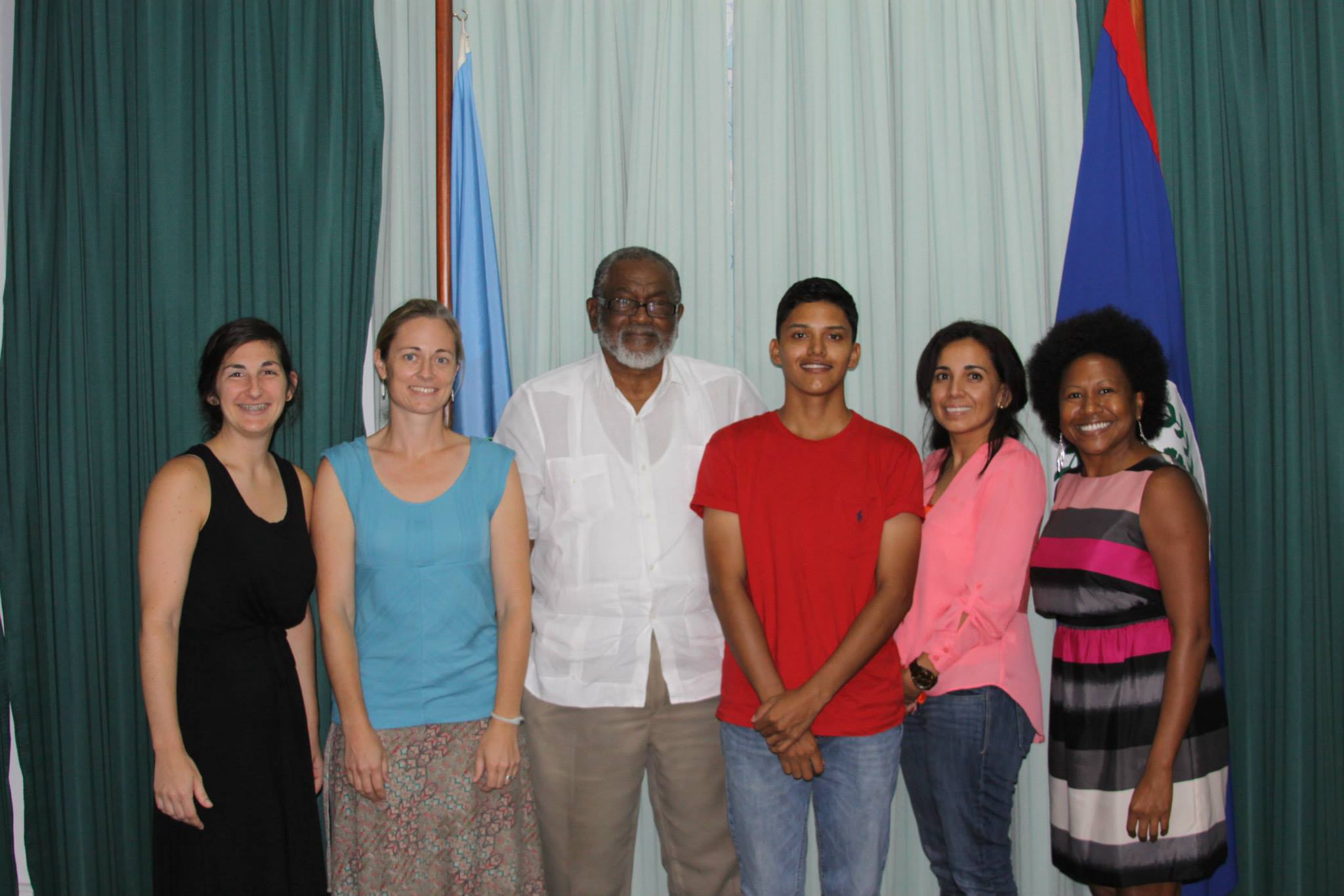
CCCCC partnership with Universities CCCCC Deputy Director and Science Advisor Dr Ulric Troz with the USF delegation

Christy Prouty, a Ph.D. student in Environmental Engineering at the University of South Florida, reflects on her  Her area of research includes systems dynamics modeling which is used to understand the behavior of complex systems over time.  She also enjoys internationally-focused research in water and sanitation

Climate change, sea level rise, community perceptions, drinking water, sanitation, coastal erosion, water quality monitoring, coral reef degradation, nutrient management, STEM education, and community capacity building— these were some of the topics discussed last month (June 6, 2014) during a meeting between the Caribbean Community Climate Change Center (5Cs) and a team of researchers affiliated with the University of South Florida’s Partnership for International Research and Education (USF PIRE) grant. During the introductions, the 5Cs shared insights about their field data and the ways it informed climate change models for predicting…

View original post 360 more words