An open letter for the people in Gaza – The Lancet

We are doctors and scientists, who spend our lives developing means to care and protect health and lives. We are also informed people; we teach the ethics of our professions, together with the knowledge and practice of it. We all have worked in and known the situation of Gaza for years.

On the basis of our ethics and practice, we are denouncing what we witness in the aggression of Gaza by Israel.

We ask our colleagues, old and young professionals, to denounce this Israeli aggression. We challenge the perversity of a propaganda that justifies the creation of an emergency to masquerade a massacre, a so-called “defensive aggression”. In reality it is a ruthless assault of unlimited duration, extent, and intensity. We wish to report the facts as we see them and their implications on the lives of the people.

We are appalled by the military onslaught on civilians in Gaza under the guise of punishing terrorists. This is the third large scale military assault on Gaza since 2008. Each time the death toll is borne mainly by innocent people in Gaza, especially women and children under the unacceptable pretext of Israel eradicating political parties and resistance to the occupation and siege they impose.

This action also terrifies those who are not directly hit, and wounds the soul, mind, and resilience of the young generation. Our condemnation and disgust are further compounded by the denial and prohibition for Gaza to receive external help and supplies to alleviate the dire circumstances.

The blockade on Gaza has tightened further since last year and this has worsened the toll on Gaza's population. In Gaza, people suffer from hunger, thirst, pollution, shortage of medicines, electricity, and any means to get an income, not only by being bombed and shelled. Power crisis, gasoline shortage, water and food scarcity, sewage outflow and ever decreasing resources are disasters caused directly and indirectly by the siege.1

People in Gaza are resisting this aggression because they want a better and normal life and, even while crying in sorrow, pain, and terror, they reject a temporary truce that does not provide a real chance for a better future. A voice under the attacks in Gaza is that of Um Al Ramlawi who speaks for all in Gaza: “They are killing us all anyway—either a slow death by the siege, or a fast one by military attacks. We have nothing left to lose—we must fight for our rights, or die trying.”2

Gaza has been blockaded by sea and land since 2006. Any individual of Gaza, including fishermen venturing beyond 3 nautical miles of the coast of Gaza, face being shot by the Israeli Navy. No one from Gaza can leave from the only two checkpoints, Erez or Rafah, without special permission from the Israelis and the Egyptians, which is hard to come by for many, if not impossible. People in Gaza are unable to go abroad to study, work, visit families, or do business. Wounded and sick people cannot leave easily to get specialised treatment outside Gaza. Entries of food and medicines into Gaza have been restricted and many essential items for survival are prohibited.3 Before the present assault, medical stock items in Gaza were already at an all time low because of the blockade.3 They have run out now. Likewise, Gaza is unable to export its produce. Agriculture has been severely impaired by the imposition of a buffer zone, and agricultural products cannot be exported due to the blockade. 80% of Gaza's population is dependent on food rations from the UN.

Much of Gaza's buildings and infrastructure had been destroyed during Operation Cast Lead, 2008—09, and building materials have been blockaded so that schools, homes, and institutions cannot be properly rebuilt. Factories destroyed by bombardment have rarely been rebuilt adding unemployment to destitution.

Despite the difficult conditions, the people of Gaza and their political leaders have recently moved to resolve their conflicts “without arms and harm” through the process of reconciliation between factions, their leadership renouncing titles and positions, so that a unity government can be formed abolishing the divisive factional politics operating since 2007. This reconciliation, although accepted by many in the international community, was rejected by Israel. The present Israeli attacks stop this chance of political unity between Gaza and the West Bank and single out a part of the Palestinian society by destroying the lives of people of Gaza. Under the pretext of eliminating terrorism, Israel is trying to destroy the growing Palestinian unity. Among other lies, it is stated that civilians in Gaza are hostages of Hamas whereas the truth is that the Gaza Strip is sealed by the Israelis and Egyptians.

Gaza has been bombed continuously for the past 14 days followed now by invasion on land by tanks and thousands of Israeli troops. More than 60 000 civilians from Northern Gaza were ordered to leave their homes. These internally displaced people have nowhere to go since Central and Southern Gaza are also subjected to heavy artillery bombardment. The whole of Gaza is under attack. The only shelters in Gaza are the schools of the UN Relief and Works Agency for Palestine Refugees in the Near East (UNRWA), uncertain shelters already targeted during Cast Lead, killing many.

According to Gaza Ministry of Health and UN Office for the Coordination of Humanitarian Affairs (OCHA),1 as of July 21, 149 of the 558 killed in Gaza and 1100 of the 3504 wounded are children. Those buried under the rubble are not counted yet. As we write, the BBC reports of the bombing of another hospital, hitting the intensive care unit and operating theatres, with deaths of patients and staff. There are now fears for the main hospital Al Shifa. Moreover, most people are psychologically traumatised in Gaza. Anyone older than 6 years has already lived through their third military assault by Israel.

The massacre in Gaza spares no one, and includes the disabled and sick in hospitals, children playing on the beach or on the roof top, with a large majority of non-combatants. Hospitals, clinics, ambulances, mosques, schools, and press buildings have all been attacked, with thousands of private homes bombed, clearly directing fire to target whole families killing them within their homes, depriving families of their homes by chasing them out a few minutes before destruction. An entire area was destroyed on July 20, leaving thousands of displaced people homeless, beside wounding hundreds and killing at least 70—this is way beyond the purpose of finding tunnels. None of these are military objectives. These attacks aim to terrorise, wound the soul and the body of the people, and make their life impossible in the future, as well as also demolishing their homes and prohibiting the means to rebuild.

Weaponry known to cause long-term damages on health of the whole population are used; particularly non fragmentation weaponry and hard-head bombs.4, 5 We witnessed targeted weaponry used indiscriminately and on children and we constantly see that so-called intelligent weapons fail to be precise, unless they are deliberately used to destroy innocent lives.

We denounce the myth propagated by Israel that the aggression is done caring about saving civilian lives and children's wellbeing.

Israel's behaviour has insulted our humanity, intelligence, and dignity as well as our professional ethics and efforts. Even those of us who want to go and help are unable to reach Gaza due to the blockade.

This “defensive aggression” of unlimited duration, extent, and intensity must be stopped.

Additionally, should the use of gas be further confirmed, this is unequivocally a war crime for which, before anything else, high sanctions will have to be taken immediately on Israel with cessation of any trade and collaborative agreements with Europe.

As we write, other massacres and threats to the medical personnel in emergency services and denial of entry for international humanitarian convoys are reported.6 We as scientists and doctors cannot keep silent while this crime against humanity continues. We urge readers not to be silent too. Gaza trapped under siege, is being killed by one of the world's largest and most sophisticated modern military machines. The land is poisoned by weapon debris, with consequences for future generations. If those of us capable of speaking up fail to do so and take a stand against this war crime, we are also complicit in the destruction of the lives and homes of 1·8 million people in Gaza.

We register with dismay that only 5% of our Israeli academic colleagues signed an appeal to their government to stop the military operation against Gaza. We are tempted to conclude that with the exception of this 5%, the rest of the Israeli academics are complicit in the massacre and destruction of Gaza. We also see the complicity of our countries in Europe and North America in this massacre and the impotence once again of the international institutions and organisations to stop this massacre.

We declare no competing interests. More


Palestinian Open Letter to UNSG Ban Ki-moon on Gaza

Richard Falk's avatarGlobal Justice in the 21st Century

[Prefatory Note: Below is the text of an Open Letter to the UN Secretary General Ban Ki-moon alleging his inappropriate responses to the carnage and massacres taking place in Gaza, and by his behavior undermining respect for and the authority of the United Nations and international law. Given such a performance, the challenge posed to the highest ranking UN official is to revise his past comments on the Israeli attack or to resign his office. The peoples of the world, and not just the Palestinians, have a paramount interest in holding morally, legally, and politically accountable the UN and those who lead and represent the organization in response to such breaches of the peace and acts of aggression in accordance with law and justice, and never more so than when such unlawful behavior is directly responsible for a grave humanitarian catastrophe of the kind that has befallen the civilian…

View original post 2,330 more words

Strange Regional Alignments in the Gaza Massacre

Richard Falk's avatarGlobal Justice in the 21st Century

Neighborly Crimes of Complicity in Gaza


[Prefatory Note: my post below, an earlier version of which was published in AlJazeera English as an opinion piece. It was written before I had the opportunity to read an illuminating assessment of the regional and global turmoil that culminated for now in the massacre carried out by Israeli armed forces in Gaza. I highly recommend “The Tragedy of Great Power: The Massacre of Gaza and the Inevitable Failure of the Arab Spring” written by the learned Islamic jurist and scholar, Khaled Abou El Fadl, a distinguished professor at UCLA School of Law, with the link to the article below:

http://www.abc.net.au/religion/articles/2014/08/08/4064106.htm

 What makes Professor El Fadl profound essay particularly valuable is his ability to fit the regional pieces together in a convincing manner, showing how and why governments that rule in Saudi Arabia and the UAE, encouraged the overthrow of Egypt’s elected…

View original post 3,320 more words

George Galloway calls for boycott of ‘illegitimate’ Israel

Israel is COMPLETELY illegitimate! – George Galloway speech – 9th August 2014

Published on Aug 9, 2014 • O

More than 150,000 people marched through London today, Saturday, in Britain’s biggest protest ever against Israel’s oppression of Gaza. They came on coaches, trains and minibuses from round the country. The march gathered outside the BBC, angry at the appalling coverage of Israel’s massacre of nearly 2,000 Palestinians. It finished with a mass rally in Hyde Park. The march took an hour and three quarters to arrive. The park was a sea of Palestinian flags. More than 3,000 also protested in Edinburgh. They marched to Bute House, the first minister’s residence. For two hours they held a sit-down protest blocking the city’s main shopping street, Princes Street. Today has been called a Day of Rage for Gaza across the world. Up to 200,000 also marched in Cape Town, South Africa, drawing parallels between Israel and the apartheid regime. Demonstrators also marched in Delhi. Safia Hibah from Isleworth, west London, was on the London march. She told Socialist Worker, “The story the news is telling us is different to the reality of little kids being bombed. Is the government blind to what is going on? Why do they keep arming Israel?”

http://youtu.be/Di78NDVoXG8


Natural Gas in the Palestinian Authority: The Potential of the Gaza Marine Offshore Field

Summary: Although in strict legal terms its status is ambig-uous, a 25-year exploration license for the marine area off the Gaza Strip was awarded by the Palestinian Authority in 1999.

The Gaza Marine field was discovered the following the year though its natural gas has yet to be exploited. Politics as well as failure to agree on commercial terms have been the principal reasons for the delay.

Exploitation of the field would provide the Palestinian Authority with an important revenue stream. Using Gaza Marine gas may also reduce the need of Israel to consume its own natural gas to generate electricity for the Palestinians. Ultimately the decision will be political, but, in economic terms, the case for the exploita-tion of Gaza Marine is strong. Download PDF


“Containing the Resource Crisis”

LONDON – The proclamation of a new Cold War, following Russia’s annexation of Crimea, turned out to be alarmist and premature. However, it reflected the anxiety of today’s decision-makers in the face of a crumbling global order.


With emerging economies far from committed to established norms in international relations, many governments and multinational companies are feeling vulnerable about relying on others for vital resources – the European Union’s dependence on Russian gas being a case in point.

Competition for scarce resources is sorely testing our assumptions about global governance and cooperation, at a time when collective leadership is becoming ever more necessary. But even in the absence of overarching global legal frameworks, it is possible to maintain a sense of common security if the terms of resource investments are founded on long-term political understanding and commercial relationships, rather than short-term competition.

The stakes are high. Resource scarcity is closely linked to political risks. Consider, for example, the drought that decimated Russia’s 2010 wheat harvest. In response, Russia imposed export restrictions to shore up its domestic supplies, sending food prices soaring in its main export markets, especially Egypt. This in turn helped spark the political uprisings that spread rapidly across North Africa and the Middle East. Climate change is expected to trigger many more such chains of events.

One test case for such cooperation is the potentially explosive issue of the Nile Delta’s water resources. Britain’s colonial-era treaty has, since 1929, given Egypt a veto over any upstream river project that might affect the country’s water supply

One test case for such cooperation is the potentially explosive issue of the Nile Delta’s water resources. Britain’s colonial-era treaty has, since 1929, given Egypt a veto over any upstream river project that might affect the country’s water supply. Several Nile Basin countries, including Sudan and Ethiopia, have now ratified a new, Nile River Basin Cooperative Framework agreement, which Egypt has yet to sign. Given Egypt’s concerns about potential water shortages arising from Ethiopia’s new upstream hydropower plants, its assent is far from assured.

Indeed, in Egypt’s febrile political atmosphere, its newly elected president, General Abdul Fattah el-Sisi, may be tempted to escalate the threat of military action in response to Ethiopia’s hydropower projects. Such a move would send shockwaves through a region already reeling from conflict in South Sudan, Syria, Iraq, and Lebanon.

To avoid another dangerous political-environmental chain reaction, nudging all sides toward agreement will require achieving mutual recognition of resource concerns. Ethiopia must credibly guarantee the supply of water downstream, for example, by establishing a water-replenishment rate at its dam reservoirs that does not threaten the onward flow of water to Egypt. At the same time, Egypt, while retaining the fundamental right to protect its water supply, must recognize the interests of its upstream neighbors and be ready to negotiate in good faith a new Nile Basin treaty.

Multinational companies and sovereign investors like China, which have financed hydropower projects upstream, will come under increasing pressure to adopt a position. They, too, can play a positive role by considering the cross-border investments that will address critical interdependencies, like Egypt’s wasteful agricultural irrigation practices.

Similar resource-related tensions are surfacing in other parts of the world. Water stress and food security threaten to constrain India’s economic promise, as increasing coal-powered electricity generation diverts water resources away from agriculture. The political risks of investing in Nigeria’s agriculture sector are also rising as a result of the country’s demographic explosion, high inflation, weak rule of law, and insecure land rights, with wider political consequences.

These resource strains are aggravated by foreign investments that seek to meet developed-country consumers’ voracious demand for resources without attention to their impact on sustainability in the host countries. This virtual outsourcing of the industrialized world’s environmental impacts, apart from being hypocritical, is no basis for building a strategy for global environmental sustainability.

Instead, the world needs to invest in sustainable agriculture, renewable energy, and green infrastructure. To be sure, the most promising efforts by leading multinationals today must confront entrenched subsidies and vested political interests. Unless the necessary policy frameworks are put in place green investment initiatives will continue to struggle to achieve a meaningful scale. Moreover, developed and developing countries seem unable even to agree on a fair division of environmental responsibilities, even though they have become increasingly interdependent in trade, investment, and the supply of natural resources.

These difficulties should not stop us from trying. The Earth Security Initiative is working with the BMW Foundation to develop global roundtables on resource security over a two-year period, starting in Hangzhou, China, on July 17- 20. These high-level, informal meetings will bring together leaders from politics, business, and civil society in Europe and emerging economies in an effort to bridge just such differences.

We know what needs to be done, why it is important, and who must be involved to secure our planet’s long-term future. We must now address the equally vital question of how this will be achieved.

Read more at http://www.project-syndicate.org/commentary/alejandro-litovsky-addresses-the-increasingly-close-links-between-resource-scarcity-and-political-risk#qFDfi1xP668YyhLg.99


BBC’s biased reporting of the Gaza massacre

BBC's biased reporting of the Gaza massacre: Tariq Ali


Published on Aug 10, 2014 • Tariq Ali tells the BBC on 09/08/14, when 150,000 marched in the biggest ever UK demonstration for Gaza, why there is such widespread criticism of the Israeli bias in its reporting. (For more on the demonstration see: http://bit.ly/1ozrch>

War and Natural Gas: The Israeli Invasion and Gaza’s Offshore Gas Fields

More than five years ago, Israel invaded Gaza under “Operation Cast Lead”.

The following article was first published by Global Research in January 2009 at the height of the Israeli bombing and invasion under Operation Cast Lead.

In the wake of the invasion, Palestinian gas fields were de facto confiscated by Israel in derogation of international law

A year following “Operation Cast Lead”, Tel Aviv announced the discovery of the Leviathan natural gas field in the Eastern Mediterranean “off the coast of Israel.”

At the time the gas field was: “ … the most prominent field ever found in the sub-explored area of the Levantine Basin, which covers about 83,000 square kilometres of the eastern Mediterranean region.” (i)

Coupled with Tamar field, in the same location, discovered in 2009, the prospects are for an energy bonanza for Israel, for Houston, Texas based Noble Energy and partners Delek Drilling, Avner Oil Exploration and Ratio Oil Exploration. (See Felicity Arbuthnot, Israel: Gas, Oil and Trouble in the Levant, Global Research, December 30, 2013

The Gazan gas fields are part of the broader Levant assessment area.

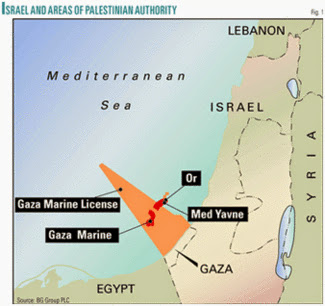
What is now unfolding is the integration of these adjoining gas fields including those belonging to Palestine into the orbit of Israel. (see map below).

It should be noted that the entire Eastern Mediterranean coastline extending from Egypt’s Sinai to Syria constitutes an area encompassing large gas as well as oil reserves.

War and Natural Gas: The Israeli Invasion and Gaza's Offshore Gas Fields

More than five years ago, Israel invaded Gaza under “Operation Cast Lead”.

The following article was first published by Global Research in January 2009 at the height of the Israeli bombing and invasion under Operation Cast Lead.

In the wake of the invasion, Palestinian gas fields were de facto confiscated by Israel in derogation of international law

A year following “Operation Cast Lead”, Tel Aviv announced the discovery of the Leviathan natural gas field in the Eastern Mediterranean “off the coast of Israel.”

At the time the gas field was: “ … the most prominent field ever found in the sub-explored area of the Levantine Basin, which covers about 83,000 square kilometres of the eastern Mediterranean region.” (i)

Coupled with Tamar field, in the same location, discovered in 2009, the prospects are for an energy bonanza for Israel, for Houston, Texas based Noble Energy and partners Delek Drilling, Avner Oil Exploration and Ratio Oil Exploration. (See Felicity Arbuthnot, Israel: Gas, Oil and Trouble in the Levant, Global Research, December 30, 2013

The Gazan gas fields are part of the broader Levant assessment area.

What is now unfolding is the integration of these adjoining gas fields including those belonging to Palestine into the orbit of Israel. (see map below).

It should be noted that the entire Eastern Mediterranean coastline extending from Egypt’s Sinai to Syria constitutes an area encompassing large gas as well as oil reserves.

levant gas map1 felicity

Michel Chossudovsky, January 3, 2014

War and Natural Gas: The Israeli Invasion and Gaza’s Offshore Gas Fields

by Michel Chossudovsky

January 8, 2009

The December 2008 military invasion of the Gaza Strip by Israeli Forces bears a direct relation to the control and ownership of strategic offshore gas reserves.

This is a war of conquest. Discovered in 2000, there are extensive gas reserves off the Gaza coastline.

British Gas (BG Group) and its partner, the Athens based Consolidated Contractors International Company(CCC) owned by Lebanon’s Sabbagh and Koury families, were granted oil and gas exploration rights in a 25 year agreement signed in November 1999 with the Palestinian Authority.

The rights to the offshore gas field are respectively British Gas (60 percent); Consolidated Contractors (CCC) (30 percent); and the Investment Fund of the Palestinian Authority (10 percent). (Haaretz, October 21, 2007).

The PA-BG-CCC agreement includes field development and the construction of a gas pipeline.(Middle East Economic Digest, Jan 5, 2001).

The BG licence covers the entire Gazan offshore marine area, which is contiguous to several Israeli offshore gas facilities. (See Map below). It should be noted that 60 percent of the gas reserves along the Gaza-Israel coastline belong to Palestine.

Map 1

The BG Group drilled two wells in 2000: Gaza Marine-1 and Gaza Marine-2. Reserves are estimated by British Gas to be of the order of 1.4 trillion cubic feet, valued at approximately 4 billion dollars. These are the figures made public by British Gas. The size of Palestine’s gas reserves could be much larger.

Who Owns the Gas Fields

The issue of sovereignty over Gaza’s gas fields is crucial. From a legal standpoint, the gas reserves belong to Palestine.

The death of Yasser Arafat, the election of the Hamas government and the ruin of the Palestinian Authority have enabled Israel to establish de facto control over Gaza’s offshore gas reserves.

British Gas (BG Group) has been dealing with the Tel Aviv government. In turn, the Hamas government has been bypassed in regards to exploration and development rights over the gas fields.

Map 2

The election of Prime Minister Ariel Sharon in 2001 was a major turning point. Palestine’s sovereignty over the offshore gas fields was challenged in the Israeli Supreme Court. Sharon stated unequivocally that “Israel would never buy gas from Palestine” intimating that Gaza’s offshore gas reserves belong to Israel.

In 2003, Ariel Sharon, vetoed an initial deal, which would allow British Gas to supply Israel with natural gas from Gaza’s offshore wells. (The Independent, August 19, 2003)

The election victory of Hamas in 2006 was conducive to the demise of the Palestinian Authority, which became confined to the West Bank, under the proxy regime of Mahmoud Abbas.

In 2006, British Gas “was close to signing a deal to pump the gas to Egypt.” (Times, May, 23, 2007). According to reports, British Prime Minister Tony Blair intervened on behalf of Israel with a view to shunting the agreement with Egypt.

The following year, in May 2007, the Israeli Cabinet approved a proposal by Prime Minister Ehud Olmert “to buy gas from the Palestinian Authority.” The proposed contract was for $4 billion, with profits of the order of $2 billion of which one billion was to go the Palestinians.

Tel Aviv, however, had no intention on sharing the revenues with Palestine. An Israeli team of negotiators was set up by the Israeli Cabinet to thrash out a deal with the BG Group, bypassing both the Hamas government and the Palestinian Authority:

Israeli defence authorities want the Palestinians to be paid in goods and services and insist that no money go to the Hamas-controlled Government.” (Ibid, emphasis added)

The objective was essentially to nullify the contract signed in 1999 between the BG Group and the Palestinian Authority under Yasser Arafat.

Under the proposed 2007 agreement with BG, Palestinian gas from Gaza’s offshore wells was to be channeled by an undersea pipeline to the Israeli seaport of Ashkelon, thereby transferring control over the sale of the natural gas to Israel.

The deal fell through. The negotiations were suspended:

”Mossad Chief Meir Dagan opposed the transaction on security grounds, that the proceeds would fund terror”. (Member of Knesset Gilad Erdan, Address to the Knesset on “The Intention of Deputy Prime Minister Ehud Olmert to Purchase Gas from the Palestinians When Payment Will Serve Hamas,” March 1, 2006, quoted in Lt. Gen. (ret.) Moshe Yaalon, Does the Prospective Purchase of British Gas from Gaza’s Coastal Waters Threaten Israel’s National Security? Jerusalem Center for Public Affairs, October 2007)

Israel’s intent was to foreclose the possibility that royalties be paid to the Palestinians. In December 2007, The BG Group withdrew from the negotiations with Israel and in January 2008 they closed their office in Israel.(BG website).

Invasion Plan on The Drawing Board

The invasion plan of the Gaza Strip under “Operation Cast Lead” was set in motion in June 2008, according to Israeli military sources:

“Sources in the defense establishment said Defense Minister Ehud Barak instructed the Israel Defense Forces to prepare for the operation over six months ago [June or before June] , even as Israel was beginning to negotiate a ceasefire agreement with Hamas.”(Barak Ravid, Operation “Cast Lead”: Israeli Air Force strike followed months of planning, Haaretz, December 27, 2008)

That very same month, the Israeli authorities contacted British Gas, with a view to resuming crucial negotiations pertaining to the purchase of Gaza’s natural gas:

“Both Ministry of Finance director general Yarom Ariav and Ministry of National Infrastructures director general Hezi Kugler agreed to inform BG of Israel’s wish to renew the talks.

The sources added that BG has not yet officially responded to Israel’s request, but that company executives would probably come to Israel in a few weeks to hold talks with government officials.” (Globes online- Israel’s Business Arena, June 23, 2008)

The decision to speed up negotiations with British Gas (BG Group) coincided, chronologically, with the planning of the invasion of Gaza initiated in June. It would appear that Israel was anxious to reach an agreement with the BG Group prior to the invasion, which was already in an advanced planning stage.

Moreover, these negotiations with British Gas were conducted by the Ehud Olmert government with the knowledge that a military invasion was on the drawing board. In all likelihood, a new “post war” political-territorial arrangement for the Gaza strip was also being contemplated by the Israeli government.

In fact, negotiations between British Gas and Israeli officials were ongoing in October 2008, 2-3 months prior to the commencement of the bombings on December 27th.

In November 2008, the Israeli Ministry of Finance and the Ministry of National Infrastructures instructed Israel Electric Corporation (IEC) to enter into negotiations with British Gas, on the purchase of natural gas from the BG’s offshore concession in Gaza. (Globes, November 13, 2008)

“Ministry of Finance director general Yarom Ariav and Ministry of National Infrastructures director general Hezi Kugler wrote to IEC CEO Amos Lasker recently, informing him of the government’s decision to allow negotiations to go forward, in line with the framework proposal it approved earlier this year.

The IEC board, headed by chairman Moti Friedman, approved the principles of the framework proposal a few weeks ago. The talks with BG Group will begin once the board approves the exemption from a tender.” (Globes Nov. 13, 2008)

Gaza and Energy Geopolitics

The military occupation of Gaza is intent upon transferring the sovereignty of the gas fields to Israel in violation of international law.

What can we expect in the wake of the invasion?

What is the intent of Israel with regard to Palestine’s Natural Gas reserves?

A new territorial arrangement, with the stationing of Israeli and/or “peacekeeping” troops?

The militarization of the entire Gaza coastline, which is strategic for Israel?

The outright confiscation of Palestinian gas fields and the unilateral declaration of Israeli sovereignty over Gaza’s maritime areas?

If this were to occur, the Gaza gas fields would be integrated into Israel’s offshore installations, which are contiguous to those of the Gaza Strip. (See Map 1 above).

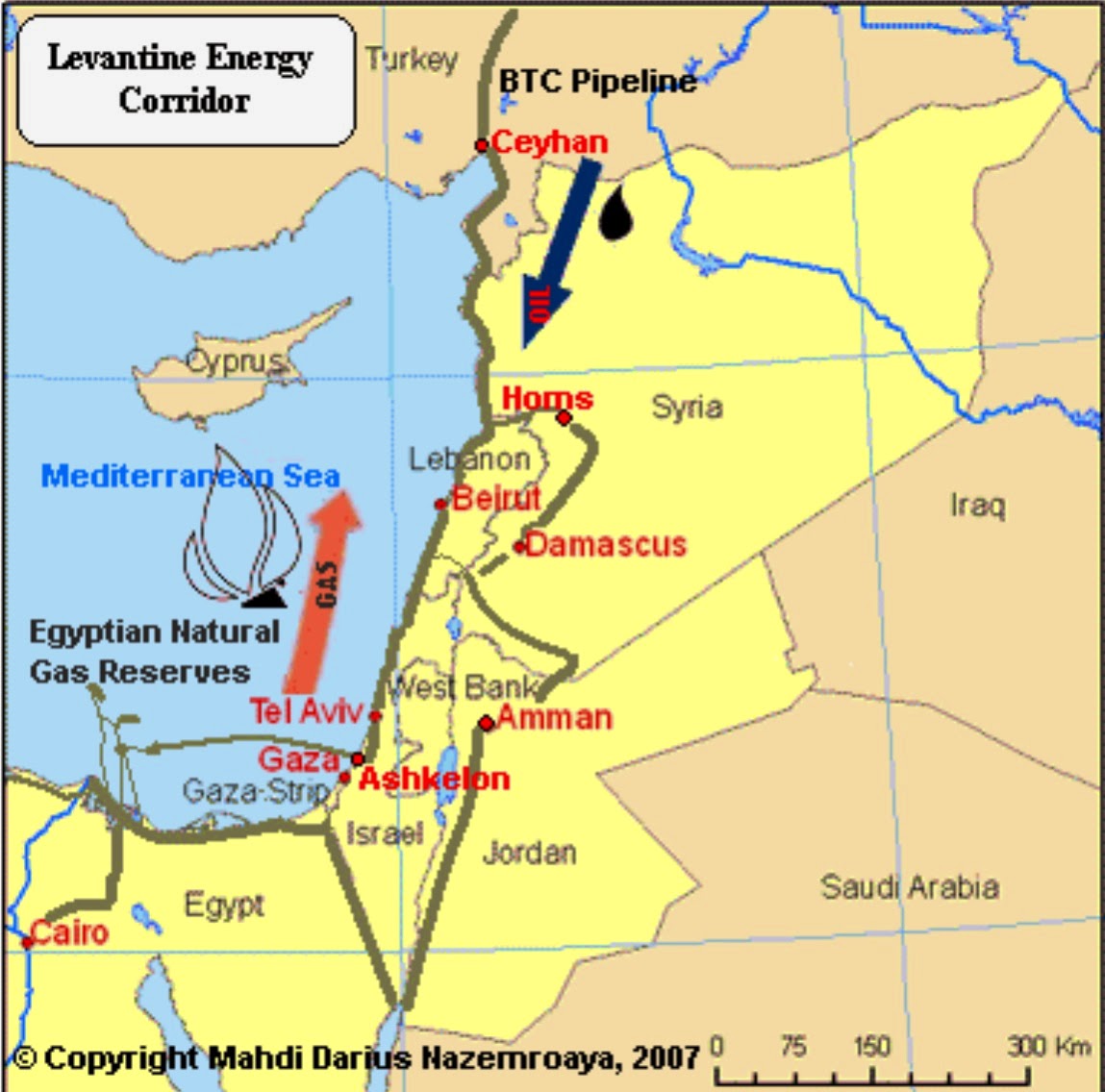
These various offshore installations are also linked up to Israel’s energy transport corridor, extending from the port of Eilat, which is an oil pipeline terminal, on the Red Sea to the seaport – pipeline terminal at Ashkelon, and northwards to Haifa, and eventually linking up through a proposed Israeli-Turkish pipeline with the Turkish port of Ceyhan.

Map 3

Ceyhan is the terminal of the Baku, Tblisi Ceyhan Trans Caspian pipeline. “What is envisaged is to link the BTC pipeline to the Trans-Israel Eilat-Ashkelon pipeline, also known as Israel’s Tipline.” (See Michel Chossudovsky, The War on Lebanon and the Battle for Oil, Global Research, July 23, 2006)

More