Iowa Roots: Speaking Truth to Power

James Hansen writes: I was lucky to be born in Iowa. The nature of my childhood and later education at the State University of Iowa, odd as it seems, have relevance to fundamental political matters that I hope Iowans will think about. I will argue that Iowa could alter our nation’s course on energy and climate, matters of monumental importance to our children and indeed to all life on Earth.

James Hansen

I was born in 1941 in a small farmhouse in western Iowa, the fifth of seven children. My father was an itinerant tenant farmer, moving from one farm to another, sharing crops with the owner.

By 1945 small farms were disappearing. My father took a job as bartender and we moved a small house to a lot in Denison Iowa. Our life then seems hard by today’s standards. There were three bedrooms for nine of us. Even after we got a septic system the toilet was in the cellar, which required going outdoors. The only sink was in the kitchen, which was also the dining room. Washing up was done in turn, quickly. Our parents quarreled vehemently when our mother took a job as a waitress. I shrank in fear from our father’s angry voice.

Yet it was a good life to grow up in small town Iowa in a time of rising expectations. Today’s young people face a harder situation, with diminishing opportunities. That hurts deeply because, as I will explain, it is unnecessary, a result of tragic political machinations for which we adults must accept responsibility.

Politics back then was simpler. My father shouted “give ‘em Hell, Harry!” and slapped the table while listening to President Truman on the radio. My father called the Republican Party “the rich man’s party.” But shortly before my parents divorced he took me to listen to General Eisenhower speaking from the back of a train, as he came through Denison on a whistle-stop campaign trip in 1952. My father decided that he “liked Ike”, so he voted Republican.

Politicians were more honest regarding fundamental situations. Truman was blunt, with courage to remove war-hero MacArthur, thus maintaining civilian control of policy. Eisenhower warned us about the rising military-industrial complex. Below I contrast this with today’s situation.

It was easier in those days for young people to get ahead. I had a paper route from 3rd grade and by high school was the distributor of the Omaha World Herald for Denison (competing with the Des Moines Register for customers). From such a job I could save enough for college, where costs were within reach of all. Costs today have exploded. With our federal government in cahoots with banks, many college students look forward to decades of debt, not a better life.

My good fortune was to go to the University of Iowa. Professor James Van Allen was building instruments in the basement of the physics building, including the one on the first U.S. satellite, which discovered Earth’s radiation belts. In an exciting research environment Prof. Van Allen taught us how science works. The only “authority” was the rigorous objectivity of science.

Prof. Van Allen did not shirk from speaking truth to power and the public. When microwave ovens were introduced and fear of microwave radiation began to spread, Prof. Van Allen offered to sit on a microwave oven while it cooked his dinner. He helped quell irrational fear.

Prof. Van Allen told me about new data on the planet Venus. It led me to study why Venus was so hot and to propose an instrument for a mission to Venus after I joined NASA. The extreme heat on Venus turned out to be caused by the large amount of CO2 in the planet’s atmosphere.

CO2 was known to be increasing rapidly on Earth, because of our burning of fossil fuels – coal, oil and gas. What would it mean for life on our planet? I formed a small team at the NASA Goddard Institute for Space Studies to study the problem.

We showed that Earth was warming by the amount expected due to the CO2 increase. Later we showed that Earth was out of energy balance: Earth is absorbing more energy from the sun than it is radiating to space as heat. This confirms the most fundamental physics, as it is the added CO2 that reduces heat radiation to space. The conclusion is based on data, not models.

One implication: more warming is “in the pipeline”, without additional increase of atmospheric CO2. In turn, it follows that CO2 emissions must be reduced rapidly or young people in coming decades will face unacceptable consequences: continually retreating shorelines, shifting climate zones with extermination of many species, increasing occurrence of climate extremes with widespread disruption to food and water supplies, more severe droughts and heat waves, more damaging forest fires, stronger storms, and greater flooding.

Implications for energy policy are crystal clear. Most remaining fossil fuels must be left in the ground, unless the CO2 is captured and buried. There is no serious scientific debate about this.

Remarkably, scientific analysis also shows that the policies needed to achieve fossil fuel phasedown would also address problems such as underemployment and growing income disparities. Why are such policies not pursued, if they are in the best interests of the public?

I learned why when I worked for the government. I was repeatedly warned not to connect the dots in the climate problem all the way to policy implications. End steps must be left to “policy-makers” and, it turns out, to special interests. NASA did not want to annoy the powers that be.

Scientists are trained to analyze complex problems and connect all the dots. If we fail to tell the whole story clearly, if we shirk speaking truth to power, we fail our children and grandchildren.

The truth is that present energy and climate policies of the United States and the United Nations are dishonest and tragic.

Out of one side of their mouths our leaders profess to understand that we have a planet in peril and that we must rapidly phase down CO2 emissions. At the same time they encourage pursuit of almost every fossil fuel that can be found, while knowing that such policies make achievement of climate goals impossible.

The fundamental reason that fossil fuel emissions continue to increase is that they appear to the consumer to provide the cheapest energy. This apparent cheapness is a mirage. Why? (1) We subsidize fossil fuels directly, and indirectly by protecting supply lines. (2) Impacts of air and water pollution are borne by the public; e.g., if your child gets asthma, you pay the costs, not the fossil fuel company. (3) Costs of climate catastrophes are borne by the victims and taxpayers.

We should make the price of fossil fuels honest by collecting a gradually rising carbon fee from fossil fuel companies. It is easy to collect, at domestic mines and ports of entry. 100% of the collected money should be given to the public, an equal amount to each legal resident, distributed electronically to bank accounts or debit cards. Not one dime to the government.

The person doing better than average in limiting his “carbon footprint” will make money. He will have an incentive to reduce fossil fuel use via future purchases. Entrepreneurs will have an incentive to develop no-carbon products. Businesses will be able to plan energy investments.

Detailed economic studies show that a carbon fee of $10 per ton of CO2, increasing $10 each year, will reduce U.S. CO2 emissions 33% in 10 years. That is 12 times more than the amount of carbon in the oil that would be carried by the Keystone XL pipeline.

While a tax would depress the economy, a fee with 100% of the money distributed to the public spurs the economy. After 10 years national employment increases 2.1 million jobs! The simple explanation is that honest pricing of energy makes the economy more efficient.

I should explain why I say that our governments’ policies are “dishonest and tragic.” They are dishonest because they pretend that policies that try to “cap” emissions could actually phase down emissions rapidly, for example the “cap-and-trade” of the Kyoto Protocol or Democratic bills in Congress. These amount to tax increases, they depress the economy, and they reduce emissions very little. And what “cap” would India accept – three times that of the U.S.? This is why governments allow all fossil fuel development, fracking, deep-ocean and Arctic drilling, mountaintop removal – because they know that their carbon policies are ineffectual.

Why tragic? Because policies that would actually work, fee-and-dividend in particular, do not cost the economy anything. They would spur the economy, create jobs, and modernize our infrastructure as we move to clean energies and energy efficiency.

Is it possible that Iowa, perhaps in cooperation with one or more neighboring states, such as Nebraska, Minnesota or Wisconsin, could help avert the tragedy? I believe it is conceivable that Midwest common sense could affect national and international policies by providing an example. A regional carbon fee cannot rise too high without disadvantaging local industry, because states do not have the practical ability to impose border tax adjustments. However, up to a reasonable level the net effect of a carbon fee would be beneficial, if the proceeds went to the public.

There is a conservative tendency in the Midwest. But conservatives are not the enemy of the planet. Historically conservatives have been the environments best friend. Conservation and creation care should be in the blood of conservatives.

A political divide has developed because conservatives fear that liberals will use the climate issue to increase taxes and government intrusion into their lives. These concerns provide fertile ground for anti-science nut-cases (global warming is a hoax!) to flourish.

Most conservatives I know are thoughtful. They do not want to go down in history as being responsible for blocking effective action to stabilize climate. Gaining their support for a rising revenue-neutral carbon fee, which is in fact a conservative approach, is possible.

A rigorously nonpartisan organization, Citizens Climate Lobby, has grown rapidly in the past several years. Their objective is to promote fee-and-dividend. They are unfailingly polite and respectful, but also knowledgeable and determined. They have met with legislators in almost all states. They could be a valuable resource in helping to organize a Midwest climate initiative.

Finally, I point out that, although a gradually rising carbon fee is the essential foundation for a successful policy to rapidly phase down our fossil fuel addiction, there are other requirements. The crucial technical need is abundant affordable carbon-free electricity generation.

Today, except for limited hydroelectric and biomass power plants, there are two options for baseload electricity: fossil fuels and nuclear power. We will not be able to phase out fossil fuel power plants without major contributions from nuclear power.

Most nuclear power plants in operation today are of a 40-50 year-old technology, yet they have saved millions of lives by displacing fossil fuel power plants. Fossil fuel air pollution kills more than 3.7 million people per year globally. Pollution is much less in the U.S. than in China or India, yet thousands of people are killed by it every year in the U.S. In contrast the one major nuclear accident in the U.S., at Three Mile Island, Pennsylvania, may result in the death of 1-2 people, which is undetectable among the 40,000 cancer deaths that will occur from other causes among the Pennsylvania residents exposed to radiation.

Modern nuclear technology has major improvements including passive shutdown in case of emergency and an ability to cool the nuclear fuel without external power. It is also possible to include reactors in the nuclear fleet that “burn” nuclear waste and utilize 99% of the energy in the nuclear fuel, compared with less than 1% in the older technology. Thus the nuclear waste problem can be solved and, if we choose, we can stop mining uranium because we have shown that an inexhaustible amount of nuclear fuel can be sieved from the ocean.

There is an analogy between the nuclear and aircraft industries. At the time of the earliest airplanes, who would have imagined that we would fly huge aircraft with more than 100 people at altitudes of 10 miles without parachutes! If a window broke at that altitude, everyone could die! So we worked on the technology. Now the chance you will lose your life by flying from New York to LA is much smaller than if you drove your car. Yes, there is still danger, especially due to human error, and we must be vigilant and develop control systems to minimize danger.

President Clinton in his State-of-the-Union message in 1993 made the chilling announcement that he was eliminating unnecessary programs such as nuclear power research and development. However, nuclear technology is not disappearing from Earth, on the contrary, and if the U.S. drifts further toward technical mediocrity, leaving nuclear leadership to nations such as Russia, the world will be a more dangerous place. If the United States chooses to focus on being a petro-state, the economic well-being of our children eventually will decline further.

Fortunately, all clean energy technologies would be spurred by the carbon fee-and-dividend approach, providing a broad revival of our technology leadership in many areas, especially clean energies which should all be free to compete rather than specified by politicians. The result would be greatly improved economic well-being for future generations.

It is not always easy to speak truth to power, but all citizens have the opportunity if they choose. I have one minor, easy suggestion for you to consider, and another requiring more effort. More


Take a PDC with Rhamis Kent in Marrakesh, December 22nd to January 5th, 2015!

marrakeshorganics's avatarMarrakesh Organics

The Course

banner

We will be running a Permaculture Design Course (PDC) December 22nd to January 5th, 2015!

This 15-Day course follows the standard accredited 72-hour design course syllabus and will include several hands-on sessions including making Bio-vital compost, Bio Fertilizer, Actively Aerated Compost Tea, Vegetable beds and Organic Gardening, land surveying, natural building and much more!

This Course is in English only, there will be no translation.

The course will be hosted in an organic olive farm in the foothills of the gorgeous Ourika valley, 25 Km south of Marrakesh, right on the way to historical and scenic destinations such as the Siti Fatma waterfall, Lake Lalla Takerkoust, the Oukaimeden ski resort, the ancient Berber village of Tinmel and the Toubkal national park.

The course covers in detail the ecological basis of Permaculture design, the ethics, the principles of design, strategies for restoring soils, managing water, partitioning land between intensity of…

View original post 741 more words

30 Percent of Singapore’s Water Supply is Currently Met by Recycled Water

The South-east Asian island country has a population of 5 million residing on less than 750 square kilometers of land. Whilst known for its strong economy, Singapore is lacking one essential asset — water.

Water security has long been a national priority in Singapore as half of its current water supplies are imported from neighboring Malaysia. “We are preparing for the day that should the water agreement expire, we should be ready to fulfill our own needs,” says Chew Men Leong, Chief Executive of the Public Utilities Board.

The agreement with Malaysia is due to expire in 2061, so the country has time to be ready.

Singapore’s strategy for a hydrated nation is four-fold: as well as importation, it includes desalinization plants, efficient catchment of rainwater and recycling of sewage.

Rainwater is collected through a network of drains, canals, rivers, storm water, collection ponds and reservoirs with the aim to catch water across two-thirds of the country. But the real hope lies in the membrane technology to treat wastewater known as ‘NEWater’, created by the country’s public utilities board.

Through a four-step series of barriers and membranes, wastewater is made free of solids, microorganisms, and contaminants resulting in potable water supplies for use by humans and industry.

After one decade, the technology meets 30 percent of Singapore’s water needs, with plans to triple volumes by 2060.

“The level of quality we receive from the Public Utility Board meets and exceeds the expectation,” explains Jagadish CV, CEO of Systems on Silicon Manufacturing, where the water is used in their processing of silicon wafers. “We are using the water three times before we let it into the drain,” he says.

The demand by industry is being further met by a new collaboration with Japanese firm Meiden that will supply factories with recycled industrial water. One and a half Olympic-sized swimming pools of water are currently filtered and treated every day.

The goal is to more cost-effectively treat industrial waste streams in the long run.

Professor Asit Biswas from the Lee Kuan School of Public Policy feels other countries should follow the example set by Singapore and even the current standards can be improved to eventually re-use every last drop of water. More

Source: CNN


Antigua Faces Climate Risks with Ambitious Renewables Target

Ruth Spencer is a pioneer in the field of solar energy. She promotes renewable technologies to communities throughout her homeland of Antigua and Barbuda, playing a small but important part in helping the country achieve its goal of a 20-percent reduction in the use of fossil fuels by 2020.

She also believes that small non-governmental organisations (NGOs) have a crucial role to play in the bigger projects aimed at tackling the problems caused by the burning of fossil fuels, such as coal, oil and gas.

Spencer, who serves as National Focal Point for the Global Environment Facility (GEF)-Small Grants Programme (SGP) in Antigua and Barbuda, has been at the forefront of an initiative to bring representatives of civil society, business owners and NGOs together to educate them about the dangers posed by climate change.

“The GEF/SGP is going to be the delivery mechanism to get to the communities, preparing them well in advance for what is to come,” she told IPS.

The GEF Small Grants Programme in the Eastern Caribbean is administered by the United Nations office in Barbados.

“Since climate change is heavily impacting the twin islands of Antigua and Barbuda, it is important that we bring all the stakeholders together,” said Spencer, a Yale development economist who also coordinates the East Caribbean Marine Managed Areas Network funded by the German government.

“The coastal developments are very much at risk and we wanted to share the findings of the IPCC report with them to let them see for themselves what all these scientists are saying,” Spencer told IPS.

“We are in a small island so we have to build synergies, we have to network, we have to partner to assist each other. By providing the information, they can be aware and we are going to continue doing follow up….so together we can tackle the problem in a holistic manner,” she added.

The United Nations’ Intergovernmental Panel on Climate Change (IPCC) has sent governments a final draft of its synthesis report, which paints a harsh picture of what is causing global warming and what it will do to humans and the environment. It also describes what can be done about it.

Ruleta Camacho, project coordinator for the sustainable island resource management mechanism within Antigua and Barbuda’s Ministry of the Environment, told IPS there is documented observation of sea level rise which has resulted in coastal erosion and infrastructure destruction on the coastline.

She said there is also evidence of ocean acidification and coral bleaching, an increase in the prevalence of extreme weather events – extreme drought conditions and extreme rainfall events – all of which affect the country’s vital tourism industry.

“The drought and the rainfall events have impacts on the tourism sector because it impacts the ancillary services – the drought affects your productivity of local food products as well as your supply of water to the hotel industry,” she said.

“And then you have the rainfall events impacting the flooding so you have days where you cannot access certain sites and you have flood conditions which affect not only the hotels in terms of the guests but it also affects the staff that work at the hotels. If we get a direct hit from a storm we have significant instant dropoff in the productivity levels in the hotel sector.”

Antigua and Barbuda, which is known for its sandy beaches and luxurious resorts, draws nearly one million visitors each year. Tourism accounts for 60 to 75 percent of the country’s gross domestic product, and employs nearly 90 percent of the population.

Like Camacho, Ediniz Norde, an environment officer, believes sea level rise is likely to worsen existing environmental stresses such as a scarcity of freshwater for drinking and other uses.

“Many years ago in St. John’s we had seawater intrusion all the way up to Tanner Street. It cut the street in half. It used to be a whole street and now there is a big gutter running through it, a ship was lodged in Tanner Street,” she recalled.

“Now it only shows if we have these levels of sea water rising that this is going to be a reality here in Antigua and Barbuda,” Norde told IPS. “This is how far the water can get and this is how much of our environment, of our earth space that we can lose in St. John’s. It’s a reality that we won’t be able to shy away from if we don’t act now.”

As the earth’s climate continues to warm, rainfall in Antigua and Barbuda is projected to decrease, and winds and rainfall associated with episodic hurricanes are projected to become more intense. Scientists say these changes would likely amplify the impact of sea level rise on the islands.

But Camacho said climate change presents opportunities for Antigua and Barbuda and the country must do its part to implement mitigation measures.

She explained that early moves towards mitigation and building renewable energy infrastructure can bring long-term economic benefits.

“If we retrain our population early enough in terms of our technical expertise and getting into the renewable market, we can actually lead the way in the Caribbean and we can offer services to other Caribbean countries and that’s a positive economic step,” she said.

“Additionally, the quicker we get into the renewable market, the lower our energy cost will be and if we can get our energy costs down, it opens us for economic productivity in other sectors, not just tourism.

“If we can get our electricity costs down we can have financial resources that would have gone toward your electricity bills freed up for improvement of the [tourism] industry and you can have a better product being offered,” she added. More


World on the brink of oil war as Opec bickers over price

Oil prices ended last week in freefall as the world’s largest group of producers from petro-states in the Middle East dithered over whether to cut output.

A secretive group of the world’s most powerful oil ministers will soon gather in Vienna to take arguably one of the most important decisions that could affect the still fragile world economy: whether to cut production of crude to defend prices at $100 per barrel, or keep open the spigots as winter looms among the biggest energy-consuming nations?

A sudden slump in the price of crude has exposed deep divisions within the Organisation of Petroleum Exporting Countries (Opec) ahead of its final scheduled meeting of the year next month to decide on how much oil to pump.

Some members, led by Iran, have called for immediate action to stem the drop in oil prices, while the Arab sheikhdoms of the Gulf have so far argued that it could be another three months before it becomes clear whether the group should cut production for the first time since December 2008.

Whatever they decide, oil remains the lifeblood of the global economic system due to its direct impact on inflation and input prices. Brent crude – a global benchmark of oil drawn from 15 fields in the North Sea, dipped last week to multi-year lows below $92 per barrel as a perfect storm of a strong US dollar, oversupply in the system and declining demand shattered confidence in the market. Brent has tumbled 20pc in the last three months after touching $115 per barrel in June.

In the US – the world’s biggest consumer – crude for November delivery at one point last week dropped below the psychologically important $90 pricing level, raising fears that a prolonged slump could put many of America’s shale drillers out of business. Shale oil, which can cost up to $80 per barrel to produce, has spurred an energy revolution in the US, which has started to threaten the dominance of producers in the Middle East.

However, at current price levels many of these new so called “tight oil” wells are approaching the point when they will soon become unprofitable.

Like the situation in the US, falling oil prices are also a double-edged sword for Britain’s economy and investors. Although George Osborne, the Chancellor, is less reliant on tax revenues from the North Sea than some of his predecessors, prices are approaching the point when many of the developments planned offshore west of Shetland by international oil companies could be placed on ice.

A sharp drop-off in domestic oil production and associated tax receipts from the North Sea would give Mr Osborne an unwelcome hole to fill in the government’s public finances heading into next year’s general election. However, falling oil prices will help to keep inflation low.

For Britain’s motorists the current declines have been good news that has trickled through to the price of petrol on forecourts. A litre of unleaded petrol in the UK has fallen a few pence over the past month to an average of around 127.21p on average, a figure last seen in 2011, just before Mr Osborne raised the value added tax on fuel to 20pc, from 17.5pc.

All eyes are now firmly focused on the next move by Opec, which controls 60pc of the world’s oil reserves and about a third of daily physical supply. The group has been branded an unaccountable “cartel” by free-market critics in North America who claim its system of limiting production by setting an output ceiling and quotas is tantamount to price rigging.

Although this is an accusation that the group’s secretariat which is based in Vienna strongly denies, its mostly unelected group of policymaking oil ministers undeniably pull the strings of the global energy industry in the same way that central bankers can control currencies.

Opec states have largely managed to maintain cohesion over the last decade as prices over $100 per barrel have enriched their economies and encouraged adherence to quotas. This consensus is now starting to break down, creating more uncertainty in the market and a potentially destabilising situation for the global economy.

Next month’s meeting promises to be the most tense held since the onset of the Arab Spring in 2010, with the Shi’ite Muslim faction of Iran and Iraq already appearing to line up against Saudi Arabia and the United Arab Emirates (UAE).

Iran’s Oil Minister Bijan Zanganeh has placed his cards on the table early by calling for Opec to urgently cut output to stem the sharp recent decline in prices, which threatens the Islamic Republic’s fragile economy after years of restrictive sanctions.

According to research from Deutsche Bank, Iran has the highest fiscal break-even price for its budget at over $130 per barrel of Brent, compared with the UAE at around $70 per barrel and Saudi Arabia at about $90. More


Global Inequality Reaches Levels Not Seen in Nearly 200 Years

Global income inequality has returned to levels recorded in the 1820s—when the Industrial Revolution produced sizable wealth gaps between the rich and poor—according to a new report released Thursday by the Organization for Economic Cooperation and Development (OECD).

The sweeping study, “How Was Life? Global Well-Being Since 1820,” uses historical data from eight world regions to present for the first time “systematic evidence” of trends in areas such as health, education, inequality, the environment, and personal security over the past 200 years.

The report reveals that great strides have been made in some areas such as literacy, life expectancy, and gender inequality. “People's well-being has generally progressed since the early 20th century across a large part of the world,” it reads.

But while income inequality, as measured by pre-tax household income among individuals within a country, fell between the end of the 19th century until around 1970, it began to rise markedly at that point, perhaps in response to globalization.

“The enormous increase of income inequality on a global scale is one of the most significant—and worrying—features of the development of the world economy in the past 200 years,” the authors write. “It is hard not to notice the sharp increase in income inequality experienced by the vast majority of countries from the 1980s. There are very few exceptions to this.”

In a speech Wednesday in Strasbourg, France before the Parliamentary Assembly of the Council of Europe, OECD secretary-general Angel Gurría called on world leaders to “strengthen our efforts to reduce inequality.”

He declared:

The financial and economic crisis has exacerbated rising inequality and fueled a social crisis. In OECD countries the income of the top 10 percent of the population is 9.5 times that of the bottom 10 percent, up by more than 30 percent in 25 years. Anchored poverty has increased by approximately 2 percentage points between 2007 and 2011, with much larger increases in countries that have experienced the deepest and longest downturns. The number of those living in households without any income from work has doubled in Greece, Ireland, and Spain. And worryingly for our future, the youth have now replaced the elderly as the group experiencing the greatest risk of income poverty. More


UNGA General Debate 2014 Addresses Climate Agreement, Financing, SIDS


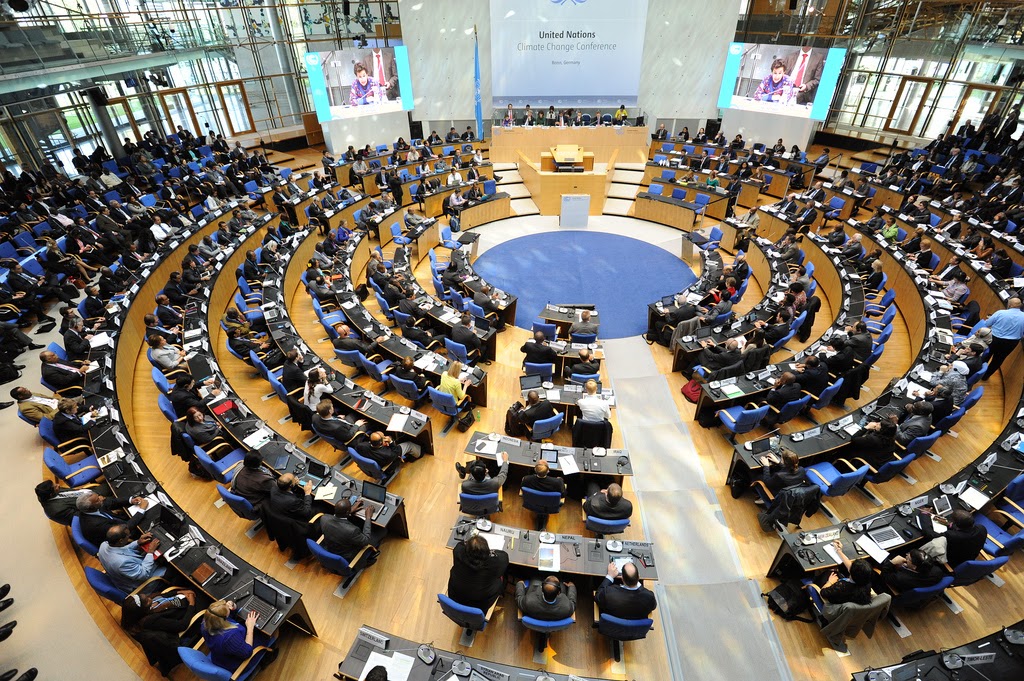
United Nations27 September 2014: During days three and four of the UN General Assembly (UNGA) General Debate 2014, many speakers addressed climate change. Speakers focused on international and national action, including transitions to renewable energy, and financing. Small island developing States (SIDS) particularly urged action, emphasizing they are already experiencing adverse effects on food and water security, biodiversity and oceans.


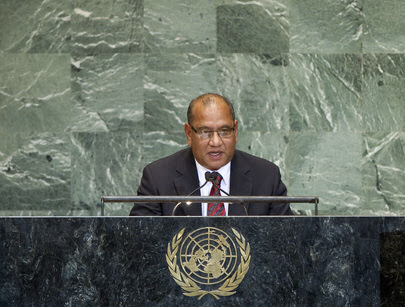
“Some members have criticized us for focusing too much on climate change and sea level rise, but these issues influence our every decision and affect every aspect of life on our islands,” said Christopher J. Loeak, President of the Marshall Islands, stressing that small island countries cannot afford to speak of climate change as a future threat. Tuilaepa Sailele Malielegaoi, Prime Minister of Samoa, underscored that apportioning blame serves no useful purpose, saying “those who exploit the traditional divide between developed and developing countries and ideological and political differences do so conveniently to mask their unwillingness to be part of the solution to an impending global catastrophe.” He suggested viewing the world as a single constituency where everyone must work together within the limits of their capacity and capability to address climate change. Charles Angelo Savarin, President of Dominica, Anote Tong, President of Kiribati, and Malielegaoi emphasized climate change is not an event in the future but an issue SIDS are already experiencing.


Several speakers commended the Climate Summit, welcoming its political momentum. Tong, Ikililou Dhoinine, President of the Comoros, Enele Sosene Sopoga, Prime Minister of Tuvalu, and Carlos Raúl Morales, Minister for Foreign Affairs of Guatemala, called for translating Summit commitments into action. Malielegaoi said the Summit underscored that the world is focusing more on symptoms of climate change than on the root causes.


Many supported a global, legally binding agreement on climate change by 2015, including Donald Rabindranauth Ramotar, President of Guyana, Tomislav Nikolić, President of Serbia, Alpha Condé, President of Guinea, Lubomír Zaorálek, Minister for Foreign Affairs of the Czech Republic, Salva Kiir, President of South Sudan, Frank-Walter Steinmeier, Minister for Foreign Affairs of Germany, Tong and Savarin. Malielegaoi said the agreement should be ambitious, effective, binding and capable of swift implementation. Hifikepunye Pohamba, President of Namibia, supported a coordinated global agreement. Denis Sassou Nguesso, President of the Republic of Congo, supported a binding agreement that included adaptation. Sopoga said a new protocol must: curb greenhouse gas (GHG) emissions; keep average temperature well below 1.5 degrees Celsius; include loss and damage and insurance mechanisms for SIDS; and provide adequate and accessible financing for SIDS' adaption support.


Noting Luxembourg will assume the Presidency of the Council of the EU in the second semester of 2015, Xavier Bettel, Prime Minister of Luxembourg, said his country would “spare no effort” to find an international agreement on climate, applicable to all countries, with the objective of keeping global warming below two degrees.


Sushil Koirala, Prime Minister of Nepal, supported a binding agreement on climate change with long-term and comprehensive global commitment based on common but differentiated responsibilities (CBDR), equity and respective capabilities. King Tupou VI of Tonga emphasized CBDR and equity principles.


Catherine Samba-Panza, President of the Transitional Government of the Central African Republic, urged ratification of the Doha amendment to the Kyoto Protocol.


Several speakers outlined national action on climate change, including Pohamba, Gjorge Ivanov, President of Macedonia, and Erlan A. Idrissov, Minister for Foreign Affairs of Kazakhstan. Bettel said the EU will present additional contributions to reduce GHG emissions and mitigate climate change, in accordance with the timetable agreed in Warsaw, Poland. At the national level, Bettel said Luxembourg is supporting carbon pricing.


Tong, Loeak and Tupou highlighted national action on adaptation and integrated disaster risk management (DRM). Tong said Kiribati's ‘migration with dignity' strategy is an investment in youth education to allow them to develop employable skills so that they can migrate to other countries voluntarily.


Several countries mentioned renewable energy efforts as part of contributions to addressing climate change, including Steinmeier, Sopoga, Nicos Anastasiades, President of Cyprus, Tomislav Nikolić, President of Serbia, and Morales. Savarin and Loeak described their efforts to increase renewable energy, including through SIDS DOCK, a platform for the development of sustainable energy in SIDS. Erlan A. Idrissov, Minister for Foreign Affairs of Kazakhstan, highlighted the promotion of best practices in sustainable energy, noting it is launching a project on the installation of biogas systems in nine Pacific SIDS. Sheikh Abdullah Bin Zayed Al Nahyan, Minister for Foreign Affairs of the United Arab Emirates (UAE), described his country's efforts and investments in renewable energy throughout the world. Muhammad Nawaz Sharif, Prime Minister of Pakistan, said his country's goals are aligned with the Sustainable Energy for All (SE4ALL) Initiative.


Emanuel Mori, President, Federated States of Micronesia, described its proposal to amend the Montreal Protocol to phase down the production and consumption of hydrofluorocarbons (HFCs), which are GHGs, to prevent temperature increases. He stressed success with the Montreal Protocol over the next six months is “our ticket to a successful outcome in Paris” and urged adoption of the HFC amendment.


On climate financing, Loeak urged the full capitalization of the Green Climate Fund (GCF) and other financial mechanisms to address climate change and support the post-2015 agenda. He applauded nations who have pledged specific amounts and urged delivery of real money by major economic powers who he said are also major polluters. Sopoga stressed adequate resources for the GCF, particularly access for SIDS. Nguesso identified innovative financing, technology transfer and capitalization of the GCF as critical. Koirala, Bangladesh and Serbia stressed financing for adaptation, with Koirala saying there should be special provisions for addressing least developed countries (LDCs) and SIDS mitigation and adaptation needs in additional to regular official development assistance (ODA). Bangladesh also recommended adequate, predictable and additional climate finance, support for capacity and institution building and access to locally adaptable technologies.


Bettel highlighted Luxembourg's contribution of 5 million Euros to the GCF, which is new and additional to its ODA. Steinmeier stated Germany's commitment of US$1 billion to the GCF.


Climate change should be included in the post-2015 agenda, according to Savarin and Morales. Sopoga supported a standalone Sustainable Development Goal (SDG) on climate change. Idrissov and San Marino highlighted links between climate change and sustainable development. Bangladesh reiterated the need to integrate the UNFCCC, DRR and SDG processes.


Tupou and Sopoga underscored the link between climate change and peace and security, with Tupou advocating for Ban to appoint a Special Representative on Climate and Security and Sopoga supporting addressing climate change and security through the UN Security Council. More


[UNGA General Debate 26 September 2014] [UNGA General Debate 27 September 2014] [UN Press Release on SIDS]


UNGA General Debate 2014 Addresses Climate Agreement, Financing, SIDS


United Nations27 September 2014: During days three and four of the UN General Assembly (UNGA) General Debate 2014, many speakers addressed climate change. Speakers focused on international and national action, including transitions to renewable energy, and financing. Small island developing States (SIDS) particularly urged action, emphasizing they are already experiencing adverse effects on food and water security, biodiversity and oceans.


“Some members have criticized us for focusing too much on climate change and sea level rise, but these issues influence our every decision and affect every aspect of life on our islands,” said Christopher J. Loeak, President of the Marshall Islands, stressing that small island countries cannot afford to speak of climate change as a future threat. Tuilaepa Sailele Malielegaoi, Prime Minister of Samoa, underscored that apportioning blame serves no useful purpose, saying “those who exploit the traditional divide between developed and developing countries and ideological and political differences do so conveniently to mask their unwillingness to be part of the solution to an impending global catastrophe.” He suggested viewing the world as a single constituency where everyone must work together within the limits of their capacity and capability to address climate change. Charles Angelo Savarin, President of Dominica, Anote Tong, President of Kiribati, and Malielegaoi emphasized climate change is not an event in the future but an issue SIDS are already experiencing.


Several speakers commended the Climate Summit, welcoming its political momentum. Tong, Ikililou Dhoinine, President of the Comoros, Enele Sosene Sopoga, Prime Minister of Tuvalu, and Carlos Raúl Morales, Minister for Foreign Affairs of Guatemala, called for translating Summit commitments into action. Malielegaoi said the Summit underscored that the world is focusing more on symptoms of climate change than on the root causes.


Many supported a global, legally binding agreement on climate change by 2015, including Donald Rabindranauth Ramotar, President of Guyana, Tomislav Nikolić, President of Serbia, Alpha Condé, President of Guinea, Lubomír Zaorálek, Minister for Foreign Affairs of the Czech Republic, Salva Kiir, President of South Sudan, Frank-Walter Steinmeier, Minister for Foreign Affairs of Germany, Tong and Savarin. Malielegaoi said the agreement should be ambitious, effective, binding and capable of swift implementation. Hifikepunye Pohamba, President of Namibia, supported a coordinated global agreement. Denis Sassou Nguesso, President of the Republic of Congo, supported a binding agreement that included adaptation. Sopoga said a new protocol must: curb greenhouse gas (GHG) emissions; keep average temperature well below 1.5 degrees Celsius; include loss and damage and insurance mechanisms for SIDS; and provide adequate and accessible financing for SIDS' adaption support.


Noting Luxembourg will assume the Presidency of the Council of the EU in the second semester of 2015, Xavier Bettel, Prime Minister of Luxembourg, said his country would “spare no effort” to find an international agreement on climate, applicable to all countries, with the objective of keeping global warming below two degrees.


Sushil Koirala, Prime Minister of Nepal, supported a binding agreement on climate change with long-term and comprehensive global commitment based on common but differentiated responsibilities (CBDR), equity and respective capabilities. King Tupou VI of Tonga emphasized CBDR and equity principles.


Catherine Samba-Panza, President of the Transitional Government of the Central African Republic, urged ratification of the Doha amendment to the Kyoto Protocol.


Several speakers outlined national action on climate change, including Pohamba, Gjorge Ivanov, President of Macedonia, and Erlan A. Idrissov, Minister for Foreign Affairs of Kazakhstan. Bettel said the EU will present additional contributions to reduce GHG emissions and mitigate climate change, in accordance with the timetable agreed in Warsaw, Poland. At the national level, Bettel said Luxembourg is supporting carbon pricing.


Tong, Loeak and Tupou highlighted national action on adaptation and integrated disaster risk management (DRM). Tong said Kiribati's ‘migration with dignity' strategy is an investment in youth education to allow them to develop employable skills so that they can migrate to other countries voluntarily.


Several countries mentioned renewable energy efforts as part of contributions to addressing climate change, including Steinmeier, Sopoga, Nicos Anastasiades, President of Cyprus, Tomislav Nikolić, President of Serbia, and Morales. Savarin and Loeak described their efforts to increase renewable energy, including through SIDS DOCK, a platform for the development of sustainable energy in SIDS. Erlan A. Idrissov, Minister for Foreign Affairs of Kazakhstan, highlighted the promotion of best practices in sustainable energy, noting it is launching a project on the installation of biogas systems in nine Pacific SIDS. Sheikh Abdullah Bin Zayed Al Nahyan, Minister for Foreign Affairs of the United Arab Emirates (UAE), described his country's efforts and investments in renewable energy throughout the world. Muhammad Nawaz Sharif, Prime Minister of Pakistan, said his country's goals are aligned with the Sustainable Energy for All (SE4ALL) Initiative.


Emanuel Mori, President, Federated States of Micronesia, described its proposal to amend the Montreal Protocol to phase down the production and consumption of hydrofluorocarbons (HFCs), which are GHGs, to prevent temperature increases. He stressed success with the Montreal Protocol over the next six months is “our ticket to a successful outcome in Paris” and urged adoption of the HFC amendment.


On climate financing, Loeak urged the full capitalization of the Green Climate Fund (GCF) and other financial mechanisms to address climate change and support the post-2015 agenda. He applauded nations who have pledged specific amounts and urged delivery of real money by major economic powers who he said are also major polluters. Sopoga stressed adequate resources for the GCF, particularly access for SIDS. Nguesso identified innovative financing, technology transfer and capitalization of the GCF as critical. Koirala, Bangladesh and Serbia stressed financing for adaptation, with Koirala saying there should be special provisions for addressing least developed countries (LDCs) and SIDS mitigation and adaptation needs in additional to regular official development assistance (ODA). Bangladesh also recommended adequate, predictable and additional climate finance, support for capacity and institution building and access to locally adaptable technologies.


Bettel highlighted Luxembourg's contribution of 5 million Euros to the GCF, which is new and additional to its ODA. Steinmeier stated Germany's commitment of US$1 billion to the GCF.


Climate change should be included in the post-2015 agenda, according to Savarin and Morales. Sopoga supported a standalone Sustainable Development Goal (SDG) on climate change. Idrissov and San Marino highlighted links between climate change and sustainable development. Bangladesh reiterated the need to integrate the UNFCCC, DRR and SDG processes.


Tupou and Sopoga underscored the link between climate change and peace and security, with Tupou advocating for Ban to appoint a Special Representative on Climate and Security and Sopoga supporting addressing climate change and security through the UN Security Council. More


[UNGA General Debate 26 September 2014] [UNGA General Debate 27 September 2014] [UN Press Release on SIDS]


Online Course: Climate Change Science and Negotiations

Climate Change Science and Negotiation


Course Summary


Humanity has just about run out of time to address climate change. Scientists have pointed out that a rise in mean surface temperature of 2º Celsius above pre-industrial levels will put the Earth in dangerous, uncharted territory. Yet we currently are on a path toward an increase of 4º or more this century. The last chance for action has arrived. That chance lies in Paris in December 2015. Either governments will agree to decisive action, as they have promised, or we will look back at 2015 as the year when climate sanity slipped through our fingers.

Fortunately, solutions exist to deeply decarbonize the global energy systems, and put the world on a 2°C pathway: improvements in energy efficiency in the building, transport and industry sectors; the generation of low-carbon electricity, through a mix of renewable energies (wind, solar), nuclear, and fossil fuels with Carbon Capture and Sequestration (CCS); and the shift to low-carbon energy carriers in energy end-use sectors, such as electric vehicles.

“Climate Change Science and Negotiations” is a two-semester course, with the first semester launching in fall 2014. During the first semester, you will learn about these solutions, and how they can be applied in different national contexts, based on the results from the Deep Decarbonization Pathways Project (DDPP), a global initiative to show how countries can transition to a low carbon economy by 2050, and how the world can stay within the 2°C limit.

The second semester of the course, which will open for registration in late fall 2014, will be a dynamic online climate change negotiation. The negotiation will be modeled on the real negotiations under the United Nations Framework Convention on Climate Change (UNFCCC), which are scheduled to reach an agreement in Paris in December 2015, at the 21st Conference of the Parties (COP21). The outcomes of the second semester simulated negotiations will be presented to global leaders in advance of COP21.

We need you to show the world how an ambitious, fair and effective global agreement on climate change can be achieved. More