Did US intelligence tie Israel to 9/11?

Jonathan Cook

29 AUGUST 2014 Good to have Justin Raimondo at Anti-war.com set out the hugely suppressed but growing indicators that Israeli intelligence knew of the 9/11 attacks but failed to alert the Americans (while the Saudis were probably more directly involved in the attacks).

The definitive evidence is likely to be found in the censored 28 pages of the joint report of the intelligence committees of the two houses of Congress, as Raimondo highlights.

As to the Israeli interests at work in allowing 9/11 to take place, Raimondo misses revealing comments made by the two most senior Israeli intelligence officials at the time, statements I noted in my book “Israel and the Clash of Civilisations” (p. 103):

Israel’s National Security Adviser, General Uzi Dayan, and the head of the Mossad, Ephraim Halevy … reportedly told that year’s Herzliya conference [in 2001] that the 9/11 attacks were a ‘Hanukkah miracle’, offering Israel the chance to sideline and punish its enemies. Halevy spoke of the imminent arrival of ‘a world war different from all its predecessors’ and the emergence after 9/11 of a common perception combining ‘all the elements of Islamic terror into one clear and identifi able format’, creating ‘a genuine dilemma for every ruler and every state in our region. Each one must reach a moment of truth and decide how he will position himself in the campaign.’

Dayan, meanwhile, identified the targets, after Afghanistan, for the next stage of the regional campaign: ‘The Iran, Iraq and Syria triangle, all veteran supporters of terror which are developing weapons of mass destruction.’ He argued: ‘They must be confronted as soon as possible, and that is also understood in the US. Hezbollah and Syria have good reason to worry about the developments in this campaign, and that’s also true for the organizations and other states.’

Sounds like a rather accurate prediction of how things turned out, no?

The Haaretz article on 18 Dec 2001 that quoted the pair, written by Aluf Benn, now the paper’s editor-in-chief, was originally titled “For Israel, September 11 was a Hanukkah miracle”. The version on Haaretz that can now be found has excised all references to “Hanukkah” and “miracles”, and is under the much blander – and misleading – headline “Israel strives to import America’s war on terror“.

More likely, as I explain in my book, Israel tried to export to Washington, care of the neocons, its own “war on terror” – and its long-term designs for breaking up the Middle East into feuding sects and tribes. More

http://original.antiwar.com/justin/2014/08/28/did-certain-foreign-governments-facilitate-the-911-attacks/


When fear changed sides – Quand la peur change de camp

Thoughts on the Arab revolutions – Réflexions sur les révolutions arabes…

The organization abbreviated as ISIS (Islamic State in Iraq and Syria) is not new in the region, nor is it a newfound expression of the crises afflicting Arab societies at a moment of profound transformations, initiated by 2011 revolutions.

To the contrary, ISIS is the offspring of more than one father, and the product of more than one longstanding and widespread sickness. The organization’s explosive growth today is in fact the result of previously existing, worsening conflicts that were caused by the different fathers.

ISIS is first the child of despotism in the most heinous form that has plagued the region. Therefore, it is no coincidence that we see its base, its source of strength concentrated in Iraq and Syria, where Saddam Hussein and Hafez and Bashar Al-Assad reigned for decades, killing hundreds of thousands of people, destroying political life, and deepening sectarianism by transforming it into a mechanism of exclusion and polarization, to the point that injustices and crimes against humanity became commonplace.

ISIS is second the progeny of the American invasion of Iraq in 2003, both the way in which it was initially conducted and the catastrophic mismanagement that followed. Specifically, it was the exclusion of a wide swath of Iraqis from post invasion political processes and the formation of a new authority that discriminated against them and held them collectively at fault for the guilt of Saddam and his party, which together enabled groups (such as those first established by Abu Musab al-Zarqawi) whose activities have been resumed by ISIS to get in touch with some parts of Iraqi society and to establish itself among them.

ISIS is third the son of Iranian aggressive regional policies that have worsened in recent years — taking Iraq, Lebanon, and Syria as its backyard, feeding (directly or indirectly) confessional divisions and making these divides the backbone of ideological mobilization and a policy of revenge and retaliation that has constructed a destructive feedback loop.

ISIS is fourth the child of some of the Salafist networks in the Gulf (in Saudi Arabia and other states), which emerged and developed throughout the 1980s, following the oil boom and the “Afghan jihad”. These networks have continued to operate and expand throughout the last two decades under various names, all in the interest of extremism and obscurantism.

ISIS is fifth the offspring of a profound crisis, deeply rooted in the thinking of some Islamist groups seeking to escape from their terrible failure to confront the challenges of the present toward a delusional model ostensibly taken from the seventh century, believing that they have found within its imaginary folds the answer to all contemporary or future questions.

ISIS is sixth the progeny of violence, or of an environment that has been subjected to striking brutality, which has allowed the growth of this disease and facilitated the emergence of what could be called “ISISism”. Like Iraq previously, Syria today has been abandoned beneath explosive barrels to become a laboratory, a testing ground for violence, daily massacres and their outcomes.

ISIS, an abominable, savage creature, is thus the product of at least these six fathers. Its persistency depends on the continuation of these aforementioned elements, particularly the element of violence embodied by the Assad regime in Syria. Those who think that they should be impartial toward or even support tyrants like Assad in the fight against ISISism fail to realize that his regime is in fact at the root of the problem.

Until this fact is recognized — that despotism is the disease and not the cure — we can only expect more deadly repercussions, from the Middle East to the distant corners of the globe… More


Tomgram: Patrick Cockburn, How to Ensure a Thriving Caliphate

Think of the new “caliphate” of the Islamic State, formerly the Islamic State in Iraq and Syria (ISIS), as George W. Bush and Dick Cheney's gift to the world (with a helping hand from the Saudis and other financiers of extremism in the Persian Gulf). How strange that they get so little credit for its rise, for the fact that the outlines of the Middle East, as set up by Europe’s colonial powers in the wake of World War I, are being swept aside in a tide of blood.

Had George and Dick not decided on their “cakewalk” in Iraq, had they not raised the specter of nuclear destruction and claimed that Saddam Hussein’s regime was somehow linked to al-Qaeda and so to the 9/11 attacks, had they not sent tens of thousands of American troops into a burning, looted Baghdad (“stuff happens”), disbanded the Iraqi army, built military bases all over that country, and generally indulged their geopolitical fantasies about dominating the oil heartlands of the planet for eternity, ISIS would have been an unlikely possibility, no matter the ethnic and religious tensions in the region. They essentially launched the drive that broke state power there and created the kind of vacuum that a movement like ISIS was so horrifically well suited to fill.

All in all, it’s a remarkable accomplishment to look back on. In September 2001, when George and Dick launched their “Global War on Terror” to wipe out — so they then claimed — “terrorist networks” in up to 60 countries, or as they preferred to put it, “drain the swamp,” there were scattered bands of jihadis globally, while al-Qaeda had a couple of camps in Afghanistan and a sprinkling of supporters elsewhere. Today, in the wake of the invasions of Afghanistan and Iraq and an air power intervention in Libya, after years of drone (and non-drone) bombing campaigns across the Greater Middle East, jihadist groups are thriving in Yemen and Pakistan, spreading through Africa (along with the U.S. military), and ISIS has taken significant parts of Iraq and Syria right up to the Lebanese border for its own bailiwick and is still expanding murderously, despite a renewed American bombing campaign that may only strengthen that movement in the long run.

Has anyone covered this nightmare better than the world’s least embedded reporter, Patrick Cockburn of the British Independent? Not for my money. He’s had the canniest, clearest-eyed view of developments in the region for years now. As it happens, when he publishes a new book on the Middle East (the last time was 2008), he makes one of his rare appearances at TomDispatch. This month, his latest must-read work, The Jihadis Return: ISIS and the New Sunni Uprising, is out. Today, this website has an excerpt from its first chapter on why the war on terror was such a failure (and why, if Washington was insistent on invading someplace, it probably should have chosen Saudi Arabia). It includes a special introductory section written just for TomDispatch. Thanks go to his publisher, OR Books. Tom

Why Washington’s War on Terror Failed

The Underrated Saudi Connection

By Patrick Cockburn

[This essay is excerpted from the first chapter of Patrick Cockburn’s new book, The Jihadis Return: ISIS and the New Sunni Uprising, with special thanks to his publisher, OR Books. The first section is a new introduction written for TomDispatch.]

There are extraordinary elements in the present U.S. policy in Iraq and Syria that are attracting surprisingly little attention. In Iraq, the U.S. is carrying out air strikes and sending in advisers and trainers to help beat back the advance of the Islamic State of Iraq and the Levant (better known as ISIS) on the Kurdish capital, Erbil. The U.S. would presumably do the same if ISIS surrounds or attacks Baghdad. But in Syria, Washington’s policy is the exact opposite: there the main opponent of ISIS is the Syrian government and the Syrian Kurds in their northern enclaves. Both are under attack from ISIS, which has taken about a third of the country, including most of its oil and gas production facilities.

But U.S., Western European, Saudi, and Arab Gulf policy is to overthrow President Bashar al-Assad, which happens to be the policy of ISIS and other jihadis in Syria. If Assad goes, then ISIS will be the beneficiary, since it is either defeating or absorbing the rest of the Syrian armed opposition. There is a pretense in Washington and elsewhere that there exists a “moderate” Syrian opposition being helped by the U.S., Qatar, Turkey, and the Saudis. It is, however, weak and getting more so by the day. Soon the new caliphate may stretch from the Iranian border to the Mediterranean and the only force that can possibly stop this from happening is the Syrian army.

The reality of U.S. policy is to support the government of Iraq, but not Syria, against ISIS. But one reason that group has been able to grow so strong in Iraq is that it can draw on its resources and fighters in Syria. Not everything that went wrong in Iraq was the fault of Prime Minister Nouri al-Maliki, as has now become the political and media consensus in the West. Iraqi politicians have been telling me for the last two years that foreign backing for the Sunni revolt in Syria would inevitably destabilize their country as well. This has now happened.

By continuing these contradictory policies in two countries, the U.S. has ensured that ISIS can reinforce its fighters in Iraq from Syria and vice versa. So far, Washington has been successful in escaping blame for the rise of ISIS by putting all the blame on the Iraqi government. In fact, it has created a situation in which ISIS can survive and may well flourish.

Using the al-Qa'ida Label

The sharp increase in the strength and reach of jihadist organizations in Syria and Iraq has generally been unacknowledged until recently by politicians and media in the West. A primary reason for this is that Western governments and their security forces narrowly define the jihadist threat as those forces directly controlled by al-Qa‘ida central or “core” al-Qa‘ida. This enables them to present a much more cheerful picture of their successes in the so-called war on terror than the situation on the ground warrants.

In fact, the idea that the only jihadis to be worried about are those with the official blessing of al-Qa‘ida is naïve and self-deceiving. It ignores the fact, for instance, that ISIS has been criticized by the al-Qa‘ida leader Ayman al-Zawahiri for its excessive violence and sectarianism. After talking to a range of Syrian jihadi rebels not directly affiliated with al-Qa‘ida in southeast Turkey earlier this year, a source told me that “without exception they all expressed enthusiasm for the 9/11 attacks and hoped the same thing would happen in Europe as well as the U.S.”

Jihadi groups ideologically close to al-Qa‘ida have been relabeled as moderate if their actions are deemed supportive of U.S. policy aims. In Syria, the Americans backed a plan by Saudi Arabia to build up a “Southern Front” based in Jordan that would be hostile to the Assad government in Damascus, and simultaneously hostile to al-Qa‘ida-type rebels in the north and east. The powerful but supposedly moderate Yarmouk Brigade, reportedly the planned recipient of anti-aircraft missiles from Saudi Arabia, was intended to be the leading element in this new formation. But numerous videos show that the Yarmouk Brigade has frequently fought in collaboration with JAN, the official al-Qa‘ida affiliate. Since it was likely that, in the midst of battle, these two groups would share their munitions, Washington was effectively allowing advanced weaponry to be handed over to its deadliest enemy. Iraqi officials confirm that they have captured sophisticated arms from ISIS fighters in Iraq that were originally supplied by outside powers to forces considered to be anti-al-Qa‘ida in Syria. More


How Israel’s lies are used to justify mass slaughter of civilians in Gaza

Israel's lies make it clear to the Palestinians that it will continue to wage a campaign of state terror and will never admit its atrocities or its intentions.


ALL GOVERNMENTS lie, including Israel and Hamas. But Israel engages in the kinds of jaw-dropping lies that characterize despotic and totalitarian regimes.


It does not deform the truth; it inverts it. It routinely paints a picture for the outside world that is diametrically opposed to reality. And all of us reporters who have covered the occupied territories have run into Israel's Alice-in-Wonderland narratives, which we dutifully insert into our stories — required under the rules of American journalism — although we know they are untrue.


I saw small boys baited and killed by Israeli soldiers in the Gaza refugee camp of Khan Younis. The soldiers swore at the boys in Arabic over the loudspeakers of their armored jeep. The boys, about 10 years old, then threw stones at an Israeli vehicle and the soldiers opened fire, killing some, wounding others. I was present more than once as Israeli troops drew out and shot Palestinian children in this way.


Such incidents, in the Israeli lexicon, become children caught in crossfire.


I was in Gaza when F-16 attack jets dropped 1,000-pound iron fragmentation bombs on overcrowded hovels in Gaza City. I saw the corpses of the victims, including children. This became a surgical strike on a bomb-making factory.


I have watched Israel demolish homes and entire apartment blocks to create wide buffer zones between the Palestinians and the Israeli troops that ring Gaza. I have interviewed the destitute and homeless families, some camped out in crude shelters erected in the rubble. The destruction becomes the demolition of the homes of terrorists.


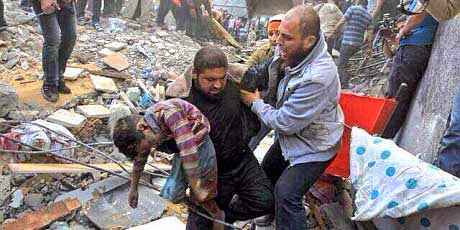
I have stood in the remains of schools — Israel struck two United Nations schools in the last six days, causing at least 10 fatalities at one in Rafah on Sunday and at least 19 at one in the Jebaliya refugee camp Wednesday — as well as medical clinics and mosques. I have heard Israel claim that errant rockets or mortar fire from the Palestinians caused these and other deaths, or that the attacked spots were being used as arms depots or launching sites.


I, along with every other reporter I know who has worked in Gaza, have never seen any evidence that Hamas uses civilians as “human shields.”


There is a perverted logic to Israel's repeated use of the Big Lie — the lie favored by tyrants from Josef Stalin to Saddam Hussein. The Big Lie feeds the two reactions Israel seeks to elicit — racism among its supporters and terror among its victims.


By painting a picture of an army that never attacks civilians, that indeed goes out of its way to protect them, the Big Lie says Israelis are civilized and humane, and their Palestinian opponents are inhuman monsters.


The Big Lie serves the idea that the slaughter in Gaza is a clash of civilizations, a war between democracy, decency and honor on one side and Islamic barbarism on the other. And in the uncommon cases when news of atrocities penetrates to the wider public, Israel blames the destruction and casualties on Hamas.


George Orwell in his novel “Nineteen Eighty-Four” called this form of propaganda doublethink. Doublethink uses “logic against logic” and “repudiate[s] morality while laying claim to it.”


The Big Lie does not allow for the nuances and contradictions that can plague conscience. It is a state-orchestrated response to the dilemma of cognitive dissonance. The Big Lie permits no gray zones. The world is black and white, good and evil, righteous and unrighteous.


The Big Lie allows believers to take comfort — a comfort they are desperately seeking — in their own moral superiority at the very moment they have abrogated all morality.


The Big Lie, as the father of American public relations, Edward Bernays, wrote, is limited only by the propagandist's capacity to fathom and harness the undercurrents of individual and mass psychology. And since most supporters of Israel do not have a desire to know the truth, a truth that would force them to examine their own racism and self-delusions about Zionist and Western moral superiority, like packs of famished dogs they lap up the lies fed to them by the Israeli government.


But the Big Lie is also consciously designed to send a chilling message to Gaza's Palestinians, who have lost large numbers of their dwellings, clinics, mosques, and power, water and sewage facilities, along with schools and hospitals, who have suffered some 1,850 deaths since this assault began — most of the victims women and children — and who have seen 400,000 people displaced from their homes.


The Big Lie makes it clear to the Palestinians that Israel will continue to wage a campaign of state terror and will never admit its atrocities or its intentions. The vast disparity between what Israel says and what Israel does tells the Palestinians that there is no hope. Israel will do and say whatever it wants. International law, like the truth, will always be irrelevant. There will never, the Palestinians understand from the Big Lie, be an acknowledgement of reality by the Israeli leadership.


The Israel Defense Forces website is replete with this black propaganda. “Hamas exploits the IDF's sensitivity towards protecting civilian structures, particularly holy sites, by hiding command centers, weapons caches and tunnel entrances in mosques,” the IDF site reads. “In Hamas' world, hospitals are command centers, ambulances are transport vehicles, and medics are human shields,” the site insists.


“… [Israeli] officers are tasked with an enormous responsibility: to protect Palestinian civilians on the ground, no matter how difficult that may be,” the site assures its viewers. And the IDF site provides this quote from a drone operator identified as Lt. Or. “I have personally seen rockets fired at Israel from hospitals and schools, but we couldn't strike back because of civilians nearby. In one instance, we acquired a target but we saw that there were children in the area. We waited around, and when they didn't leave we were forced to abort a strike on an important target.”


Israel's ambassador to the United States, Ron Dermer, in a Big Lie of his own, said last month at a conference of Christians United for Israel that the Israeli army should be given the “Nobel Peace Prize … a Nobel Peace Prize for fighting with unimaginable restraint.”


The Big Lie destroys any possibility of history and therefore any hope for a dialogue between antagonistic parties that can be grounded in truth and reality.


And when facts no longer matter, when there is no shared history grounded in the truth, when people foolishly believe their own lies, there can be no useful exchange of information.


The Big Lie, used like a bludgeon by Israel, as perhaps it is designed to be, ultimately reduces all problems in the world to the brutish language of violence. And when oppressed people are addressed only through violence they will answer only through violence. More


Sifting through the wreckage of MH17, searching for sense amid the horror

Any journalist should hesitate before saying this, but news can be bad for you. You don’t have to agree with the analyst who reckons “news is to the mind what sugar is to the body” to see that reading of horror and foreboding hour by hour, day after day, can sap the soul.

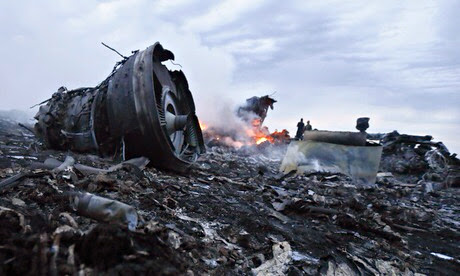
This week ended with a double dose, administered within the space of a few hours: Israel’s ground incursion into Gaza and, more shocking because entirely unexpected, the downing of Malaysia Airlines flight MH17 over Ukraine, killing all 298 on board.

So in Gaza we look at the wildly lopsided death tolls – nearly 300 Palestinians and two Israelis killed these past nine days.

The different responses these events stir in those of us who are distant, and the strategies we devise to cope with them, say much about our behaviour as consumers of news. But they also go some way to determining our reaction as citizens, as constituent members of the amorphous body we call public, or even world, opinion.

As I write, 18 of the 20 most-read articles on the Guardian website are about MH17. The entry into Gaza by Israeli forces stands at number 21. It’s not hard to fathom why the Malaysian jet strikes the louder chord. As the preacher might put it, “There but for the grace of God go I.” Stated baldly, most of us will never live in Gaza, but we know it could have been us boarding that plane in Amsterdam.

Which is why there is a morbid fascination with tales of the passenger who changed flights at the last minute, thereby cheating death, or with the crew member who made the opposite move, hastily switching to MH17 at the final moment, taking a decision that would have seemed so trivial at the time but which cost him his life. When we read about the debris – the holiday guidebooks strewn over the Ukrainian countryside, the man found next to an iPhone, the boy with his seatbelt still on – our imaginations put us on that flight. Of course we have sympathy for the victims and their families. But our fear is for ourselves.

It’s quite true that if the US truly decided that Israel’s 47-year occupation of Palestinian territory was no longer acceptable, that would bring change.

The reports from Gaza stir a different feeling. When we read the Guardian’s Peter Beaumont describe the sights he saw driving around the strip on Friday morningthree Palestinian siblings killed by an Israeli artillery shell that crashed into their bedroom, a father putting the remains of his two-year-old son into a plastic shopping bag – we are shaken by a different kind of horror. It is compassion for another human being, someone in a situation utterly different to ours. We don’t worry that this might happen to us, as we now might when we contemplate an international flight over a war zone. Our reaction is directed not inward, but outward. More

There is an interesting article by Chris Hedges entitled It's NOT going to be OK on the current economic disparity which, he believes could lead to a drastic decline in democracy as states respond to social protests. The question I ask is what can be done to slow or erradicate this process? Editor