The West’s Repeated Mistakes Over Eastern Europe

Something very similar is happening now in the countries east of the European Union and west of Russia. As the people of Ukraine’s Euromaidan protest movement showed in January 2014 on Kiev’s Independence Square, they were not going to accept a post–Cold War status quo in which Russia sets the agenda. They wanted to choose their own political path.
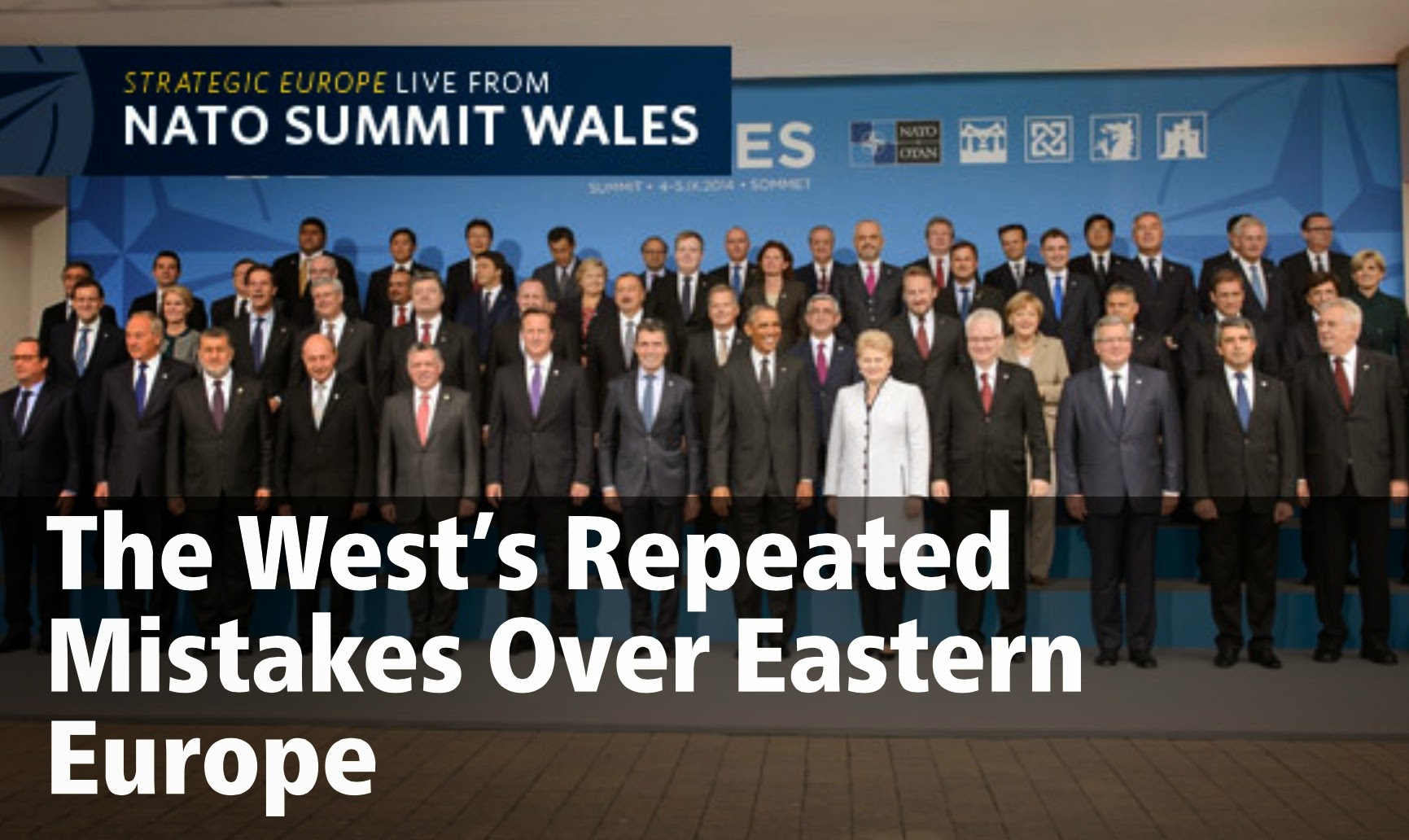
It seems that history is repeating itself. This time round, NATO is not prepared to help the countries in Europe’s East, while the EU is divided and weak over how to deal with Russian President Vladimir Putin’s invasion of eastern Ukraine and illegal annexation of Crimea in March.

During a press conference with Ukrainian President Petro Poroshenko on September 4 at the NATO summit in Wales, the alliance’s Secretary General Anders Fogh Rasmussen tried to put the best spin on NATO help to Ukraine. Since NATO is not prepared even to consider the idea of Ukraine one day becoming a member of the organization, Rasmussen—and indeed Poroshenko—didn’t mention the “m-word.”

“It is for the Ukrainian people to decide . . . [their] future relationship with NATO,” the secretary general said—as if Putin will allow that to happen.

Rasmussen did say that NATO allies had pledged to provide support to help Ukraine improve its own security. “Our support is concrete and tangible. . . . Ukraine has stood by NATO. Now in these difficult times, NATO stands by Ukraine.”

Rasmussen explained how the allies had established “a comprehensive and tailored package of measures” to help Ukraine. The focus of NATO support would be on four areas: rehabilitation for injured troops, cyberdefense, logistics, and command and control and communications. “And allies will assist Ukraine with around €15 million [$19 million] through NATO,” Rasmussen added. NATO would not be supplying weapons. But that won’t stop individual countries from doing so.

Above all, the NATO chief insisted that an independent, sovereign, and stable Ukraine firmly committed to democracy and the rule of law was key to Euro-Atlantic security. “We stand united in our support of Ukraine’s sovereignty and territorial integrity,” he said.

Actually, the West is only rhetorically united over Ukraine’s sovereignty and territorial integrity. Western nations have no real intentions of matching that statement with deeds to allow Ukraine to regain territory in eastern Ukraine that has been taken over by rebels backed by Russian troops and tanks—let alone Crimea.

As for the EU, it is prepared to impose more sanctions on Russia—but with many misgivings and criticisms from several member states, especially Hungary, Slovakia, and the Czech Republic. That is despite the fact that until twenty-five years ago, these countries were under the Soviet yoke.

The measures undertaken by NATO and the EU are insufficient because they perpetuate the new rules of the game that Putin is writing across Eastern Europe. And because the West’s responses give him no reason to desist, at least for the moment, Western countries are repeating the mistakes they made when Eastern European civil society reared its head during the Communist era. The West is not prepared to stand up to Putin’s Russia.

Instead, willy-nilly, the West is allowing a new cordon sanitaire of countries to take hold between Russia and the EU. But if Putin and European leaders believe that this buffer zone is going to represent a new, stable “post-post–Cold War” status quo, they are seriously mistaken.

The reason is that civil society across these countries, from Belarus to Armenia, will not accept these new demarcation lines on a permanent basis. Just as Poles challenged their country’s Communist regime in 1980, the same will happen across the states in Europe’s East.

That has already happened in Ukraine. And despite the war in eastern Ukraine and the continuing influence of the country’s oligarchs, the supporters of the Euromaidan are not prepared to let this revolution fail. They are not naive enough to believe that the EU and NATO will come to their rescue. Instead, against all the odds, they will continue to struggle for their freedom to choose their own political path. More


The Yuri Orlov File

Yuri Orlov

Human Rights Legend and Distinguished Physicist Turns 90

Founder of Moscow Helsinki Group Endured Gulag and Exile, Still Teaches at Cornell

Web Posting Includes KGB and Politburo Documents on Orlov’s Dissident Career, Declassified U.S. Reports on the Human Rights Challenge Orlov Faced, Complete Orlov Physics Publications List, First Publication in English of Orlov’s Historic 1956 Speech Criticizing the Communist Party, and Video of Orlov-Reagan White House Meeting from 1986

National Security Archive Electronic Briefing Book No. 482
Posted August 13, 2014

Compiled and edited by Svetlana Savranskaya and Tom Blanton
Editorial assistance by Anya Melyakova and Allison Brady
Special thanks to Sidney Orlov

For more information contact:
202/994-7000 or nsarchiv@gwu.edu

Washington, D.C., August 13, 2014 — Marking the 90th birthday of the human rights legend and distinguished physicist Yuri Orlov, the National Security Archive at George Washington University (www.nsarchive.org) and the Memorial Society in Moscow (www.memo.ru) today posted online an extensive collection of formerly secret Soviet and U.S. documents on Orlov’s career as a Soviet dissident, including the first English-language translation of his historic 1956 speech at his physics institute in Moscow, and his 1976 founding of the Moscow Helsinki Group.

The posting also includes Orlov’s complete publications list as a still-active research physicist, his 2009 Vernon Hughes Memorial Lecture at the Brookhaven National Laboratory, and never-before-published video of Orlov’s White House meeting with President Ronald Reagan in 1986.

The documents include detailed KGB, Communist Party Central Committee and Politburo documents, together with parallel CIA and White House assessments, that suggest how courageous human rights activism by leading Soviet scientists like Orlov as early as 1956 fundamentally threatened the repressive Soviet system while setting the stage for the late 1980s perestroika/glasnost period that ended the Cold War.

The documents show that through organizing the Moscow Helsinki Group (with Lyudmila Alexeyeva) in May 1976, Orlov institutionalized human rights monitoring based on the principles in the 1975 Helsinki Final Act, signed by the USSR and even published in Pravda. Multiple other Helsinki groups soon followed throughout Eastern and Western Europe, the U.S. and the Soviet Union, contributing enormous intellectual capital to the international human rights movement and to social processes that culminated in the peaceful revolutions of 1989. The Moscow Helsinki Group remains the oldest still-functioning human rights organization in Russia, and Orlov subsequently became honorary chairman of the International Helsinki Federation.

Check out today’s posting at the National Security Archive’s Website –http://www2.gwu.edu/~nsarchiv/NSAEBB/NSAEBB482/

Find us on Facebook – http://www.facebook.com/NSArchive

Unredacted, the Archive blog – http://nsarchive.wordpress.com/

________________________________________________________
THE NATIONAL SECURITY ARCHIVE is an independent non-governmental research institute and library located at The George Washington University in Washington, D.C. The Archive collects and publishes declassified documents acquired through the Freedom of Information Act (FOIA). A tax-exempt public charity, the Archive receives no U.S. government funding; its budget is supported by publication royalties and donations from foundations and individuals.


Russia’s Strategic Pakistan Play

Russia’s decision to go ahead with the sale of Mi-35 attack helicopters to Pakistan, even in the face of official Indian concerns, is being seen by some quarters as evidence of a “major” regional re-alignment in the wake of the American drawdown in Afghanistan.

In fact, the Russia-Pakistan dialogue for regional integration has been underway for some time now and beyond security cooperation, it is more fundamentally driven by Moscow’s push towards ‘southern” markets and Pakistan’s need for a capable yet politically “manageable” strategic sector trade and investment partner. The Mi-35 sale (if it does materialize) reflects the fact that the geo-economic stakes for both sides are now high enough for them to make a concerted push towards a long term compartmentalized working relationship in a manner not dissimilar to the way in which their more traditional partners – India for Russia and America for Pakistan – deal with each other. Indeed, in a world characterized by both competition and cooperation the heady rhetoric of “strategic partnership” means little and it is the transactional content that weighs on any relationship. Far more than cooperation in counter-terrorism, Russia and Pakistan will have to move forward quickly on Putin’s commitment to invest in the latter’s energy and metallurgy sectors for their relationship to be meaningful.

Mi-35

It could be argued that it was actually America’s entry into the region a decade ago that ultimately accentuated the circumstances that impel Russia and Pakistan closer to each other. Pakistan’s counter-terrorism cooperation with America salved with military aid has been toxic for domestic stability, as the situation in FATA and Waziristan reveal. As the tempo of internal stability operations has increased, Pakistan is keen to diversify away from America for certain classes of weaponry to a source that can supply cheaper and more rugged alternatives with a much smaller political price on the domestic front. The Mi-35 fits that bill and is likely to prove useful for Pakistani operations against the Tehrik-i-Taliban Pakistan (TTP) in mountainous areas, given its pedigree from the Afghan theater. At the moment Pakistan is using AH-1 Cobra Gunships that were originally obtained from America for use against Indian armoured formations in the plains and are proving expensive to use in operations against the TTP. Pakistan may not wish to be saddled with too much expensive American equipment that it can”t afford without generous aid.

Russia until recently was “reluctant” to transfer equipment that could be labelled as offensive in nature such as the Mi-35, and was holding back probably with an eye on a number of Indian military procurement tenders such as the multi-billion dollar medium multirole combat aircraft (MMRCA) competition. In 2010, Russia’s UAC, which was participating in the tender, even made noises about blocking the re-export of 150 KlimovRD-93 turbofans from China for Pakistan Air force’s future mainstay, the JF-17, on the grounds that it would compete with the Russian Mig-29 in international markets. By 2013, however, with Russia having lost out on the MMRCA tender and other Indian competitions, the Russians reiterated their commitment to continue supplies of the RD-93 and the JF-17 Block II commenced production in late 2013. So while much is being made of the Mi-35 sale, the fact is the Pakistanis seem set to rely on Russian engines for a majority of their fleet in the coming decades. When seen along with the fact that Russia supplied IL-78 MP refuelling tankers to Pakistan between 2009 and 2012, it is clear that comfort levels on both sides have been growing for quite a while now.

However, Russia is now willing to supply tactical equipment to Pakistan, especially in categories such as attack helicopters, where India either has domestic projects or may buy American. In many of these categories, though Pakistani spending ability given relatively cheaper Russian equipment is not insignificant, the pull for the Russians also comes from securing greater Pakistani willingness to help the Russians maintain security over energy infrastructure transiting areas like Eastern Afghanistan.

Once again, the American push to set up energy transit corridors from Central Asia to India such as the Turkmenistan-Afghanistan-Pakistan-India (TAPI) gas pipeline has created a situation of Russia-Pakistan commonality. Russia has for some time expressed an interest in joining the TAPI project and is now pushing decisively for it even while proposing new oil pipelines next to it. Russia is also eager to partner in the Iran-Pakistan-India pipeline project, opposed by the Americans, but with clear potential if Pakistan agrees to guarantee delivery of gas to the India border. Of course, besides military supplies, Russia can also offer Pakistan a lot of useful intelligence in the latter’s fight against the TTP given that group’s link with various Central Asian terrorist organizations.

For Pakistan, the opening of Russia as a source for weapons greatly increases Pakistan’s leg room vis-à-vis American pressure at the strategic level. Moreover while Pakistan is certainly eager to get involved in trilateral military projects with Russia and China like the JF-17 (which may now even be exported to Myanmar), direct Russian weapon sales are also coveted since the Pakistani military does not want to field only Chinese weapons either.

In fact, as terrorist activities in Xingjiang increase and Pakistan’s internal security situation worsens, the Chinese have been rather selective in their Pakistani investments. For instance, Pakistan’s decrepit railways have actually had to turn to India for help and are looking to lease up to 50 diesel engines as rolling stock. While Indian industry has been making overtures to Nawaz Sharif’s government to open up to cross border investment, the Pakistani military is still looking to a politically less sensitive prospect to shore up the flagging core sectors of the Pakistani economy clearly in need of reliable foreign capital.

Of course, if former Pakistani Army Chief General Kayani’s views are anything to go by, the military understands that there can be no Pakistan without a viable economy. While in uniform, it was Kayani who made a couple of visits to Russia and today the Russians are being wooed as a source for investment in Pakistan’s flagship Thar Coal Project as well as a strategic partner for upgrading the South Asian country’s moribund steel industry. Chechnya it seems is more distant than Kashmir or even Xingjiang and Russia could yet prove a politically acceptable partner for meeting an energy crisis ridden Pakistan’s requirements in quite a few sectors.

For Russia the benefits of succeeding in Pakistan are worth the risk, since it could leverage influence over Af-Pak to reach Indian shores. Indeed, even Pakistan’s Gwadar port, much touted as a Chinese “pearl” could actually host a LNG liquefaction facility that could send cheaper gas supplies than Qatar to import terminals in South India. However, both Russia and Pakistan will have to work quicker to remove long-standing trade disputes for a more conducive environment.

India will of course watch closely to see whether the Russians are indeed able to use the dependencies they are creating in Pakistan for closer regional energy integration. That the Russians are increasing strategic options for their neighbor when even the Saudis are handing over Lashkar-e-Taiba terrorists will obviously be of concern to New Delhi. That is especially so since the Pakistanis themselves are masters at selective counterterrorism at a time when many jihadists in Syria and Afghanistan may soon be looking for a re-direct.

Saurav Jha is a commentator on energy and security. Follow him on twitter @SJha1618.


Ukraine shows uselessness of NATO nukes in Europe

Many people in Germany, Belgium, and the Netherlands wonder why there are still US tactical nuclear weapons on their soil. These B-61 nuclear gravity bombs were stationed in Europe during the Cold War to deter the Soviet threat, but while this may (or may not) have once made sense, most pundits nowadays agree that at least from a military point of view, the weapons are irrelevant. More

Editorial

Given the tremendous damage the we humans have already done to the Earth, our home planet, the use of nuclear weapons in a conflict would be beyond insane.

We have already gone a long way to poisoning our atmosphere, making our oceans, one of the major sources of food, so acidic that we may be at a tipping point that will wipe out the shellfish and crustaceans that compose a large part of the ocean food chain. Fish stocks are in many areas depleted leading the FAO to suggest banning commercial fishing in some areas of some oceans.

We also have to face global heating which may bring with it changing rainfall patterns, which may lead to water and food shortages. Many inhabitants of our world are already living on barely enough food and water to keep them alive. Furthermore, the planetary population is growing and heading for nine billion by mid-century. Experts are questioning whether or not we will be able to feed this many.

We have to keep in mind that we have only this small fragile planet. A planet in a backwater of our local galaxy. There are no inhabitable worlds to go to nor the transport to get there on. If we do not take care and preserve our world, which will take a global effort to accomplish, the human race may perish. Think of your children and family members,your friends and colleagues If we use nuclear weapons all will certainly perish.

Chernobyl and Fukushima and all the nuclear testing carried out by the UN's P5 have spread more than enough nuclear pollution through the planet. A nuclear conflict would seal our fate.

Pope Francis said recently, “Even today we raise our hand against our brother… We have perfected our weapons, our conscience has fallen asleep, and we have sharpened our ideas to justify ourselves as if it were normal we continue to sow destruction, pain, death. Violence and war lead only to death”.

As H.H. 14th Dalai Lama said, “Peace does not mean an absence of conflicts; differences will always be there. Peace means solving these differences through peaceful means; through dialogue, education, knowledge; and through humane ways.” Editor