LONDON – The proclamation of a new Cold War, following Russia’s annexation of Crimea, turned out to be alarmist and premature. However, it reflected the anxiety of today’s decision-makers in the face of a crumbling global order.
With emerging economies far from committed to established norms in international relations, many governments and multinational companies are feeling vulnerable about relying on others for vital resources – the European Union’s dependence on Russian gas being a case in point.
Competition for scarce resources is sorely testing our assumptions about global governance and cooperation, at a time when collective leadership is becoming ever more necessary. But even in the absence of overarching global legal frameworks, it is possible to maintain a sense of common security if the terms of resource investments are founded on long-term political understanding and commercial relationships, rather than short-term competition.
The stakes are high. Resource scarcity is closely linked to political risks. Consider, for example, the drought that decimated Russia’s 2010 wheat harvest. In response, Russia imposed export restrictions to shore up its domestic supplies, sending food prices soaring in its main export markets, especially Egypt. This in turn helped spark the political uprisings that spread rapidly across North Africa and the Middle East. Climate change is expected to trigger many more such chains of events.
One test case for such cooperation is the potentially explosive issue of the Nile Delta’s water resources. Britain’s colonial-era treaty has, since 1929, given Egypt a veto over any upstream river project that might affect the country’s water supply
One test case for such cooperation is the potentially explosive issue of the Nile Delta’s water resources. Britain’s colonial-era treaty has, since 1929, given Egypt a veto over any upstream river project that might affect the country’s water supply. Several Nile Basin countries, including Sudan and Ethiopia, have now ratified a new, Nile River Basin Cooperative Framework agreement, which Egypt has yet to sign. Given Egypt’s concerns about potential water shortages arising from Ethiopia’s new upstream hydropower plants, its assent is far from assured.
Indeed, in Egypt’s febrile political atmosphere, its newly elected president, General Abdul Fattah el-Sisi, may be tempted to escalate the threat of military action in response to Ethiopia’s hydropower projects. Such a move would send shockwaves through a region already reeling from conflict in South Sudan, Syria, Iraq, and Lebanon.
To avoid another dangerous political-environmental chain reaction, nudging all sides toward agreement will require achieving mutual recognition of resource concerns. Ethiopia must credibly guarantee the supply of water downstream, for example, by establishing a water-replenishment rate at its dam reservoirs that does not threaten the onward flow of water to Egypt. At the same time, Egypt, while retaining the fundamental right to protect its water supply, must recognize the interests of its upstream neighbors and be ready to negotiate in good faith a new Nile Basin treaty.
Multinational companies and sovereign investors like China, which have financed hydropower projects upstream, will come under increasing pressure to adopt a position. They, too, can play a positive role by considering the cross-border investments that will address critical interdependencies, like Egypt’s wasteful agricultural irrigation practices.
Similar resource-related tensions are surfacing in other parts of the world. Water stress and food security threaten to constrain India’s economic promise, as increasing coal-powered electricity generation diverts water resources away from agriculture. The political risks of investing in Nigeria’s agriculture sector are also rising as a result of the country’s demographic explosion, high inflation, weak rule of law, and insecure land rights, with wider political consequences.
These resource strains are aggravated by foreign investments that seek to meet developed-country consumers’ voracious demand for resources without attention to their impact on sustainability in the host countries. This virtual outsourcing of the industrialized world’s environmental impacts, apart from being hypocritical, is no basis for building a strategy for global environmental sustainability.
Instead, the world needs to invest in sustainable agriculture, renewable energy, and green infrastructure. To be sure, the most promising efforts by leading multinationals today must confront entrenched subsidies and vested political interests. Unless the necessary policy frameworks are put in place green investment initiatives will continue to struggle to achieve a meaningful scale. Moreover, developed and developing countries seem unable even to agree on a fair division of environmental responsibilities, even though they have become increasingly interdependent in trade, investment, and the supply of natural resources.
These difficulties should not stop us from trying. The Earth Security Initiative is working with the BMW Foundation to develop global roundtables on resource security over a two-year period, starting in Hangzhou, China, on July 17- 20. These high-level, informal meetings will bring together leaders from politics, business, and civil society in Europe and emerging economies in an effort to bridge just such differences.
We know what needs to be done, why it is important, and who must be involved to secure our planet’s long-term future. We must now address the equally vital question of how this will be achieved.
BBC's biased reporting of the Gaza massacre: Tariq Ali
Published on Aug 10, 2014 • Tariq Ali tells the BBC on 09/08/14, when 150,000 marched in the biggest ever UK demonstration for Gaza, why there is such widespread criticism of the Israeli bias in its reporting. (For more on the demonstration see: http://bit.ly/1ozrch>
More than five years ago, Israel invaded Gaza under “Operation Cast Lead”.
The following article was first published by Global Research in January 2009 at the height of the Israeli bombing and invasion under Operation Cast Lead.
In the wake of the invasion, Palestinian gas fields were de facto confiscated by Israel in derogation of international law
A year following “Operation Cast Lead”, Tel Aviv announced the discovery of the Leviathan natural gas field in the Eastern Mediterranean “off the coast of Israel.”
At the time the gas field was: “ … the most prominent field ever found in the sub-explored area of the Levantine Basin, which covers about 83,000 square kilometres of the eastern Mediterranean region.” (i)
Coupled with Tamar field, in the same location, discovered in 2009, the prospects are for an energy bonanza for Israel, for Houston, Texas based Noble Energy and partners Delek Drilling, Avner Oil Exploration and Ratio Oil Exploration. (See Felicity Arbuthnot, Israel: Gas, Oil and Trouble in the Levant, Global Research, December 30, 2013
The Gazan gas fields are part of the broader Levant assessment area.
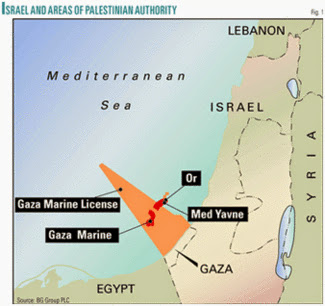
What is now unfolding is the integration of these adjoining gas fields including those belonging to Palestine into the orbit of Israel. (see map below).
It should be noted that the entire Eastern Mediterranean coastline extending from Egypt’s Sinai to Syria constitutes an area encompassing large gas as well as oil reserves.
War and Natural Gas: The Israeli Invasion and Gaza's Offshore Gas Fields
More than five years ago, Israel invaded Gaza under “Operation Cast Lead”.
The following article was first published by Global Research in January 2009 at the height of the Israeli bombing and invasion under Operation Cast Lead.
In the wake of the invasion, Palestinian gas fields were de facto confiscated by Israel in derogation of international law
A year following “Operation Cast Lead”, Tel Aviv announced the discovery of the Leviathan natural gas field in the Eastern Mediterranean “off the coast of Israel.”
At the time the gas field was: “ … the most prominent field ever found in the sub-explored area of the Levantine Basin, which covers about 83,000 square kilometres of the eastern Mediterranean region.” (i)
Coupled with Tamar field, in the same location, discovered in 2009, the prospects are for an energy bonanza for Israel, for Houston, Texas based Noble Energy and partners Delek Drilling, Avner Oil Exploration and Ratio Oil Exploration. (See Felicity Arbuthnot, Israel: Gas, Oil and Trouble in the Levant, Global Research, December 30, 2013
The Gazan gas fields are part of the broader Levant assessment area.
What is now unfolding is the integration of these adjoining gas fields including those belonging to Palestine into the orbit of Israel. (see map below).
It should be noted that the entire Eastern Mediterranean coastline extending from Egypt’s Sinai to Syria constitutes an area encompassing large gas as well as oil reserves.
levant gas map1 felicity
Michel Chossudovsky, January 3, 2014
War and Natural Gas: The Israeli Invasion and Gaza’s Offshore Gas Fields
by Michel Chossudovsky
January 8, 2009
The December 2008 military invasion of the Gaza Strip by Israeli Forces bears a direct relation to the control and ownership of strategic offshore gas reserves.
This is a war of conquest. Discovered in 2000, there are extensive gas reserves off the Gaza coastline.
British Gas (BG Group) and its partner, the Athens based Consolidated Contractors International Company(CCC) owned by Lebanon’s Sabbagh and Koury families, were granted oil and gas exploration rights in a 25 year agreement signed in November 1999 with the Palestinian Authority.
The rights to the offshore gas field are respectively British Gas (60 percent); Consolidated Contractors (CCC) (30 percent); and the Investment Fund of the Palestinian Authority (10 percent). (Haaretz, October 21, 2007).
The PA-BG-CCC agreement includes field development and the construction of a gas pipeline.(Middle East Economic Digest, Jan 5, 2001).
The BG licence covers the entire Gazan offshore marine area, which is contiguous to several Israeli offshore gas facilities. (See Map below). It should be noted that 60 percent of the gas reserves along the Gaza-Israel coastline belong to Palestine.
Map 1
The BG Group drilled two wells in 2000: Gaza Marine-1 and Gaza Marine-2. Reserves are estimated by British Gas to be of the order of 1.4 trillion cubic feet, valued at approximately 4 billion dollars. These are the figures made public by British Gas. The size of Palestine’s gas reserves could be much larger.
Who Owns the Gas Fields
The issue of sovereignty over Gaza’s gas fields is crucial. From a legal standpoint, the gas reserves belong to Palestine.
The death of Yasser Arafat, the election of the Hamas government and the ruin of the Palestinian Authority have enabled Israel to establish de facto control over Gaza’s offshore gas reserves.
British Gas (BG Group) has been dealing with the Tel Aviv government. In turn, the Hamas government has been bypassed in regards to exploration and development rights over the gas fields.
Map 2
The election of Prime Minister Ariel Sharon in 2001 was a major turning point. Palestine’s sovereignty over the offshore gas fields was challenged in the Israeli Supreme Court. Sharon stated unequivocally that “Israel would never buy gas from Palestine” intimating that Gaza’s offshore gas reserves belong to Israel.
In 2003, Ariel Sharon, vetoed an initial deal, which would allow British Gas to supply Israel with natural gas from Gaza’s offshore wells. (The Independent, August 19, 2003)
The election victory of Hamas in 2006 was conducive to the demise of the Palestinian Authority, which became confined to the West Bank, under the proxy regime of Mahmoud Abbas.
In 2006, British Gas “was close to signing a deal to pump the gas to Egypt.” (Times, May, 23, 2007). According to reports, British Prime Minister Tony Blair intervened on behalf of Israel with a view to shunting the agreement with Egypt.
The following year, in May 2007, the Israeli Cabinet approved a proposal by Prime Minister Ehud Olmert “to buy gas from the Palestinian Authority.” The proposed contract was for $4 billion, with profits of the order of $2 billion of which one billion was to go the Palestinians.
Tel Aviv, however, had no intention on sharing the revenues with Palestine. An Israeli team of negotiators was set up by the Israeli Cabinet to thrash out a deal with the BG Group, bypassing both the Hamas government and the Palestinian Authority:
“Israeli defence authorities want the Palestinians to be paid in goods and services and insist that no money go to the Hamas-controlled Government.” (Ibid, emphasis added)
The objective was essentially to nullify the contract signed in 1999 between the BG Group and the Palestinian Authority under Yasser Arafat.
Under the proposed 2007 agreement with BG, Palestinian gas from Gaza’s offshore wells was to be channeled by an undersea pipeline to the Israeli seaport of Ashkelon, thereby transferring control over the sale of the natural gas to Israel.
The deal fell through. The negotiations were suspended:
”Mossad Chief Meir Dagan opposed the transaction on security grounds, that the proceeds would fund terror”. (Member of Knesset Gilad Erdan, Address to the Knesset on “The Intention of Deputy Prime Minister Ehud Olmert to Purchase Gas from the Palestinians When Payment Will Serve Hamas,” March 1, 2006, quoted in Lt. Gen. (ret.) Moshe Yaalon, Does the Prospective Purchase of British Gas from Gaza’s Coastal Waters Threaten Israel’s National Security? Jerusalem Center for Public Affairs, October 2007)
Israel’s intent was to foreclose the possibility that royalties be paid to the Palestinians. In December 2007, The BG Group withdrew from the negotiations with Israel and in January 2008 they closed their office in Israel.(BG website).
Invasion Plan on The Drawing Board
The invasion plan of the Gaza Strip under “Operation Cast Lead” was set in motion in June 2008, according to Israeli military sources:
“Sources in the defense establishment said Defense Minister Ehud Barak instructed the Israel Defense Forces to prepare for the operation over six months ago [June or before June] , even as Israel was beginning to negotiate a ceasefire agreement with Hamas.”(Barak Ravid, Operation “Cast Lead”: Israeli Air Force strike followed months of planning, Haaretz, December 27, 2008)
That very same month, the Israeli authorities contacted British Gas, with a view to resuming crucial negotiations pertaining to the purchase of Gaza’s natural gas:
“Both Ministry of Finance director general Yarom Ariav and Ministry of National Infrastructures director general Hezi Kugler agreed to inform BG of Israel’s wish to renew the talks.
The sources added that BG has not yet officially responded to Israel’s request, but that company executives would probably come to Israel in a few weeks to hold talks with government officials.” (Globes online- Israel’s Business Arena, June 23, 2008)
The decision to speed up negotiations with British Gas (BG Group) coincided, chronologically, with the planning of the invasion of Gaza initiated in June. It would appear that Israel was anxious to reach an agreement with the BG Group prior to the invasion, which was already in an advanced planning stage.
Moreover, these negotiations with British Gas were conducted by the Ehud Olmert government with the knowledge that a military invasion was on the drawing board. In all likelihood, a new “post war” political-territorial arrangement for the Gaza strip was also being contemplated by the Israeli government.
In fact, negotiations between British Gas and Israeli officials were ongoing in October 2008, 2-3 months prior to the commencement of the bombings on December 27th.
In November 2008, the Israeli Ministry of Finance and the Ministry of National Infrastructures instructed Israel Electric Corporation (IEC) to enter into negotiations with British Gas, on the purchase of natural gas from the BG’s offshore concession in Gaza. (Globes, November 13, 2008)
“Ministry of Finance director general Yarom Ariav and Ministry of National Infrastructures director general Hezi Kugler wrote to IEC CEO Amos Lasker recently, informing him of the government’s decision to allow negotiations to go forward, in line with the framework proposal it approved earlier this year.
The IEC board, headed by chairman Moti Friedman, approved the principles of the framework proposal a few weeks ago. The talks with BG Group will begin once the board approves the exemption from a tender.” (Globes Nov. 13, 2008)
Gaza and Energy Geopolitics
The military occupation of Gaza is intent upon transferring the sovereignty of the gas fields to Israel in violation of international law.
What can we expect in the wake of the invasion?
What is the intent of Israel with regard to Palestine’s Natural Gas reserves?
A new territorial arrangement, with the stationing of Israeli and/or “peacekeeping” troops?
The militarization of the entire Gaza coastline, which is strategic for Israel?
The outright confiscation of Palestinian gas fields and the unilateral declaration of Israeli sovereignty over Gaza’s maritime areas?
If this were to occur, the Gaza gas fields would be integrated into Israel’s offshore installations, which are contiguous to those of the Gaza Strip. (See Map 1 above).
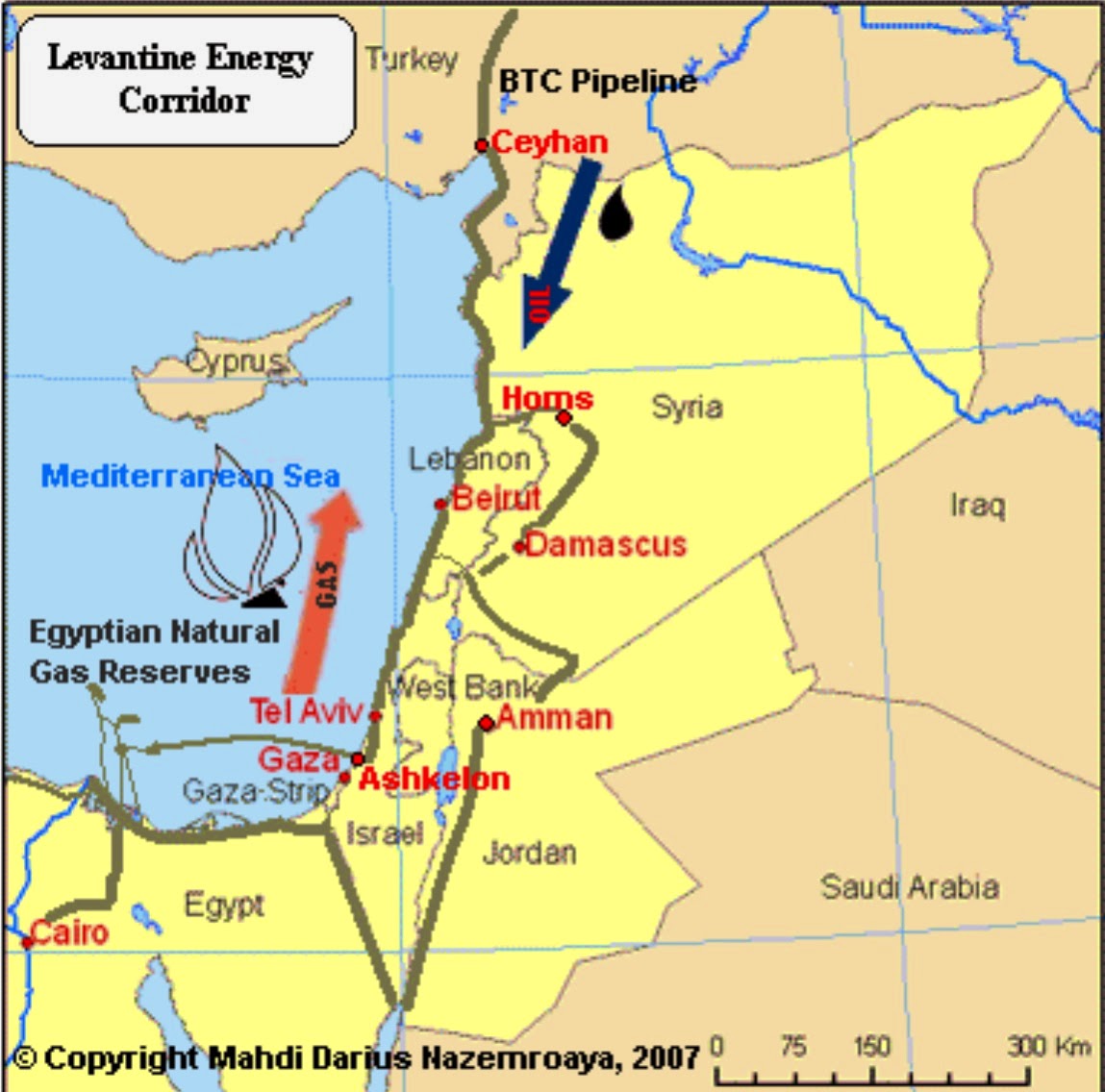
These various offshore installations are also linked up to Israel’s energy transport corridor, extending from the port of Eilat, which is an oil pipeline terminal, on the Red Sea to the seaport – pipeline terminal at Ashkelon, and northwards to Haifa, and eventually linking up through a proposed Israeli-Turkish pipeline with the Turkish port of Ceyhan.
Map 3
Ceyhan is the terminal of the Baku, Tblisi Ceyhan Trans Caspian pipeline. “What is envisaged is to link the BTC pipeline to the Trans-Israel Eilat-Ashkelon pipeline, also known as Israel’s Tipline.” (See Michel Chossudovsky, The War on Lebanon and the Battle for Oil, Global Research, July 23, 2006)
A video that Israel and the United States does not want you to see. Anna, a Jewish American from the International Womens Peace Service (IWPS) speaks about documenting human rights abuses in occupied Palesting and supporting non-violent resistance.
The government stands accused of seeking to conceal Britain’s role in extraordinary rendition, ahead of the release of a declassified intelligence report that exposes the use of torture at US secret prisons around the world.
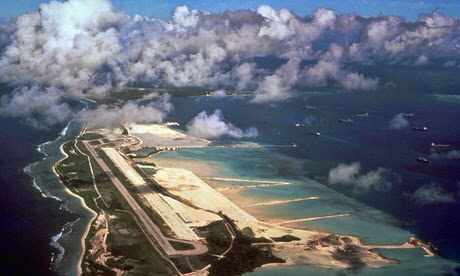
Diego Garcia
The Senate report on the CIA’s interrogation programme, due to be released in days, will confirm that the US tortured terrorist suspects after 9/11. In advance of the release, Barack Obama admitted on Friday: “We tortured some folks. We did some things that were contrary to our values.”
Now, in a letter to the human rights group Reprieve, former foreign secretary William Hague has confirmed that the UK government has held discussions with the US about what it intends to reveal in the report which, according to al-Jazeera, acknowledges that the British territory of Diego Garcia was used for extraordinary rendition.
“We have made representations to seek assurances that ordinary procedures for clearance of UK material will be followed in the event that UK material provide[d] to the Senate committee were to be disclosed,” Hague wrote.
Cori Crider, a director at Reprieve, accused the UK government of seeking to redact embarrassing information: “This shows that the UK government is attempting to censor the US Senate’s torture report. In plain English, it is a request to the US to keep Britain’s role in rendition out of the public domain.”
Lawyers representing a number of terrorist suspects held at Guantánamo Bay believe their clients were rendered via Diego Garcia. Papers found in Libya indicated that the US planned to transport Abdul-Hakim Belhaj, an opponent of Muammar Gaddafi, and his wife via the territory, an atoll in the Indian Ocean leased by Britain to the US. The government has denied Belhaj was rendered via Diego Garcia, but there are suspicions that others were held on the atoll.
Crider said the UK’s attempts to lobby the US into redacting parts of the report “turns the government’s defence in the Libyan renditions case of Abdul-Hakim Belhaj and his wife entirely on its head”.
The government has consistently sought to block Belhaj from bringing a case against it.
“The government protested America would be angered if this kidnap case ever went to trial – and now we learn the British government is leaning on the Americans not to air Britain’s dirty laundry. It exposes their litigation stance as mere posturing,” she added.
Confirmation that a British territory was involved in extraordinary rendition could leave the government vulnerable to legal action. Last month the European court of human rights ruled that the Polish government actively assisted the CIA’s European “black site” programme, which saw detainees interrogated in secret prisons across the continent.
The court concluded it was “established beyond reasonable doubt” that Abu Zubaydah, a Guantánamo detainee the US mistakenly believed to be a senior member of al-Qaida, was flown from a secret site in Thailand to another CIA prison in Stare Kiejkuty in northern Poland.
The judges concluded that not only was Poland “informed of and involved in the preparation and execution of the [High Value Detainee] Programme on its territory”, but also “for all practical purposes, facilitated the whole process, created the conditions for it to happen and made no attempt to prevent it”, prompting lawyers to ask what else it has been used for since. More
So far, the diplomatic effort to end the violence in Gaza has failed miserably, with Israel on Friday rejecting a cease-fire proposal from U.S. Secretary of State John Kerry. (On Saturday Israel and Hamas agreed to a 12-hour humanitarian pause in the fighting brokered by the United Nations.)
Washington’s attempt is representative of the overall failure of American policy toward the Israeli-Palestinian conflict, only on this occasion the consequences can be measured in the growing pile of dead bodies and the widespread devastation that includes numerous homes, public buildings and even artillery damage to several United Nations schools sheltering Palestinian civilians.
The U.S. approach fails because it exhibits extreme partisanship in a setting where trust, credibility and reciprocity are crucial. Kerry is undoubtedly dedicated to achieving a cease-fire, just as he demonstrated for most of the past year in pushing for a negotiated peace agreement between Israel and the Palestinian Authority. Yet the United States exhibited its tendency toward extreme partisanship when it designated Martin Indyk, a former staff member of the America Israel Public Affairs Committee (AIPAC) and former ambassador to Israel, as the U.S. special envoy to the peace talks.
The U.S. approach up to this point to achieving a cease-fire in Gaza has been undertaken in a manner that is either woefully ignorant of the real constraints or callously cynical about their relevance. This is especially clear from the attempt to garner a cease-fire by consulting only one side, Israel — the party bearing the major responsibility for causing massive casualties and damage — and leaving Hamas out in the cold. Even if this is a consequence of Hamas being treated as “a terrorist entity,” it still makes no sense. When Israel wanted to deal with Hamas in the past, it had no trouble doing so — for instance, when it arranged the prisoner exchange that led to the release of the single captured Israeli soldier Gilad Schalit back in 2011.
The basic facts are astounding: The U.S. relied on Egypt as the broker of a proposal it vetted, supposedly with the text delivered personally by Tony Blair to President Abdel Fattah El Sisi in Cairo, endorsed by the Netanyahu government, and then announced on July 15 via the media as a cease-fire proposal accepted by Israel, without Hamas even knowing the details. It’s a diplomatic analogue to the theater of the absurd. Last July, then-General Sisi was the Egyptian mastermind of a coup that brutally cracked down on the Muslim Brotherhood and criminalized the entire organization. The Sisi government has made no secret of its unrelenting hostility to Hamas, which it views as an offshoot of the Muslim Brotherhood. It destroyed the extensive tunnel network connecting Gaza with the outside world to circumvent the punitive Israeli blockade that has been maintained since 2007. Is there any reason for Hamas to go forward with such a cease-fire arrangement? As some respected Israeli commentators have suggested, most prominently Amira Hass, the “normalization” of the occupation is what the Israeli military operation Protective Edge is all about. Hass suggests that Israel seeks a compliant Palestinian response to an occupation that has for all intents and purposes become permanent. Such periodic shows of force aim to break once and for all the will to resist, associated with Hamas and its rockets.
Even more telling, the cease-fire’s terms were communicated to Hamas via the media, making the proposal “take it or leave it.” It also ignored the reasonable conditions Hamas had posited as the basis of a cease-fire it could accept. These conditions included ending the unlawful seven-year siege of Gaza, releasing prisoners arrested in the anti-Hamas campaign prior to launching the military operation on July 8, and stopping interference with the unity government that brought Hamas and the Palestinian Authority together on June 3. Kerry, by contrast, has urged restoring the cease-fire text that had been accepted by both sides in November 2012 after the previous major Israeli military attack upon Gaza.
Hamas’ chief leader, Khaled Meshaal, has been called “defiant” by Kerry because he would not go along with this tilted diplomacy. “Everyone wanted us to accept a cease-fire and then negotiate for our rights,” Meshaal said. This was tried by Hamas in 2012 and didn’t work. As soon as the violence ceased, Israel refused to follow through on the cease-fire agreement that had promised negotiations seeking an end of the blockade and an immediate expansion of Gazan fishing rights.
In the aftermath of Protective Edge is it not reasonable, even mandatory, for Hamas to demand a firm commitment to end the siege of Gaza? Israel as the occupying power has an obligation under the Geneva Conventions to protect the civilian population of an occupied people. Israel claims that its “disengagement” in 2005, involving the withdrawal of security forces and the dismantling of settlements, ended such obligations. Such a position is almost uniformly rejected in the international community, since the persistence of effective Israeli control of entry and exit, as well as air and sea, and violent incursions amounts to a shift in the form of occupation — not its end. Israel is certainly right to complain about the rockets, but it is wrong to impose an oppressive regime of collective punishment on the civilians of Gaza. More
Ever since this latest Israeli major military operation against Gaza started on July 8, there have been frequent suggestions that Israel is guilty of war crimes, and that Palestine should do its best to activate the International Criminal Court (ICC) on its behalf.
The evidence overwhelmingly supports basic Palestinian allegations—Israel is guilty either of aggression in violation of the UN Charter or is in flagrant violation of its obligations as the Occupying Power under the Geneva Convention to protect the civilian population of an Occupied People; Israel seems guilty of using excessive and disproportionate force against a defenseless society in the Gaza Strip; and Israel, among an array of other offenses, seems guilty of committing Crimes Against Humanity in the form of imposing an apartheid regime in the West Bank and through the transfer of population to an occupied territory as it has proceeded with its massive settlement project.
Considering this background of apparent Israeli criminality it would seem a no brainer for the Palestinian Authority to seek the help of the ICC in waging its struggle to win over world public opinion to their struggle. After all, the Palestinians are without military or diplomatic capabilities to oppose Israel, and it is on law and global solidarity must rest their hopes for eventually realizing their rights, particularly the right of self-determination and the right of return. Palestinian demonstrators in the West Bank are demanding that their leaders in the Palestinian Authority adhere to the Rome Statute, and become members of the ICC without further delay. It has become part of the message of Palestinian street politics that the Palestinians are being criminally victimized, and that the Palestinian Authority if it wants to retain the slightest shred of respect as representatives of the Palestinian people must join in this understanding of the Palestinian plight and stop ‘playing nice’ with Israeli authorities.
Such reasoning from a Palestinian perspective is reinforced by the May 8th letter sent by 17 respected human rights NGOs to President Mahmoud Abbas urging Palestine to become a member of the ICC, and act to end Israel’s impunity. This was not a grandstanding gesture dreamed up on the irresponsible political margins of liberal Western society. Among the signatories were such human rights stalwarts as Human Rights Watch, Amnesty International, Al Haq, and the International Commission of Jurists, entities known for their temporizing prudence in relation to the powers that be.
Adding further credence to the idea that the ICC option should be explored was the intense opposition by Israel and United States, ominously threatening the PA with dire consequences if it tried to join the ICC, much less to seek justice through its activating its investigative procedures. The American ambassador to the UN, Samantha Power, herself long ago prominent as a human rights advocate, revealed Washington’s nervous hand when she confessed that the ICC “is something that really poses a profound threat to Israel.” I am not sure that Power would like to live with the idea that because Israel is so vulnerable to mounting a legal challenge that its impunity must be upheld whatever the embarrassment to Washington of doing so. France and Germany have been more circumspect, saying absurdly that recourse to the ICC by Palestine should be avoided because it would disrupt ‘the final status negotiations,’ as if this pseudo-diplomacy was ever of any of value, a chimera if there ever was one, in the elusive quest for a just peace.
In a better world, the PA would not hesitate to invoke the authority of the ICC, but in the world as it is, the decision is not so simple. To begin with, is the question of access, which is limited to states. Back in 2009, the PA tried to adhere to the Rome Statute, which is the treaty governing the ICC, and was rebuffed by the prosecutor who turned the issue over to the Security Council, claiming a lack of authority to determined whether the PA represented a ‘state.’ Subsequently, on November 29th the UN General Assembly overwhelmingly recognized Palestine as ‘a nonmember observer state.’ Luis Moreno–Ocampo who had acted in 2009 for the ICC, and now speaking as the former prosecutor, asserted that in his opinion Palestine would now in view of the General Assembly action qualify as a state enjoying the option of becoming an ICC member. Normally, ICC jurisdiction is limited to crimes committed after the state becomes a member, but there is a provision that enables a declaration to be made accepting jurisdiction for crimes committed at any date in its territory so long as it is after the ICC itself was established in 2002.
Is this enough? Israel has never become a party to the Rome Statute setting up the ICC, and would certainly refuse to cooperate with a prosecutor who sought to investigate war crimes charges with the possible intention of prosecution. In this regard, recourse to ICC might appear to be futile as even if arrest warrants were to be issued by the court, as was done in relation to Qaddafi and his son in 2011, there would be no prospect that the accused Israeli political and military figures would be handed over, and without the presence of such defendants in the court at The Hague, a criminal trial cannot go forward. This illustrates a basic problem with the enforcement of international criminal law. It has been effective only against the losers in wars fought against the interests of the West and, to some extent, against those whose crimes are in countries located in sub-Saharan Africa. This biased form of international criminal law implementation has been the pattern since the first major effort was made after World War II at Nuremberg and Tokyo. Surviving German and Japanese leaders were prosecuted for their crimes while exempting the winners, despite Allied responsibility for the systematic bombing of civilian populations by way of strategic bombing and the American responsibility for dropping the atomic bombs on Hiroshima and Nagasaki. More
Any journalist should hesitate before saying this, but news can be bad for you. You don’t have to agree with the analyst who reckons “news is to the mind what sugar is to the body” to see that reading of horror and foreboding hour by hour, day after day, can sap the soul.
So in Gaza we look at the wildly lopsided death tolls – nearly 300 Palestinians and two Israelis killed these past nine days.
The different responses these events stir in those of us who are distant, and the strategies we devise to cope with them, say much about our behaviour as consumers of news. But they also go some way to determining our reaction as citizens, as constituent members of the amorphous body we call public, or even world, opinion.
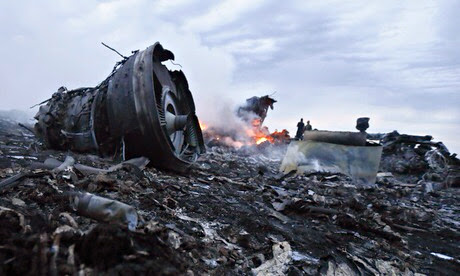
As I write, 18 of the 20 most-read articles on the Guardian website are about MH17. The entry into Gaza by Israeli forces stands at number 21. It’s not hard to fathom why the Malaysian jet strikes the louder chord. As the preacher might put it, “There but for the grace of God go I.” Stated baldly, most of us will never live in Gaza, but we know it could have been us boarding that plane in Amsterdam.
Which is why there is a morbid fascination with tales of the passenger who changed flights at the last minute, thereby cheating death, or with the crew member who made the opposite move, hastily switching to MH17 at the final moment, taking a decision that would have seemed so trivial at the time but which cost him his life. When we read about the debris – the holiday guidebooks strewn over the Ukrainian countryside, the man found next to an iPhone, the boy with his seatbelt still on – our imaginations put us on that flight. Of course we have sympathy for the victims and their families. But our fear is for ourselves.
It’s quite true that if the US truly decided that Israel’s 47-year occupation of Palestinian territory was no longer acceptable, that would bring change.
There is an interesting article by Chris Hedges entitled It's NOT going to be OK on the current economic disparity which, he believes could lead to a drastic decline in democracy as states respond to social protests. The question I ask is what can be done to slow or erradicate this process? Editor
We now have confirmation from the Israeli daily Haaretz of what we should have suspected: that the idea for the so-called Egyptian “ceasefire proposal” was actually hatched in Washington, the messenger boy was arch-war criminal Tony Blair, and the terms were drafted by Israel.
Click to Enlarge
The intention was either to corner Hamas into surrendering – and thereby keep the savage blockade of Gaza in place – or force Hamas to reject the proposal and confirm the Israeli narrative that it is a terrorist organisation with which Israel cannot make peace.
According to Haaretz, Blair secretly initiated his “ceasefire” activity after “coordinating” with US Secretary of State John Kerry. On Saturday he headed off to Cairo to meet with the US-backed Egyptian dictator Abdel Fattah al-Sisi to persuade him to put his name to the proposal.
Immediately afterwards, he travelled to Israel to meet Benjamin Netanyahu on Saturday afternoon. Sisi and Netanyahu were then supposed to thrash out the details. When they failed to do so, Blair intervened again on behalf of the Americans and the pair spoke by phone on Saturday evening.
Here’s the key paragraph from Haaretz:
Senior Israeli officials and Western diplomats said the reason the Egyptian cease-fire initiative was so short-lived is that it was prepared hastily and was not coordinated with all the relevant parties, particularly Hamas.
Wonderful that throw-away last line. In all this activity, it never occurred to the US, Blair, Sisi or Netanyahu – and no doubt Mahmoud Abbas, who is strangely absent from this account – that it might be necessary to sound out Hamas on the terms of a ceasefire it would need to abide by.
Now it seems Kerry is using US muscle to get Egypt, Qatar and Turkey to strong-arm Hamas into surrendering.
It’s depressingly predictable that the corporate media have swallowed the line of Israel accepting the “ceasefire proposal” and Hamas rejecting it. What Hamas did was reject a US-Israeli diktat to sign away the rights of the people of Gaza to end a siege that cuts them off from the rest of the world.
But there is a long pedigree to such deceptions. It is reminiscent of a hasbara favourite: that the Jews accepted the UN partition plan of 1947 while the Palestinians rejected it. The reality – then, as now – is that the the colonial powers sought to strip the Palestinians of their rights and their homeland without even consulting them.



 © 2014




 Democracy & Good Governance