5 February 2015: The Caribbean Centre for Renewable Energy and Energy Efficiency (CCREEE) and the Caribbean region's sustainable energy strategies were at the center stage at two Special Meetings of the Council for Trade and Economic Development (COTED) of the Caribbean Community (CARICOM).
The ministerial meetings on energy and the environment focused on the establishment of the CCREEE, regional energy coordination and sustainable energy strategies, and the post-2015 development agenda, among other themes.
The establishment of the CCREEE, which was endorsed by COTED in November 2014, was on the agenda of the Special Meetings on Energy, and Energy and the Environment, held in Georgetown, Guyana, from 4-5 February. The meetings, among other things, explored “the full ramifications and optimum exploitations of CCREEE.” CCREEE is currently in the process of being established with the assistance of the UN Industrial Development Organisation (UNIDO), Austrian Government and SIDS DOCK initiative of the Alliance of Small Island States (AOSIS). The Centre's mandate will be technical, namely to support and coordinate the execution of CARICOM's sub-regional and regional renewable energy and energy efficiency programmes, projects and activities.
Calling for a “cohesive regional effort” to achieve sustainable energy security, Chair of the Special Meeting on Energy, and Minister of Science, Technology, Energy and Mining of Jamaica Phillip Paulwell said that “although sustainable energy solutions have made great strides” in the CARICOM region, significant gaps and barriers remained in the areas of renewable energy access, energy efficiency and reliable grid development and deployment.
CARICOM Deputy Secretary-General Manorma Soeknandan similarly noted that, despite progress made, “significant additional changes” would need to be made to meet the demands for reliable, secure, efficient and cost-effective energy services, suggesting that “energy is about sustainable livelihoods and job creation alike.”
Cayman Renewable Energy Association launched last week. In this segment we learn more about the group’s mission and what they see as the next step in implementing alternative energy in Cayman.
James E. Whittaker of GreenTech Group of Companies and Jim Knapp of Endless Energy talk to Vanessa Hansen of Cayman 27 about the premise of the organiization and why it’s important to have the association in Cayman.
That solar photovoltaic (PV) technology is poised to become a dominant energy generation technology throughout the world is of no surprise to most, but the sheer wealth of possibility being forecast throughout the middle and southern hemispheres begins to give an idea of just how prevalent the technology will be by the end of the decade.
So it should really come as no surprise that NPD Solarbuzz’s recent figures show that the Latin America and Caribbean region is set to install 9 GW of solar PV over the next five years.
Latin America and Caribbean Five-Year Cumulative Demand Forecast by Project Status
“Solar PV is now starting to emerge as a preferred energy technology for Latin American and Caribbean countries,” said Michael Barker, senior analyst at NPD Solarbuzz. “The region has high electricity prices and it also benefits from strong solar irradiation, which makes it a good candidate for solar PV deployment. As a result, experienced global solar PV developers are seeing strong solar PV growth potential in the region.”
NPD Solarbuzz’s Emerging PV Markets Report: Latin America and Caribbean shows that the total PV project pipeline now exceeds 22 GW of projects across all stages of development — with 1 GW of projects already under construction, and another 5 GW of projects have received the appropriate approval to proceed.
The Latin America and Caribbean region was previously home to many small-scale and off-grid solar PV applications, however governments are now looking to solar PV to address large-scale utility power requrements — specifically in Brazil, Chile, and Mexico.
“Many countries across the LAC region have the potential to develop into major solar PV markets in the future,” added Barker. “While project pipelines vary by country, there is a strong contribution from early-stage developments that have yet to finalize supply deals or find end-users to purchase the generated electricity, which presents both risks and opportunities for industry players.”
A number of countries throughout the developing and second-world countries are turning to renewable energy technologies to develop strong, future-proof, and economically efficient energy generation. Such a trend is being backed by major manufacturing companies who are focusing their efforts on these regions, hoping to increase their own profits while fulfilling renewable energy demand. More
Ten years ago peak oil was assumed to be a rather straight forward, transparent process. What was then thought of as “oil” production was going to stop growing around the middle of the last decade.
Shortages were going to occur; prices were going to rise; demand was going to drop; economies would falter; and eventually a major economic depression was going to occur. Fortunately or not, depending on your point of view, the last ten years have turned out to a lot more complicated than expected. Production of what is now known as “conventional” oil did indeed peak back around 2005, and many of the phenomena that were expected to result did occur and continue to this day.
Oil prices have climbed several-fold from where they were in the early years of the last decade – surging upwards from $20 a barrel to circa $100. This rapid jump in energy costs did slow many nations’ economies, cut oil consumption, and with some other factors set off a “great” recession. Real economic hardships have not yet occurred
What is so interesting about all this is that a temporary surge in what was heretofore a little known source of oil in the U.S. is masking the larger story of what is taking place in the global oil situation
Much of this is due to the reaction that set in from high oil prices and increased government intervention into the economy. In the case of the U.S., Washington turned on the modern day equivalent of the printing presses and began handing out money that was used to develop expensive sources of oil and gas. The high selling price per barrel, coupled with cheap money led to a boom in U.S. oil production where fortuitous geological conditions in North Dakota and South Texas allowed the production of shale oil at money-making prices provided oil prices stay high.
U.S. unconventional oil production soared by some 3.3 million barrels a day (b/d) in the last four years, and, if the US Energy Information Administration is correct, is due to climb by another million b/d or so in 2015. While this jump in production was unexpected by most, it was just another phenomenon resulting from unprecedentedly high oil prices, which in turn resulted from the lack of adequate “conventional” oil production. As is well known, economic development can have major reactions and feedbacks
What is so interesting about all this is that a temporary surge in what was heretofore a little known source of oil in the U.S. is masking the larger story of what is taking place in the global oil situation. The simple answer is that except for the U.S. shale oil surge almost no increase in oil production is taking place around the world. No other country as yet has gotten significant amounts of shale oil or gas into production. Russia’s conventional oil production seems to be peaking at present, and its Arctic oil production is still many years, or perhaps even decades, away. Brazilian production is going nowhere at the minute, deepwater production in the Gulf of Mexico is stagnating and the Middle East is busy killing itself. On top of all this, global demand for oil continues to increase by some million b/d each year – most of which is going to Asia.
If we step back and acknowledge that the shale oil phenomenon will be over in a couple of years and that oil production is dropping in the rest of the world, then we have to expect that the remainder of the peak oil story will play out shortly. The impact of shrinking global oil production, which is been on hold for nearly a decade, will appear. Prices will go much higher, this time with lowered expectations that more oil will be produced as prices go higher. The great recession, which has never really gone away for most, will return with renewed vigor and all that it implies.
An additional factor which has grown considerably worse in the last ten years is climate change, largely brought about by the combustion of fossil fuels. We are already seeing global weather anomalies with record high and low temperatures and record floods as well as droughts. This too will take its toll on economic development as mitigating this change will soon become enormously expensive. We are already seeing migrations of restive peoples. Thousands are dying in efforts to get from the Middle East and Africa into the EU. Millions are already homeless across the Middle East and recent developments foretell hundreds of thousands if not millions more being added to ranks of refugees as decades and even centuries-old political arrangements collapse.
All this is telling us that the peak oil crisis we have been watching for the last ten years has not gone away, but is turning out to be a more prolonged event than previous believed. Many do not believe that peak oil is really happening as they read daily of surging oil production and falling oil prices. Rarely do they hear that another shoe has yet to drop and that much worse in terms of oil shortages, higher prices and interrupted economic growth is just ahead.
We are sitting in the eye of the peak oil crisis and few recognize it. Five years from now, it should be apparent to all. More
20 August 2014: A regional workshop organized by the Organization of American States (OAS) discussed how to improve donor interventions regarding sustainable energy projects in the Caribbean.
The workshop, titled 'Development of Sustainable Energy Projects: Experiences, Strategies and Implementation,' took place on 19 August 2014 in Saint Lucia. The event brought together major donors for Caribbean energy projects with country representatives to: examine current and planned sustainable energy projects; discuss local barriers to commercialization of sustainable energy; identify Caribbean country project priorities and gaps in current assistance; and look at ways to foster collaboration and complementarity between projects.
During the opening session, OAS consultant Christina Becker-Birck provided an overview of the 80+ energy initiatives in the region, amounting since 2004 to around US$129 million in technical assistance and grants, about US$108 million in loans and lines of credit, with at least US$100 million pending and planned.
Philipp Blechinger, Reiner Lemoine Institut, outlined the results of a survey on barriers to the development of renewable energy technologies for power generation on Caribbean island States. Carolina Peña, OAS Sustainable Development Department (DSD), outlined OAS energy interventions in the region.
During a roundtable discussion on learning from success stories and failures, the Organization of Eastern Caribbean States (OECS) detailed its Sustainable Energy Programme on technical assistance and energy labeling. The Carbon War Room discussed its 10 Island Challenge to catalyze private investment and produce a Ten Island Renewable Roadmap/Blueprint. The Caribbean Development Bank outlined the proposed Sustainable Energy for the Eastern Caribbean (SEEC) and Geothermal Drill Risk Facility projects. The EU provided an overview of its support for energy projects in the region, and the Clean Energy Solutions Center (CESC) outlined its technical support.
The workshop was organized by the OAS DSD in the framework of the Sustainable Energy Capacity Building Initiative (SECBI) of the Energy and Climate Change Partnership of the Americas (ECPA). More
Copyright Disclaimer Under Section 1 07 of the Copyright Act 1976, allowance is made for “fair use” for purposes such as criticism, comment, news reporting, teaching, scholarship, and research. Fair use is a use permitted by copyright statute that might otherwise be infringing. Non-profit, educational or personal use tips the balance in favor of fair use. All copyrighted materials contained herein belong to their respective copyright holders, I do not claim ownership over any of these materials. I realize no profit, monetary or otherwise, from the exhibition of these videos.
News: High-level Event Discusses Renewable Energy in SIDS
1 September 2014: Participants recognized sustainable energy for all as a tool for eradicating poverty, combating climate change, creating economic opportunities and achieving sustainable development for all small island developing States (SIDS), at a high-level side event, titled ‘Linking SIDS and Sustainable Energy for All (SE4ALL): From Barbados to Samoa, and Beyond.' The event took place on the sidelines of the Third International Conference on SIDS, in Apia, Samoa, on 1 September 2014.
The SE4ALL side event aimed to build on commitments from the UN Conference on Sustainable Development (UNCSD, or Rio+20+) and the Barbados SIDS High-Level Conference on SE4ALL, to take stock of progress since these events and chart the way forward to ensure sustainable energy for all SIDS.
Speaking at the event, UN Secretary-General Ban Ki-moon said achieving the three targets of the SE4ALL initiative is an important part of putting the world on a pathway for keeping temperature rise below two degrees Celsius. He outlined the need for a new energy paradigm, particularly for SIDS, who he said are particularly vulnerable to climate change and faced inflated energy costs due to their remoteness, and he welcomed the proposal of a dedicated Sustainable Development Goal (SDG) on sustainable energy for all with a focus on access, efficiency and renewables. Ban encouraged all leaders to “bring bold actions and ideas and strong political vision and political will” to the UN Climate Summit.
“SIDS are creating opportunities and examples that, if replicated worldwide, could lead the transition from fossil fuel energy to renewable and sustainable energy,” said UN General Assembly President John Ashe in his remarks.
The panel was moderated by Helen Clark, UN Development Programme (UNDP) Administrator, and featured: Adnan Amin, Director-General, International Renewable Energy Agency (IRENA); Camillo Gonsalves, Foreign Minister of Saint Vincent and the Grenadines; Salvatore Bernabei, General Manager, Enel Green Power Chile and Andean Countries; Naoko Ishii, CEO and Chairperson of the Global Environment Facility (GEF); and Reginald Burke, Caribbean Policy Development Centre. Key messages included the importance of reducing risk to catalyze private investment, the leadership being taken by SIDS, and various SIDS initiatives on sustainable energy, such as SIDS Dock and IRENA's SIDS Lighthouse project.
Participants highlighted: energy costs and energy security; climate change; and challenges and vulnerabilities faced by SIDS, including their small size and the high costs of importing fossil fuels. They stressed SIDS' renewable energy potential and the importance of addressing energy access and efficiency, highlighting the role of partnerships to address these issues. [UN Press Release] [UN Secretary-General Statement] [UNDP Administrator Remarks] [IISD RS Meeting Coverage, 1 September] [IISD RS Sources]
In the immortal words of Montserratian singer/songwriter, Arrow, the Caribbean is “…feelin’ hot, hot, hot!” And, that’s agoodthing.
With a little help from Mother Nature, the islands of the Caribbean are learning to harness the power of high temperature geothermal energy beneath the earth’s surface.
In an effort to move away from reliance on expensive, fossil-fueled, diesel-powered generators toward a dependable, eco-friendly source of renewable energy, a number of forward-thinking Caribbean islands are aggressively searching for and identifying alternative sources of power beneath the surface.
Energy self-sufficiency, long sought-after by local governments may soon become a reality for some islands in the Caribbean.
While the road to sustainable geothermal power generation has no short cuts and faces a number of financial, administrative and physical challenges, the rewards can be substantial in the long-run.
Geothermal power produces an environmentally-friendly, long-lasting energy source that can provide electricity at significantly lower cost and, in some cases, may produce enough excess power, exported via submarine cables, to create a revenue stream between islands.
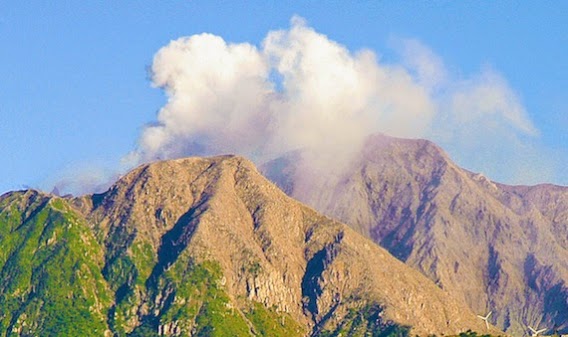
The Caribbean island of Montserrat is among the leaders in geothermal exploration.
It is also on a mission of rebirth from the devastation caused by the eruption of the Soufrière Volcano in the mid-1990s which destroyed the capital town of Plymouth, left more than half of the island’s residents homeless and covered more than 30 percent of the island with lava and ash.
Today, Montserrat has plans for a new capital town, a new port, a vibrant hospitality and tourism industry and the regeneration of private enterprise equipped with a sustainable infrastructure. Geothermal power will play a major role in this transformation.
Ironically, the same geological forces that created the Soufrière Volcano will now be harnessed to power the island’s electricity grid from a geothermal source. Iceland Drilling Company Ltd., a leading high-tech company in the field of high temperature deep geothermal drilling, has successfully tested two geothermal wells on Montserrat and the foundation is now in place for a third well backed by the UK government, part of its continuing support for the British Overseas Territory’s Master Plan for Growth.
It is our hope that Montserrat’s geothermal resources and sustainable, “green” energy infrastructure will attract environmentally-conscious developers and investors as “founding fathers” of our new capital town.
Ultimately, “going green” in Montserrat may help the nation move to the forefront in eco-tourism while driving a self-sufficient economic future.
In Dominica, geothermal exploration supported by the European Union brings with it the hopes of clean energy generation sufficient to supply the entire island and provide electricity for export as well.
Nevis, another volcanic island, is hoping to become a regional supplier of power to nearby St. Kitts, among others, and has said it intends to begin exploratory well-digging at various sites around the island.
Geothermal power has the possibility of transforming the Caribbean.
It will allow for a rise in the standard of living, an increase in job opportunities and a cleaner environment for residents and visitors to enjoy.
If nations can reduce, or eliminate, their reliance on expensive, environmentally harmful fossil fuels, they will not only pave the way for energy independence but also create an attractive environment for investors to support sustainable practices and economic development that will benefit the entire region. More
Young people have the most to gain from solving the climate crisis — and the sooner the better.
They didn't cause the issue, but they'll have to live with it for decades. And for far too long, they and their interests have been ignored by leaders who refuse to protect the planet.
On September 23, this is going to change when exceptional young people get a chance to put their questions to the world's decision-makers — to speak for their generation at the U.N. Climate Summit in New York City.
More than five years ago, Israel invaded Gaza under “Operation Cast Lead”.
The following article was first published by Global Research in January 2009 at the height of the Israeli bombing and invasion under Operation Cast Lead.
In the wake of the invasion, Palestinian gas fields were de facto confiscated by Israel in derogation of international law
A year following “Operation Cast Lead”, Tel Aviv announced the discovery of the Leviathan natural gas field in the Eastern Mediterranean “off the coast of Israel.”
At the time the gas field was: “ … the most prominent field ever found in the sub-explored area of the Levantine Basin, which covers about 83,000 square kilometres of the eastern Mediterranean region.” (i)
Coupled with Tamar field, in the same location, discovered in 2009, the prospects are for an energy bonanza for Israel, for Houston, Texas based Noble Energy and partners Delek Drilling, Avner Oil Exploration and Ratio Oil Exploration. (See Felicity Arbuthnot, Israel: Gas, Oil and Trouble in the Levant, Global Research, December 30, 2013
The Gazan gas fields are part of the broader Levant assessment area.
What is now unfolding is the integration of these adjoining gas fields including those belonging to Palestine into the orbit of Israel. (see map below).
It should be noted that the entire Eastern Mediterranean coastline extending from Egypt’s Sinai to Syria constitutes an area encompassing large gas as well as oil reserves.
War and Natural Gas: The Israeli Invasion and Gaza's Offshore Gas Fields
More than five years ago, Israel invaded Gaza under “Operation Cast Lead”.
The following article was first published by Global Research in January 2009 at the height of the Israeli bombing and invasion under Operation Cast Lead.
In the wake of the invasion, Palestinian gas fields were de facto confiscated by Israel in derogation of international law
A year following “Operation Cast Lead”, Tel Aviv announced the discovery of the Leviathan natural gas field in the Eastern Mediterranean “off the coast of Israel.”
At the time the gas field was: “ … the most prominent field ever found in the sub-explored area of the Levantine Basin, which covers about 83,000 square kilometres of the eastern Mediterranean region.” (i)
Coupled with Tamar field, in the same location, discovered in 2009, the prospects are for an energy bonanza for Israel, for Houston, Texas based Noble Energy and partners Delek Drilling, Avner Oil Exploration and Ratio Oil Exploration. (See Felicity Arbuthnot, Israel: Gas, Oil and Trouble in the Levant, Global Research, December 30, 2013
The Gazan gas fields are part of the broader Levant assessment area.
What is now unfolding is the integration of these adjoining gas fields including those belonging to Palestine into the orbit of Israel. (see map below).
It should be noted that the entire Eastern Mediterranean coastline extending from Egypt’s Sinai to Syria constitutes an area encompassing large gas as well as oil reserves.
levant gas map1 felicity
Michel Chossudovsky, January 3, 2014
War and Natural Gas: The Israeli Invasion and Gaza’s Offshore Gas Fields
by Michel Chossudovsky
January 8, 2009
The December 2008 military invasion of the Gaza Strip by Israeli Forces bears a direct relation to the control and ownership of strategic offshore gas reserves.
This is a war of conquest. Discovered in 2000, there are extensive gas reserves off the Gaza coastline.
British Gas (BG Group) and its partner, the Athens based Consolidated Contractors International Company(CCC) owned by Lebanon’s Sabbagh and Koury families, were granted oil and gas exploration rights in a 25 year agreement signed in November 1999 with the Palestinian Authority.
The rights to the offshore gas field are respectively British Gas (60 percent); Consolidated Contractors (CCC) (30 percent); and the Investment Fund of the Palestinian Authority (10 percent). (Haaretz, October 21, 2007).
The PA-BG-CCC agreement includes field development and the construction of a gas pipeline.(Middle East Economic Digest, Jan 5, 2001).
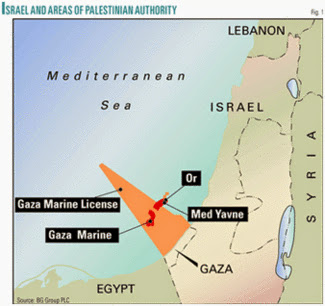
The BG licence covers the entire Gazan offshore marine area, which is contiguous to several Israeli offshore gas facilities. (See Map below). It should be noted that 60 percent of the gas reserves along the Gaza-Israel coastline belong to Palestine.
Map 1
The BG Group drilled two wells in 2000: Gaza Marine-1 and Gaza Marine-2. Reserves are estimated by British Gas to be of the order of 1.4 trillion cubic feet, valued at approximately 4 billion dollars. These are the figures made public by British Gas. The size of Palestine’s gas reserves could be much larger.
Who Owns the Gas Fields
The issue of sovereignty over Gaza’s gas fields is crucial. From a legal standpoint, the gas reserves belong to Palestine.
The death of Yasser Arafat, the election of the Hamas government and the ruin of the Palestinian Authority have enabled Israel to establish de facto control over Gaza’s offshore gas reserves.
British Gas (BG Group) has been dealing with the Tel Aviv government. In turn, the Hamas government has been bypassed in regards to exploration and development rights over the gas fields.
Map 2
The election of Prime Minister Ariel Sharon in 2001 was a major turning point. Palestine’s sovereignty over the offshore gas fields was challenged in the Israeli Supreme Court. Sharon stated unequivocally that “Israel would never buy gas from Palestine” intimating that Gaza’s offshore gas reserves belong to Israel.
In 2003, Ariel Sharon, vetoed an initial deal, which would allow British Gas to supply Israel with natural gas from Gaza’s offshore wells. (The Independent, August 19, 2003)
The election victory of Hamas in 2006 was conducive to the demise of the Palestinian Authority, which became confined to the West Bank, under the proxy regime of Mahmoud Abbas.
In 2006, British Gas “was close to signing a deal to pump the gas to Egypt.” (Times, May, 23, 2007). According to reports, British Prime Minister Tony Blair intervened on behalf of Israel with a view to shunting the agreement with Egypt.
The following year, in May 2007, the Israeli Cabinet approved a proposal by Prime Minister Ehud Olmert “to buy gas from the Palestinian Authority.” The proposed contract was for $4 billion, with profits of the order of $2 billion of which one billion was to go the Palestinians.
Tel Aviv, however, had no intention on sharing the revenues with Palestine. An Israeli team of negotiators was set up by the Israeli Cabinet to thrash out a deal with the BG Group, bypassing both the Hamas government and the Palestinian Authority:
“Israeli defence authorities want the Palestinians to be paid in goods and services and insist that no money go to the Hamas-controlled Government.” (Ibid, emphasis added)
The objective was essentially to nullify the contract signed in 1999 between the BG Group and the Palestinian Authority under Yasser Arafat.
Under the proposed 2007 agreement with BG, Palestinian gas from Gaza’s offshore wells was to be channeled by an undersea pipeline to the Israeli seaport of Ashkelon, thereby transferring control over the sale of the natural gas to Israel.
The deal fell through. The negotiations were suspended:
”Mossad Chief Meir Dagan opposed the transaction on security grounds, that the proceeds would fund terror”. (Member of Knesset Gilad Erdan, Address to the Knesset on “The Intention of Deputy Prime Minister Ehud Olmert to Purchase Gas from the Palestinians When Payment Will Serve Hamas,” March 1, 2006, quoted in Lt. Gen. (ret.) Moshe Yaalon, Does the Prospective Purchase of British Gas from Gaza’s Coastal Waters Threaten Israel’s National Security? Jerusalem Center for Public Affairs, October 2007)
Israel’s intent was to foreclose the possibility that royalties be paid to the Palestinians. In December 2007, The BG Group withdrew from the negotiations with Israel and in January 2008 they closed their office in Israel.(BG website).
Invasion Plan on The Drawing Board
The invasion plan of the Gaza Strip under “Operation Cast Lead” was set in motion in June 2008, according to Israeli military sources:
“Sources in the defense establishment said Defense Minister Ehud Barak instructed the Israel Defense Forces to prepare for the operation over six months ago [June or before June] , even as Israel was beginning to negotiate a ceasefire agreement with Hamas.”(Barak Ravid, Operation “Cast Lead”: Israeli Air Force strike followed months of planning, Haaretz, December 27, 2008)
That very same month, the Israeli authorities contacted British Gas, with a view to resuming crucial negotiations pertaining to the purchase of Gaza’s natural gas:
“Both Ministry of Finance director general Yarom Ariav and Ministry of National Infrastructures director general Hezi Kugler agreed to inform BG of Israel’s wish to renew the talks.
The sources added that BG has not yet officially responded to Israel’s request, but that company executives would probably come to Israel in a few weeks to hold talks with government officials.” (Globes online- Israel’s Business Arena, June 23, 2008)
The decision to speed up negotiations with British Gas (BG Group) coincided, chronologically, with the planning of the invasion of Gaza initiated in June. It would appear that Israel was anxious to reach an agreement with the BG Group prior to the invasion, which was already in an advanced planning stage.
Moreover, these negotiations with British Gas were conducted by the Ehud Olmert government with the knowledge that a military invasion was on the drawing board. In all likelihood, a new “post war” political-territorial arrangement for the Gaza strip was also being contemplated by the Israeli government.
In fact, negotiations between British Gas and Israeli officials were ongoing in October 2008, 2-3 months prior to the commencement of the bombings on December 27th.
In November 2008, the Israeli Ministry of Finance and the Ministry of National Infrastructures instructed Israel Electric Corporation (IEC) to enter into negotiations with British Gas, on the purchase of natural gas from the BG’s offshore concession in Gaza. (Globes, November 13, 2008)
“Ministry of Finance director general Yarom Ariav and Ministry of National Infrastructures director general Hezi Kugler wrote to IEC CEO Amos Lasker recently, informing him of the government’s decision to allow negotiations to go forward, in line with the framework proposal it approved earlier this year.
The IEC board, headed by chairman Moti Friedman, approved the principles of the framework proposal a few weeks ago. The talks with BG Group will begin once the board approves the exemption from a tender.” (Globes Nov. 13, 2008)
Gaza and Energy Geopolitics
The military occupation of Gaza is intent upon transferring the sovereignty of the gas fields to Israel in violation of international law.
What can we expect in the wake of the invasion?
What is the intent of Israel with regard to Palestine’s Natural Gas reserves?
A new territorial arrangement, with the stationing of Israeli and/or “peacekeeping” troops?
The militarization of the entire Gaza coastline, which is strategic for Israel?
The outright confiscation of Palestinian gas fields and the unilateral declaration of Israeli sovereignty over Gaza’s maritime areas?
If this were to occur, the Gaza gas fields would be integrated into Israel’s offshore installations, which are contiguous to those of the Gaza Strip. (See Map 1 above).
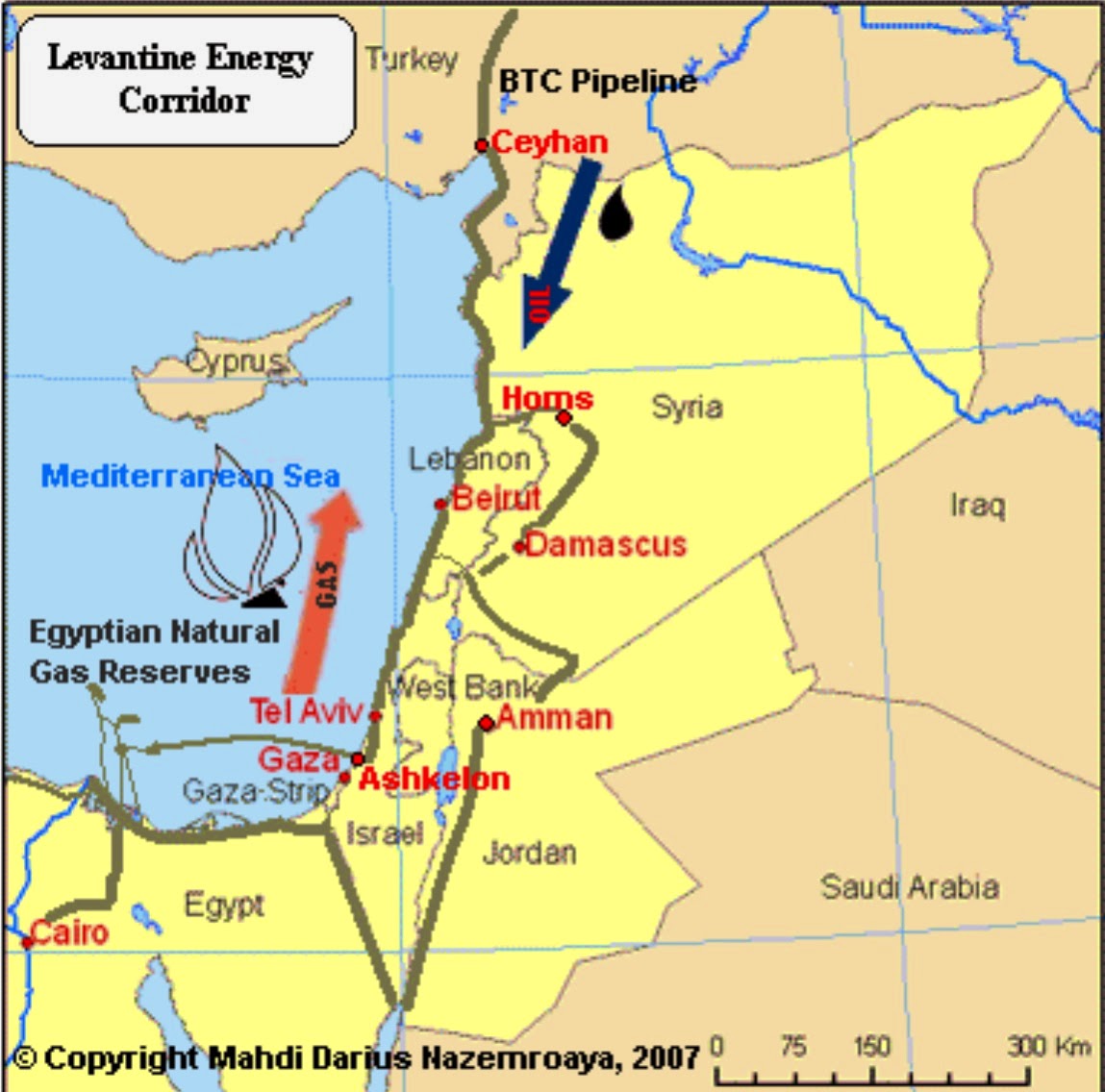
These various offshore installations are also linked up to Israel’s energy transport corridor, extending from the port of Eilat, which is an oil pipeline terminal, on the Red Sea to the seaport – pipeline terminal at Ashkelon, and northwards to Haifa, and eventually linking up through a proposed Israeli-Turkish pipeline with the Turkish port of Ceyhan.
Map 3
Ceyhan is the terminal of the Baku, Tblisi Ceyhan Trans Caspian pipeline. “What is envisaged is to link the BTC pipeline to the Trans-Israel Eilat-Ashkelon pipeline, also known as Israel’s Tipline.” (See Michel Chossudovsky, The War on Lebanon and the Battle for Oil, Global Research, July 23, 2006)



 ©
© 





 Democracy & Good Governance