Gallery

We have reached water!!!!!!!

irishingaza's avatarIrish in gaza

We need your help to complete this project, please read, share and if Possible, Please donate below.

Part 2.

Thursday 23 October… Another milestone reached. This morning, more than 45 metres below ground, we hit Water…

014

So, The drilling now comes to an end, No more pictures of men below ground throwing out buckets of sand, no spitting and puffing from an old generator and no more listening to the repetitive thud of an old drill forcing open the ground…  It really is the most primitive of equipment, it keeps breaking down, it has been mended more times but it’s all there is, and they manage to use it successfully… obviously. So now, we have water…

002

Tomorrow, Friday, is a day of rest… Back at it again on Saturday. Next in line is the submersion of the pump which will then feed the water up to a de-salination /filtration system…

View original post 239 more words

Amnesty: US Human Rights Abuses on Display in Ferguson

In a report released on Friday, Amnesty International roundly condemns the excessive force used by local law enforcement agencies in Ferguson, Missouri earlier this year and called for ‘accountability and systemic change’ in order to curb the kinds of human rights abuses increasingly seen in U.S. communities when it comes to regulating street protests and use of force by police.

The report—entitled On the Streets of America: Human Rights Abuses in Ferguson (pdf)—documents the human rights concerns witnessed first-hand by Amnesty investigators dispatched to Ferguson following initial protests in the city spurred by the shooting death of an unarmed African American teenager, Michael Brown, by a police officer Darren Wilson on August 9. The Amnesty team arrived and documented public protest and the behavior of local law enforcement from August 14 to August 22.

Amnesty’s report makes takes no position or determination on the killing of Brown, but says the shooting and his death “highlighted on a national level the persistent and widespread pattern of racially discriminatory treatment by law enforcement officers across the United States, including unjustified stops and searches, ill treatment and excessive, and sometimes lethal, use of force.”

Focused on both the community response to Brown’s death and the subsequent police reaction to protests, the report’s authors present what they witnessed first-hand in Ferguson in order to highlight some of the national trends of human rights abuses that often, though with less attention, take place in U.S. communities.

“What Amnesty International witnessed in Missouri on the ground this summer underscored that human rights abuses do not just happen across borders and oceans,” said Steven W. Hawkins, executive director of Amnesty International USA. “No matter where you live in the world, everyone is entitled to the same basic rights as a human being – and one of those rights is the freedom to peacefully protest. Standing on W. Florissant Avenue with my colleagues, I saw a police force, armed to the teeth, with military-grade weapons. I saw a crowd that included the elderly and young children fighting the effects of tear gas. There must be accountability and systemic change that follows this excessive force.”

According to the report:

The rights of peaceful assembly, freedom of association and freedom of expression are basic human rights. These rights are also guaranteed under the Constitution of the United States and the laws of the state of Missouri. The vast majority of those participating in the demonstrations in Ferguson that spontaneously grew in the days and weeks following the shooting Michael Brown have been peaceful – as noted by government officials such as the President of the United States, the Governor of Missouri and Attorney General along with the Missouri Highway Patrol. However, the responses by state officials and law enforcement to the violent actions of a limited number of protestors have impacted the rights of all participating in peaceful protests.

Overall, said Hawkins, “This is about accountability.”

“The events in Ferguson sparked a much-needed and long-overdue conversation on race and policing in America,” he said. “That conversation cannot stop. In order to restore justice to Ferguson, and every community afflicted by police brutality, we must both document the injustices committed and fight to prevent them from happening again. There is a path forward, but it requires substantive actions on the local, state and federal levels.”

In addition to documenting the abuses witnessed in Ferguson, the Amnesty report also puts forth a series of recommendations for local, state, and national agencies that include: better policies on use of force: calling for a thorough and transparent investigation into Brown’s death; improved policing standards of public protests; and a plea to end the unnecessay militarization of local police departments. More


Micropower’s Quiet Takeover

In a cover story and article 14 years ago about the emergent disruption of utilities, The Economist’s Vijay Vaitheeswaran coined the umbrella term “micropower” to mean sources of electricity that are relatively small, modular, mass-producible, quick-to-deploy, and hence rapidly scalable—the opposite of cathedral-like power plants that cost billions of dollars and take about a decade to license and build.

His term combined two kinds of micropower: renewables other than big hydroelectric dams, and cogeneration of electricity together with useful heat in factories or buildings (also known as combined-heat-and-power, or CHP).

Besides being cost-competitive and rapidly scalable, why does micropower matter? First, as explained below, its operation releases little or no carbon.[1] Second, micropower enables individuals, communities, building owners, and factory operators to generate electricity, displacing dependence on centralized, inefficient, dirty generators. This democratizes energy choices, promotes competition, speeds learning and innovation, and can further accelerate deployment—because “vernacular” technologies accessible to many diverse market actors, even if individually small, tend to deploy faster in sum than a few big units requiring specialized institutions, complex approvals, intricate logistics, and hence long lead times.

Thanks to Bloomberg New Energy Finance, which tracks investments and generating capacity, and the global expert network REN21.net, which tracks capacity and (where known) electrical output, global progress in renewables has become rather transparent. Starting in 2005 and updated with a fifth edition in July 2014, RMI’s Micropower Database added a third source: industry sales data for cogeneration equipment. Tracking renewables, minus big hydro, plus cogeneration, this database documents the global progress of distributed, rapidly scalable, and (as we’ll see) no- or low-carbon generators.

The update’s most astonishing finding: micropower now produces about one-fourth of the world’s total electricity (Fig. 1).

MICROPOWER’S CLIMATE IMPLICATIONS

Operating modern renewables is essentially carbon-free, except for minor subsets fueled by biomass grown using unsustainable practices that gradually deplete soil carbon.[2] Of the estimated 3–5 percent of cogeneration fueled by biomass, most is in the forest products industry, whose biomass wastes produce most of its electricity and process heat.

Cogeneration in refineries often burns waste fuels that would otherwise be uselessly flared. Similarly, much industrial cogeneration harnesses waste heat previously thrown away. Where extra fuel is burned to make electricity as well as heat, typically far less is burned than when making them separately. If cogeneration also produces cooling and other services, it can convert as much as 93 percent of fuel energy into useful work, both in industry and in buildings. Moreover, the natural gas that fuels most cogeneration is only about half as carbon-intensive as the coal-fired power-only generation it often displaces.[3]

Big hydroelectric dams and nuclear power are also carbon-free in operation. Thus in 2013, nearly half of the world’s electricity was produced with little or no carbon release: 8.4 percent by modern renewables [4], 10.2 percent by nuclear power (set to be overtaken by modern renewables in 2015), 15.5 percent by cogeneration [5], and 13.5 percent by big hydroelectric dams (excluding the 2.8 percent small hydro classified under modern renewables).

The other half came from power-only plants, burning mainly coal. Those plants cost more to build, and often more just to run, than their competitors, so their orders are fading, their operations are dwindling, and over decades, they’ll retire in favor of cleaner, cheaper substitutes—both micropower and efficient use.

WINNERS AND LOSERS

Far from recognizing that they’re being rapidly overtaken, many advocates of coal or nuclear power stations don’t even acknowledge micropower as an important competitor—even as it grabs their markets and destroys their sales. In 2009, a senior strategic planner for a major nuclear vendor told me micropower was trivial—having failed to find it in official databases of utility-owned central power stations, without understanding the difference. And even at minor market share, micropower can have major effects. The solar 4.7 percent of Germany’s 2013 generation destroyed the incumbent utilities’ business model and wiped a half-trillion Euros off their market cap. More


Belize Fights to Save a Crucial Barrier Reef

caribbeanclimate's avatarcaribbeanclimate

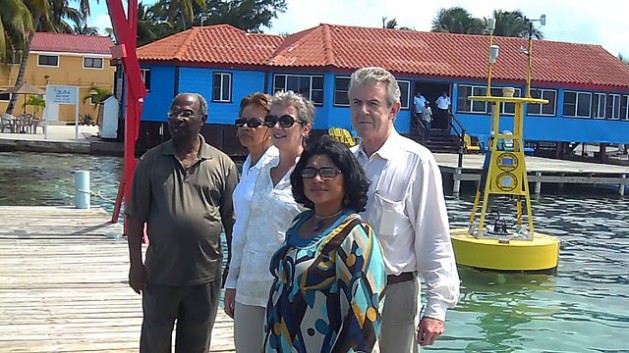
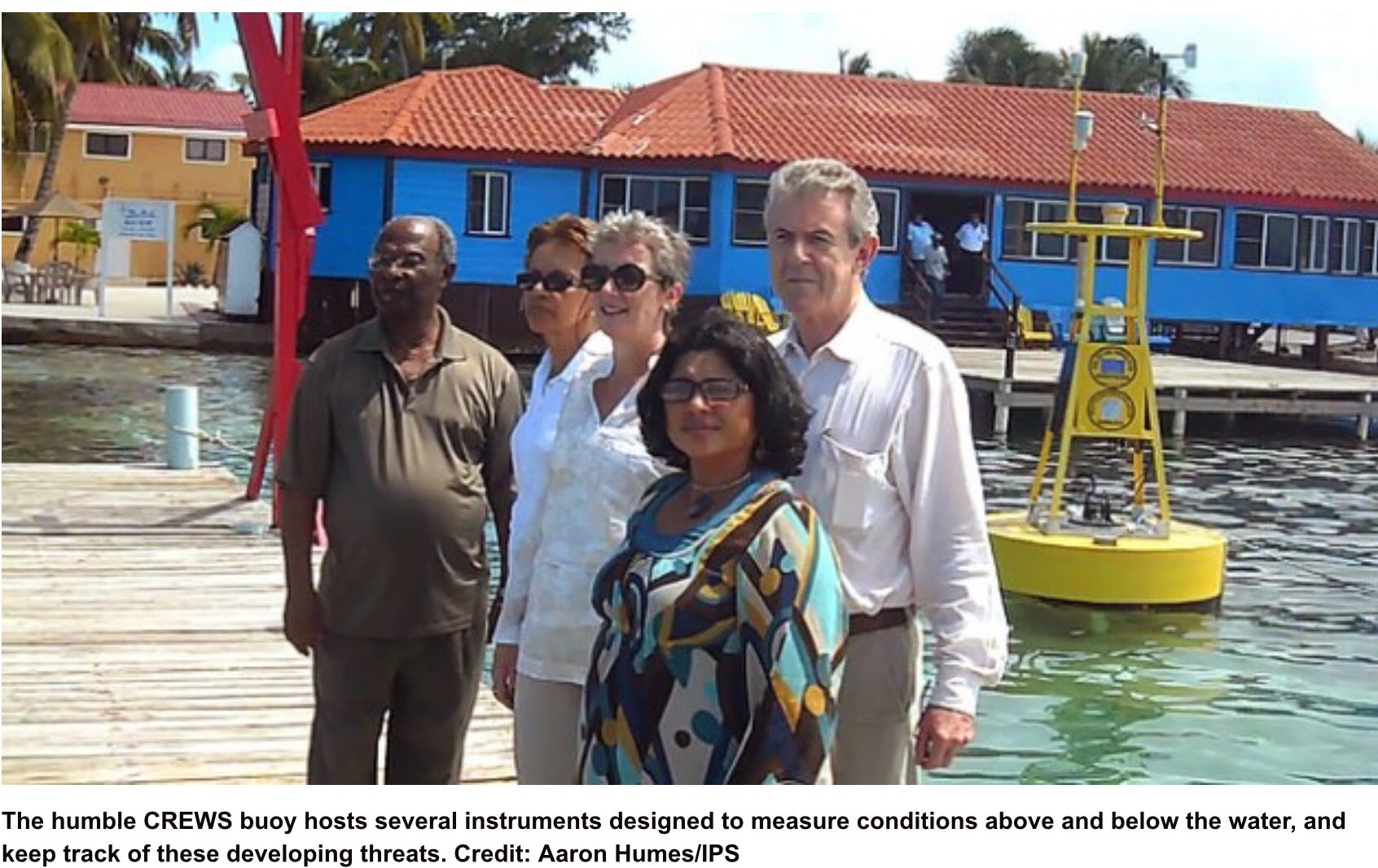
The humble CREWS buoy hosts several instruments designed to measure conditions above and below the water, and keep track of these developing threats. Credit: Aaron Humes/IPS The humble CREWS buoy hosts several instruments designed to measure conditions above and below the water, and keep track of these developing threats. Credit: Aaron Humes/IPS

Home to the second longest barrier reef in the world and the largest in the Western Hemisphere, which provides jobs in fishing, tourism and other industries which feed the lifeblood of the economy, Belize has long been acutely aware of the need to protect its marine resources from both human and natural activities.

However, there has been a recent decline in the production and export of marine products including conch, lobster, and fish, even as tourism figures continue to increase.

“What happens on the land will eventually reach the sea, via our rivers.” — Dr. Kenrick Leslie

The decline is not helped by overfishing and the harvest of immature conch and lobster outside of the standard fishing season. But the primary reason for less…

View original post 712 more words

Belize Fights to Save a Crucial Barrier Reef

BELIZE CITY, Oct 20 2014 (IPS) Home to the second longest barrier reef in the world and the largest in the Western Hemisphere, which provides jobs in fishing, tourism and other industries which feed the lifeblood of the economy, Belize has long been acutely aware of the need to protect its marine resources from both human and natural activities.

However, there has been a recent decline in the production and export of marine products including conch, lobster, and fish, even as tourism figures continue to increase.

“What happens on the land will eventually reach the sea, via our rivers.” — Dr. Kenrick Leslie

The decline is not helped by overfishing and the harvest of immature conch and lobster outside of the standard fishing season. But the primary reason for less conch and lobster in Belize’s waters, according to local experts, is excess ocean acidity which is making it difficult for popular crustacean species such as conch and lobster, which depend on their hard, spiny shells to survive, to grow and mature.

According to the executive director of the Caribbean Community Climate Change Center (CCCCC), Dr. Kenrick Leslie, acidification is as important and as detrimental to the sustainability of the Barrier Reef and the ocean generally as warming of the atmosphere and other factors generally associated with climate change.

Carbon dioxide which is emitted in the atmosphere from greenhouse gases is absorbed into the ocean as carbonic acid, which interacts with the calcium present in the shells of conch and lobster to form calcium carbonate, dissolving those shells and reducing their numbers. Belize also faces continuous difficulties with coral bleaching, which has attacked several key sections of the reef in recent years.

Dr. Leslie told IPS that activities on Belize’s terrestrial land mass are also contributing to the problems under Belize’s waters. “What happens on the land will eventually reach the sea, via our rivers,” he noted.

To fight these new problems, there is need for more research and accurate, up to the minute data.

Last month, the European Union (EU), as part of its Global Climate Change Alliance Caribbean Support Project handed over to the government of Belize and specifically the Ministry of Forestry, Fisheries and Sustainable Development for its continued usage a Coral Reef Early Warning System (CREWS) buoy based at South Water Caye off the Stann Creek District in southern Belize. More


Mismanaging Climate Change

Pakistan’s extreme vulnerability to climate change is not a scientific secret but is, in fact, a logical certainty owing to its geographic location, inclined elevation, as well as demographics.

Former Minister Malik Amin Aslam Khan

The issue directly impacts upon the country’s already volatile water dynamics driven by the northern glaciers and the seasonal monsoon rains and, if not managed properly, could burden our economy to the tune of $6-14 billion per year (United Nations Framework Convention on Climate Change NEEDS study 2010). In response to this challenge, Pakistan’s National Climate Change Policy has laid out a comprehensive ‘to do’ list for the government, which was approved by the government but, unfortunately, has not been acted upon by the authorities. Oblivious to this apathy and inaction, Pakistan continues to face a mammoth challenge to not only climate-proof its future development path, but also take steps to cope with an issue, which is here to stay. These steps include establishing early warning systems, effective flood plain management, improving weather forecasting with cross-border data exchange and enhancing the disaster preparedness, as well as emergency response capabilities to deal with predicted climate-induced natural disasters.

To their credit, previous governments did begin to take concrete institutional building measures, such as establishing a very high-level Prime Minister’s Cabinet Committee on Climate Change, setting up a dedicated Ministry of Climate Change built on the debris of a misguidedly devolved Environment Ministry and creating a focused climate research centre i.e., the Global Change Impact Studies Centre. However, in one stroke of convenient denial, the present government has undone and dismantled all those measures by downgrading the ministry to a division level, drastically cutting the funds for the division, leaving it headless without an appointed minister and also drying up all finances for the climate research centre. It is, thus, not surprising, that the country received a rude wake-up call when, during the recent floods, the forces of nature once again caught it totally off guard and institutionally ill-prepared to deal with a situation, which had been predicted and forewarned time and again by climate experts.

The 2014 flood came in two surges. The first surge occurred due to exceptionally high rainfall in the rivers Jhelum, Chenab, Ravi and their catchments. It is a recorded fact that the Pakistan meteorological office gave clear warnings about this enhanced rainfall activity, which were not heeded to in a timely manner. The result of this negligence was that the Mangla Dam remained filled to the brim, while storm waters gathered upstream and, subsequently, the floodgates were forced open at the worst possible time when water levels were already dangerously peaking downstream. Had the water been incrementally released, as advised, the massive flood surge that eventually occurred could have been effectively prevented. Dams remain a double-edged sword — if used intelligently, they can be the best tool for controlling and regulating floods, but if used improperly, as they were on this occasion, they can quickly convert floods into mega human disasters.

This first human-induced deluge was followed by the second flood surge that occurred due to the unpredictably high ‘cloud-burst’ in Indian-held Kashmir. The information about this second surge was also received hours in advance as the water roared down River Chenab. Again, our own meteorological office issued a timely flood peak warning, but again, the reaction time and response measures of our government were found severely lacking.

The floods were triggered by climate-induced cloud-bursts and monsoonal shifts, but the human tragedy and destruction got multiplied due to poor government planning, human negligence and a criminal mixture of absence and apathy of relevant institutional response mechanisms.

Climate related calamities, including more flooding and an enhanced frequency of freak natural events are, unequivocally, predicted for Pakistan and it is time to take these warnings seriously, and for the government to heed to them by planning to deal with the consequences, limiting the damage and adapting to this shifting scenario. The recent floods, which are surely not the last one, have also rudely exposed the human, economic and environmental costs to be paid for our politically motivated aversion to building large dams, as well as the suicidal trend of encroaching upon flood plains and continuing to challenge the flood water boundaries.

Pakistan lies at the geographic crossroads of melting glaciers, shifting monsoons and enhanced disaster activity. This locational risk cannot be changed, but how we deal with this looming catastrophe can certainly be changed. What it requires is better responsive measures and heeding to technical advice and scientifically based warnings with timely decisions.

The political optics of wading through floodwaters and post disaster bear hugs with destitute and frustrated victims is beginning to lose its vote-gathering lustre. As we haplessly subject millions to avoidable disasters, it is time to face up to reality. Climate-proofing of infrastructure, conserving the yearly deluge of water that is callously flushed into the Arabian Sea and effectively enforced flood plains management needs to get the priority it deserves. The politics of underpasses and overpasses has to give way to the politics of common sense, based on what Pakistan’s real challenges are and what it is predicted to face up to in the near future. Governing with confused priorities and institutional mismanagement will continue to worsen the responses forced upon us as we face up to the unpredictability of climate change. More

Published in The Express Tribune, October 19th, 2014.


Turks & Caicos Joins The Caribbean’s Renewable Energy Race

New York, October 16,2014— Tlirks & Caicos fTCI) deepened its commitment to advancing renewable energy by joining the Carbon War Room’s Ten Island Challenge today.

The Premier of Turks and Caicos, the Honorable Doctor Rufus Ewing, and Carbon War Room Operation Director, Justin Locke, signed a Memorandum of Understanding, committing to work together to reduce the island’s dependence on fossil fuels through increased renewable energy production and improved energy efficiency.

“With the addition of Turks & Caicos, the Ten Island Challenge continues to expand its efforts to transform Caribbean economies and help the region achieve independence from fossil fuels.”Sir Richard Branson, Founder of Carbon War Room

The Ten Island Challenge, driven by partners Carbon War Room and Rocky Mountain Institute, provides the Government of TCI the opportunity and platform to define and realize its own vision of a clean economy. In order to achieve this vision, the Carbon War Room and Rocky Mountain Institute will provide a range of technical, project management, communications, and business advisory support services.

The MOU signing builds on a commitment made by the Governor of Turks and Caicos, Peter Beckingham at the Creating Climate Wealth Islands Summit in February 2014, when Turks & Caicos expressed interest in joining the Challenge.

Governor Peter Beckingham

The Ten Island Challenge

The Ten Island Challenge works to accelerate the transition of Caribbean island economies from a heavy dependence on fossil fuels to renewable resources. Caribbean economies suffer from some of the highest electricity prices in the world—contributing to their national debts, and slowing efforts toward sustainable development. Despite an abundance of sun and wind, Caribbean islands have implemented relatively low amounts of renewables to date. The Ten Island Challenge is tackling this by identifying the technical and commercial solutions that can facilitate low-carbon energy use in the Caribbean.

In 2013, Sir Richard Branson committed his home of Necker Island in the British Virgin Islands to serve as a ‘demo’ island in the Challenge, and, in February of this year, US energy giant NRG Energy was awarded the contract to transition the island to renewables. More


From Miasma to Ebola: The History of Racist Moral Panic Over Disease

On October 1st, the New York Times published a photograph of a four-year-old girl in Sierra Leone. In the photograph, the anonymous little girl lies on a floor covered with urine and vomit, one arm tucked underneath her head, the other wrapped around her small stomach. Her eyes are glassy, returning the photographer’s gaze. The photograph is tightly focused on her figure, but in the background the viewer can make out crude vials to catch bodily fluids and an out-of-focus corpse awaiting disposal.

The photograph, by Samuel Aranda, accompanied a story headlined “A Hospital From Hell, in a City Swamped by Ebola.” Within it, the Times reporter verbally re-paints this hellish landscape where four-year-olds lie “on the floor in urine, motionless, bleeding from her mouth, her eyes open.” Where she will probably die amidst “pools of patients’ bodily fluids,” “foul-smelling hospital wards,” “pools of infectious waste,” all overseen by an undertrained medical staff “wearing merely bluejeans” and “not wearing gloves.”

Aranda's photograph is in stark contrast to the images of white Ebola patients that have emerged from the United States and Spain. In these images the patient, and their doctors, are almost completely hidden; wrapped in hazmat suits and shrouded from public view, their identities are protected. The suffering is invisible, as is the sense of stench produced by bodily fluids: these photographs are meant to reassure Westerners that sanitation will protect us, that contagion is contained.

Pernicious undertones lurk in these parallel representations of Ebola, metaphors that encode histories of nationalism and narratives of disease. African illness is represented as a suffering child, debased in its own disease-ridden waste; like the continent, it is infantile, dirty and primitive. Yet when the same disease is graphed onto the bodies of Americans and Europeans, it morphs into a heroic narrative: one of bold doctors and priests struck down, of experimental serums, of hazmat suits and the mastery of modern technology over contaminating, foreign disease. These parallel representations work on a series of simple, historic dualisms: black and white, good and evil, clean and unclean.

The Western medical discourse on Africa has never been particularly subtle: the continent is often depicted as an undivided repository of degeneration. Comparing the representations of disease in Africa and in the West, you can hear the whispers of an underlying moral panic: a sense that Africa, and its bodies, are uncontainable. The discussion around Ebola has already evoked—almost entirely from Tea Party Republicans—the explicit idea that American borders are too porous and that all manners of perceived primitiveness might infect the West.

And indeed, with the history of American and European panic over regulating foreign disease comes a history of regulating the perception of filth from beyond our borders, a history of policing non-white bodies that have signified some unclean toxicity.


If the history of modernity can, as Dominique Laporte suggests in his genealogical meditation History of Shit, be written as a triumph of cleanliness over bodily refuse, then so too could the European colonization of Africa and India. The sanitary crusade of the nineteenth century is central to the violent project of empire. Western medicine, with its emphasis on personal hygiene, functioned (and in some arenas still functions) as colonialism's benevolent cover—an acknowledgment that, while empire was about profit at all costs, that it could also conceal this motive slightly by concerning itself with bettering the health of debased bodies.

The bureaucratic annals of colonialism are filled with reports on the unsanitary conditions of life and unhygienic practices of natives. Dr. Thomas R. Marshall, an American in the Philippines, wrote of the “promiscuous defecation” of the “Filipino people.” An 1882 British report, “Indian Habits,” observed that, “The people of India seem to be very much the condition of children. They must be made clean by compulsion until they arrive at that degree of moral education when dirt shall become hateful to them, and then they will keep themselves clean for their own sakes.” Dirtiness and defecation indicated their primitiveness and savagery; it reaffirmed the white body's privileged position and claim to moral and medical modernity.

This intense focus on hygiene emerged from an old medical doctrine known as miasma. According to the miasma theory, illness was the direct result of the polluting emanations of filth: sewer gas, garbage fumes and stenches that permeated air and water, creating disease in the process. Filth, however, had many incarnations. It could be literal, or also a catch-all metaphorical designation for anything that made people uncomfortable about race, gender and sexuality. (This idea underpins phrases still in use today, for example: a “dirty whore”).

So, the medical mission of hygiene was simultaneously a moral and medical imperative. And it was this fervent belief in miasmas that led to colonial administrations deeply interested in the bodily fluids of bodies of color; as Lord Wellesley, the British governor of India, briefly noted in an 1803 report, “Indians defecate everywhere.”

But if colonial governments exercised concern over what they believed to be the contaminated cultures of native populations, it was more likely the result of panic over the health of their own officials and soldiers. “The white man's grave,” as one nineteenth-century British colonist called Sierra Leone, was a dangerous trap of foreign disease, carried by the contagious peoples who inhabited valuable land. Their culture, like their natural resources, must be conquered. Who better to do that then scientifically advanced westerners who valued cleanliness and life?

Miasma theory proved a powerful science through which to construct “the African” or “the Indian.” Long after its late-nineteenth-century demise and subsequent replacement with an epidemiological understanding of contagion, the metaphors it produced endured. The move from miasma theories to germ theories simply added pathological depth to older social resentments. Minorities might look clean: but who knew what invisible, contagious threats lurked within?

These stereotypes showed up everywhere. Take, for example, Victorian soap advertisements: ordinary markers of domesticity that, according to feminist scholar Anne McClintock, “persuasively mediated the Victorian poetics of racial hygiene and imperial progress.” In a Pears' Soap advertisement from around 1882, race is linked to dirtiness and ignorance: blacks could become clean (here, actually, white) if they just bathed; they barely know how to clean themselves; they need a white man to teach them cleanliness, civilization, culture, etc. More


The Smithsonian Institution Announces an Official Climate Change Statement

Living in the Anthropocene: Prospects for Climate, Economics, Health, and Security

In conjunction with the one-day symposium “Living in the Anthropocene: Prospects for Climate, Economics, Health, and Security,” the Smithsonian has released the following statement on climate change:

Rapid and long-lasting climate change is a topic of growing concern as the world looks to the future. Scientists, engineers and planners are seeking to understand the impact of new climate patterns, working to prepare our cities against the perils of rising storms and anticipating threats to our food, water supplies and national security. Scientific evidence has demonstrated that the global climate is warming as a result of increasing levels of atmospheric greenhouse gases generated by human activities. A pressing need exists for information that will improve our understanding of climate trends, determine the causes of the changes that are occurring and decrease the risks posed to humans and nature.

Climate change is not new to the Smithsonian—our scholars have investigated the effects of climate change on natural systems for more than 160 years. We look at processes that occurred millions of years ago alongside developments taking place in today’s climate system.

The Smithsonian responds to climate change in four ways: by increasing knowledge of the human and natural environment through research; by making our findings available to the public; by protecting the Institution’s core asset, the national collections; and by operating our facilities and programs in a sustainable manner.

Research underlies all that we do. Scholars use the Smithsonian’s unparalleled collection of more than 138 million objects and specimens, together with our global network of marine and terrestrial monitoring stations, to examine climate change through multiple lenses. Smithsonian research scientists use satellite- and place-based sensors to study the changing composition of air, water and soil. They study climate history at geological and archaeological field sites around the world. Finally, they excel at baseline studies carried out over decades, which are recognized as essential to tracking the long-term effects of climate change.

The 500 Smithsonian scientists working around the world see the impact of a warming planet each day in the course of their diverse studies. A sample of our investigations includes anthropologists learning from the Native people of Alaska, who see warming as a threat to their 4,000-year-old culture; marine biologists tracking the impacts of climate change on delicate corals in tropical waters; and coastal ecologists investigating the many ways climate change is affecting the Chesapeake Bay.

The dissemination of knowledge gained through research is a public responsibility of the Smithsonian. Our scientists continually communicate with the scholarly community through publications and academic interactions. At the same time, the Smithsonian’s unique combination of museums and interconnected array of traveling exhibitions, publications, media and Web-based tools provide platforms to reach hundreds of millions of people each year across the world. Our goal is to explain in clear and objective terms the causes and effects of climate change as documented in our research and the research of our colleagues.

The Smithsonian has assembled collections of scientific specimens unsurpassed anywhere else in the world. These collections provide invaluable documentation of cultures and global biodiversity for scientists, scholars and the public. Extreme weather, rising sea levels and storm surges pose significant threats to the museums and research centers that house these collections, many of them located on low-lying land. Our charge is to protect, now and far into the future, this irreplaceable resource from the impacts of climate change and other hazards.

We are always striving to operate in ways that minimize the Smithsonian’s environmental footprint, meeting Institutional goals to decrease the use of potable water and fossil fuels, reduce direct and indirect greenhouse gas emissions and increase use of renewable energy. The National Museum of African American History and Culture is set to be the “greenest” Smithsonian museum yet, designed to achieve a LEED Gold rating, and the new Mathias Laboratory building at the Smithsonian Environmental Research Center is on track to receive LEED Platinum certification.

The Smithsonian will continue, as it has for more than a century and a half, to produce basic scientific information about climate change and to explore the cultural and historical significance of these changes. The urgency of climate change requires that we boost and expand our efforts to increase public knowledge and that we inspire others through education and by example. We live in what has come to be called the Anthropocene, or “The Age of Humans.” The Smithsonian is committed to helping our society make the wise choices needed to ensure that future generations inherit a diverse world that sustains our natural environments and our cultures for centuries to come. More