Water as a single post-2015 UN Sustainable Development Goal

We need a single post-2015 Sustainable Economic and Social Development Goal for Water with four concrete targets responding to the major challenges: access to truly safe water for basic needs, access to decent sanitation, primary treatment of all wastewater (see my previous post), and, last but not least, rebalancing overdraft of freshwater.

I made my proposals already on several occasions and would like to use this platform to bring them to the attention of an even wider group of people. They are based on a broad consultationearlier this year and then further developed in many discussions with persons from civil society, private sector and government. A single goal for water with four concrete targets as part of the Post-2015 UN Sustainable Development GoalsThe discussion on the post-2015 Goals is ongoing both in New York and in capitals of UN member countries.

The proposals of a single water goals with the four targets as specified below need, if you agree with them, your support whenever and wherever possible

1) Water as a human right – implement the universal accesses to safe drinking water bringing ‘improved’ water to all people by 2025 at the latest, with a parallel focus and longer-term perspective (i.e., beyond 2025) on quality, i.e., moving from an ‘improved’ water perspective to ‘truly safe drinking water’, and on bringing this water actually to the homes of individual citizens. While it is essential for achieving this target that infrastructure costs (including capital costs) are fully covered, water to cover the very basic needs must be free for those who are unable to pay

2) Accelerate the provision of access to improved sanitation to at least 120 million additional people per year, aiming for universal access before 2050. Data on actual improvements achieved show that this is realistically possible; with further strengthened efforts political leaders might aim for even more ambitious targets.

3) Adequate treatment of all municipal and industrial wastewater prior to discharge by 2030. Best practice initiatives and learning to reduce groundwater pollution by agricultural production (traditional, organic, etc.). According to FAO only about half of the 285 cubic-kilometres of wastewater are treated, and only some 10% of treated municipal wastewater is directly re-used. This means there is potential here to close the gap – as outlined in my previous post here on LinkedIn

4) Finally, yet fundamentally, we must address the water overdraft, i.e., bringing freshwater use/waste (initially measured as withdrawals) back into line with sustainable supply (natural renewal minus environmental flows). Without change in the way we are using water today, we risk shortfalls of up to 30% of global cereal production due to water scarcity by 2030. First priority must be on this target 4, if we can’t overcome water overuse, water shortage will impact all other targets above. Cost effective and comprehensive actions are needed, combining the supply side and demand side by increasing the efficiency of water use and managing wastewater as a reusable resource. The 2030 Water Resources Group that I am chairing, a disruptive public-private partnership, is participating in these efforts. But it is an initiative that still needs more support – we are looking for more companies and other stakeholders to join.

Need for reality checks of goals, need for good management, and need for a broader policy context.

All of these targets need to be checked against reality: we did it with data of improvements of the past. But then it is also about good management of their local implementation, rather than solemn declarations, that is what is most needed in the coming years.

And they need to be put in the context of other policies and urgent policy changes:

  • more efforts to reduce loss and waste of food, again a management task, also with the necessary investment in infrastructure, and more responsibility of consumers in advanced economies;
  • we must further liberalise international trade (of virtual water) so, water intensive staple food, for instance, can be grown in regions where water is abundant;
  • land and other property, but also usage rights, for instance private rights to use water particularly of small farmers must be better protected;
  • and governments must no longer wait and stop mandates and subsidies for biofuels.

Water plays a complex role in society and human life, which makes its management quite challenging. This means further discussion on all the points I’ve made over the past few posts remains necessary. More


30 Percent of Singapore’s Water Supply is Currently Met by Recycled Water

The South-east Asian island country has a population of 5 million residing on less than 750 square kilometers of land. Whilst known for its strong economy, Singapore is lacking one essential asset — water.

Water security has long been a national priority in Singapore as half of its current water supplies are imported from neighboring Malaysia. “We are preparing for the day that should the water agreement expire, we should be ready to fulfill our own needs,” says Chew Men Leong, Chief Executive of the Public Utilities Board.

The agreement with Malaysia is due to expire in 2061, so the country has time to be ready.

Singapore’s strategy for a hydrated nation is four-fold: as well as importation, it includes desalinization plants, efficient catchment of rainwater and recycling of sewage.

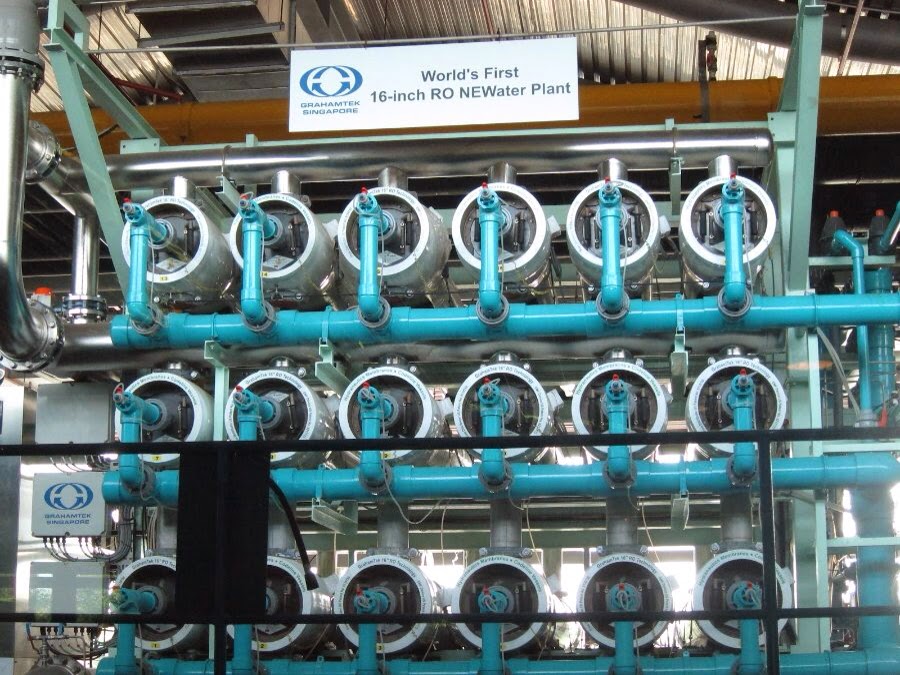
Rainwater is collected through a network of drains, canals, rivers, storm water, collection ponds and reservoirs with the aim to catch water across two-thirds of the country. But the real hope lies in the membrane technology to treat wastewater known as ‘NEWater’, created by the country’s public utilities board.

Through a four-step series of barriers and membranes, wastewater is made free of solids, microorganisms, and contaminants resulting in potable water supplies for use by humans and industry.

After one decade, the technology meets 30 percent of Singapore’s water needs, with plans to triple volumes by 2060.

“The level of quality we receive from the Public Utility Board meets and exceeds the expectation,” explains Jagadish CV, CEO of Systems on Silicon Manufacturing, where the water is used in their processing of silicon wafers. “We are using the water three times before we let it into the drain,” he says.

The demand by industry is being further met by a new collaboration with Japanese firm Meiden that will supply factories with recycled industrial water. One and a half Olympic-sized swimming pools of water are currently filtered and treated every day.

The goal is to more cost-effectively treat industrial waste streams in the long run.

Professor Asit Biswas from the Lee Kuan School of Public Policy feels other countries should follow the example set by Singapore and even the current standards can be improved to eventually re-use every last drop of water. More

Source: CNN


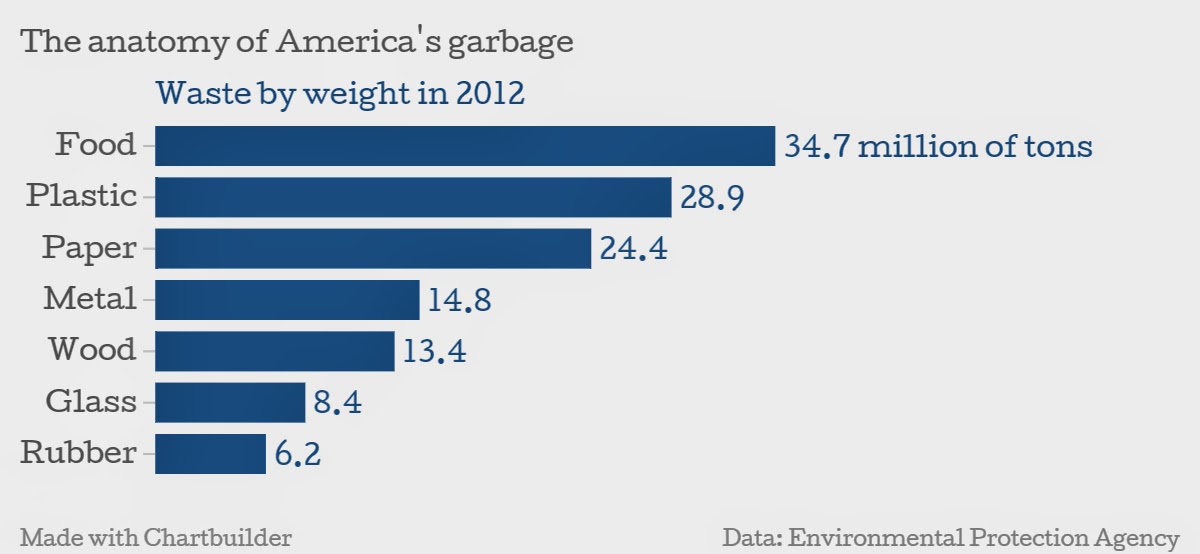
We throw out more food than plastic, paper, metal, and glass

The much-anticipated U.N. Climate Summit, which began a few days ago in New York, and was ostensibly a platform for world leaders to leap frog debates over whether climate change is real, and skip straight to discussions centered around how to overcome the challenges it poses.

But it’s also an impetus for those beyond the sessions’ panels to illuminate troubling patterns of behavior that are contributing to our collective carbon footprint—and food waste is without question one of the most egregious, especially in the United States.

In 2012, the most recent year for which estimates are available, Americans threw out roughly 35 million tons of food, according to the Environmental Protection Agency. That’s almost 20 percent more food than the United States tossed out in 2000, 50 percent more than in 1990, and nearly three times what Americans discarded in 1960, when the country threw out a now seemingly paltry 12.2 million tons.

“Food waste is an incredible and absurd issue for the world today,” Jose Lopez, Nestle’s head of operations said of the issue earlier this month.

Take as percentages, not tonnage.

Roughly a third of the food produced worldwide never gets eaten. The problem is particularly egregious in developed countries, where food is seen as being more expendable than it is elsewhere. “Every year, consumers in rich countries waste almost as much food (222 million tonnes) as the entire net food production of sub-Saharan Africa (230 million tonnes),” the U.N. notes on its website.

This country is one of the worst offenders: a 2012 paper by the Natural Resources Defense Council estimated that as much as 40 percent of America’s food supply ends up in a dumpster.

The most obvious problem with this waste is that while Americans are throwing out their food, an estimated one in every nine people in the world still suffers from chronic hunger—that is, insufficient food—including more than 200 million in Sub-Saharan Africa and more than 500 million Asia. Even in the United States, where that number is significantly lower, some 14 percent of U.S. households still struggled to put food on the table for a portion of last year, according to the USDA.

The level of food waste suggests that curbing hunger isn’t a matter of producing more food so much as better preserving and distributing the food currently being produced. As the United Nations noted in its report on world hunger last week, there is actually enough food to feed all seven billion people living in the world today.

But there’s another less apparent problem with food waste: the threat to the environment. Landfills full of decomposing food release methane, which is said to be at least 20 times more lethal a greenhouse gas than carbon dioxide. And America’s landfills are full of food—organic waste is the second largest contributor to the country’s landfills. Those same landfills are the single largest producer of methane emissions in the United States—they produce almost a quarter of the country’s total methane emissions, according to the NRDC.

The environmental cost of food waste goes further than just methane emissions. Producing food is a costly affair for the environment—an estimated one third of global carbon emissions come from agriculture—but it’s one society pays to feed itself.

The price for producing food that never ends up in someone’s mouth is much more—it includes both the resources and environmental decay sacrificed for its making. The livestock industry contributes more than 15 percent of global carbon emissions, according to the U.N, which means that when Americans throw out meat, they are wasting some of the most environmentally costly food available. More

Given all the discussions concerning the creation of a new landfill here in the Cayman Islands, here a link to creating healthy soil using composted food scraps and hervested water, and helping to reduce waste going to the dump.

Read about what how you can build better soil with all that food “waste” in the WMG's Soil Resource Guide: Here or here from the Watershed Management group's site here


Who Will Feed China

Twenty years ago, Lester Brown published an article in World Watch magazine entitled “Who Will Feed China?” A year later, he followed with a book of the same name.

The article and book generated an enormous outcry from China and dozens of conferences, seminars, and studies, as he writes in his autobiography, Breaking New Ground.

“In 1994 I wrote an article for the September/October issue of World Watch magazine entitled “Who Will Feed China?” The late August press conference releasing it generated only moderate coverage. But when the article was reprinted that weekend on the front of the Washington Post’s Outlook section with the title “How China Could Starve the World,” it unleashed a political firestorm in Beijing. …

The World Watch article attracted more attention than anything I have ever written. In addition to appearing in our magazine’s five language editions—English, Japanese, Chinese (Taiwan), German, and Italian—it also appeared in abridged form in many of the world’s leading newspapers, including the Washington Post, Los Angeles Times, and the International Herald Tribune. It was syndicated internationally by both the Los Angeles Times and The New York Times. Among the other major news organizations covering the analysis were the Associated Press and The Wall Street Journal, including the Asian edition. …

One of the most interesting responses was in Washington, DC, where the National Intelligence Council, the umbrella over all the U.S. intelligence agencies, analyzed the effect of China’s growing demand for grain on world agriculture and any security threats that it might pose. A panel of prominent researchers, led by Michael McElroy, then head of the Department of Earth and Planetary Sciences at Harvard, produced a first-rate study of several hundred pages. …

Meanwhile, within China, every few weeks another study was released attempting to demonstrate why my analysis was wrong. These critiques came from such disparate sources as a scientist from the Chinese Academy of Sciences, an official from the Ministry of Agriculture, and an independent academic scholar. Not long after, an enterprising Chinese publisher took a copy of the original World Watch magazine article and a collection of the critiques of it and published them in a book entitled The Great Debate Between Lester Brown and China. …

Over time, China’s leaders came to both appreciate and acknowledge how Who Will Feed China? had helped change their thinking. A late 1998 issue of Feedstuffs, a weekly agribusiness newspaper, quotes Lu Mai, an agricultural economist and senior fellow at a government think tank in Beijing, as saying, “Brown seems to have been accorded guru status in high places. ‘He’s like the monk from outside who knows how to read the Bible.’” …

Lester proved prescient in his analysis. China is a leading importer of grain and it imports a staggering 60 percent of all soybeans entering world trade—and it looks like it will continue. The problem is not so much population growth, but China’s rising affluence, which is allowing its population to move up the food chain, consuming more grain-intensive livestock, poultry, and farmed fish.

Janet Larsen, EPI’s director of research, wrote last year on the Chinese purchase of Smithfield, the world’s leading pork producer. She has also written on how China’s meat consumption has grown to double that of the United States where meat consumption is falling.

Essentially, twenty years later, we are still wondering who will feed China?

Lester has written a number of articles over the last dozen years about China, which are available on Earth Policy Institute’s website. Below are some highlights. More


Whether We Engage or Do Nothing… This Changes Everything

The following is an excerpt taken from the introduction of Naomi Klein's newly published book, This Changes Everything: Capitalism vs. the Climate, and appears at Common Dreams with permission from the book's publisher Simon & Shuster. All rights reserved.

“Most projections of climate change presume that future changes—greenhouse gas emissions, temperature increases and effects such as sea level rise—will happen incrementally. A given amount of emission will lead to a given amount of temperature increase that will lead to a given amount of smooth incremental sea level rise. However, the geological record for the climate reflects instances where a relatively small change in one element of climate led to abrupt changes in the system as a whole. In other words, pushing global temperatures past certain thresholds could trigger abrupt, unpredictable and potentially irreversible changes that have massively disruptive and large-scale impacts. At that point, even if we do not add any additional CO2 to the atmosphere, potentially unstoppable processes are set in motion. We can think of this as sudden climate brake and steering failure where the problem and its consequences are no longer something we can control.” —Report by the American Association for the Advancement of Science, the world’s largest general scientific society, 2014

“I love that smell of the emissions.” — Sarah Palin, 2011

I denied climate change for longer than I care to admit. I knew it was happening, sure. Not like Donald Trump and the Tea Partiers going on about how the continued existence of winter proves it’s all a hoax. But I stayed pretty hazy on the details and only skimmed most of the news stories, especially the really scary ones. I told myself the science was too complicated and that the environmentalists were dealing with it. And I continued to behave as if there was nothing wrong with the shiny card in my wallet attesting to my “elite” frequent flyer status

Climate change is… hard to keep it in your head for very long. We engage in this odd form of on-again-off-again ecological amnesia for perfectly rational reasons. We deny because we fear that letting in the full reality of this crisis will change everything. And we are right.”

A great many of us engage in this kind of climate change denial. We look for a split second and then we look away. Or we look but then turn it into a joke (“more signs of the Apocalypse!”). Which is another way of looking away.

Or we look but tell ourselves comforting stories about how humans are clever and will come up with a technological miracle that will safely suck the carbon out of the skies or magically turn down the heat of the sun. Which, I was to discover while researching this book, is yet another way of looking away.

“Climate change is… hard to keep it in your head for very long. We engage in this odd form of on-again-off-again ecological amnesia for perfectly rational reasons. We deny because we fear that letting in the full reality of this crisis will change everything. And we are right.”

Or we look but try to be hyper-rational about it (“dollar for dollar it’s more efficient to focus on economic development than climate change, since wealth is the best protection from weather extremes”)—as if having a few more dollars will make much difference when your city is underwater. Which is a way of looking away if you happen to be a policy wonk. Or we look but tell ourselves we are too busy to care about something so distant and abstract—even though we saw the water in the subways in New York City, and the people on their rooftops in New Orleans, and know that no one is safe, the most vulnerable least of all. And though perfectly understandable, this too is a way of looking away.

Or we look but tell ourselves that all we can do is focus on ourselves. Meditate and shop at farmers’ markets and stop driving—but forget trying to actually change the systems that are making the crisis inevitable because that’s too much “bad energy” and it will never work. And at first it may appear as if we are looking, because many of these lifestyle changes are indeed part of the solution, but we still have one eye tightly shut.

Or maybe we do look—really look—but then, inevitably, we seem to forget. Remember and then forget again. Climate change is like that; it’s hard to keep it in your head for very long. We engage in this odd form of on-again-off-again ecological amnesia for perfectly rational reasons. We deny because we fear that letting in the full reality of this crisis will change everything. And we are right.

We know that if we continue on our current path of allowing emissions to rise year after year, climate change will change everything about our world. Major cities will very likely drown, ancient cultures will be swallowed by the seas, and there is a very high chance that our children will spend a great deal of their lives fleeing and recovering from vicious storms and extreme droughts. And we don’t have to do anything to bring about this future. All we have to do is nothing. Just continue to do what we are doing now, whether it’s counting on a techno-fix or tending to our gardens or telling ourselves we’re unfortunately too busy to deal with it.

All we have to do is not react as if this is a full-blown crisis. All we have to do is keep on denying how frightened we actually are. And then, bit by bit, we will have arrived at the place we most fear, the thing from which we have been averting our eyes. No additional effort required.

There are ways of preventing this grim future, or at least making it a lot less dire. But the catch is that these also involve changing everything. For us high consumers, it involves changing how we live, how our economies function, even the stories we tell about our place on earth. The good news is that many of these changes are distinctly un-catastrophic. Many are downright exciting. But I didn’t discover this for a long while.

“All we have to do is not react as if this is a full-blown crisis. All we have to do is keep on denying how frightened we actually are. And then, bit by bit, we will have arrived at the place we most fear, the thing from which we have been averting our eyes. No additional effort required.”

I remember the precise moment when I stopped averting my eyes to the reality of climate change, or at least when I first allowed my eyes to rest there for a good while. It was in Geneva, in April 2009, and I was meeting with Bolivia’s ambassador to the World Trade Organization (WTO), who was then a surprisingly young woman named Angélica Navarro Llanos. Bolivia being a poor country with a small international budget, Navarro Llanos had recently taken on the climate portfolio in addition to her trade responsibilities. Over lunch in an empty Chinese restaurant, she explained to me (using chopsticks as props to make a graph of the global emission trajectory) that she saw climate change both as a terrible threat to her people—but also an opportunity.

A threat for the obvious reasons: Bolivia is extraordinarily dependent on glaciers for its drinking and irrigation water and those white-capped mountains that tower over its capital were turning gray and brown at an alarming rate. The opportunity, Navarro Llanos said, was that since countries like hers had done almost nothing to send emissions soaring, they were in a position to declare themselves “climate creditors,” owed money and technology support from the large emitters to defray the hefty costs of coping with more climate-related disasters, as well as to help them develop on a green energy path.

She had recently given a speech at a United Nations climate conference in which she laid out the case for these kinds of wealth transfers, and she gave me a copy. “Millions of people,” it read, “in small islands, least developed countries, landlocked countries as well as vulnerable communities in Brazil, India and China, and all around the world—are suffering from the effects of a problem to which they did not contribute. . . . If we are to curb emissions in the next decade, we need a massive mobilization larger than any in history. We need a Marshall Plan for the Earth. This plan must mobilize financing and technology transfer on scales never seen before. It must get technology onto the ground in every country to ensure we reduce emissions while raising people’s quality of life. We have only a decade.” More


Jamaican’s Cautioned Against False Sense Of Water Security

THE RAINS have returned, bringing with them relief from drought conditions that plagued the island during the summer, but Jamaicans must guard against a false sense of water security.

Hope River in dry season

So says Director of the Climate Studies Group Mona Dr Michael Taylor, who is supported in his caution by Herbert Thomas, deputy managing director of the Water Resources Authority.

Taylor, a physicist, urges Jamaicans to be mindful not only of the El Niño phenomenon that promises a return to the dry spell towards the end of this year and into next year. They need, too, he warned, to be cognisant of climate change, which will see the island experiencing longer and more severe dry spells over the long term, as well as flooding incidents.

“As El Niño peaks, we might revert to dry conditions somewhere between the end of the year and early next year, but as it declines, we are susceptible to the reverse, which is flooding, when the early rainfall season kicks in,” he said.

“So the point is, we have to figure out how to be resilient to these swings in extremes from drought to flood within the course of a year, and these kinds of swings will become more and more the norm under climate change,” the scientist posited.

This is borne out by research done over the last two to three years by the Climate Studies Group for the Planning Institute of Jamaica.

That research, Taylor said, looks at climate scenarios up to 2040, with a focus on projections for temperature and rainfall.

“The temperature will continue increasing about one degree up to 2040, and that is further from where we are now. We have warmed by about one degree over the last 50 years. What that really translates into is, the number of really hot days is increasing every year and the number of really hot nights is also increasing and will continue to increase,” he said.

“Rainfall will continue with this form of variability, which is a yearly swing between drought and flood conditions, but by 2040 will show the beginning of an overall long-term drying trend. This means that, from 2040 onward, even though we will get rain, we will get less overall rain,” added Taylor.

The solution, he said, is a comprehensive look at water security, something Government is attempting to tackle, with work ongoing on a new water policy that takes account of climate impacts.

“We need to be concerned about water capture, water storage, water access, conservation, efficiency, and using science to help us to better plan for these kinds of extreme variations,” the head of the physics department at the University of the West Indies said.

Thomas agreed, noting that the island’s long-term water security will depend on a comprehensive plan, informed by the new water policy now nearing completion, and with both private citizens and Government working in concert.

“Some people like to stand under the shower and sing. Cutting out things like those [is important]; you would be surprised to know the amount of water you waste that way,” he told The Gleaner recently.

Retrofitting for conservation

In addition, Thomas said Jamaicans might have to look at retrofitting their homes and offices to include features such as low-flush toilets and faucets that use less water for showers. This, while the island looks at alternative energy sources in order to reduce the overall cost of getting water to the areas where it is needed.

Checks with communications manager at the National Water Commission, Charles Buchanan, revealed that current electricity cost for water stands at some of $500 million monthly.

Beyond that, Thomas said there is the need to look at rainwater harvesting and the comprehensive use of wastewater, to which the water policy also gives attention.

“For example, the treated sewage out at Soapberry, there is the thinking that some of the water could be used in St Catherine areas for agriculture and, therefore, the water normally used for agriculture could be freed up for domestic use in Kingston,” he noted.

“And there are other things … . You might have to consider a double-plumbing system so you separate grey water (water from bathroom sinks, tubs and washing machines, etc) from black water. Grey water you can use to flush toilets and water lawns,” Thomas added. More


Wastewater recycling, part of the solution to water shortage?

After the report on mountaineering and my experiences on the ascent to Mount Aconcagua, I return to the subject of water, and the opportunities and challenges in recycling it.

In earlier posts here I wrote about a very sophisticated system of wastewater recycling in Singapore, which turns it back into drinking water.

And at this year’s Singapore International Water Week, the Californian Orange County received the highest recognition, for a scheme where perfectly treated wastewater is pumped back into underground aquifers, to be later pumped up again as drinking water. It also serves as a barrier to seawater intrusion.

These two examples, especially Singapore, are probably the most far-reaching examples I know of achievement in water recycling.

Places like San Diego, hit by a drought, are now re-considering again the idea to follow the Singapore example, despite some opposition from civil society. So, to what extent is it possible to scale up these kinds of activities globally; is there potential for wastewater to contribute in a substantial way to closing the gap of some 300 cubic kilometres between the level of water withdrawals and sustainable supply?

Estimates show close to 300 cubic kilometres of wastewater is generated by municipalities per year (average 2003-12). This is the equivalent of some 50% of global average annual withdrawals for household use.

Part of the other 50% of withdrawals not counted as ‘wastewater’ may well be lost in leakage in pipes (in some countries this accounts for up to 70% of the water withdrawn by the municipal water supply schemes). Another part could be ‘used’ through evapotranspiration in lawns and gardens, etc.

As the table below shows, only about half of this wastewater is actually collected and treated, but less than 10% of the treated wastewater is directly reused.

Table 1: Municipal wastewater generation and treatment data 2003-2012, country groups by income per capita

Source: FAO aquastat


To get an idea of how municipal water could contribute to closing the gap between withdrawals and sustainable supply, let me go through the water supply chain.

The first step would require a better understanding of what happens with the 50% of municipal water apparently ‘disappearing’. Where this is down to leakage, governments have to set the right incentives so municipal water authorities address the issue.

One way proposed by the 2030 Water Resources Group (2030 WRG) in South Africa, which has been implemented by the government there, is to measure both water delivery and water intake, and to pay a premium to the schemes where the difference (i.e., water unaccounted for) gets smaller.

According to 2030 WRG cost-curve estimates, the cost savings would by far exceed the necessary spending to reduce the leakage.

As part of my proposals for targets within the water goal for post-2015 sustainable development, I suggest primary treatment of all wastewater by 2030 – an idea I will come back to in a later post.

So, what happens with 285 km³ of estimated wastewater generated, and what needs to be done? We will first have to increase collection, particularly in economically deprived areas, to make sure wastewater is collected and available for proper treatment.

Actually, only 36% of the world’s population has a sewage connection; this leaves 4.6 billion people unconnected. According to a WHO study, initial investment to set up a sewer connection is about USD 170 per capita; so the investment cost to connect them would be somewhere close to USD 800 billion. The annual cost of capital, repayment and operating cost is estimated at USD 1 per m³.

Next: treatment of both the up-to-now untreated collected – and the newly collected – wastewater. Estimates amount to USD 0.35 per m³. A big part of this cost is energy, an often forgotten link in the water-food-energy nexus framework.

And last but not least: less than 10% of treated wastewater is used directly. This can and must be increased. Direct use is, for instance, the Singapore approach, bringing treated water back to consumers as so-called ‘NEWater’.

Another example is Australia: around 1.4 cubic kilometers of municipal wastewater are treated, of which 0.4 cubic kilometers are used directly, mostly in agriculture.

At Nestlé we have a similar approach. All our factories treat wastewater (in fact the first wastewater treatment plant in the group was built in the 1930s, so we understood the need for this very early) and as much of this treated wastewater as possible is used directly.

At the same time, we should keep in mind indirect use, even though it’s often difficult to measure. Treated wastewater is returned to rivers and then often withdrawn again and treated further for human consumption.

One might, for instance, assume that a significant part of the water in the River Thames, once it reaches London, is treated wastewater from communities further up the river. Increasing the share of direct use of wastewater should clearly be encouraged – in a form accepted by local communities.

So, all in all there are some significant opportunities to use treated wastewater as a resource, helping to close the gap between freshwater withdrawals and sustainable supply. But these opportunities need to be carefully evaluated, to make sure they are fully accepted, but also cost and energy effective when compared to other solutions. Via Peter Brabeck-Letmathe – Linkedin More


Drought apocalypse begins in California as wells run dry

(NaturalNews) Water wells in central California have begun to run dry, reports the LA Times. (1) “Extreme drought conditions have become so harsh for the Central Valley community of East Porterville [that] many of its residents dependent on their own wells have run out of water.”

Tulare County has confirmed their wells have run out of water, and so far hundreds of homes have no running water.

According to the LA Times, rumors are also spreading that Child Protective Services officials will begin taking children away from families who have no running water, although the county claims the rumor is false.

It begins: the collapse of California's water aquifers

With this news, it is now official that the collapse of California's water aquifers has begun. With each passing month and year, more and more wells will run dry across the state as California plummets into the desert conditions from which it once sprang.

Extreme drought now covers 82% of California, according to the National Drought Mitigation Center. (2) Fifty-eight percent of the state is in “exceptional drought.”

During the unfolding of this drought, California farmers and cities have siphoned unprecedented volumes of water out of the state's underground aquifers. This is called “fossil water” and it can take centuries to regenerate. Once this fossil water is used up, it's gone.

35-year “megadrought” may be on the way

“The southwestern United States has fifty percent change of suffering a 'megadrought' that lasts 35 years,” reports the Daily Mail. (3)

“They say global warming has meant the chance of a decade long drought is at least 50 percent, and the chances of a 'megadrought' – one that lasts up to 35 years – ranges from 20 to 50 percent over the next century.”

One scientist is quoted in the story as saying, “This will be worse than anything seen during the last 2,000 years and would pose unprecedented challenges to water resources in the region.”

Unless politicians become magical wizards and figure out a way to create water out of nothing, what all this really means is that cities of the American southwest will not be able to support present-day populations. A mass migration (evacuation) out of the cities will be necessary sooner or later.

California's water deficit will lead to ecological and economic collapse

In an almost perfect reflection of California's state budget deficits, the state is also running an unsustainable water deficit. It is a mathematical certainty that when you remove far more water from the aquifers than is being replenished, the amount of water remaining in those aquifers will eventually reach zero.

This “zero day” water reality is still psychologically denied by most Californians. If the reality of this situation were widely recognized, California would be experiencing a glut of real estate inventory as millions of homeowners tried to sell their properties and evacuate the state. The fact that the real estate market has not yet collapsed in California tells us that Californians are still living in a state of denial about the future of their water supply.

Even as California's water supply collapses by the day, local farmers and towns have few options other than drilling for more water. “Drill! Drill! Drill!” is the mantra of the day, creating an 18-month backlog for well drilling companies. Each new well that's drilled must seek to go deeper than the previous wells which are running dry. It's a literal race to the bottom which can only end in catastrophe.

Then again, a willful acceleration toward catastrophe is merely a sign of the times when it comes to human civilization. There is almost no area in which humans have ever achieved balance: not in fossil fuels, metals mining, fossil water exploitation, debt creation, industrial chemical contamination, ecological exploitation or even global population. It's almost as if the human race is determined to destroy itself while racing to see who can achieve self destruction first. More


UN Climate Summit 2014

Climate change is not a far-off problem. It is happening now and is having very real consequences on people’s lives. Climate change is disrupting national economies, costing us dearly today and even more tomorrow. But there is a growing recognition that affordable, scalable solutions are available now that will enable us all to leapfrog to cleaner, more resilient economies.UN Climate Summit 2014

There is a sense that change is in the air. UN Secretary-General Ban Ki-moon has invited world leaders, from government, finance, business, and civil society to Climate Summit 2014 this 23 September to galvanize and catalyze climate action. He has asked these leaders to bring bold announcements and actions to the Summit that will reduce emissions, strengthen climate resilience, and mobilize political will for a meaningful legal agreement in 2015. Climate Summit 2014 provides a unique opportunity for leaders to champion an ambitious vision, anchored in action that will enable a meaningful, global agreement in Paris in 2015. More


Henan’s Big Drought. Is This From The South–North Water Transfer Project?

Mainland media reported that, since this summer, Henan Province rainfall is 60 percent less than usual over the same period since 1951, which is the lowest value over the same period of history. Pingdingshan City's main water source, Baiguishan reservoir water level is even lower than the dead water of 97.5 meters.

Henan Zhecheng County Shuangmiao Village Ms. Li, “over the entire summer it did not rain. The crops are dry. We are not allowed to irrigate the crops. If I use the well water, I probably cannot even have drinking water.”

Droughts have had a serious impact on local agriculture.

Ms. Li, “most places basically have no harvest. Individual crops can be harvested a little, but there is not much. If one place can harvest 40 percent, that’s the best.''

Hubei Province is rich in water during the main flood season this year. But rainfall in most areas decreased by more than 20 percent. 111 small reservoirs and over 50,000 ponds dried up; over 600 reservoirs are below the dead water level; Hanjiang River downstream water level dropped. Danjiangkou reservoir water level is only 142.77 meters on August 19. This is far below the SNWTP planned water level of 170 meters.

For this major disaster, the authorities explained that the drought is caused by a variety of climatic reasons. They claimed that, even if the current trend of precipitation is “north flood south dry”, it is still to “transfer water from south to north” to fill the gap of an especially severe water shortage in Beijing.

But the villagers in drought regions have different thoughts.

Ms. Li, ” we all think it is due to the SNWTP. In previous years, it was not as dry as in these years.”

Villagers discussed and believe that, SNWTP leads the Han River, the Yangtze River and the Yellow River water back and forth; the Three Gorges Reservoir also caused natural flowing rivers to change direction. Poor circulation, and loss of groundwater resources are also very serious. It has a massive impact not only to the surrounding geological environment, but also caused imbalances to the water, clouds, rain, and natural circulation system leading to a severe drought.

Living in Germany, water resources expert Wang Weiluo, has published many articles about Jiang Zemin who to “supply water to the 2008 Beijing Olympics”, hastily approved and launched the SNWTP in 2001. It introduced one billion cubic meters of water annually to Beijing, with diversion channels crossing more than 700 natural rivers in Central China. The project completely

broke the law of nature of these rivers; There is a serious engineering problem, even bigger than the Three Gorges, and the threat is to a wider area.

Beijing electrical engineer Mr. Tian, “in principle there is a problem, because it is not that the south is high, the north is low, and it naturally flows across. It is to artificially add a number of processes, which undermines the law of nature. I think this may be even worse than the Three Gorges Dam.”

Problems have been reported recently about SNWTP by the media. When the Diversion project tested the water on July 3 for the first time, the media exposed that the water source from Danjiangkou Reservoir exceeded the nitrogen content, and was seriously polluted. The official also acknowledged that water quality for nitrogen and phosphorus exceeded the standards. However he stressed that it would naturally degrade through long-distance transportation.

In late July, the mainland media also reported that SNWTP led to a decrease in the Han River water level. Due to the reduced water flow the fish were unable to spawn by end of July, while in previous years they had finished spawning. Yicheng city located by the Han River was without water three times since last year, the longest time was 48 hours.

In addition to the environmental damages, Beijing electrical engineer Mr. Tian pointed out that the drain from SNWTP is likely to outweigh the benefits.

Mr. Tian, “this unnatural process takes a lot of energy and wastes a lot of water. Introduce ten percent water, and finally arriving in Beijing, maybe even not two percent will get there.”

SNWTP has three water diversion routes, namely the east, middle and west line. Of which the middle and east lines cost amounted to 500 billion yuan, 2.5 times larger than the Three Gorges Project. The East line is pumped from the Yangtze River to Tianjin, Qingdao and Yantai direction. The Midline is from Danjiangkou Reservoir as a division of Yangtze tributary the Han River, in Beijing’s direction; The West line is from the upper Yangtze River to the Yellow River water diversion. The East line started in December 2002, until December 8, 2013 the water went through. The Midline started in December 2003, is expected to have water through in October 2014. The West Line has not been started yet. More