Why Peak Oil Refuses To Die

Perhaps you’ve seen one of the recent barrage of articles claiming that fears of an imminent peak and decline in world oil production have either been dispelled (because we actually have plenty of oil) or are misplaced (because climate change is the only environmental problem we should be concerned with). I’m not buying either argument.

Richard Heinberg

Why? Let’s start with the common assertion that oil supplies are sufficiently abundant so that a peak in production is many years or decades away. Everyone agrees that planet Earth still holds plenty of petroleum or petroleum-like resources: that’s the kernel of truth at the heart of most attempted peak-oil debunkery. However, extracting and delivering those resources at an affordable price is becoming a bigger challenge year by year. For the oil industry, costs of production have rocketed; they’re currently soaring at a rate of about 10 percent annually. Producers need very high oil prices to justify going after the resources that remain—tight oil from source rocks, Arctic oil, ultra-deepwater oil, and bitumen. But oil prices have already risen to the point where many users of petroleum just can’t afford to pay more. The US economyhas a habit of responding to oil price hikes by swooning into recession, and during the shift from $20 per barrel oil to $100 per barrel oil (which occurred between 2002 and 2011), the economies of most industrialized countries began to shudder and stall. What would be their response to a sustained oil price of $150 or $200? We may never know: it remains to be seen whether the world can afford to pay what will be required for oil producers to continue wresting liquid hydrocarbons from the ground at current rates. While industry apologists who choose to focus only on the abundance of remaining petroleum resources claim that peak oil is rubbish, the market is telling Houston we have a problem.

Meanwhile some environmentalists have abandoned the subject of peak oil because they believe it’s just not relevant. For them, climate change is the only thing that matters. Society must deal with its collective carbon habit by going cold turkey on all fossil fuels. We can make the needed energy transition through the strategies of substitution and efficiency. Develop low-carbon energy sources (solar and wind, possibly nuclear), and use energy smarter! Electrify transport with battery-powered cars! Get with the program and stop wasting time on side issues!

Like the abundant-resource argument, this line of thinking proceeds from an unassailable premise. Anthropogenic climate change is indeed the nastiest, gnarliest environmental issue humanity has ever faced. The potential consequences stretch centuries or millennia into the future and imperil not just humanity, but thousands or millions of other species. But peak oil won’t go away just because it’s an inconvenient distraction from addressing that gargantuan issue. In fact, the two problems are closely linked and society will need to address both by way of a realistic, comprehensive strategy. I’ll get back to that point toward the end of this essay.

Is the necessary transition to renewable energy a simple matter of politics and regulation, as many climate campaigners seem to suggest? Hardly. Transitioning the electricity sector is a huge task in itself (the variability of wind and solar power implies soaring costs for energy storage, capacity redundancy, and grid upgrades once these sources start to provide a substantial portion of total electrical energy consumed). But liquid fuels pose an even bigger hurdle. Even the most advanced batteries do a poor job of storing energy when compared to oil; that’s why we’re unlikely ever to see electric airplanes, tractors, ships, 18-wheel trucks, or bulldozers. Some energy pundits tout compressed natural gas as a viable bridge fuel for transport, but that assumes sufficient availability and continued affordability of fracked shale gas—a prospect that seems highly unlikely in view of the results of Post Carbon Institute’s ongoing research into possible shale gas drilling locations and per-well production profiles. Hydrogen could be a niche fuel in some instances, but conversion from other energy sources (electricity or natural gas) to hydrogen implies energy losses, as does hydrogen storage. Further, if we were to make lots of H2 from water, using electricity, in order to fuel much of the transport sector, this would place an enormous extra burden on solar and wind, which already face a daunting job replacing coal and natural gas in the power generation sector.

How about energy efficiency? Good idea! We need to cut energy waste, and the folks at Rocky Mountain Institute have proposed many good ways of doing that. But, at the end of the day, efficiency is subject to the law of diminishing returns; so, while the tie between energy consumption and economic output is somewhat elastic, it cannot be severed. Specifically regarding oil: yes, many nations have reduced petroleum consumption in the last few years as a way of adapting to higher prices. But the fact that their economies have weakened suggests that efficiency gains have tended to lag behind oil price increases. Average vehicle fuel economy has improved, but not fast enough—so our main “efficiency” strategy has in reality simply been to travel less, and then deal with the withdrawal of economic benefits that cheap transport formerly provided.

None of this is trivial: oil is essential to the functioning of the modern industrial world. We use it for just about all transportation, which is key to trade. It’s also the fuel for construction, resource extraction (mining, fishing, forestry), and agriculture. Together, these sectors form the backbone of the real, physical economy of industrialized nations.

Again: the costs of oil production are rising and oil is stubbornly hard to substitute. As I argued in a recent book, this effectively spells the end of the historic period of rapid economic growth that began shortly after World War II. There is no way out; inevitably, society will become less mobile and—this should be cause for much greater concern—it will either produce less food or produce it in more labor-intensive ways.

Of course, peak oil and climate change aren’t the only looming challenges we should be concerned about. Economists rightly worry that the world is mired in far too much debt. Ecologists warn us about biodiversity loss, pervasive chemical pollution, and human overpopulation. Food system analysts try (usually in vain) to direct public attention toward the predicaments of topsoil degradation and depletion of aquifers from over-irrigation. Public health professionals caution us about the specter of pandemics as antibiotics lose effectiveness due to rapid microbial evolution. For city managers, the crumbling of water, sewerage, bridge, gas, and electricity grid infrastructure implies countless disasters just waiting to happen. I could go on. It’s all so overwhelming! Perhaps the only way to avoid crisis fatigue these days is simply to stop paying attention. But amid all these priorities and problems, peak oil refuses to die.

Those of us who insist on paying attention sooner or later get around to doing a form of mental triage. What are the worst crises that humanity faces over the long run? Which are the worst in the short term? What are the deeper issues, of which many problems are mere symptoms? This sorting process has led many systems thinkers to the conclusion that our species, in essence, faces an ecological dilemma of overpopulation, resource depletion, and environmental degradation resulting from a relatively brief period of rapid expansion enabled by a huge but temporary energy subsidy in the form of fossil fuels. We discovered buried treasure and went on a spending binge, adopting a way of life that cannot be supported long-term. Peak oil, climate change, mineral depletion, soil degradation, species loss, and the rest are justwords that blind men use to describe an elephant.

What we must do now is treat symptoms while keeping in mind the root disease, seeing why and how various crises are related. I have a couple of suggestions in this regard. One is that we begin to speak of peak oil and climate change as two sides of the same coin. The coin itself represents our reliance on fossil fuels and their unique energetic benefits. Both side-problems (the declining economic value of fossil fuels as they deplete, on one side, and the increasing environmental cost of burning them, on the other) demand that we reduce our fossil fuel dependency as rapidly as possible, even though that means sacrificing benefits we have come to depend on. If we maintain this holistic view of the situation, we’re more likely to understand that there is no way to keep eating our cake while having it too, either by continuing to burn fossil fuels of declining quality or by relying on new technology to fix what is actually an ecological problem. We can’t frack our way back to economic prosperity; nor can we unplug a coal plant, plug in a solar panel, and go on expanding population and consumption. We will have to adapt to the quantities and qualities of energy that are actually available from renewable sources alone, and that will mean changing the way we do just about everything.

Which brings me to the second, related suggestion. The constellation of challenges before us ensures that economic growth, as we have known it, is over, finished, kaput. That’s a terrible thing, in that the end of growth will almost certainly entail financial and political turbulence with real human casualties. But from the standpoint of diagnosis and treatment, it simplifies everything marvelously. If our impending crises stem from fossil-fueled expansion of population and consumption, their resolution surely starts with a coordinated, planned, and managed program of decarbonization and degrowth. We must reduce population and energy consumption from fossil fuels, while minimizing the human and environmental impacts of both past growth and the process of contraction. Easily said, not so easily done. But if civilization is to maintain itself in any recognizable form, this is what’s necessary. It would really help if those of us working at treating the various symptoms of the global meta-crisistogether acknowledged that growth is a core part of the underlying problem, not a solution, and that it is effectively over in any case.

Ignore peak oil (this could equally be said of climate change), and our view of the global problem-set immediately becomes distorted. We grasp at apparent solutions that turn out to be a useless waste of effort, or worse. Peak oil helps us understand what we’re faced with, and what we must do. It’s a gift wrapped in a curse. And it refuses to go away no matter how often it is pronounced dead.

By. Richard Heinberg


2028: The End of the World As We Know It?

“There is nothing radical in what we’re discussing,” journalist and climate change activist Bill McKibben said before a crowd of nearly 1,000 at the University of California Los Angeles last night. “The radicals work for the oil companies.”

Bill McKibben

Taken on its own, a statement like that would likely sound hyperbolic to most Americans—fodder for a sound bite on Fox News. Anyone who saw McKibben’s lecture in full, however, would know he was not exaggerating.

McKibben was in Los Angeles as part of his nationwide “Do the Math” tour. Based on a recent article of his in Rolling Stone, (“The one with Justin Bieber on the cover,” McKibben joked) the event is essentially a lecture circuit based on a single premise: climate change is simple math—and the numbers do not look good. If immediate action isn’t taken by global leaders: “It’s game-over for the planet.”

The math, McKibben explained, works like this. Global leaders recently came to an international agreement based on the scientific understanding that a global temperature raise of 2°C would have “catastrophic” consequences for the future of humanity. In order to raise global temperatures to this catastrophic threshold, the world would have to release 565 gigatons of carbon dioxide into the atmosphere. Here’s the problem: Fossil fuel companies currently have 2,795 gigatons of carbon dioxide in their fuel reserves—and their business model depends on that fuel being sold and burned. At current rates of consumption, the world will have blown through its 565-gigaton threshold in 16 years.

To prevent the end of the world as we know it, it will require no less than the death of the most profitable industry in the history of humankind.

“As of tonight,” McKibben said, “we’re going after the fossil fuel industry.”

Obviously no easy task. The oil industry commands annual profits of $137 billion and the political power to match. As McKibben noted, “Oil companies follow the laws because they get to write them.”

However, there are some numbers on McKibben’s side. Recent polling data shows 74 percent of Americans now believe in climate change, and 68 percent view it as dangerous. The problem environmental activists are facing is in converting those favorable polling numbers into grassroots action.

Enter “Do the Math.”

Using McKibben’s popularity as an author, organizers are turning what would otherwise be a lecture circuit into a political machine. Before rolling into town, Do the Math smartly organizes with local environmental groups. Prior to McKibben’s lecture, these groups are allowed to take the stage and talk about local initiatives that need fighting. Contact information is gathered to keep the audience updated on those efforts. Instead of simply listening to McKibben, as they perhaps intended, the audience has suddenly become part of their local environmental movement.

It’s a smart strategy, and an essential one—because the problem of climate change is almost exclusively a political in nature. Between renewable energy and more efficient engineering, the technology already exists to stave off catastrophic global warming. Though its application is lagging in the United States, it is being employed on a mass scale in other countries. In socially-stratified China, with its billion-plus population and tremendous wealth inequalities, 25 percent of the country still manages to use solar arrays to heat its water. Germany—Europe’s economic powerhouse—in less than a decade, has managed to get upwards of half of its energy from sustainable sources.

The same can happen here in America—provided we have the will to make it happen. McKibben says the key to realizing that goal is to battle the lifeblood of the fossil fuel industry—its bottom line.

To start, he’s calling for an immediate global divestment from fossil fuel companies. “We’re asking that people who believe in the problem of climate change to stop profiting from it. Just like with divestment movement in South Africa over apartheid, we need to eliminate the oil companies veneer of respectability.”

In conjunction with the divestment regimen, continued protests against unsustainable energy projects will also be crucial. McKibben will be in Washington, D.C. on November 18 to lead a mass rally against climate change and the Keystone Pipeline. “We can no longer just assume that President Obama is going to do everything he promised during his campaign. We need to push him.”

“I don’t know if we’re going to win. But I do know we’re going to fight.” More


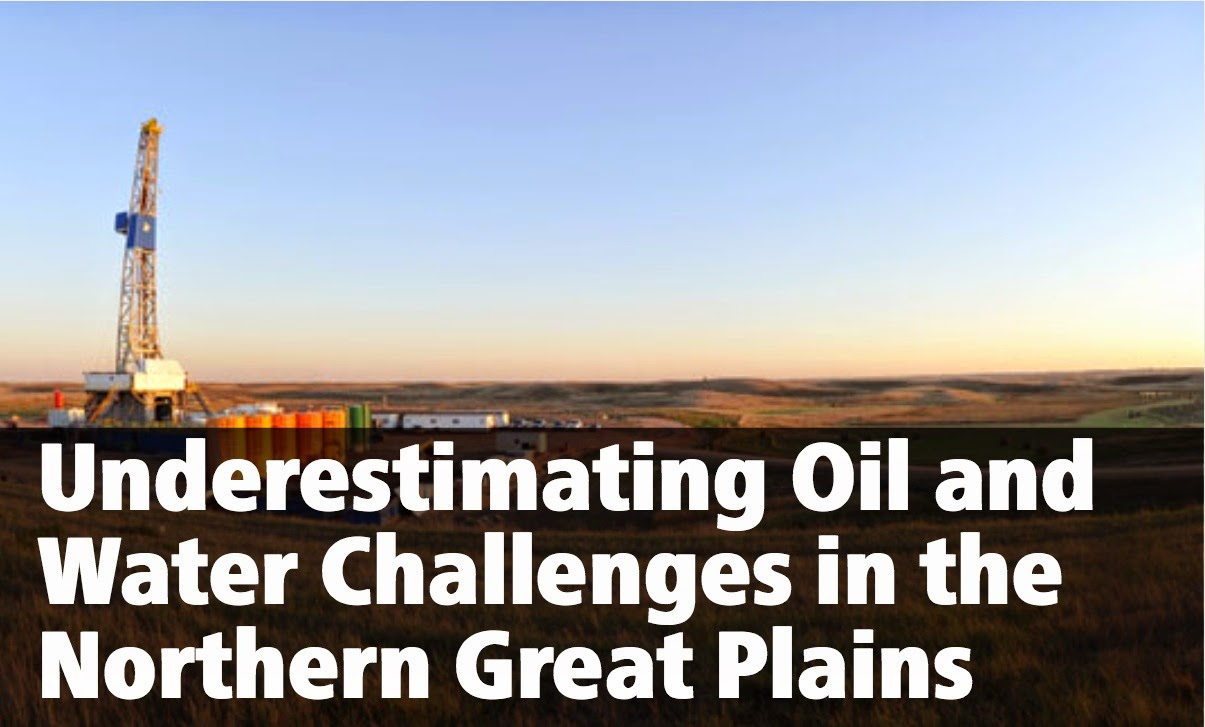
Underestimating Oil and Water Challenges in the Northern Great Plains

The Northern Great Plains has become the epicenter of new oil development in the United States. New production techniques have set off an oil boom there reminiscent of the chaotic conditions over a century ago when the prospect of black gold drew developers to Texas.

Water impacts were not remotely a consideration back then. But now, unprecedented levels of drilling in this huge oil basin require the implementation of careful water management practices to protect regional resources.

Drilling takes place throughout the Great Plains’ Williston oil basin, home to the Bakken, Three Forks, and Tyler formations, reaching into the U.S. states of North Dakota, South Dakota,1 and Montana as well as Canada’s provinces of Saskatchewan and Alberta. With an estimated 7.4 billion barrels of technically recoverable oil in the United States (plus an additional 1.6 billion barrels in Canada), the Williston basin is the largest continuous oil accumulation in the country.

It is also one of the world’s most rapidly and densely developed oil plays with about 8,000 still-active wells drilled between 2006 and 2014. The United States Geological Survey (USGS) estimates that five times that number will be needed to access the total technically recoverable oil. But plans to continue producing at this rate will pose severe oil-water risks in the area.

The region’s geology and history convey unique water challenges, quite different from those in other U.S. shale formations. The sheer number of wells needed to produce the Williston creates a huge demand on freshwater for drilling, hydraulic fracturing, and maintenance. Along with oil, produced water (wastewater produced as a byproduct during oil production) is brought to the surface through these wells. Produced water yields are correlated to oil yields, so as the Williston basin’s oil production increases, produced water quantities and the associated contamination risks and disposal needs will accumulate. Further complicating the freshwater quantity demands and wastewater contamination concerns, a mosaic of state, national, and tribal borders provides potential for irregular data reporting, insufficient regulatory oversight, inconsistent rules, and inadequate contamination cleanup.

If the Williston basin is going to help supply America’s oil needs over the long term, the Northern Great Plains’ oil-water challenges must be adequately controlled and safely managed.

Continuous, Complex Geology

The Williston’s shale is relatively easy to navigate. Overlapping formations allow oil companies to extract the oil with great speed and success.

The Bakken, while it has limited amounts of conventionally pooled oil, is almost completely an unconventional shale oil play. It is comprised of three informal layers: the upper, middle, and lower. Directly beneath the Bakken lies the Three Forks formation.2 Three Forks 1, the shallowest of the formation’s four main layers, has been produced in conjunction with the Bakken for many years. Recently, however, oil companies have begun to explore some of the deeper layers, allowing them to produce at multiple depths from the same plot of land, gaining access to more oil without acquiring more land. The Tyler formation, which is much shallower than the Bakken and Three Forks formations, is located farther south, and its unconventional oil potential is just beginning to be explored.

The Bakken formation was first identified in the early 1950s, though production was initially quite slow. That changed with the advent of hydraulic fracturing—the process of injecting a high-pressure slurry of chemicals, water, and propping agents to break apart shale and allow hydrocarbons to flow out of rock formations. Innovations in this technique transformed North Dakota’s oil operations.

Since 2006, oil production has expanded exponentially into the Bakken, Three Forks, and Tyler formations along with other smaller, lesser-known formations in the area (see map). Recently, drilling horizontally to produce oil in the Tyler formation has begun though it is still uncertain if the Tyler formation will be able to transition from a somewhat successful conventional play (accessed by vertical drilling) into a strong continuous play, produced by replicating new techniques used in the Bakken.

Companies aim to further reduce the space between wells to maximize access to oils at different depths from the same acreage. Leases that had only one well before may now have up to eight. As seen in Kodiak Oil & Gas Corp’s, Continental Resources Inc.’s, and other companies’ plans, there could be 14–34 wells per 1,280 acre lease.5 Wells are drilled and fracked more quickly and more cheaply as technology advances allowing companies to expand and increase their water demands rapidly.

The drilling process demands some water, but the hydraulic fracturing process and the water used to clean the well over its lifetime account for most of the water consumed during oil extraction. A single well fracking in the Williston averages 2 million gallons of water. Refracking wells two to three times, which is now common practice in the Williston, demands proportionately more freshwater than one-time fracking seen in other basins. And while some of the water used to clean wells can be reused as the base fluid for new fracking projects, new freshwater is required for each maintenance flush.

Getting to the Water Sources

With so much freshwater required to boost oil production, the question is: Where will the water come from? A range of resources can be found in the Northern Great Plains’ geology, including bedrock aquifers at many depths, glacial aquifers, the Missouri River winding through Montana and North Dakota, and Lake Sakakawea, a reservoir on the Missouri. These water resources vary markedly, and their characteristics must be used to determine how much water and which water the states can afford to permit oil companies to acquire, directly and indirectly.6

Making the situation more complicated, while the area may have ample water supplies, many rural citizens do not have secure access to them. The region currently struggles with fresh groundwater scarcity, low precipitation, minimal water infrastructure making transporting water extremely difficult, and federal restrictions regarding the use of the Missouri River and Lake Sakakawea as surface water sources.

Overdrawn Aquifers

Confined bedrock aquifers of varying water quality underlie the Williston basin, some of which are artesian aquifers that flow to the surface without the need for electrical pumps, a boon in remote locations that must be protected.

The slightly saline Fox Hills–Hell Creek aquifer (noted with diagonal orange lines on the map) is the only groundwater source capable of consistently producing large amounts of freshwater. As a result, it is overdrawn. Although rarely a drinking water source because of its relatively high concentration of total dissolved solids, (2,500 milligrams per liter), it is a major source for industrial, livestock, and residential use.7

Overuse has caused rapid long-term reduction in aquifer pressure by 1 to 2 feet per year. As a result, some of the artesian wells drawing from the Fox Hills–Hell Creek aquifer have stopped flowing and more will dry up in the future. Using this aquifer solely for domestic and livestock purposes and forcing industry to find other sources of water has been discussed, but stronger action may be needed.

Difficult-to-Manage Aquifers

Glacial aquifers, formed as glaciers melted and receded leaving permeable sediment behind, can be found in drainage system patterns throughout North Dakota and Montana. These aquifers, usually less than a few hundred feet deep, can be much more productive than bedrock aquifers, often with lower total dissolved solids concentrations. Their high flow rates mean water spends shorter times within the aquifer dissolving and accumulating salts and minerals. Thus, these aquifers often tend to be the only source of irrigation-quality groundwater in the area. High flow rates, however, lead to difficulty managing the resource, as discharge can happen quickly while recharge rates are variable and uncertain.

Tapping Lakes and Rivers

The most reliable sources of surface water in the area are the Missouri River and its reservoir, Lake Sakakawea. Much of the water currently used for hydraulic fracturing in North Dakota and Montana comes from the Missouri River.

Without depending on water withdrawal from lakes and rivers, it will be impossible to meet the upward trend of oil production without harming the Northern Great Plains’ aquifers and tributary streams. So, as industry demands rise, oil companies are pushing back on the U.S. Corps of Engineers’ (USCOE) 2010 moratorium that prevents lake-water access permits. North Dakota law makes the state water commission responsible for issuing permits for Lake Sakakawea water use, but the USCOE is the only power that can grant permission to access the lake for water diversion. The moratorium was put in place temporarily while the USCOE determined what price to charge for Missouri River water stored behind its dam. Over time, however, the moratorium has morphed into a 100,000 acre foot per year temporary permitting limit, with no storage fee applicable until the USCOE approves a water price.

The oil industry would benefit from permanent access to Lake Sakakawea at little or no cost, but such an arrangement would not be durable. The millions of gallons each well uses over its lifetime would necessitate many new infrastructure investments to transport Lake Sakakawea’s water throughout the basin. These oil-water commitments would also impact local residents’ future higher-priority needs.

Oil companies in eastern Montana do not currently have access to Lake Sakakawea, instead depending on the Missouri River as a surface water resource, even though many of its tributaries are over-appropriated. The Yellowstone River, which cuts through parts of the Williston basin, is also a potential water source for the oil industry; however, some stretches are closed off to new appropriations, and temporal variation in flow causes the river to be over-appropriated at times. While finding cheap and accessible water may be difficult in Montana, the oil industry’s surface water (and groundwater) needs there pale in comparison to the struggles facing North Dakota, where the majority of drilling occurs.

The Salt Problem

All this is particularly problematic because the Northern Great Plains contains large volumes of highly saline water. This water—up to ten times the salinity of ocean water—is housed in the same rocks that trap oil in the Williston basin. When pumped out with the oil, this produced water must be treated as waste.

Once production begins, a well operator begins pumping out the fluid used to frack the well along with highly saline produced water and oil. This continues through the well’s lifetime—with volumes of these three fluids changing dramatically over the lifetime of the well, the amount of fracking fluid recovered at the surface dropping off dramatically in the days following fracking, and the ratio of produced water to oil increasing as the well ages. Produced water from the Bakken formation also contains toxic metals and radioactive substances and can measure up to 300,000 milligrams per liter of total dissolved solids.

Most of the produced water in the Williston is transported to Class II injection wells (see blue dots on map) for disposal. Injecting this water deep underground can prevent ground and surface water contamination, if done properly. Proper disposal is important because spills and contamination in the Williston basin are far more damaging than mishandlings of less saline produced waters from other U.S. basins.

One possibility for contamination in the Northern Great Plains arises during produced water transport—by truck and underground pipeline—to its injection site. With trucks and pipelines covering long distances between the producing well and the Class II injection well, the potential to spill oil and produced water arises. Truck spills may be obvious, but pipeline spills may go unnoticed as any evidence remains underground for some time.

Contamination of water resources can also be caused by spilling oil or produced water through operator error, illegal dumping, well blowouts, and flooding (sometimes caused by ice jams or heavy rains). Produced water spills are a far greater concern than oil spills because they spread much more rapidly and salts disperse quickly through surface or ground water. Spills’ boundaries are rarely well defined and oil and produced water can saturate any permeable soil near the spill, including by migrating beyond state or reservation borders.

Glacial aquifers in particular, with their fast recharge rates, can be quickly contaminated by surface spills, especially from produced water. Successful management of glacial aquifers is vital to protect one of the Williston’s only sources of high quality groundwater.

The Williston basin region has experienced sizeable spills since the oil industry boomed in the mid-2000s. North Dakota’s largest and most damaging saltwater spill occurred in 2006 when a Zenergy pipeline failed, releasing more than 1 million gallons of saltwater into Charbonneau Creek (a Yellowstone River tributary). The pipeline didn’t have a monitoring system to record the pressure drop or the differential between input and output quantity that would have quickly notified the company of the leak. Eight years later, Zenergy is still remediating, and efforts are expected to continue into the future.8

Problems also stem from practices long past. The Northern Great Plains is just now seeing the effects of contamination from oil production that began over fifty years ago. According to a USGS report, the city of Poplar in the Fort Peck Reservation has never been able to pinpoint the precise source(s) of contamination on its territory (beyond linking it to oil field contamination) that has damaged upwards of 37 billion gallons of water in its shallow aquifers. Three thousand residents depend on these aquifers as their sole sources of water. The EPA reached an agreementwith the three oil companies they deemed responsible, and these companies must now monitor Poplar’s public water supply monthly, provide treatment or an alternate water source for any degraded water quality, and cover the city’s $320,000 cost to identify safer water sources and relocate public water infrastructure. It has taken a half-century since initial contamination for stakeholders to experience its consequences because of the slow speed at which contamination travels in the subsurface. This contamination acts as a warning that the negative effects of oil production may take many years to come to light.

Beyond contamination, the high concentrations of salt in Williston produced water routinely builds up on equipment, damaging it and restricting oil flow. To prevent this salt buildup, oil companies use maintenance water—freshwater treated with biocides—to flush wells. Over a well’s thirty-year lifetime, almost 9 million gallonsof additional water may be used to remove the oil-restricting salt buildup.

Oil-production-related water contamination plagues all oil fields but, because of the Williston basin’s high salt content, water spills in eastern Montana and western North Dakota are especially dangerous to the environment and the people dependent on local water for their drinking, domestic, irrigation, and livestock water needs. Comprehensive regulations could help mitigate the risks, but protecting water resources in this area will be an ongoing challenge in the Williston basin.

Reporting Issues and Regulatory Confusion

Data on oil production in the Williston basin are extensive, but underreporting is a growing concern. Some counties do not report any produced water despite highly productive oil wells, and it remains unclear as to whether the Fort Peck Reservation reports its produced water. There are also loopholes in reporting spills and contamination events. Accuracy varies depending on the regulator and extent of regulatory oversight.9

A new online tool helps navigate oilfield-related spills in North Dakota, of which, until now, the public was rarely informed. But companies can report “no” water spilled when the actual amount discharged is unknown. Wells can be listed as confidentialfor up to six months after drilling begins, reporting no spill information to the public except in rare cases. Montana does not even maintain an electronic database, and the state government records spill information only on paper, making spill and contamination research more difficult. This means that rural residents do not have easy access to the history of contamination and the presence of spills in the area in which they live.


How Saudi Arabia Helped Isis Take Over the North of Iraq

How far is Saudi Arabia complicit in the Isis takeover of much of northern Iraq, and is it stoking an escalating Sunni-Shia conflict across the Islamic world?

Some time before 9/11, Prince Bandar bin Sultan, once the powerful Saudi ambassador in Washington and head of Saudi intelligence until a few months ago, had a revealing and ominous conversation with the head of the British Secret Intelligence Service, MI6, Sir Richard Dearlove. Prince Bandar told him: “The time is not far off in the Middle East, Richard, when it will be literally ‘God help the Shia’. More than a billion Sunnis have simply had enough of them.”

The fatal moment predicted by Prince Bandar may now have come for many Shia, with Saudi Arabia playing an important role in bringing it about by supporting the anti-Shia jihad in Iraq and Syria. Since the capture of Mosul by the Islamic State of Iraq and the Levant (Isis) on 10 June, Shia women and children have been killed in villages south of Kirkuk, and Shia air force cadets machine-gunned and buried in mass graves near Tikrit.

In Mosul, Shia shrines and mosques have been blown up, and in the nearby Shia Turkoman city of Tal Afar 4,000 houses have been taken over by Isis fighters as “spoils of war”. Simply to be identified as Shia or a related sect, such as the Alawites, in Sunni rebel-held parts of Iraq and Syria today, has become as dangerous as being a Jew was in Nazi-controlled parts of Europe in 1940.

There is no doubt about the accuracy of the quote by Prince Bandar, secretary-general of the Saudi National Security Council from 2005 and head of General Intelligence between 2012 and 2014, the crucial two years when al-Qa’ida-type jihadis took over the Sunni-armed opposition in Iraq and Syria. Speaking at the Royal United Services Institute last week, Dearlove, who headed MI6 from 1999 to 2004, emphasised the significance of Prince Bandar’s words, saying that they constituted “a chilling comment that I remember very well indeed”.

He does not doubt that substantial and sustained funding from private donors in Saudi Arabia and Qatar, to which the authorities may have turned a blind eye, has played a central role in the Isis surge into Sunni areas of Iraq. He said: “Such things simply do not happen spontaneously.” This sounds realistic since the tribal and communal leadership in Sunni majority provinces is much beholden to Saudi and Gulf paymasters, and would be unlikely to cooperate with Isis without their consent.

Dearlove’s explosive revelation about the prediction of a day of reckoning for the Shia by Prince Bandar, and the former head of MI6′s view that Saudi Arabia is involved in the Isis-led Sunni rebellion, has attracted surprisingly little attention. Coverage of Dearlove’s speech focused instead on his main theme that the threat from Isis to the West is being exaggerated because, unlike Bin Laden’s al-Qa’ida, it is absorbed in a new conflict that “is essentially Muslim on Muslim”. Unfortunately, Christians in areas captured by Isis are finding this is not true, as their churches are desecrated and they are forced to flee. A difference between al-Qa’ida and Isis is that the latter is much better organised; if it does attack Western targets the results are likely to be devastating.

The forecast by Prince Bandar, who was at the heart of Saudi security policy for more than three decades, that the 100 million Shia in the Middle East face disaster at the hands of the Sunni majority, will convince many Shia that they are the victims of a Saudi-led campaign to crush them. “The Shia in general are getting very frightened after what happened in northern Iraq,” said an Iraqi commentator, who did not want his name published. Shia see the threat as not only military but stemming from the expanded influence over mainstream Sunni Islam of Wahhabism, the puritanical and intolerant version of Islam espoused by Saudi Arabia that condemns Shia and other Islamic sects as non-Muslim apostates and polytheists.

Dearlove says that he has no inside knowledge obtained since he retired as head of MI6 10 years ago to become Master of Pembroke College in Cambridge. But, drawing on past experience, he sees Saudi strategic thinking as being shaped by two deep-seated beliefs or attitudes. First, they are convinced that there “can be no legitimate or admissible challenge to the Islamic purity of their Wahhabi credentials as guardians of Islam’s holiest shrines”. But, perhaps more significantly given the deepening Sunni-Shia confrontation, the Saudi belief that they possess a monopoly of Islamic truth leads them to be “deeply attracted towards any militancy which can effectively challenge Shia-dom”.

Western governments traditionally play down the connection between Saudi Arabia and its Wahhabist faith, on the one hand, and jihadism, whether of the variety espoused by Osama bin Laden and al-Qa’ida or by Abu Bakr al-Baghdadi’s Isis. There is nothing conspiratorial or secret about these links: 15 out of 19 of the 9/11 hijackers were Saudis, as was Bin Laden and most of the private donors who funded the operation.

The difference between al-Qa’ida and Isis can be overstated: when Bin Laden was killed by United States forces in 2011, al-Baghdadi released a statement eulogising him, and Isis pledged to launch 100 attacks in revenge for his death.

But there has always been a second theme to Saudi policy towards al-Qa’ida type jihadis, contradicting Prince Bandar’s approach and seeing jihadis as a mortal threat to the Kingdom. Dearlove illustrates this attitude by relating how, soon after 9/11, he visited the Saudi capital Riyadh with Tony Blair.

He remembers the then head of Saudi General Intelligence “literally shouting at me across his office: ’9/11 is a mere pinprick on the West. In the medium term, it is nothing more than a series of personal tragedies. What these terrorists want is to destroy the House of Saud and remake the Middle East.’” In the event, Saudi Arabia adopted both policies, encouraging the jihadis as a useful tool of Saudi anti-Shia influence abroad but suppressing them at home as a threat to the status quo. It is this dual policy that has fallen apart over the last year.

Saudi sympathy for anti-Shia “militancy” is identified in leaked US official documents. The then US Secretary of State Hillary Clinton wrote in December 2009 in a cable released by Wikileaks that “Saudi Arabia remains a critical financial support base for al-Qa’ida, the Taliban, LeT [Lashkar-e-Taiba in Pakistan] and other terrorist groups.” She said that, in so far as Saudi Arabia did act against al-Qa’ida, it was as a domestic threat and not because of its activities abroad. This policy may now be changing with the dismissal of Prince Bandar as head of intelligence this year. But the change is very recent, still ambivalent and may be too late: it was only last week that a Saudi prince said he would no longer fund a satellite television station notorious for its anti-Shia bias based in Egypt.

The problem for the Saudis is that their attempts since Bandar lost his job to create an anti-Maliki and anti-Assad Sunni constituency which is simultaneously against al-Qa’ida and its clones have failed.

By seeking to weaken Maliki and Assad in the interest of a more moderate Sunni faction, Saudi Arabia and its allies are in practice playing into the hands of Isis which is swiftly gaining full control of the Sunni opposition in Syria and Iraq. In Mosul, as happened previously in its Syrian capital Raqqa, potential critics and opponents are disarmed, forced to swear allegiance to the new caliphate and killed if they resist.

The West may have to pay a price for its alliance with Saudi Arabia and the Gulf monarchies, which have always found Sunni jihadism more attractive than democracy. A striking example of double standards by the western powers was the Saudi-backed suppression of peaceful democratic protests by the Shia majority in Bahrain in March 2011. Some 1,500 Saudi troops were sent across the causeway to the island kingdom as the demonstrations were ended with great brutality and Shia mosques and shrines were destroyed.

An alibi used by the US and Britain is that the Sunni al-Khalifa royal family in Bahrain is pursuing dialogue and reform. But this excuse looked thin last week as Bahrain expelled a top US diplomat, the assistant secretary of state for human rights Tom Malinowksi, for meeting leaders of the main Shia opposition party al-Wifaq. Mr Malinowski tweeted that the Bahrain government’s action was “not about me but about undermining dialogue”.

Western powers and their regional allies have largely escaped criticism for their role in reigniting the war in Iraq. Publicly and privately, they have blamed the Iraqi Prime Minister Nouri al-Maliki for persecuting and marginalising the Sunni minority, so provoking them into supporting the Isis-led revolt. There is much truth in this, but it is by no means the whole story. Maliki did enough to enrage the Sunni, partly because he wanted to frighten Shia voters into supporting him in the 30 April election by claiming to be the Shia community’s protector against Sunni counter-revolution.

But for all his gargantuan mistakes, Maliki’s failings are not the reason why the Iraqi state is disintegrating. What destabilised Iraq from 2011 on was the revolt of the Sunni in Syria and the takeover of that revolt by jihadis, who were often sponsored by donors in Saudi Arabia, Qatar, Kuwait and United Arab Emirates. Again and again Iraqi politicians warned that by not seeking to close down the civil war in Syria, Western leaders were making it inevitable that the conflict in Iraq would restart. “I guess they just didn’t believe us and were fixated on getting rid of [President Bashar al-] Assad,” said an Iraqi leader in Baghdad last week.

Of course, US and British politicians and diplomats would argue that they were in no position to bring an end to the Syrian conflict. But this is misleading. By insisting that peace negotiations must be about the departure of Assad from power, something that was never going to happen since Assad held most of the cities in the country and his troops were advancing, the US and Britain made sure the war would continue.

The chief beneficiary is Isis which over the last two weeks has been mopping up the last opposition to its rule in eastern Syria. The Kurds in the north and the official al-Qa’ida representative, Jabhat al-Nusra, are faltering under the impact of Isis forces high in morale and using tanks and artillery captured from the Iraqi army. It is also, without the rest of the world taking notice, taking over many of the Syrian oil wells that it did not already control.

Saudi Arabia has created a Frankenstein’s monster over which it is rapidly losing control. The same is true of its allies such as Turkey which has been a vital back-base for Isis and Jabhat al-Nusra by keeping the 510-mile-long Turkish-Syrian border open. As Kurdish-held border crossings fall to Isis, Turkey will find it has a new neighbour of extraordinary violence, and one deeply ungrateful for past favours from the Turkish intelligence service.

As for Saudi Arabia, it may come to regret its support for the Sunni revolts in Syria and Iraq as jihadi social media begins to speak of the House of Saud as its next target. It is the unnamed head of Saudi General Intelligence quoted by Dearlove after 9/11 who is turning out to have analysed the potential threat to Saudi Arabia correctly and not Prince Bandar, which may explain why the latter was sacked earlier this year.

Nor is this the only point on which Prince Bandar was dangerously mistaken. The rise of Isis is bad news for the Shia of Iraq but it is worse news for the Sunni whose leadership has been ceded to a pathologically bloodthirsty and intolerant movement, a sort of Islamic Khmer Rouge, which has no aim but war without end.

The Sunni caliphate rules a large, impoverished and isolated area from which people are fleeing. Several million Sunni in and around Baghdad are vulnerable to attack and 255 Sunni prisoners have already been massacred. In the long term, Isis cannot win, but its mix of fanaticism and good organisation makes it difficult to dislodge.

“God help the Shia,” said Prince Bandar, but, partly thanks to him, the shattered Sunni communities of Iraq and Syria may need divine help even more than the Shia. More


The Peak Oil Crisis: Iraq on the Precipice

The daily newspapers are now full of stories predicting that Iraq, as we know it, will soon disintegrate into three or more warring states.

Tom Whipple

In the last two weeks Sunni insurgents led by the extremist ISIS have routed a good part of the Iraqi army, taken over much of northern Iraq not controlled by the Kurds, and now are moving close to Baghdad. Despite the dispatch of American and Iranian military advisors to at least assess the situation, most observers say government forces are too weak to drive back the insurgents and retake the lost territory. Washington is refusing to get involved unless the Shiite-dominated Iraqi government makes radical changes in its relations with the Sunnis and Kurds.

Our concern here, however, is what all this has to do with the world’s oil supply and, closer to home, our gasoline prices. In recent days we have been told innumerable times that most of Iraq’s oil is way south of Baghdad where it is relatively immune from the turmoil in the north – so there is little chance that Iraq's 2.5 million barrels a day (b/d) of exports will be affected. While this may true for the next few weeks or even months, the Sunni resurgence in the north is not a short-term problem and in the past week the ISIS has captured some formidable assets which could bring heavy pressure on, if not strangle, Baghdad.

ISIS now has control of one of three major refineries in Iraq which supplies the motor fuel and oil for power stations for the northern part of the country. Lines are already forming at gas stations. The ISIS controls the Euphrates and will likely gain control of the Haditha power dam, which supplies 360 MW to the national power grid. With control of the river dams, reduced flows of water could make life very difficult in southern Iraq before the summer is over. It is doubtful if the thousands of foreign oil workers that are expanding and overseeing Iraq’s oil production would stick around too long. Some non-essential-to-production foreigner oil workers are already leaving the country or moving to safer areas.

Another facet of last week’s developments is that the insurgent forces in Anbar province are getting very close to Baghdad’s airport. All it would take would be a few of the howitzers they captured from the Iraqi army and air travel into Baghdad could be restricted.

While it may be impossible for insurgent forces even of the fanatical variety to fight their way through thousands of Shiite militiamen to the southern Shiite shrines and oil fields, in a prolonged standoff (and this one has been going on for 1,400 years) serious harm is likely to be done to Iraq’s current and prospective oil production. Some observers are already saying that large increases in Iraqi oil production in the immediate future are unlikely, but as yet few are writing off the current 3.3 million barrels of daily oil production.

Let’s assume, however, that before this year or next is out, Iraqi oil exports drop substantially as it has in several other oil-exporting states undergoing similar political trauma. Just what does this mean for the world’s oil supply?

With 2.5 million additional barrels of oil disappearing from the market added to the 3.5 million that have already been lost due to lower production in Libya, Iran, Sudan, and Nigeria, the world markets would clearly be stressed.

The Saudis could probably come up with an extra million b/d for a while, but that is about it. Iran could sign a nuclear treaty this summer and be out from under sanctions, but it will take a while to develop significant increases in production. Libya, Sudan, Syria, Nigeria and Yemen show no signs of settling their internal political problems and start exporting significantly larger amounts of crude in the foreseeable future.

Keep in mind that global demand for oil has recently been increasing at a rate of about 1.2 million b/d or so every year, while depletion of existing oilfields requires that another 3-4 million b/d be brought into production each year just to keep even.

Many people, including government forecasters, are looking to increasing U.S. shale oil production and more deepwater oil from the Gulf of Mexico to keep the world’s supply and demand in balance without sharp price increases. Somewhere down the line there may be more oil produced from the Arctic; from Kazakhstan; from off the coast of Brazil; from East Africa; and even significant shale oil production from other than in the U.S. But it will be many years before these new sources can start producing significant amounts of crude, and none of these are likely to make up for any shortages that develop in the next few years.

Deepwater oil production from the Gulf of Mexico has been flat recently, and we are starting to get indications that the rapid increases in U.S. shale oil production, which have kept prices under control for several years, may be drawing to a close. The geology of shale oil production dictates that once it stops growing, a rapid decline in production is likely.

In sum, it looks as if there will be higher and possibly much higher oil and gas prices coming soon. If ISIS decides that the way to finish off the Shiite “infidels” is by cutting their oil revenues, then a bombing and terror campaign against southern Iraqi oil installations and oil workers would be a likely result. It would not take much to send the foreigners running. The Chinese are already moving out some of the 10,000 oil workers they have in southern Iraq, and others are likely to follow as we have seen in so many other places.

Where do oil and gas prices go? The official forecasters are only talking about another couple of dollars a barrel this year, but this is clearly too low if significant shortages develop.

By Tom Whipple of Post Carbon Institute