The Economics of Happiness

Economic globalization has led to a massive expansion in the scale and power of big business and banking. It has also worsened nearly every problem we face: fundamentalism and ethnic conflict; climate chaos and species extinction; financial instability and unemployment.

There are personal costs too. For the majority of people on the planet life is becoming increasingly stressful. We have less time for friends and family and we face mounting pressures at work.

The Economics of Happiness describes a world moving simultaneously in two opposing directions. On the one hand, government and big business continue to promote globalization and the consolidation of corporate power. At the same time, all around the world people are resisting those policies, demanding a re-regulation of trade and finance—and, far from the old institutions of power, they're starting to forge a very different future. Communities are coming together to re-build more human scale, ecological economies based on a new paradigm — an economics of localization.

We hear from a chorus of voices from six continents including Vandana Shiva, Bill McKibben, David Korten, Michael Shuman, Juliet Schor, Zac Goldsmith and Samdhong Rinpoche – the Prime Minister of Tibet's government in exile. They tell us that climate change and peak oil give us little choice: we need to localize, to bring the economy home. The good news is that as we move in this direction we will begin not only to heal the earth but also to restore our own sense of well-being. The Economics of Happiness restores our faith in humanity and challenges us to believe that it is possible to build a better world.

http://www.filmsforaction.org/watch/the_economics_of_happiness/


New NASA data show how the world is running out of water

The world’s largest underground aquifers – a source of fresh water for hundreds of millions of people — are being depleted at alarming rates, according to new NASA satellite data that provides the most detailed picture yet of vital water reserves hidden under the Earth’s surface.

Twenty-one of the world’s 37 largest aquifers — in locations from India and China to the United States and France — have passed their sustainability tipping points, meaning more water was removed than replaced during the decade-long study period, researchers announced Tuesday. Thirteen aquifers declined at rates that put them into the most troubled category. The researchers said this indicated a long-term problem that’s likely to worsen as reliance on aquifers grows.

Scientists had long suspected that humans were taxing the world’s underground water supply, but the NASA data was the first detailed assessment to demonstrate that major aquifers were indeed struggling to keep pace with demands from agriculture, growing populations, and industries such as mining.

“The situation is quite critical,” said Jay Famiglietti, senior water scientist at NASA’s Jet Propulsion Laboratory in California and principal investigator of the University of California Irvine-led studies.

Underground aquifers supply 35 percent of the water used by humans worldwide. Demand is even greater in times of drought. Rain-starved California is currently tapping aquifers for 60 percent of its water use as its rivers and above-ground reservoirs dry up, a steep increase from the usual 40 percent. Some expect water from aquifers will account for virtually every drop of the state’s fresh water supply by year end

The aquifers under the most stress are in poor, densely populated regions, such as northwest India, Pakistan and North Africa, where alternatives are limited and water shortages could quickly lead to instability.

The researchers used NASA’s GRACE satellites to take precise measurements of the world’s groundwater aquifers. The satellites detected subtle changes in the Earth’s gravitational pull, noting where the heavier weight of water exerted a greater pull on the orbiting spacecraft. Slight changes in aquifer water levels were charted over a decade, from 2003 to 2013.

“This has really been our first chance to see how these large reservoirs change over time,” said Gordon Grant, a research hydrologist at Oregon State University, who was not involved in the studies.

But the NASA satellites could not measure the total capacity of the aquifers. The size of these tucked-away water supplies remains something of a mystery. Still, the satellite data indicated that some aquifers may be much smaller than previously believed, and most estimates of aquifer reserves have “uncertainty ranges across orders of magnitude,” according to the research.

Aquifers can take thousands of years to fill up and only slowly recharge with water from snowmelt and rains. Now, as drilling for water has taken off across the globe, the hidden water reservoirs are being stressed.

“The water table is dropping all over the world,” Famiglietti said. “There’s not an infinite supply of water.”

The health of the world’s aquifers varied widely, mostly dependent on how they were used. In Australia, for example, the Canning Basin in the country’s western end had the third-highest rate of depletion in the world. But the Great Artesian Basin to the east was among the healthiest.

The difference, the studies found, is likely attributable to heavy gold and iron ore mining and oil and gas exploration near the Canning Basin. Those are water-intensive activities.

The world’s most stressed aquifer — defined as suffering rapid depletion with little or no sign of recharging — was the Arabian Aquifer, a water source used by more than 60 million people. That was followed by the Indus Basin in India and Pakistan, then the Murzuk-Djado Basin in Libya and Niger.

California’s Central Valley Aquifer was the most troubled in the United States. It is being drained to irrigate farm fields, where drought has led to an explosion in the number of water wells being drilled. California only last year passed its first extensive groundwater regulations. But the new law could take two decades to take full effect.

Also running a negative balance was the Atlantic and Gulf Coastal Plains Aquifer, which stretches across the southeast coast and Florida. But three other aquifers in the middle of the country appeared to be in relatively good shape.

Some groundwater filters back down to aquifers, such as with field irrigation. But most of it is lost to evaporation or ends up being deposited in oceans, making it harder to use. A 2012 study by Japanese researchers attributed up to 40 percent of the observed sea-level rise in recent decades to groundwater that had been pumped out, used by humans and ended up in the ocean.

Famiglietti said problems with groundwater are exacerbated by global warming, which has caused the regions closest to the equator to get drier and more extreme latitudes to experience wetter and heavier rains. A self-reinforcing cycle begins. People living in mid-range latitudes not only pump more water from aquifers to contend with drier conditions, but that water — once removed from the ground — also then evaporates and gets recirculated to areas far north and south.

The studies were published Tuesday in the Water Resources Research journal.

Famiglietti said he hoped the findings would spur discussion and further research into how much groundwater is left.

“We need to get our heads together on how we manage groundwater,” he said, “because we’re running out of it.” More


The World’s Most Hostile International Water Basins

At the launch of A New Climate for Peace, a new report on climate-fragility risks produced for the G7 by a consortium of international partners including the Wilson Center, USAID Deputy Assistant Administrator Christian Holmes called water a common denominator for climate risk.

“How you manage your water programs…has a huge amount to do with how you mitigate the prospect for increased fragility,” he said. “Sometimes it’s the obvious that’s so easy to miss, and I think that the obvious on water as it relates to economic development is, essentially, the question of sustainable water supply.”

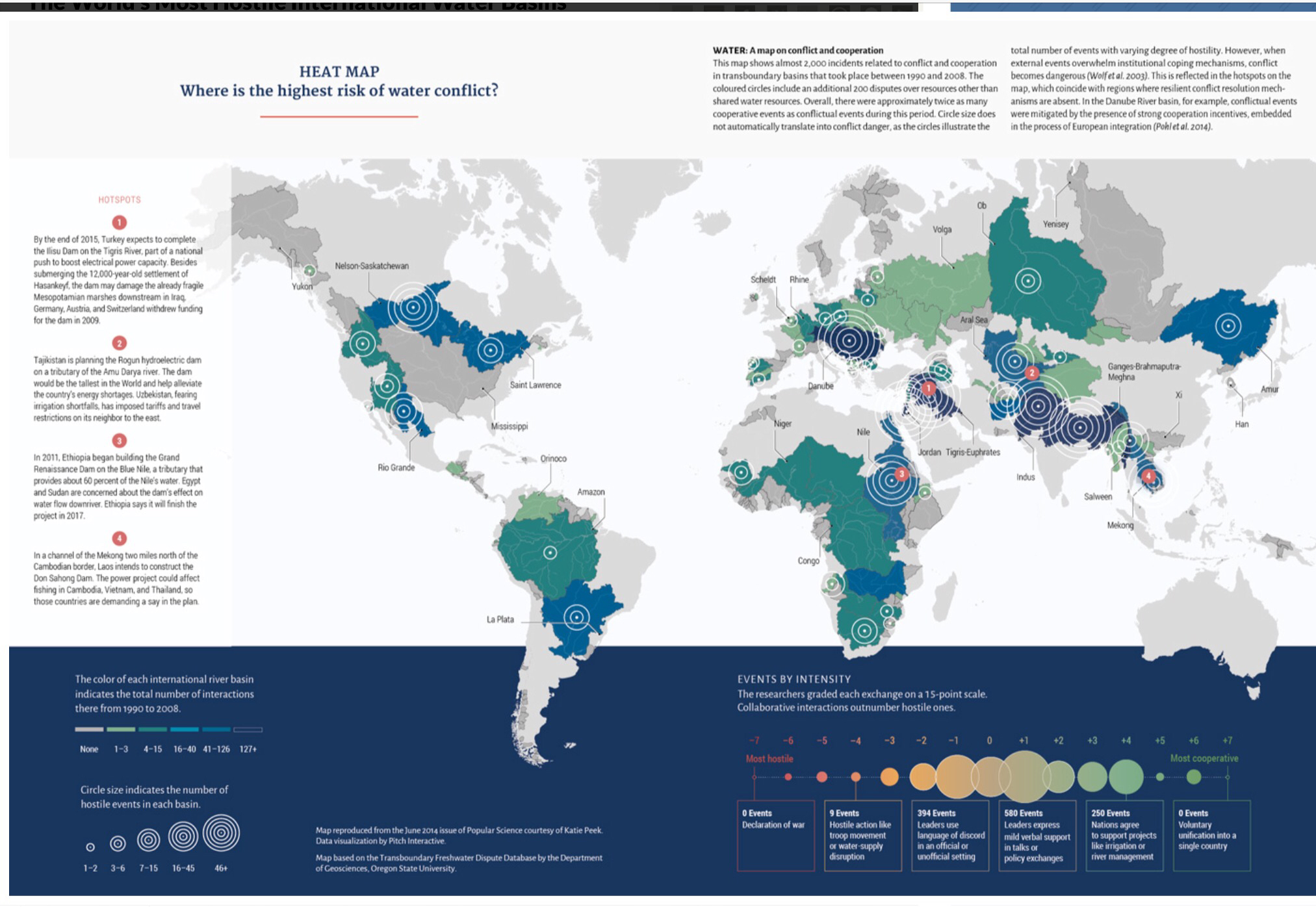
One of the most striking infographics from A New Climate for Peace touches on that question of supply. Using data from Oregon State University’s Transboundary Freshwater Dispute Database and adapted from a graphic that originally appeared in Popular Sciencelast year, the map shows the world’s most active – and tension-filled – international water basins.

Water is a common denominator for climate risk

The Transboundary Freshwater Dispute Database measures not only the frequency of hostile events in a basin, but cooperative ones as well, each on a sliding scale. Hostile events range from declarations of war (zero recorded from 1990 to 2008, the period of time encompassed by the graphic) to leaders using “language of discord.” Cooperative events range from “mild verbal support” to “voluntary unification into a single country.”

The total number of events is indicated by shades of blue – the darker the blue, the more transboundary events, both positive and negative. This is essentially the “hot list” of international water basins – which regions have the most official and unofficial chatter over water.

Circles superimposed on the basins represent the total number of hostile events. As the description text points out, however, “circle size does not automatically translate into conflict danger.” In some places, transboundary institutions and diplomatic frameworks allow different actors to work through their differences. Cooperative hostility, if you will. In the Danube River Basin, for example, the high number of “hostile” events is mitigated by strong cooperative incentives associated with European integration. Likewise in North America, where Canada, the United States, and Mexico share several basins with a high number of hostile events, there is little chance of violent conflict.

Water basins in South Asia, the Middle East, and East Africa are major hotspots with a high number of hostile events and weaker institutional frameworks to mitigate them. The Indus, Ganges-Brahmaputra-Meghna, Salween, Tigris-Euphrates, and Jordan basins witness a very high number of interactions, suggesting at least that continued dialogue could be a way forward to mitigate the risk of violent conflict or fragility. The Nile Basin has less activity reflecting the stalled negotiations between the basin’s 10 member states to replace colonial-era water agreements. The Mekong Basin, where the largest member, China, does not participate as a full member of the Mekong River Commission, shows less activity as well.

The map does a great job illustrating why it can be difficult to answer the question, where is the highest risk of water-related violence? Tensions between states and other freshwater basin actors isn’t necessarily a sign of impending violence if there’s a framework to resolve them. Likewise, lack of communication over a major natural resource can be a bad sign for cooperation when the resource in question is the Nile. More

More infographics from ‘A New Climate for Peace: Taking Action on Climate and Fragility Risks’ are available on NewClimateforPeace.org.


Society will collapse by 2040 due to catastrophic food shortages, says Foreign Office-funded study

A scientific model supported by the [UK's] Foreign Office has suggested that society will collapse in less than three decades due to catastrophic food shortages if policies do not change.

The model, developed by a team at Anglia Ruskin University’s Global Sustainability Institute, does not account for society reacting to escalating crises by changing global behaviour and policies.

However the model does show that our current way of life appears to be unsustainable and could have dramatic worldwide consequences.

Dr Aled Jones, the Director of the Global Sustainability Institute, told Insurge Intelligence: “We ran the model forward to the year 2040, along a business-as-usual trajectory based on ‘do-nothing’ trends — that is, without any feedback loops that would change the underlying trend.

“The results show that based on plausible climate trends, and a total failure to change course, the global food supply system would face catastrophic losses, and an unprecedented epidemic of food riots.

“In this scenario, global society essentially collapses as food production falls permanently short of consumption.”

The model follows a report from Lloyds of London which has evaluated the extent of the impact of a shock scenario on crop production, and has concluded that the “global food system is under chronic pressure.”

The report said: “The global food system is under chronic pressure to meet an ever-rising demand, and its vulnerability to acute disruptions is compounded by factors such as climate change, water stress, ongoing globalisation and heightening political instability. More


To fight desertification, let’s manage our land better

Every year, we lose 24 billion tons of fertile soil to erosion and 12 million hectares of land to desertification and drought. This threatens the lives and livelihoods of 1.5 billion people now.

In the future, desertification could displace up to 135 million people by 2045. Land degradation could also reduce global food production by up to 12% and push world food prices up by 30%. In Egypt, Ghana, Central African Republic, Pakistan, Tajikistan and Paraguay, land degradation could cause an annual GDP loss of up to 7%.

Pressure on land resources is expected to increase as populations grow, socio-economic development happens and the climate changes. A growing population will demand more food, which means that unsuitable or especially biodiverse land will be claimed for farming and be more vulnerable to degradation. Increased fertilizer and pesticide use related to agriculture will increase nutrient loading in soils, causing eutrophication and declines in fertility over time. Climate change will also aggravate land degradation—especially in drylands, which occupy 40% of global land area, and are inhabited by some 2 billion people. Urban areas, which are located in the world’s highly fertile areas, could grow to account for more than 5% of global land by mid-century.

Unless we manage our land better, every person will rely on just .11 hectares of land for their food; down from .45 hectares in 1960.

So how do we manage land better?

It will all come down to what we do with our soil, which is the most significant natural capital for ensuring food, water, and energy security while adapting and building resilience to climate change and shocks. The soil’s nutrient cycling provides the largest contribution (51%) of the total value (USD33 trillion) of all ‘ecosystem services’ provided each year. But soil’s important function is often forgotten as the missing link in our pursuit of sustainable development.

We must invest in applicable solutions that are transformative, and can be scaled up. Climate-smart agriculture is an alternative approach to managing land sustainably whilst increasing agricultural productivity. It includes land management options that sequester carbon and enhance resilience to climate change. Proven climate-smart practices such as agroforestry, integrated soil fertility management, conservation agriculture, and improved irrigation can ensure that land is used optimally, restored and managed in a manner that maximizes ecological, economic and social benefits.

But climate-smart agriculture requires conducive policy frameworks, increased investment, and judicious policy management. Rural poverty is often a product of policies that discriminate against small landholders, forcing them off the land, creating sub-optimal land use outcomes, and long term degradation. Secure land rights are necessary for climate-smart agriculture, providing incentives for local communities to manage land more sustainably. In Rwanda, for instance, land tenure reform rapidly doubled investment in soil conservation, with even larger increases for plots managed by female farmers.

Second, there is need for increased national investment in climate smart agriculture. For technologies such as conservation agriculture that require substantial up-front investment in machinery and other inputs, schemes such as those involving payment for ecosystem services may be more effective in promoting CSA technology adoption. For technologies such as agroforestry systems, innovative finance mechanisms that help farmers bridge the period between when trees are planted, mature and generate income can be decisive.

Third, in some cases, direct public investment in landscape restoration and rehabilitation can bring about sizeable livelihood benefits and create better conditions for attracting further investments by farmers and communities. The China Loess Plateau is a well-documented success story of landscape restoration. Similar experiences are happening in Ethiopia, Kazakhstan and Senegal.

Fourth, a number of improved land management technologies are knowledge-intensive, and promoting their adoption will require training. Conservation agriculture for instance entails sophisticated combinations of no-tillage, residue management, use of cover crops, and other activities and practices that many farmers have limited experience with. The knowledge base of local land management practices can also be improved through targeted capacity development programs.

Many demand-side interventions can strategically break the adoption barriers associated with climate-smart practices. These include: providing farmers with improved weather forecasting, weather-indexed crop insurance, and measures to reduce production variability such as drought-tolerant crops, deep-rooted crops, and irrigation. These should be combined with supply-side measures such as lowering trade barriers to increase national and regional market size, improving road and rail infrastructure to lower transport costs, and improving market information systems to increase farmers’ access to markets.

Lastly, public support is as crucial as the amount of support to fully realize the productivity, adaptation, and mitigation benefits in agriculture. Public support that focuses on research, investments in improved land management, and land tenure rather than on input support is generally more effective, benefits more farmers, and is more sustainable in the long run.

Actions to reduce the negative impacts of land degradation and desertification must indeed go hand in hand with interventions that eradicate poverty and address inequality. Without them, we will not end poverty and boost shared prosperity. More


Turning Ethiopia’s desert green

A generation ago Ethiopia’s Tigray province was stricken by a famine that shocked the world. Today, as Chris Haslam reports, local people are using ancient techniques to turn part of the desert green.

People performing their 20 days of compulsory community labour

In the pink-streaked twilight, a river of humanity is flowing across Tigray’s dusty Hawzien plain. This cracked and desiccated landscape, in Ethiopia’s far north, occupies a dark corner of the global collective memory. Thirty years ago, not far from here, the BBC’s Michael Buerk first alerted us to a biblical famine he described as “the closest thing to hell on earth”.

Then Bob Geldof wrote Do They Know It’s Christmas? – a curious question to ask of perhaps the world’s most devoutly Christian people – and thereafter the name Tigray became synonymous with refugees, Western aid and misery. The Tigrayan people were depicted as exemplars of passive suffering, dependent on the goodwill of the rest of the planet just to get through the day without dying.

But here, outside the village of Abr’ha Weatsbaha, I’m seeing a different version. From all directions, streams of people are trickling into that human river. You hear them before you see them – some chatting excitedly, others singing hymns – as they converge on a viciously steep valley at the edge of the plain. They were summoned before dawn by horns, an Old Testament echo calling every able-bodied man and woman over 18 years of age to report for the first of 20 days of compulsory community labour. Their job, quite simply, is to tame the desert.

“This is how the Axumite kings got stuff done 2,000 years ago,” says my guide Zablon Beyene. “With the same tools, too.

By 10 in the morning, some 3,000 people have turned up. Using picks, shovels, iron bars and their bare hands, they will turn these treacherous slopes into neat staircases of rock-walled terraces that will trap the annual rains, forcing the water to percolate into the soil rather than running off in devastating, ground-ripping flash floods.

“Sisters are doing it for themselves,” says Kidane, a pick-wielding Amazon whose arched eyebrow suggests I might want to put down my camera and do some actual work. Brothers, too: from strapping, sweat-shiny youths to Ephraim, a legless old man who clearly ignored the bit about being able-bodied and sits on his stumps, rolling rocks downhill to the terrace builders.

Overseeing this extraordinary effort is 58-year-old Aba Hawi, Abr’ha Weatsbaha’s community leader. Short, pot-bellied and bearded, he darts from one side of the valley to the other, barking orders into his mobile phone, slapping backs and showing the youngsters the proper way to split half-ton boulders. Rumour has it that Aba Hawi once took up arms to fight for Tigrayan independence, but these days he prefers to describe himself as “just a farmer”.

Either way, his tireless leadership has brought a miraculous transformation to this sun-blasted land. In just a decade, entire mountains have been terraced. Once you had to dig 50ft (15m) down to find water. Now it’s just 10ft, and 94 acres (38 hectares) of former desert have been transformed into fertile fields. Families are now reaping three harvests a year from fields of corn, chillis, onions and potatoes. Free-range grazing for sheep, goats and cattle has been banned, allowing new forests of eucalyptus and acacias to take root, and Aba Hawi is particularly keen to show me what he’s done with the deep flash-flood canyons that rive the plain.

We take a long, hot hike to a vast pool of cool, green water held back by a huge hand-built dam. “We’ve built 85 of these check-dams so far,” says Aba Hawi, “and you can see how they work. These mini-reservoirs fill up during the rains and are fed by groundwater in times of drought. Now, every farmer has a well.” He tosses a handful of dust into the wind. “Ten years ago, that was our land.” Then he points at a shimmering blue flash in the reeds. “Now look: we’ve got malachite kingfishers living in the desert.”

But success brings its own problems. Abr’ha Weatsbaha is now facing an immigration problem as people from neighbouring valleys clamour for their share of Aba Hawi’s oasis.

“They shouldn’t need to come here,” he says. “Every district in Tigray is supposed to be using compulsory community labour for terracing but, well…” he shrugs with just a tad of false modesty… “not all community leaders are so, er, committed.”

And as fear of starvation fades, Aba Hawi faces new demands.

“People want electricity now,” he sighs.

I’m interested in his views of where God comes into all this. After all, this valley was once the physical definition of the term “Godforsaken.”

Aba Hawi disagrees. “God was here when the land was bad,” he says. “And he’s still here. But God will only help those who help themselves.” More


FAO Reports Address Disaster Risk Management in Fisheries and Aquaculture

March 2015: The Fisheries and Aquaculture Department of the Food and Agriculture Organization of the UN (FAO) has published a number of reports addressing climate change vulnerability in fisheries and aquaculture based on six regional studies, and disaster risk management (DRM) in fisheries and aquaculture in the Caribbean Community (CARICOM) and the wider Caribbean region.


The report titled ‘Climate Change Vulnerability in Fisheries and Aquaculture: A Synthesis of Six Regional Studies' came about due to the scarcity of information on climate impacts on the sector, with FAO launching six regional case studies to fill the information gaps and provide guidance towards adaptation planning. The case studies, which were undertaken in the Lake Chad Basin, the Caribbean, the Mekong Delta, the Benguela Current, the Pacific Island countries and territories, and Latin America, aimed to: define vulnerability to climate change by understanding potential impacts, sensitivities to such changes and adaptive capacity; identify knowledge gaps in assessing vulnerability; and identify strategies for, and provide policy guidance in reducing vulnerability to climate change.


The other publications focus specifically on DRM and adaptation in the Caribbean. A regional report from a workshop held in Kingston, Jamaica, from 10-12 December 2012, on formulating a strategy, action plan and programme for fisheries and aquaculture, addresses: resilience building and the reduction of vulnerabilities; the regional trend towards adaptation; the development of a regional DRM framework; and regional initiatives in advancing DRM and adaptation. The workshop recommended finalizing and implementing a strategy, action plan and programme proposal in order to strengthen regional and national cooperation, and develop capacity in addressing climate change impacts and disasters in fisheries and aquaculture.


Another document describes a series of local, national and regional programme proposals for the Caribbean. The strategy and action plan publication discusses: mainstreaming climate change adaptation strategies into sustainable development; promoting the implementation of specific adaptation measures to address regional vulnerabilities; promoting actions to reduce emissions through fossil fuel reduction and conservation, and transitioning to renewable and cleaner energy sources; promoting actions to reduce the vulnerability to the impacts of climate change in CARICOM countries; and promoting efforts to gain social, economic and environmental benefits from managing forests in the Caribbean. More


[Publication: Climate Change Vulnerability in Fisheries and Aquaculture: A Synthesis of Six Regional Studies] [Publication: DRM and Climate Change Adaptation in the CARICOM and Wider Caribbean Region: Formulating a Strategy, Action Plan and Programme for Fisheries and Aquaculture] [Publication: DRM and Climate Change Adaptation in the CARICOM and Wider Caribbean Region: Programme Proposals] [Publication: DRM and Climate Change Adaptation in the CARICOM and Wider Caribbean Region: Strategy and Action Plan]


Water for Life Voices’ Exhibition in UN Headquarters to highlight progress during the Water Decade

Water for Life Voices’ Exhibition in UN Headquarters to highlight progress during the Water Decade

Date: 9 March to 14 April 2015 – Place: UN Headquarters, New York, United States

Organiser: UN-Water Decade Programmeon Advocacy and Communication (UNW-DPAC)

Achieving the Water for Life Decade’s goals has needed sustained commitment, engagement, cooperation and investment from all. As the Decade is officially drawing to a close in 2015, the UN-Water Decade Programme on Advocacy and Communication (UNW-DPAC)wants to show how people’s efforts have contributed to its success. To this end, the Water for Life Voices campaign has gathered the voices of those whose life has changed over the last 10 years due to water and sanitation. Selected contributions from the campaign will form the exhibition at the UN Headquarters from 9 March to 14 April 2015. It is hoped that the exhibition will bring the voices of beneficiaries of water programmes over the Decade and highlight the human aspect of water programmes, and thus help support the inclusion of such considerations into the Sustainable Development Goals (SDG). As Josefina Maestu, Director of the Office to support the Water for Life Decade, explains: “This exhibit brings the lives and voices of the beneficiaries of water programmes right into the halls of the UN General Assembly. It serves as a reminder to the UN’s top decision makers of just how much impact their work has had on people over the last Decade. It should also show visitors how much has been done, and how much there is yet to do to ensure continued development and progress for all the world’s peoples.”

>> Access the Water for Life Voices website!

>> More on the Water for Life Voices campaign


Climate change key in Syrian conflict – and it will trigger more war in future

Climate change was a key driver of the Syrian uprising, according to research which warns that global warming is likely to unleash more wars in the coming decades, with Eastern Mediterranean countries such as Jordan and Lebanon particularly at risk.

Experts have long predicted that climate change will be a major source of conflict as drought and rising temperatures hurt agriculture, putting a further strain on resources in already unstable regimes.

But the Syria conflict is the first war that scientists have explicitly linked to climate change. Researchers say that global warming intensified the region’s worst-ever drought, pushing the country into civil war by destroying agriculture and forcing an exodus to cities already straining from poverty, an influx of refugees from war-torn Iraq next door and poor government, the report finds.

“Added to all the other stressors, climate change helped kick things over the threshold into open conflict,” said report co-author Richard Seager, of Columbia University in New York.

“I think this is scary and it’s only just beginning. It’s going to continue through the current century as part of the general drying of the Eastern Mediterranean – I don’t see how things are going to survive there,” Professor Seager added.

Turkey, Lebananon, Israel, Jordan, Iraq and Afghanistan are among those most at risk from drought because of the intensity of the drying and the history of conflict in the region, he says. Israel is much better equipped to withstand climate change than its neighbours because it is wealthy, politically stable and imports much of its food. Drought-ravaged East African countries such as Somalia and Sudan are also vulnerable along with parts of Central America – especially Mexico, which is afflicted by crime, is politically unstable, short of water and reliant on agriculture, Prof Seager said.

The conflict in Syria began in spring 2011 and has evolved into a complex multinational war that has killed at least 200,000 people and displaced millions more, according to the Columbia study, which appears in the journal Proceedings of the National Academy of Sciences. It was preceded by a record drought that ravaged Syria between 2006 and 2010.The paper says the timing is unlikely to be a coincidence, citing a recent interview with a 38-year old farmer in Mohasen, an agricultural village in the north east of Syria.

Asked if the conflict was about the drought, Faten – a female farmer who did not want to give her last name – said: “Of course. The drought and unemployment were important in pushing people towards revolution. When the drought happened, we could handle it for two years, and then we said, ‘It’s enough’,” the report said.

The study combined climate, social and economic data relating to the so-called Fertile Crescent, spanning parts of Turkey and much of Syria and Iraq, where agriculture and herding are thought to have started 12,000 years ago and continue to be crucial.

The region has warmed by between 1 and 1.2C since 1900, reducing rainfall in the wet season by an average of 10 per cent. In addition to the warming – which has found to be caused by human greenhouse gas emissions – Syria has had to contend with rapid population growth, from 4 million in the 1950s to 22 million now.

The ruling al-Assad family encouraged water-intensive export crops such as cotton, while illegal drilling of irrigation wells dramatically depleted groundwater that might have provided valuable reserves, the report said. The drought’s effects were immediate. Agriculture production, which typically makes up a quarter of Syria’s economy, plummeted by a third.

In the hard-hit northeast, livestock herds were practically obliterated, cereal prices doubled and nutrition-related diseases among children increased dramatically. As many as 1.5m people fled from the country to the city.

“Whether it was a primary or substantial factor is impossible to know, but drought can lead to devastating consequences when coupled with pre-existing acute vulnerability,” said lead author Colin Kelley, who did the work at Columbia but is now the University of California, Santa Barbara.

The pressure exerted by climate change is even more dangerous because it comes against a backdrop of rising populations and growing scarcity of resources, experts say.

With demand for basic commodities such as wheat and copper set to soar over the next two decades, relatively small shocks to supply risk causing sudden price rises and triggering “overreactions or even militarised responses”, the Chatham House think-tank has warned.

Furthermore, while the effects of rising population and global warming may be felt hardest among the poorer countries most affected by climate change, the impact will be felt worldwide.

Global trade is so interconnected that no importer of resources is insulated from the problems of key exporters – a fact of concern to the UK, which imports 40 per cent of its food and a high proportion of fossil fuels and metals, the think-tank warns. More