That Was Easy: In Just 60 Years, Neoliberal Capitalism Has Nearly Broken Planet Earth

A pair of new studies show how various forms of human activity, driven by a flawed economic system and vast consumption, is laying waste to Earth's natural systems
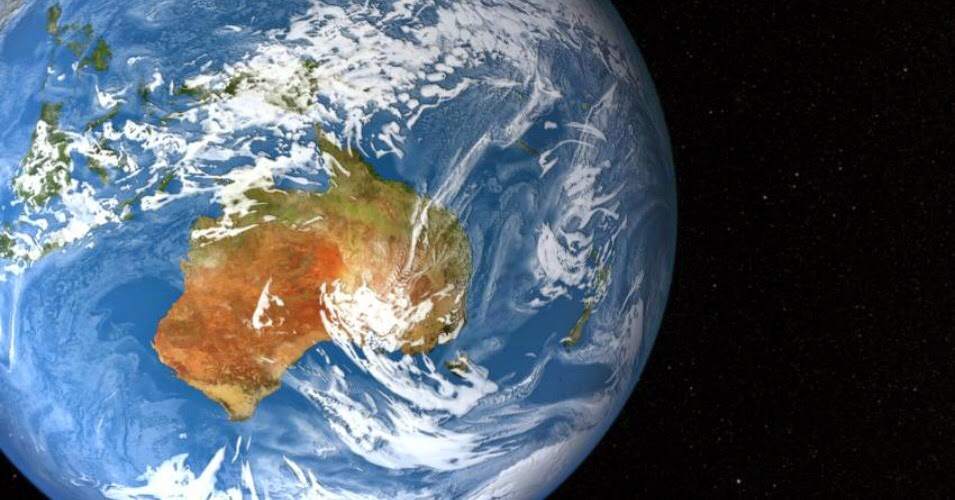
The conclusion that the world's dominant economic model—a globalized form of neoliberal capitalism, largely based on international trade and fueled by extracting and consuming natural resources—is the driving force behind planetary destruction will not come as a shock, but the model's detailed description of how this has worked since the middle of the 20th century makes a more substantial case than many previous attempts. (Photo: NASA)

Humanity's rapacious growth and accelerated energy needs over the last generation—particularly fed by an economic system that demands increasing levels of consumption and inputs of natural resources—are fast driving planetary systems towards their breaking point, according to a new pair of related studies.

“It is difficult to overestimate the scale and speed of change. In a single lifetime humanity has become a geological force at the planetary-scale.” —Prof. Will Steffen

Prepared by researchers at the Stockholm Resilience Centre, the first study looks specifically at how “four of nine planetary boundaries have now been crossed as a result of human activity.” Published in the journal Nature on Thursday, the 18 researchers involved with compiling evidence for the report—titled 'Planetary Boundaries 2.0'—found that when it comes to climate change, species extinction and biodiversity loss, deforestation and other land-system changes, and altered biogeochemical cycles (such as changes to how key organic compounds like phosphorus and nitrogen are operating in the environment), the degradation that has already take place is driving the Earth System, as a whole, into a new state of imbalance.

“Transgressing a boundary increases the risk that human activities could inadvertently drive the Earth System into a much less hospitable state, damaging efforts to reduce poverty and leading to a deterioration of human well-being in many parts of the world, including wealthy countries,” said Professor Will Steffen, a researcher at the Centre and the Australian National University, Canberra, who was lead author for both studies.

In addition to the four boundaries that have already been crossed, the study looked five other ways in which the planetary systems are under assault by human activity. They include: stratospheric ozone depletion; ocean acidification; freshwater use; atmospheric aerosol loading (microscopic particles in the atmosphere that affect climate and living organisms); and the introduction of novel entities into ecosystems (e.g. organic pollutants, radioactive materials, nanomaterials, and micro-plastics).

“I don't think we've broken the planet but we are creating a much more difficult world,” Sarah Cornell, another report author, told Reuters.

In this interview with Wired last year, Johan Rockström, executive director of the Stockholm Resilience Centre, described the idea about planetary boundaries in details:

Related to the findings of the first study, the second report examines what it calls the “Great Acceleration” and is an assessment of the speed and influence that specific factors have had in damaging the planetary systems described in Planetary Boundaries 2.0. Using a series of indicators, the study compares the relationship, over time, between 12 'socio-economic factors'—including economic growth (GDP); population; foreign direct investment; energy consumption; and water use—on one side with 12 'Earth system trends'—like the carbon cycle; the nitrogen cycle and biodiversity—on the other.

Using what it calls a “planetary dashboard,” the research charts the spread and speed of human activity from the start of the industrial revolution in 1750 to 2010, and the subsequent changes in the Earth System – e.g. greenhouse gas levels, ocean acidification, deforestation and biodiversity deterioration. The analysis found that increased human activity—and “predominantly the global economic system”—has unseated all other factors as the primary driver of change in the Earth System, which the report describes as “the sum of our planet's interacting physical, chemical, biological and human processes.” The most striking, i.e. “accelerated,” changes to that system have occurred in the last sixty years.

“It’s clear the economic system is driving us towards an unsustainable future and people of my daughter’s generation will find it increasingly hard to survive. History has shown that civilisations have risen, stuck to their core values and then collapsed because they didn’t change. That’s where we are today.” —Prof. Will Steffen”It is difficult to overestimate the scale and speed of change. In a single lifetime humanity has become a geological force at the planetary-scale,” said Steffen, who also led the Acceleration study.

The conclusion that the world's dominant economic model—a globalized form of neoliberal capitalism, largely based on international trade and fueled by extracting and consuming natural resources—is the driving force behind planetary destruction will not come as a shock, but the model's detailed description of how this has worked since the middle of the 20th century makes a more substantial case than many previous attempts.

“When we first aggregated these datasets, we expected to see major changes but what surprised us was the timing. Almost all graphs show the same pattern. The most dramatic shifts have occurred since 1950. We can say that around 1950 was the start of the Great Acceleration,” says Steffen. “After 1950 we can see that major Earth System changes became directly linked to changes largely related to the global economic system. This is a new phenomenon and indicates that humanity has a new responsibility at a global level for the planet.”

The paper makes a point to acknowledge that consumption patterns and the rise of what has become known as the Anthropocene Era does not fall equally on the human population and its examination of the economic system which is underpinning planetary destruction is one rife with inequality, in which certain populations consume at vastly higher levels than others.

According to the report, “The new study also concludes that the bulk of economic activity, and so too, for now, the lion's share of consumption, remain largely within the OECD countries, which in 2010 accounted for about 74% of global GDP but only 18% of the global population. This points to the profound scale of global inequality, which distorts the distribution of the benefits of the Great Acceleration and confounds international efforts, for example climate agreements, to deal with its impacts on the Earth System.”

A worrying trend, notes the paper, is how a growing global middle class—exemplified by those in the BRICS nations of Brazil, Russia, India, China, and South Africa—is an increasing threat to the planet as the consumer mindset established in the OECD nations, particularly the U.S., spreads.

In an interview with the Guardian, Steffen spoke clearly about the overall impacts of the two new studies as he sounded the alarm over humanity's trajectory. “People say the world is robust and that’s true, there will be life on Earth, but the Earth won’t be robust for us,” he said. “Some people say we can adapt due to technology, but that’s a belief system, it’s not based on fact. There is no convincing evidence that a large mammal, with a core body temperature of 37C, will be able to evolve that quickly. Insects can, but humans can’t and that’s a problem.”

“It’s clear the economic system is driving us towards an unsustainable future and people of my daughter’s generation will find it increasingly hard to survive. History has shown that civilisations have risen, stuck to their core values and then collapsed because they didn’t change. That’s where we are today.”

What increasing amounts of strong evidence shows, he said, is that that there “tipping points” that the human race should simply not “want to cross.” More

This work is licensed under a Creative Commons Attribution-Share Alike 3.0 License


Abu Dhabi summit to discuss water security challenges

More than 32,000 global leaders from 170 countries representing government, industry, investment and research to Abu Dhabi, will provide an upfront look at affordable technologies to enable sustainable water resource management to help meet the Middle East’s rising demand for water.

Hosted by Masdar, Abu Dhabi’s renewable energy company, ADSW is a yearly platform that addresses the interconnected challenges of energy and water security, climate risk and sustainable development.

Running from January 17 to 24, ADSW includes the World Future Energy Summit (WFES), the world’s foremost event dedicated to the advancement of renewable energy, energy efficiency and clean technology; and the International Water Summit (IWS), which provides a business approach to addressing water scarcity, sustainable growth and economic development in arid regions.

“The Mena region is in a truly unique position to solve the challenge of water security,” remarked Raed Bkayrat, vice president of development for Saudi Arabia at First Solar, which is participating in WFES.

“While the region is quite arid, it also has one of the highest solar irradiances of any region in the world, and much of the population has ready access to seawater. Accordingly, solar photovoltaic projects are proving to be sustainable means of powering water desalination in the region, ensuring that the supply of clean water will keep up with the region’s increasing demand for it,” he noted.

Masdar took a major step by launching a pilot project to test energy-efficient desalination technologies – such as reverse osmosis and forward osmosis – powered by renewable energy.

The company awarded contracts to Abengoa, Degremont, Sidem/Veolia and Trevi Systems to build the desalination plants, which are expected to enable the implementation of cost-competitive desalination plants powered by renewable energy in the UAE and abroad.

“Engaging different sectors of the industry is really crucial to bring forward innovative solutions, as well as pilot projects that demonstrate to governments the value of new integrated systems,” Bkayrat added.

Both WFES and IWS will offer numerous keynote addresses, panel discussions and workshops as well as exhibitors introducing affordable technologies to enable sustainable water resource management.

Along with WFES and IWS, ADSW will include the second EcoWaste and the seventh Zayed Future Energy Prize Award Ceremony; it also coincides with the Fifth General Assembly of the International Renewable Energy Agency.-TradeArabia News Service More


Joining Forces to Combat Climate Change and Re-ignite the Global Economy

The world’s three biggest carbon emitters—the United States, China, and the European Union—have all announced emissions goals or limits in the past few months. That’s great news, but global fossil fuel demand continues to rise, and with it, so do climate change’s risks—to economy, to environment, to security, to human health, to people living in poverty in areas where climate change will have devastating impact.

The most recent IPCC report (AR5) found that “warming of the climate system is unequivocal,” “human influence on the climate system is clear,” and “limiting climate change will require substantial and sustained reductions in greenhouse gas emissions.”

The 2014 report Risky Business: The Economic Risks of Climate Change in the United States detailed the serious economic harm we can expect from climate change if we continue on our current path. But the challenge before us is about more than averting the worst economic impacts of climate change. As highlighted in the recently released Better Growth, Better Climate report from The New Climate Economy, it’s also about finding enormous economic opportunity in clean energy solutions that both tackle global warming and unlock growth opportunities for all.

The transformation to a low-carbon future is arguably the greatest business opportunity of our time. Combating climate change through energy efficiency, renewable energy technologies, clean transportation, and smarter land use can reap rewards as great economically as environmentally.

Fortunately, an energy revolution is rising all around us—enabled by smart policies in mindful markets, and led by business for profit. Efficient energy use fuels more economic activity than oil, at far lower cost, while its potential gets ever bigger and cheaper. In each of the past three years, the world invested a quarter-trillion dollars—more than the market cap of the world’s coal industry—to add over 80 billion watts of renewable capacity (excluding big hydro dams). Generating capacity added last year was 37 percent renewable in the United States, 53 percent in the world, 68 percent in China, 72 perent in Europe. Last year, the world invested over $600 billion in efficiency, renewables, and cogeneration.

This growth is accelerating: solar power is scaling faster than cellphones. Last year alone, China added more solar capacity than the U.S. has added in 60 years. Electric vehicle sales are growing twice as fast as hybrid cars did at a comparable stage. Shrewd companies are realizing climate solutions’ enormous business opportunities—a prospect scarcely dimmed by cheaper oil, which makes only a few percent of the world’s electricity.

Global companies like IKEA, Google, Apple, Facebook, Salesforce, and Walmart have committed to 100 percent renewable power. Tesla’s stock is up an astounding 660 percent over the past two years and has half the market value of General Motors Corp. The NEX index, which tracks clean energy companies worldwide, grew by 50 percent over the past two years—far outperforming the general market—while equity raisings by quoted clean energy companies more than doubled. Many of the world’s top financial firms concur that the era of coal and of big power plants is drawing to a close; Germany’s biggest utility is divesting those assets to focus on efficiency and renewables.

Yet we need to create even bigger and faster change. Which is why we are delighted to announce that our two nonprofit organizations—Rocky Mountain Institute and the Carbon War Room—are joining forces. By uniting two of the world’s preeminent nonprofit practitioners of market-based energy and climate solutions, we will help turn the toughest long-term energy challenges into vast opportunities for entrepreneurs to create wealth and public benefit for all. More


Dystopian Fiction’s Popularity Is a Warning Sign for the Future

Dystopian fiction is hot right now, with countless books and movies featuring decadent oligarchs, brutal police states, ecological collapse, and ordinary citizens biting and clawing just to survive. For bestselling author Naomi Klein, all this gloom is a worrying sign.

“I think what these films tell us is that we’re taking a future of environmental catastrophe for granted,” Klein says in Episode 129 of the Geek’s Guide to the Galaxy podcast. “And that’s the hardest part of my work, actually convincing people that we’re capable of something other than this brutal response to disaster.”

Her new book, This Changes Everything: Capitalism vs. The Climate, argues that only dramatic policy shifts can avert climate catastrophe, and that ordinary people need to speak up and demand emissions caps, public transportation, and a transition to renewable energy. That’s a hard sell politically, which is why dubious measures like geoengineering and cap-and-trade have been proposed instead.

“It seems easier, more realistic, to dim the sun than to put up solar panels on every home in the United States,” says Klein. “And that says a lot about us, and what we think is possible, and what we think is realistic.”

But things are starting to change, with indigenous groups winning lawsuits to block drilling on their land, local communities coming together to ban fracking and establish solar energy grids, and a growing divestment campaign seeking to shame and isolate the fossil fuel industry. Many of these movements are being led by young activists like Anjali Appadurai, who gave a speech in 2010 pointing out that the United Nations has been fruitlessly debating climate change action since before she was born.

“Young people have a critical role to play because they’ll be dealing with the worst impacts of climate change,” says Klein. “And when young people find their moral voice in this crisis, it’s transformative.”

Listen to our complete interview with Naomi Klein in Episode 129 of the Geek’s Guide to the Galaxy podcast (above), and check out some highlights from the discussion below.

Naomi Klein on how the wealthy are preparing for climate change:

“There are a lot of examples of ways that companies are preparing. The most insidious is the way that oil companies—who have been funding climate change denial—are simultaneously exploring all the wonderful extraction opportunities there are because the arctic ice is melting, so they obviously know it’s happening. … After Superstorm Sandy, there was a big uptick in the way that luxury developers in New York and elsewhere started to market themselves as being ‘disaster proof’—having their own generators, having their own ‘moats’ in a way, having their own storm barriers, and basically saying, ‘When the apocalypse comes, you’ll be safe.’ … In the aftermath of Hurricane Katrina, there was a company that was launched in Florida called HelpJet. … HelpJet was a private disaster rescue operation that literally had the slogan, ‘We’ll turn your disaster into a luxury vacation.’”

Naomi Klein on geoengineering:

“In general the geoengineering world is populated by very overconfident, overwhelmingly male figures who don’t make me feel at all reassured that they have learned the lessons of large-scale technological failure. When I went to this one conference that was hosted by the Royal Society in England, the Fukushima disaster had just started, and in fact a photographer I was working with—a videographer—had just come back from Fukushima and was completely shell-shocked. And I was surprised it didn’t come up the whole time we were meeting, because it seemed relevant to me. Yeah, we humans screw up. BP had been two years earlier. I have been profoundly shaped as a journalist by covering the BP disaster, the derivatives failure, seeing what’s happened in Fukushima. I’m sorry, but I think the smartest guys in the room screw up a lot. And the kind of hubris that I’ve seen expressed from the ‘geo-clique,’ as they’ve been called, makes me not want to scale up the risks that we’re taking.”

Naomi Klein on our relationship with nature:

“If you go back and look at the way fossil fuels were marketed in the 1700s, when coal was first commercialized with the Watt steam engine, the great promise of coal was that it liberated humans from nature, that you no longer had to worry about when the wind blew to sail your ship, and you no longer had to build your factory next to a waterfall or rushing rapids in order to power your water wheel. You were in charge, that was the promise of coal. It was the promise of man transcending the natural world. And that was, it turns out, a lie. We never transcended nature, and that I think is what is so challenging about climate change, not just to capitalism but to our core civilizational myth. Because this is nature going, ‘You thought you were in charge? Actually all that coal you’ve been burning all these years has been building up in the atmosphere and trapping heat, and now comes the response.’ … Renewable energy puts us back in dialog with nature. We have to think about when the wind blows, we have to think about where the sun shines, we cannot pretend that place and space don’t matter. We are back in the world.”

Naomi Klein on science fiction:

“This boom in cli-fi literature is exciting, but I think it can become dangerous if it isn’t seen as a warning, but just seen as inevitable. I think Margaret Atwood—not to be too Canadian about it—but I think Margaret Atwood’s In the Year of the Flood and that whole trilogy, that whole climate trilogy, is an example of the kind of narrative that really does serve as clarion warning, as opposed to just sort of hopeless ‘we’re on this road, we can’t get off.’ And it’s hard to define what makes something more of a warning than just affirming that sense of the inevitable. I loved Ursula Le Guin‘s acceptance speech at the Booker awards this year. I’m a huge Ursula Le Guin fan, and I think she’s one of the few science fiction writers that has pulled off utopian fiction well. She’s done both. But when she accepted the award she sort of accepted on behalf of the genre, and talked about how important it is to have and nurture voices from people who can imagine different worlds.”


Bahamas takes on renewable energy challenge – Missed Opportunity for Cayman?

The Bahamas has become the latest recruit to Richard Branson's green energy drive for Caribbean islands.

Branson's Carbon War Room NGO is aiming to help islands in the region transition from expensive fossil fuel imports to using their own renewable energy resources as part of its Ten Island Challenge programme.

This week the Bahamas joined the push, committing to developing 20MW of solar PV generation in the outer Family Islands, bringing energy efficiency and solar solutions to a local high school, and replacing streetlights across the nation with energy efficient LED lights.

Carbon War Room plans to support these goals by providing the country's government with a range of technical, project management, communications, and business advisory services.

The Bahamas joins the islands of Aruba, Grenada, San Andres and Providencia in Colombia, Saint Lucia, and Turks & Caicos in the challenge, which aims to generate how small states can decarbonise in a cost-effective manner.

“The Bahamas' entry into the Ten Island Challenge signals another step forward for the Caribbean region in the effort towards a clean energy future,” Branson said in a statement. “The progress made in The Bahamas will help inspire other islands to work towards accomplishing their renewable energy objectives.”

While the focus to date has been on Caribbean islands, earlier this year Peter Boyd, Carbon War Room's chief operating officer, told BusinessGreen the programme could expand into the Pacific and to isolated communities, military bases, or mines. “There are island energy economies even if the 'island' isn't surrounded by water,” he said at the time.


Disconnected: Hundreds live with no power in Grand Cayman

(CNS): A freedom of information request to the Electricity Regulatory Authority (ERA) has revealed that more than 640 CUC customers have been cut off by the power supplier, mostly as a result of non-payment of bills. Many of those cut off are families who have been living without electricity for 90 days or more.

The request, which was submitted by a CNS reader, asked for the details of residential customers who had been cut off because their bills were not paid. The statistics show hundreds of people, including children, across Grand Cayman have been without a power supply for more than three months, confirming fears that the number of people living in real poverty is increasingly significant.

The ERA said it was not able to break down all the statistics because CUC merely tracks non-voluntary disconnections, which may also be due to safety reasons and not always because customers failed to pay their bills.

The ERA also explained that CUC did not indicate whether these more long term cut offs were commercial or domestic. Although some businesses may indeed be involuntarily disconnected, the situation would not be for extended periods, as any commercial enterprise without power would not last for very long. It is fair to assume that the disconnections are predominantly residential.

The largest number of disconnections are in the capital, where 306 premises have been cut off for more than three months, as at 24 November. Another 119 customers in Bodden Town were disconnected by CUC and some 117 in West Bay. Meanwhile, another 29 people were cut off in North Side and a further 23 in East End. A spokesperson for the ERA explained that the missing 47 are accounts that have been written off as CUC believes they are abandoned premises.

In addition, the ERA was able to state that 273 residential consumers had been disconnected for a period of less than 90 days, but these figures are constantly changing and any number could have been reconnected to the supply while additional households could have been cut off.

However, on 24 November there were 51 households in Bodden Town, six in East End, 50 in George Town, Seven in North Side and 59 in West Bay without power that had been disconnected within the last 90 days.

CUC recently confirmed to CNS that the firm is now cutting off power suppy without warning to customers who fail to pay their bills within 30 days. More


World Resources Institute Publishes Renewable Energy Cost Comparison Factsheet

17 November 2014: The World Resources Institute (WRI) has launched a factsheet that enables better cost comparisons of electricity from renewables and fossil fuels by identifying key factors to consider, namely: type of user; supply options; and factors that impact additional costs and benefits, such as environmental risks or financial incentives.

The publication, titled ‘Understanding Renewable Energy Cost Parity,’ seeks to provide a simple, “go-to” resource for information on appropriate comparisons of renewable and “traditional” electricity supply options. The factsheet constitutes the first in a series of three publications that aim to support clarity and precision in cost analyses of renewable energy options made by decision makers in companies, residences, governments and advocacy organizations. In particular, the guide is intended for electricity buyers looking for financial savings, and electricity system planners, regulators and policy makers seeking economic and social benefits for end-users.

The publication argues that, in order for decision makers to know where and when renewable energy is the cheapest solution, they should establish: “with what should a renewable energy option be compared”; and “which factors need to be considered in determining cost parity.”

Among the publication’s key messages are that: for end-use consumers, on-site generation is cost-competitive when its average cost of energy is lower than or equal to the retail electricity price over the project’s lifetime; for large industrial and/or commercial consumers, power purchase agreements (PPAs) are cost-competitive when the price paid for generated electricity is lower than or equal to the retail electricity price over the project’s lifetime or contract; and, for utilities and other wholesale buyers, a renewable energy project is cost-competitive if its cost of energy and/or risk is lower than or equal to that of other technologies providing the same service during the same period of time.

The factsheet also argues for the need to take into account potential additional factors, including fluctuations in electricity prices, different time periods used in comparisons, assumptions and methodologies relating to levelized cost of energy (LCOE) calculations, technology-specific subsidies, possible PPAs, and costs of compliance with environmental regulations. [WRI Blog Post] [WRI Publication Webpage] [Publication: Understanding Renewable Energy Cost Parity] More


Scientists predict green energy revolution after incredible new graphene discoveries

A recently discovered form of carbon graphite – the material in pencil lead – has turned out to have a completely unexpected property which could revolutionise the development of green energy and electric cars.

Researchers have discovered that graphene allows positively charged hydrogen atoms or protons to pass through it despite being completely impermeable to all other gases, including hydrogen itself.

The implications of the discovery are immense as it could dramatically increase the efficiency of fuel cells, which generate electricity directly from hydrogen, the scientists said.

The breakthrough raises the prospect of extracting hydrogen fuel from air and burning it as a carbon-free source of energy in a fuel cell to produce electricity and water with no damaging waste products.

“In the atmosphere there is a certain amount of hydrogen and this hydrogen will end up on the other side [of graphene] in a reservoir. Then you can use this hydrogen-collected reservoir to burn it in the same fuel cell and make electricity,” said Professor Sir Andrei Geim of Manchester Univeristy.

Ever since its discovery 10 years ago, graphene has astonished scientists. It is the thinnest known material, a million times thinner than human hair, yet more than 200 times stronger than steel, as well as being the world’s best conductor of electricity.

Until now, being permeable to protons was not considered a practical possibility, but an international team of scientists led by Sir Andre, who shares the 2010 Nobel Prize for his work on graphene, has shown that the one-atom thick crystal acts like a chemical filter. It allows the free passage of protons but forms an impenetrable barrier to other atoms and molecules.

“There have been three or four scientific papers before about the theoretical predictions for how easy or how hard it would be for a proton to go through graphene and these calculations give numbers that take billions and billions of years for a proton to go through this same membrane,” Sir Andrei said.

“It’s just so dense an electronic field it just doesn’t let anything through. But it’s a question of numbers, no more than that. This makes a difference between billions of years and a reasonable time for permeation. There is no magic,” he said.

The study, published in the journal Nature, shows that graphene and a similar single-atom material called boron nitride allowed the build-up of protons on one side of a membrane, yet prevented anything else from crossing over into a collecting chamber.

In their scientific paper, the researchers speculate that there could be many applications in the field of hydrogen fuel cells and in technology for collecting hydrogen gas from the atmosphere, which would open up a new source of clean energy.

“It’s really the very first paper on the subject so what we’re doing is really to introduce the material for other experts to think about it,” Sir Andrei said.

“It was difficult not to speculate. If you can pump protons from a hydrogen-containing gas into a chamber that doesn’t contain anything, you start thinking how you can exploit this?” he said.

“One of the possibilities we can imagine, however futuristic, which has to be emphasised because everything has been shown on a small scale, is applying a small electric current across the membrane and pushing hydrogen though the graphene or boron nitrite membrane,” he explained.

“Essentially you pump your fuel from the atmosphere and get electricity out of this fuel, in principle. Before this paper, this wouldn’t even be speculation; it would be science fiction. At least our paper provides a guidance and proof that this kind of device is possible and doesn’t contradict to any known laws of nature,” Sir Andre added.

Graphene: potential uses

Graphene is tough, about 200 times stronger than steel, yet incredibly light. It is considered the first two-dimensional material because it forms sheets of crystal that are just one atom thick.

It is also an excellent conductor of electricity, so is useful for anything involving electronics, such as bendable mobile phones and cameras, and wearable electrical devices attached to clothing.

Medical applications include its possible use as a material for delivering drugs to damaged sites within the body, which could open new avenues for treating patients with brain conditions such as Parkinson’s disease or cancer.

Graphene is also being developed as a new material for membranes involved in separating liquids. It could be used to purify water in the developing world or to create more efficient desalination plants.

Scientists also believe that graphene’s high strength and low weight can be harnessed in the making of new composite materials and polymers for the transport industry, making travel safer and more fuel efficient.

Now, it seems, graphene might also be used to generate new forms of generating clean electricity using hydrogen fuel cells, and even as a technology for harvesting hydrogen fuel from air. More


Naomi Klein’s ‘This Changes Everything’

“Every inhabitant of this planet must contemplate the day when this planet may no longer be habitable.” Thus spoke President Kennedy in a 1961 address to the United Nations.

Naomi Klein

The threat he warned of was not climate chaos — barely a blip on anybody’s radar at the time — but the hydrogen bomb. The nuclear threat had a volatile urgency and visual clarity that the sprawling, hydra-headed menace of today’s climate calamity cannot match. How can we rouse citizens and governments to act for concerted change? Will it take, as Naomi Klein insists, nothing less than a Marshall Plan for Earth?

“This Changes Everything: Capitalism vs. the Climate” is a book of such ambition and consequence that it is almost unreviewable. Klein’s fans will recognize her method from her prior books, “No Logo: Taking Aim at the Brand Bullies” (1999) and “The Shock Doctrine: The Rise of Disaster Capitalism” (2007), which, with her latest, form an antiglobalization trilogy. Her strategy is to take a scourge — brand-­driven hyperconsumption, corporate exploitation of disaster-struck communities, or “the fiction of perpetual growth on a finite planet” — trace its origins, then chart a course of liberation. In each book she arrives at some semihopeful place, where activists are reaffirming embattled civic values.

To call “This Changes Everything” environmental is to limit Klein’s considerable agenda. “There is still time to avoid catastrophic warming,” she contends, “but not within the rules of capitalism as they are currently constructed. Which is surely the best argument there has ever been for changing those rules.” On the green left, many share Klein’s sentiments. George Monbiot, a columnist for The Guardian, recently lamented that even though “the claims of market fundamentalism have been disproven as dramatically as those of state communism, somehow this zombie ideology staggers on.” Klein, Monbiot and Bill McKibben all insist that we cannot avert the ecological disaster that confronts us without loosening the grip of that superannuated zombie ideology.

That philosophy — ­neoliberalism — promotes a high-consumption, ­carbon-hungry system. Neoliberalism has encouraged mega-mergers, trade agreements hostile to environmental and labor regulations, and global hypermobility, enabling a corporation like Exxon to make, as McKibben has noted, “more money last year than any company in the history of money.” Their outsize power mangles the democratic process. Yet the carbon giants continue to reap $600 billion in annual subsidies from public coffers, not to speak of a greater subsidy: the right, in Klein’s words, to treat the atmosphere as a “waste dump.”

So much for the invisible hand. As the science fiction writer Kim Stanley Robinson observed, when it comes to the environment, the invisible hand never picks up the check.

Klein diagnoses impressively what hasn’t worked. No more claptrap about fracked gas as a bridge to renewables. Enough already of the international summit meetings that produce sirocco-quality hot air, and nonbinding agreements that bind us all to more emissions. Klein dismantles the boondoggle that is cap and trade. She skewers grandiose command-and-control schemes to re-engineer the planet’s climate. No point, when a hubristic mind-set has gotten us into this mess, to pile on further hubris. She reserves a special scorn for the partnerships between Big Green organizations and Immense Carbon, peddled as win-win for everyone, but which haven’t slowed emissions. Such partnerships remind us that when the lamb and the lion lie down together, only one of them gets eaten.

In democracies driven by lobbyists, donors and plutocrats, the giant polluters are going to win while the rest of us, in various degrees of passivity and complicity, will watch the planet die. “Any attempt to rise to the climate challenge will be fruitless unless it is understood as part of a much broader battle of worldviews,” Klein writes. “Our economic system and our planetary system are now at war.”

Klein reminds us that neoliberalism was once an upstart counterrevolution. Through an epic case of bad timing, the Reagan-Thatcher revolution, the rise of the anti-regulatory World Trade Organization, and the cult of privatizing and globalizing everything coincided with the rising public authority of climate science. In 1988, James Hansen, director of NASA’s Goddard Institute, delivered historic testimony at Congressional hearings, declaring that the science was 99 percent unequivocal: The world was warming and we needed to act collectively to reduce emissions. Just one year earlier, Margaret Thatcher famously declared: “There is no such thing as society. There are individual men and women and there are families.” In the battle since, between a collective strategy for forging an inhabitable long-term future and the antisocial, hyper-­corporatized, hyper-carbonized pursuit of short-term growth at any cost, well, there has been only one clear winner.

But counterrevolutions are reversible. Klein devotes much of her book to propitious signs that this can happen — indeed is happening. The global climate justice movement is spreading. Since the mid-1990s, environmental protests have been growing in China at 29 percent per year. Where national leaders have faltered, local governments are forging ahead. Hundreds of German cities and towns have voted to buy back their energy grids from corporations. About two-thirds of Britons favor renationalizing energy and rail.

The divestment movement against Big Carbon is gathering force. While it will never bankrupt the mega-corporations, it can reveal unethical practices while triggering a debate about values that recognizes that such practices are nested in economic systems that encourage, inhibit or even prohibit them.

The voices Klein gathers from across the world achieve a choral force. We hear a Montana goat rancher describe how an improbable alliance against Big Coal between local Native American tribes and settler descendants awakened in the latter a different worldview of time and change and possibility. We hear participants in Idle No More, the First Nations movement that has swept across Canada and beyond, contrast the “extractivist mind-set” with systems “designed to promote more life.”

One quibble: What’s with the subtitle? “Capitalism vs. the Climate” sounds like a P.R. person’s idea of a marquee cage fight, but it belies the sophistication and hopefulness of Klein’s argument. As is sometimes said, it is easier to imagine the end of the world than to imagine the end of capitalism. Klein’s adversary is neoliberalism — the extreme capitalism that has birthed our era of extreme extraction. Klein is smart and pragmatic enough to shun the never-never land of capitalism’s global overthrow. What she does, brilliantly, is provide a historically refined exposé of “capitalism’s drift toward monopoly,” of “corporate interests intent on capturing and radically shrinking the public sphere,” and of “the disaster capitalists who use crises to end-run around democracy.”

To change economic norms and ethical perceptions in tandem is even more formidable than the technological battle to adapt to the heavy weather coming down the tubes. Yet “This Changes Everything” is, improbably, Klein’s most optimistic book. She braids together the science, psychology, geopolitics, economics, ethics and activism that shape the climate question. The result is the most momentous and contentious environmental book since “Silent Spring.” More