Mismanaging Climate Change

Pakistan’s extreme vulnerability to climate change is not a scientific secret but is, in fact, a logical certainty owing to its geographic location, inclined elevation, as well as demographics.

Former Minister Malik Amin Aslam Khan

The issue directly impacts upon the country’s already volatile water dynamics driven by the northern glaciers and the seasonal monsoon rains and, if not managed properly, could burden our economy to the tune of $6-14 billion per year (United Nations Framework Convention on Climate Change NEEDS study 2010). In response to this challenge, Pakistan’s National Climate Change Policy has laid out a comprehensive ‘to do’ list for the government, which was approved by the government but, unfortunately, has not been acted upon by the authorities. Oblivious to this apathy and inaction, Pakistan continues to face a mammoth challenge to not only climate-proof its future development path, but also take steps to cope with an issue, which is here to stay. These steps include establishing early warning systems, effective flood plain management, improving weather forecasting with cross-border data exchange and enhancing the disaster preparedness, as well as emergency response capabilities to deal with predicted climate-induced natural disasters.

To their credit, previous governments did begin to take concrete institutional building measures, such as establishing a very high-level Prime Minister’s Cabinet Committee on Climate Change, setting up a dedicated Ministry of Climate Change built on the debris of a misguidedly devolved Environment Ministry and creating a focused climate research centre i.e., the Global Change Impact Studies Centre. However, in one stroke of convenient denial, the present government has undone and dismantled all those measures by downgrading the ministry to a division level, drastically cutting the funds for the division, leaving it headless without an appointed minister and also drying up all finances for the climate research centre. It is, thus, not surprising, that the country received a rude wake-up call when, during the recent floods, the forces of nature once again caught it totally off guard and institutionally ill-prepared to deal with a situation, which had been predicted and forewarned time and again by climate experts.

The 2014 flood came in two surges. The first surge occurred due to exceptionally high rainfall in the rivers Jhelum, Chenab, Ravi and their catchments. It is a recorded fact that the Pakistan meteorological office gave clear warnings about this enhanced rainfall activity, which were not heeded to in a timely manner. The result of this negligence was that the Mangla Dam remained filled to the brim, while storm waters gathered upstream and, subsequently, the floodgates were forced open at the worst possible time when water levels were already dangerously peaking downstream. Had the water been incrementally released, as advised, the massive flood surge that eventually occurred could have been effectively prevented. Dams remain a double-edged sword — if used intelligently, they can be the best tool for controlling and regulating floods, but if used improperly, as they were on this occasion, they can quickly convert floods into mega human disasters.

This first human-induced deluge was followed by the second flood surge that occurred due to the unpredictably high ‘cloud-burst’ in Indian-held Kashmir. The information about this second surge was also received hours in advance as the water roared down River Chenab. Again, our own meteorological office issued a timely flood peak warning, but again, the reaction time and response measures of our government were found severely lacking.

The floods were triggered by climate-induced cloud-bursts and monsoonal shifts, but the human tragedy and destruction got multiplied due to poor government planning, human negligence and a criminal mixture of absence and apathy of relevant institutional response mechanisms.

Climate related calamities, including more flooding and an enhanced frequency of freak natural events are, unequivocally, predicted for Pakistan and it is time to take these warnings seriously, and for the government to heed to them by planning to deal with the consequences, limiting the damage and adapting to this shifting scenario. The recent floods, which are surely not the last one, have also rudely exposed the human, economic and environmental costs to be paid for our politically motivated aversion to building large dams, as well as the suicidal trend of encroaching upon flood plains and continuing to challenge the flood water boundaries.

Pakistan lies at the geographic crossroads of melting glaciers, shifting monsoons and enhanced disaster activity. This locational risk cannot be changed, but how we deal with this looming catastrophe can certainly be changed. What it requires is better responsive measures and heeding to technical advice and scientifically based warnings with timely decisions.

The political optics of wading through floodwaters and post disaster bear hugs with destitute and frustrated victims is beginning to lose its vote-gathering lustre. As we haplessly subject millions to avoidable disasters, it is time to face up to reality. Climate-proofing of infrastructure, conserving the yearly deluge of water that is callously flushed into the Arabian Sea and effectively enforced flood plains management needs to get the priority it deserves. The politics of underpasses and overpasses has to give way to the politics of common sense, based on what Pakistan’s real challenges are and what it is predicted to face up to in the near future. Governing with confused priorities and institutional mismanagement will continue to worsen the responses forced upon us as we face up to the unpredictability of climate change. More

Published in The Express Tribune, October 19th, 2014.


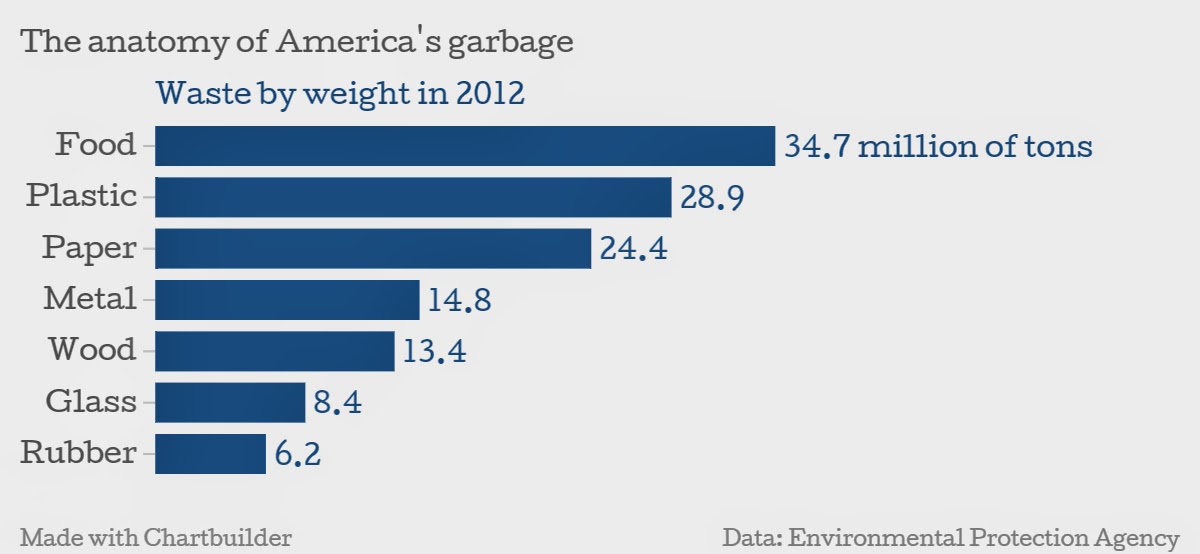
We throw out more food than plastic, paper, metal, and glass

The much-anticipated U.N. Climate Summit, which began a few days ago in New York, and was ostensibly a platform for world leaders to leap frog debates over whether climate change is real, and skip straight to discussions centered around how to overcome the challenges it poses.

But it’s also an impetus for those beyond the sessions’ panels to illuminate troubling patterns of behavior that are contributing to our collective carbon footprint—and food waste is without question one of the most egregious, especially in the United States.

In 2012, the most recent year for which estimates are available, Americans threw out roughly 35 million tons of food, according to the Environmental Protection Agency. That’s almost 20 percent more food than the United States tossed out in 2000, 50 percent more than in 1990, and nearly three times what Americans discarded in 1960, when the country threw out a now seemingly paltry 12.2 million tons.

“Food waste is an incredible and absurd issue for the world today,” Jose Lopez, Nestle’s head of operations said of the issue earlier this month.

Take as percentages, not tonnage.

Roughly a third of the food produced worldwide never gets eaten. The problem is particularly egregious in developed countries, where food is seen as being more expendable than it is elsewhere. “Every year, consumers in rich countries waste almost as much food (222 million tonnes) as the entire net food production of sub-Saharan Africa (230 million tonnes),” the U.N. notes on its website.

This country is one of the worst offenders: a 2012 paper by the Natural Resources Defense Council estimated that as much as 40 percent of America’s food supply ends up in a dumpster.

The most obvious problem with this waste is that while Americans are throwing out their food, an estimated one in every nine people in the world still suffers from chronic hunger—that is, insufficient food—including more than 200 million in Sub-Saharan Africa and more than 500 million Asia. Even in the United States, where that number is significantly lower, some 14 percent of U.S. households still struggled to put food on the table for a portion of last year, according to the USDA.

The level of food waste suggests that curbing hunger isn’t a matter of producing more food so much as better preserving and distributing the food currently being produced. As the United Nations noted in its report on world hunger last week, there is actually enough food to feed all seven billion people living in the world today.

But there’s another less apparent problem with food waste: the threat to the environment. Landfills full of decomposing food release methane, which is said to be at least 20 times more lethal a greenhouse gas than carbon dioxide. And America’s landfills are full of food—organic waste is the second largest contributor to the country’s landfills. Those same landfills are the single largest producer of methane emissions in the United States—they produce almost a quarter of the country’s total methane emissions, according to the NRDC.

The environmental cost of food waste goes further than just methane emissions. Producing food is a costly affair for the environment—an estimated one third of global carbon emissions come from agriculture—but it’s one society pays to feed itself.

The price for producing food that never ends up in someone’s mouth is much more—it includes both the resources and environmental decay sacrificed for its making. The livestock industry contributes more than 15 percent of global carbon emissions, according to the U.N, which means that when Americans throw out meat, they are wasting some of the most environmentally costly food available. More

Given all the discussions concerning the creation of a new landfill here in the Cayman Islands, here a link to creating healthy soil using composted food scraps and hervested water, and helping to reduce waste going to the dump.

Read about what how you can build better soil with all that food “waste” in the WMG's Soil Resource Guide: Here or here from the Watershed Management group's site here


Jamaican’s Cautioned Against False Sense Of Water Security

THE RAINS have returned, bringing with them relief from drought conditions that plagued the island during the summer, but Jamaicans must guard against a false sense of water security.

Hope River in dry season

So says Director of the Climate Studies Group Mona Dr Michael Taylor, who is supported in his caution by Herbert Thomas, deputy managing director of the Water Resources Authority.

Taylor, a physicist, urges Jamaicans to be mindful not only of the El Niño phenomenon that promises a return to the dry spell towards the end of this year and into next year. They need, too, he warned, to be cognisant of climate change, which will see the island experiencing longer and more severe dry spells over the long term, as well as flooding incidents.

“As El Niño peaks, we might revert to dry conditions somewhere between the end of the year and early next year, but as it declines, we are susceptible to the reverse, which is flooding, when the early rainfall season kicks in,” he said.

“So the point is, we have to figure out how to be resilient to these swings in extremes from drought to flood within the course of a year, and these kinds of swings will become more and more the norm under climate change,” the scientist posited.

This is borne out by research done over the last two to three years by the Climate Studies Group for the Planning Institute of Jamaica.

That research, Taylor said, looks at climate scenarios up to 2040, with a focus on projections for temperature and rainfall.

“The temperature will continue increasing about one degree up to 2040, and that is further from where we are now. We have warmed by about one degree over the last 50 years. What that really translates into is, the number of really hot days is increasing every year and the number of really hot nights is also increasing and will continue to increase,” he said.

“Rainfall will continue with this form of variability, which is a yearly swing between drought and flood conditions, but by 2040 will show the beginning of an overall long-term drying trend. This means that, from 2040 onward, even though we will get rain, we will get less overall rain,” added Taylor.

The solution, he said, is a comprehensive look at water security, something Government is attempting to tackle, with work ongoing on a new water policy that takes account of climate impacts.

“We need to be concerned about water capture, water storage, water access, conservation, efficiency, and using science to help us to better plan for these kinds of extreme variations,” the head of the physics department at the University of the West Indies said.

Thomas agreed, noting that the island’s long-term water security will depend on a comprehensive plan, informed by the new water policy now nearing completion, and with both private citizens and Government working in concert.

“Some people like to stand under the shower and sing. Cutting out things like those [is important]; you would be surprised to know the amount of water you waste that way,” he told The Gleaner recently.

Retrofitting for conservation

In addition, Thomas said Jamaicans might have to look at retrofitting their homes and offices to include features such as low-flush toilets and faucets that use less water for showers. This, while the island looks at alternative energy sources in order to reduce the overall cost of getting water to the areas where it is needed.

Checks with communications manager at the National Water Commission, Charles Buchanan, revealed that current electricity cost for water stands at some of $500 million monthly.

Beyond that, Thomas said there is the need to look at rainwater harvesting and the comprehensive use of wastewater, to which the water policy also gives attention.

“For example, the treated sewage out at Soapberry, there is the thinking that some of the water could be used in St Catherine areas for agriculture and, therefore, the water normally used for agriculture could be freed up for domestic use in Kingston,” he noted.

“And there are other things … . You might have to consider a double-plumbing system so you separate grey water (water from bathroom sinks, tubs and washing machines, etc) from black water. Grey water you can use to flush toilets and water lawns,” Thomas added. More


Drought apocalypse begins in California as wells run dry

(NaturalNews) Water wells in central California have begun to run dry, reports the LA Times. (1) “Extreme drought conditions have become so harsh for the Central Valley community of East Porterville [that] many of its residents dependent on their own wells have run out of water.”

Tulare County has confirmed their wells have run out of water, and so far hundreds of homes have no running water.

According to the LA Times, rumors are also spreading that Child Protective Services officials will begin taking children away from families who have no running water, although the county claims the rumor is false.

It begins: the collapse of California's water aquifers

With this news, it is now official that the collapse of California's water aquifers has begun. With each passing month and year, more and more wells will run dry across the state as California plummets into the desert conditions from which it once sprang.

Extreme drought now covers 82% of California, according to the National Drought Mitigation Center. (2) Fifty-eight percent of the state is in “exceptional drought.”

During the unfolding of this drought, California farmers and cities have siphoned unprecedented volumes of water out of the state's underground aquifers. This is called “fossil water” and it can take centuries to regenerate. Once this fossil water is used up, it's gone.

35-year “megadrought” may be on the way

“The southwestern United States has fifty percent change of suffering a 'megadrought' that lasts 35 years,” reports the Daily Mail. (3)

“They say global warming has meant the chance of a decade long drought is at least 50 percent, and the chances of a 'megadrought' – one that lasts up to 35 years – ranges from 20 to 50 percent over the next century.”

One scientist is quoted in the story as saying, “This will be worse than anything seen during the last 2,000 years and would pose unprecedented challenges to water resources in the region.”

Unless politicians become magical wizards and figure out a way to create water out of nothing, what all this really means is that cities of the American southwest will not be able to support present-day populations. A mass migration (evacuation) out of the cities will be necessary sooner or later.

California's water deficit will lead to ecological and economic collapse

In an almost perfect reflection of California's state budget deficits, the state is also running an unsustainable water deficit. It is a mathematical certainty that when you remove far more water from the aquifers than is being replenished, the amount of water remaining in those aquifers will eventually reach zero.

This “zero day” water reality is still psychologically denied by most Californians. If the reality of this situation were widely recognized, California would be experiencing a glut of real estate inventory as millions of homeowners tried to sell their properties and evacuate the state. The fact that the real estate market has not yet collapsed in California tells us that Californians are still living in a state of denial about the future of their water supply.

Even as California's water supply collapses by the day, local farmers and towns have few options other than drilling for more water. “Drill! Drill! Drill!” is the mantra of the day, creating an 18-month backlog for well drilling companies. Each new well that's drilled must seek to go deeper than the previous wells which are running dry. It's a literal race to the bottom which can only end in catastrophe.

Then again, a willful acceleration toward catastrophe is merely a sign of the times when it comes to human civilization. There is almost no area in which humans have ever achieved balance: not in fossil fuels, metals mining, fossil water exploitation, debt creation, industrial chemical contamination, ecological exploitation or even global population. It's almost as if the human race is determined to destroy itself while racing to see who can achieve self destruction first. More


UN Climate Summit 2014

Climate change is not a far-off problem. It is happening now and is having very real consequences on people’s lives. Climate change is disrupting national economies, costing us dearly today and even more tomorrow. But there is a growing recognition that affordable, scalable solutions are available now that will enable us all to leapfrog to cleaner, more resilient economies.UN Climate Summit 2014

There is a sense that change is in the air. UN Secretary-General Ban Ki-moon has invited world leaders, from government, finance, business, and civil society to Climate Summit 2014 this 23 September to galvanize and catalyze climate action. He has asked these leaders to bring bold announcements and actions to the Summit that will reduce emissions, strengthen climate resilience, and mobilize political will for a meaningful legal agreement in 2015. Climate Summit 2014 provides a unique opportunity for leaders to champion an ambitious vision, anchored in action that will enable a meaningful, global agreement in Paris in 2015. More


Global Climate Inaction Will Mean Economic Turmoil for South Asia, Warns Bank

The first comprehensive study ever issued on the economic costs that uncontrolled climate change would inflict on South Asia predicts a staggering burden that would hit the region's poorest the hardest.


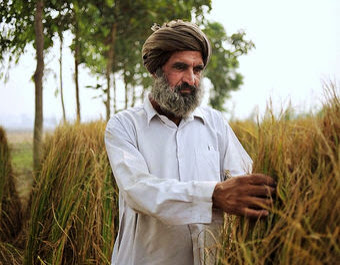
Rice Farmer in Punjab, India

“The impacts of climate change are likely to result in huge economic, social and environmental damage to South Asian countries, compromising their growth potential and poverty reduction efforts,” said the study, published by the Asian Development Bank.

The cuts in regional GDP are so deep that they might ripple around the world, as six developing countries with 1.4 billion people—a third of them living in poverty—pay the price of the world's continuing reliance on fossil fuels.

Projections like this feed into the urgency for action as world leaders prepare to meet at the United Nations next month to discuss the climate crisis. Recent warnings show that the steps nations seem willing to take will fall well short of what is needed.

Action now, the study shows, would pay immediate and lasting dividends to the countries it examined: Bangladesh, Bhutan, India, the Maldives, Nepal and Sri Lanka.

The study, published as a new 160-page book, says that if the world cuts fossil fuel consumption enough to keep warming within 2 degrees Celsius—the goal of UN negotiations—the costs to South Asian countries of adapting to rising seas and temperatures in the decades ahead might be cut almost in half.

But if business-as-usual continues, leading to a world that is 4 or 5 degrees warmer by 2100 than at the start of the industrial age, the outlook looks grim.

“Climate change will slash up to 9 percent off the South Asian economy every year by the end of this century if the world continues on its current fossil-fuel intensive path,” the bank said. “The human and financial toll could be even higher if the damage from floods, droughts, and other extreme weather events is included.”

Because this kind of estimate is inherently imprecise, the bank warned that the real damage could be much worse than expected. Under business-as-usual trends, there is a one in 20 chance that South Asia will lose 24 percent of its annual GDP by the end of the century, the study found.

Paying to stave off those damages will cost these nations dearly, the study said.

To avoid the damage that is expected if the world takes no action on climate change, South Asia would have to spend nearly $40 billion per year by 2050 on adaptation measures, or nearly half a percentage point of average annual GDP. By 2100, the costs would have to increase to $73 billion per year, or roughly nine-tenths of a point of GDP.

If the world were to achieve the 2-degree warming goal established by UN negotiators at climate treaty talks in Copenhagen in 2009—a goal also at the heart of culminating talks set for Paris in 2015—annual adaptation costs for South Asia would be considerably less: $31 billion a year at mid-century, and $41 billion at century's end.

And instead of losing nearly 9 percent of annual GDP by the end of the century, the study found, South Asia would lose about 2.5 percent by 2100 if the world lives up to the goals of Copenhagen. More


Grain Harvest Fact Sheet

With grain providing much of the calories that sustain humanity, the status of the world grain harvest is a good indicator of the adequacy of the food supply.

Lester Brown

More than 2 billion tons of grain are produced each year worldwide, nearly half of it in just three countries: China, the United States, and India.

Corn, wheat, and rice account for most of the world’s grain harvest. Whereas rice and most wheat are consumed directly as food, corn is largely used for livestock and poultry feed, and for industrial purposes.

Global grain consumption has exceeded production in 8 of the last 14 years, leading to a drawdown in reserves.

Population growth is the oldest source of increasing grain demand. In recent years, the annual growth in grain use has doubled, largely a result of increased use for fuel ethanol and livestock and poultry feed.

In 2013, the United States harvested more than 400 million tons of grain. Of this, 129 million tons (30 percent) went to ethanol distilleries.

Rising yields are the key to expanding the grain harvest as there is little unused cropland. Since 1950, over 93 percent of world grain harvest growth has come from raising yields.

The global grain area planted per person has shrunk from about half an acre (0.2 hectares) in 1950 to a quarter acre (0.1 hectares) in 2013.

At 10 tons per hectare, U.S. corn yields are the highest of any major grain anywhere. In Iowa, some counties harvest up to 13 tons per hectare.

Global average grain yields more than tripled from 1.1 tons per hectare in 1950 to 3.5 tons per hectare in 2013. However, yield growth has slowed from 2.2 percent a year between 1950 and 1990 to 1.4 percent in the years since.

In France, Germany, and the United Kingdom, wheat yields have been flat for more than a decade. The story is similar for rice in Japan and South Korea.

World fertilizer use climbed from 14 million tons in 1950 to 181 million tons in 2013. But in many countries, fertilizer use has reached diminishing returns.

Since 2007, the world has experienced three major grain price spikes. The U.N. Food Price Index indicates that grain in 2014 was twice as expensive as in 2002–04.

Rising global temperatures threaten the world’s major food crops; the “rule of thumb” is that each 1-degree-Celsius rise in temperature (1.8 degrees Fahrenheit) above the growing season optimum can cut productivity by at least 10 percent. More