Prosecute Torturers and Their Bosses

Since the day President Obama took office, he has failed to bring to justice anyone responsible for the torture of terrorism suspects — an official government program conceived and carried out in the years after the attacks of Sept. 11, 2001.
He did allow his Justice Department to investigate the C.I.A.’s destruction of videotapes of torture sessions and those who may have gone beyond the torture techniques authorized by President George W. Bush. But the investigation did not lead to any charges being filed, or even any accounting of why they were not filed.

Mr. Obama has said multiple times that “we need to look forward as opposed to looking backwards,” as though the two were incompatible. They are not. The nation cannot move forward in any meaningful way without coming to terms, legally and morally, with the abhorrent acts that were authorized, given a false patina of legality, and committed by American men and women from the highest levels of government on down.

Americans have known about many of these acts for years, but the 524-page executive summary of the Senate Intelligence Committee’s report erases any lingering doubt about their depravity and illegality: In addition to new revelations of sadistic tactics like “rectal feeding,” scores of detainees were waterboarded, hung by their wrists, confined in coffins, sleep-deprived, threatened with death or brutally beaten. In November 2002, one detainee who was chained to a concrete floor died of “suspected hypothermia.”

These are, simply, crimes. They are prohibited by federal law, which defines torture as the intentional infliction of “severe physical or mental pain or suffering.” They are also banned by the Convention Against Torture, the international treaty that the United States ratified in 1994 and that requires prosecution of any acts of torture.

So it is no wonder that today’s blinkered apologists are desperate to call these acts anything but torture, which they clearly were. As the report reveals, these claims fail for a simple reason: C.I.A. officials admitted at the time that what they intended to do was illegal.

In July 2002, C.I.A. lawyers told the Justice Department that the agency needed to use “more aggressive methods” of interrogation that would “otherwise be prohibited by the torture statute.” They asked the department to promise not to prosecute those who used these methods. When the department refused, they shopped around for the answer they wanted. They got it from the ideologically driven lawyers in the Office of Legal Counsel, who wrote memos fabricating a legal foundation for the methods. Government officials now rely on the memos as proof that they sought and received legal clearance for their actions. But the report changes the game: We now know that this reliance was not made in good faith.

No amount of legal pretzel logic can justify the behavior detailed in the report. Indeed, it is impossible to read it and conclude that no one can be held accountable. At the very least, Mr. Obama needs to authorize a full and independent criminal investigation.

The American Civil Liberties Union and Human Rights Watch are to give Attorney General Eric Holder Jr. a letter Monday calling for appointment of a special prosecutor to investigate what appears increasingly to be “a vast criminal conspiracy, under color of law, to commit torture and other serious crimes.”

The question everyone will want answered, of course, is: Who should be held accountable? That will depend on what an investigation finds, and as hard as it is to imagine Mr. Obama having the political courage to order a new investigation, it is harder to imagine a criminal probe of the actions of a former president.

But any credible investigation should include former Vice President Dick Cheney; Mr. Cheney’s chief of staff, David Addington; the former C.I.A. director George Tenet; and John Yoo and Jay Bybee, the Office of Legal Counsel lawyers who drafted what became known as the torture memos. There are many more names that could be considered, including Jose Rodriguez Jr., the C.I.A. official who ordered the destruction of the videotapes; the psychologists who devised the torture regimen; and the C.I.A. employees who carried out that regimen.

One would expect Republicans who have gone hoarse braying about Mr. Obama’s executive overreach to be the first to demand accountability, but with one notable exception, Senator John McCain, they have either fallen silent or actively defended the indefensible. They cannot even point to any results: Contrary to repeated claims by the C.I.A., the report concluded that “at no time” did any of these techniques yield intelligence that averted a terror attack. And at least 26 detainees were later determined to have been “wrongfully held.” More


Dystopian Fiction’s Popularity Is a Warning Sign for the Future

Dystopian fiction is hot right now, with countless books and movies featuring decadent oligarchs, brutal police states, ecological collapse, and ordinary citizens biting and clawing just to survive. For bestselling author Naomi Klein, all this gloom is a worrying sign.

“I think what these films tell us is that we’re taking a future of environmental catastrophe for granted,” Klein says in Episode 129 of the Geek’s Guide to the Galaxy podcast. “And that’s the hardest part of my work, actually convincing people that we’re capable of something other than this brutal response to disaster.”

Her new book, This Changes Everything: Capitalism vs. The Climate, argues that only dramatic policy shifts can avert climate catastrophe, and that ordinary people need to speak up and demand emissions caps, public transportation, and a transition to renewable energy. That’s a hard sell politically, which is why dubious measures like geoengineering and cap-and-trade have been proposed instead.

“It seems easier, more realistic, to dim the sun than to put up solar panels on every home in the United States,” says Klein. “And that says a lot about us, and what we think is possible, and what we think is realistic.”

But things are starting to change, with indigenous groups winning lawsuits to block drilling on their land, local communities coming together to ban fracking and establish solar energy grids, and a growing divestment campaign seeking to shame and isolate the fossil fuel industry. Many of these movements are being led by young activists like Anjali Appadurai, who gave a speech in 2010 pointing out that the United Nations has been fruitlessly debating climate change action since before she was born.

“Young people have a critical role to play because they’ll be dealing with the worst impacts of climate change,” says Klein. “And when young people find their moral voice in this crisis, it’s transformative.”

Listen to our complete interview with Naomi Klein in Episode 129 of the Geek’s Guide to the Galaxy podcast (above), and check out some highlights from the discussion below.

Naomi Klein on how the wealthy are preparing for climate change:

“There are a lot of examples of ways that companies are preparing. The most insidious is the way that oil companies—who have been funding climate change denial—are simultaneously exploring all the wonderful extraction opportunities there are because the arctic ice is melting, so they obviously know it’s happening. … After Superstorm Sandy, there was a big uptick in the way that luxury developers in New York and elsewhere started to market themselves as being ‘disaster proof’—having their own generators, having their own ‘moats’ in a way, having their own storm barriers, and basically saying, ‘When the apocalypse comes, you’ll be safe.’ … In the aftermath of Hurricane Katrina, there was a company that was launched in Florida called HelpJet. … HelpJet was a private disaster rescue operation that literally had the slogan, ‘We’ll turn your disaster into a luxury vacation.’”

Naomi Klein on geoengineering:

“In general the geoengineering world is populated by very overconfident, overwhelmingly male figures who don’t make me feel at all reassured that they have learned the lessons of large-scale technological failure. When I went to this one conference that was hosted by the Royal Society in England, the Fukushima disaster had just started, and in fact a photographer I was working with—a videographer—had just come back from Fukushima and was completely shell-shocked. And I was surprised it didn’t come up the whole time we were meeting, because it seemed relevant to me. Yeah, we humans screw up. BP had been two years earlier. I have been profoundly shaped as a journalist by covering the BP disaster, the derivatives failure, seeing what’s happened in Fukushima. I’m sorry, but I think the smartest guys in the room screw up a lot. And the kind of hubris that I’ve seen expressed from the ‘geo-clique,’ as they’ve been called, makes me not want to scale up the risks that we’re taking.”

Naomi Klein on our relationship with nature:

“If you go back and look at the way fossil fuels were marketed in the 1700s, when coal was first commercialized with the Watt steam engine, the great promise of coal was that it liberated humans from nature, that you no longer had to worry about when the wind blew to sail your ship, and you no longer had to build your factory next to a waterfall or rushing rapids in order to power your water wheel. You were in charge, that was the promise of coal. It was the promise of man transcending the natural world. And that was, it turns out, a lie. We never transcended nature, and that I think is what is so challenging about climate change, not just to capitalism but to our core civilizational myth. Because this is nature going, ‘You thought you were in charge? Actually all that coal you’ve been burning all these years has been building up in the atmosphere and trapping heat, and now comes the response.’ … Renewable energy puts us back in dialog with nature. We have to think about when the wind blows, we have to think about where the sun shines, we cannot pretend that place and space don’t matter. We are back in the world.”

Naomi Klein on science fiction:

“This boom in cli-fi literature is exciting, but I think it can become dangerous if it isn’t seen as a warning, but just seen as inevitable. I think Margaret Atwood—not to be too Canadian about it—but I think Margaret Atwood’s In the Year of the Flood and that whole trilogy, that whole climate trilogy, is an example of the kind of narrative that really does serve as clarion warning, as opposed to just sort of hopeless ‘we’re on this road, we can’t get off.’ And it’s hard to define what makes something more of a warning than just affirming that sense of the inevitable. I loved Ursula Le Guin‘s acceptance speech at the Booker awards this year. I’m a huge Ursula Le Guin fan, and I think she’s one of the few science fiction writers that has pulled off utopian fiction well. She’s done both. But when she accepted the award she sort of accepted on behalf of the genre, and talked about how important it is to have and nurture voices from people who can imagine different worlds.”


Regime Change in Cuba

Normalization of relations with Cuba is not the result of a diplomatic breakthrough or a change of heart on the part of Washington. Normalization is a result of US corporations seeking profit opportunities in Cuba, such as developing broadband Internet markets in Cuba.

Before the American left and the Cuban government find happiness in the normalization, they should consider that with normalization comes American money and a US Embassy. The American money will take over the Cuban economy. The embassy will be a home for CIA operatives to subvert the Cuban government. The embassy will provide a base from which the US can establish NGOs whose gullible members can be called to street protest at the right time, as in Kiev, and the embassy will make it possible for Washington to groom a new set of political leaders.

In short, normalization of relations means regime change in Cuba. Soon Cuba will be another of Washington’s vassal states.

Conservatives and Republicans such as Peggy Noonan and Senator Marco Rubio, have made it clear that Castro is “a bad man who turned an almost-paradise into a floating prison” and that normalizing relations with Cuba will not “grant the Castro regime legitimacy.”

Noonan forgets about Guantanamo, Washington’s offshore torture prison in Cuba where hundreds of innocent people have been held and tortured for a large part of their lives by the exceptional Americans. The Cuban Revolution intended to free Cubans from foreign domination and from exploitation by foreign capitalists. Whatever the likelihood of success, a half century of Washington’s hostility has as much to do with Cuba’s economic problems as communist ideology.

The self-righteousness of Americans is extreme. Noonan is happy. American money is now going to defeat Castro’s life work. And if the money doesn’t do it, the CIA will. The agency has long been waiting to avenge the Bay of Pigs, and normalization of relations brings the opportunity. More


My grandma was a warrior.

Rez Chick's avatarJust A Rez Chick

There is always an uproar when a scantily clad model, celebrity, or even our own women wear war bonnets.  There is always an outcry and I have even stood my ground against this:  You can not do this.  It is wrong.  Women do not traditionally wear headdresses like men, etc.

There have been attacks on fashion shows, Gwen Stefani, Victoria’s Secret,  Halloween costumes, and these social media attacks have been successful.  There re always strong women behind them, giving the reasons why our women don’t wear warbonnets.  Most of the time, because they are nearly naked, the main reason is stereotyping Native women that way.   As if all native women hyper sexual vamps when the rate of sexual violence against native women is higher than the national rate.  The number of missing and murdered Native women is off the charts and rarely does each case see justice.

I…

View original post 416 more words

Arctic Methane Monster Shortens Tail: Shakova, Semiletov Study Shows ESAS Emitting Methane at Twice Expected Rate

robertscribbler's avatarrobertscribbler

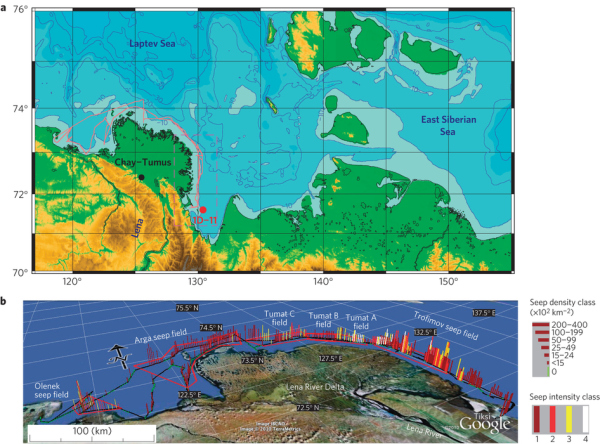
ESAS emissions map

(ESAS Bathymetric and Methane Emissions Map. Image source: Nature)

Arctic Methane emissions have been a touchy subject ever since sporadic reports began trickling in during the mid-2000s that volumes of the gas coming from local sources were on the rise. Two of the scientists producing these reports, Igor Semiletov and Natalia Shakova have been observing a key region of the Arctic called the East Siberian Arctic Shelf (ESAS) since the mid 1990s. At that time, Semiletov and Shakova found no major emissions sources coming from this vast sea whose bottom is composed primarily of carbon-rich submerged tundra.

That all changed in 2010 when an expedition led by Semiletov and Shakova discovered bubbling structures tens of meters across on the shallow and vulnerable ESAS sea bed. Returning in 2011, the pair were surprised and terrified by methane bubbling up from structures as large as 1 kilometer across. During this time…

View original post 2,333 more words

Reflections on the UN Climate Talks (Guest Post)

caribbeanclimate's avatarcaribbeanclimate

Indi Mclymont-Lafayette (L), Journalist and the Regional Director of Panos Caribbean Indi Mclymont-Lafayette (L), Journalist and the Regional Director of Panos Caribbean

COP 20 wrapped up in Lima, Peru last week and many attendees are reflecting on the negotiations. Today Caribbean Climate features a review by Indi Mclymont-Lafayette, a Journalist and the Regional Director of Panos Caribbean – a non-government organisation that focuses on development communication.

Soo… what has been achieved after two weeks of talks?

That was the question one of my friends whatsapped me – knowing that I was attending the 20th United Nations Climate Talks in Lima, Peru from December 1-12.

I hesitated before answering.

Truth to tell, if you followed the achievements highlighted by the United Nations – then a lot had been done. The achievements included:

  • Country pledges to the Green Climate Fund (GCF) pushing it past a US$10 billion start up target.
  • Germany pledging and giving 55 million Euros (roughly US$68 million) to the Adaptation…

View original post 352 more words

ECLAC Updates Study on Economics of Climate Change in Latin America and the Caribbean read more

5 December 2014: The UN Economic Commission for Latin America and the Caribbean (ECLAC) has published an update of its study ‘The Economics of Climate Change in Latin America and the Caribbean: Paradoxes and challenges of sustainable development,' which provides an overview of expected climate impacts in the region, as well as subregional and national figures.

The report explains that, while growth in the region has led to improved economic and social conditions, it has had negative impacts on the environment, economy and society as a whole, including through more air pollution in urban areas and a deterioration of natural assets, such as water resources and forests.

The report states that the “foundations of the region's economic buoyancy are being undermined” through the region's production structures and consumption patterns, which contribute to a large carbon footprint. The report contends that the region must transition towards a sustainable form of development that will preserve its economic, social and natural assets for future generations and leave them with “a more equal, socially inclusive, low-carbon form of economic growth.”

The report concludes that the climate change challenge is also a sustainable development challenge and recommends achieving “a global consensus that recognizes the asymmetries and paradoxes of the problem.”

ECLAC, in collaboration with the Government of Peru, has also released a document estimating the economic costs of climate change in Peru. Both reports were launched at the Lima Climate Change Conference. [ECLAC Press Release] [Publication: The Economics of Climate Change in Latin America and the Caribbean: Paradoxes and challenges of sustainable development] [IISD RS Coverage of Lima Climate Change Conference]


read more: http://larc.iisd.org/news/eclac-updates-study-on-economics-of-climate-change-in-latin-america-and-the-caribbean/


Climate Change: The State of the Science


Climate Change: The State of the Science

Published on Nov 19, 201 3 • Produced by the International Geosphere-Biosphere Programme and Globaia and funded by the UN Foundation.

The data visualization summarises and visualizes several of the most significant statements in the Intergovernmental Panel on Climate Change’s (IPCC) recent Fifth Assessment Report, (Working Group I summary for policymakers, the Physical Science Basis). In 2014, IPCC will publish summaries concerning societal impacts, mitigation and adaptation. The statements and facts presented are derived from the IPCC summary for policymakers.

Download the IPCC Working Group I summary for policymakers (The Physical Science Basis) here: www.climatechange2013.org

Produced and directed by Owen Gaffney and Felix Pharand-Deschenes

Animation Felix Pharand-Deschenes GlobaTa

Peak Oil Notes December 11 2014

Peak oil notes – Dec 11 – by Tom Whipple,

The drop in oil prices continued this week as US crude stocks increased, OPEC lowered its demand forecast for next year, several OPEC countries reduced their selling prices to Asian customers, and the Saudi Oil Minster reaffirmed his intention to maintain production.

By the close on Wednesday London's Brent was down to $64.24 a barrel and NY futures were at $60.94. London’s close, below $65 a barrel, was the lowest in five years.

The drop in oil prices spread to the equities markets on Wednesday which also saw major losses. Shares in shale-drilling companies have dropped sharply as the drillers revenues have gone down. The financial press is filled with stories about “survival of the fittest” as many anticipate that several of the weaker shale oil drillers will go under unless oil prices revive soon.

The OPEC secretariat announced that the cartel’s production in November was 30.05 million b/d down by 390,000 b/d from October, but this was after the October figure was revised up by 190,000 b/d leaving a net drop of only 200,000 b/d. The secretariat has never had much proprietary information on how much oil its members are producing and is forced to rely on third parties and the press for production numbers. The cartel also reduced its forecast for its demand in 2015 to 28.9 million b/d as compared to demand of 29.4 million b/d this year.

This week's stocks report showed that US refiners are taking advantage of the low crude prices to bump up US oil refining to 16.5 million b/d, the highest level in records going back to 1989. Even with the record refining, US crude stocks increased by an unexpected 1.5 million barrels. All the refining last week left US gasoline inventories up by 8.2 million barrels and distillate inventories up by 5.6 million barrels. US “oil” production rose to 9.1 million b/d last week, the highest since 1983.

Months of steady declines in oil prices have lead to consternation across the world. Although oil importers are celebrating lower gasoline prices and the likelihood that their economies will receive an economic boost, other countries are seeing serious problems ahead as oil revenues drop precipitously and budgets must be slashed. In the US, numerous companies have announced plans to cut back on drilling next year, but in general, prices have fallen so fast that there has not been time to see all the implications of the price drop.

Comments on the current situation and just how low oil prices will go continues unabated. Tom Kloza of the Oil Price Information Service says that $35-$50 a barrel is a possibility next year if OPEC does not reduce production. In this case, average US gasoline prices would be below $2 a barrel. Iran’s President says his country is the victim of a gigantic conspiracy that is causing grave damage to his country’s economy. More

Originally published by ASPO-USA