Israelis rattled by search for truth about the Nakba

First ‘truth commission’ avoids issue of reconciliation as veteran Israeli fighters due to confess to 1948 war crimes

Middle East Eye – 9 December 2014

The first-ever “truth commission” in Israel, to be held on Wednesday, will feature confessions from veteran Israeli fighters of the 1948 war who are expected to admit to perpetrating war crimes as hundreds of thousands of Palestinians were expelled from their homes.

The commission is the culmination of more than decade of antagonistic confrontations between a small group of activists called Zochrot, the Hebrew word for Remembering, and the Israeli authorities as well as much of the Jewish public.

Founded in 2002, Zochrot is dedicated to educating Israeli Jews about what Palestinians call the Nakba, Arabic for catastrophe, referring to Israel’s creation on the ruins of their homeland more than six decades ago. The group also campaigns for the right of return for Palestinian refugees to Israel, probably the biggest taboo in Israeli society.

The commission, which has no official standing, could be the first of several such events around Israel, to investigate atrocities and war crimes committed in different localities, said Liat Rosenberg, Zochrot’s director.

“We have looked to other such commissions around the world as models, most obviously in South Africa,” she said. “But unlike the one there, ours does not include the element of reconciliation because the conflict here has yet to be resolved.

“We cannot talk about reconciliation when the Nakba is ongoing. We are still in a situation where there is apartheid, constant violations of human rights and 70 percent of the Palestinian community are refugees.”

The commission is likely to provoke outrage from the Israeli government, which passed the so-called Nakba Law in 2011 to try to make it harder to commemorate Palestinian suffering. The impact of the law is being widely felt. Just last month, the culture ministry vowed to block a government grant to a Tel Aviv cultural centre that hosted a Zochrot film festival on the Nakba.

Names kept secret

Rosenberg said Israeli veteran fighters and Palestinian witnesses participating in the truth commission had asked for their names to be kept secret until the hearings for fear that friends and family would put pressure on them to withdraw.

The commission is being held in the city of Beersheva, a once-Bedouin town that was ethnically cleansed in 1948 and is today the largest Jewish city in the Negev region in southern Israel.

Zochrot said it had chosen the city to host the first event event because forced expulsions of Bedouin from the Negev had taken place not only in 1948, but had continued on a large scale, out of view of observers, for many years afterwards.

The commission is the latest project by Zochrot that discredits a traditional Israeli narrative that some 750,000 Palestinians left under orders from Arab leaders and that Israel’s army acted only in self-defence. Such beliefs have fed into the common assumption from the Israeli public that Israel’s army is the “most moral in the world”.

“This is not just about researching the truth,” said Rosenberg. “The truth of the Nakba is to a large degree known, but the task is to expose the truth to the Israeli Jewish public – both so that it is forced to take responsibility for what happened and so there can be accountability.”

The commission is the direct result of a project launched by Zochrot two years ago to create an alternative archive of the Nakba, based on filmed testimonies from Palestinian refugees and Israeli veterans. Activists fear that, as the generation of refugees and fighters dies off, they will take their secrets to the grave.

Israeli military archives relating to the 1948 war began being opened to academics in the late 1980s. This led to a group of so-called “new historians” overturning the traditional accounts of that period and unearthing written evidence of massacres and ethnic cleansing operations for the first time.

Archives closed

However, historians have reported in recent years that the Israeli authorities have become more reluctant to open files and many of the more controversial episodes of the 1948 war are still unclear.

Rosenberg hopes the commission will begin to fill some of the gaps.

According to Rosenberg, three Israeli fighters and three Palestinian witnesses will testify before a panel of six commissioners. The commissioners will then question them further about events and make follow up recommendations.

The hearings are due to be streamed online.

One veteran of the fighting in the Negev, Amnon Neumann, has already gone on record in testimony that can be seen in Zochrot’s film archive.

He has said the Bedouin in the Negev – contrary to popular Israeli perception – put up almost no resistance to advancing Jewish forces because they lacked “a military capacity” and “had no weapons”. Nonetheless, he said, the Israeli army terrified the Bedouin villagers out of their homes by shooting either at them, or above their heads.

“We drove them out. Women and children went to Gaza. … By the morning there was nobody there. We burnt their houses,” Neumann said.

When villagers tried to sneak back to tend crops or vineyards under the cover of night, he recounted, the soldiers opened fire. “We would shoot and kill them. This was part of the horrible things we did.”

In other filmed testimony, Mordechai Bar-On, an officer in 1948 with the Givati Brigade, confirmed that orders were to shoot “infiltrators” – a reference to refugees who tried to return to their villages. “Even if there were women and children. I remember I told myself that we would do it. … There was an order to kill, not even catch them,” Bar-On said.

For the most part, the Israeli veterans are coming forward now out of a feeling of guilt.

“At that time I did not see anything wrong with what we were doing,” Neumann said. “If I was told to do things that I do not want to mention [here], I did them with no doubts at all. … Not now. It is already 50, 60 years that I am filled with regret.”

But challenges remain, and despite veterans coming forward, piecing together events can still be difficult.

Rosenberg said many of those giving filmed testimony, including Neumann, have been reluctant to go into details of the war crimes they participated in. It is now hoped that the questioning by the commissioners will encourage participants to be even more forthcoming.

Put on trucks to Gaza

The commission will also move beyond the 1948 period and examine expulsions in the semi-desert Negev region, comprising nearly two-thirds of Israel’s landmass, for the 12 years following the war.

Isolated from the rest of the new state of Israel, the Negev was largely unmonitored as the Israeli military carried out expulsions of Bedouin throughout the 1950s, said Raneen Jeries, a Zochrot organiser.

More than 2,000 Palestinian inhabitants of al-Majdal, which later became the Jewish city of Ashkelon, were put on trucks and shipped to Gaza nearly two years after the war ended, according to Nur Masalha, a Palestinian historian and expert on Israeli “transfer” policies.

Jeries said the legacy of the events of 1948 was being felt to this day, with policies of expulsion continuing in the Negev and the occupied territories.

Haaretz reporter Amira Hass revealed three months ago that the Israeli military was planning to forcibly relocate for a second time the Jahalin tribe. The tribe was driven out of the Negev in 1948 and fled to the safety of the West Bank, then under Jordanian control. However, Israel occupied the land after the 1967 war, and it seems that Israeli authorities now want to expel some 12,500 Jahalin tribes people, this time to a site near Jericho.

Zochrot had been successful in forcing Israelis to recognise the Nakba and a darker side to the 1948 war, said Neve Gordon, a politics professor at Ben Gurion University in Beersheva, where the truth commission is to be held.

“A decade ago, if I mentioned the Nakba in a class of 150 students, hardly any of them would have known what I meant. Now 80 or 90 per cent would know,” Gordon told MEE.

Gordon also attributed the change both to Zochrot’s activities and statements by Arab legislators representing Israel’s large Palestinian minority, comprising a fifth of the total population.

Law against commemoration

But as the issue of the Nakba has become more visible in Israel, sensitivity about it has only grown. Ahead of Nakba Day last May, Prime Minister Benjamin Netanyahu lashed out at the Palestinian Authority for commemorating the day, saying: “They are standing silent to mark the tragedy of the establishment of Israel, the state of the Jewish people.”

Palestinians were educating their children with “endless propaganda” calling for the disappearance of Israel, he said.

Economy Minister Naftali Bennett went further, saying: “We need not tolerate Israeli Arabs who promote Nakba Day.”

The government has backed up its rhetoric with legislation, passing a Nakba Law in 2011 that denies public funds to institutions and organisations that commemorate the Palestinians’ dispossession. The measure is partly seen as a reaction to Zochrot’s growing success.

The original legislation, which would have criminalised any commemoration of the Nakba – making many of Zochrot’s activities illegal – was water-downed after Israel came under strong international pressure.

In Zochrot’s early years, its main efforts were directed at escorting Israeli Jews and Palestinian refugees to some of the more than 500 Palestinian villages that Israel destroyed during and after the 1948 war. The villages were razed to prevent refugees from returning home.

The remnants of most of the villages are now barely traceable, hidden under forests planted by a charity called the Jewish National Fund or lost within gated communities in which only Jews can live.

Zochrot has continued such visits, placing signposts to remind the new Jewish inhabitants that their communities are built on the ruins of Palestinian homes, often belonging to neighbours living a short distance away. A large proportion of Israel’s Palestinian minority were internally displaced by the 1948 war and live close to their original homes but are barred from returning.

Backlash on campuses

Eitan Bronstein, who founded Zochrot, said the current challenge was how to change Israeli Jews’ perception of the Nakba.

“They now recognise the word but what does it mean to them? Many, it seems, think it is simply a negative label Palestinians have attached to Israel’s establishment. We have an Independence Day that they call their Nakba,” Bronstein said.

“We need to educate them about the events of the Nakba, what occurred and our responsibility for it. They have to stop thinking of it as just propaganda against Israel.”

The right wing, including the government of Benjamin Netanyahu, has grown increasingly rattled by Zochrot’s agenda-setting programme of events.

The popularity of a far-right youth movement, Im Tirtzu, has grown rapidly on Israeli university campuses over the past few years, in part as a backlash to commemorations of the Nakba by Zochrot and Palestinian students.

Last month, when Zochrot held its second Nakba and Right of Return Film Festival in Tel Aviv, the culture minister, Limor Livnat, immediately threatened to pull a government grant worth more than $450,000 from the cinema that hosted it.

“The state cannot bear the cost of funding of an entity that encourages debate over what the Palestinians call ‘the right of return’,” Livnat said in a statement. She was reported to have based her decision on her reading of the Nakba Law.

“The antagonism towards Zochrot and the idea of the Nakba is part of the educational process,” said Bronstein. “It is a necessary phase Israel needs to pass through if we are to get to a point of reconciliation.”

Unfazed by threats

Bronstein and others have faced angry opposition from the Israeli public and police as they have tried to stage Nakba commemorations – most notably in Tel Aviv in 2012, when they were surrounded by riot police for four hours. Three Zochrot activists were arrested.

Yet Zochrot’s organisers, whose members include both Jewish and Palestinian citizens, seem largely unfazed by the threats and hostility their group generates.

Last year Zochrot arranged a conference that for the first time examined not just the principle of the right of return but practical ways to implement it.

This year the group launched a phone app, called iNakba, in three languages, which provides users with detailed maps and information on the destroyed villages.

Jeries said it had had thousands of downloads, giving Israelis for the first time the chance to peel away the subsequent layers of construction and forestation to see what was destroyed, often on their doorstep. More

Tagged as: Bedouin, destroyed villages, Nakba


A Decade Of Great Earthquakes

It’s been almost 10 years since the 2004 Sumatra-Andaman-Aceh great earthquake produced a tsunami that devastated the area around the Indian Ocean.

The Pacific Tsunami Warning Center put together this brief video showing the progression of Earthquakes over the last decade, including both pretty small ones and large ones. Awesome to see how completely they’re controlled by plate tectonics and how the occasional rare “great earthquake” does pop up.

The last decade actually has seen more great earthquakes than typically occur during a decade, but that’s what happens with extremely rare events. Sometimes you go a couple decades with none, sometimes you have a decade with 2 or 3 in a fairly short succession. More

http://the-earth-story.com/post/105063905532/its-been-almost-10-years-since-the-2004


Browse the IDRC Davos 2014 Outcomes Report

caribbeanclimate's avatarcaribbeanclimate

Global Risk Forum

The outcomes of the 5th International Disaster and Risk Conference (IDRC) Davos 2014, which was held from 24th -28 thof August in Davos, Switzerland, is now available.

The Outcomes Report is now available for download and consists of two major parts. Part I provides a summary of the findings of the post-conference expert workshop with focus on science and technology, education and training, and implementation (workshop participants are listed in the annex part III).

Part II shows all the various comments which have been provided by the IDRC Davos 2014 participants to the pre-zero and the zero draft concept. The comments are listed according to the numbering used in the existent zero draft. Many comments are very much in-line with the existent draft and might also serve for confirmation purposes of the existent zero draft.

The outcomes of the IDRC Davos 2014 expected to serve as a science & technology input for the post-2015…

View original post 89 more words

Bahamas takes on renewable energy challenge – Missed Opportunity for Cayman?

The Bahamas has become the latest recruit to Richard Branson's green energy drive for Caribbean islands.

Branson's Carbon War Room NGO is aiming to help islands in the region transition from expensive fossil fuel imports to using their own renewable energy resources as part of its Ten Island Challenge programme.

This week the Bahamas joined the push, committing to developing 20MW of solar PV generation in the outer Family Islands, bringing energy efficiency and solar solutions to a local high school, and replacing streetlights across the nation with energy efficient LED lights.

Carbon War Room plans to support these goals by providing the country's government with a range of technical, project management, communications, and business advisory services.

The Bahamas joins the islands of Aruba, Grenada, San Andres and Providencia in Colombia, Saint Lucia, and Turks & Caicos in the challenge, which aims to generate how small states can decarbonise in a cost-effective manner.

“The Bahamas' entry into the Ten Island Challenge signals another step forward for the Caribbean region in the effort towards a clean energy future,” Branson said in a statement. “The progress made in The Bahamas will help inspire other islands to work towards accomplishing their renewable energy objectives.”

While the focus to date has been on Caribbean islands, earlier this year Peter Boyd, Carbon War Room's chief operating officer, told BusinessGreen the programme could expand into the Pacific and to isolated communities, military bases, or mines. “There are island energy economies even if the 'island' isn't surrounded by water,” he said at the time.


Water woes in Lima: A glimpse of our future?

As UN negotiators meet in Lima to work out a plan for dealing with rising temperatures, Matt McGrath visited a community paying a high price for water supplies threatened by climate change and increasing demand. Is Peru’s experience a sign of things to come?

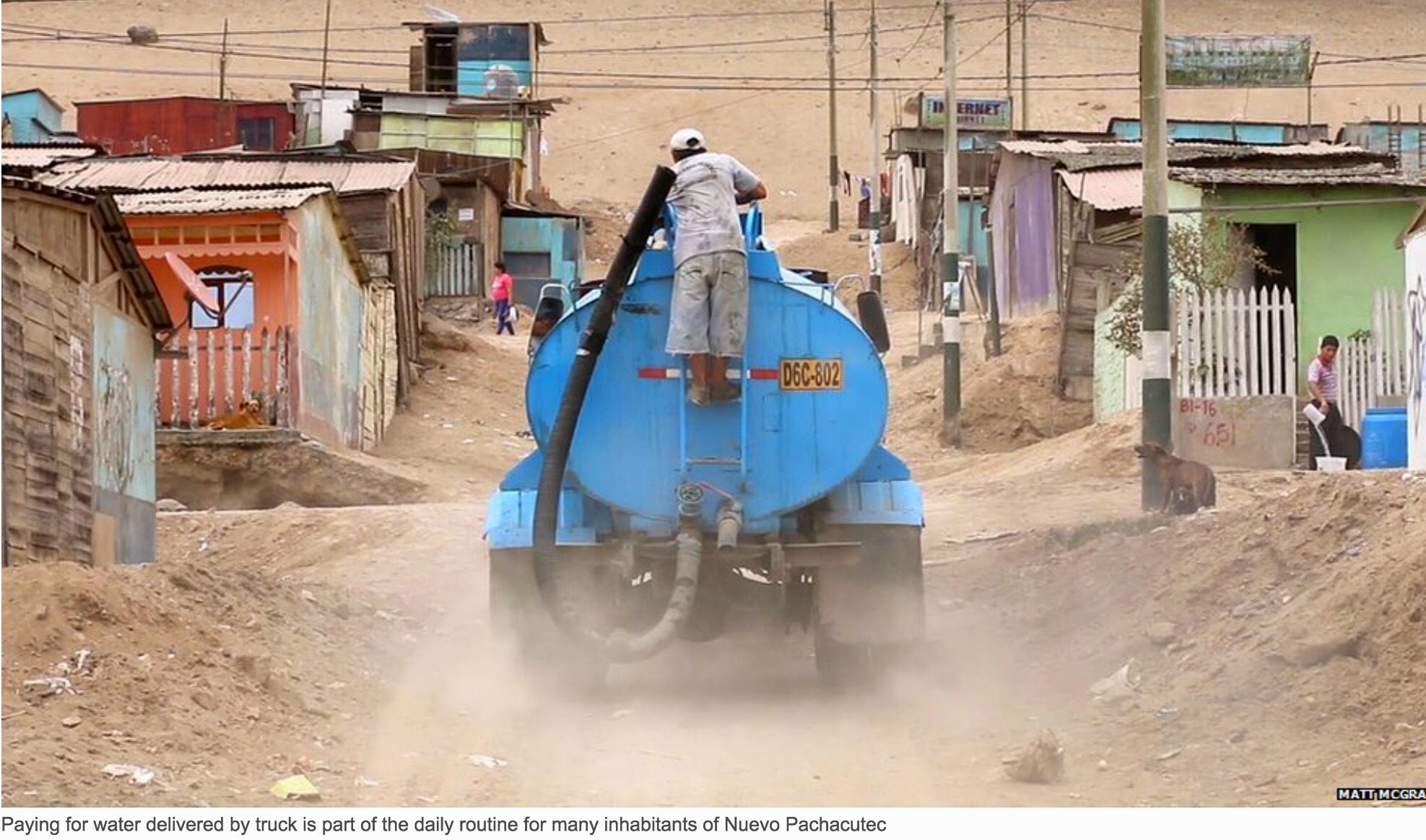
Snarling and screeching, the bouncing water truck speeds backwards down the steep hill, in a cloud of coarse dust.

It halts with a judder and a wild eyed, sweaty man jumps from the cab, grabs a large plastic pipe on the back and starts to fill a series of plastic containers on the ground, with little care.

Dressed in bright pink, a woman looks on nonchalantly.

The man runs up to her and holds out his hand. She drops some coins and away he goes, jumping onto the running board of his vehicle, already snorting its way to the next stop.

This is daily routine for tens of thousands of people who live in this sprawling hillside settlement that looks down on the Pacific Ocean, less than an hour north of Lima, Peru.

Water in Nuevo Pachacutec is not just the vital substance for life, it is a measure of social status and progress.

People first came to these hazy hills in the 1980s, in response to politicians who promised them land in return for votes.

When they first arrived the women said their feet would just sink in the sand. That’s all that was here.

The politicians allowed them to take the ground – but most of the 160,000 people here do not have legal title. They are “possessors of the land” but not the owners.

And land is too grand a word. This is really a desert. After Cairo, Lima is said to be the world’s second biggest city built in one. Rainfall here amounts to just 50mm of water per year.

A river runs through it

A few kilometres south of Nuevo Pachacutec, a miserable, dirty stream meanders under a motorway.

Bags of rubbish sit alongside the ubiquitous tractor tyres.

This is the Chillon river, the sole water source for around two million people in northern Lima.

The waters of the Chillon are fed by glaciers in the Andes. And this is a source of concern.

“We are worried here in Peru because climate change is already having a huge impact on our access to water,” says Armando Mendoza a research officer with Oxfam in the country.

“In the last 40 years, the glacial coverage has retreated by 40% more or less, because of the increase in global warming.

“The predictions are that in the future access to water will become even more difficult and the ones who are most vulnerable to this are the poor.”

These longer term water issues with glaciers are not the immediate priority in Nuevo Pachacutec.

As well as the speeding tuktuks, the sandy roads are festooned with signs for car washes, even private schools.

Despite the fact that 80% of the homes are made of wood, incomes and aspirations are rising here.

Access to water is critical in this development, as it is in developing nations all over the world.

With funding from the German government, a green group called Alternativa has helped build networks of white water tanks, connected by underground tubes that bring water directly to the houses.

They have also installed 900 outside water points in this sprawling settlement.

Their efforts to date have brought the vital liquid to 9,000 households.

In this community, water is more than just a key ingredient for life, it is a reflection of harsh social divisions.

The blue barrels

Despite the fact that 80% of the homes are made of wood, incomes and aspirations are rising here.

Access to water is critical in this development, as it is in developing nations all over the world.

With funding from the German government, a green group called Alternativa has helped build networks of white water tanks, connected by underground tubes that bring water directly to the houses.

They have also installed 900 outside water points in this sprawling settlement.

Their efforts to date have brought the vital liquid to 9,000 households.

In this community, water is more than just a key ingredient for life, it is a reflection of harsh social divisions.

Radios and children play loudly on the street where Daniza Cruz Navarro lives.

The homes on this stretch are known as the “casas azules” – the blue houses.

Outside many sit blue plastic barrels, some with lids, some without, that hold the water residents get from the trucks that constantly career about the local roads.

Dogs lap from the open containers. Mosquitoes lay their eggs in the water.

“You can see the effects of the way the water is being stored in the kids’ health,” says Daniza.

“They often get sick, there is often misuse and mismanagement of the water here.”

She has moved on from the blue barrel and is now the owner of a more effective and efficient water tank that she has bought through the efforts of Alternativa.

However, as she still gets water directly from the delivery trucks, she has to pay significantly more than her neighbours.

Daniza says she pays 120 Nuevo Soles (£26; $40) per month for the precious water. This is about 10% of her household income.

Those who are connected to the main water grid pay just 6-12 Soles per month.

These are big sums of money and the differences can be a source of friction between neighbours.

Despite these problems, those who work with the people in Nuevo Pachacutec say progress is being made. It’s really a story of local self-empowerment.

“Even if they are not perfect, they have bettered considerably,” says engineer Osvaldo Caceres who works with Alternativa.

“This infrastructure is managed by them, for them. The local population know what they want, but they know and understand they have to participate to get it.

Plug and pay


“When we first got here it was all desert – there were no roads, it was pure sand,” says Ycella Bonilla a resident of Nuevo Pachacutec.

She stands proudly in the doorway of her recently built bathroom cum laundry room, completed with the help of microfinance.

Ycella calls it her “unit of dignity”.

Despite this advance, Ycella and her family are still paying heavily for water. She has a hose and a key that allows her family to plug into a water point. For this she pays 80 Nuevo Soles a month (£18; $27) a month.

Despite the gripes over cost, Ycella recognises that water is the bedrock of development for the community.

“We have roads, we have schools, we have a lot of the basic necessities now, including water.”

The struggle for development and the need to have resources like water to empower that development is not just on the minds of those in Nuevo Pachacutec.

An hour down the road in Lima itself, UN climate negotiators are struggling with that same dilemma. How to balance the burgeoning needs of a growing population, with the need to limit those same enriching activities because they threaten the future of the planet.

Osvaldo Caceres says that as in solving the water stresses of Nuevo Pachacutec, the climate battle can be won, by everyone playing their part now. It’s no use passing the buck down the generations.

“Every actor in this chain must take responsibility for what they have to do,” he says.

“The governments, the authorities, and obviously the people, they all need to act.” “There is no other way.” More


“If we save Tuvalu, we save the world

“If we save Tuvalu, we save the world” – UN Climate Convention, Peru


9 December 2014, Lima, Peru – The Prime Minister of Tuvalu paid homage to ancestors buried in Peru at the UN Climate Convention today. Taking the floor at the High Level Segment of the 20th Conference of the Parties, he began his statement acknowledging the interesting and tragic historical connection with Peru.

During the 1860's slave traders known as blackbirders took approximately 400 people from Tuvalu to work in Peru. None of them ever returned.

“There are Tuvaluans buried here on this land and we pay our respects to our ancestors who were brought here against their will,” stated Hon. Enele Sosene Sopoaga, Prime Minister of Tuvalu – remembering the history of Tuvalu before looking to the future.


“I am here at this important meeting as the highest representative of the people of Tuvalu. I carry a huge burden and responsibility. I carry their hopes that there will be a future for Tuvalu. This is an enormous burden to carry. It keeps me awake at night. No national leader in the history of humanity has ever faced this question. Will we survive or will we disappear under the sea? I ask you all to think what it is like to be in my shoes.”

On the frontlines of climate change, the greatest single threat to the island atoll, Tuvalu is heartened by the progress leading to a new climate change protocol made at the UN Climate Convention in Peru yet also very clear that they will not support a new protocol without a substantive programme on loss and damage. The new agreement must be agreed upon by the end of December, 2015 in Paris, the host of the next Conference of the Parties.

“Tuvalu, and I suspect most of the world, believes that reaching a comprehensive new protocol in Paris is absolutely essential. We cannot repeat Copenhagen. We cannot suffer the frustration and humiliation of being asked to accept a half-hearted response to a critical global crisis.”

“The new protocol must be comprehensive it must cover all issues in a meaningful way. It has to include effective mitigation targets for all countries. It must deliver real outcomes on adaptation and loss and damage. It must deliver the necessary finance to transform our society. And it must deliver the technology and the necessary capacity building to ensure everyone can respond to climate change. All these pillars are essential.”

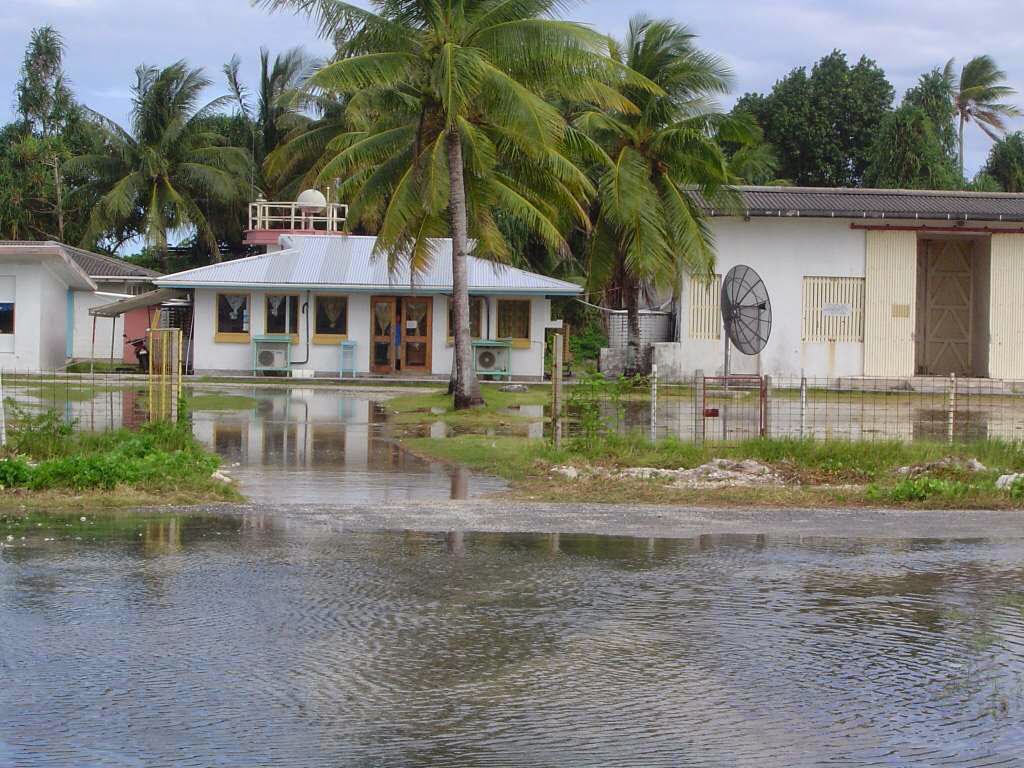
The coral atoll nation of Tuvalu consists of nine inhabited islands with the highest point above sea level being four meters. Now experiencing climate change impacts through saltwater intrusion into agricultural areas, lack of potable water and coastal erosion – the fate of Tuvalu is in the hands of the international community.

“I ask everyone who leaves this room to look into the eyes of the first child they see. I want everyone to look into the child’s eyes and imagine what those eyes will see in ten or twenty years. Will they see hell or will they see a sustainable planet.”

“Let us stand proud in Paris. Let us look into the eyes of children and say, yes we have a real future for you. Let us make 2015 the year we saved the Earth! Let us make 2015 the year we saved Tuvalu. For if we save Tuvalu we save the world.”

To access the full statement presented by Hon. Enele Sosene Sopoaga, Prime Minister of Tuvalu at the High Level Segment of the 20th Conference of the Parties to the United Nations Framework Convention on Climate Change please visit: http://unfccc.int/files/meetings/lima_dec_2014/statements/application/pdf/cop20_hls_tuvalu.pdf

Bringing agriculture into Climate Change commitments

caribbeanclimate's avatarcaribbeanclimate

Government officials, representatives of UN bodies and agencies, intergovernmental organizations and civil society organizations are meeting at COP20 in Lima, Peru, to discuss a new global climate change agreement. Since the notion of agriculture is not on the agenda, The Technical Centre for Agricultural and Rural Cooperation ACP-EU (CTA) and other organisations working in agriculture and rural development are striving to establish formal arrangements for addressing agriculture within the next UN Climate Change negotiations. As week two of COP 20 gets into full gear, we urge you to join the online discussion by tweeting #cop20 or #foodsecurity.

Lima
6KEYISSUESStepping up the challenge: six issues facing global climate change and food security

To this end, on 7 December 2014, a special seminar, Stepping up to the challenge – Six issues facing global climate change and food security, was co-organised by CARE International, the CGIAR Research Program on Climate Change, Agriculture and…

View original post 283 more words

COP2O Week 1 Recap: Caribbean notes “small victories” and anticipates Ministerial decisions

caribbeanclimate's avatarcaribbeanclimate

Week two of COP20 is now underway in Lima, Peru. Here's a round-up of week one from  Sharon Lindo, International and Regional Policy Officer at the Caribbean Community Climate Change Centre.

The Caribbean Community continues to carve out a niche for itself in the Climate Change negotiations underway at COP 20 in Lima, Peru.  If the first week of COP20 were to be summed up in a few words, it would be one of celebrating small victories.  But any seasoned negotiator would caution against celebrating now.

The Alliance of Small Island States welcomed the call by the Subsidiary Body for Scientific and Technological Advice for the Intergovernmental Panel on Climate Change outcomes to inform the Ad-Hoc Working Group on the Durban Platform and other UNFCCC processes.  This augers well for CARICOM, who have always supported science-based methods to inform action in the negotiations.  The region looks forward to the use…

View original post 334 more words

Typhoon Hagupit Hits Philippines: Climate Catastrophe Is Here Now! by Kumi Naidoo

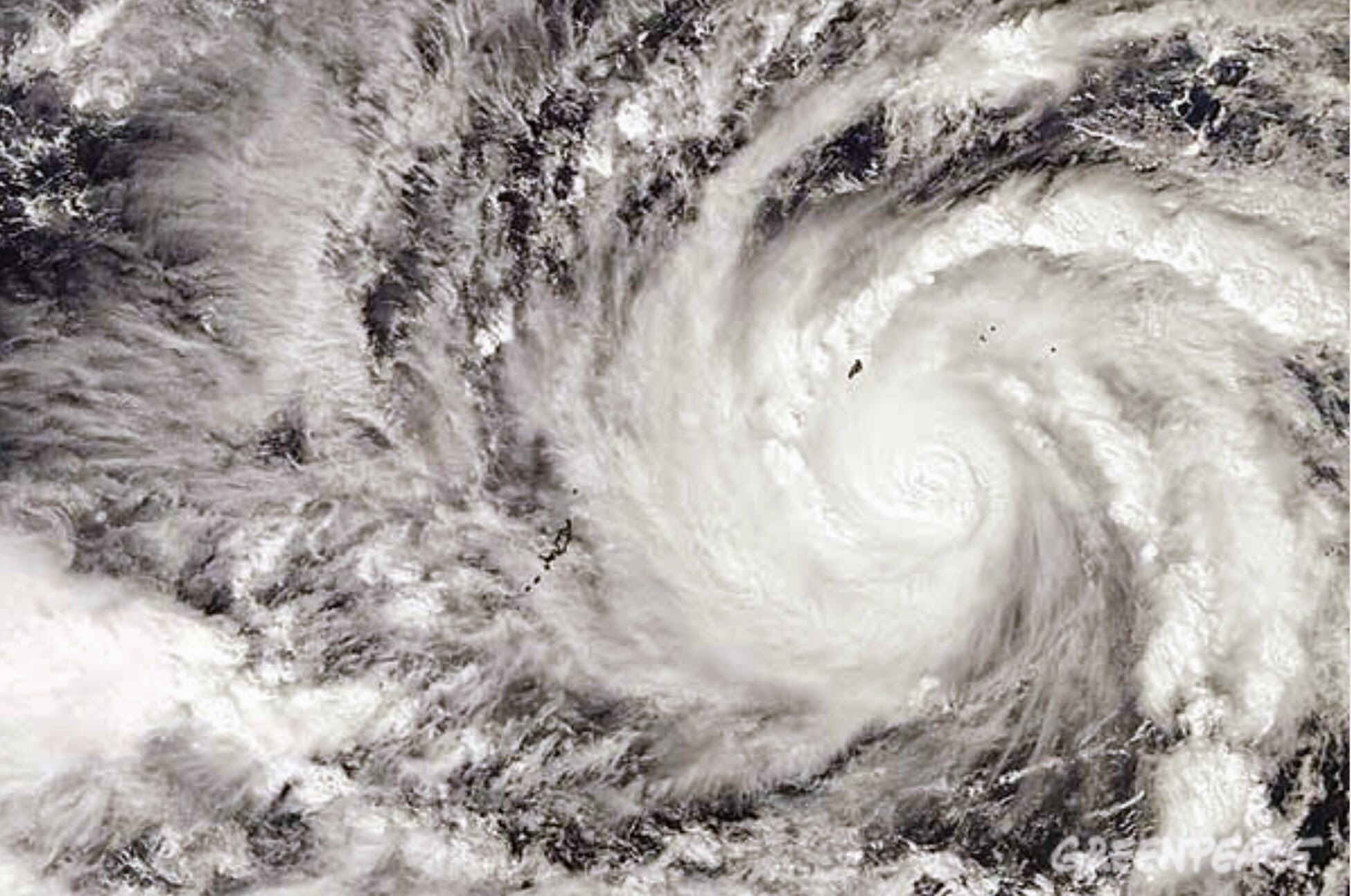
As Typhoon Hagupit hits the Philippines, one of the biggest peacetime evacuations in history has been launched to prevent a repeat of the massive loss of life which devastated communities when Super Typhoon Haiyan hit the same area just over a year ago.

Typhoon Hagupit

“One of the biggest evacuations in peacetime” strikes a sickening chord. Is this peacetime or are we at war with nature?

I was about to head to Lima, when I got a call to come to the Philippines to support our office and its work around Typhoon Hagupit (which means lash). In Lima another round of the UN climate talks are underway to negotiate a global treaty to prevent catastrophic climate change. A truce of sorts with nature.

But these negotiations have been going on far too long, with insufficient urgency and too much behind the scenes, and not so much behind the scenes, interference from the fossil fuel lobby.

This year, like last year and the year before these negotiations take place against a devastating backdrop of a so-called ‘extreme weather event’, something that climate scientists have been warning us about if we don’t take urgent action.

Tragically, we are not taking urgent action. Nature does not negotiate, it responds to our intransigence. For the people of the Philippines, and in many other parts of the world, climate change is already a catastrophe.

Only one year ago, Super Typhoon Haiyan killed thousands, destroyed communities and caused billions of dollars in damage. Many survivors who are still displaced have this week had to evacuate the tents they have been living in as Typhoon Hagupit carves a path across the country as I write.

It’s too early to assess the impact so far—we are all hoping early indications will spare the Philippines of the same pain that was experienced after Haiyan.

Here in Manila, we prepare to travel to the impacted areas in the wake of Typhoon Hagupit, or Ruby, as it has been named. We will offer what minor assistance we can.

We will stand in solidarity with the Filipino people and we will call out those who are responsible for climate change, those who are responsible for the devastation and who should be helping pay for the clean up and for adaptation to a world in which our weather is an increasing source of mass destruction.

With heavy hearts we prepare to bear witness. We challenge those in Lima to turn their attention from the lethargy and process of the negotiations and pay attention to what is happening in the real world.

We call on them to understand that climate change is not a future threat to be negotiated but a clear and present danger that requires urgent action now!

Each year, the people of the Philippines learn the hard way what inaction on emissions mean. They might be slightly better prepared and more resilient, but they are also rightly more aghast that each year—at the same time—the climate meetings seem to continue in a vacuum, not prepared to take meaningful action, not able to respond to the urgency of our time and not holding accountable the Big Polluters that are causing the climate to change with ferocious pace.

Before leaving for Manila I also received a message from Yeb Saño, climate commissioner for the Philippines: “I hope you can join us as we bear witness to the impact of this new super typhoon. Your help would be very valuable in delivering a message to Lima loud and clear.”

Yeb was the Filipino chief negotiator for three years at the UN climate talks and recently visited the Arctic on a Greenpeace ship to witness the Arctic sea ice minimum. Two years ago in Doha, as Typhoon Pablo took the lives of many he broke through the normally reserved language of dispassionate diplomacy that dominates UN climate treaty talks:

“Please … let 2012 be remembered as the year the world found the courage to … take responsibility for the future we want. I ask of all of us here, if not us, then who? If not now, then when? If not here, then where?”

I am joining Greenpeace Philippines and Yeb to visit the worst hit areas, document the devastation and send a clear message from climate change ground zero to Lima and the rest of the world that the ones that are responsible for the majority of emissions will be held accountable by the communities that are suffering the impacts of extreme weather events linked to climate change.

We will call on the heads of the fossil fuel companies who are culpable for the unfolding tragedy to examine their consciences and accept their historic responsibility. They say the truth is the first casualty of war, in this war against nature, the truth of climate science is unquestionable.

Please join us. Please add your voice by signing our petition calling on Big Polluters to be held legally and morally accountable for climate damages. After signing the petition you will be redirected to a site where you can make a donation to the relief efforts of partner organizations. More