Gallery

We are building a network of Climate Change Clubs!

caribbeanclimate's avatarcaribbeanclimate

The Caribbean Community Climate Change Centre (CCCCC) welcomed a group of 25 students from the Belmopan Comprehensive High School today for an interactive climate change exchange. The visit forms part of a broader engagement with young people in an effort to create a network of school-based environmental clubs with a strong climate change focus across the region. The initiative is being piloted by the Centre in five (5) schools in Belmopan, Belize with support from the Ministry of Forestry, Fisheries and Sustainable Development (MFFSD) under the “Enhancing Belize’s Resilience to Adapt to the Effects of Climate Change” project which is funded by the European Union.

The participating schools are:

  • Belmopan Comprehensive High School
  • Belize Christian Academy
  • Belmopan Baptist High School
  • Our Lady of Guadalupe High School
  • Belmopan Methodist High School

Through this means of youth engagement, we  are using a mixture of specially designed games, discussions, music and other tools…

View original post 78 more words

Designation as “special areas” in the Caribbean

caribbeanclimate's avatarcaribbeanclimate

The Wider Caribbean Region (WCR) has the greatest concentration of plant and animal species in the Atlantic Ocean Basin.  Yet these precious, and often irreplaceable, natural resources are disappearing at an astounding rate. The vast majority of all species are threatened by habitat loss or modification in addition to unsustainable practices such as over-fishing, unplanned coastal development and pollution. These same habitats are often the main source of food and income for many coastal communities.

The Protocol Concerning Specially Protected Areas and Wildlife (SPAW) of the Cartagena Convention, is a regional agreement for biodiversity management and conservation in the Wider Caribbean Region, in existence since 1990. It is managed by the United Nations Caribbean Environment Programme (CEP) and it became international law in 2000.  It aims to protect critical marine and coastal ecosystems while promoting regional co-operation and sustainable development.

To date, sixteen countries from the region have ratified the…

View original post 946 more words

As California Water Resources Dwindle, New Fears Over Drilling Waste Contamination

Situation described as 'unfolding catastrophe' as investigation finds oil drilling companies injected untold amounts of waste into protected groundwater reserves

With the blessing of California state regulators, drilling companies have injected an untold amount of toxic wastewater left over from fracking and other drilling operations into aquifers, according to an investigation by the San Francisco Chronicle published on Sunday.

In October, it was confirmed that nearly 3 billion gallons of oil industry wastewater had been illegally dumped in aquifers through at least nine disposal wells. According to data reviewed by The Chronicle, it is now evident that more than 170 such wells injected a mix of “briny water, hydrocarbons and trace chemicals,” including acid, into aquifers suitable for drinking and irrigation.

This information about the extent of the aquifer contamination comes as the state's historic drought continues to push many desperate municipalities to tap groundwater reserves for drinking water and agricultural irrigation.

“It is an unfolding catastrophe, and it’s essential that all oil and gas wastewater injection into underground drinking water stop immediately,” Kassie Siegel, director of the Climate Law Institute at the Center for Biological Diversity, told The Chronicle.

The practice first came to light in July 2014 when state regulators shut down 11 waste disposal wells in Kern County over fears of possible groundwater contamination.

The Chronicle reports on the source of the wastewater injection problem, which they say dates back to 1983 when EPA officials agreed to allow the state's Division of Oil, Gas and Geothermal Resources responsibility for enforcing the federal Safe Drinking Water Act:

The agreement listed, by name, aquifers considered exempt, where oil companies could legally inject leftover water with a simple permit from the division. If state regulators wanted to add any aquifers to the list, they would need EPA’s approval.

But there were two signed copies of the agreement, said Steven Bohlen, the division’s new supervisor. Eleven aquifers listed as exempt on one copy weren’t included on the other. The state and the oil companies considered those aquifers exempt — perfectly suitable places to dispose of wastewater. The EPA didn’t.

“We cannot tell, nor can the EPA, which version is correct,” said Bohlen, appointed by Gov. Jerry Brown last year.

The bureaucratic confusion didn’t stop there. In some cases, the state treated entire aquifers as exempt when, in fact, only specific portions of them had been approved for oil industry use. In other instances, the state issued injection permits for aquifers that the EPA had never declared exempt, Blumenfeld said.

Water classified as containing 500 parts per million or less of dissolved salts and other materials is considered high quality and safe to drink. The state aims to protect all water that registers below 3,000 ppm.

According to The Chronicle's analysis of state data, drilling companies bore 171 injection wells into aquifers with counts of 3,000 ppm or less and an additional 253 wells into potentially usable aquifers that the EPA considers protected. Further, an additional 40 injection wells were drilled into aquifers for which no water-quality data was available.

According to state officials, tests of nearby drinking-water wells show no contamination thus far.

However, the federal EPA has threatened to seize control of regulating the waste-injection wells, and the state has a February 6 deadline to present a comprehensive plan to fix the problem and prevent future contamination of supposedly off-limits drinking water wells. More


Climate-Proofing Water Investment in the Caribbean

caribbeanclimate's avatarcaribbeanclimate

The Global Water Partnership-Caribbean (GWP-C) has embarked on a new initiative under its Water, Climate and Development Programme (WACDEP) called “Climate-Proofing Water Investment in the Caribbean” which is being executed in partnership with the Caribbean Community Climate Change Centre (CCCCC).

The initiative includes the development of a Caribbean Climate Resilience and Water Security Investment Plan (CCReWSIP) which aims to provide a coordinated and programmatic approach to identifying, prioritising and sourcing finance for actions to enhance the climate resilience of the Caribbean through improved water resources management.

The project is being funded by the Climate and Development Knowledge Network (CDKN) and falls within one of the key components of the GWP-C WACDEP which recognises the need to prioritise water investments which perform well under a full range of climate scenarios.

Also crucial to the GWP-C WACDEP is its emphasis on no/low regret investment options given climate uncertainties. Once completed, the…

View original post 56 more words

Caribbean Energy Security Summit Commits to Energy Transition

Twenty-six countries, together with seven regional and international organizations, have released a joint statement in support of the transformation of the energy systems of Caribbean countries. The signatories of the statement, signed during the Caribbean Energy Security Summit, commit to pursuing comprehensive approaches to an energy transition toward “clean sustainable energy for all” and reforms that support the creation of favourable policy and regulatory environments for sustainable energy.

The Summit, which was co-hosted by the US Department of State, the Council of the Americas and the Atlantic Council, brought together finance and private sector leaders from the US and the Caribbean, and representatives of the international community. The event showcased the initiatives under the Caribbean Energy Security Initiative (CESI) in the areas of improved governance, access to finance and donor coordination, and featured discussions by partner countries on comprehensive energy diversification strategies.

During the event, the US Government announced enhanced support for technical assistance and capacity-building programs in the Caribbean, through the Energy and Climate Partnership of the Americas (ECPA) initiative, among others, with the aim of promoting a cleaner and more secure energy future in the region. Caribbean leaders agreed to pursue comprehensive energy diversification programs and facilitate the deployment of clean energy.

Furthermore, presentations and updates were provided by, inter alia: Caribbean leaders on energy sector goals; the World Bank on a proposed Caribbean Energy Investment Network for improved coordination and communication among partners; and the US Overseas Private Investment Corporation (OPIC) on a new focus on clean energy project development in the Caribbean, which includes US$43 million in financing for a 34 MW wind energy project in Jamaica.

Highlighting the role of the Organization of American States (OAS) in supporting the transition to sustainable energy in the Caribbean, OAS Secretary General José Miguel Insulza said the past five years had seen an “unprecedented push” in the Caribbean toward the development of the region’s renewable energy sources, noting this was “doubly impressive” “in a time of low oil prices.”

The Summit, which took place on 26 January 2015, in Washington, DC, US, is part of CESI, launched by US Vice President Joseph Biden in June 2014. The regional and international organizations signing the statement were the Caribbean Community (CARICOM) Secretariat, the Caribbean Development Bank, the EU, the Inter-American Development Bank (IADB), the International Renewable Energy Agency (IRENA), the OAS and the World Bank.

The joint statement was also signed by the Governments of Antigua and Barbuda, Aruba, Bahamas, Barbados, Belize, Canada, Colombia, Curacao, Dominica, Dominican Republic, France, Germany, Grenada, Guyana, Haiti, Jamaica, Mexico, New Zealand, Spain, St. Kitts and Nevis, St. Lucia, St. Vincent and the Grenadines, Suriname, Trinidad and Tobago, United Kingdom, and the United States. More

Credit: SIDS Policy & Practice IISD


Caribbean Energy Summit 2015: US Announce Investments in Energy Security for Caribbean Countries During First-Ever DC Summit

The Obama administration recently hosted the first Caribbean Energy Security Summit to support the region's improved governance, access to finance and increased donor coordination for the energy sector.

Vice President Joe Biden has led the issue of Caribbean energy security and said the Obama administration considers the topic as a primary issue.

“This is extremely important to us. It's overwhelmingly in the interest of the United States of America that we get it right, and that this relationship changes for the better across the board,” Biden said.

Biden added that the low oil prices have given little breathing room for governments, but there are alternatives. He mentioned renewable energy as an affordable source in addition to developing wind and solar energy.

“Meanwhile, we're in the midst of a seismic shift in the global economy: the ascendancy of the Americas as the epicenter of energy production in the world,” Biden said. “We have more oil and gas rigs running in the United States, than all the rest of the world combined. Mexico, Canada and the United States is the new epicenter of energy — not the Arabian Peninsula. It is the new epicenter of energy in the 21st century.”

The vice president called for an integrated North America to promote energy security since the U.S. wants Caribbean countries to “succeed as prosperous, secure, energy-independent neighbors — not a world apart, but an integral part of the hemisphere, where every nation is middle class, democratic and secure.”

Biden further stressed the purpose of the summit is not to “put up another solar panel or sign another gas contract” but to help countries establish protocol to attract private-sector investment. The vice president, however, acknowledged that countries have to confront corruption by having clear and transparent rules.

The U.S. created the Overseas Private Investment Corporation (OPIC), which will focus on developing energy projects for the Caribbean. Biden announced $90 million from the OPIC will be funded to Jamaica for wind projects.

The Caribbean Energy Security Summit is a “key component” to Biden's Caribbean Energy Security Initiative, which he announced in June 2014.

A joint statement on Monday had participating countries and regional and international organization agreeing for the Caribbean to make “necessary and specific reforms” that include efforts for sustainable and clean energy technologies. The participants also stated their commitment to exchange data and energy information.

The Jan. 26 summit from Washington, D.C. included governments from Antigua and Barbuda, Aruba, Bahamas, Barbados, Belize, Canada, Colombia, Curacao, Dominica, Dominican Republic, France, Germany, Grenada, Guyana, Haiti, Jamaica, Mexico, New Zealand, Spain, St. Kitts and Nevis, St. Lucia, St. Vincent and the Grenadines, Suriname, Trinidad and Tobago and the United Kingdom. The Caribbean Community (CARICOM) Secretariat, Caribbean Development Bank, European Union, Inter-American Development Bank Group, International Renewable Energy Agency, Organization of American States and the World Bank Group also participated. More


CBP Drone Fleet Under Scrutiny, Kill/Capture List Published, and Much More: FRINFORMSUM 1/8/2015

Lauren Harper's avatarUNREDACTED: The National Security Archive Blog

CBP drone take off from Fort Huachuca in Sierra Vista, Ariz. (Matt York/AP) CBP drone take off from Fort Huachuca in Sierra Vista, Ariz. (Matt York/AP)

Customs and Border Protection (CBP) caught 120,939 illegal boarder crossers in Arizona during 2013, but CBP’s fleet of 24 drones providing aerial border surveillance aided in fewer than two per cent of the apprehensions. This statistic is cited in a recent Department of Homeland Security (DHS) inspector general audit that found “little or no evidence” CBP’s current fleet – that surveys a mere “100 miles of the Arizona border and 70 miles of the Texas border” – warrants the agency’s planned $443 million expansion of the program. The DHS audit is released while “Congress considers whether to spend more on drone surveillance to secure the borders as part of immigration legislation.”

WikiLeaks has released a July 7, 2009, CIA analysis entitled “Making High-Value Targeting Operations an Effective Counterinsurgency Tool,” highlighting the limited overall effect of “high…

View original post 1,079 more words

Documenting Mexico’s Recurring Nightmare

Michael Evans's avatarUNREDACTED: The National Security Archive Blog

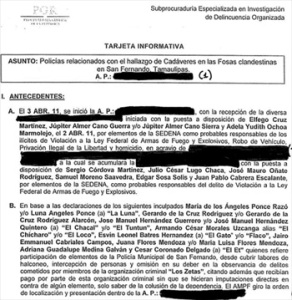
flyer San Fernando police delivered detainees to the Zetas drug gang, according to a newly-declassified memo.

As demonstrators across Mexico take to the streets to protest the government’s involvement in the September 2014 disappearance of 43 students in Iguala, Guerrero, a case bearing many of the same grim hallmarks is getting renewed attention.

Today, in a new article for The Nation, I examine newly-declassified evidence of police involvement in the 2011 San Fernando massacre and what it all means for access to information on human rights cases in Mexico.

In August 2010, the Zetas criminal group abducted and killed 72 people pulled from buses traveling the highways near San Fernando, Tamaulipas, a town more than 1,000 kilometers northeast of Guerrero. The remains of 193 people were discovered buried in dozens of mass graves in the same part of the state the following April. Members of the Zetas and 17 San…

View original post 369 more words

UNEP Manual Provides Guidance on Valuing SIDS’ Ecosystem Services

26 January 2015: The UN Environment Programme (UNEP) launched a manual on calculating the value of ecosystems in small island developing States (SIDS), with the aim of supporting a transition to a green economy. The manual underscores the importance of accounting for the contribution of ecosystem services to human well-being in order to quantify and value these benefits.

The ‘Guidance Manual on Valuation and Accounting of Ecosystem Services for SIDS' highlights the interdependence between SIDS' economies and the natural environment. In Antigua and Barbuda, Anguilla, Seychelles and Vanuatu, 50% of gross domestic product (GDP) comes from the tourism industry, according to the manual. In the Federated States of Micronesia (FSM), fisheries contribute 10% of GDP while 52% of Grenada's exports come from tuna, albacore, cocoa beans and nutmeg.

The manual provides a step-by-step methodological approach to select, design and implement island ecosystem services valuation and accounting exercises, and shares case study examples of accounting and valuation techniques. For instance, a 1% increase in the number of coastal protected areas is associated with a 2.9% increase in international coastal tourism arrivals. The manual also provides guidance on designing a payments for ecosystem services (PES) scheme in SIDS, using the example of Palau's Green Fee.

The manual aims to support policymakers in achieving sustainable development, taking into consideration SIDS' unique environmental, socio-economic and capacity issues. The manual emphasizes that “there is no simple solution” to valuing and accounting for SIDS' ecosystem services, emphasizing that economic valuation and accounting techniques depend on the category of island ecosystem services (cultural, provisioning or regulating) and the island's type of economic policy.

UNEP launched the manual at an event marking the close of the 2014 International Year of SIDS. [Publication: Guidance Manual on Valuation and Accounting of Ecosystem Services in Small Island Developing States] [UNEP Press Release] [UNEP Publications Website]


Water Power In The Andes

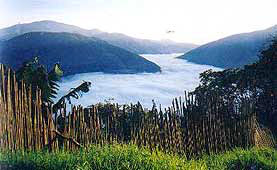
Going to work these days is always a bit of a thrill for me–often more than I care for. It means crossing a 15,000 foot (4,570 m) pass over the Bolivian Andes and snaking down a muddy one lane road carved into the face of immense cliffs. The Most Dangerous Road in the World was the title of an old National Geographic article…

World's Largest Solar Machine

Actually I'm entering the world's biggest solar energy machine-the Amazon basin. Towering glacier-topped 20,000 foot (6,100 m) mountains are clearly visible from our tropical water power demonstration site. This mountainous east-facing wall so thoroughly captures the Amazon moisture that the western side-the Atacama desert-is the driest place in the world. Sometimes rain only falls there a few times during an entire lifetime.

But on this side, it's just the opposite. Uncounted streams and waterfalls abound, some falling hundreds of feet directly onto the roadway! About 80 people die yearly on this short section of road, since it is very narrow and slippery. Vehicles that slip off the road can simply disappear into dense vegetation a thousand feet (300 m) below. It's incredible to think that this is the only road into a tropical part of Bolivia that's the size of Texas.

It's a relief to arrive in the lovely 5,500 foot (1676 m) high town of Coroico, near our demo site. Green hillsides are covered with coffee, citrus, and bananas. This also happens to be the home of Bolivia's traditional coca leaf production, so the area is much affected by the U.S. “War on Drugs.”

Campo Nuevo – Meeting People's Needs

Our family-sized appropriate technology organization, Campo Nuevo, was started to better the lives of Bolivia's rural poor. We teach them how to use their local natural resources for energy. We show them how easy it is to employ the abundant small local sources of water power to improve their lives. This can help make it possible for them to remain on their land and in their own communities.

We are working with Aymara speaking native Americans, one of the largest and most intact indigenous cultures in the Western Hemisphere. Notable for having withstood the Incan conquest, and later the Spaniards, the Aymaras are now succumbing to the pressures of modern global economics. Like rural people all over the “third world,” they are being forced to relocate simply to survive. They usually migrate to a desolate l3,000 foot (3,960 m) suburb of La Paz, in order to compete for unskilled, low paying, and often temporary jobs.

A New/Old Solution

Although they may not realize it, what visitors to our demonstration site see is not actually new. It's actually a revival of the now nearly forgotten traditional use of water power. For thousands of years before the invention of centrally-generated electricity, water power was employed to directly run machines, something it does very well.

What is new is the development of a modern low-cost turbine specifically for this purpose-a “motor” driven by water power. We call it the “Watermotor.” It can provide the energy to drive a variety of machines, replacing the mid-sized electric motors upon which nearly all modern production depends.

Lester Pelton, who invented the pelton wheel, produced a variety of these water powered motors and they were in use before l900. They were used to power individual machines – he even used one to run a sewing machine! The direct drive hydro units were replaced by electric motors after the popularization of centrally produced electricity.

Few people realize how closely rural poverty is related to the lack of machines necessary for local production and services. In the third world, the power grid is usually confined to cities and large towns. Rural people still use muscle power as everyone did in the past, and they do without electric lights. The need to generate cash to buy anything they don't produce themselves causes a focus on cash crops. This further reduces their self-sufficiency, encouraging a downward spiral towards dependency on a system that cannot be depended upon!

Demo Site
At our new Campo Nuevo demonstration site, we are featuring practical machines, directly powered by water. There are woodworking tools, air compressors, grain mills and an auto alternator to charge batteries and provide lighting. This is switched on when mechanical power is not being used, run by the same belt drive that powers the tools.

The main attraction at our site is our Campo Nuevo Watermotor driving a multipurpose woodworking unit. The machine is suitable for producing doors, window frames and furniture-necessities usually purchased from the city. It processes locally produced lumber instead of wood carried up from the Amazon forest.

The Watermotor at our demonstration site is provided with power from a water source located 60 feet (18.3 m) above the machine by 160 feet (50m.) of lightweight 4″ plastic pipe.

We get 1.3 h.p at 1850 r.p.m.s using 115 gal. (440 l.) per minute with the Watermotor Model 90 , and 2.5 h.p. at 1000 r.p.m.s with Model 150 using about 225 gal. (850 l.) per minute.

At the heart of our Watermotor turbine is a Swedish designed 4 jet Turgo wheel and a patented Turgo control system which provides the same instant on/off power control as an electric motor.

Unlike an electric motor, the Watermotor costs nothing to operate and can't be “burned out” from hard use.

It's Not Easy

Not much of this area is served by roads or the power grid. The U.S. owned (and U.S. priced) power generating system has little incentive to provide long distance lines to a widely scattered and typically impoverished rural population. Water power is the sole available practical source of energy to run machines. There is not a good wind resource in the mountain valleys and PV is just not economical, compared to the abundant water power here.

There are major obstacles to the introduction of unfamiliar technology to an indigenous population that has traditionally used no machines of any kind. These people have little money to invest in anything that does not promise a practical return. In addition to this, the Aymaras are unlikely to be reached by advertising in the newspapers from La Paz. This is why we felt that a local demonstration site was necessary.

Other problems are encountered when machines, however useful, need to be “professionally” installed, maintained or repaired. Such services are frequently unreliable, hard to come by in rural areas, and expensive when available.

Keep It Simple

In designing the Watermotor system, we have tried to overcome these obstacles as much as possible. It is designed to be user-installed, maintained, and repaired because of the difficulties in finding competent, honest and reliable technical services in rural areas of Bolivia. Because the Watermotor is locally produced from common materials, most parts can be easily replaced.

The efficiency of direct drive water power is a big advantage. A surprisingly small amount of water falling a short distance can produce the 0.5 to 5 h.p. of mechanical power required by most common machines. This means that many potential water power sites are available, and a minimum of civil engineering is required.

Of course the power output of the Watermotor depends on the fall and the amount of water that one uses to run it. Here are some examples of other possible installations and the energy output that they would produce:

A Watermotor Model 90 would produce:
1.5 h.p.at 2365 r.p.m.s with a 100 ft. (30.5 m.) fall and 75 gal.(284 l.) per minute
3 h.p. at 2900 r.p.m.s with 150 ft (46 m.) fall and 100 gal.(378 l.) per minute

A Model 150 will produce:
2 h.p. at 865 r.p.m.s with a 40 ft. (12.2 m.) fall and 250 gal. (950 l.) per minute
3 h.p. at 950 r.p.m.s with a 75 ft. fall (23 m.) and 200 gal.(750 l.) per minute
5 h.p. at 1366 r.p.m.s with a 100 ft.(30.5 m.) fall and 250 gal.(950 l.) per minute

The Watermotor itself is very simple to operate, and maintain. It functions efficiently in a variety of water power situations. By merely experimenting with easily changed water jets of different sizes, it is possible to vary maximum power output. This also allows the turbine to maintain efficient output over seasonal water flow variations. A single control handle diverts water away from the Turgo wheel, instantly cutting power.

The Watermotor can be used to drive most stationary machines normally driven by an externally-mounted electric motor or small gasoline engine in the 0.5 to 4 horsepower range.

Machines being driven by the Watermotor can be mounted directly on the turbine housing or beside the turbine. The tools are connected to the Watermotor by a standard belt, which limits the distance between the two parts of the system.

Make the Comparison

How does the Watermotor stack up against the competition? I asked a couple of renewable energy experts to give me the rough cost of a wind or photovoltaic system capable of producing 2 1/2 hp of mechanical energy 24 hours a day, including installation in rural Bolivia and technical expertise for maintenance and repair.

Richard Perez of Home Power said, “Well, the photovoltaic panels alone will cost about US$35,000. And the requirement for 24 hour power at that level means a very large battery bank which will bring the system cost up to around US$70,000. And we still need to add small stuff like racks, inverter, and controls. Overall, I'd say about US$80,000. It really points out how cheap hydro is.

Mick Sagrillo, North American wind power guru, said, “My guess, using off the shelf equipment, would be that you'd need a Bergey Excel. While it's larger than what's needed, it's cheaper than putting up several smaller turbines. Cost for genny and controls is about US$19,000, less tower, wiring, batteries, and balance of systems components. Total system cost would be roughly US$35,000. The one message I always deliver at my wind power workshops is that if anyone has a good hydro site, they're in the wrong workshop. While wind is cheaper than PV, it's no comparison for a hydro site with a 100 percent capacity factor.”

Now, this is not a scientific comparison, and these are admittedly rough figures. But the Watermotor can do this-produce 2 1/2 hp continuous-with a system cost of less than US$2,000. It's user installable and maintainable (two lube points), and easily repairable. It has only one moving part and is immune to damage from hard use. Consider also the sources of PV and wind equipment (all imported) and the possibility of damage from misuse or poor maintenance.

Watermotor type designs were abandoned about l00 years ago in the developed world in favor of electric motors. To the best of my knowledge, there are no machines equivalent to the Watermotor being produced today. Generally, very few products, no matter how useful, are produced with the aim of promoting self-sufficiency among the rural poor.

Making It Available

The best advertisement for our water driven machines is for them to be seen hard at work by the many people passing the demo site daily. Woodworking and grain milling machines in particular have a substantial per-hour cash value. Because the Watermotor is immune to damage from hard use, it is suitable to rent or lease. At current rates, the entire cost of a Watermotor installation should be recovered in only a few months.

We expect visitors to our demonstration site to have their own ideas about how they can use the Watermotor. The success of this site will provide us with knowledge and incentive to build similar sites in other parts of Bolivia.

While Bolivia is especially rich in water power resources, many other parts of the world have similar conditions, and similar needs. We would like to see this clean, self-renewing, and easy to use natural resource made available to all.

Access

Author: Ron Davis, Campo Nuevo, Casilla 4365 La Paz, Bolivia *
Mobile: +591 2 71527700 * contact@watermotor.net

Campo Nuevo is a California registered 50l(c)3 non-profit organization founded over fifteen years ago by Ron Davis and Diane Bellomy to bring simple technology to Bolivia's indigenous people.