Drought apocalypse begins in California as wells run dry

(NaturalNews) Water wells in central California have begun to run dry, reports the LA Times. (1) “Extreme drought conditions have become so harsh for the Central Valley community of East Porterville [that] many of its residents dependent on their own wells have run out of water.”

Tulare County has confirmed their wells have run out of water, and so far hundreds of homes have no running water.

According to the LA Times, rumors are also spreading that Child Protective Services officials will begin taking children away from families who have no running water, although the county claims the rumor is false.

It begins: the collapse of California's water aquifers

With this news, it is now official that the collapse of California's water aquifers has begun. With each passing month and year, more and more wells will run dry across the state as California plummets into the desert conditions from which it once sprang.

Extreme drought now covers 82% of California, according to the National Drought Mitigation Center. (2) Fifty-eight percent of the state is in “exceptional drought.”

During the unfolding of this drought, California farmers and cities have siphoned unprecedented volumes of water out of the state's underground aquifers. This is called “fossil water” and it can take centuries to regenerate. Once this fossil water is used up, it's gone.

35-year “megadrought” may be on the way

“The southwestern United States has fifty percent change of suffering a 'megadrought' that lasts 35 years,” reports the Daily Mail. (3)

“They say global warming has meant the chance of a decade long drought is at least 50 percent, and the chances of a 'megadrought' – one that lasts up to 35 years – ranges from 20 to 50 percent over the next century.”

One scientist is quoted in the story as saying, “This will be worse than anything seen during the last 2,000 years and would pose unprecedented challenges to water resources in the region.”

Unless politicians become magical wizards and figure out a way to create water out of nothing, what all this really means is that cities of the American southwest will not be able to support present-day populations. A mass migration (evacuation) out of the cities will be necessary sooner or later.

California's water deficit will lead to ecological and economic collapse

In an almost perfect reflection of California's state budget deficits, the state is also running an unsustainable water deficit. It is a mathematical certainty that when you remove far more water from the aquifers than is being replenished, the amount of water remaining in those aquifers will eventually reach zero.

This “zero day” water reality is still psychologically denied by most Californians. If the reality of this situation were widely recognized, California would be experiencing a glut of real estate inventory as millions of homeowners tried to sell their properties and evacuate the state. The fact that the real estate market has not yet collapsed in California tells us that Californians are still living in a state of denial about the future of their water supply.

Even as California's water supply collapses by the day, local farmers and towns have few options other than drilling for more water. “Drill! Drill! Drill!” is the mantra of the day, creating an 18-month backlog for well drilling companies. Each new well that's drilled must seek to go deeper than the previous wells which are running dry. It's a literal race to the bottom which can only end in catastrophe.

Then again, a willful acceleration toward catastrophe is merely a sign of the times when it comes to human civilization. There is almost no area in which humans have ever achieved balance: not in fossil fuels, metals mining, fossil water exploitation, debt creation, industrial chemical contamination, ecological exploitation or even global population. It's almost as if the human race is determined to destroy itself while racing to see who can achieve self destruction first. More


Nation-building policies in Timor-Leste: disaster risk reduction, including climate change adaptation

“Nation building policies in Timor-Leste: disaster risk reduction, including climate change adaptation”.

Few studies have explored the relationships between nation-building, disaster risk reduction and climate change adaptation. Focusing on small island developing states, this paper examines nation-building in Timor-Leste, a small island developing state that recently achieved independence. Nation-building in Timor-Leste is explored in the context of disaster risk reduction, which necessarily includes climate change adaptation. The study presents a synopsis of Timor-Leste's history and its nation-building efforts as well as an overview of the state of knowledge of disaster risk reduction including climate change adaptation. It also offers an analysis of significant gaps and challenges in terms of vertical and horizontal governance, large donor presence, data availability and the integration of disaster risk reduction and climate change adaptation for nation-building in Timor-Leste. Relevant and applicable lessons are provided from other small island developing states to assist Timor-Leste in identifying its own trajectory out of underdevelopment while it builds on existing strengths.

  1. Jessica Mercer1,*,
  2. Ilan Kelman2,3,
  3. Francisco do Rosario4,
  4. Abilio de Deus de Jesus Lima5,
  5. Augusto da Silva6,
  6. Anna-Maija Beloff7 and
  7. Alex McClean8

Article first published online: 5 SEP 2014

DOI: 10.1111/disa.12082


http://onlinelibrary.wiley.com/doi/10.1111/disa.12082/abstract


UN Climate Summit 2014

Climate change is not a far-off problem. It is happening now and is having very real consequences on people’s lives. Climate change is disrupting national economies, costing us dearly today and even more tomorrow. But there is a growing recognition that affordable, scalable solutions are available now that will enable us all to leapfrog to cleaner, more resilient economies.UN Climate Summit 2014

There is a sense that change is in the air. UN Secretary-General Ban Ki-moon has invited world leaders, from government, finance, business, and civil society to Climate Summit 2014 this 23 September to galvanize and catalyze climate action. He has asked these leaders to bring bold announcements and actions to the Summit that will reduce emissions, strengthen climate resilience, and mobilize political will for a meaningful legal agreement in 2015. Climate Summit 2014 provides a unique opportunity for leaders to champion an ambitious vision, anchored in action that will enable a meaningful, global agreement in Paris in 2015. More


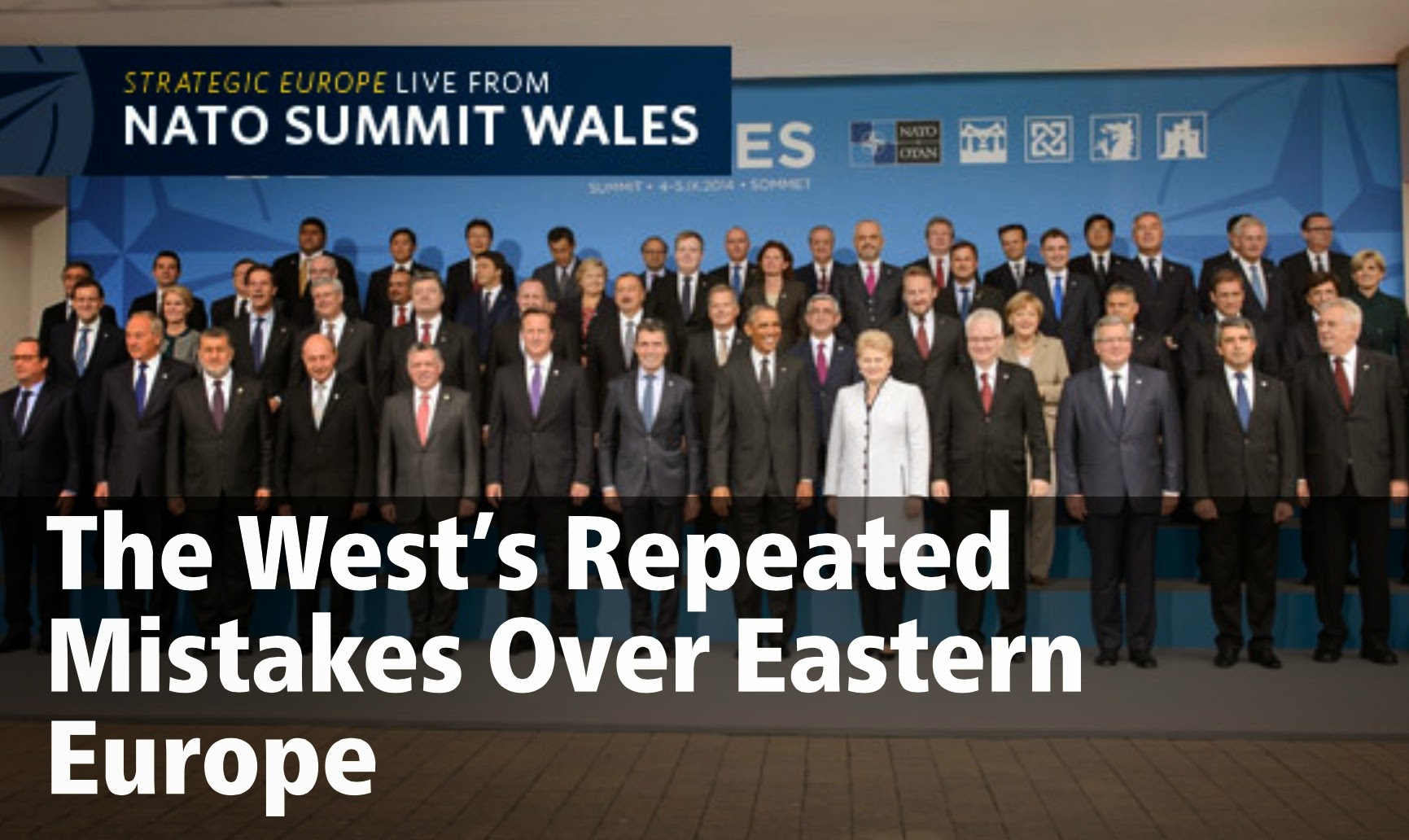
The West’s Repeated Mistakes Over Eastern Europe

Something very similar is happening now in the countries east of the European Union and west of Russia. As the people of Ukraine’s Euromaidan protest movement showed in January 2014 on Kiev’s Independence Square, they were not going to accept a post–Cold War status quo in which Russia sets the agenda. They wanted to choose their own political path.

It seems that history is repeating itself. This time round, NATO is not prepared to help the countries in Europe’s East, while the EU is divided and weak over how to deal with Russian President Vladimir Putin’s invasion of eastern Ukraine and illegal annexation of Crimea in March.

During a press conference with Ukrainian President Petro Poroshenko on September 4 at the NATO summit in Wales, the alliance’s Secretary General Anders Fogh Rasmussen tried to put the best spin on NATO help to Ukraine. Since NATO is not prepared even to consider the idea of Ukraine one day becoming a member of the organization, Rasmussen—and indeed Poroshenko—didn’t mention the “m-word.”

“It is for the Ukrainian people to decide . . . [their] future relationship with NATO,” the secretary general said—as if Putin will allow that to happen.

Rasmussen did say that NATO allies had pledged to provide support to help Ukraine improve its own security. “Our support is concrete and tangible. . . . Ukraine has stood by NATO. Now in these difficult times, NATO stands by Ukraine.”

Rasmussen explained how the allies had established “a comprehensive and tailored package of measures” to help Ukraine. The focus of NATO support would be on four areas: rehabilitation for injured troops, cyberdefense, logistics, and command and control and communications. “And allies will assist Ukraine with around €15 million [$19 million] through NATO,” Rasmussen added. NATO would not be supplying weapons. But that won’t stop individual countries from doing so.

Above all, the NATO chief insisted that an independent, sovereign, and stable Ukraine firmly committed to democracy and the rule of law was key to Euro-Atlantic security. “We stand united in our support of Ukraine’s sovereignty and territorial integrity,” he said.

Actually, the West is only rhetorically united over Ukraine’s sovereignty and territorial integrity. Western nations have no real intentions of matching that statement with deeds to allow Ukraine to regain territory in eastern Ukraine that has been taken over by rebels backed by Russian troops and tanks—let alone Crimea.

As for the EU, it is prepared to impose more sanctions on Russia—but with many misgivings and criticisms from several member states, especially Hungary, Slovakia, and the Czech Republic. That is despite the fact that until twenty-five years ago, these countries were under the Soviet yoke.

The measures undertaken by NATO and the EU are insufficient because they perpetuate the new rules of the game that Putin is writing across Eastern Europe. And because the West’s responses give him no reason to desist, at least for the moment, Western countries are repeating the mistakes they made when Eastern European civil society reared its head during the Communist era. The West is not prepared to stand up to Putin’s Russia.

Instead, willy-nilly, the West is allowing a new cordon sanitaire of countries to take hold between Russia and the EU. But if Putin and European leaders believe that this buffer zone is going to represent a new, stable “post-post–Cold War” status quo, they are seriously mistaken.

The reason is that civil society across these countries, from Belarus to Armenia, will not accept these new demarcation lines on a permanent basis. Just as Poles challenged their country’s Communist regime in 1980, the same will happen across the states in Europe’s East.

That has already happened in Ukraine. And despite the war in eastern Ukraine and the continuing influence of the country’s oligarchs, the supporters of the Euromaidan are not prepared to let this revolution fail. They are not naive enough to believe that the EU and NATO will come to their rescue. Instead, against all the odds, they will continue to struggle for their freedom to choose their own political path. More


ISIS and Our Times – Noam Chomsky

It is not pleasant to contemplate the thoughts that must be passing through the mind of the Owl of Minerva as the dusk falls and she undertakes the task of interpreting the era of human civilization, which may now be approaching its inglorious end.

Bajid Kandala refugee cam, Iraq

The era opened almost 10,000 years ago in the Fertile Crescent, stretching from the lands of the Tigris and Euphrates, through Phoenicia on the eastern coast of the Mediterranean to the Nile Valley, and from there to Greece and beyond. What is happening in this region provides painful lessons on the depths to which the species can descend.

The land of the Tigris and Euphrates has been the scene of unspeakable horrors in recent years. The George W. Bush-Tony Blair aggression in 2003, which many Iraqis compared to the Mongol invasions of the 13th century, was yet another lethal blow. It destroyed much of what survived the Bill Clinton-driven UN sanctions on Iraq, condemned as “genocidal” by the distinguished diplomats Denis Halliday and Hans von Sponeck, who administered them before resigning in protest. Halliday and von Sponeck's devastating reports received the usual treatment accorded to unwanted facts.

One dreadful consequence of the US-UK invasion is depicted in a New York Times “visual guide to the crisis in Iraq and Syria”: the radical change of Baghdad from mixed neighborhoods in 2003 to today's sectarian enclaves trapped in bitter hatred. The conflicts ignited by the invasion have spread beyond and are now tearing the entire region to shreds.

Much of the Tigris-Euphrates area is in the hands of ISIS and its self-proclaimed Islamic State, a grim caricature of the extremist form of radical Islam that has its home in Saudi Arabia. Patrick Cockburn, a Middle East correspondent for The Independent and one of the best-informed analysts of ISIS, describes it as “a very horrible, in many ways fascist organization, very sectarian, kills anybody who doesn't believe in their particular rigorous brand of Islam.”

Cockburn also points out the contradiction in the Western reaction to the emergence of ISIS: efforts to stem its advance in Iraq along with others to undermine the group's major opponent in Syria, the brutal Bashar Assad regime. Meanwhile a major barrier to the spread of the ISIS plague to Lebanon is Hezbollah, a hated enemy of the US and its Israeli ally. And to complicate the situation further, the US and Iran now share a justified concern about the rise of the Islamic State, as do others in this highly conflicted region.

Egypt has plunged into some of its darkest days under a military dictatorship that continues to receive US support. Egypt's fate was not written in the stars. For centuries, alternative paths have been quite feasible, and not infrequently, a heavy imperial hand has barred the way.

After the renewed horrors of the past few weeks it should be unnecessary to comment on what emanates from Jerusalem, in remote history considered a moral center.

Eighty years ago, Martin Heidegger extolled Nazi Germany as providing the best hope for rescuing the glorious civilization of the Greeks from the barbarians of the East and West. Today, German bankers are crushing Greece under an economic regime designed to maintain their wealth and power.

The likely end of the era of civilization is foreshadowed in a new draft report by the Intergovernmental Panel on Climate Change, the generally conservative monitor of what is happening to the physical world.

The report concludes that increasing greenhouse gas emissions risk “severe, pervasive and irreversible impacts for people and ecosystems” over the coming decades. The world is nearing the temperature when loss of the vast ice sheet over Greenland will be unstoppable. Along with melting Antarctic ice, that could raise sea levels to inundate major cities as well as coastal plains.

The era of civilization coincides closely with the geological epoch of the Holocene, beginning over 11,000 years ago. The previous Pleistocene epoch lasted 2.5 million years. Scientists now suggest that a new epoch began about 250 years ago, the Anthropocene, the period when human activity has had a dramatic impact on the physical world. The rate of change of geological epochs is hard to ignore.

One index of human impact is the extinction of species, now estimated to be at about the same rate as it was 65 million years ago when an asteroid hit the Earth. That is the presumed cause for the ending of the age of the dinosaurs, which opened the way for small mammals to proliferate, and ultimately modern humans. Today, it is humans who are the asteroid, condemning much of life to extinction.

The IPCC report reaffirms that the “vast majority” of known fuel reserves must be left in the ground to avert intolerable risks to future generations. Meanwhile the major energy corporations make no secret of their goal of exploiting these reserves and discovering new ones.

A day before its summary of the IPCC conclusions, The New York Times reported that huge Midwestern grain stocks are rotting so that the products of the North Dakota oil boom can be shipped by rail to Asia and Europe.

One of the most feared consequences of anthropogenic global warming is the thawing of permafrost regions. A study in Science magazine warns that “even slightly warmer temperatures [less than anticipated in coming years] could start melting permafrost, which in turn threatens to trigger the release of huge amounts of greenhouse gases trapped in ice,” with possible “fatal consequences” for the global climate.

Arundhati Roy suggests that the “most appropriate metaphor for the insanity of our times” is the Siachen Glacier, where Indian and Pakistani soldiers have killed each other on the highest battlefield in the world. The glacier is now melting and revealing “thousands of empty artillery shells, empty fuel drums, ice axes, old boots, tents and every other kind of waste that thousands of warring human beings generate” in meaningless conflict. And as the glaciers melt, India and Pakistan face indescribable disaster.

Sad species. Poor Owl.

© 2014 Noam Chomsky
Distributed by The New York Times Syndicate


Israel’s Video Justifying Destruction of a Hospital Was From 2009

The video clip showing apparent firing from an annex to the hospital was actually shot during Israel's 2008-09 “Operation Cast Lead,” and the audio clip accompanying it was from an incident unrelated to Al Wafa. (Screengrab: The Times of Israel)

A video distributed by the Israeli military in July suggesting that Palestinian fighters had fired from the Al Wafa Rehabilitation and Geriatric Hospital in Gaza City was not shot during the recent Israeli attack on Gaza, and both audio and video clips were manipulated to cover up the fact that they were from entirely different incidents, a Truthout investigation has revealed.

The video, released by the Israel Defense Forces (IDF) on July 23, the same day Israeli airstrikes destroyed Al Wafa, was widely reported by pro-Israeli publications and websites as proving that the hospital was destroyed because Hamas had turned the hospital into a military facility. But the video clip showing apparent firing from an annex to the hospital was actually shot during Israel's 2008-09 “Operation Cast Lead,” and the audio clip accompanying it was from an incident unrelated to Al Wafa.

The misleading video was only the last in a series of IDF dissimulations about Al Wafa hospital that included false claims that Hamas rockets had been launched from the hospital grounds, or very near it, and that the hospital had been damaged by an attack on the launching site.

The IDF began to prepare the ground for the destruction of Al Wafa hospital well before Israeli ground troops entered Gaza on July 17. On July 11, the IDF fired four warning rockets on the fourth floor of Al Wafa, making a large hole in the ceiling – the standard IDF signal that a building was going to be destroyed by an airstrike.

On July 17, the hospital was hit by a total of 15 rockets, according to Dr. Basman Alashi, Al Wafa's director. After the first few rockets, a phone call from the IDF “asked how much time do you need to evacuate?” he told Truthout. After the second and third floors were largely destroyed, the patients' rooms were filled with smoke and the hospital lost electricity, he gave the order to evacuate the hospital.

An IDF spokesman told Allison Deger of Mondoweiss that Hamas rocket launches had come “from exactly near the hospital, 100 meters near.” A slide show released by the IDF August 19 includes an aerial view of Al Wafa Hospital with two alleged rocket launching sites marked that are clearly much farther from the hospital than the 100 meters.

Even if that IDF claim of 100 meters were accurate, however, it was more than sufficient to allow the IDF to hit the launch site with precision-guided munitions without damaging the hospital. Israeli air to ground missiles, especially those fired from drones, are known to be able to hit small targets without causing collateral damage to nearby buildings. An IDF video posted on August 9, for example, shows a missile destroying what is said to be a hidden rocket launch site without harming a mosque only a few meters away from the explosion.

IDF spokesman Captain Eytan Buchman nevertheless blandly suggested that it was collateral damage from striking the launch site. He said the IDF was “left with no choice” but to “target the launcher with the most precise munitions capable of ensuring its destruction.”

On July 21, the IDF Spokesman's Office pushed its propaganda line linking Al Wafa and rocket launching sites even further, claiming in a tweet and on its blog, “Hamas fires rockets from Wafa hospital in the Gaza neighborhood of Shujaiya.” Under that headline was an aerial photo enhanced to highlight what was said to be Al Wafa Hospital, along with a red dot representing an M-75 rocket launch site that was not on the hospital grounds, but appeared to be a few meters away.

But the building shown in the aerial photo was not Al Wafa hospital, as Dr. Alashi quickly pointed out. A Google map of Al Wafa hospital shows none of the buildings resemble the one the IDF identified as Al Wafa. The building in the IDF image belongs to the Right to Life Society.

After that prevarication had been revealed, the IDF added a new claim that “the hospital grounds” had been used by Hamas and the Palestinian Islamic Jihad as “a post enabling terrorists to open fire at soldiers.”

The IDF said that Hamas had “fired at Israel and at IDF forces from the hospital” despite warnings from the IDF, and the IDF had been forced to attack targets on the hospital site.

The statement was accompanied by a video purporting to document the firing at Israeli troops. Based on the camera angle and altitude, the video was taken by an Israeli drone, according to a former US intelligence officer, with experience in interpreting military-related images, who analyzed the video for Truthout.

The first segment of the video is a grainy, black-and-white aerial shot of a building that starts with the legend, “Terrorists Threaten IDF from inside Wafa Hospital.” The building shown is not Al Wafa hospital, however, but an annex to the hospital that had been empty, both Dr. Alashi and Charlie Andeasson, a Swedish activist who was in the hospital when it was attacked on July 16, told Truthout.

The eight-second video shows what could be two brief bursts of fire from one of the windows on the third floor and then a third flash in a fourth story window. The former US intelligence officer confirmed that the footage of the building was selected from two different times of day. After the first three seconds of the video, the camera angle and the amount of light both change perceptibly. Nevertheless an exchange between the two voices on the audiotape accompanying the video continues as though the scene were continuous during the entire eight seconds.

The first voice heard on the audio recording says, in Hebrew, “Do you see this firing? Have spotted fires from within the house.” The English subtitles accompanying the audio add “hospital” in parentheses after the word “house,” but Seattle-based blogger on Israeli affairs Richard Silverstein, who speaks Hebrew, confirmed to Truthout after listening to the audio clip that the speaker uses the word “bayit,” which can only mean “house.”

A second voice then says, according to the subtitles, “Positive, fire from within the house.” But the speaker actually uses the term “small house” (“bayit ha katan hazeh”), according to Silverstein.

Those references to firing from a small house indicate that the audio clip was taken from an entirely different incident at another location. That device was obviously used because there was no audio of an incident involving firing from the hospital.

Dr. Alashi said he believes the eight-second video clip portrays firing from the annex that occurred in the 2008-09 Israeli attack on Gaza. “People confirmed to me that there was firing from the building then,” he told Truthout. That building was, in fact, attacked on January 16, 2009, by Israeli tanks only 70 meters away from the hospital, damaging the third and fourth floors of the building – the very floors from which the flashes are shown in the video – as the UN Fact-Finding Mission noted in its September 2009 report.

The last segment of the video showing the bombing of the Al Wafa hospital, bears the legend “secondary explosion” – meaning explosions of weapons – as each building is shown being destroyed, in line with the Israeli argument throughout the operation that Hamas stored rockets and other weapons in hospitals, schools and mosques.

The video fist shows the hospital itself being blown up, followed by heavy billowing smoke covering the entire hospital and then another flash of fire. But the former intelligence official who viewed the video said that flash indicated another Israeli missile strike on the target rather than a secondary explosion.

The clip then cuts to the destruction of the annex, again with the “secondary explosion” legend. The billowing smoke from the initial bomb explosion covers the building, and then two or three small puffs of darker smoke appear. Those puffs of smoke would suggest a secondary explosion, according to the former US intelligence officer. But he also observed that a hospital would have flammable materials other than hidden weapons that could cause the darker smoke to appear.

Given the existence of Hamas' complex network of tunnels, which provided plenty of storage space for its rockets and other weaponry, it would have made no sense for Hamas to store rockets in a hospital that it knew had already been targeted by the IDF.

In its final seconds, the video focuses in to show a square which the legend describes as a “tunnel opening near Al Wafa.” But Dr. Alashi told Truthout that it is actually a water well.

The IDF real reason for the destruction of Al Wafa hospital appears to be related to the determination to raise the cost to the civilian population of Gaza for Palestinian resistance, in line with the approach represented by its “Dahiya doctrine,” named after the Beirut suburb dominated by Hezbollah, much of which the Israeli Air Force reduced to rubble in the 2006 war.

That strategy, recognized as a violation of the international laws of war, was pursued most obviously in the complete destruction of every house in several square blocks in three separate areas of the Shujaiya district of Gaza City July 19-20. But it was also evident in IDF attacks on Al Wafa and in the series of mortar and artillery attacks on six different UN shelters from July 21 though August 3. Those attacks killed a total of 47 civilians and wounded 341, according to a survey of the incidents by The Guardian.

In none of the six cases where UN shelters were hit by IDF mortar shells was the military able to offer a plausible explanation, and in three cases, it offered no explanation whatever. More

Gareth Porter (@GarethPorter) is an independent investigative journalist and historian writing about US national security policy, and the recipient of the Gellhorn Prize for Journalism in 2012. His investigation of the US entry into war in Vietnam, Perils of Dominance: Imbalance of Power and the Road to War in Vietnam, was published by University of California Press in 2005.


Nearly Half the World’s Trash Is Burned, and That’s Worsening Climate Change

Nearly half the world’s trash is burned in the open, spewing pollutants into the atmosphere that contribute to climate change and affect human health, according to a new study.

Since such burning is largely unregulated and unreported, emissions of some pollutants have been underestimated by as much as 40 percent, said the researchers, who published their findings in the journalEnvironmental Science & Technology.

“I was shocked at the numbers,” said Christine Wiedinmyer, an atmospheric scientist at the National Center for Atmospheric Research and the study’s lead author. “They were much larger than I expected, particularly the air pollutants.”

The researchers estimated the amount of carbon dioxide, carbon monoxide, mercury, tiny particulate matter, and other pollutants released by burning trash.

Every year 970 million metric tons of food, paper, plastics, and metals are set aflame at homes, businesses, and dumps—roughly 41 percent of the world’s garbage, according to the study.

The garbage problem is likely to get worse. Researchers predict the world will triple its production of garbage to more than 11 million tons daily by 2100.

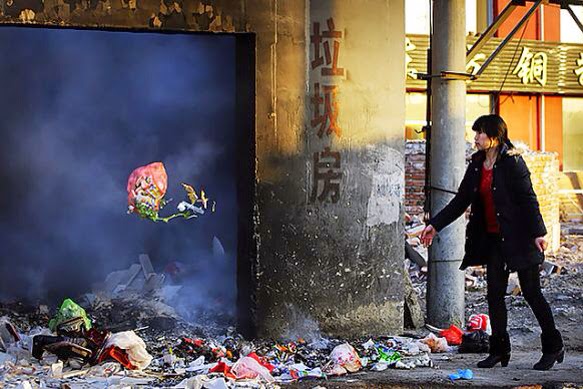
Fires can spring up at dumps with little warning. A fire in Iqaluit, the capital of the Canadian territory of Nunavut, broke out in May and burned for almost 100 days before fire crews began dousing the flames of the “dumpcano.” In March, a dump fire outside Bangkok blanketed neighborhoods with so much thick smoke that it could be seen by satellites.

Heavily populated countries, including China, the United States, India, Japan, Brazil, and Germany, produce the most waste, according to the study. China, India, Brazil, Mexico, Pakistan, and Turkey generate the most emissions from trash burning.

Trash burning produces mercury, chemicals known as polycyclic aromatic hydrocarbons, and fine particulate matter. These pollutants have been linked to heart and lung disease, neurological disorders, and cancer. Annual emissions of mercury and PAHs may have been underestimated by 10 to 40 percent, the researchers said.

Trash burning may also be clogging the air with far more particulate matter than was previously thought. A global tally of reported pollutants indicated that 34 million kilograms of tiny airborne particles called PM 2.5 are released into the air annually.

Wiedinmyer and her colleagues calculate that open burning shoots another 10 million kilograms into the atmosphere—an increase of 29 percent. In Sri Lanka, garbage burning produced five times more emissions of PM 10 (a larger particle) than was included in the official national tally.

These particles can penetrate deep into the lungs and have been associated with heart disease, asthma, and premature death. About 3.7 million people die prematurely from outdoor air pollution, according to the World Health Organization.

Open burning of garbage is closely related to poverty. Unregulated dump fires may be adjacent to settlements, putting the families that live there, especially women and children, at risk of health complications from the pollution. Some of these families derive income from the dump, removing valuable materials for resale.

The contribution of garbage burning to global carbon dioxide emissions is relatively small—only 5 percent of the 2010 global annual emissions. But on a country-by-country basis, it can be quite large. The study found that trash burning in Lesotho, Burundi, Mali, Somalia, and Sri Lanka produced more carbon dioxide than was recorded by the official registers.

Emissions from open burning of trash are rarely reported by environmental agencies, meaning the pollution goes uncounted and is left out of policy decisions.

Air Pollution Isn’t Just Bad for Your Health—It’s Taking Food off Your Plate

Brian Gullett, an environmental engineer at the United States Environmental Protection Agency and a coauthor of the paper, pointed out how difficult it is to calculate the emissions that come from open burning. Unlike with coal-burning power plants, no one knows the exact number of garbage-burning fires, and it can be difficult to trap and analyze the emissions.

Knowing where pollutants come from doesn’t change the burden they place on health, said Patrick Kinney, an expert on health and air pollution at Columbia University. But it does point to “which sources to go after in controlling the problem.”

Said Wiedinmyer, “If we’re looking at air pollution control strategies, we need to include all sources of air pollutants to get the most effective controls in place. If we’re missing a large source, it could lead to control strategies that aren’t going to work at all, or as well.” More


Iran-Contra Revisited

Iran-Contra Revisited: New Book Places Reagan at Center of 1980s Scandal

Lack of Legal or Legislative Closure to Affair Opened Path to Future Presidential Abuses

Narrative Spotlights Iranian, Israeli, Nicaraguan Perspectives

National Security Archive Electronic Briefing Book No. 483 – Posted September 5, 2014

For more information contact: +1 202/994-7000 or nsarchiv@gwu.edu

Washington, D.C., September 5, 2014 — A new book on the Iran-Contra affair shows that President Ronald Reagan stood at the epicenter of the scandal both in terms of his willingness to break the law in order to free American hostages in Lebanon and his failure to take account of the costs and consequences of his decisions, including the illicit conduct of numerous aides.

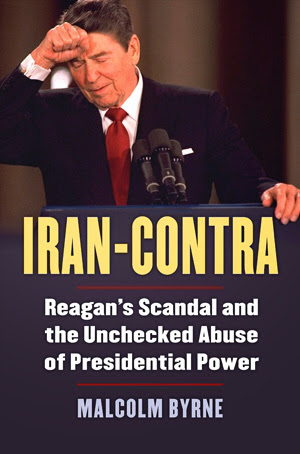
Advance praise for “Iran-Contra: Reagan’s Scandal and the Unchecked Abuse of Presidential Power” by Malcolm Byrne (University Press of Kansas, September 15, 2014), includes this from Seymour Hersh: “At last, the Reagan administration’s Iran-Contra affair finally has a comprehensive history worthy of the scandal … Malcolm Byrne has told the complex story in brilliant fashion.”

“Iran-Contra” details the historical, political, and institutional background against which the affair played out. Utilizing tens of thousands of pages of previously classified materials, the narrative describes in detail all the administration’s decisions and actions, and discusses the rationales invoked at the time as well as after the fact (explanations that sometimes differed widely).

Looking beyond the U.S. side, the volume explores — through documents and interviews — the views and actions of Iranians, Israelis, Nicaraguans, and others who played parts in the affair. Many of these insights are published here for the first time.

“Iran-Contra” is the first full-length account of the affair to study and assess the various official investigations that were convened — the Tower Commission, the joint congressional hearings, and the independent counsel’s inquiry. The limitations of each helped lead to an inconclusive end to the affair, which has had implications for the unchecked conduct of future presidents and their administrations.

While the scandal had many contributors — including Congress, which failed to avert either element of the affair or to pass meaningful legislation in its wake — the role of the president and his top aides stands out.

Today’s posting includes a revealing series of recently declassified high-level records that explore the president’s thinking and actions during the affair.

Check out today’s posting at the National Security Archive’s Website –http://www2.gwu.edu/~nsarchiv/NSAEBB/NSAEBB483/

Find us on Facebook – http://www.facebook.com/NSArchive

Unredacted, the Archive blog – http://nsarchive.wordpress.com/

________________________________________________________
THE NATIONAL SECURITY ARCHIVE is an independent non-governmental research institute and library located at The George Washington University in Washington, D.C. The Archive collects and publishes declassified documents acquired through the Freedom of Information Act (FOIA). A tax-exempt public charity, the Archive receives no U.S. government funding; its budget is supported by publication royalties and donations from foundations and individuals.
_________________________________________________________