On Sunday, September 21st, a huge crowd will march through the middle of Manhattan. It will almost certainly be the largest rally about climate change in human history, and one of the largest political protests in many years in New York.
More than 1,000 groups are coordinating the march — environmental justice groups, faith groups, labor groups — which means there’s no one policy ask. Instead, it’s designed to serve as a loud and pointed reminder to our leaders, gathering that week at the United Nations to discuss global warming, that the next great movement of the planet’s citizens centers on our survival and their pathetic inaction.
As a few of the march’s organizers, though, we can give some sense of why we, at least, are marching, words we think represent many of those who will gather at Columbus Circle for the walk through midtown Manhattan.
We march because the world has left the Holocene behind: scientists tell us that we’ve already raised the planet’s temperature almost one degree Celsius, and are on track for four or five by century’s end. We march because Hurricane Sandy filled the New York City subway system with salt water, reminding us that even one of the most powerful cities in the world is already vulnerable to slowly rising ocean levels.
We march because we know that climate change affects everyone, but its impacts are not equally felt: those who have contributed the least to causing the crisis are hit hardest, here and around the world. Communities on the frontlines of global warming are already paying a heavy price, in some cases losing the very land on which they live. This isn’t just about polar bears any more.
And we march for generations yet to come, our children, grandchildren and their children, whose lives will be systematically impoverished and degraded. It’s the first time one century has wrecked the prospects of the millennia to come, and it makes us mad enough to march.
We march with hope, too. We see a few great examples around the world of how quickly we could make the transition to renewable energy. We know that if there were days this summer when Germany generated nearly 75% of its power from renewable sources of energy, the rest of us could, too — especially in poorer nations around the equator that desperately need more energy. And we know that labor-intensive renewables would provide far more jobs than capital-intensive coal, gas and oil.
And we march with some frustration: why haven’t our societies responded to 25 years of dire warnings from scientists? We’re not naïve; we know that the fossil fuel industry is the 1% of the 1%. But sometimes we think we shouldn’t have to march. If our system worked the way it should, the world would long ago have taken the obvious actions economists and policy gurus have recommended — from taxing carbon to reflect the damage it causes to funding a massive World War II-scale transition to clean energy.
Marching is not all, or even most, of what we do. We advocate; we work to install solar panels; we push for sustainable transit. We know, though, that history shows marching is usually required, that reason rarely prevails on its own. (And we know that sometimes even marching isn’t enough; we’ve been to jail and we’ll likely be back.)
We’re tired of winning the argument and losing the fight. And so we march. We march for the beaches and the barrios. We march for summers when the cool breeze still comes down in the evening. We march because Exxon spends $100 million every day looking for more hydrocarbons, even though scientists tell us we already have far more in our reserves than we can safely burn. We march for those too weak from dengue fever and malaria to make the journey. We march because California has lost 63 trillion gallons of groundwater to the fierce drought that won’t end, and because the glaciers at the roof of Asia are disappearing. We march because researchers told the world in April that the West Antarctic ice sheet has begun to melt “irrevocably”; Greenland’s ice shield may soon follow suit; and the waters from those, as rising seas, will sooner or later drown the world’s coastlines and many of its great cities.
We don’t march because there’s any guarantee it will work. If you were a betting person, perhaps you’d say we have only modest hope of beating the financial might of the oil and gas barons and the governments in their thrall. It’s obviously too late to stop global warming entirely, but not too late to slow it down — and it’s not too late, either, to simply pay witness to what we’re losing, a world of great beauty and complexity and stability that has nurtured humanity for thousands of years.
There’s a world to march for — and a future, too. The only real question is why anyone wouldn’t march.More
We need a “multi-faceted approach for educating the children and adults vulnerable to climate change […] to reduce the adverse impacts of climate change,” according to Dr. Leslie A. North, Assistant Professor in the Department of Geography and Geology at the Western Kentucky University , and Mr. Kianoosh Ebrahimi, Center for Water Resource Studies, Western Kentucky University in an exclusive guest post toCaribbean Climate.
Credit: The 5Cs
Communities of scientists acknowledge that global climate change is happening, and is predominantly the result of human activities (IPCC, 2014). Yet, despite the wealth of information about the potentially catastrophic impacts of climate change, there are many persons still skeptical about the importance of understanding and responding to climate change risk. There are equally as many people simply unaware of how to minimize the impacts of climate change (Alejandro et al., 2012). Generally speaking, as climate change is typically perceived as remote and distant…
Perhaps you’ve seen one of the recent barrage of articles claiming that fears of an imminent peak and decline in world oil production have either been dispelled (because we actually have plenty of oil) or are misplaced (because climate change is the only environmental problem we should be concerned with). I’m not buying either argument.
Richard Heinberg
Why? Let’s start with the common assertion that oil supplies are sufficiently abundant so that a peak in production is many years or decades away. Everyone agrees that planet Earth still holds plenty of petroleum or petroleum-like resources: that’s the kernel of truth at the heart of most attempted peak-oil debunkery. However, extracting and delivering those resources at an affordable price is becoming a bigger challenge year by year. For the oil industry, costs of production have rocketed; they’re currently soaring at a rate of about 10 percent annually. Producers need very high oil prices to justify going after the resources that remain—tight oil from source rocks, Arctic oil, ultra-deepwater oil, and bitumen. But oil prices have already risen to the point where many users of petroleum just can’t afford to pay more. The US economyhas a habit of responding to oil price hikes by swooning into recession, and during the shift from $20 per barrel oil to $100 per barrel oil (which occurred between 2002 and 2011), the economies of most industrialized countries began to shudder and stall. What would be their response to a sustained oil price of $150 or $200? We may never know: it remains to be seen whether the world can afford to pay what will be required for oil producers to continue wresting liquid hydrocarbons from the ground at current rates. While industry apologists who choose to focus only on the abundance of remaining petroleum resources claim that peak oil is rubbish, the market is telling Houston we have a problem.
Meanwhile some environmentalists have abandoned the subject of peak oil because they believe it’s just not relevant. For them, climate change is the only thing that matters. Society must deal with its collective carbon habit by going cold turkey on all fossil fuels. We can make the needed energy transition through the strategies of substitution and efficiency. Develop low-carbon energy sources (solar and wind, possibly nuclear), and use energy smarter! Electrify transport with battery-powered cars! Get with the program and stop wasting time on side issues!
Like the abundant-resource argument, this line of thinking proceeds from an unassailable premise. Anthropogenic climate change is indeed the nastiest, gnarliest environmental issue humanity has ever faced. The potential consequences stretch centuries or millennia into the future and imperil not just humanity, but thousands or millions of other species. But peak oil won’t go away just because it’s an inconvenient distraction from addressing that gargantuan issue. In fact, the two problems are closely linked and society will need to address both by way of a realistic, comprehensive strategy. I’ll get back to that point toward the end of this essay.
Is the necessary transition to renewable energy a simple matter of politics and regulation, as many climate campaigners seem to suggest? Hardly. Transitioning the electricity sector is a huge task in itself (the variability of wind and solar power implies soaring costs for energy storage, capacity redundancy, and grid upgrades once these sources start to provide a substantial portion of total electrical energy consumed). But liquid fuels pose an even bigger hurdle. Even the most advanced batteries do a poor job of storing energy when compared to oil; that’s why we’re unlikely ever to see electric airplanes, tractors, ships, 18-wheel trucks, or bulldozers. Some energy pundits tout compressed natural gas as a viable bridge fuel for transport, but that assumes sufficient availability and continued affordability of fracked shale gas—a prospect that seems highly unlikely in view of the results of Post Carbon Institute’s ongoing research into possible shale gas drilling locations and per-well production profiles. Hydrogen could be a niche fuel in some instances, but conversion from other energy sources (electricity or natural gas) to hydrogen implies energy losses, as does hydrogen storage. Further, if we were to make lots of H2 from water, using electricity, in order to fuel much of the transport sector, this would place an enormous extra burden on solar and wind, which already face a daunting job replacing coal and natural gas in the power generation sector.
How about energy efficiency? Good idea! We need to cut energy waste, and the folks at Rocky Mountain Institute have proposed many good ways of doing that. But, at the end of the day, efficiency is subject to the law of diminishing returns; so, while the tie between energy consumption and economic output is somewhat elastic, it cannot be severed. Specifically regarding oil: yes, many nations have reduced petroleum consumption in the last few years as a way of adapting to higher prices. But the fact that their economies have weakened suggests that efficiency gains have tended to lag behind oil price increases. Average vehicle fuel economy has improved, but not fast enough—so our main “efficiency” strategy has in reality simply been to travel less, and then deal with the withdrawal of economic benefits that cheap transport formerly provided.
None of this is trivial: oil is essential to the functioning of the modern industrial world. We use it for just about all transportation, which is key to trade. It’s also the fuel for construction, resource extraction (mining, fishing, forestry), and agriculture. Together, these sectors form the backbone of the real, physical economy of industrialized nations.
Again: the costs of oil production are rising and oil is stubbornly hard to substitute. As I argued in a recent book, this effectively spells the end of the historic period of rapid economic growth that began shortly after World War II. There is no way out; inevitably, society will become less mobile and—this should be cause for much greater concern—it will either produce less food or produce it in more labor-intensive ways.
Of course, peak oil and climate change aren’t the only looming challenges we should be concerned about. Economists rightly worry that the world is mired in far too much debt. Ecologists warn us about biodiversity loss, pervasive chemical pollution, and human overpopulation. Food system analysts try (usually in vain) to direct public attention toward the predicaments of topsoil degradation and depletion of aquifers from over-irrigation. Public health professionals caution us about the specter of pandemics as antibiotics lose effectiveness due to rapid microbial evolution. For city managers, the crumbling of water, sewerage, bridge, gas, and electricity grid infrastructure implies countless disasters just waiting to happen. I could go on. It’s all so overwhelming! Perhaps the only way to avoid crisis fatigue these days is simply to stop paying attention. But amid all these priorities and problems, peak oil refuses to die.
Those of us who insist on paying attention sooner or later get around to doing a form of mental triage. What are the worst crises that humanity faces over the long run? Which are the worst in the short term? What are the deeper issues, of which many problems are mere symptoms? This sorting process has led many systems thinkers to the conclusion that our species, in essence, faces an ecological dilemma of overpopulation, resource depletion, and environmental degradation resulting from a relatively brief period of rapid expansion enabled by a huge but temporary energy subsidy in the form of fossil fuels. We discovered buried treasure and went on a spending binge, adopting a way of life that cannot be supported long-term. Peak oil, climate change, mineral depletion, soil degradation, species loss, and the rest are justwords that blind men use to describe an elephant.
What we must do now is treat symptoms while keeping in mind the root disease, seeing why and how various crises are related. I have a couple of suggestions in this regard. One is that we begin to speak of peak oil and climate change as two sides of the same coin. The coin itself represents our reliance on fossil fuels and their unique energetic benefits. Both side-problems (the declining economic value of fossil fuels as they deplete, on one side, and the increasing environmental cost of burning them, on the other) demand that we reduce our fossil fuel dependency as rapidly as possible, even though that means sacrificing benefits we have come to depend on. If we maintain this holistic view of the situation, we’re more likely to understand that there is no way to keep eating our cake while having it too, either by continuing to burn fossil fuels of declining quality or by relying on new technology to fix what is actually an ecological problem. We can’t frack our way back to economic prosperity; nor can we unplug a coal plant, plug in a solar panel, and go on expanding population and consumption. We will have to adapt to the quantities and qualities of energy that are actually available from renewable sources alone, and that will mean changing the way we do just about everything.
Which brings me to the second, related suggestion. The constellation of challenges before us ensures that economic growth, as we have known it, is over, finished, kaput. That’s a terrible thing, in that the end of growth will almost certainly entail financial and political turbulence with real human casualties. But from the standpoint of diagnosis and treatment, it simplifies everything marvelously. If our impending crises stem from fossil-fueled expansion of population and consumption, their resolution surely starts with a coordinated, planned, and managed program of decarbonization and degrowth. We must reduce population and energy consumption from fossil fuels, while minimizing the human and environmental impacts of both past growth and the process of contraction. Easily said, not so easily done. But if civilization is to maintain itself in any recognizable form, this is what’s necessary. It would really help if those of us working at treating the various symptoms of the global meta-crisistogether acknowledged that growth is a core part of the underlying problem, not a solution, and that it is effectively over in any case.
Ignore peak oil (this could equally be said of climate change), and our view of the global problem-set immediately becomes distorted. We grasp at apparent solutions that turn out to be a useless waste of effort, or worse. Peak oil helps us understand what we’re faced with, and what we must do. It’s a gift wrapped in a curse. And it refuses to go away no matter how often it is pronounced dead.
An Economic Hit Man Speaks Out: John Perkins on How Greece Has Fallen Victim to “Economic Hit Men”
John Perkins
“My sin was ripping off people around the world,” said John Perkins, author of “Confessions of an Economic Hit Man,” at Transitions Bookplace in Chicago, on February 3, 2006. (Photo: Peter Thompson / The New York Times)John Perkins, author of Confessions of an Economic Hit Man, discusses how Greece and other eurozone countries have become the new victims of “economic hit men.”
John Perkins is no stranger to making confessions. His well-known book, Confessions of an Economic Hit Man, revealed how international organizations such as the International Monetary Fund (IMF) and the World Bank, while publicly professing to “save” suffering countries and economies, instead pull a bait-and-switch on their governments: promising startling growth, gleaming new infrastructure projects and a future of economic prosperity – all of which would occur if those countries borrow huge loans from those organizations. Far from achieving runaway economic growth and success, however, these countries instead fall victim to a crippling and unsustainable debt burden.
“That's part of the game: convince people that they're wrong, that they're inferior. The corporatocracy is incredibly good at that.”
That's where the “economic hit men” come in: seemingly ordinary men, with ordinary backgrounds, who travel to these countries and impose the harsh austerity policies prescribed by the IMF and World Bank as “solutions” to the economic hardship they are now experiencing. Men like Perkins were trained to squeeze every last drop of wealth and resources from these sputtering economies, and continue to do so to this day. In this interview, which aired on Dialogos Radio, Perkins talks about how Greece and the eurozone have become the new victims of such “economic hit men.”
Michael Nevradakis: In your book, you write about how you were, for many years, a so-called “economic hit man.” Who are these economic hit men, and what do they do?
John Perkins: Essentially, my job was to identify countries that had resources that our corporations want, and that could be things like oil – or it could be markets – it could be transportation systems. There're so many different things. Once we identified these countries, we arranged huge loans to them, but the money would never actually go to the countries; instead it would go to our own corporations to build infrastructure projects in those countries, things like power plants and highways that benefitted a few wealthy people as well as our own corporations, but not the majority of people who couldn't afford to buy into these things, and yet they were left holding a huge debt, very much like what Greece has today, a phenomenal debt.
“[Indebted countries] become servants to what I call the corporatocracy … today we have a global empire, and it's not an American empire. It's not a national empire … It's a corporate empire, and the big corporations rule.”
And once [they were] bound by that debt, we would go back, usually in the form of the IMF – and in the case of Greece today, it's the IMF and the EU [European Union] – and make tremendous demands on the country: increase taxes, cut back on spending, sell public sector utilities to private companies, things like power companies and water systems, transportation systems, privatize those, and basically become a slave to us, to the corporations, to the IMF, in your case to the EU, and basically, organizations like the World Bank, the IMF, the EU, are tools of the big corporations, what I call the “corporatocracy.”
And before turning specifically to the case of Greece, let's talk a little bit more about the manner in which these economic hit men and these organizations like the IMF operate. You mentioned, of course, how they go in and they work to get these countries into massive debt, that money goes in and then goes straight back out. You also mentioned in your book these overly optimistic growth forecasts that are sold to the politicians of these countries but which really have no resemblance to reality.
Exactly, we'd show that if these investments were made in things like electric energy systems that the economy would grow at phenomenally high rates. The fact of the matter is, when you invest in these big infrastructure projects, you do see economic growth, however, most of that growth reflects the wealthy getting wealthier and wealthier; it doesn't reflect the majority of the people, and we're seeing that in the United States today.
“In the case of Greece, my reaction was that 'Greece is being hit.' There's no question about it.”
For example, where we can show economic growth, growth in the GDP, but at the same time unemployment may be going up or staying level, and foreclosures on houses may be going up or staying stable. These numbers tend to reflect the very wealthy, since they have a huge percentage of the economy, statistically speaking. Nevertheless, we would show that when you invest in these infrastructure projects, your economy does grow, and yet, we would even show it growing much faster than it ever conceivably would, and that was only used to justify these horrendous, incredibly debilitating loans.
Is there a common theme with respect to the countries typically targeted? Are they, for instance, rich in resources or do they typically possess some other strategic importance to the powers that be?
Yes, all of those. Resources can take many different forms: One is the material resources like minerals or oil; another resource is strategic location; another resource is a big marketplace or cheap labor. So, different countries make different requirements. I think what we're seeing in Europe today isn't any different, and that includes Greece.
What happens once these countries that are targeted are indebted? How do these major powers, these economic hit men, these international organizations come back and get their “pound of flesh,” if you will, from the countries that are heavily in debt?
By insisting that the countries adopt policies that will sell their publicly owned utility companies, water and sewage systems, maybe schools, transportation systems, even jails, to the big corporations. Privatize, privatize. Allow us to build military bases on their soil. Many things can be done, but basically, they become servants to what I call the corporatocracy. You have to remember that today we have a global empire, and it's not an American empire. It's not a national empire. It doesn't help the American people very much. It's a corporate empire, and the big corporations rule. They control the politics of the United States, and to a large degree they control a great deal of the policies of countries like China, around the world.
John, looking specifically now at the case of Greece, of course you mentioned your belief that the country has become the victim of economic hit men and these international organizations . . . what was your reaction when you first heard about the crisis in Greece and the measures that were to be implemented in the country?
I've been following Greece for a long time. I was on Greek television. A Greek film company did a documentary called “Apology of an Economic Hit Man,” and I also spent a lot of time in Iceland and in Ireland. I was invited to Iceland to help encourage the people there to vote on a referendum not to repay their debts, and I did that and encouraged them not to, and they did vote no, and as a result, Iceland is doing quite well now economically compared to the rest of Europe. Ireland, on the other hand: I tried to do the same thing there, but the Irish people apparently voted against the referendum, though there's been many reports that there was a lot of corruption.
“That's part of the game: convince people that they're wrong, that they're inferior. The corporatocracy is incredibly good at that.”
In the case of Greece, my reaction was that “Greece is being hit.” There's no question about it. Sure, Greece made mistakes, your leaders made some mistakes, but the people didn't really make the mistakes, and now the people are being asked to pay for the mistakes made by their leaders, often in cahoots with the big banks. So, people make tremendous amounts of money off of these so-called “mistakes,” and now, the people who didn't make the mistakes are being asked to pay the price. That's consistent around the world: We've seen it in Latin America. We've seen it in Asia. We've seen it in so many places around the world. More
The Cayman Islands must be very discriminating as to what pieces of the public sector get sold off. Some sectors, such as water production and distribution, if sold, and without well thought policies, could well have a negative effect on certain sectors of our population, as recent events in Detroit have proved. Editor
Rudy Dent is a Vietnam War veteran, a four year member of the NYPD and spent thirty-two years as a NYC firefighter.
He was at Ground Zero as a firefighter on 9/11 and was there when Building 7 came down. In this interview Infowars reporter Lee AnnMcAdoo talks to Rudy Dent tabout his incredible first hand experience of the lies surrounding WTC 7.
The western USA is not the only place suffering from lack of rain, Latin America’s economic powerhouse has been struck hard by a powerful and ongoing water crisis.
The worst drought since records began 84 years ago has constrained the Brazillian economy in many ways, particularly coffee production, agriculture and hydroelectric power generation, which accounted for 80% of electricity generation. This power fuels the economic development on which millions are counting to rise out of poverty, and the loss has slowed the entire economy, due to the need to import expensive fossil fuels in order to keep the lights on and water pumps running (costing $6 billion extra so far this year, while increasing the country’s greenhouse gas emissions).
Water rationing has been imposed in many parts of the country for months, but the situation is approaching a critical point. Nineteen large cities are under water rationing rules, and the water catchment capacity feeding the megalopolis of Sao Paolo (20 million inhabitants and the economic capital of the entire continent) is down to 10%. Carefully husbanded, and tapping water usually deemed of inferior quality, there is enough left to squeeze out of the system for a hundred days consumption. States are now squabbling over allocation of the remaining water resources, and fighting has erupted sporadically in some rural areas.
In Sao Paolo itself, financial incentives to reduce consumption have been accompanied by cutting water pressure at night, effectively cutting off all the poorer areas of the city which sit on hills. In nearby Gaurulhos residents of some neighbourhoods are getting water one day in three. Balancing the competing needs of drinking water and power generation is also having societal consequences, exacerbating general social tension, and helping fuel reactions such as the protests and riots back in June.
The drought may be linked to climate change, since the rains that normally come south from evaporation in the Amazon basin failed to arrive, a potentially very worrying symptom. It also reveals some of the likely types of economic cost and societal tension that will arise and worsen as the world warms further and the consequences begin to bite. Some early spring rains appeared in Brazil this week, enough at least to halt the fall in Sao Paolo’s reserves, but the prognosis for the coming rainy season is still very uncertain.
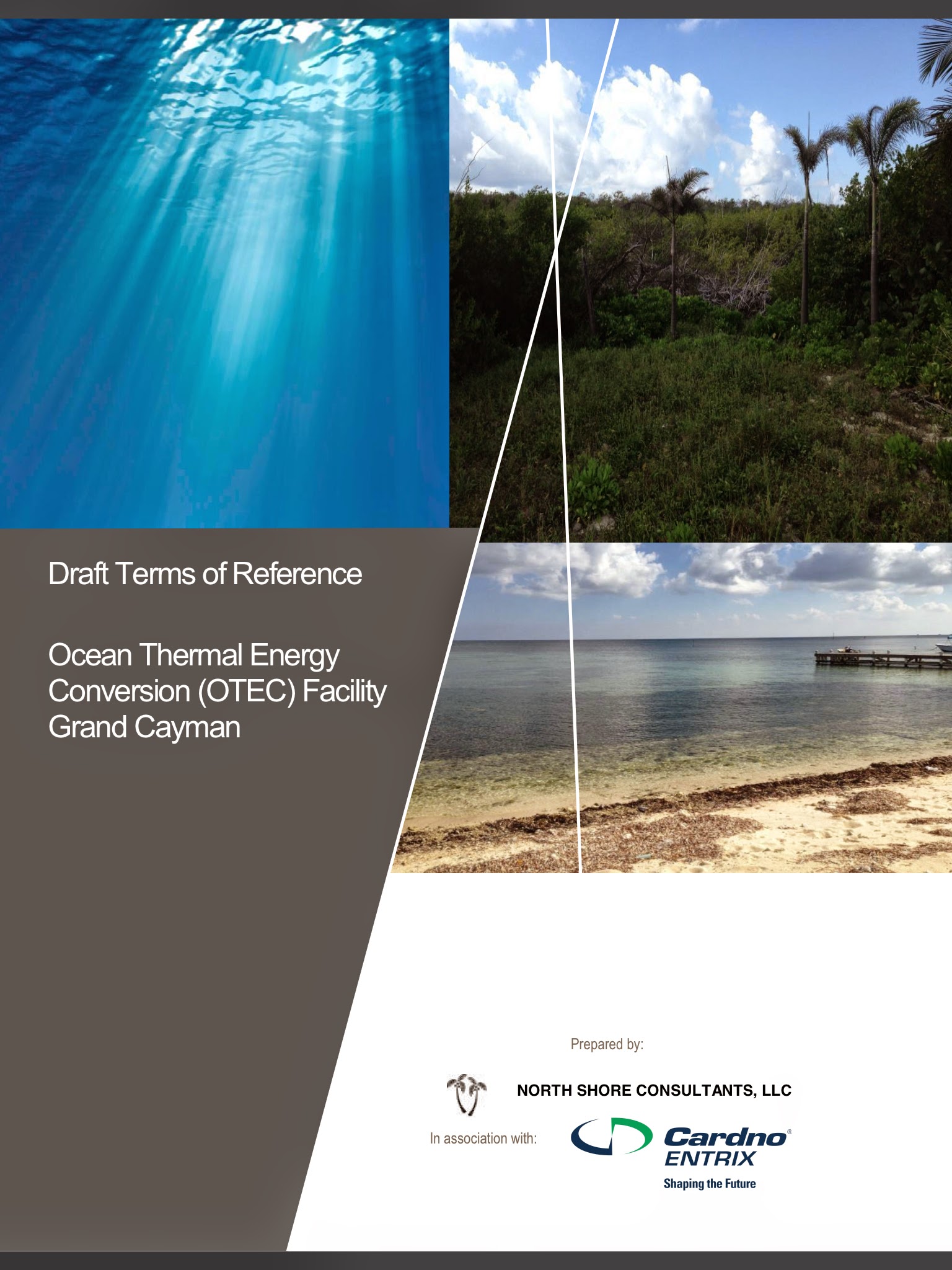
The Environmental Assessment Board (EAB) is providing Notice to the Public of the publication of the Draft Terms of Reference (ToR) for the Environmental Impact Assessment (EIA) for a proposed Ocean Thermal Energy Conversion (OTEC) Project on the north shore of Grand Cayman. The public is invited to review and comment on the To R which has been developed in collaboration with the EAB, which includes representatives from the Department of Environment, Planning Authority. Port Authority, and the Electricity Regulatory Authority.
The prolect Proponent. OTEC international. LLC (OTI) ie undertaking an EIA for its proposed phased installation of 25 megawatts (MWe) of power. The Initial phase would be a 6.25Mwe floating power platform (FPP). The result of the ElA will be an Environmental Statement (ES) which will help to inform the decision-making process. Download PDF
Yo u r input will be considered in the finalization of the To R document which is available oniine at www.doe.ky or hard copies can be reviewed at the following locations:
centre to provide an opportunity for OTI and the EIA Consultant to outline the project and to invite comments and questions from the Public on the draft ToR. Representatives from OTI, the EIA Consultant and the EAB will be available to provide information and receive comments concerning the ToR . The presentation will commence at 7:30 p.m. and will be followed by a question and answer session at 8:00 p.m.
The period for written comments on the draft ToR opens on Friday 12 September for a duration of 21 days and will officially close at midnight on Friday 3 October 2014.
The civilian population in Gaza is “a partner of terror” that “gets what they choose,” the top commander of the Israeli army’s Givati Brigade told the Israeli press recently, after orchestrating some of the deadliest episodes of butchery visited upon the Gaza Strip this summer.
Colonel Ofer Winter
Colonel Ofer Winter also admitted to ordering the mass-bombardment of an area where an Israeli soldier was know to be in order to prevent his capture alive by Palestinian resistance fighters — an army policy known as the Hannibal Directive.
These are just two of the many incriminating comments made by Winter in a lengthy and candid interview published in a paper-only edition of the Hebrew-language Israeli newspaper Yediot Ahronot on 15 August.
The interview took place near the end of Israel’s 51-day bombing campaign which killed more than 2,100 people in Gaza, the vast majority of them civilians — including more than 500 children. Israel expert Dena Shunra translated the interview for The Electronic Intifada.
In addition to justifying the mass killing of civilians in Gaza, Winter applauded the carpet bombing he ordered in Rafah as a necessary punishment and repeatedly invoked religious supremacy as a leading factor in what he views as a Jewish victory in Gaza.
Rafah massacre
Just as a temporary three-day humanitarian ceasefire negotiated by Egypt and the United States went into effect on the morning of Friday 1 August, a unit of soldiers from the Israeli army’s Givati Brigade conducted a tunnel incursion in Rafah, provoking fire from Palestinian resistance fighters.
Two Israeli soldiers were killed in the ensuing firefight and another, Hadar Goldin, went missing. It was later determined that Goldin died in the battle, but in the immediate aftermath the Israeli army operated under the assumption that he had been captured.
Ofer Winter was napping when he woke up to news of Goldin’s possible capture. He told Yediot Ahronot’sYossi Yehoshua:
At 9 am, half an hour after I put my head down, the Deputy Brigade Commander woke me up: “come quickly, it’s best you be here.” We asked for a snapshot, we wanted information. We didn’t think there was an abduction yet. While inquiring if everyone was there, I commanded Sagiv, the Armored Forces Commander operating under my orders, to start moving from Hirbat Hiza’a, which was where he was, toward Rafah. Just then I got the message “it’s not green in our eyes” – in other words, not everyone had been found. We were missing a soldier. At 9:36, after inquiries with the battalion commander on site, I announced on the communication system the word that no one wants to say – “Hannibal.” In other words, there had been an abduction. I instructed all the forces to move forward, to occupy space, so the abductors would not be able to move.
The Hannibal Directive is an unwritten Israeli military protocol for executing captured Israeli soldiers to avoid politically painful prisoner swaps. Although its existence has been reported in the Israeli press since the 1980s, this interview with Winter appears to be the most frank acknowledgement of its use.
The idea is to prevent the captors from taking the soldier alive, effectively denying Palestinian or other Arab resistance groups a bargaining chip down the line and relieving Israeli leaders of the political fallout from having to make concessions (such as prisoner swaps) to secure the soldier’s release.
Executing their own
According to blogger Richard Silverstein, the Israeli army has implemented the Hannibal Directive on at least three occasions during this latest war on Gaza, deploying massive firepower with the intention of executing three of their own.
An Israeli army officer told the Associated Press that soldiers pounded Rafah with 500 artillery shells in just eight hours and launched an estimated 100 airstrikes within two days.
Acting on Winter’s “Hannibal” order, the Israeli army sealed off Rafah to prevent the alleged captors from escaping with Goldin alive. Homes were flattened on top of families sheltering inside. Civilians who attempted to flee the inferno were torn to shreds by artillery. Vehicles trying desperately to evacuate the wounded were fired upon.
By 2 August, the Israeli army had killed 190 Palestinians in Rafah, including 55 children. With the morgues full to capacity, medical workers were forced to store corpses in vegetable refrigerators to accommodate the high volume of dead bodies.
As Israel laid waste to Rafah, the Obama administration called the alleged capture of Goldin, an invading Israeli soldier engaged in armed hostilities against Gaza, a “barbaric” and “outrageous” act.
“They messed with the wrong brigade”
“A lot of criticism was heard about the force you employed in Rafah, directly after the abduction,” said interviewer Yossi Yehoshua to Winter.
“Everything we did was from the understanding that we could return Hadar Goldin alive,” responded Winter. “Stop the abduction event. Come from above to the places he could come out of. That’s what we employed all the force for,” he insisted.
These claims are totally inconsistent with the reality on the ground, where the only possible intended outcome of bombing everything was to kill Goldin and his captors while collectively punishing the surrounding population in the process.
Winter continued with an even more contradictory remark, hinting that the response in Rafah was partly an act of retribution. “Anyone who abducts should know that he will pay a price. This was not revenge. They simply messed with the wrong brigade,” he said.
Then, in a stunning display of hypocrisy, Winter (who relies on airstrikes and indiscriminate artillery fire to avoid face to face confrontations with the supposed enemy and who had to be woken up from a nap to be informed that his soldiers were killed in Rafah) tried to portray Palestinian resistance fighters as cowards.
“We fought against two Hamas brigades. Where were their brigade commanders?” he asked indignantly. “I hoped they would come face to face with us, but they chickened out. They sent their men forward, causing more evil and killing. That’s not combat. There were very few places where there were fighting retreats. They left everything and escaped.”
Divine intervention
As an orthodox Jew firmly in Israel’s religious nationalist camp, Winter is making a career of mixing his brand of messianic Zionism with military aggression.
As a graduate of Bnei David, a religious pre-military academy located in Eli, an illegal Jewish-only settlement in the occupied West Bank, Winter epitomizes the mainstreaming of religiously motivated brutalityin the Israeli army. Bnei David’s goal is to replace Israel’s largely secular military elite with religious Zionists, like Winter.
On the eve of Israel’s ground invasion, Winter declared in a letter to his troops that they were fighting a Jewish holy war to punish the blasphemous Palestinians of Gaza.
Responding to criticism of the letter, Winter doubled down, telling Yediot Ahronot, “if I had to do so, I would write the same letter again, without batting an eyelid.”
The impact of Winter’s fanaticism on Palestinians in Gaza was nothing short of catastrophic.
Soldiers from the Givati Brigade under Winter’s command made up the majority of ground troops that thundered into Khuzaa, a farming community near the Israeli boundary line. With massive artillery shelling accompanied by airstrikes, the Israeli army reduced all of Khuzaa to rubble to secure a path for columns of invading tanks, jeeps and soldiers.
Cut off from the outside world for days, the residents of Khuzaa were at the mercy of Winter’s religiously-guided soldiers who carried out summary executions of both fighters and civilians and mowed down anyone trying to flee, including a wheelchair-using 16-year-old girl with epilepsy and a wounded elderly women crawling on the ground desperate for help.
Speaking about his brigade’s reign of terror in Khuzaa, Winter is cited by Yediot Ahronot as telling the ultra-Orthodox weekly newspaper Mishpacha that as the sun rose during the ground invasion, the movement of his troops remained hidden by “clouds of divine honor.”
“It was only when the homes that were supposed to be exploded were exploded and there was no longer any danger to our lives, the fog suddenly dispersed,” said Winter, insisting that the clouds were a direct intervention from God to protect the Jewish people.
Winter offered further religious explanations for his “victory” in Gaza to Yediot Ahronot.
Noting that the ground invasion coincided with “The Between the Straits Days” — a three-week mourning period observed by orthodox Jews to commemorate the ancient siege on Jerusalem and the loss of Jewish statehood — Winter opined that the overlap “was not just a coincidence.”
The Between the Straits Days end on the 9th of Av, also known as Tisha B’Av [observed on 5 August of this year], the very day that the fighting ended. It was especially on this day, a day of national mourning, that the decision was made: the IDF [Israeli military], the Nation of Israel – they won. We proved that we are a unified, determined nation and that we will not be beaten. Unitedness won. No ill words were spoken. Even the ultra-orthodox public – which cannot be taken for granted – fought with all its might from the place where it stands [meaning they prayed very hard]. I received lots of messages during the war. This is a tikun – repair – for what our ancestors have hurt. It enhanced the victory.
“The terrorists are the children” of Gaza
Despite the Palestinian blood on his hands, or more likely because of it, Winter has emerged as a hero in Israel, completely revered within the military and adored by the public.
Asked about his earlier complaints that the political and military establishment was holding him back from finishing the job in Gaza, Winter told Yediot Ahronot that he is ultimately satisfied with the outcome of the onslaught and then proceeded to brag about the carnage.
“There are hundreds of terrorists who were killed,” he boasted. “That is the message – no matter what we do, we’ll go in wherever we want to go. It is important that the enemy know this.”
“We shredded them. We can do it much worse, and it’s best for them that we not do it,” added Winter. “We gave them a much stronger beating than in Cast Lead.”
“When the Palestinians return to their home they will understand the scope of the damage Hamas has inflicted on them. Hamas used them,” he said.
Winter clarified that the enemy is not just Hamas but all of Gaza.
“This population is a hostage, but I think it is also a partner. I don’t exonerate them of responsibility so quickly,” said Winter of the 1.8 million Palestinians who inhabit the besieged coastal enclave, half of whom are children.
“True, there are some pitiable people there, but in many cases the terrorists are the children or relatives of the people who live there. In almost every home there is a son or other relative that is a partner in terror. How do you raise children in a home with explosives? In the end, everyone gets what they choose.”
“Forces of darkness”
He went on to call the Israeli assault “A just war against a cruel enemy. We, who sanctify life, fought against an enemy who sanctifies death. The forces of light against the forces of darkness.”
“This is an important statement due to the absolutism of it,” explains Israel expert Dena Shunra, who translated the article for The Electronic Intifada. “If Hamas (or Gaza as a whole) are the forces of darkness, any action is absolved. It is a Manichean sentiment similar to what we hear from the US military, and does not leave any room for ending hostilities – a war to the death.”
Winter’s warped vision of a civilian population in Gaza complicit in the “forces of darkness” essentially justifies killing them en masse, which is exactly what he did in Rafah and Khuzaa.
As a result, “[Winter] cannot walk around today without being halted, hugged, asked for a photo opportunity,” according to Yediot.
In a final address to his troops following the Gaza slaughter, Winter alluded to the next round of massacres.
“I am proud of you for everything that you have done. It is all thanks to you,” he told the soldiers. “I cannot promise you, like the song does, that this will be the last war, but I promise that this war, which is so just, will push the next war a good few years away.” More
It takes a professional trauma, I suspect, for a journalist to awaken from the slumber that is their role as news entertainer. Then, like Neo in the Matrix finally seeing the binary code that is the basis of what he assumes to be reality, the reasons for the media’s dismal performance become unavoidably clear.
Andrew MacGregor Marshall has grounds to be disillusioned. Despite a long and successful career, including a stretch covering Iraq as bureau chief, he was abandoned by the Reuters news agency in 2011 when he took possession of classified documents about the Thai monarchy. Reuters showed what a news organisation does when one of its reporters provokes the fury of a US ally: it quickly loses its backbone and sides with the power elites against its own reporter.
Only a few journalists find themselves coming up against their news organisation in such dramatic fashion. And of those, an even smaller number decide to act on principle and resign. An even tinier number choose to speak out, based on their own experiences, about the failures of journalism. Doing so is likely to be a form of career suicide. So bravo to Marshall for this interview with RT that offers many great insights into the role of journalists.
Highlights:
I came to believe that what we’d done in Iraq had been fairly useless, because we covered the day-to-day bloodshed and killing, but we failed to give the proper context that would allow readers to understand what was going on. It was almost like bloodthirsty entertainment. It makes headlines, but I don’t think mainstream media coverage of these conflicts really produces understanding. In fact I say it does the opposite, it prevents understanding. There is a focus on blood and gore and there is no attempt to really explain what the geopolitical forces behind it are. …
Nobody ever told me that I should lie, and if they ever had I would refuse. I think most of my colleagues in the mainstream media are similar.
But what was interesting is that it’s more insidious than that. There is a certain discourse that becomes normalized, in which certain views are acceptable and others not. And if you make obvious statements, you know, like about the role of banks or global superpowers, and about the disaster that’s befallen the world in many areas in recent years, you are often marginalized as some sort of loony figure. And there is a “cult of moderation,” of being “neutral”’ in the media. Being neutral is normally held to be that if there is a crazy right-winger or left-winger, you are somewhere in the middle. But obviously, truth is not always in the middle. …
I think it is through this process that the mainstream media basically becomes a tool of misinforming people, rather than informing people. It’s not so much deliberate lies, although some clearly do engage in deliberate lies, but it’s just the sense that there are some things that are safe to say that we become conditioned that they are safe to say, and there are other things that we probably know them to be true, but if we say them we are mocked or delegitimised. …
We have seen Guantanamo, Abu-Ghraib and Bagram, and many other US detention centers. We have seen torture, and sexual torture became normalized. But when I was trying to report any story like this for Reuters, my editors would demand enormous evidence. I had to jump over innumerable hurdles to prove that my staff had been tortured. And I knew these men very well and I knew they were telling me the truth.
But if we wanted to report on atrocities by a militant group in Baqubah or Fallujah, we would just write “that it had been reported,” and there would be no attempt to ask us to prove what happened, because it was just assumed that this is what the militants do – they do bad things, and the Westerners do good things. …
I think that there is tendency for the Western media to claim that it is neutral and unbiased, when in fact it’s clearly propagating a one-sided, quiet nationalistic and selfish view of its own interventions in these countries. If I’d ever been told by any of my bosses to lie, I would have quit. And I ended up quitting, because I was told to lie about Thailand. But it’s done more subtly. If you want to accuse the US military of an atrocity, you have to make sure that every last element of your story is absolutely accurate, because if you make one mistake, you will be vilified and your career will be over. And we have seen that happen to some people in recent years. But if you want to say that some group of militants in Yemen or Afghanistan or Iraq have committed an atrocity, your story might be completely wrong, but nobody will vilify you and nobody will ever really check it out….
I think it is our responsibility to dig deeper and talk about causes. Why are these conflicts happening? So rather than focus on the froth and the atrocities, and the horror on the top, which are important, we have to also try and provide the framework that allows people to understand why this is happening. More


 © 2014





 Democracy & Good Governance