Your ecological footprint – what?!

Tânia Vargas's avatarInternationally Unrelated

green-footprint-shutterstock11I could start with the typical “save the earth, it is the only we have”, which is completely true, but I will start to tell you that we, as humans need to stop acting like the planet is infinite and it is never going to run out of resources, if not for the earth we share, for ourselves. It will. It is already… And still, it passes us by like it is nothing. Why? Because we don’t see it truly in front of us. If we see war, we see dead people, we see injured people, we know it is happening, we know we need to do something. We don’t see the impact of our actions in our planet, at least clearly. But it is happening.

Yesterday, according to the Global Footprint Network, was the Earth Overshoot Day. For those of you who are not familiar with this, the…

View original post 225 more words

Groundbreaking Technology Transforms Greenhouse Gases Into Furniture, Phone Cases, and Plastic Bags

If there’s a symbol of the environmental destructiveness of our consumer culture, it’s plastic, made from carbon-spewing petroleum products. But what if bags, bottles, and other plastics could help save the environment, not destroy it? What if your laptop computer, smartphone case, and office furniture, rather than emitting planet-warming greenhouse gases, stored them instead?

An AirCarbon chair. (Photo credit: NewLight Technologies)

They will soon.

A Southern California company called Newlight Technologies has developed a way to make plastic from carbon dioxide and other greenhouse gases. It’s called AirCarbon, and this fall, Dell Latitude laptops manufactured near El Paso, Tex., will be shipped in a Newlight AirCarbon plastic bag made from greenhouse gases that would otherwise be heating the planet. Virgin Mobile, meanwhile, has struck a deal to sell AirCarbon phone cases through Sprint, and furniture maker KI will start using AirCarbon plastic in its products.

“This has the potential not to just change our industry but the world at large,” says Dick Resch, chief executive of Green Bay, Wis.–based KI. “We’re taking pollutants out of the air and turning them into plastics that can be recycled. It’s pretty amazing on several fronts.”

Oliver Campbell, Dell’s head of worldwide procurement for packaging, said that testing by independent laboratories not only verified that AirCarbon plastic is carbon negative but that it is significantly cheaper than petroleum-based plastic.

“This is a big paradigm shift,” says Campbell. “With technology like AirCarbon, we’re starting to leave the planet in better shape than we found it.”

AirCarbon also helps solve a climate change conundrum: how to contain greenhouse gas emissions while promoting economic growth, particularly in poor, fossil fuel–dependent developing countries.

The creators of this fantastic plastic are a pair of Orange County high school buddies named Mark Herrema and Kenton Kimmel.

As Herrema prepared to graduate from Princeton University 11 years ago, he had a revelation that could have come straight out of a 21st-century version of the famous scene in The Graduate. (An executive corners a newly graduated Dustin Hoffman at a Los Angeles cocktail party in 1967 and offers a bit of advice: “I want to say one word to you. Just one word. Plastics. There’s a great future in plastics.”)

In this case, Herrema was reading a Los Angeles Times story about efforts to contain emissions of methane, a potent greenhouse gas, from dairy cows. A lightbulb went off. Plastics.

“I thought, Why are we just emitting all the carbon in the air or taxing it or putting it in the ground when most of the materials we are making today are made from carbon,” Herrema, Newlight’s chief executive, recalls at the company’s Costa Mesa, Calif., headquarters, which are next to an auto repair shop. “Why not use this as a resource to make plastic?”

It was not a new idea. But past efforts foundered on a fundamental problem: cost. It took one pound of a pricey catalyst to create one pound of really expensive plastic. Herrema and Kimmel, Newlight’s chief technology officer, ran into the same roadblock.

“I spent my entire 20s in this building trying to make this work,” says Herrema, 32, a self-described “science nerd” who looks more like the Southern California surfer that he is. “Eventually we had a breakthrough, and the breakthrough was a new kind of catalyst that wouldn’t turn itself off at this one-to-one ratio.”

That was in 2010. Newlight’s new catalyst initially produced plastic at a three-to-one ratio. But the plastic wasn’t exactly ready for prime time. Herrema and Kimmel made their first chair for KI’s Resch, an early investor in Newlight. The executive picked up the chair and snapped it in half with his hand. Today Newlight is producing 10 pounds of plastic for every pound of catalyst, and all the chairs in the company’s offices were made by KI from AirCarbon.

At the company’s research lab, methane gas—yes, from cows like those Herrema read about in the newspaper—is mixed with air in a steel tank. Newlight’s patented biocatalyst then strips out the carbon from the methane and chains the molecules together to form different grades of plastic resin. At the end of the production line, the resin is chopped into pellets. Newlight sells the pellets to manufacturers to be molded into products. The company operates a plant in California and is building another one in the Midwest that will produce 50 million pounds of plastic annually. The company will obtain greenhouse gases from landfills or farms.

In one corner of the lab, scientists are experimenting with creating an AirCarbon replacement for plastic water bottles and foam packaging, those other ubiquitous scourges of modern life. More


Gaza reminds us of Zionism’s original sin

The morning after Lailat al-Qadr, the death toll in Gaza was approaching its first thousand.

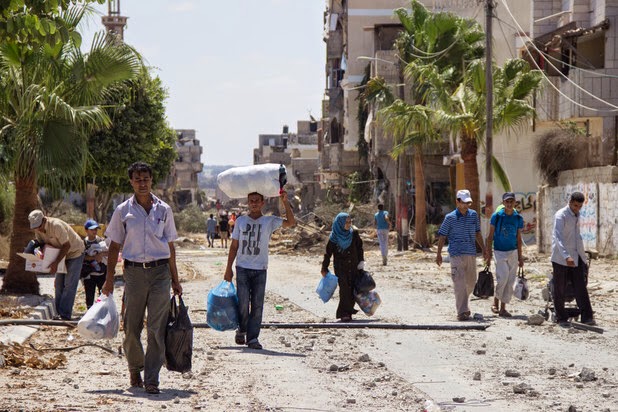
Palestinians recover belongings from the
Khuzaa neighborhood of Khan Younis

Al-Qadr — the night before the last Friday in the holy month of Ramadan — is believed to be the night when the Quran was revealed to the prophet Muhammad. I spent this special night with friends in the occupied West Bank city of Ramallah after participating in the “48K March” for Gaza.

The march began in Ramallah and went to Qalandiya checkpoint. What began as a peaceful event with families bringing their children and even babies in strollers, ended with young Palestinians with gunshot wounds being rushed in ambulances to the local hospital.

Qalandiya crossing was fortified and air-tight, and the Israeli soldiers stationed on top were shooting live ammunition at the crowd.

As the ambulances were speeding through the crowd, I couldn’t help but wonder why there is no hospital between Qalandiya and Ramallah, a good distance which includes the municipalities of Jerusalem, al-Bireh and Ramallah.

The following night I was scheduled to leave Palestine to return to the United States. But Israeli forces sealed all the roads from Ramallah to Jerusalem for the night, and they were likely to be sealed the following day as well.

At the crack of dawn, when things had quietened down, my friend Samer drove me to a checkpoint that he suspected would be open. It was open, albeit for Israelis only, and from there I made my way back to Jerusalem.

That evening, as I was preparing to leave for Ben Gurion airport near Tel Aviv, people around me were trying to calm me down. “Don’t aggravate them, cooperate and they will be nice,” they said. “Why go through all this unnecessary inconvenience?”

They were talking about the “Smiling Gestapo,” Israeli security officers at Tel Aviv airport that go by the squeaky clean name of the Airport Security Division.

Non-cooperation and resistance

Listening to this, I was reminded of Jewish communities under the Nazi regime who believed that if they cooperated and showed they were good citizens then all would be well. But the road from cooperation to the concentration camps and then the gas chambers was a direct one.

The policies of racist discrimination and humiliation at Ben Gurion airport, and the policies of ethnic cleansing and murder of Palestinians in Gaza, emanate from the same Zionist ideology.

As we have seen over the past seven decades, cooperation and laying low do not make things ok.

Cooperation with the Israeli authorities might lead to short-term relief but it also validates Israel’s “right” to terrorize and humiliate Palestinians with our consent, “we” being all people of conscience. Whether we are Palestinian or not, the call of the hour is non-cooperation and resistance against injustice.

Today, Israel and its supporters lay the blame for the violence in Gaza on Hamas. But Israel did not start its assaults on the Gaza Strip when Hamas was established in the late 1980s. Israel began attacking Gaza when the Strip was populated with the first generation refugees in the early 1950s.

Palestinians, particularly in Gaza, are not faced with an option to resist and be killed or live in peace. They are presented with the options of being killed standing up and fighting or being killed sleeping in their beds.

“Sea of hatred”

Gaza is being punished because Gaza is a constant reminder to Israel and the world of the original sin of the ethnic cleansing of Palestine and the creation of a so-called Jewish state. Even though Palestinian resistance has never presented a military threat to Israel, it has always been portrayed as an existential threat to the state.

Moshe Dayan, the famed Israeli general with the eyepatch, described this in a speech in April 1956. He spoke in Kibbutz Nahal Oz, an Israeli settlement on the boundary of the Gaza Strip where Israeli tanks park each time there is a ground invasion of Gaza.

“Beyond the furrow of this border, there surges a sea of hatred and revenge,” Dayansaid then. Ironically, when six months later Israel had occupied Gaza and my father was appointed its military governor, he said that he saw “no hatred or desire for vengeance but a people eager to live and work together for a better future.”

Still, today, Israeli commanders and politicians say pretty much the same: Israel is destined to live by the sword and must strike Gaza whenever possible. Never mind the fact that Palestinians have never posed a military challenge, much less a threat to Israel.

After all, Palestinians have never possessed as much as a tank, a warship or a fighter jet, not to say a regular army.

So why the fear? Why the constant, six-decade-long campaign against Gaza? Because Palestinians in Gaza, more so than anywhere else, pose a threat to Israel’s legitimacy.

Israel is an illegitimate creation brought about by a union between racism and colonialism. The refugees who make up the majority of the population in the Gaza Strip are a constant reminder of this.

They are a reminder of the crime of ethnic cleansing upon which Israel was established. The poverty, lack of resources and lack of freedom stand in stark contrast to the abundance, freedom and power that exist in Israel and that rightfully belongs to Palestinians.

Generous offer

Back at Ben Gurion airport that night, I was told that if I cooperate and plead with the shift supervisor it would make the security screening go faster. When I declined this generous offer, I was told they “did not like my attitude.”

They proceeded to paste a sticker with the same bar code on my luggage and give me the same treatment Palestinians receive.

As I write these words, the number of Palestinians murdered by Israel in Gaza has exceeded two thousand. Ending the insufferable, brutal and racist regime that was created by the Zionists in Palestine is the call of our time.

Criticizing Palestinian resistance is unconscionable. Israel must be subjected toboycott, divestment and sanctions. Israeli diplomats must be sent home in shame. Israeli leaders, and Israeli commanders traveling abroad, must fear prosecution.

And these measures are to be combined with disobedience, non-cooperation and uncompromising resistance. This and only this will show mothers, fathers and children in Gaza that the world cares and that “never again” is more than an empty promise. More


Grain Harvest Fact Sheet

With grain providing much of the calories that sustain humanity, the status of the world grain harvest is a good indicator of the adequacy of the food supply.

Lester Brown

More than 2 billion tons of grain are produced each year worldwide, nearly half of it in just three countries: China, the United States, and India.

Corn, wheat, and rice account for most of the world’s grain harvest. Whereas rice and most wheat are consumed directly as food, corn is largely used for livestock and poultry feed, and for industrial purposes.

Global grain consumption has exceeded production in 8 of the last 14 years, leading to a drawdown in reserves.

Population growth is the oldest source of increasing grain demand. In recent years, the annual growth in grain use has doubled, largely a result of increased use for fuel ethanol and livestock and poultry feed.

In 2013, the United States harvested more than 400 million tons of grain. Of this, 129 million tons (30 percent) went to ethanol distilleries.

Rising yields are the key to expanding the grain harvest as there is little unused cropland. Since 1950, over 93 percent of world grain harvest growth has come from raising yields.

The global grain area planted per person has shrunk from about half an acre (0.2 hectares) in 1950 to a quarter acre (0.1 hectares) in 2013.

At 10 tons per hectare, U.S. corn yields are the highest of any major grain anywhere. In Iowa, some counties harvest up to 13 tons per hectare.

Global average grain yields more than tripled from 1.1 tons per hectare in 1950 to 3.5 tons per hectare in 2013. However, yield growth has slowed from 2.2 percent a year between 1950 and 1990 to 1.4 percent in the years since.

In France, Germany, and the United Kingdom, wheat yields have been flat for more than a decade. The story is similar for rice in Japan and South Korea.

World fertilizer use climbed from 14 million tons in 1950 to 181 million tons in 2013. But in many countries, fertilizer use has reached diminishing returns.

Since 2007, the world has experienced three major grain price spikes. The U.N. Food Price Index indicates that grain in 2014 was twice as expensive as in 2002–04.

Rising global temperatures threaten the world’s major food crops; the “rule of thumb” is that each 1-degree-Celsius rise in temperature (1.8 degrees Fahrenheit) above the growing season optimum can cut productivity by at least 10 percent. More


A Movement Grows in Ferguson

Is the Ferguson Movement the begining of a Nationwide Movement driven by Racism and Economic Disparity?

In the eight days since Michael Brown, an eighteen-year-old, was killed by a police officer named Darren Wilson in Ferguson, Missouri, what began as an impromptu vigil evolved into a sustained protest; it is now beginning to look like a movement. The local QuikTrip, a gas station and convenience store that was looted and burned on the second night of the protests, has now been repurposed as the epicenter for gatherings and the exchange of information. The front of the lot bears an improvised graffiti sign identifying the area as the “QT People’s Park.” With the exception of a few stretches, such as Thursday afternoon, when it was veiled in clouds of tear gas, protesters have been a constant presence in the lot. On Sunday afternoon the area was populated by members of local churches, black fraternity and sorority groups, Amnesty International, the Outcast Motorcycle Club, and twenty or so white supporters from the surrounding area. On the north side of the station, a group of volunteers with a mobile grill served free hot dogs and water, and a man stood on a crate, handing out bright yellow T-shirts with the logo of the National Action Network, the group led by Al Sharpton.

The conversation here has shifted from the immediate reaction to Michael Brown’s death and toward the underlying social dynamics. Two men I spoke with pointed to the disparity in education funding for Ferguson and more affluent municipalities nearby. Another talked about being pulled over by an officer who claimed to smell marijuana in the car as a pretense for searching him. “I’m in the United States Navy,” he told me. “We have to take drug tests in the military so I had proof that there were no drugs in my system. But other people can’t do that.” Six black men I spoke to, nearly consecutively, pointed to Missouri’s felon-disfranchisement laws as part of the equation. “If you’re a student in one of the black schools here and you get into a fight you’ll probably get arrested and charged with assault. We have kids here who are barred from voting before they’re even old enough to register,” one said. Ferguson’s elected officials did not look much different than they had years earlier, when it was a largely white community.

Ferguson had, instead, recently seen two highly visible African-American public officials lose their jobs. Two weeks before Brown was shot, Charles Dooley, an African-American who has served as St. Louis County Executive for a decade, lost a bitter primary election to Steve Stenger, a white county councilman, in a race that, whatever the merits of the candidates, was seen as racially divisive. Stenger lobbed allegations of financial mismanagement and incompetence, and worse. Bob McCulloch, the county prosecutor appeared in an ad for Stenger, associating Dooley with corruption; McCulloch would also be responsible for determining whether to charge Darren Wilson. In December, the largely white Ferguson-Florissant school board fired Art McCoy, the superintendent, who is African-American. Those who were gathered at the QuikTrip parking lot on Saturday were as inclined to talk about the underlying political issues as they were about the hail of bullets that ended Brown’s life.

When word came that afternoon that the governor had announced a curfew, to take effect at midnight, the mood shifted to defiance and disbelief. Few thought that the curfew would do much practical good; many thought it was counterproductive, a move back to militarized police response earlier in the week. Curfew or no, the protesters felt that, with the exception of last Thursday, when Captain Ron Johnson of the Missouri State Highway Patrol, a black Ferguson native, took charge of operations, the amalgam of county and local law enforcement rolling through Ferguson had tried to clear the streets each day at dusk.

On Johnson’s first night in charge, the police presence in the neighborhood was hardly visible; officers withdrew to the perimeter and removed a roadblock that had cut off Florissant Road, which runs just south of the QuikTrip. The protests that night had a giddy quality. Cars drove up and down the strip, the sounds of honking horns accompanying shouts of Brown’s name and “Hands Up, Don’t Shoot,” which has emerged as the signature slogan here.

But as early as Friday morning people began to wonder if Johnson really was in charge, in any meaningful way. Ferguson Police Chief Thomas Jackson began the day by releasing Officer Wilson’s name, which had been kept from the public until then. He undercut that gesture by simultaneously releasing a video that appeared to show Brown menacing a local store owner soon before his encounter with Wilson—thus suggesting that Wilson had been pursuing Brown as a suspect. It took a few hours, and a second press conference, for Jackson to acknowledge that Wilson hadn’t stopped Brown because he thought he was a robber but because Brown was walking in the street and not, as Wilson believed he should, on the sidewalk.

Ron Johnson had to concede that he had not even known that the video would be released; he saw it on television just as everyone else had. (“I would like to have been consulted,” he said at his own press conference.) After sporadic looting on Saturday night—halted largely by other protestors who rushed to protect the establishments being vandalized—Governor Jay Nixon declared a curfew, further undercutting Johnson’s authority. In the span of twenty-four hours, Johnson had gone, in the community’s eyes, from empowered native son to black token. One of the local activists I’d met in Feguson sent me a text message after the curfew announcement saying, “Johnson has good intentions but no power. This is beyond him.”On Sunday, Johnson stepped into the pulpit at Greater Grace Church, the site of a rally, and apologized to Brown’s family, saying, “I wear this uniform and I feel like that needs to be said.” With that, he implicitly condemned the Ferguson Police Department for their failure to do so. Johnson had promised not to use tear gas in the streets of Ferguson but, during a skirmish with looters on Saturday night, police tear-gassed the crowd. Johnson’s address at the church carried the message that his allegiances were, nonetheless, with the people of Ferguson. James Baldwin remarked that black leaders chronically find themselves in a position of asking white people to hurry up while pleading with black people to wait. Johnson finds himself asking black people to remain calm while imploring white police officers not to shoot. The problem here is that few people in Ferguson believe that the former is any guarantee of the latter.

Brown remains unburied. His family, whose faith evaporated early on, refused to simply trust the autopsy performed by local authorities and held out for a second post mortem, by federal authorities. Attorney Eric Holder granted that request late Sunday morning. It might produce a definitive answer to some of the basic questions—like how many times Brown was shot, and whether any of the bullets hit him in the back—that, a week later, remain murky. From the outset, the overlapping bureaucracies in Ferguson handled the case in ways that suggested ineptitude. Yet subsequent developments—the stonewalling followed by contradictory statements, the detention of reporters, the clumsy deployment of sophisticated military equipment—all point not to a department too inept to handle this investigation objectively but one too inept to cloak the fact that they never intended to do so. One protestor held a sign that said, “Ferguson Police Need Better Scriptwriters.” More


In an article by Alex Kane entitled 11 Eye-Opening Facts About America’s Militarized Police Forces the author writing in AlterNet states; The “war on terror” has come home — and it’s wreaking havoc on innocent American lives. The culprit is the militarization of the police.

The weapons that destroyed Afghanistan and Iraq have made their way to local law enforcement. While police forces across the country began a process of militarization — complete with SWAT teams and flash-bang grenades — when President Reagan intensified the “war on drugs,” the post-9/11 “war on terror” has added fuel to the fire.

Through laws and regulations like a provision in defense budgets that authorizes the Pentagon to transfer surplus military gear to police forces, local law enforcement agencies are using weapons found on the battlefields of South Asia and the Middle East.

A recent New York Times article by Matt Apuzzo reported that in the Obama era, “police departments have received tens of thousands of machine guns; nearly 200,000 ammunition magazines; thousands of pieces of camouflage and night-vision equipment; and hundreds of silencers, armored cars and aircraft.” The result is that police agencies around the nation possess military-grade equipment, turning officers who are supposed to fight crime and protect communities into what looks like an invading army. And military-style police raids have increased in recent years, with one count putting the number at 80,000 such raids last year.

In June, the American Civil Liberties Union (ACLU) brought more attention to police militarization when it issued a comprehensive, nearly 100-page report titled, War Comes Home: The Excessive Militarization of American Policing. Based on public records requests to more than 260 law enforcement agencies in 26 states, the ACLU concluded that this police militarization “unfairly impacts people of color and undermines individual liberties, and it has been allowed to happen in the absence of any meaningful public discussion.”

The information contained in the ACLU report — and in other investigations into the phenomenon — is sobering. From the killing of innocent people to the almost complete lack of debate on these policies, police militarization has turned into a key issue for Americans. It is harming civil liberties, ramping up the “war on drugs,” impacting the most marginalized members of society and transforming neighborhoods into war zones. Here are 11 important — and horrifying — things you should know about the militarization of police. More

One has to question the reason for militatising the police departments in the United States and where this is leading? Is the government expecting insurrection or invasion? Are their citizens now enemies of the state? Editor


Facing Rising Ocean, Pacific Island Town Must Relocate

In an unprecedented move that illustrates the dramatic impacts of planetary global warming, one community in the South Pacific has decided it has no choice but to pick itself up entirely and flee for higher ground.

All too aware of their vulnerability to the effects of climate change — such as rising sea levels and extreme weather events — communities in the Pacific Islands have long acknowledged that their very existence isthreatened by global warming.

But now, authorities in a town on Taro Island, a coral atoll off Choiseul in the Solomon Islands that sits less than seven feet above sea level, have decided to relocate to the mainland in response to increasing coastal hazards including tsunamis, storm surges, and erosion. The exodus from Choiseul Bay Township, the provincial capital that's currently home to about 500 people, will take place over many years. It is the first such official migration — of people, services, and facilities — in the Pacific Islands.

According to Reuters, “the groups behind the Choiseul adaptation plan said it is being hailed by the Solomon Islands national government as a model for other provinces across the nation and more broadly across the Pacific.”

The plan comes out of Choiseul Bay Township's consultation with a team of engineers, scientists and planners, funded by the Australian government, on how best to adapt to the impact of climate change. Extensive community input was solicited, Choiseul Province premier Jackson Kiloe said in a statement Friday.

“Relocation is the only option available that will keep the community safe and will allow for future growth and prosperity of the capital and the province,” said Philip Haines, project manager at BMT, an engineering firm that worked on the plan.

Land to build a new, larger settlement that could accommodate up to 5,000 inhabitants has already been acquired, Haines told Reuters. The town will essentially have to be built up from scratch, with a hospital and school expected to be constructed within five years. In the meantime, the plan prescribes detailed actions to increase the community’s resilience to climate change, including the preparation of a tsunami response plan, and the handover of a hand-wound siren to alert the local communities of a tsunami warning.

The Solomon Islands government would be looking for climate change funding from international donors to finance the relocation, Reuters reports.

Some of that funding could come from the U.S., which has millions invested in Asia-Pacific climate change adaptation, as U.S. Secretary of State John Kerry pointed out when he visited the Solomon Islands just last week.

In remarks delivered in Honolulu last week, Kerry said:

I just came from the Solomon Islands yesterday, a thousand islands, some of which could be wiped out if we don’t make the right choices. The Pacific Islands across the entire Pacific are vulnerable to climate change. And just yesterday, I saw with my own eyes what sea level rise would do to parts of it: It would be devastating — entire habitats destroyed, entire populations displaced from their homes, in some cases entire cultures wiped out. They just had flash flooding in Guadalcanal — unprecedented amounts of rainfall. And that’s what’s happened with climate change — unprecedented storms, unprecedented typhoons, unprecedented hurricanes, unprecedented droughts, unprecedented fires, major damage, billions and billions of dollars of damage being done that we’re paying for instead of investing those billions of dollars in avoiding this in the first place. More


Hague court under western pressure not to open Gaza war crimes inquiry

The international criminal court has persistently avoided opening an investigation into alleged war crimesin Gaza as a result of US and other western pressure, former court officials and lawyers claim.

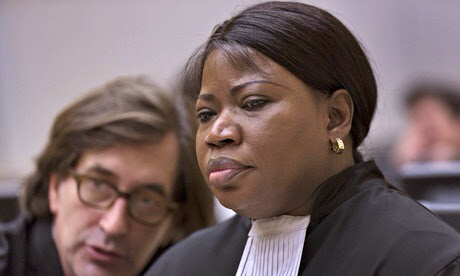
Fatou Bensouda, the international criminal court prosecutor

In recent days, a potential ICC investigation into the actions of both the Israel Defence Forces and Hamas in Gaza has become a fraught political battlefield and a key negotiating issue at ceasefire talks in Cairo. But the question of whether the ICC could or should mount an investigation has also divided the Hague-based court itself.

An ICC investigation could have a far-reaching impact. It would not just examine alleged war crimes by the Israeli military, Hamas and other Islamist militants in the course of recent fighting in Gaza that left about 2,000 people dead, including women and children. It could also address the issue of Israeli settlements in the Palestinian territories, for which the Israeli leadership would be responsible.

The ICC’s founding charter, the 1998 Rome statute (pdf), describes as a war crime “the transfer, directly or indirectly, by the occupying power of parts of its own civilian population into the territory it occupies”.

Also at stake is the future of the ICC itself, an experiment in international justice that occupies a fragile position with no superpower backing. Russia, China and India have refused to sign up to it. The US and Israel signed the accord in 2000 but later withdrew.

Some international lawyers argue that by trying to duck an investigation, the ICC is not living up to the ideals expressed in the Rome statute that “the most serious crimes of concern to the international community as a whole must not go unpunished”.

John Dugard, a professor of international law at the University of Leiden, in the Netherlands, and a longstanding critic of Israel’s human rights record, said: “I think the prosecutor could easily exercise jurisdiction. Law is a choice. There are competing legal arguments, but she should look at the preamble to the ICC statute which says the purpose of the court is to prevent impunity.”

In an exchange of letters in the last few days, lawyers for the Palestinians have insisted that the ICC prosecutor, Fatou Bensouda, has all the legal authority she needs to launch an investigation, based on a Palestinian request in 2009. However, Bensouda is insisting on a new Palestinian declaration, which would require achieving elusive consensus among political factions such as Hamas, who would face scrutiny themselves alongside the Israeli government. There is strong US and Israeli pressure on the Palestinian leader, Mahmoud Abbas, not to pursue an ICC investigation.

Western pressure on the ICC to stay away from the issue has caused deep rifts within the prosecutor’s office. Some former officials say the Palestinians were misled in 2009 into thinking their request for a war crimes investigation – in the wake of an earlier Israeli offensive on Gaza, named Cast Lead – would remain open pending confirmation of statehood. That confirmation came in November 2012 when the UN general assembly (UNGA) voted to award Palestine the status of non-member observer state, but no investigation was launched.

Bensouda initially appeared open to reviewing the standing Palestinian request, but the following year issued a controversial statement (pdf) saying the UNGA vote made no difference to the “legal invalidity” of the 2009 request.

Luis Moreno Ocampo, who was prosecutor at the time of the Palestinian 2009 declaration, backed Bensouda, saying in an email to the Guardian: “If Palestine wants to accept jurisdiction, it has to submit a new declaration.”

But another former official from the ICC prosecutor’s office who dealt with the Palestinian declaration strongly disagreed. “They are trying to hiding behind legal jargon to disguise what is a political decision, to rule out competence and not get involved,” the official said.

Dugard said Bensouda was under heavy pressure from the US and its European allies. “For her it’s a hard choice and she’s not prepared to make it,” he argued. “But this affects the credibility of the ICC. Africans complain that she doesn’t hesitate to open an investigation on their continent.”

Moreno Ocampo took three years to make a decision on the status of the 2009 Palestinian request for an investigation, during which time he was lobbied by the US and Israel to keep away. According to a book on the ICC published this year, American officials warned the prosecutor that the future of the court was in the balance.

According to the book, Rough Justice: the International Criminal Court in a World of Power Politics, by David Bosco, the Americans suggested that a Palestine investigation “might be too much political weight for the institution to bear. They made clear that proceeding with the case would be a major blow to the institution.”

Although the US does not provide funding for the ICC, “Washington’s enormous diplomatic, economic and military power can be a huge boon for the court when it periodically deployed in support of the court’s work,” writes Bosco, an assistant professor of international politics at American University.

In his book, Bosco reports that Israeli officials held several unpublicised meetings with Moreno Ocampo in The Hague, including a dinner at the Israeli ambassador’s residence, to lobby against an investigation.

A former ICC official who was involved in the Palestinian dossier said: “It was clear from the beginning that Moreno Ocampo did not want to get involved. He said that the Palestinians were not really willing to launch the investigation, but it was clear they were serious. They sent a delegation with two ministers and supporting lawyers in August 2010 who stayed for two days to discuss their request. But Moreno Ocampo was aware that any involvement would spoil his efforts to get closer to the US.”

Moreno Ocampo denied that he had been influenced by US pressure. “I was very firm on treating this issue impartially, but at the same time respecting the legal limits,” he said in an email on Sunday. “I heard all the arguments. I received different Oxford professors who were explaining the different and many times opposing arguments, and I concluded that the process should … go first to the UN. They should decide what entity should be considered a state.”

He added: “Palestine was using the threat to accept jurisdiction to negotiate with Israel. Someone said that if you have nine enemies surrounding you and one bullet, you don’t shoot, you try to use your bullet to create leverage.”

A spokeswoman for his successor, Fatou Bensouda, rejected allegations of bias in the prosecutor’s choice of investigations. “The ICC is guided by the Rome statute and nothing else,” she said. “Strict rules about jurisdiction, about where and when ICC can intervene should be not be deliberately misrepresented … Geographical and political consideration will thus never form part of any decision making by the office.”

The French lawyer representing the Palestinians, Gilles Devers, argued that it was for the court’s preliminary chamber, not the ICC’s prosecutor, to decide on the court’s jurisdiction in the Palestinian territories. Devers said negotiations were continuing among the Palestinian parties on whether to file a new request for an investigation, even though he believed it to be unnecessary in legal terms. Ultimately, he said, the outcome would be determinedly politically.

“There is enormous pressure not to proceed with an investigation. This pressure has been exerted on Fatah and Hamas, but also on the office of the prosecutor,” Devers said. “In both cases, it takes the form of threats to the financial subsidies, to Palestine and to the international criminal court.”

Among the biggest contributors to the ICC budget are the UK and France, which have both sought to persuade the Palestinians to forego a war crimes investigation. More


76 Year old Najiba Mansoor an Assyirian IDP displaced by the war with ISIS


ERBIL IRAQ KURDISTAN: 76 Year old Najiba Mansoor an Assyirian displaced by the war with ISIS and Peshmaga fighters sleeps on her makeshift bed in an abandoned construction site in the Iraqi Kurdish capital Erbil. I showed Najiba this image on the back of my camera and she burst into tears

“Is that all I have left now a filthy mattress and my broken wheel chair, no no no how did this happen”

Image Copyright: Sebastian Rich / AII rights reserved


Central America braces for drought-linked food crisis

Low rainfall linked to the El Nino weather phenomenon has led to drought in parts of Central America, causing widespread damage to crops, shortages and rising prices of food, and worsening hunger among the region’s poor.

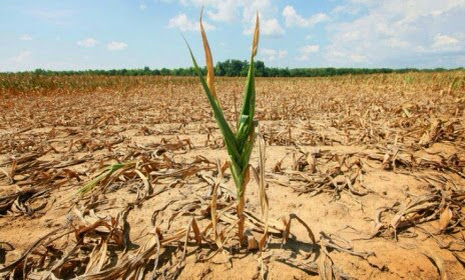
An unusually hot season and extended dry spells have brought drought to areas in eastern and western Guatemala and El Salvador, southern Honduras and northern and central Nicaragua, destroying swathes of bean and maize crops, the region’s staple foods, and putting pressure on subsistence farmers and food prices.

“Extremely poor households across large areas of Guatemala, Nicaragua, Honduras, and El Salvador will experience a rapid deterioration in their food security in early 2015.

“Atypically high levels of humanitarian assistance, possibly the highest since Hurricane Mitch in 1998, will likely be required in order to avoid a food crisis,” said a recent report by the Famine Early Warning Systems Network (FEWS NET), run by the US Agency for International Development (USAID).

Thousands of families in the region have become too poor to buy enough food for survival because poor harvests are pushing up prices of staple foods while coffee producers are hiring fewer seasonal coffee pickers and paying lower wages because of a coffee leaf rust or roya epidemic across Central America.

In Nicaragua and Honduras, red bean prices rose by up to 129 percent between January and June 2014, according to FEWS NET.

Other livelihoods in Central America, including fishing and livestock breeding, have also been hard hit by the recent drought and the El Nino weather phenomenon, FEWS NET said.

El Nino, which can last more than a year, significantly raises surface temperatures in the central and eastern areas of the tropical Pacific Ocean, a phenomenon linked to major climate fluctuations around the world.

In response to the drought, the Guatemalan government has said it will begin distributing 4,000 tonnes of food aid to more than 170,000 families affected by the drought from early October, using government and United Nations World Food Programme (WFP) food reserves.

One of the poorest countries in Central America, Guatemala already struggles to feed its population, particularly those impoverished indigenous communities living in rural areas.

Around half Guatemala’s population of 15 million lives in poverty and the country has the world’s fourth highest rate of chronic malnutrition, which affects almost half the children under five, according to the WFP.

In neighboring Honduras, the government is distributing food, including rice, beans and flour, and vitamin supplements to 76,000 families, many subsistence farmers, affected by the drought.

First Blogged on http://robinwestenra.blogspot.com/

China Suffers Drought, Water Shortage

This summer has been one of the hottest in decades in Jilin Province, China, and several counties are facing the complete loss of their harvests.

Currently, Changling, Nongan, Gongzhuling and 10 other agricultural counties in Jilin are facing a severe drought. The severity of the drought is comparable to that in 1951.

A villager Ms. Lee from Wanglong village, Huajia Township, Nongan County, Changhun City, told Epoch Times: “The drought is very bad. All the corn leaves have turned yellow. Corns are not fully grown, only their tips are seen with barely any kernels.”

Since July 1 this year, the rainfall in Jilin Province totaled only 4.4 inches, which is about 48 percent less compared to the same period from previous years. This year had the second lowest rainfall in history; the least amount since 1951.

Over 14 million acres of farmland are affected.

Government data indicates the drought has impacted more than 1.3 million acres of farmland in the major agricultural areas of Jilin with no improvements in sight. According to the weather forecast, the average rainfall could be as low as a third of an inch per day.

Ms. Lee, a villager from Wanglong village said: “Even the water level of our own well is slowly dropping. It is only enough for domestic use. Our farmland has not been irrigated for over a month.”

Mr. Sun from Zhen-Chai village, Nongan County said that all their cucumber plants have perished from the drought.

Chinese media has reported two-thirds of the corn stalks have withered in some towns while others have completely perished.

Local governments have not taken any measure to tackle this problem and villagers are on their own. A staff member at Jilin Grain Bureau only briefly told Epoch Times that the situation was “unclear” and then hung up the phone.

Other Provinces Impacted

During the summer, a total of 12 provinces, including Shandong, Henan, Shaanxi Anhui, Hubei, Gangsu, and Xinjiang, have been affected by the drought. Over 14 million acres of farmland are affected.

Henan Province, for example, is witnessing the worst drought in the last 63 year with 740,000 people facing a temporary shortage of drinking water. In Shandong Province the cost of the lost harvest is reaching $630 million.

All these statistics put into question the recently announced food exports to Russia. After Russia announced it would stop importing food from Europe, the United States, and Australia, China immediately started building a warehouse on the Russian boarder to facilitate customs clearance for fruit going into Russia. More