Major Companies Push for More, Easier Renewable Energy

Some of the largest companies in the United States have banded together to call for a substantial increase in the production of renewable electricity, as well as for more simplicity in purchasing large blocs of green energy.
A dozen U.S-based companies, most of which operate globally, say they want to significantly step up the amount of renewable energy they use, but warn that production levels remain too low and procurement remains too complex. The 12 companies have now put forward a set of principles aimed at helping to “facilitate progress on these challenges” and lead to a broader shift in the market.

“We would like our efforts to result in new renewable power generation,” the Corporate Renewable Energy Buyers’ Principles, released Friday, state. The companies note “our desire to promote new projects, ensure our purchases add new capacity to the system, and that we buy the most cost-competitive renewable energy products.”

The principles consist of six broad reforms, aimed at broadening and strengthening the renewable energy marketplace. Companies want more choice in their procurement options, greater cost competitiveness between renewable and traditional power sources, and “simplified processes, contracts and financing” around the long-term purchase of renewables.

Founding signatories to the principles, which were shepherded by civil society, include manufacturers and consumer goods companies (General Motors, Johnson & Johnson, Mars, Proctor & Gamble), tech giants (Facebook, HP, Intel, Sprint) and major retailers (Walmart, the outdoor-goods store REI).

These 12 companies combined have renewable energy consumption targets of more than eight million megawatt hours of energy through the end of this decade, according to organisers. Yet the new principles, meant to guide policy discussions, have come about due to frustration over the inability of the U.S. renewables market to keep up with spiking demand.

“The problem these companies are seeing is that they’re paying too much, even though they know that cost-effective renewable energy is available. These companies are used to having choices,” Marty Spitzer, director of U.S. climate policy at the World Wildlife Fund (WWF), a conservation and advocacy group that helped to spearhead the principles, told IPS.

WWF was joined in the initiative by the World Resources Institute and the Rocky Mountain Institute, both think tanks that focus on issues of energy and sustainability.

“The companies have also recognised that it’s often very difficult to procure renewables and bring them to their facilities,” Spitzer continues. “While most of them didn’t think of it this way at first, they’ve now realised that they have been experiencing a lot of the same problems.”

‘Too difficult’

In recent years, nearly two-thirds of big U.S. businesses have created explicit policies around climate goals and renewable energy usage, according to WWF. While there is increasing political and public compunction behind these new policies, a primary goal remains simple cost-cutting and long-term efficiencies.

“A significant part of the value to us from renewable energy is the ability to lock in energy price certainty and avoid fuel price volatility,” the principles note.

In part due to political deadlock in Washington, particularly around issues of climate and energy, renewable production in the United States remains too low to keep up with this corporate demand. According to the U.S. government, only around 13 percent of domestic energy production last year was from renewable sources.

Accessing even that small portion of the market remains unwieldy.

“We know cost-competitive renewable energy exists but the problem is that it is way too difficult for most companies to buy,” Amy Hargroves, director of corporate responsibility and sustainability for Sprint, a telecommunications company, said in a statement.

“Very few companies have the knowledge and resources to purchase renewable energy given today’s very limited and complex options. Our hope is that by identifying the commonalities among large buyers, the principles will catalyse market changes that will help make renewables more affordable and accessible for all companies.”

One of the most far-reaching sustainability commitments has come from the world’s largest retailer, Walmart. A decade ago, the company set an “aspirational” goal for itself, to be supplied completely by renewable energy.

Last year, it created a more specific goal aimed at helping to grow the global market for renewables, pledging to drive the production or procurement of seven billion kilowatt hours of renewable energy globally by the end of 2020, a sixfold increase over 2010. (The company is also working to increase the energy efficiency of its stores by 20 percent over this timeframe.)

While the company has since become a leader in terms of installing solar and wind projects at its stores and properties, it has experienced frustrations in trying to make long-term bulk purchases of renewable electricity from U.S. utilities.

“The way we finance is important … cost-competitiveness is very important, as is access to longer-term contracts,” David Ozment, senior director of energy at Walmart, told IPS. “We like to use power-purchase agreements to finance our renewable energy projects, but currently only around half of the states in the U.S. allow for these arrangements.”

Given Walmart’s size and scale, Ozment says the company is regularly asked by suppliers, regulators and utilities about what it is looking for in power procurement. The new principles, he says, offer a strong answer, providing direction as well as flexibility for whatever compulsion is driving a particular company’s energy choices, whether “efficiency, conservation or greenhouse gas impact”.

“We’ve seen the price of solar drop dramatically over the past five years, and we hope our participation helped in that,” he says. “Now, these new principles will hopefully create the scale to continue to drop the cost of renewables and make them more affordable for everyone.”

Internationally applicable

Ozment is also clear that the new principles need not apply only to U.S. operations, noting that the principles “dovetail” with what Walmart is already doing internationally.

In an e-mail, a representative for Intel, the computer chip manufacturer, likewise told IPS that the company is “interested in promoting renewables markets in countries where we have significant operations … at a high level, the need to make renewables both more abundant and easier to access applies outside the U.S.”

For his part, WWF’s Spitzer says that just one of the principles is specific to the U.S. regulatory context.

“Many other countries have their own instruments on renewable production,” he says, “but five out of these six principles are relevant and perfectly appropriate internationally.”

Meanwhile, both the principles and their signatories remain open-ended. Spitzer says that just since Friday he’s heard from additional companies interested in adding their support. More


Palestinian factions reportedly set 10 conditions for 10-year truce with Israel

Reports in Israeli and Palestinian media say that the two Palestinian resistance groups Hamas and Islamic Jihad have set forth ten conditions for a ceasefire and ten-year truce with Israel.

Israel’s Maariv said that an unnamed “senior Palestinian official” passed it a copy of the demands, which have been transmitted by the factions to Egypt.

They include an end to all armed hostilities, the end of the siege of Gaza, and the construction of internationally supervised air and seaports.

Palestinians sleep in UN school

While Hamas has not as yet officially stated these demands, they are in line with the group’s long-standing policy of offering Israel a multi-year truce.

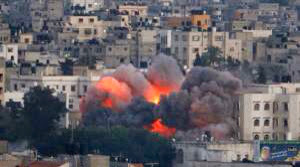
The reported conditions come after nine days of Israeli bombardment of the Gaza Strip that has killed more than 200 people, injured close to 1,400, and destroyed the homes of 8,200 others. Almost 80 percent of the dead, who include more than thirty children, are civilians, according to the UN.

Yesterday, Hamas refused to respond to a unilateral “ceasefire” declared by Israel that would have left the situation of siege on the Gaza Strip unchanged.

Airport, seaport and an end to violence

The ten conditions were translated by The Electronic Intifada from an Arabic version published by Ma’an News Agency:

  • Mutual cessation of the war and withdrawal of tanks to previous locations and the return of farmers to work their land in the agricultural border areas.
  • Release of all the Palestinians detained since 23 June 2014 and improvement of the conditions of Palestinian prisoners, especially the prisoners from Jerusalem, Gaza and Palestinians of the interior [present-day Israel].
  • Total lifting of the siege of Gaza and opening the border crossings to goods and people and allowing in all food and industrial supplies and construction of a power plant sufficient to supply all of Gaza.
  • Construction of an international seaport and an international airport supervised by the UN and non-biased countries.
  • Expansion of the maritime fishing zone to 10 kms and supplying fishermen with larger fishing and cargo vessels.
  • Converting the Rafah crossing into an international crossing under supervision of the UN and Arab and friendly countries.
  • Signing a 10-year truce agreement and deployment of international monitors to the borders.
  • A commitment by the occupation government not to violate Palestinian airspace and easing of conditions for worshipers in Al-Aqsa Mosque.
  • The occupation will not interfere in the affairs of the Palestinian government and will not hinder national reconciliation.
  • Restoration of the border industrial areas and their protection and development.

“Should have been met years ago”


Dr. Ramy Abdu, chair of the independent group Euro-Mid Observer for Human Rights (euromid.org, told The Electronic Intifada from Gaza City this morning:

I believe that these requirements should have been met years ago. The core of these requirements are not political but purely humanitarian and legally binding. The international community has called many times for their implementation. Palestinians have the right to move in and out freely like others in the world. They have the right to import and export, to control their borders and airspace. Israel argues that it left Gaza, so it should stop controlling the lives of Palestinians.

Abdu noted that his organization recently published a detailed proposal to establish a maritime link from Gaza to the rest of the world with an international role that could “alleviate security concerns.” More


How Politics and Lies Triggered an Unintended War in Gaza

In the flood of angry words that poured out of Israel and Gaza during a week of spiraling violence, few statements were more blunt, or more telling, than this throwaway line by the chief spokesman of the Israeli military, Brigadier General Moti Almoz, speaking July 8 on Army Radio’s morning show: “We have been instructed by the political echelon to hit Hamas hard.”

That’s unusual language for a military mouthpiece. Typically they spout lines like “We will take all necessary actions” or “The state of Israel will defend its citizens.” You don’t expect to hear: “This is the politicians’ idea. They’re making us do it.”

Admittedly, demurrals on government policy by Israel’s top defense brass, once virtually unthinkable, have become almost routine in the Netanyahu era. Usually, though, there’s some measure of subtlety or discretion. This particular interview was different. Where most disagreements involve policies that might eventually lead to some future unnecessary war, this one was about an unnecessary war they were now stumbling into.

Spokesmen don’t speak for themselves. Almoz was expressing a frustration that was building in the army command for nearly a month, since the June 12 kidnapping of three Israeli yeshiva boys. The crime set off a chain of events in which Israel gradually lost control of the situation, finally ending up on the brink of a war that nobody wanted — not the army, not the government, not even the enemy, Hamas.

The frustration had numerous causes. Once the boys’ disappearance was known, troops began a massive, 18-day search-and-rescue operation, entering thousands of homes, arresting and interrogating hundreds of individuals, racing against the clock. Only on July 1, after the boys’ bodies were found, did the truth come out: The government had known almost from the beginning that the boys were dead. It maintained the fiction that it hoped to find them alive as a pretext to dismantle Hamas’ West Bank operations.

The initial evidence was the recording of victim Gilad Shaer’s desperate cellphone call to Moked 100, Israel’s 911. When the tape reached the security services the next morning — neglected for hours by Moked 100 staff — the teen was heard whispering “They’ve kidnapped me” (“hatfu oti”) followed by shouts of “Heads down,” then gunfire, two groans, more shots, then singing in Arabic. That evening searchers found the kidnappers’ abandoned, torched Hyundai, with eight bullet holes and the boys’ DNA. There was no doubt.

Prime Minister Benjamin Netanyahu immediately placed a gag order on the deaths. Journalists who heard rumors were told the Shin Bet wanted the gag order to aid the search. For public consumption, the official word was that Israel was “acting on the assumption that they’re alive.” It was, simply put, a lie.

Moti Almoz, as army spokesman, was in charge of repeating the lie. True, others backed him up, including Defense Minister Moshe Yaalon. But when the truth came out on July 1, Almoz bore the brunt of public derision. Critics said his credibility was shot. He’d only been spokesman since October, after a long career as a blunt-talking field commander with no media experience. Others felt professional frustration. His was personal.

Nor was that the only fib. It was clear from the beginning that the kidnappers weren’t acting on orders from Hamas leadership in Gaza or Damascus. Hamas’ Hebron branch — more a crime family than a clandestine organization — had a history of acting without the leaders’ knowledge, sometimes against their interests. Yet Netanyahu repeatedly insisted Hamas was responsible for the crime and would pay for it.

This put him in a ticklish position. His rhetoric raised expectations that after demolishing Hamas in the West Bank he would proceed to Gaza. Hamas in Gaza began preparing for it. The Israeli right — settler leaders, hardliners in his own party — began demanding it.

But Netanyahu had no such intention. The last attack on Gaza, the eight-day Operation Pillar of Defense in November 2012, targeted Hamas leaders and taught a sobering lesson. Hamas hadn’t fired a single rocket since, and had largely suppressed fire by smaller jihadi groups. Rocket firings, averaging 240 per month in 2007, dropped to five per month in 2013. Neither side had any desire to end the détente. Besides, whatever might replace Hamas in Gaza could only be worse.

The kidnapping and crackdown upset the balance. In Israel, grief and anger over the boys’ disappearance grew steadily as the fabricated mystery stretched into a second and third week. Rallies and prayer meetings were held across the country and in Jewish communities around the world. The mothers were constantly on television. One addressed the United Nations in Geneva to plead for her son’s return. Jews everywhere were in anguish over the unceasing threat of barbaric Arab terror plaguing Israel.

This, too, was misleading. The last seven years have been the most tranquil in Israel’s history. Terror attacks are a fraction of the level during the nightmare intifada years — just six deaths in all of 2013. But few notice. The staged agony of the kidnap search created, probably unintentionally, what amounts to a mass, worldwide attack of post-traumatic stress flashback.

When the bodies were finally found, Israelis’ anger exploded into calls for revenge, street riots and, finally, murder.

Amid the rising tension, cabinet meetings in Jerusalem turned into shouting matches. Ministers on the right demanded the army reoccupy Gaza and destroy Hamas. Netanyahu replied, backed by the army and liberal ministers, that the response must be measured and careful. It was an unaccustomed and plainly uncomfortable role for him. He was caught between his pragmatic and ideological impulses.

In Gaza, leaders went underground. Rocket enforcement squads stopped functioning and jihadi rocket firing spiked. Terror squads began preparing to counterattack Israel through tunnels. One tunnel exploded on June 19 in an apparent work accident, killing five Hamas gunmen, convincing some in Gaza that the Israeli assault had begun while reinforcing Israeli fears that Hamas was plotting terror all along.

On June 29, an Israeli air attack on a rocket squad killed a Hamas operative. Hamas protested. The next day it unleashed a rocket barrage, its first since 2012. The cease-fire was over. Israel was forced to retaliate for the rockets with air raids. Hamas retaliated for the raids with more rockets. And so on. Finally Israel began calling up reserves on July 8 and preparing for what, as Moti Almoz told Army Radio, “the political echelon instructed.”

Later that morning, Israel’s internal security minister Yitzhak Aharonovitch told reporters that the “political echelon has given the army a free hand.” Almoz returned to Army Radio that afternoon and confirmed that the army had “received an absolutely free hand” to act.

And how far, the interviewer asked, will the army go? “To the extent that it’s up to the army,” Almoz said, “the army is determined to restore quiet.” Will simply restoring quiet be enough? “That’s not up to us,” he said. The army will continue the operation as long as it’s told.

The operation’s army code-name, incidentally, is “Protective Edge” in English, but the original Hebrew is more revealing: Tzuk Eitan, or “solid cliff.” That, the army seems to feel, is where Israel is headed. More

Contact J.J. Goldberg at goldberg@forward.com


The Unity of Water

MOSCOW – In May, Vietnam became the 35th and decisive signatory of the 1997 United Nations Convention on the Law of the Non-Navigational Uses of International Watercourses. As a result, 90 days later, on August 17, the convention will enter into force.

The fact that it took almost 50 years to draft and finally achieve the necessary ratification threshold demonstrates that something is very wrong with the modern system of multilateralism. Regardless of longstanding disagreements over how cross-border freshwater resources should be allocated and managed, and understandable preferences by governments and water professionals to rely on basin agreements rather than on international legal instruments, that half-century wait can be explained only by a lack of political leadership. So, though the world may celebrate the convention’s long-awaited adoption, we cannot rest on our laurels.

Roughly 60% of all freshwater runs within cross-border basins; only an estimated 40% of those basins, however, are governed by some sort of basin agreement. In an increasingly water-stressed world, shared water resources are becoming an instrument of power, fostering competition within and between countries. The struggle for water is heightening political tensions and exacerbating impacts on ecosystems.

But the really bad news is that water consumption is growing faster than population – indeed, in the twentieth century it grew at twice the rate. As a result, several UN agencies forecast that, by 2025, 1.8 billion people will be living in regions stricken with absolute water scarcity, implying a lack of access to adequate quantities for human and environmental uses. Moreover, two-thirds of the world’s population will face water-stress conditions, meaning a scarcity of renewable freshwater.

Without resolute counter-measures, demand for water will overstretch many societies’ adaptive capacities. This could result in massive migration, economic stagnation, destabilization, and violence, posing a new threat to national and international security.

The UN Watercourses Convention must not become just another ignored international agreement, filed away in a drawer. The stakes are too high. In today’s context of climate change, rising demand, population growth, increasing pollution, and overexploited resources, everything must be done to consolidate the legal framework for managing the world’s watersheds. Our environmental security, economic development, and political stability directly depend on it.

The convention will soon apply to all of the cross-border rivers of its signatories’ territories, not just the biggest basins. It will complement the gaps and shortcomings of existing agreements and provide legal coverage to the numerous cross-border rivers that are under increasing pressure.

Worldwide, there are 276 cross-border freshwater basins and about as many cross-border aquifers. Backed by adequate financing, political will, and the engagement of stakeholders, the convention can help address the water challenges that we are all facing. But will it?

An ambitious agenda should be adopted now, at a time when the international community is negotiating the contents of the Sustainable Development Goals (SDGs), the successor to the UN Millennium Development Goals, which will expire in 2015. We at Green Cross hope that the new goals, which are to be achieved by 2030, will include a stand-alone target that addresses water-resources management.

Moreover, the international community will soon have to agree on a climate-change framework to replace the Kyoto Protocol. Climate change directly affects the hydrological cycle, which means that all of the efforts that are undertaken to contain greenhouse-gas emissions will help to stabilize rainfall patterns and mitigate the extreme water events that so many regions are already experiencing.

But the UN Watercourses Convention’s entry into force raises as many new questions as existed in the period before its ratification. What will its implementation mean in practice? How will countries apply its mandates within their borders and in relation to riparian neighbors? How will the American and Asian countries that have largely ignored ratification respond?

Furthermore, how will the convention relate to the Convention on the Protection and Use of Transboundary Watercourses and International Lakes, which is already in force in most European and Central Asian countries and, since February 2013, has aimed to open its membership to the rest of the world? Similarly, how will the convention’s implementation affect existing regional and local cross-border freshwater agreements?

The countries that ratified the UN Watercourses Convention are expected to engage in its implementation and to go further in their efforts to protect and sustainably use their cross-border waters. What instruments, including financial, will the convention provide to them?

Several legal instruments can be implemented jointly and synergistically: the Ramsar Convention on Wetlands, the UN Convention to Combat Desertification, and the UN Framework Convention on Climate Change, to name just a few. The UN Watercourses Convention’s long-delayed enactment should be viewed as an opportunity for signatory states to encourage those that are not yet party to cooperative agreements to work seriously on these issues.

Clearly, politicians and diplomats alone cannot respond effectively to the challenges that the world faces. What the world needs is the engagement of political, business, and civil-society leaders; effective implementation of the UN Watercourses Convention is impossible without it.

This is too often overlooked, but it constitutes the key to the long-term success of cooperation that generates benefits for all. Inclusive participation by stakeholders (including the affected communities), and the development of the capacity to identify, value, and share the benefits of cross-border water resources, should be an integral part of any strategy to achieve effective multilateral collaboration. More


New Study Reveals Whales as Marine Ecosystem Engineers

Baleen and sperm whales, known collectively as the great whales, include the largest animals in the history of life on Earth.

Though large in size, whales have long been considered too rare to make much of a difference in the ocean, and the focus of much marine ecological research has been on smaller organisms, such as algae and planktonic animals. While these small organisms are essential to life in the sea, they are not the whole story. As great whales recover from centuries of overhunting, scientists are beginning to appreciate their roles as ecosystem engineers of the ocean.

A recent synthesis, published in Frontiers in Ecology and the Environment, evaluates decades of research on the ecological role of great whales. The authors, led by Joe Roman at the University of Vermont, suggest that the influence of these animals has been substantially undervalued because, until now, scientists have underestimated the degree to which the decline in whale population has altered marine ecosystems.

Commercial whaling dramatically reduced the abundance of great whales—by at least 66 percent and perhaps as high as 90 percent, according to some estimates—but recovery is possible, and potentially critical for ocean resiliency.

Among their many ecological functions, whales recycle nutrients and enhance primary productivity, locally and on a regional scale. Whales mix the water column, and after feeding at depth, release surface plumes of fecal material. This “whale pump” supplies iron and nitrogen—essentially fertilizers—to primary producers in the surface ocean. Further, the migrations of baleen whales between highly productive, high-latitude feeding and low-latitude calving grounds are among the longest annual movements of mammals. By fasting in these winter calving grounds near the equator, humpback whales, for example, release nitrogen in the form of urea into comparatively nutrient-poor areas—transporting nutrients nearly 10,000 kilometers on the “great whale conveyor belt.”

Sometimes, commercial fishermen have seen whales as competition. But this new paper summarizes a strong body of evidence that indicates the opposite can be true: whale recovery “could lead to higher rates of productivity in locations where whales aggregate to feed and give birth,” supporting more robust fisheries.

Whales, as one of the longer-lived species in marine systems, can ease the impact of perturbations inclimate, predation and productivity. The continued recovery of great whales may help buffer marine ecosystems from destabilizing stresses and could lead to higher rates of productivity in locations where whales aggregate to feed and give birth.

And when they die, many whale carcasses sink to dark depths of the ocean—delivering massive pulses of organic material to a realm that is typically nutrient and energy impoverished. A 40-ton gray whale, for example, provides more than 2,000 times the background carbon flux that would typically rain down on the area underlying the carcass in an entire year.

“Whales appear to harbor a specialized suite of animals in the deep sea, with many species requiring whale falls to complete their life cycles and persist in the ocean,” said Craig Smith, co-author and Oceanography Professor at the University of Hawai‘i at Mānoa. “When whales were removed from the ocean by whalers, these whale-fall specialists lost their essential habitat.” More

________________________________________________

I question if it would be possible for humans to work with marine mamals and other sea creatures to 'manage' the oceans for the benefit of the marine environment, the inhabitants of the oceans as well as the living beings on the planet. It would certainly be beneficial to all concerned and would possible go some way towards mitigating climate change. Editor


World first: Australian solar plant has generated “supercritical” steam that rivals fossil fuels’

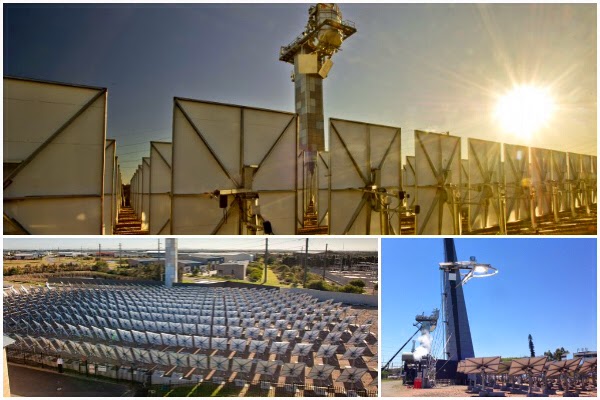
A solar thermal test plant in Newcastle, Australia, has generated “supercritical” steam at a pressure of 23.5 mpa (3400 psi) and 570°C (1,058°F).

CSIRO is claiming it as a world record, and it’s a HUGE step for solar thermal energy.

“It's like breaking the sound barrier; this step change proves solar has the potential to compete with the peak performance capabilities of fossil fuel sources,” Dr Alex Wonhas, CSIRO’s Energy Director, told Colin Jeffrey for Gizmag.

The Energy Centre uses a field of more than 600 mirrors (known as heliostats) which are all directed at two towers housing solar receivers and turbines, Gizmag reports.

This supercritical steam is used to drive the world’s most advanced power plant turbines, but previously it’s only been possible to produce it by burning fossil fuels such as coal or gas.

“Instead of relying on burning fossil fuels to produce supercritical steam, this breakthrough demonstrates that the power plants of the future could instead be using the free, zero emission energy of the sun to achieve the same result,” Dr Wonhas explained.

Currently, commercial solar thermal or concentrating solar power power plants only operate a “subcritical” levels, using less pressurised steam. This means that they’ve never been able to match the output or efficiency of the world’s best fossil fuel power plants – until now.

The commercial development of this technology is still a fair way off, but this is an important first step towards a more sustainable future. More

Watch the video to see the plant in action.


Famke Janssen addresses the World Youth Parliament for Water

gcint.org

March 14

Dear friends and distinguished members of the World Youth Parliament for Water.

The efforts of youth from all around the world to offer solutions and to work together to tackle the global water crisis both humble and inspire me. You are truly making a difference.

President Gorbachev, who spoke at the opening of the World Water Forum just two days ago, believes in the power of all people, particularly the youth, to make change aimed at protecting the environment. Young people – who will be tomorrow’s leaders — have a vital role to play to ensure all people can live free of poverty and insecurity, and enjoy a world that conserves – not exploits – its many natural wonders.

I come from the Netherlands, a country that has a lot of experience in “coping” with water. My country is one that is vulnerable to global warming and rising oceans. Fortunately, we have a long history of finding ways to stop the ocean from flooding much of a country that rests largely below sea level. Water is a central part of Dutch life, from our many canals and dikes to the water-powered windmills that are dotted all over the country. Many historians argue that our social organization was built on the need for communities to organize democratically in order to pull together to stop an invading ocean or a broken dike – a recognition that water crises do not discriminate whether they come in the form of floods or drought and, most importantly, that water crises can unite people and not only separate them.

The Netherlands, however, is not a country associated with scarcity of water, a curse for many populations today that will grow much worse. For our world is already buckling under the weight of our 7-billion strong population, and in less than 20 years from now, we will have grown to 8.3 billion . As you know, this will only increase the demand for water. Consequently, by 2025 experts estimate that two-thirds of the world’s population could be living under water stressed conditions.

Water scarcity is the problem that our future generations will have to face. Responsibility for solving this global challenge, some might say, lies unfairly in the hands of you and young people around the world. You did not cause the crisis, but it will be up to today’s youth to be prepared for steering our world toward a more sustainable future, a path that will ensure we respond to the water crisis, fairly share our available water resources, promote conservation and end waste, and help millions upon millions of people realize their basic Human Right to have access to safe Water and Sanitation.

Lack of adequate drinking water and poor or non-existent sanitation target the youth unfairly. For example, 443 million school days are missed every year due to sickness caused by water-related diseases, such as diarrhoea, dysentery and cholera. Lack of access to safe drinking water and sanitation is one of the main obstacles to education today. This is bad, but what is absolutely intolerable is that diarrhoea is the world’s second biggest killer of children and accounts for 1.5 million young lives every year. Moreover, in the absence of functioning drainage systems, water forms stagnant puddles that are soon infested with malaria-carrying mosquitoes: 3600 people die of malaria each day and 3200 of them are children. These grim statistics do not even take into account the ravages imposed on children as a result of water scarcity, which affects the availability of food and increases the risk of malnutrition among children.

Young girls are especially vulnerable to today’s water problems. For in many communities, young girls fetch water – often walking many miles to do so – placing their health, safety, education and development at grave risk. If a girl’s town or village has no safe source of water, it is often her job to collect it for her family, meaning she cannot attend school. This is a double tragedy that must be overcome.

Another factor against girls is the lack of sanitation facilities in schools, which can force many to stop attending classes when they reach puberty. Without education, futures of children and young women are being lost.

Without access to safe water and education, many young people will find it even harder – if not impossible – to rise out of poverty. As a result, when they become parents themselves, their own children will be trapped by the same problems.

But there are things we can all do today.

You are an extremely powerful voice of change. The more noise you make the more power you have. You have the right to demand a better world, as you are the ones who will inherit the problems we have caused. There are concrete actions that you can take that will result in meaningful change.

Green Crosses’ Green Lane Environmental Diary, which some of you may have participated in, shows ways to reduce our water footprints, from taking shorter showers, to avoiding use of plastic bottles. These basic tips, when practiced by an entire community can result in massive changes in the management of water resources. These are guidelines for individuals but collectively they can have profound impacts.

On a policy level you can demand that countries that have not ratified the United Nations Watercourses Convention do so. Some of you live in places that have not ratified the Convention and just 11 more signatures are needed from governments to validate it. It is the only global set of regulations and measures drafted for governing the more than 270 rivers in the world that are shared by multiple countries. 145 countries share these rivers and the groundwater linked to them. Their basins are home to 40% of the planet’s human population. But only 40% of these rivers are covered by official agreements on how to share and manage them, many of which are unsatisfactory. These weaknesses must be addressed if we are to tackle global challenges such as climate change and growing water demands.

Since you are here you have already developed the taste for politics. As potential future parliamentarians you will demand that the Right to Water and Sanitation is enshrined in your country’s constitutions and laws. It is imperative that you do all in your power to ensure your fellow countrymen and women can realize this fundamental, life-preserving right.

After meeting many of you and seeing what you have done here in Marseille, I have great confidence in your abilities to make a difference when it comes to ensuring all people have access to safe water.

I know you wont forget the experiences you have had here at the World Youth Parliament for Water. But I urge you to apply what you have absorbed, and put it into action, first and foremost in your own communities, and hopefully further afield.

Eleanor Roosevelt said, “the future belongs to those who believe in the beauty of their dreams”. I encourage you to start believing. Thank you for the honor to speak with you and good luck. More


The Peak Oil Crisis: Iraq on the Precipice

The daily newspapers are now full of stories predicting that Iraq, as we know it, will soon disintegrate into three or more warring states.

Tom Whipple

In the last two weeks Sunni insurgents led by the extremist ISIS have routed a good part of the Iraqi army, taken over much of northern Iraq not controlled by the Kurds, and now are moving close to Baghdad. Despite the dispatch of American and Iranian military advisors to at least assess the situation, most observers say government forces are too weak to drive back the insurgents and retake the lost territory. Washington is refusing to get involved unless the Shiite-dominated Iraqi government makes radical changes in its relations with the Sunnis and Kurds.

Our concern here, however, is what all this has to do with the world’s oil supply and, closer to home, our gasoline prices. In recent days we have been told innumerable times that most of Iraq’s oil is way south of Baghdad where it is relatively immune from the turmoil in the north – so there is little chance that Iraq's 2.5 million barrels a day (b/d) of exports will be affected. While this may true for the next few weeks or even months, the Sunni resurgence in the north is not a short-term problem and in the past week the ISIS has captured some formidable assets which could bring heavy pressure on, if not strangle, Baghdad.

ISIS now has control of one of three major refineries in Iraq which supplies the motor fuel and oil for power stations for the northern part of the country. Lines are already forming at gas stations. The ISIS controls the Euphrates and will likely gain control of the Haditha power dam, which supplies 360 MW to the national power grid. With control of the river dams, reduced flows of water could make life very difficult in southern Iraq before the summer is over. It is doubtful if the thousands of foreign oil workers that are expanding and overseeing Iraq’s oil production would stick around too long. Some non-essential-to-production foreigner oil workers are already leaving the country or moving to safer areas.

Another facet of last week’s developments is that the insurgent forces in Anbar province are getting very close to Baghdad’s airport. All it would take would be a few of the howitzers they captured from the Iraqi army and air travel into Baghdad could be restricted.

While it may be impossible for insurgent forces even of the fanatical variety to fight their way through thousands of Shiite militiamen to the southern Shiite shrines and oil fields, in a prolonged standoff (and this one has been going on for 1,400 years) serious harm is likely to be done to Iraq’s current and prospective oil production. Some observers are already saying that large increases in Iraqi oil production in the immediate future are unlikely, but as yet few are writing off the current 3.3 million barrels of daily oil production.

Let’s assume, however, that before this year or next is out, Iraqi oil exports drop substantially as it has in several other oil-exporting states undergoing similar political trauma. Just what does this mean for the world’s oil supply?

With 2.5 million additional barrels of oil disappearing from the market added to the 3.5 million that have already been lost due to lower production in Libya, Iran, Sudan, and Nigeria, the world markets would clearly be stressed.

The Saudis could probably come up with an extra million b/d for a while, but that is about it. Iran could sign a nuclear treaty this summer and be out from under sanctions, but it will take a while to develop significant increases in production. Libya, Sudan, Syria, Nigeria and Yemen show no signs of settling their internal political problems and start exporting significantly larger amounts of crude in the foreseeable future.

Keep in mind that global demand for oil has recently been increasing at a rate of about 1.2 million b/d or so every year, while depletion of existing oilfields requires that another 3-4 million b/d be brought into production each year just to keep even.

Many people, including government forecasters, are looking to increasing U.S. shale oil production and more deepwater oil from the Gulf of Mexico to keep the world’s supply and demand in balance without sharp price increases. Somewhere down the line there may be more oil produced from the Arctic; from Kazakhstan; from off the coast of Brazil; from East Africa; and even significant shale oil production from other than in the U.S. But it will be many years before these new sources can start producing significant amounts of crude, and none of these are likely to make up for any shortages that develop in the next few years.

Deepwater oil production from the Gulf of Mexico has been flat recently, and we are starting to get indications that the rapid increases in U.S. shale oil production, which have kept prices under control for several years, may be drawing to a close. The geology of shale oil production dictates that once it stops growing, a rapid decline in production is likely.

In sum, it looks as if there will be higher and possibly much higher oil and gas prices coming soon. If ISIS decides that the way to finish off the Shiite “infidels” is by cutting their oil revenues, then a bombing and terror campaign against southern Iraqi oil installations and oil workers would be a likely result. It would not take much to send the foreigners running. The Chinese are already moving out some of the 10,000 oil workers they have in southern Iraq, and others are likely to follow as we have seen in so many other places.

Where do oil and gas prices go? The official forecasters are only talking about another couple of dollars a barrel this year, but this is clearly too low if significant shortages develop.

By Tom Whipple of Post Carbon Institute


IEA says ‘peak oil demand’ could hit as early as 2020

Little more that a year after the International Energy Agency added its voice to the chorus chiming that peak oil was dead, a new report from the uconservative adviser to industrialised nations suggests it has changed its tune. Only this time it is not peak supply that is on its radar, but peak demand.

The IEA’s Medium-Term Oil Market Report 2014 has predicted that global growth in oil demand may start to slow down as soon as the end of this decade, due to environmental concerns and cheaper alternatives, and despite boosting its 2014 forecast of global demand by 960,000 barrels per day.

While supply is forecast to remain strong – thanks largely to the unconventional, or “tight” oil revolution currently underway in north America – the IEA says it expects the global market to hit an “inflexion point”, by the end of 2019, “after which demand growth may start to decelerate due to high oil prices, environmental concerns and cheaper fuel alternatives.”

These factors, says the report, will lead to fuel-switching away from oil, as well as overall fuel savings. In short, it says, “while ‘peak demand’ for oil – other than in mature economies – may still be years away, and while there are regional differences, peak oil demand growth for the market as a whole is already in sight.”

It’s worrying news for the over-invested and under-prepared; not least of all oil importing nations, to which, as Samuel Alexander noted in this article last September, the economic costs of peak oil are especially significant.

“When oil gets expensive, everything dependent on oil gets more expensive: transport, mechanised labour, industrial food production, plastics, etc,” he wrote. “This pricing dynamic sucks discretionary expenditure and investment away from the rest of the economy, causing debt defaults, economic stagnation, recessions, or even longer-term depressions. That seems to be what we are seeing around the world today, with the risk of worse things to come.”

This then adds to the peak oil cycle, increasing governments’ motivation to decarbonise their economies – better late than never – “not only because oil has become painfully expensive, but also because the oil we are burning is environmentally unaffordable.”

This view has been echoed in numerous recent reports. US investment banks Sanford Bernstein raised the prospect of “energy price deflation”, caused by the plunging cost of solar and the taking up of market share by that technology as it displaced diesel, gas and oil in various economies. It predicted that could trigger a massive shift in capital.

Analyst Mark Fulton last month also questioned the wisdom of the private-sector investing over $1 trillion to develop new sources of high-cost oil production. While Mark Lewis, of French broking firm, suggested that $US19 trillion in revenuescould be lost from the oil industry if the world takes action to address climate change, cleans up pollution and moves to decarbonise the global energy system.

The IEA report also includes an updated forecast of product supply, which draws out the consequences of the shifts in demand, feedstock supply and refining capacity.

“Given planned refinery construction and the growth in supply that bypasses the refining sector, such as NGLs and biofuels, the refining industry faces a new cycle of weak margins and a glut of light distillates like gasoline and naphtha as a by-product of needed diesel and jet fuel,” it says.

It also predicts that “the unconventional supply revolution that has redrawn the global oil map” will expand beyond North America before the end of the decade, just as OPEC supplies face headwinds, and regional imbalances in gasoline and diesel markets broaden.

The report projects that by 2019, tight oil supply outside the United States could reach 650 000 barrels per day (650 kb/d), including 390 kb/d from Canada, 100 kb/d from Russia and 90 kb/d from Argentina. US LTO output is forecast to roughly double from 2013 levels to 5.0 million barrels per day (mb/d) by 2019.

“We are continuing to see unprecedented production growth from North America, and the United States in particular. By the end of the decade, North America will have the capacity to become a net exporter of oil liquids,” IEA Executive Director Maria van der Hoeven said as she launched the report in Paris. “At the same time, while OPEC remains a vital supplier to the market, it faces significant headwinds in expanding capacity.”

Beyond ageing fields, the major hurdle facing OPEC producers is the escalation in “above-ground woes,” as security concerns become a growing issue in producers like Iraq, and investment risks deter investment and exploration.

The report notes that as much as three-fifths of OPEC’s expected growth in capacity by 2019 is set to come from Iraq. The projected addition of 1.28 mb/d to Iraqi production by 2019, a conservative forecast made before the launch last week of a military campaign by insurgents that subsequently claimed several key cities in northern and central Iraq, faces considerable downside risk. More


Besieged by the rising tides of climate change, Kiribati buys land in Fiji

The people of Kiribati, a group of islands in the Pacific ocean particularly exposed to climate change, now own a possible refuge elsewhere. President Anote Tong has recently finalised the purchase of 20 sq km on Vanua Levu, one of the Fijiislands, about 2,000km away.

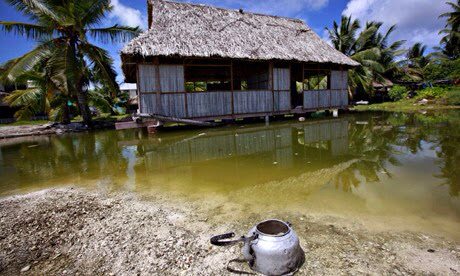
Abandoned house affected by sea water

The Church of England has sold a stretch of land mainly covered by dense forest for $8.77m. “We would hope not to put everyone on [this] one piece of land, but if it became absolutely necessary, yes, we could do it,” Tong told the Associated Press. Kiribati has a population of about 110,000 scattered over 33 small, low-lying islands extending over a total area of 3.5m sq km.

In 2009 the Maldives were the first to raise the possibility of purchasing land in another country in anticipation of being gradually submerged. At the time the government looked at options in India and Sri Lanka.

Now Kiribati has taken action. “Kiribati is just the first on a list which could get longer as time passes,” says Ronald Jumeau, Seychelles ambassador at the United Nations, who took part in the international negotiations on climate change in Bonn last month.

In March the Intergovernmental Panel on Climate Change published the volume on adaptation of its fifth assessment report, confirming in starker terms forecasts first outlined by scientists in 1990. Within a few decades, small islands in the Pacific and Indian oceans risk being extensively or even completely submerged. In places the sea level is rising by 1.2cm a year, four times faster than the global average.

The cost of protecting these places against rising sea levels, compared with national income, is among the highest in the world. Kiribati, Tuvalu and the Maldives are among the 10 countries where the financial impact of climate change is the most severe.

For many of these countries, which are represented by the Alliance of Small Island States, the impacts of climate change are “irreparable”, as Tong has often stressed. “Whatever is agreed within the United States today, with China [the two largest sources of CO2 emissions], it will not have a bearing on our future, because already, it's too late for us … And so we are the canary. But hopefully, that experience will send a very strong message that we might be on the frontline today, but others will be on the frontline next,” he said in an interview on CNN last month. This explains why small island states think it is so important to set up an international mechanism for loss and damage, to compensate for the irremediable consequences of global warming.

The international community approved the principle of such a mechanism in November 2013. “When a population is forced to leave its country, it is no longer a matter of adaptation,” Jumeau claims. “Where will these countries find funds? It is up to the industrialised countries, which caused global warming, to shoulder their responsibilities.” He wants to make the loss and damage mechanism a priority for the global deal on climate change slated to be signed in Paris in December 2015.

In the immediate future, the land purchased by Kiribati will above all be used to for agricultural and fish-farming projects to guarantee the nation's food security. With sea water increasingly contaminating the atolls' groundwater and catastrophic coral bleaching – total in some cases such as Phoenix atoll – there are growing food shortages. “Among the small islands, Kiribati is the country that has done most to anticipate its population's future needs,” says François Gemenne, a specialist on migrations at Versailles-Saint Quentin University, France. “The government has launched the 'migration with dignity' policy to allow people to apply for jobs on offer in neighbouring countries such as New Zealand. The aim is to avoid one day having to cope with a humanitarian evacuation.”

Kiribati has long-standing relations with Fiji. In the 1950s families from Banaba island, who had been displaced to make room for a phosphate mine, took refuge there, Gemenne recalls. More