
A video that Israel and the United States does not want you to see. Anna, a Jewish American from the International Womens Peace Service (IWPS) speaks about documenting human rights abuses in occupied Palesting and supporting non-violent resistance.

A video that Israel and the United States does not want you to see. Anna, a Jewish American from the International Womens Peace Service (IWPS) speaks about documenting human rights abuses in occupied Palesting and supporting non-violent resistance.
Think of it as the true end of the beginning. Last week, Theodore “Dutch” Van Kirk, the final member of the 12-man crew of the Enola Gay, the plane (named after its pilot’s supportive mother) that dropped the atomic bomb on Hiroshima, died at age 93.
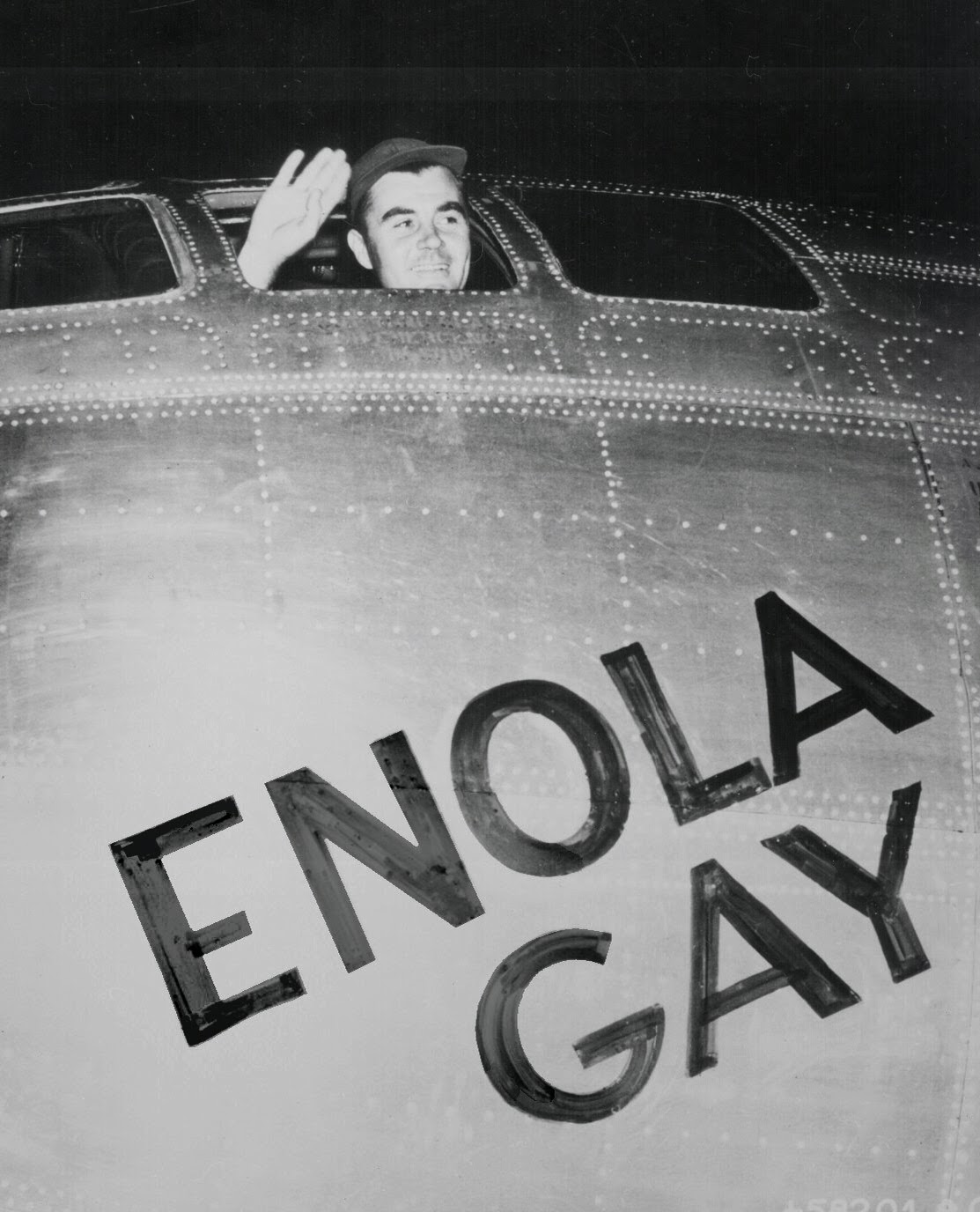
Paul Tibbetts, Jr. in cockpit
When that first A-bomb left its bomb bay at 8:15 on the morning of August 6, 1945, and began its descent toward its target, the Aioli (“Live Together”) Bridge, it was inscribed with a series of American messages, some obscene, including “Greetings to the Emperor from the men of the Indianapolis.” (That ship had delivered to the Pacific island of Tinian parts of the very bomb that would turn Hiroshima into an inferno of smoke and fire — “that awful cloud,” Paul Tibbetts, Jr., theEnola Gay's pilot, would call it — and afterward was torpedoed by a Japanese submarine with the loss of hundreds of sailors.)
The bomb, dubbed Little Boy, that had gestated in the belly of the Enola Gay represented not only the near endpoint of a bitter global war of almost unimaginable destruction, but the birthing of something new. The way for its use had been paved by an evolution in warfare: the increasing targeting of civilian populations from the air (something that can be seen again today in the carnage of Gaza). The history of that grim development extends from German airship bombings of London (1915) by way of Guernica (1937), Shanghai (1937), and Coventry (1940), to the fire bombings of Dresden (1945) and Tokyo (1945) in the last year of World War II. It even had an evolutionary history in the human imagination, where for decades writers (among others) had dreamed of the unparalleled release of previously unknown forms of energy for military purposes.
On August 7, 1945, a previous age was ending and a new one was dawning. In the nuclear era, city-busting weapons would be a dime a dozen and would spread from the superpowers to many other countries, including Great Britain, China, India, Pakistan, North Korea, and Israel. Targeted by the planet’s major nuclear arsenals would be the civilian inhabitants not just of single cities but of scores and scores of cities, even of the planet itself. On August 6th, 70 years ago, the possibility of the apocalypse passed out of the hands of God or the gods and into human hands, which meant a new kind of history had begun whose endpoint is unknowable, though we do know that even a “modest” exchange of nuclear weapons between India and Pakistan would not only devastate South Asia, but thanks to the phenomenon of nuclear winter also cause widespread famine on a planetary scale.
In other words, 70 years later, the apocalypse is us. Yet in the United States, the only nuclear bomb you're likely to read about is Iran’s (even though that country possesses no such weapon). For a serious discussion of the U.S. nuclear arsenal, those more than 4,800 increasingly ill-kept weapons that could incinerate several Earth-sized planets, you need to look not to the country’s major newspapers or news programs but to comic John Oliver — or TomDispatch regular Noam Chomsky. Tom
How Many Minutes to Midnight?
Hiroshima Day 2014By Noam ChomskyIf some extraterrestrial species were compiling a history of Homo sapiens, they might well break their calendar into two eras: BNW (before nuclear weapons) and NWE (the nuclear weapons era). The latter era, of course, opened on August 6, 1945, the first day of the countdown to what may be the inglorious end of this strange species, which attained the intelligence to discover the effective means to destroy itself, but — so the evidence suggests — not the moral and intellectual capacity to control its worst instincts.
Day one of the NWE was marked by the “success” of Little Boy, a simple atomic bomb. On day four, Nagasaki experienced the technological triumph of Fat Man, a more sophisticated design. Five days later came what the official Air Force history calls the “grand finale,” a 1,000-plane raid — no mean logistical achievement — attacking Japan’s cities and killing many thousands of people, with leaflets falling among the bombs reading “Japan has surrendered.” Truman announced that surrender before the last B-29 returned to its base.
Those were the auspicious opening days of the NWE. As we now enter its 70th year, we should be contemplating with wonder that we have survived. We can only guess how many years remain.
Some reflections on these grim prospects were offered by General Lee Butler, former head of the U.S. Strategic Command (STRATCOM), which controls nuclear weapons and strategy. Twenty years ago, he wrote that we had so far survived the NWE “by some combination of skill, luck, and divine intervention, and I suspect the latter in greatest proportion.”
Reflecting on his long career in developing nuclear weapons strategies and organizing the forces to implement them efficiently, he described himself ruefully as having been “among the most avid of these keepers of the faith in nuclear weapons.” But, he continued, he had come to realize that it was now his “burden to declare with all of the conviction I can muster that in my judgment they served us extremely ill.” And he asked, “By what authority do succeeding generations of leaders in the nuclear-weapons states usurp the power to dictate the odds of continued life on our planet? Most urgently, why does such breathtaking audacity persist at a moment when we should stand trembling in the face of our folly and united in our commitment to abolish its most deadly manifestations?”
He termed the U.S. strategic plan of 1960 that called for an automated all-out strike on the Communist world “the single most absurd and irresponsible document I have ever reviewed in my life.” Its Soviet counterpart was probably even more insane. But it is important to bear in mind that there are competitors, not least among them the easy acceptance of extraordinary threats to survival.
Survival in the Early Cold War Years
According to received doctrine in scholarship and general intellectual discourse, the prime goal of state policy is “national security.” There is ample evidence, however, that the doctrine of national security does not encompass the security of the population. The record reveals that, for instance, the threat of instant destruction by nuclear weapons has not ranked high among the concerns of planners. That much was demonstrated early on, and remains true to the present moment.
In the early days of the NWE, the U.S. was overwhelmingly powerful and enjoyed remarkable security: it controlled the hemisphere, the Atlantic and Pacific oceans, and the opposite sides of those oceans as well. Long before World War II, it had already become by far the richest country in the world, with incomparable advantages. Its economy boomed during the war, while other industrial societies were devastated or severely weakened. By the opening of the new era, the U.S. possessed about half of total world wealth and an even greater percentage of its manufacturing capacity.
There was, however, a potential threat: intercontinental ballistic missiles with nuclear warheads. That threat was discussed in the standard scholarly study of nuclear policies, carried out with access to high-level sources — Danger and Survival: Choices About the Bomb in the First Fifty Years by McGeorge Bundy, national security adviser during the Kennedy and Johnson presidencies.
Bundy wrote that “the timely development of ballistic missiles during the Eisenhower administration is one of the best achievements of those eight years. Yet it is well to begin with a recognition that both the United States and the Soviet Union might be in much less nuclear danger today if [those] missiles had never been developed.” He then added an instructive comment: “I am aware of no serious contemporary proposal, in or out of either government, that ballistic missiles should somehow be banned by agreement.” In short, there was apparently no thought of trying to prevent the sole serious threat to the U.S., the threat of utter destruction in a nuclear war with the Soviet Union.
Could that threat have been taken off the table? We cannot, of course, be sure, but it was hardly inconceivable. The Russians, far behind in industrial development and technological sophistication, were in a far more threatening environment. Hence, they were significantly more vulnerable to such weapons systems than the U.S. There might have been opportunities to explore these possibilities, but in the extraordinary hysteria of the day they could hardly have even been perceived. And that hysteria was indeed extraordinary. An examination of the rhetoric of central official documents of that moment like National Security Council Paper NSC-68 remains quite shocking, even discounting Secretary of State Dean Acheson’s injunction that it is necessary to be “clearer than truth.” Read More
So far, the diplomatic effort to end the violence in Gaza has failed miserably, with Israel on Friday rejecting a cease-fire proposal from U.S. Secretary of State John Kerry. (On Saturday Israel and Hamas agreed to a 12-hour humanitarian pause in the fighting brokered by the United Nations.)

Washington’s attempt is representative of the overall failure of American policy toward the Israeli-Palestinian conflict, only on this occasion the consequences can be measured in the growing pile of dead bodies and the widespread devastation that includes numerous homes, public buildings and even artillery damage to several United Nations schools sheltering Palestinian civilians.
The U.S. approach fails because it exhibits extreme partisanship in a setting where trust, credibility and reciprocity are crucial. Kerry is undoubtedly dedicated to achieving a cease-fire, just as he demonstrated for most of the past year in pushing for a negotiated peace agreement between Israel and the Palestinian Authority. Yet the United States exhibited its tendency toward extreme partisanship when it designated Martin Indyk, a former staff member of the America Israel Public Affairs Committee (AIPAC) and former ambassador to Israel, as the U.S. special envoy to the peace talks.
The U.S. approach up to this point to achieving a cease-fire in Gaza has been undertaken in a manner that is either woefully ignorant of the real constraints or callously cynical about their relevance. This is especially clear from the attempt to garner a cease-fire by consulting only one side, Israel — the party bearing the major responsibility for causing massive casualties and damage — and leaving Hamas out in the cold. Even if this is a consequence of Hamas being treated as “a terrorist entity,” it still makes no sense. When Israel wanted to deal with Hamas in the past, it had no trouble doing so — for instance, when it arranged the prisoner exchange that led to the release of the single captured Israeli soldier Gilad Schalit back in 2011.
The basic facts are astounding: The U.S. relied on Egypt as the broker of a proposal it vetted, supposedly with the text delivered personally by Tony Blair to President Abdel Fattah El Sisi in Cairo, endorsed by the Netanyahu government, and then announced on July 15 via the media as a cease-fire proposal accepted by Israel, without Hamas even knowing the details. It’s a diplomatic analogue to the theater of the absurd. Last July, then-General Sisi was the Egyptian mastermind of a coup that brutally cracked down on the Muslim Brotherhood and criminalized the entire organization. The Sisi government has made no secret of its unrelenting hostility to Hamas, which it views as an offshoot of the Muslim Brotherhood. It destroyed the extensive tunnel network connecting Gaza with the outside world to circumvent the punitive Israeli blockade that has been maintained since 2007. Is there any reason for Hamas to go forward with such a cease-fire arrangement? As some respected Israeli commentators have suggested, most prominently Amira Hass, the “normalization” of the occupation is what the Israeli military operation Protective Edge is all about. Hass suggests that Israel seeks a compliant Palestinian response to an occupation that has for all intents and purposes become permanent. Such periodic shows of force aim to break once and for all the will to resist, associated with Hamas and its rockets.
Even more telling, the cease-fire’s terms were communicated to Hamas via the media, making the proposal “take it or leave it.” It also ignored the reasonable conditions Hamas had posited as the basis of a cease-fire it could accept. These conditions included ending the unlawful seven-year siege of Gaza, releasing prisoners arrested in the anti-Hamas campaign prior to launching the military operation on July 8, and stopping interference with the unity government that brought Hamas and the Palestinian Authority together on June 3. Kerry, by contrast, has urged restoring the cease-fire text that had been accepted by both sides in November 2012 after the previous major Israeli military attack upon Gaza.
Hamas’ chief leader, Khaled Meshaal, has been called “defiant” by Kerry because he would not go along with this tilted diplomacy. “Everyone wanted us to accept a cease-fire and then negotiate for our rights,” Meshaal said. This was tried by Hamas in 2012 and didn’t work. As soon as the violence ceased, Israel refused to follow through on the cease-fire agreement that had promised negotiations seeking an end of the blockade and an immediate expansion of Gazan fishing rights.
In the aftermath of Protective Edge is it not reasonable, even mandatory, for Hamas to demand a firm commitment to end the siege of Gaza? Israel as the occupying power has an obligation under the Geneva Conventions to protect the civilian population of an occupied people. Israel claims that its “disengagement” in 2005, involving the withdrawal of security forces and the dismantling of settlements, ended such obligations. Such a position is almost uniformly rejected in the international community, since the persistence of effective Israeli control of entry and exit, as well as air and sea, and violent incursions amounts to a shift in the form of occupation — not its end. Israel is certainly right to complain about the rockets, but it is wrong to impose an oppressive regime of collective punishment on the civilians of Gaza. More
Any journalist should hesitate before saying this, but news can be bad for you. You don’t have to agree with the analyst who reckons “news is to the mind what sugar is to the body” to see that reading of horror and foreboding hour by hour, day after day, can sap the soul.
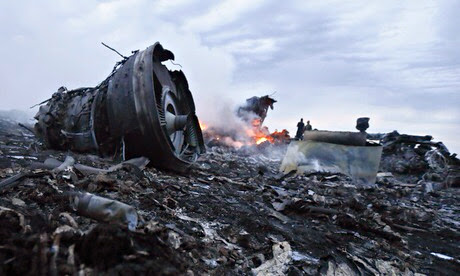
This week ended with a double dose, administered within the space of a few hours: Israel’s ground incursion into Gaza and, more shocking because entirely unexpected, the downing of Malaysia Airlines flight MH17 over Ukraine, killing all 298 on board.
So in Gaza we look at the wildly lopsided death tolls – nearly 300 Palestinians and two Israelis killed these past nine days.
The different responses these events stir in those of us who are distant, and the strategies we devise to cope with them, say much about our behaviour as consumers of news. But they also go some way to determining our reaction as citizens, as constituent members of the amorphous body we call public, or even world, opinion.
As I write, 18 of the 20 most-read articles on the Guardian website are about MH17. The entry into Gaza by Israeli forces stands at number 21. It’s not hard to fathom why the Malaysian jet strikes the louder chord. As the preacher might put it, “There but for the grace of God go I.” Stated baldly, most of us will never live in Gaza, but we know it could have been us boarding that plane in Amsterdam.
Which is why there is a morbid fascination with tales of the passenger who changed flights at the last minute, thereby cheating death, or with the crew member who made the opposite move, hastily switching to MH17 at the final moment, taking a decision that would have seemed so trivial at the time but which cost him his life. When we read about the debris – the holiday guidebooks strewn over the Ukrainian countryside, the man found next to an iPhone, the boy with his seatbelt still on – our imaginations put us on that flight. Of course we have sympathy for the victims and their families. But our fear is for ourselves.
It’s quite true that if the US truly decided that Israel’s 47-year occupation of Palestinian territory was no longer acceptable, that would bring change.
The reports from Gaza stir a different feeling. When we read the Guardian’s Peter Beaumont describe the sights he saw driving around the strip on Friday morning – three Palestinian siblings killed by an Israeli artillery shell that crashed into their bedroom, a father putting the remains of his two-year-old son into a plastic shopping bag – we are shaken by a different kind of horror. It is compassion for another human being, someone in a situation utterly different to ours. We don’t worry that this might happen to us, as we now might when we contemplate an international flight over a war zone. Our reaction is directed not inward, but outward. More
There is an interesting article by Chris Hedges entitled It's NOT going to be OK on the current economic disparity which, he believes could lead to a drastic decline in democracy as states respond to social protests. The question I ask is what can be done to slow or erradicate this process? Editor
Surviving the 21st Century
Published on May 28, 2014 • Professor Noam Chomsky Institute Professor & Professor of Linguistics (Emeritus), Massachusetts Institute of Technology addressed this question of global significance in a special Durham Castle Lecture on 22nd May.
 © 2014
 Democracy & Good Governance