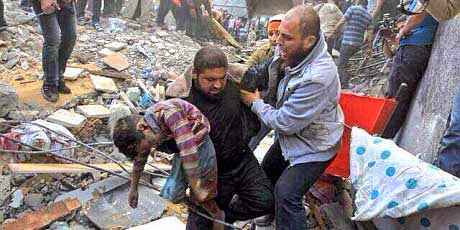
How Israel’s lies are used to justify mass slaughter of civilians in Gaza

Israel's lies make it clear to the Palestinians that it will continue to wage a campaign of state terror and will never admit its atrocities or its intentions.


ALL GOVERNMENTS lie, including Israel and Hamas. But Israel engages in the kinds of jaw-dropping lies that characterize despotic and totalitarian regimes.


It does not deform the truth; it inverts it. It routinely paints a picture for the outside world that is diametrically opposed to reality. And all of us reporters who have covered the occupied territories have run into Israel's Alice-in-Wonderland narratives, which we dutifully insert into our stories — required under the rules of American journalism — although we know they are untrue.


I saw small boys baited and killed by Israeli soldiers in the Gaza refugee camp of Khan Younis. The soldiers swore at the boys in Arabic over the loudspeakers of their armored jeep. The boys, about 10 years old, then threw stones at an Israeli vehicle and the soldiers opened fire, killing some, wounding others. I was present more than once as Israeli troops drew out and shot Palestinian children in this way.


Such incidents, in the Israeli lexicon, become children caught in crossfire.


I was in Gaza when F-16 attack jets dropped 1,000-pound iron fragmentation bombs on overcrowded hovels in Gaza City. I saw the corpses of the victims, including children. This became a surgical strike on a bomb-making factory.


I have watched Israel demolish homes and entire apartment blocks to create wide buffer zones between the Palestinians and the Israeli troops that ring Gaza. I have interviewed the destitute and homeless families, some camped out in crude shelters erected in the rubble. The destruction becomes the demolition of the homes of terrorists.


I have stood in the remains of schools — Israel struck two United Nations schools in the last six days, causing at least 10 fatalities at one in Rafah on Sunday and at least 19 at one in the Jebaliya refugee camp Wednesday — as well as medical clinics and mosques. I have heard Israel claim that errant rockets or mortar fire from the Palestinians caused these and other deaths, or that the attacked spots were being used as arms depots or launching sites.


I, along with every other reporter I know who has worked in Gaza, have never seen any evidence that Hamas uses civilians as “human shields.”


There is a perverted logic to Israel's repeated use of the Big Lie — the lie favored by tyrants from Josef Stalin to Saddam Hussein. The Big Lie feeds the two reactions Israel seeks to elicit — racism among its supporters and terror among its victims.


By painting a picture of an army that never attacks civilians, that indeed goes out of its way to protect them, the Big Lie says Israelis are civilized and humane, and their Palestinian opponents are inhuman monsters.


The Big Lie serves the idea that the slaughter in Gaza is a clash of civilizations, a war between democracy, decency and honor on one side and Islamic barbarism on the other. And in the uncommon cases when news of atrocities penetrates to the wider public, Israel blames the destruction and casualties on Hamas.


George Orwell in his novel “Nineteen Eighty-Four” called this form of propaganda doublethink. Doublethink uses “logic against logic” and “repudiate[s] morality while laying claim to it.”


The Big Lie does not allow for the nuances and contradictions that can plague conscience. It is a state-orchestrated response to the dilemma of cognitive dissonance. The Big Lie permits no gray zones. The world is black and white, good and evil, righteous and unrighteous.


The Big Lie allows believers to take comfort — a comfort they are desperately seeking — in their own moral superiority at the very moment they have abrogated all morality.


The Big Lie, as the father of American public relations, Edward Bernays, wrote, is limited only by the propagandist's capacity to fathom and harness the undercurrents of individual and mass psychology. And since most supporters of Israel do not have a desire to know the truth, a truth that would force them to examine their own racism and self-delusions about Zionist and Western moral superiority, like packs of famished dogs they lap up the lies fed to them by the Israeli government.


But the Big Lie is also consciously designed to send a chilling message to Gaza's Palestinians, who have lost large numbers of their dwellings, clinics, mosques, and power, water and sewage facilities, along with schools and hospitals, who have suffered some 1,850 deaths since this assault began — most of the victims women and children — and who have seen 400,000 people displaced from their homes.


The Big Lie makes it clear to the Palestinians that Israel will continue to wage a campaign of state terror and will never admit its atrocities or its intentions. The vast disparity between what Israel says and what Israel does tells the Palestinians that there is no hope. Israel will do and say whatever it wants. International law, like the truth, will always be irrelevant. There will never, the Palestinians understand from the Big Lie, be an acknowledgement of reality by the Israeli leadership.


The Israel Defense Forces website is replete with this black propaganda. “Hamas exploits the IDF's sensitivity towards protecting civilian structures, particularly holy sites, by hiding command centers, weapons caches and tunnel entrances in mosques,” the IDF site reads. “In Hamas' world, hospitals are command centers, ambulances are transport vehicles, and medics are human shields,” the site insists.


“… [Israeli] officers are tasked with an enormous responsibility: to protect Palestinian civilians on the ground, no matter how difficult that may be,” the site assures its viewers. And the IDF site provides this quote from a drone operator identified as Lt. Or. “I have personally seen rockets fired at Israel from hospitals and schools, but we couldn't strike back because of civilians nearby. In one instance, we acquired a target but we saw that there were children in the area. We waited around, and when they didn't leave we were forced to abort a strike on an important target.”


Israel's ambassador to the United States, Ron Dermer, in a Big Lie of his own, said last month at a conference of Christians United for Israel that the Israeli army should be given the “Nobel Peace Prize … a Nobel Peace Prize for fighting with unimaginable restraint.”


The Big Lie destroys any possibility of history and therefore any hope for a dialogue between antagonistic parties that can be grounded in truth and reality.


And when facts no longer matter, when there is no shared history grounded in the truth, when people foolishly believe their own lies, there can be no useful exchange of information.


The Big Lie, used like a bludgeon by Israel, as perhaps it is designed to be, ultimately reduces all problems in the world to the brutish language of violence. And when oppressed people are addressed only through violence they will answer only through violence. More


Water Efficiency in a Global Crisis

Listen to the headlines and you will hear more and more frequent anecdotal evidence of the crisis facing our global fresh water supply. Only 3 percent of the water on earth is fresh, and of that some 2 percent is locked in the polar ice caps, thus leaving us with the astonishing conclusion that the entire population on earth is reliant on 1 percent of the available water worldwide to sustain its fundamental need.

That need is universal; each of us — no matter who we are, what we earn, or where we live — should consume at least two quarts of water per day to sustain basic daily physical health. According to the World Health Organization, an individual requires 18 gallons a day to provide medium term maintenance to include drinking, cooking, personal hygiene, washing clothes, cleaning homes, growing food, and sanitation and waste disposal.

There is an apocryphal story of a proposed reality television show focusing on water use of a middle-class American family of two adults and three children. The value entertainment was to derive from the inter-personal consequences of reliance on the minimal supply to meet the profligate use of water in the United States for domestic uses only. The trial was a disaster as the family chosen could not subsist a week on these conditions, deprived of infinite supply for cooking, showers, dishwashers and washing machines, lawn and garden watering, without serious negative psychological effect, inter-family conflict, and rejection of the experiment.

The headlines speak of water shortages everywhere, in large amounts, and in many forms. We read of cities closing down their water systems because of toxic run-off, of the poisoned water from fracking oil wells that leak into watersheds, streams, and rivers; of droughts that evaporate available water and radically decrease supply for irrigation of industrial farms and orchards; of wildfires that cannot be contained because there is no available water to fight them. There are many more examples; add them all up and you have a water crisis that threatens rich and poor everywhere in the world, has serious financial implications now and for the future, destroys communities, and indeed becomes a context for conflict.

All this threatens total supply and must force us to re-think how we manage the efficiency of our water use. Certain changes seem obvious: becoming more aware of the problem and modify personal use by turning off faucets, shortening showers, collecting rain water for gardens, not washing the car, replacing old appliances with conservation-certified new ones, and understanding that every gallon wasted by indifference is a gallon gone and irreplaceable for you or anyone else.

Individual actions can, of course, be scaled up by government actions and regulations. The Alliance for Water Efficiency, for example, exists as an authoritative voice for water conservation in North America, informs and advocates for the development of state and municipal laws, codes, and standards, and supports a national partnership with the US Environmental Protection Agency called “WaterSense” that promotes best water conservation management practices for homes, hotels, factories, businesses, treatment plants and water distribution infrastructure, and rewards the best examples of the most efficient water conservation technologies.

But this is nowhere near enough. Water consciousness must improve dramatically at all levels of society to enable us to recycle water effectively, to divert treated water to alternative use, to channel urban run-off from roofs and storm systems back into the usable water supply, to revolutionize our agricultural irrigation practices that today consume a vast majority of water resources worldwide, and regulate any and all industrial or extraction behavior that continues to pollute our waterways with harmful pollutants and poisons with unacceptable local health and downstream consequences.

And yet, in the United States at least, determined politicians are attempting to reverse any such intelligent controls by diluting or over-turning clean water laws and regulations already established in the name of protecting threatened corporate interests, denying the role of government to regulate destructive practice, and sustaining the status quo. Wouldn’t it be interesting to put those representative lawmakers in a situation like that American family? Where they would have to live together, with of their individual hypocrisies, compromised decisions, and destructive political ideologies? I wonder how long they would last having to live together up close and personal in today’s global fresh water crisis? More

Follow Peter Neill on Twitter: www.twitter.com/the_w2o

Going Wild in the Gaza War – by Sandy Tolan

The carnage in the Gaza Strip has been horrendous: more than 1,900 dead, mainly civilians; its sole power plant destroyed (and so electricity and water denied and a sewage disaster looming); 30,000 to 40,000 homes and buildings damaged or destroyed; hundreds of thousands of residents put to flight with nowhere to go; and numerous U.N. schools or facilities housing some of those refugees hit by Israeli firepower.

And then there was the evident targeting by the Israelis of the Gazan economy itself: 175 major factories taken out, according to the New York Times, in a place that already had an estimated unemployment rate of 47%.

The last weeks represent the latest episode in a grim, unbalanced tale of the destructive urges of both the Israeli government and Hamas, in a situation in which the most fundamental thing has been the desire to punish civilians. Worse yet, indiscriminate assaults on civilian populations create the basis for more of the same — fiercer support in Israel for governments committed to ever worse actions and ever more recruits for Hamas or successor organizations potentially far worse and more fundamentalist), and of course more children traumatized and primed for future acts of terror and revenge.

Think of it as the Middle Eastern equivalent of a self-fulfilling prophecy, which means it hardly even qualifies as a prediction to say that Israel’s violent and punishing acts against the civilian population of Gaza will settle nothing whatsoever. In fact, for the Israelis, as Sandy Tolan suggests today, the Gazan War of 2014 may prove a defeat, both in the arena of global opinion (U.S. polls show that young Americans are ever more sympathetic to the Palestinians and disapproving of Israeli actions) and in relation to Hamas itself. History indicates that air strikes and other attacks meant to break the “will” of a populace, and so of a movement’s hold on it, generally only create more support.

These have been the days of the whirlwind in Gaza and in Israel, but don’t stop there. If you want a hair-raising experience, put these events in a larger regional context.

Following 9/11, the Bush administration and its neocon supporters dubbed the area that stretched from North Africa to Central Asia “the Greater Middle East” and referred to that vast expanse as “the arc of instability.” At the time, despite their largely Muslim populations, the nations of that sprawling region had relatively little in common; nor, on the whole, was it particularly unstable, even if the roiling Israeli-Palestinian situation already sat at its heart.

Ruled largely by strongmen and autocrats, those nations remained in a grim post-Cold War state of stasis. Three American interventions — in Afghanistan (2001), Iraq (2003), and Libya (2011) — blew holes through the region, sparking bitter inter-ethnic and religious conflict, as well as an Arab Spring (largely suppressed by now), while transforming most of the Greater Middle East into a genuine arc of instability. Today, what's happening there qualifies as the perfect maelstrom, as yet more states and groups, insurgent, extremist, or otherwise, are drawn into its maw of destruction.

To start on the eastern reaches of the Greater Middle East, Pakistan is now a destabilized democracy with a fierce set of fundamentalist insurgencies operating within and from its territory; Afghanistan is an almost 13-year nation-building disaster where the Taliban is resurgent and, in the latest “insider attack” at its top military academy, an Afghan soldier considered an American “ally” managed to kill a U.S. major general sent to the country to help “stand up” its security forces. Iraq is a tripartite disaster area in which another American-trained and -equipped army stood down rather than up and in which an extreme al-Qaeda offshoot, the Islamic State (IS) is at the moment ascendant. It has routed Iraqi and Syrian forces, and most recently, the supposedly fierce Kurdish pesh merga militia in northern Iraq, while endangering the Kurdish capital and possibly seizing the country’s largest dam. Turkish and Syrian Kurdish insurgents are being drawn into the fight in Iraq, as once again is the U.S.

Syria itself is no longer a country at all, but a warring set of extremist outfits facing what’s left of the patrimony (and military) of the al-Assad family. In Lebanon last week, regular army units found themselves battling IS extremists and their captured American tanks for the control of a border town. In Egypt, the military is back in power atop a disintegrating economy. In Libya, the chaos following the U.S./NATO intervention that led to the fall of autocrat Muammar Gaddafi never ended. Recently, factional militias fighting in Tripoli, the capital, managed to destroy its international airport, while diplomatic missions, including the U.S. one, were withdrawn in haste, and now the Egyptians are threatening an intervention of their own. Meanwhile, reverberations from the chaos in Libya have been spreading across North Africa and heading south. Only Iran (eternally under threat from the U.S. and Israel), Saudi Arabia (which helped bankroll the rise of the IS), and the Gulf States seem to have remained — thus far — relatively aloof from the chaos.

In sum, the vast region the Bush people so blithely called the arc of instability seems to be heading for utter chaos or a mega-conflict, while the predicted “cakewalk” of American forces into Iraq managed, in barely a moment in historical time, to essentially obliterate the regional borders set up by the European colonial powers after World War I. In other words, a world is being unified in turmoil and extremism, as thousands die and millions are uprooted from their homes, and all of this now surrounds the volatile, still destabilizing center that is the Palestinian/Israeli nightmare. There, as Sandy Tolan, a TomDispatch regular and the author of The Lemon Tree: An Arab, a Jew, and the Heart of the Middle East, points out, both Tel Aviv and Washington have, in recent years, ignored every chance to take a less violent path and so encouraged the arrival of the maelstrom. Tom – Follow TomDispatch on Twitter @TomDispatch.

Blown Chances in Gaza
Israel and the U.S. Miss Many Chances to Avoid War
By Sandy Tolan

Alongside the toll of death and broken lives, perhaps the saddest reality of the latest Gaza war, like the Gaza wars before it, is how easy it would have been to avoid. For the last eight years, Israel and the U.S. had repeated opportunities to opt for a diplomatic solution in Gaza. Each time, they have chosen war, with devastating consequences for the families of Gaza.

Let’s begin in June 2006, when the University of Maryland’s Jerome Segal, founder of the Jewish Peace Lobby, carried a high-level private message from Gaza to Washington. Segal had just returned from a meeting with Ismail Haniyeh, whose Hamas faction had recently won free and fair elections and taken power in Gaza. Hamas was seeking a unity government with the rival Fatah faction overseen by Mahmoud Abbas.

The previous year, Israel had withdrawn its soldiers and 8,000 settlers from Gaza, though its armed forces maintained a lockdown of the territory by air, land, and sea, controlling the flow of goods and people. Gazans believed they were trapped in the world’s largest open-air prison. For generations they had lived in overcrowded refugee camps, after their villages were depopulated by Israel and new Israeli cities built on their ruins in the years that followed Israel’s birth in 1948. By voting for Hamas in 2006, Palestinians signaled their weariness with Fatah’s corruption and its failure to deliver an independent state, or even a long-promised safe passage corridor between the West Bank and Gaza. In the wake of its surprise election victory, Hamas was in turn showing signs of edging toward the political center, despite its militant history.

Nevertheless, Israel and “the Quartet” — the U.S., the European Union, Russia, and the U.N. — refused to recognize the outcome of the democratic elections, labeling Hamas a “terrorist organization,” which sought Israel’s destruction. The administration of George W. Bush strongly pressured Abbas not to join a unity government. The Quartet suspended economic aid and Israel severely curtailed the flow of goods in and out of Gaza.

“It’s like meeting with a dietician,” remarked Dov Weisglass, a top aide to Israeli Prime Minister Ariel Sharon. “We have to make [Gazans] much thinner, but not enough to die.” Only years later did researchers prove that Weisglass was speaking literally: Israeli officials had restricted food imports to levels below those necessary to maintain a minimum caloric intake. Child welfare groups began to report a sharp rise in poverty and chronic child malnutrition, anemia, typhoid fever, and potentially fatal infant diarrhea. Human rights organizations denounced the measures as collective punishment. Avi Shlaim, a veteran of the Israeli army, author of numerous books on Middle East history, and professor of international relations at the University of Oxford, wrote:

“America and the EU [European Union] shamelessly joined Israel in ostracizing and demonizing the Hamas government and in trying to bring it down by withholding tax revenues and foreign aid. A surreal situation thus developed with a significant part of the international community imposing economic sanctions not against the occupier but against the occupied, not against the oppressor but against the oppressed. As so often in the tragic history of Palestine, the victims were blamed for their own misfortunes.”

These punitive measures were to remain in place until Hamas renounced violence (including stopping its cross-border rocket attacks), recognized Israel, and accepted all previous agreements based on the Oslo peace accords.

Which brings us back to that Washington-bound letter from Gaza. In the wake of the elections, Hamas was no longer the militant opposition to a ruling Fatah party, but a legally elected government operating under siege. Hamas leader Ismail Haniyeh, suddenly responsible for governing and facing a mounting economic, humanitarian, and political catastrophe, sought to defuse the situation. In his June 2006 hand-written note to President Bush that Jerome Segal delivered to the State Department and the National Security Council, he requested a direct dialogue with the administration.

Despite Hamas’s charter calling for the elimination of Israel, Haniyeh’s conciliatory note to the American president conveyed a different message. “We are so concerned about stability and security in the area that we don't mind having a Palestinian state in the 1967 borders and offering a truce for many years,” Haniyeh wrote to Bush. This essentially added up to an offer ofde facto recognition of Israel with a cessation of hostilities — two of the key U.S. and Israeli demands of Hamas.

“The continuation of this situation,” Haniyeh wrote to Bush, “will encourage violence and chaos in the whole region.”

A few lonely voices in the U.S. and Israel urged that the moment be seized and Hamas coaxed toward moderation. After all, Israel itself had been birthed in part by the Irgun and Stern Gang (or Lehi), groups considered terrorist by the British and the U.N. In the years before Israel’s birth, they had been responsible for a horrific massacre in the Palestinian village of Deir Yassin and the Irgun bombing of the King David Hotel, killing 91 people. Leaders of the two organizations, Menachem Begin and Yitzhak Shamir, later became prime ministers of Israel. Similarly, Yasser Arafat, whose Palestine Liberation Organization was considered a terrorist group by Israel and the West, recognized Israel’s right to exist in a pivotal 1988 speech, paving the way for the Oslo peace process. More


US Leaders Aid and Abet Israeli War Crimes, Genocide & Crimes against Humanity – Jurist


By sending vast amounts of military aid to Israel, members of the US Congress, President George W. Bush, President Barack Obama and Defense Secretary Chuck Hagel have aided and abetted the commission of war crimes, genocide and crimes against humanity by Israeli officials and commanders in Gaza.


An individual can be convicted of a war crime, genocide or a crime against humanity in the International Criminal Court (ICC) if he or she “aids, abets or otherwise assists” in the commission or attempted commission of the crime, “including providing the means for its commission.”

There is growing evidence that Israeli leaders and commanders have committed the following war crimes, genocide and crimes against humanity as defined in the Rome Statute for the ICC. US military aid has aided, abetted and assisted the commission of these crimes by providing Israel with the military means to commit them.

During Operation Protective Edge, Israeli forces again used the Dahiye Doctrine, which, according to the UN Human Rights Council [Goldstone] Report [PDF], involves “the application of disproportionate force and causing of great damage and destruction to civilian property and infrastructure, and suffering to civilian populations.”

A summary of Israeli leaders' extensive crimes is presented below.

US military aid to Israel

According to the Congressional Research Service, in 2007, the Bush Administration agreed to provide Israel with $30 billion [PDF] in military assistance from 2009 to 2018, provided in annual increments of $3.1 billion. During his March 2013 visit to Israel, Obama pledged that the US would continue to provide Israel with multi-year commitments of military aid subject to the approval of Congress.

Since 2012, the US has sent $276 million worth of weapons and munitions to Israel, not including exports of military transport equipment and high technologies. From January to May 2014, the US transferred to Israel almost $27 million for rocket launchers, $9.3 million worth of parts of guided missiles and nearly $762,000 for bombs, grenades and munitions of war.

On July 20, 2014, Israel requested additional ammunition, including 140mm tank rounds and 40mm illumination grenades, and the Defense Department approved the sale three days later. It came from a $1 billion stockpile of ammunition the US military stores in Israel for that country's use; it is called War Reserve Stockpile Ammunition-Israel. In early August 2014, both houses of Congress overwhelmingly passed, and Obama signed, an appropriation of $225 billion for Israel's Iron Dome missile defense system, which has also been used in Gaza. The Senate vote was unanimous. With no debate, the House of Representatives voted 395 to 8 to approve the deal.

Here is a summary of the crimes, as defined in the Rome Statute, Israeli leaders have committed and US leaders have aided and abetted:

War crimes

(1) Willful killing: Israeli forces have killed nearly 2,000 Palestinians (more than 400 children and over 80% civilians). Israel used 155-millimeter artillery, which, according to Human Rights Watch, is “utterly inappropriate in a densely populated area, because this kind of artillery is considered accurate if it lands anyplace within a 50-meter radius.”

(2) Willfully causing great suffering or serious injury to body or health: Nearly 10,000 people, 2,500 of them children, have been wounded. Naban Abu Shaar told the Daily Beast that the dead bodies from what appeared to be a “mass execution” in Khuza'a looked like they were “melted” and were piled on top of each other; assault rifle bullet casings found in the house were marked “IMI” (Israel Military Industries). UNICEF said the Israeli offensive has had a “catastrophic and tragic impact” on children in Gaza; about 373,000 children have had traumatic experiences and need psychological help. The UN Relief and Works Agency for Palestine Refugees (UNRWA) said: “There's a public health catastrophe going on. You know, most of the medical facilities in Gaza are non-operational.”

(3) Unlawful and wanton, extensive destruction and appropriation of property not justified by military necessity: Tens of thousands of Palestinians have lost their homes. More than 1,300 buildings were destroyed and 752 were severely damaged. Damage to sewer and water infrastructure has affected two-thirds of Gazans. On July 20, Israeli forces virtually flattened the small town of Khuza'a; one man counted 360 shell attacks in one hour. Reconstruction of Gaza is estimated to cost $6 billion. Israel shrunk Gaza's habitable land mass by 44 percent, establishing a 3 km “no-go” zone for Palestinians; 147 square miles of land will be compressed into 82 square miles. Oxfam described the level of destruction as “outrageous … much worse than anything we have seen in previous [Israeli] military operations.”

(4) Willfully depriving a prisoner of war or a civilian the rights of fair and regular trial: Nearly 2,000 Palestinians were arrested by Israeli forces during July 2014, according to the Palestinian Prisoners Center for Studies. Prisoners include 15 members of the Palestinian Legislative Council, about 240 children, dozens of women, journalists, activists, academics and 62 former prisoners previously released in a prisoner exchange. Israeli forces executed many prisoners after arrest, either by directly firing on them, refusing to allow treatment or allowing them to bleed to death. More than 445 prisoners are being held without charge or trial under administrative detention.

(5) Intentionally directing attacks against the civilian population, civilian objects, or humanitarian vehicles, installations and personnel: “The civilian population in the Gaza Strip is under direct attack,” reads a joint declaration of over 150 international law experts. Israeli forces violated the principle of “distinction,” which forbids deliberate attacks on civilians or civilian objects. Israeli forces bombed 142 schools (89 run by the UN), including six UN schools in which civilians were taking refuge. Israeli forces shot and killed fleeing civilians (warnings, which must effectively give civilians time to flee before bombing, do not relieve Israel from its legal obligations not to target civilians). Israeli forces repeatedly bombed Gaza's only power plant and other infrastructure, which are “beyond repair.” Israeli forces bombed one-third of Gaza's hospitals, 14 primary healthcare clinics and 29 ambulances. At least five medical staff were killed and tens of others were injured.

(6) Intentionally launching attacks with knowledge they will cause incidental loss of life or injury to civilians or damage to civilian objects or long-term severe damage to the natural environment, if they are clearly excessive in relation to the anticipated military advantage: The principle of “proportionality” forbids disproportionate and excessive civilian casualties compared to the claimed military advantage gained in the attack. The Dahiye Doctrine directly violates this principle. Responding to Hamas' rockets with 155-millimeter artillery is disproportionate. Although nearly 2,000 Palestinians (over 80 percent civilians) have been killed, 67 Israelis (all but three of them soldiers) have been killed. The coordinates of all UN facilities were repeatedly communicated to the Israeli forces; they nevertheless bombed them multiple times. Civilians were attacked in Shuja'iyyah market.

(7) Attacking or bombarding undefended towns, villages, dwellings or buildings, or intentionally attacking religious, educational and medical buildings, which are not military objectives: On July 20, Israeli forces virtually flattened the small town of Khuza'a; one man counted 360 shell attacks in one hour. Israeli forces bombed 142 schools (89 run by the UN), one-third of Gaza's hospitals, 14 primary healthcare clinics, and 29 ambulances. Israeli shelling completely destroyed 41 mosques and partially destroyed 120 mosques.

Genocide

(a) With the intent to destroy, in whole or in part, a national, ethnical, racial or religious group: Palestinians, including primarily civilians, and Palestinian infrastructure necessary to sustain life were deliberately targeted by Israeli forces.

(b) The commission of any of the following acts

(i) killing members of the group: Israeli forces killed nearly 2,000 Palestinians.

(ii) causing serious bodily or mental harm to members of the group: Israeli forces wounded 10,000 Palestinians.

(iii) deliberately inflicting on the group conditions of life calculated to bring about its destruction in whole or in part: Israeli forces devastated Gaza's infrastructure, knocking out Gaza's only power plant, and destroying homes, schools, buildings, mosques and hospitals.

Crimes against humanity

(A) The commission of murder as part of a widespread or systematic attack against any civilian population: Israeli forces relentlessly bombed Gaza for one month, killing nearly 2,000 Palestinians, more than 80 percent of whom were civilians. Israeli forces intentionally destroyed Gaza's infrastructure, knocking out Gaza's only power plant, and destroying homes, schools, buildings, mosques and hospitals.

(B) Persecution against a group or collectivity based on its political, racial, national, ethnic or religious character, as part of a widespread or systematic attack against any civilian population: Israeli forces killed, wounded, summarily executed, and administratively detained Palestinians, Hamas forces and civilians alike. Israel forces intentionally destroyed the infrastructure of Gaza, populated by Palestinians. UN Secretary General Ban Ki-moon said: “the massive death and destruction in Gaza have shocked and shamed the world.” He added the repeated bombing of UN shelters facilities in Gaza was “outrageous, unacceptable and unjustifiable.”

(C) The crime of apartheid (inhumane acts committed in the context of an institutional regime of systematic oppression and domination by one racial group over another racial group, with the intent to maintain that regime): Ali Hayek, head of Gaza's federation of industries representing 3,900 businesses that employ 35,000 people, said: “After 30 days of war, the economic situation has become, like, dead. It seems the occupation intentionally destroyed these vital factories that constitute the backbone of the society.” Israel maintains an illegal barrier wall that encroaches on Palestinian territory and builds illegal Jewish settlements on Palestinian lands. Israel keeps Gazans caged in what many call “the world's largest open air prison.” Israel controls all ingress and egress to Gaza, limits Gazans' access to medicine, subjects Palestinians to arbitrary arrest, expropriates their property, maintains separate areas and roads, segregated housing, different legal and educational systems for Palestinians and Jews and prevents mixed marriages. Only Jews, not Palestinians, have the right to return to Israel-Palestine.

Collective punishment

Although the Rome Statute does not include the crime of collective punishment, it is considered a grave breach of the Fourth Geneva Convention, which constitutes a war crime. Collective punishment means punishing a civilian for an offense he or she has not personally committed; it forbids reprisals against civilians and their property (civilian objects).

Ostensibly to rout out Hamas fighters, Israel has wreaked unprecedented devastation on the people of Gaza, killing nearly 2,000 people (more than 80 percent of them civilians) and destroying much of the infrastructure of Gaza. This constitutes collective punishment.

On August 5, 2014, veteran Israeli military advisor Giora Eiland advocated collective punishment of Gaza's civilian population, saying: “In order to guarantee our interests versus the other side's demands, we must avoid the artificial, wrong and dangerous distinction between the Hamas people, who are 'the bad guys,' and Gaza's residents, which are allegedly 'the good guys.'” That is precisely the strategy Israel has employed during Operation Protective Edge.

Israel's occupation of Palestinian lands also constitutes collective punishment. Israel maintains effective control over Gaza's land, airspace, seaport, electricity, water, telecommunications and population registry. Israel deprives Gazans of food, medicine, fuel and basic services.

Prospects for criminal accountability

Both Israel and the US have refused to ratify the Rome Statute. But if Palestine were a party to the statute, the ICC could exercise jurisdiction over crimes committed by Israelis and Americans in Palestinian territory. The ICC could also take jurisdiction if the UN Security Council refers the matter to the ICC, or if the ICC prosecutor initiates an investigation of the crime. The US would veto any Security Council referral to the ICC. And the ICC prosecutor has not initiated an investigation. So the question is whether Palestine can ratify the statute, thereby becoming a party to the ICC.

In 2009, the Palestinian National Authority filed a declaration [PDF] with the ICC accepting the court's jurisdiction. In 2012, the UN General Assembly overwhelmingly recognized Palestine as a non-member observer state. During the present war, the Palestinian minister of justice and the deputy minister of justice both submitted documents to the ICC indicating that the 2009 declaration is still valid. On August 5, 2014, the Palestinian minister of foreign affairs met with officials from the ICC and inquired about the procedures for Palestine to become a party to the statute.

On July 25, 2014, a French lawyer filed a complaint with the ICC on behalf of the Palestinian justice minister. Citing Israel's military occupation of Palestinian territories, Israel's blockade of the Gaza Strip and the ongoing military operations there, the complaint alleges that Israel committed war crimes and other crimes. The Palestinian government has not formally commented on this complaint.

On July 23, 2014, the UN Human Rights Council established a commission of inquiry into Israeli violations of international human rights and international humanitarian law. The resolution also called on parties to the Fourth Geneva Convention to convene and respond to the alleged violations. That convention requires parties to prosecute violators. Countries can bring foreign nationals to justice for war crimes, genocide and crimes against humanity under the well-established doctrine of universal jurisdiction. Genocide charges could also be brought under the Genocide Convention, to which both Israel and the United States are parties. That convention also punishes complicity in genocide; US leaders' provision of military aid would constitute complicity.

Although the Israeli and US governments continue to maintain that Israel has only acted in self-defense against Hamas' terrorism, the weight of world opinion points in the opposite direction. There is overwhelming opposition to Israeli aggression in Gaza and calls for justice and accountability.

Both Israeli and US leaders must be criminally prosecuted for committing and aiding and abetting these crimes.

Marjorie Cohn is a professor at Thomas Jefferson School of Law, deputy secretary general of the International Association of Democratic Lawyers, and a former president of the National Lawyers Guild. Her next book, “Drones and Targeted Killing: Legal, Moral, and Geopolitical Issues,” will be published in September.

Suggested Citation: Marjorie Cohn, US Leaders Aid and Abet Israeli War Crimes, Genocide & Crimes against Humanity, JURIST – Forum, August 8, 2014, http://jurist.org/forum/2014/08/marjorie-cohn-israel-crimes.php.


An open letter for the people in Gaza – The Lancet

We are doctors and scientists, who spend our lives developing means to care and protect health and lives. We are also informed people; we teach the ethics of our professions, together with the knowledge and practice of it. We all have worked in and known the situation of Gaza for years.

On the basis of our ethics and practice, we are denouncing what we witness in the aggression of Gaza by Israel.

We ask our colleagues, old and young professionals, to denounce this Israeli aggression. We challenge the perversity of a propaganda that justifies the creation of an emergency to masquerade a massacre, a so-called “defensive aggression”. In reality it is a ruthless assault of unlimited duration, extent, and intensity. We wish to report the facts as we see them and their implications on the lives of the people.

We are appalled by the military onslaught on civilians in Gaza under the guise of punishing terrorists. This is the third large scale military assault on Gaza since 2008. Each time the death toll is borne mainly by innocent people in Gaza, especially women and children under the unacceptable pretext of Israel eradicating political parties and resistance to the occupation and siege they impose.

This action also terrifies those who are not directly hit, and wounds the soul, mind, and resilience of the young generation. Our condemnation and disgust are further compounded by the denial and prohibition for Gaza to receive external help and supplies to alleviate the dire circumstances.

The blockade on Gaza has tightened further since last year and this has worsened the toll on Gaza's population. In Gaza, people suffer from hunger, thirst, pollution, shortage of medicines, electricity, and any means to get an income, not only by being bombed and shelled. Power crisis, gasoline shortage, water and food scarcity, sewage outflow and ever decreasing resources are disasters caused directly and indirectly by the siege.1

People in Gaza are resisting this aggression because they want a better and normal life and, even while crying in sorrow, pain, and terror, they reject a temporary truce that does not provide a real chance for a better future. A voice under the attacks in Gaza is that of Um Al Ramlawi who speaks for all in Gaza: “They are killing us all anyway—either a slow death by the siege, or a fast one by military attacks. We have nothing left to lose—we must fight for our rights, or die trying.”2

Gaza has been blockaded by sea and land since 2006. Any individual of Gaza, including fishermen venturing beyond 3 nautical miles of the coast of Gaza, face being shot by the Israeli Navy. No one from Gaza can leave from the only two checkpoints, Erez or Rafah, without special permission from the Israelis and the Egyptians, which is hard to come by for many, if not impossible. People in Gaza are unable to go abroad to study, work, visit families, or do business. Wounded and sick people cannot leave easily to get specialised treatment outside Gaza. Entries of food and medicines into Gaza have been restricted and many essential items for survival are prohibited.3 Before the present assault, medical stock items in Gaza were already at an all time low because of the blockade.3 They have run out now. Likewise, Gaza is unable to export its produce. Agriculture has been severely impaired by the imposition of a buffer zone, and agricultural products cannot be exported due to the blockade. 80% of Gaza's population is dependent on food rations from the UN.

Much of Gaza's buildings and infrastructure had been destroyed during Operation Cast Lead, 2008—09, and building materials have been blockaded so that schools, homes, and institutions cannot be properly rebuilt. Factories destroyed by bombardment have rarely been rebuilt adding unemployment to destitution.

Despite the difficult conditions, the people of Gaza and their political leaders have recently moved to resolve their conflicts “without arms and harm” through the process of reconciliation between factions, their leadership renouncing titles and positions, so that a unity government can be formed abolishing the divisive factional politics operating since 2007. This reconciliation, although accepted by many in the international community, was rejected by Israel. The present Israeli attacks stop this chance of political unity between Gaza and the West Bank and single out a part of the Palestinian society by destroying the lives of people of Gaza. Under the pretext of eliminating terrorism, Israel is trying to destroy the growing Palestinian unity. Among other lies, it is stated that civilians in Gaza are hostages of Hamas whereas the truth is that the Gaza Strip is sealed by the Israelis and Egyptians.

Gaza has been bombed continuously for the past 14 days followed now by invasion on land by tanks and thousands of Israeli troops. More than 60 000 civilians from Northern Gaza were ordered to leave their homes. These internally displaced people have nowhere to go since Central and Southern Gaza are also subjected to heavy artillery bombardment. The whole of Gaza is under attack. The only shelters in Gaza are the schools of the UN Relief and Works Agency for Palestine Refugees in the Near East (UNRWA), uncertain shelters already targeted during Cast Lead, killing many.

According to Gaza Ministry of Health and UN Office for the Coordination of Humanitarian Affairs (OCHA),1 as of July 21, 149 of the 558 killed in Gaza and 1100 of the 3504 wounded are children. Those buried under the rubble are not counted yet. As we write, the BBC reports of the bombing of another hospital, hitting the intensive care unit and operating theatres, with deaths of patients and staff. There are now fears for the main hospital Al Shifa. Moreover, most people are psychologically traumatised in Gaza. Anyone older than 6 years has already lived through their third military assault by Israel.

The massacre in Gaza spares no one, and includes the disabled and sick in hospitals, children playing on the beach or on the roof top, with a large majority of non-combatants. Hospitals, clinics, ambulances, mosques, schools, and press buildings have all been attacked, with thousands of private homes bombed, clearly directing fire to target whole families killing them within their homes, depriving families of their homes by chasing them out a few minutes before destruction. An entire area was destroyed on July 20, leaving thousands of displaced people homeless, beside wounding hundreds and killing at least 70—this is way beyond the purpose of finding tunnels. None of these are military objectives. These attacks aim to terrorise, wound the soul and the body of the people, and make their life impossible in the future, as well as also demolishing their homes and prohibiting the means to rebuild.

Weaponry known to cause long-term damages on health of the whole population are used; particularly non fragmentation weaponry and hard-head bombs.4, 5 We witnessed targeted weaponry used indiscriminately and on children and we constantly see that so-called intelligent weapons fail to be precise, unless they are deliberately used to destroy innocent lives.

We denounce the myth propagated by Israel that the aggression is done caring about saving civilian lives and children's wellbeing.

Israel's behaviour has insulted our humanity, intelligence, and dignity as well as our professional ethics and efforts. Even those of us who want to go and help are unable to reach Gaza due to the blockade.

This “defensive aggression” of unlimited duration, extent, and intensity must be stopped.

Additionally, should the use of gas be further confirmed, this is unequivocally a war crime for which, before anything else, high sanctions will have to be taken immediately on Israel with cessation of any trade and collaborative agreements with Europe.

As we write, other massacres and threats to the medical personnel in emergency services and denial of entry for international humanitarian convoys are reported.6 We as scientists and doctors cannot keep silent while this crime against humanity continues. We urge readers not to be silent too. Gaza trapped under siege, is being killed by one of the world's largest and most sophisticated modern military machines. The land is poisoned by weapon debris, with consequences for future generations. If those of us capable of speaking up fail to do so and take a stand against this war crime, we are also complicit in the destruction of the lives and homes of 1·8 million people in Gaza.

We register with dismay that only 5% of our Israeli academic colleagues signed an appeal to their government to stop the military operation against Gaza. We are tempted to conclude that with the exception of this 5%, the rest of the Israeli academics are complicit in the massacre and destruction of Gaza. We also see the complicity of our countries in Europe and North America in this massacre and the impotence once again of the international institutions and organisations to stop this massacre.

We declare no competing interests. More


George Galloway calls for boycott of ‘illegitimate’ Israel

Israel is COMPLETELY illegitimate! – George Galloway speech – 9th August 2014

Published on Aug 9, 2014 • O

More than 150,000 people marched through London today, Saturday, in Britain’s biggest protest ever against Israel’s oppression of Gaza. They came on coaches, trains and minibuses from round the country. The march gathered outside the BBC, angry at the appalling coverage of Israel’s massacre of nearly 2,000 Palestinians. It finished with a mass rally in Hyde Park. The march took an hour and three quarters to arrive. The park was a sea of Palestinian flags. More than 3,000 also protested in Edinburgh. They marched to Bute House, the first minister’s residence. For two hours they held a sit-down protest blocking the city’s main shopping street, Princes Street. Today has been called a Day of Rage for Gaza across the world. Up to 200,000 also marched in Cape Town, South Africa, drawing parallels between Israel and the apartheid regime. Demonstrators also marched in Delhi. Safia Hibah from Isleworth, west London, was on the London march. She told Socialist Worker, “The story the news is telling us is different to the reality of little kids being bombed. Is the government blind to what is going on? Why do they keep arming Israel?”

http://youtu.be/Di78NDVoXG8


Natural Gas in the Palestinian Authority: The Potential of the Gaza Marine Offshore Field

Summary: Although in strict legal terms its status is ambig-uous, a 25-year exploration license for the marine area off the Gaza Strip was awarded by the Palestinian Authority in 1999.

The Gaza Marine field was discovered the following the year though its natural gas has yet to be exploited. Politics as well as failure to agree on commercial terms have been the principal reasons for the delay.

Exploitation of the field would provide the Palestinian Authority with an important revenue stream. Using Gaza Marine gas may also reduce the need of Israel to consume its own natural gas to generate electricity for the Palestinians. Ultimately the decision will be political, but, in economic terms, the case for the exploita-tion of Gaza Marine is strong. Download PDF


BBC’s biased reporting of the Gaza massacre

BBC's biased reporting of the Gaza massacre: Tariq Ali


Published on Aug 10, 2014 • Tariq Ali tells the BBC on 09/08/14, when 150,000 marched in the biggest ever UK demonstration for Gaza, why there is such widespread criticism of the Israeli bias in its reporting. (For more on the demonstration see: http://bit.ly/1ozrch>

War and Natural Gas: The Israeli Invasion and Gaza’s Offshore Gas Fields

More than five years ago, Israel invaded Gaza under “Operation Cast Lead”.

The following article was first published by Global Research in January 2009 at the height of the Israeli bombing and invasion under Operation Cast Lead.

In the wake of the invasion, Palestinian gas fields were de facto confiscated by Israel in derogation of international law

A year following “Operation Cast Lead”, Tel Aviv announced the discovery of the Leviathan natural gas field in the Eastern Mediterranean “off the coast of Israel.”

At the time the gas field was: “ … the most prominent field ever found in the sub-explored area of the Levantine Basin, which covers about 83,000 square kilometres of the eastern Mediterranean region.” (i)

Coupled with Tamar field, in the same location, discovered in 2009, the prospects are for an energy bonanza for Israel, for Houston, Texas based Noble Energy and partners Delek Drilling, Avner Oil Exploration and Ratio Oil Exploration. (See Felicity Arbuthnot, Israel: Gas, Oil and Trouble in the Levant, Global Research, December 30, 2013

The Gazan gas fields are part of the broader Levant assessment area.

What is now unfolding is the integration of these adjoining gas fields including those belonging to Palestine into the orbit of Israel. (see map below).

It should be noted that the entire Eastern Mediterranean coastline extending from Egypt’s Sinai to Syria constitutes an area encompassing large gas as well as oil reserves.

War and Natural Gas: The Israeli Invasion and Gaza's Offshore Gas Fields

More than five years ago, Israel invaded Gaza under “Operation Cast Lead”.

The following article was first published by Global Research in January 2009 at the height of the Israeli bombing and invasion under Operation Cast Lead.

In the wake of the invasion, Palestinian gas fields were de facto confiscated by Israel in derogation of international law

A year following “Operation Cast Lead”, Tel Aviv announced the discovery of the Leviathan natural gas field in the Eastern Mediterranean “off the coast of Israel.”

At the time the gas field was: “ … the most prominent field ever found in the sub-explored area of the Levantine Basin, which covers about 83,000 square kilometres of the eastern Mediterranean region.” (i)

Coupled with Tamar field, in the same location, discovered in 2009, the prospects are for an energy bonanza for Israel, for Houston, Texas based Noble Energy and partners Delek Drilling, Avner Oil Exploration and Ratio Oil Exploration. (See Felicity Arbuthnot, Israel: Gas, Oil and Trouble in the Levant, Global Research, December 30, 2013

The Gazan gas fields are part of the broader Levant assessment area.

What is now unfolding is the integration of these adjoining gas fields including those belonging to Palestine into the orbit of Israel. (see map below).

It should be noted that the entire Eastern Mediterranean coastline extending from Egypt’s Sinai to Syria constitutes an area encompassing large gas as well as oil reserves.

levant gas map1 felicity

Michel Chossudovsky, January 3, 2014

War and Natural Gas: The Israeli Invasion and Gaza’s Offshore Gas Fields

by Michel Chossudovsky

January 8, 2009

The December 2008 military invasion of the Gaza Strip by Israeli Forces bears a direct relation to the control and ownership of strategic offshore gas reserves.

This is a war of conquest. Discovered in 2000, there are extensive gas reserves off the Gaza coastline.

British Gas (BG Group) and its partner, the Athens based Consolidated Contractors International Company(CCC) owned by Lebanon’s Sabbagh and Koury families, were granted oil and gas exploration rights in a 25 year agreement signed in November 1999 with the Palestinian Authority.

The rights to the offshore gas field are respectively British Gas (60 percent); Consolidated Contractors (CCC) (30 percent); and the Investment Fund of the Palestinian Authority (10 percent). (Haaretz, October 21, 2007).

The PA-BG-CCC agreement includes field development and the construction of a gas pipeline.(Middle East Economic Digest, Jan 5, 2001).

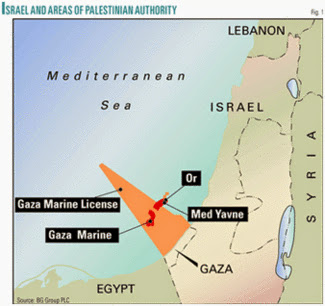
The BG licence covers the entire Gazan offshore marine area, which is contiguous to several Israeli offshore gas facilities. (See Map below). It should be noted that 60 percent of the gas reserves along the Gaza-Israel coastline belong to Palestine.

Map 1

The BG Group drilled two wells in 2000: Gaza Marine-1 and Gaza Marine-2. Reserves are estimated by British Gas to be of the order of 1.4 trillion cubic feet, valued at approximately 4 billion dollars. These are the figures made public by British Gas. The size of Palestine’s gas reserves could be much larger.

Who Owns the Gas Fields

The issue of sovereignty over Gaza’s gas fields is crucial. From a legal standpoint, the gas reserves belong to Palestine.

The death of Yasser Arafat, the election of the Hamas government and the ruin of the Palestinian Authority have enabled Israel to establish de facto control over Gaza’s offshore gas reserves.

British Gas (BG Group) has been dealing with the Tel Aviv government. In turn, the Hamas government has been bypassed in regards to exploration and development rights over the gas fields.

Map 2

The election of Prime Minister Ariel Sharon in 2001 was a major turning point. Palestine’s sovereignty over the offshore gas fields was challenged in the Israeli Supreme Court. Sharon stated unequivocally that “Israel would never buy gas from Palestine” intimating that Gaza’s offshore gas reserves belong to Israel.

In 2003, Ariel Sharon, vetoed an initial deal, which would allow British Gas to supply Israel with natural gas from Gaza’s offshore wells. (The Independent, August 19, 2003)

The election victory of Hamas in 2006 was conducive to the demise of the Palestinian Authority, which became confined to the West Bank, under the proxy regime of Mahmoud Abbas.

In 2006, British Gas “was close to signing a deal to pump the gas to Egypt.” (Times, May, 23, 2007). According to reports, British Prime Minister Tony Blair intervened on behalf of Israel with a view to shunting the agreement with Egypt.

The following year, in May 2007, the Israeli Cabinet approved a proposal by Prime Minister Ehud Olmert “to buy gas from the Palestinian Authority.” The proposed contract was for $4 billion, with profits of the order of $2 billion of which one billion was to go the Palestinians.

Tel Aviv, however, had no intention on sharing the revenues with Palestine. An Israeli team of negotiators was set up by the Israeli Cabinet to thrash out a deal with the BG Group, bypassing both the Hamas government and the Palestinian Authority:

Israeli defence authorities want the Palestinians to be paid in goods and services and insist that no money go to the Hamas-controlled Government.” (Ibid, emphasis added)

The objective was essentially to nullify the contract signed in 1999 between the BG Group and the Palestinian Authority under Yasser Arafat.

Under the proposed 2007 agreement with BG, Palestinian gas from Gaza’s offshore wells was to be channeled by an undersea pipeline to the Israeli seaport of Ashkelon, thereby transferring control over the sale of the natural gas to Israel.

The deal fell through. The negotiations were suspended:

”Mossad Chief Meir Dagan opposed the transaction on security grounds, that the proceeds would fund terror”. (Member of Knesset Gilad Erdan, Address to the Knesset on “The Intention of Deputy Prime Minister Ehud Olmert to Purchase Gas from the Palestinians When Payment Will Serve Hamas,” March 1, 2006, quoted in Lt. Gen. (ret.) Moshe Yaalon, Does the Prospective Purchase of British Gas from Gaza’s Coastal Waters Threaten Israel’s National Security? Jerusalem Center for Public Affairs, October 2007)

Israel’s intent was to foreclose the possibility that royalties be paid to the Palestinians. In December 2007, The BG Group withdrew from the negotiations with Israel and in January 2008 they closed their office in Israel.(BG website).

Invasion Plan on The Drawing Board

The invasion plan of the Gaza Strip under “Operation Cast Lead” was set in motion in June 2008, according to Israeli military sources:

“Sources in the defense establishment said Defense Minister Ehud Barak instructed the Israel Defense Forces to prepare for the operation over six months ago [June or before June] , even as Israel was beginning to negotiate a ceasefire agreement with Hamas.”(Barak Ravid, Operation “Cast Lead”: Israeli Air Force strike followed months of planning, Haaretz, December 27, 2008)

That very same month, the Israeli authorities contacted British Gas, with a view to resuming crucial negotiations pertaining to the purchase of Gaza’s natural gas:

“Both Ministry of Finance director general Yarom Ariav and Ministry of National Infrastructures director general Hezi Kugler agreed to inform BG of Israel’s wish to renew the talks.

The sources added that BG has not yet officially responded to Israel’s request, but that company executives would probably come to Israel in a few weeks to hold talks with government officials.” (Globes online- Israel’s Business Arena, June 23, 2008)

The decision to speed up negotiations with British Gas (BG Group) coincided, chronologically, with the planning of the invasion of Gaza initiated in June. It would appear that Israel was anxious to reach an agreement with the BG Group prior to the invasion, which was already in an advanced planning stage.

Moreover, these negotiations with British Gas were conducted by the Ehud Olmert government with the knowledge that a military invasion was on the drawing board. In all likelihood, a new “post war” political-territorial arrangement for the Gaza strip was also being contemplated by the Israeli government.

In fact, negotiations between British Gas and Israeli officials were ongoing in October 2008, 2-3 months prior to the commencement of the bombings on December 27th.

In November 2008, the Israeli Ministry of Finance and the Ministry of National Infrastructures instructed Israel Electric Corporation (IEC) to enter into negotiations with British Gas, on the purchase of natural gas from the BG’s offshore concession in Gaza. (Globes, November 13, 2008)

“Ministry of Finance director general Yarom Ariav and Ministry of National Infrastructures director general Hezi Kugler wrote to IEC CEO Amos Lasker recently, informing him of the government’s decision to allow negotiations to go forward, in line with the framework proposal it approved earlier this year.

The IEC board, headed by chairman Moti Friedman, approved the principles of the framework proposal a few weeks ago. The talks with BG Group will begin once the board approves the exemption from a tender.” (Globes Nov. 13, 2008)

Gaza and Energy Geopolitics

The military occupation of Gaza is intent upon transferring the sovereignty of the gas fields to Israel in violation of international law.

What can we expect in the wake of the invasion?

What is the intent of Israel with regard to Palestine’s Natural Gas reserves?

A new territorial arrangement, with the stationing of Israeli and/or “peacekeeping” troops?

The militarization of the entire Gaza coastline, which is strategic for Israel?

The outright confiscation of Palestinian gas fields and the unilateral declaration of Israeli sovereignty over Gaza’s maritime areas?

If this were to occur, the Gaza gas fields would be integrated into Israel’s offshore installations, which are contiguous to those of the Gaza Strip. (See Map 1 above).

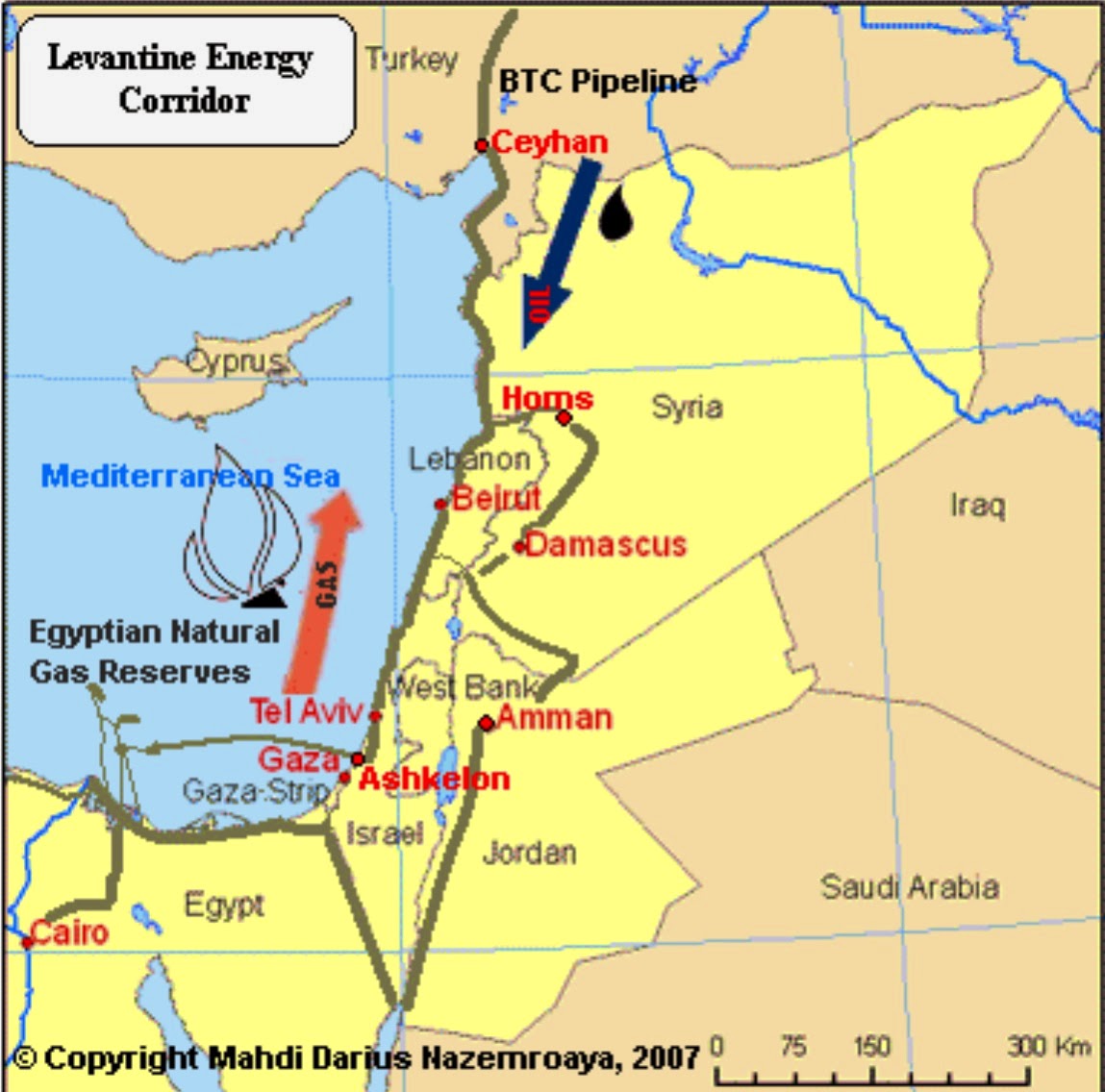
These various offshore installations are also linked up to Israel’s energy transport corridor, extending from the port of Eilat, which is an oil pipeline terminal, on the Red Sea to the seaport – pipeline terminal at Ashkelon, and northwards to Haifa, and eventually linking up through a proposed Israeli-Turkish pipeline with the Turkish port of Ceyhan.

Map 3

Ceyhan is the terminal of the Baku, Tblisi Ceyhan Trans Caspian pipeline. “What is envisaged is to link the BTC pipeline to the Trans-Israel Eilat-Ashkelon pipeline, also known as Israel’s Tipline.” (See Michel Chossudovsky, The War on Lebanon and the Battle for Oil, Global Research, July 23, 2006)

More