

Hedges is currently a columnist for news website Truthdig, a senior fellow at The Nation Institute in New York City,[1] and a contributing author for OpEdNews.[2] He spent nearly two decades as a foreign correspondent in Central America, the Middle East, Africa and theBalkans. He has reported from more than fifty countries, and has worked for The Christian Science Monitor, NPR, The Dallas Morning News, and The New York Times,[3] where he was a foreign correspondent for fifteen years (1990–2005).
gaza
 © 2014
Palestinian Recourse to the International Criminal Court: The Time has Come
Ever since this latest Israeli major military operation against Gaza started on July 8, there have been frequent suggestions that Israel is guilty of war crimes, and that Palestine should do its best to activate the International Criminal Court (ICC) on its behalf.

The evidence overwhelmingly supports basic Palestinian allegations—Israel is guilty either of aggression in violation of the UN Charter or is in flagrant violation of its obligations as the Occupying Power under the Geneva Convention to protect the civilian population of an Occupied People; Israel seems guilty of using excessive and disproportionate force against a defenseless society in the Gaza Strip; and Israel, among an array of other offenses, seems guilty of committing Crimes Against Humanity in the form of imposing an apartheid regime in the West Bank and through the transfer of population to an occupied territory as it has proceeded with its massive settlement project.
Considering this background of apparent Israeli criminality it would seem a no brainer for the Palestinian Authority to seek the help of the ICC in waging its struggle to win over world public opinion to their struggle. After all, the Palestinians are without military or diplomatic capabilities to oppose Israel, and it is on law and global solidarity must rest their hopes for eventually realizing their rights, particularly the right of self-determination and the right of return. Palestinian demonstrators in the West Bank are demanding that their leaders in the Palestinian Authority adhere to the Rome Statute, and become members of the ICC without further delay. It has become part of the message of Palestinian street politics that the Palestinians are being criminally victimized, and that the Palestinian Authority if it wants to retain the slightest shred of respect as representatives of the Palestinian people must join in this understanding of the Palestinian plight and stop ‘playing nice’ with Israeli authorities.
Such reasoning from a Palestinian perspective is reinforced by the May 8th letter sent by 17 respected human rights NGOs to President Mahmoud Abbas urging Palestine to become a member of the ICC, and act to end Israel’s impunity. This was not a grandstanding gesture dreamed up on the irresponsible political margins of liberal Western society. Among the signatories were such human rights stalwarts as Human Rights Watch, Amnesty International, Al Haq, and the International Commission of Jurists, entities known for their temporizing prudence in relation to the powers that be.
Adding further credence to the idea that the ICC option should be explored was the intense opposition by Israel and United States, ominously threatening the PA with dire consequences if it tried to join the ICC, much less to seek justice through its activating its investigative procedures. The American ambassador to the UN, Samantha Power, herself long ago prominent as a human rights advocate, revealed Washington’s nervous hand when she confessed that the ICC “is something that really poses a profound threat to Israel.” I am not sure that Power would like to live with the idea that because Israel is so vulnerable to mounting a legal challenge that its impunity must be upheld whatever the embarrassment to Washington of doing so. France and Germany have been more circumspect, saying absurdly that recourse to the ICC by Palestine should be avoided because it would disrupt ‘the final status negotiations,’ as if this pseudo-diplomacy was ever of any of value, a chimera if there ever was one, in the elusive quest for a just peace.
In a better world, the PA would not hesitate to invoke the authority of the ICC, but in the world as it is, the decision is not so simple. To begin with, is the question of access, which is limited to states. Back in 2009, the PA tried to adhere to the Rome Statute, which is the treaty governing the ICC, and was rebuffed by the prosecutor who turned the issue over to the Security Council, claiming a lack of authority to determined whether the PA represented a ‘state.’ Subsequently, on November 29th the UN General Assembly overwhelmingly recognized Palestine as ‘a nonmember observer state.’ Luis Moreno–Ocampo who had acted in 2009 for the ICC, and now speaking as the former prosecutor, asserted that in his opinion Palestine would now in view of the General Assembly action qualify as a state enjoying the option of becoming an ICC member. Normally, ICC jurisdiction is limited to crimes committed after the state becomes a member, but there is a provision that enables a declaration to be made accepting jurisdiction for crimes committed at any date in its territory so long as it is after the ICC itself was established in 2002.
Is this enough? Israel has never become a party to the Rome Statute setting up the ICC, and would certainly refuse to cooperate with a prosecutor who sought to investigate war crimes charges with the possible intention of prosecution. In this regard, recourse to ICC might appear to be futile as even if arrest warrants were to be issued by the court, as was done in relation to Qaddafi and his son in 2011, there would be no prospect that the accused Israeli political and military figures would be handed over, and without the presence of such defendants in the court at The Hague, a criminal trial cannot go forward. This illustrates a basic problem with the enforcement of international criminal law. It has been effective only against the losers in wars fought against the interests of the West and, to some extent, against those whose crimes are in countries located in sub-Saharan Africa. This biased form of international criminal law implementation has been the pattern since the first major effort was made after World War II at Nuremberg and Tokyo. Surviving German and Japanese leaders were prosecuted for their crimes while exempting the winners, despite Allied responsibility for the systematic bombing of civilian populations by way of strategic bombing and the American responsibility for dropping the atomic bombs on Hiroshima and Nagasaki. More
They call us now.
A Facebook friend shared the following remarkable poem by Lena Khalaf Tuffaha, who is a co-founder of the Institute for Middle East Understanding based in Seattle. It catches the nightmarish absurdity of the latest invasion of Gaza.

They call us now.
Before they drop the bombs.
The phone rings
and someone who knows my first name
calls and says in perfect Arabic
“This is David.”
And in my stupor of sonic booms and glass shattering symphonies
still smashing around in my head
I think “Do I know any Davids in Gaza?”
They call us now to say
Run.
You have 58 seconds from the end of this message.
Your house is next.
They think of it as some kind of
war time courtesy.
It doesn’t matter that
there is nowhere to run to.
It means nothing that the borders are closed
and your papers are worthless
and mark you only for a life sentence
in this prison by the sea
and the alleyways are narrow
and there are more human lives
packed one against the other
more than any other place on earth
Just run.
We aren’t trying to kill you.
It doesn’t matter that
you can’t call us back to tell us
the people we claim to want aren’t in your house
that there’s no one here
except you and your children
who were cheering for Argentina
sharing the last loaf of bread for this week
counting candles left in case the power goes out.
It doesn’t matter that you have children.
You live in the wrong place
and now is your chance to run
to nowhere.
It doesn’t matter
that 58 seconds isn’t long enough
to find your wedding album
or your son’s favorite blanket
or your daughter’s almost completed college application
or your shoes
or to gather everyone in the house.
It doesn’t matter what you had planned.
It doesn’t matter who you are
Prove you’re human.
Prove you stand on two legs.
Run.
– Running Orders, by Lena Khalaf Tuffaha
How US and Blair plotted ‘ceasefire’ scam
We now have confirmation from the Israeli daily Haaretz of what we should have suspected: that the idea for the so-called Egyptian “ceasefire proposal” was actually hatched in Washington, the messenger boy was arch-war criminal Tony Blair, and the terms were drafted by Israel.

Click to Enlarge
The intention was either to corner Hamas into surrendering – and thereby keep the savage blockade of Gaza in place – or force Hamas to reject the proposal and confirm the Israeli narrative that it is a terrorist organisation with which Israel cannot make peace.
According to Haaretz, Blair secretly initiated his “ceasefire” activity after “coordinating” with US Secretary of State John Kerry. On Saturday he headed off to Cairo to meet with the US-backed Egyptian dictator Abdel Fattah al-Sisi to persuade him to put his name to the proposal.
Immediately afterwards, he travelled to Israel to meet Benjamin Netanyahu on Saturday afternoon. Sisi and Netanyahu were then supposed to thrash out the details. When they failed to do so, Blair intervened again on behalf of the Americans and the pair spoke by phone on Saturday evening.
Here’s the key paragraph from Haaretz:
Senior Israeli officials and Western diplomats said the reason the Egyptian cease-fire initiative was so short-lived is that it was prepared hastily and was not coordinated with all the relevant parties, particularly Hamas.
Wonderful that throw-away last line. In all this activity, it never occurred to the US, Blair, Sisi or Netanyahu – and no doubt Mahmoud Abbas, who is strangely absent from this account – that it might be necessary to sound out Hamas on the terms of a ceasefire it would need to abide by.
Now it seems Kerry is using US muscle to get Egypt, Qatar and Turkey to strong-arm Hamas into surrendering.
It’s depressingly predictable that the corporate media have swallowed the line of Israel accepting the “ceasefire proposal” and Hamas rejecting it. What Hamas did was reject a US-Israeli diktat to sign away the rights of the people of Gaza to end a siege that cuts them off from the rest of the world.
But there is a long pedigree to such deceptions. It is reminiscent of a hasbara favourite: that the Jews accepted the UN partition plan of 1947 while the Palestinians rejected it. The reality – then, as now – is that the the colonial powers sought to strip the Palestinians of their rights and their homeland without even consulting them.
www.haaretz.com/news/diplomacy-defense/.premium-1.605499
– See more at: http://www.jonathan-cook.net/blog/2014-07-16/how-us-and-blair-plotted-ceasefire-scam/#sthash.ZXcEXokj.dpuf
Palestinian factions reportedly set 10 conditions for 10-year truce with Israel
Reports in Israeli and Palestinian media say that the two Palestinian resistance groups Hamas and Islamic Jihad have set forth ten conditions for a ceasefire and ten-year truce with Israel.

Israel’s Maariv said that an unnamed “senior Palestinian official” passed it a copy of the demands, which have been transmitted by the factions to Egypt.
They include an end to all armed hostilities, the end of the siege of Gaza, and the construction of internationally supervised air and seaports.

Palestinians sleep in UN school
While Hamas has not as yet officially stated these demands, they are in line with the group’s long-standing policy of offering Israel a multi-year truce.
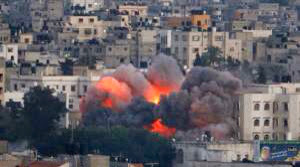
The reported conditions come after nine days of Israeli bombardment of the Gaza Strip that has killed more than 200 people, injured close to 1,400, and destroyed the homes of 8,200 others. Almost 80 percent of the dead, who include more than thirty children, are civilians, according to the UN.
Yesterday, Hamas refused to respond to a unilateral “ceasefire” declared by Israel that would have left the situation of siege on the Gaza Strip unchanged.
Airport, seaport and an end to violence
The ten conditions were translated by The Electronic Intifada from an Arabic version published by Ma’an News Agency:
- Mutual cessation of the war and withdrawal of tanks to previous locations and the return of farmers to work their land in the agricultural border areas.
- Release of all the Palestinians detained since 23 June 2014 and improvement of the conditions of Palestinian prisoners, especially the prisoners from Jerusalem, Gaza and Palestinians of the interior [present-day Israel].
- Total lifting of the siege of Gaza and opening the border crossings to goods and people and allowing in all food and industrial supplies and construction of a power plant sufficient to supply all of Gaza.
- Construction of an international seaport and an international airport supervised by the UN and non-biased countries.
- Expansion of the maritime fishing zone to 10 kms and supplying fishermen with larger fishing and cargo vessels.
- Converting the Rafah crossing into an international crossing under supervision of the UN and Arab and friendly countries.
- Signing a 10-year truce agreement and deployment of international monitors to the borders.
- A commitment by the occupation government not to violate Palestinian airspace and easing of conditions for worshipers in Al-Aqsa Mosque.
- The occupation will not interfere in the affairs of the Palestinian government and will not hinder national reconciliation.
- Restoration of the border industrial areas and their protection and development.
“Should have been met years ago”
Dr. Ramy Abdu, chair of the independent group Euro-Mid Observer for Human Rights (euromid.org, told The Electronic Intifada from Gaza City this morning:
I believe that these requirements should have been met years ago. The core of these requirements are not political but purely humanitarian and legally binding. The international community has called many times for their implementation. Palestinians have the right to move in and out freely like others in the world. They have the right to import and export, to control their borders and airspace. Israel argues that it left Gaza, so it should stop controlling the lives of Palestinians.
Abdu noted that his organization recently published a detailed proposal to establish a maritime link from Gaza to the rest of the world with an international role that could “alleviate security concerns.” More
How Politics and Lies Triggered an Unintended War in Gaza
In the flood of angry words that poured out of Israel and Gaza during a week of spiraling violence, few statements were more blunt, or more telling, than this throwaway line by the chief spokesman of the Israeli military, Brigadier General Moti Almoz, speaking July 8 on Army Radio’s morning show: “We have been instructed by the political echelon to hit Hamas hard.”
That’s unusual language for a military mouthpiece. Typically they spout lines like “We will take all necessary actions” or “The state of Israel will defend its citizens.” You don’t expect to hear: “This is the politicians’ idea. They’re making us do it.”
Admittedly, demurrals on government policy by Israel’s top defense brass, once virtually unthinkable, have become almost routine in the Netanyahu era. Usually, though, there’s some measure of subtlety or discretion. This particular interview was different. Where most disagreements involve policies that might eventually lead to some future unnecessary war, this one was about an unnecessary war they were now stumbling into.
Spokesmen don’t speak for themselves. Almoz was expressing a frustration that was building in the army command for nearly a month, since the June 12 kidnapping of three Israeli yeshiva boys. The crime set off a chain of events in which Israel gradually lost control of the situation, finally ending up on the brink of a war that nobody wanted — not the army, not the government, not even the enemy, Hamas.
The frustration had numerous causes. Once the boys’ disappearance was known, troops began a massive, 18-day search-and-rescue operation, entering thousands of homes, arresting and interrogating hundreds of individuals, racing against the clock. Only on July 1, after the boys’ bodies were found, did the truth come out: The government had known almost from the beginning that the boys were dead. It maintained the fiction that it hoped to find them alive as a pretext to dismantle Hamas’ West Bank operations.
The initial evidence was the recording of victim Gilad Shaer’s desperate cellphone call to Moked 100, Israel’s 911. When the tape reached the security services the next morning — neglected for hours by Moked 100 staff — the teen was heard whispering “They’ve kidnapped me” (“hatfu oti”) followed by shouts of “Heads down,” then gunfire, two groans, more shots, then singing in Arabic. That evening searchers found the kidnappers’ abandoned, torched Hyundai, with eight bullet holes and the boys’ DNA. There was no doubt.
Prime Minister Benjamin Netanyahu immediately placed a gag order on the deaths. Journalists who heard rumors were told the Shin Bet wanted the gag order to aid the search. For public consumption, the official word was that Israel was “acting on the assumption that they’re alive.” It was, simply put, a lie.
Moti Almoz, as army spokesman, was in charge of repeating the lie. True, others backed him up, including Defense Minister Moshe Yaalon. But when the truth came out on July 1, Almoz bore the brunt of public derision. Critics said his credibility was shot. He’d only been spokesman since October, after a long career as a blunt-talking field commander with no media experience. Others felt professional frustration. His was personal.
Nor was that the only fib. It was clear from the beginning that the kidnappers weren’t acting on orders from Hamas leadership in Gaza or Damascus. Hamas’ Hebron branch — more a crime family than a clandestine organization — had a history of acting without the leaders’ knowledge, sometimes against their interests. Yet Netanyahu repeatedly insisted Hamas was responsible for the crime and would pay for it.
This put him in a ticklish position. His rhetoric raised expectations that after demolishing Hamas in the West Bank he would proceed to Gaza. Hamas in Gaza began preparing for it. The Israeli right — settler leaders, hardliners in his own party — began demanding it.
But Netanyahu had no such intention. The last attack on Gaza, the eight-day Operation Pillar of Defense in November 2012, targeted Hamas leaders and taught a sobering lesson. Hamas hadn’t fired a single rocket since, and had largely suppressed fire by smaller jihadi groups. Rocket firings, averaging 240 per month in 2007, dropped to five per month in 2013. Neither side had any desire to end the détente. Besides, whatever might replace Hamas in Gaza could only be worse.
The kidnapping and crackdown upset the balance. In Israel, grief and anger over the boys’ disappearance grew steadily as the fabricated mystery stretched into a second and third week. Rallies and prayer meetings were held across the country and in Jewish communities around the world. The mothers were constantly on television. One addressed the United Nations in Geneva to plead for her son’s return. Jews everywhere were in anguish over the unceasing threat of barbaric Arab terror plaguing Israel.
This, too, was misleading. The last seven years have been the most tranquil in Israel’s history. Terror attacks are a fraction of the level during the nightmare intifada years — just six deaths in all of 2013. But few notice. The staged agony of the kidnap search created, probably unintentionally, what amounts to a mass, worldwide attack of post-traumatic stress flashback.
When the bodies were finally found, Israelis’ anger exploded into calls for revenge, street riots and, finally, murder.
Amid the rising tension, cabinet meetings in Jerusalem turned into shouting matches. Ministers on the right demanded the army reoccupy Gaza and destroy Hamas. Netanyahu replied, backed by the army and liberal ministers, that the response must be measured and careful. It was an unaccustomed and plainly uncomfortable role for him. He was caught between his pragmatic and ideological impulses.
In Gaza, leaders went underground. Rocket enforcement squads stopped functioning and jihadi rocket firing spiked. Terror squads began preparing to counterattack Israel through tunnels. One tunnel exploded on June 19 in an apparent work accident, killing five Hamas gunmen, convincing some in Gaza that the Israeli assault had begun while reinforcing Israeli fears that Hamas was plotting terror all along.
On June 29, an Israeli air attack on a rocket squad killed a Hamas operative. Hamas protested. The next day it unleashed a rocket barrage, its first since 2012. The cease-fire was over. Israel was forced to retaliate for the rockets with air raids. Hamas retaliated for the raids with more rockets. And so on. Finally Israel began calling up reserves on July 8 and preparing for what, as Moti Almoz told Army Radio, “the political echelon instructed.”
Later that morning, Israel’s internal security minister Yitzhak Aharonovitch told reporters that the “political echelon has given the army a free hand.” Almoz returned to Army Radio that afternoon and confirmed that the army had “received an absolutely free hand” to act.
And how far, the interviewer asked, will the army go? “To the extent that it’s up to the army,” Almoz said, “the army is determined to restore quiet.” Will simply restoring quiet be enough? “That’s not up to us,” he said. The army will continue the operation as long as it’s told.
The operation’s army code-name, incidentally, is “Protective Edge” in English, but the original Hebrew is more revealing: Tzuk Eitan, or “solid cliff.” That, the army seems to feel, is where Israel is headed. More
Contact J.J. Goldberg at goldberg@forward.com

