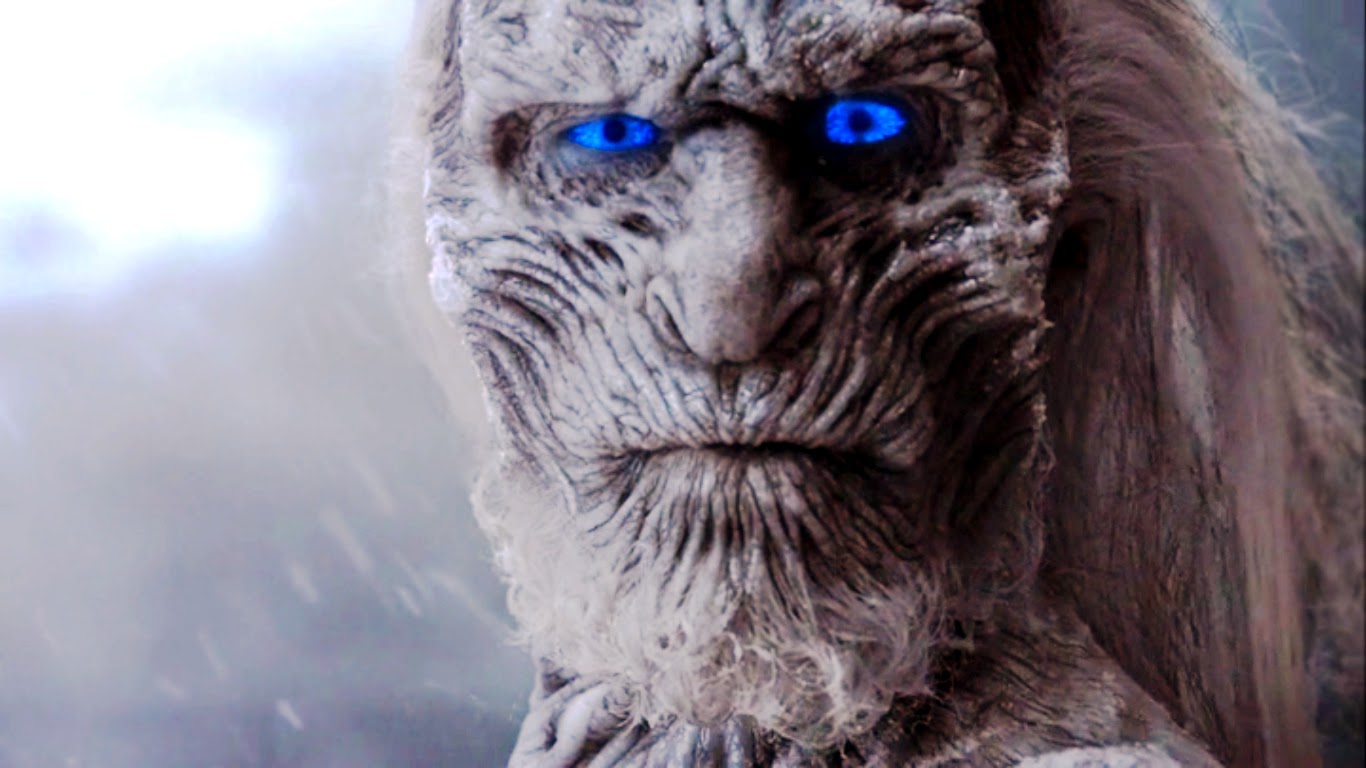
Summer is Coming

Studies such as these help us gaze into the uncertain future and ask if that is what we want for our children. Most of us don’t. A few of us actually try to do something to change it. For the rest, the lag time is comforting. The complexity of non-linear feedback systems gives us an excuse to procrastinate.

Why are zombies so ubiquitous in contemporary popular culture? The HBO mini-series, Game of Thrones, supplies one theory. Unlike in the AMC series, Walking Dead, or in the film, World War Z, the undead are not coming on like a Blitzkrieg hoard. Rather, the White Walkers are building slowly, as a rumor, sometimes killing the messenger and leaving the message undelivered. “Winter is coming” is an expression that hangs in the air, deepening the sense of foreboding.

One reviewer (for The New York Times) observed that “bringing in the White Walkers might be a way to ultimately point up the pettiness of politics — which is to say, no one cares who sits on what throne once zombies start eating people.”Thrones’ first four seasons of “people slicing, stabbing, axing, poisoning, eating, crushing and moon-dooring one another in every possible context,” underscore the point — that the pettiness of politics still rules the day.

Game of Thrones resonates because outside the window is the drama of NATO expansion bumping up against retired Red Army vets in the Ukraine, the unmasking of shadow banks in the U.K. by the Financial Times and shadowing governments by Edward Snowden, or the sniper battle on the U.S. Republican right that is so entertaining to MSNBC and CNN. It is all much ado about nothing. Just North of our popular culture Wall is a climate juggernaut, building momentum.
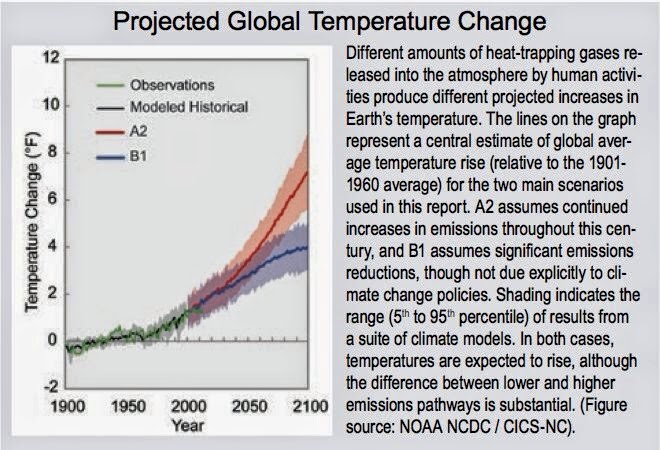
Both scenarios — business as usual and drastic curtailment — produce a temperature and climate regime that would likely be lethal for modern civilization, if not the human race. In the Cancun round of the Committee of Parties in 2010, United Nations high level negotiators produced a general agreement — over the opposition of the USA, Canada, Saudi Arabia, Australia, Israel and other obstructionists — that “recognizing that climate change represents an urgent and potentially irreversible threat to human societies and the planet,” 2°C was the “line in the sand” beyond which global temperatures should not be allowed to climb. In the latest three rounds— Durban, Doha and Warsaw — there has been a strong push from the science and civil sectors to reduce the target to 1.5°C to avert potentially unmanageable risks of tipping points from which no recovery would be possible. Since Warsaw last December some of these points — the inexorable slippage of ice in Antarctica and the release of methane from permafrost to name two — have tipped.

The NCA3 study is saying, essentially, we are in dangerous territory whether we stop emissions tomorrow or not. Summer temperatures in the U.S. have been rising on average 0.4 degrees F per decade since 1970, or about 0.2 C. Average summertime temperature increase has been 1°C overall, but the Southwest and West regions have borne the brunt of those increases, and temperatures have risen an average of 0.4°C, with a few localized areas warming as much as 0.6°C per decade. This is 5 times faster than the Earth as a whole warmed in the 20thcentury. North America, which lags other parts of the planet, is now in an exponential curve of accelerating change

“There are a number of findings in this report that sound an alarm bell signaling the need for action to combat the threats from climate change. For instance, the amount of rain coming down in heavy downpours and deluges across the U.S. is increasing; there’s an increase that’s already occurring in heat waves across the middle of the U.S.; and there are serious observed impacts of sea-level rise occurring in low-lying cities such as Miami, where, during high tides, certain parts of the city flood and seawater seeps up through storm drains. These are phenomena that are already having direct adverse impacts on human well-being in different parts of this country.”

Studies such as these help us gaze into the uncertain future and ask if it is really what we want for our children. Most of us don’t. A few of us actually try to do something to change it. For the rest, the lag time is comforting. The complexity of non-linear feedback systems gives us an excuse to procrastinate. More

Drought in Syria: a Major Cause of the Civil War?

Syria's devastating civil war that began in March 2011 has killed over 200,000 people, displaced at least 4.5 million, and created 3 million refugees.

Figure 1. The highest level of drought,
“Exceptional”, was affecting much of
Western Syria in April 2014, as measured
by the one-year Standardized Precipitation
Index (SPI).
Image credit: NOAA's Global Drought Portal

While the causes of the war are complex, a key contributing factor was the nation's devastating 2006 – 2011 drought, one of the worst in the nation's history, according to new research accepted for publication in the journal Weather, Climate, and Society by water resources expert Dr. Peter Gleick of the Pacific Institute. The drought brought the Fertile Crescent's lowest 4-year rainfall amounts since 1940, and Syria's most severe set of crop failures in recorded history. The worst drought-affected regions were eastern Syria, northern Iraq, and Iran, the major grain-growing areas of the northern Fertile Crescent. In a press release that accompanied the release of the new paper, Dr. Gleick said that as a result of the drought, “the decrease in water availability, water mismanagement, agricultural failures, and related economic deterioration contributed to population dislocations and the migration of rural communities to nearby cities. These factors further contributed to urban unemployment, economic dislocations, food insecurity for more than a million people, and subsequent social unrest.”

More

Solar is here

Solar is here.

That’s right. You know the solutions to the climate crisis are available today; we simply need the public (and political) will to implement them. Clean energy is urgently necessary, abundant, and becoming increasingly more affordable. That’s why on June 21, The Climate Reality Project is joining 12 other organizations in a day of action to support clean-energy solutions and show our commitment to bringing solar power to communities around the world.

If you don’t already have plans to take part on Saturday, don’t despair! Here are a few last minute ways to get involved:

  1. Sign: Send President Obama an email thanking him for putting solar panels on the roof of the White House.
  2. Share: Take your own #PutSolarOnIt photo and share it with your social media network.
  3. Discover: Check out the Mosaic website to find out if solar is right for you.
  4. Participate: Check out OFA’s website to find an event near you, some of which are being hosted by your fellow Climate Reality Leaders.

The reality is this: solar is affordable. It’s clean. And it’s powerful. The cost of solar panels has plummeted 60 percent since early 2011, and the number of installations keeps growing. The United States now has enough installed solar capacity to power more than 2.2 million homes. In several states, solar power is now competitive with other sources of energy without emitting the dangerous greenhouse gases that cause climate change.

Climate Reality Leaders are the first responders to the climate crisis and lead action across the globe. We’re proud so many of you will be participating on Saturday by hosting presentations, organizing events, and informing others about the benefits of solar power.

The Climate Reality Leadership Corps Team

Solar Array at Caledonian Bank, George Town, Cayman Islands


Climate Change: Implications for Tourism

IPCC AR5: Climate Change: Implications for Tourism

June 2014

The Fifth Assessment Report from the Intergovernmental Panel on Climate Change is the most up-to-date, comprehensive and relevant analysis of our changing climate.

The tourism industry faces profound impacts from climate change – impacts that are already being felt. It represents one of the world’s largest industries, accounting for some 9% of global GDP and generates 27 more than $6 trillion in revenues each year. This briefing reviews how climate change is already impacting the tourism industry and the challenges and opportunities that lie ahead. More

Download PDF


Climate change will ‘cost world far more than estimated’

Lord Stern, the world’s most authoritative climate economist, has issued a stark warning that the financial damage caused by global warming will be considerably greater than current models predict.

This makes it more important than ever to take urgent and drastic action to curb climate change by reducing carbon emissions, he argues.

Lord Stern, who wrote a hugely influential review on the financial implications of climate change in 2006, says the economic models that have been used to calculate the fiscal fallout from climate change are woefully inadequate and severely underestimate the scale of the threat.

As a result, even the recent and hugely authoritative series of reports from the UN Intergovernmental Panel on Climate Change (IPCC) are significantly flawed, he said.

“It is extremely important to understand the severe limitations of standard economic models, such as those cited in the IPCC report, which have made assumptions that simply do not reflect current knowledge about climate change and its … impacts on the economy,” said Lord Stern, a professor at the Grantham Institute, a research centre at the London School of Economics.

Professor Stern and his colleague Dr Simon Dietz will today publish the peer-reviewed findings of their research into climate change economic modelling in the The Economic Journal.

Their review is highly critical of established economic models which, among other things, fail to acknowledge the full breadth of climate change’s likely impact on the economy and are predicated on assumptions about global warming’s effect on output that are “without scientific foundation”.

Professor Stern, whose earlier research said it is far cheaper to tackle climate change now than in the future, added: “I hope our paper will prompt … economists to strive for much better models [and] … help policy-makers and the public recognise the immensity of the potential risks of unmanaged climate change.”

“Models that assume catastrophic damages are not possible fail to take account of the magnitude of the issues and the implications of the science,” he said.

Professor Stern and Dr Dietz say their findings strengthen the case for strong cuts in greenhouse gas emissions and imply that, unless this happens, living standards could even start to decline later this century.

For the study, they modified key features of the “dynamic integrated climate-economy” (Dice) model, initially devised by William Nordhaus in the 1990s. The changes take into account the latest scientific findings and some of the uncertainties about the major risks of climate change that are usually omitted.

The standard Dice model has been used in a wide range of economic studies of the potential impacts of climate change, some of which have been cited in the most recent IPCC report which has been released in three parts over the past nine months.

Dr Dietz said: “While this standard economic model has been useful for economists who estimate the potential impacts of climate change, our paper shows some major improvements are needed before it can reflect the extent of the risks indicated by the science.”

Dr Dietz said his aim was to show how a new version of the model could produce a range of results that are much more representative of the science and economics of climate change, taking into account the uncertainties.

“The new version of this standard economic model, for instance, suggests that the risks from climate change are bigger than portrayed by previous economic models and therefore strengthens the case for strong cuts in emissions of greenhouse gases,” he said.

The new model differs in that it considers a wider temperature range when estimating the impact of doubling the atmospheric concentration of greenhouse gases – a measure of “climate sensitivity”.

Whereas the standard model usually assumes a single temperature for climate sensitivity of about 3C, the new model uses a range of 1.5C to 6C, which the authors say more accurately reflects the scientific consensus.

The standard model also “implausibly” suggests a loss of global output of 50 per cent would only result after a rise in global average temperature of 18C, even though such warming would likely render the Earth uninhabitable for most species, including humans, Dr Dietz contends.

The new model includes the possibility that such damage could occur at much lower levels of global warming. Standard economic models rule out the possibility that global warming of 5-6C above pre-industrial levels could cause catastrophic damages, even though such temperatures have not occurred on Earth for tens of millions of years. Such an assertion, he says, is without scientific foundation and embodies a false assumption that the risks are known, with great confidence, to be small.

The new model also takes into account that climate change can damage not just economic output, but productivity. The standard model assumes that rising levels of greenhouse gases in the atmosphere only affect economic growth in a very limited way, according to Dr Dietz. More


Surviving the 21st Century

Surviving the 21st Century


Published on May 28, 2014 • Professor Noam Chomsky Institute Professor & Professor of Linguistics (Emeritus), Massachusetts Institute of Technology addressed this question of global significance in a special Durham Castle Lecture on 22nd May.

The Pale Blue Dot

THE SAGAN SERIES – The Pale Blue Dot

================================


Playing in the Major Leagues.


George Town, Cayman Islands – 19 October 2009


Climate change is the most serious peril that has faced humanity in its long history. However, we are faced with more than climate change, there is peak oil and an out of control population, as well as concerns for water and food security in the years to come.


As I said to a colleague earlier today “failing to plan is planning to fail”.


Humanity is today playing in the major leagues. We are in a sink or swim situation. If we can keep the planet habitable by mitigating and adapting to the changing climate, switching to alternative sources of energy such as solar, wind, geothermal, wave, ocean thermal and nuclear, sequester CO2 and provide the population with adequate supplies of water and food and bring the population under control, humanity may survive .


Warfare and conflict will also need to become a thing of the past as climate change and energy may well exacerbate conflict situations. With a 9.5 billion global population by 2050 ensuring that everyone has adequate food and water could be problematic.


There is however, no ‘Plan B’ if we fail to resolve all the problems facing us.


When playing in the major leagues there is no time out, there is no one that is going to offer help, let alone rescue us. Look around, the neighbourhood is somewhat sparsely populated and there are no other worlds on which humanity can survive. Even if there were other habitable worlds nearby they would in all probability belong to someone else.


There are, in all likelihood, other intelligent races out there somewhere, however in the major leagues one survives on ones own. As a young civilisation it is up to us to solve all our problems, to make peace among ourselves, to bring the population under control, to implement the Millennium Development Goals (MDG). We must solve our own problems. As a young race we are as children, and as such we may not be able to solve our own problems. But solve them we must.


If we are able to solve the situation facing us and make it to adulthood, in the galactic meaning of the world, we may then be introduced to the neighbours.


One of the most hopeful initiatives that has been started is the Eradicating Ecocide Initiative. Ecocide is the extensive damage to , destruction of or loss of ecosystems. It is happening on a mass scale, every day and it is getting worse. We can change this. Our aim is to stop the destruction of the Earth by making ecocide the 5th Crime Against Peace. Ecocide is a crime against nature, humanity and future generations. See http://www.thisisecocide.com/


An international law of Ecocide would make CEOs and our Heads of State legally responsible for protecting the Earth. People and planet will become the number one priority.


If we do not make it to adulthood we will be just another minor statistic, a failure, a insignificant footnote in the universal history book.


For all these reasons we have to come together and produce a new global climate change deal to replace the ageing Kyoto treaty. Unless we can do so, we are ‘planning to fail‘.


Posted by Nick Robson at 3:36 PM

Labels: catastrophe, climate

==========================

Published on Oct 21, 2013 • Facebook – http://www.facebook.com/thesaganseries

Twitter – http://twitter.com/reidgower

G+ – http://bit.lyA/pHzQh

The Sagan Series is an educational project working in the hopes of promoting scientific literacy in the general population. Created by ©ReidGower http://twitter.com/reidgower

Copyright Disclaimer Under Section 1 07 of the Copyright Act 1976, allowance is made for “fair use” for purposes such as criticism, comment, news reporting, teaching, scholarship, and research. Fair use is a use permitted by copyright statute that might otherwise be infringing. Non-profit, educational or personal use tips the balance in favor of fair use.

All copyrighted materials contained herein belong to their respective copyright holders, I do not claim ownership over any of these materials. I realize no profit, monetary or otherwise, from the exhibition of these videos.

Permaculture PDC in Palestine in September

Marda Permaculture Certification Course, Register Now!


For more information click here


Mega dry spell Spain’s worst in 150 years

Parts of Spain are currently suffering through their most intense dry spell in a century and a half with Valencia and Alicante among the worst affected regions. Future predictions are not too rosy either, meteorologists warn.

The last eight months have been brutally dry for large swathes of southern and eastern Spain.

While huge storms buffeted Spain’s Atlantic coasts and the Canary Islands during the winter and spring, Valencia and Alicante, as well as areas including Murcia, parts of Albacete province, and the Andalusian provinces of Jaén, Almería, Cadíz and Málaga have all been starved of rain.

In the last 150 years, there has never been “such a long and intense drought”, according to the country’s meteorological agency Aemet.

Indeed there are parts of the country where during “the second worst period of drought on record there was twice as much rain as now”, meteorologist José Antonio Maldonado told Spanish free daily 20 minutos.

Rainfall levels in many areas have been less than half of those seen from 1971 to 2000, while some places have seen less than 25 percent of those levels.

Most dams are still at somewhere between 74 percent and 90 percent of capacity thanks to rains from earlier years, but some farmers are already struggling to water their crops, or have gone out of business.

Spain is also facing an uncertain water future: a 2013 study by the Spanish National Research Council (CSIC) looking at the period from 1945 to 2005 found the country’s droughts were becoming more intense and more regular. More