Drought in Syria: a Major Cause of the Civil War?

Syria's devastating civil war that began in March 2011 has killed over 200,000 people, displaced at least 4.5 million, and created 3 million refugees.

Figure 1. The highest level of drought,
“Exceptional”, was affecting much of
Western Syria in April 2014, as measured
by the one-year Standardized Precipitation
Index (SPI).
Image credit: NOAA's Global Drought Portal

While the causes of the war are complex, a key contributing factor was the nation's devastating 2006 – 2011 drought, one of the worst in the nation's history, according to new research accepted for publication in the journal Weather, Climate, and Society by water resources expert Dr. Peter Gleick of the Pacific Institute. The drought brought the Fertile Crescent's lowest 4-year rainfall amounts since 1940, and Syria's most severe set of crop failures in recorded history. The worst drought-affected regions were eastern Syria, northern Iraq, and Iran, the major grain-growing areas of the northern Fertile Crescent. In a press release that accompanied the release of the new paper, Dr. Gleick said that as a result of the drought, “the decrease in water availability, water mismanagement, agricultural failures, and related economic deterioration contributed to population dislocations and the migration of rural communities to nearby cities. These factors further contributed to urban unemployment, economic dislocations, food insecurity for more than a million people, and subsequent social unrest.”

More

Dying vet’s F_ck You letter to George Bush and Dick Cheney needs to be read by every American

To: George W. Bush and Dick Cheney

From: Tomas Young

I write this letter on the 10th anniversary of the Iraq War on behalf of my fellow Iraq War veterans. I write this letter on behalf of the 4,488 soldiers and Marines who died in Iraq. I write this letter on behalf of the hundreds of thousands of veterans who have been wounded and on behalf of those whose wounds, physical and psychological, have destroyed their lives. I am one of those gravely wounded. I was paralyzed in an insurgent ambush in 2004 in Sadr City. My life is coming to an end. I am living under hospice care.

I write this letter on behalf of husbands and wives who have lost spouses, on behalf of children who have lost a parent, on behalf of the fathers and mothers who have lost sons and daughters and on behalf of those who care for the many thousands of my fellow veterans who have brain injuries. I write this letter on behalf of those veterans whose trauma and self-revulsion for what they have witnessed, endured and done in Iraq have led to suicide and on behalf of the active-duty soldiers and Marines who commit, on average, a suicide a day. I write this letter on behalf of the some 1 million Iraqi dead and on behalf of the countless Iraqi wounded. I write this letter on behalf of us all—the human detritus your war has left behind, those who will spend their lives in unending pain and grief.

I write this letter, my last letter, to you, Mr. Bush and Mr. Cheney. I write not because I think you grasp the terrible human and moral consequences of your lies, manipulation and thirst for wealth and power. I write this letter because, before my own death, I want to make it clear that I, and hundreds of thousands of my fellow veterans, along with millions of my fellow citizens, along with hundreds of millions more in Iraq and the Middle East, know fully who you are and what you have done. You may evade justice but in our eyes you are each guilty of egregious war crimes, of plunder and, finally, of murder, including the murder of thousands of young Americans—my fellow veterans—whose future you stole.

Your positions of authority, your millions of dollars of personal wealth, your public relations consultants, your privilege and your power cannot mask the hollowness of your character. You sent us to fight and die in Iraq after you, Mr. Cheney, dodged the draft in Vietnam, and you, Mr. Bush, went AWOL from your National Guard unit. Your cowardice and selfishness were established decades ago. You were not willing to risk yourselves for our nation but you sent hundreds of thousands of young men and women to be sacrificed in a senseless war with no more thought than it takes to put out the garbage.

I joined the Army two days after the 9/11 attacks. I joined the Army because our country had been attacked. I wanted to strike back at those who had killed some 3,000 of my fellow citizens. I did not join the Army to go to Iraq, a country that had no part in the September 2001 attacks and did not pose a threat to its neighbors, much less to the United States. I did not join the Army to “liberate” Iraqis or to shut down mythical weapons-of-mass-destruction facilities or to implant what you cynically called “democracy” in Baghdad and the Middle East. I did not join the Army to rebuild Iraq, which at the time you told us could be paid for by Iraq’s oil revenues. Instead, this war has cost the United States over $3 trillion. I especially did not join the Army to carry out pre-emptive war. Pre-emptive war is illegal under international law. And as a soldier in Iraq I was, I now know, abetting your idiocy and your crimes. The Iraq War is the largest strategic blunder in U.S. history. It obliterated the balance of power in the Middle East. It installed a corrupt and brutal pro-Iranian government in Baghdad, one cemented in power through the use of torture, death squads and terror. And it has left Iran as the dominant force in the region. On every level—moral, strategic, military and economic—Iraq was a failure. And it was you, Mr. Bush and Mr. Cheney, who started this war. It is you who should pay the consequences.

I would not be writing this letter if I had been wounded fighting in Afghanistan against those forces that carried out the attacks of 9/11. Had I been wounded there I would still be miserable because of my physical deterioration and imminent death, but I would at least have the comfort of knowing that my injuries were a consequence of my own decision to defend the country I love. I would not have to lie in my bed, my body filled with painkillers, my life ebbing away, and deal with the fact that hundreds of thousands of human beings, including children, including myself, were sacrificed by you for little more than the greed of oil companies, for your alliance with the oil sheiks in Saudi Arabia, and your insane visions of empire.

I have, like many other disabled veterans, suffered from the inadequate and often inept care provided by the Veterans Administration. I have, like many other disabled veterans, come to realize that our mental and physical wounds are of no interest to you, perhaps of no interest to any politician. We were used. We were betrayed. And we have been abandoned. You, Mr. Bush, make much pretense of being a Christian. But isn’t lying a sin? Isn’t murder a sin? Aren’t theft and selfish ambition sins? I am not a Christian. But I believe in the Christian ideal. I believe that what you do to the least of your brothers you finally do to yourself, to your own soul.

My day of reckoning is upon me. Yours will come. I hope you will be put on trial. But mostly I hope, for your sakes, that you find the moral courage to face what you have done to me and to many, many others who deserved to live. I hope that before your time on earth ends, as mine is now ending, you will find the strength of character to stand before the American public and the world, and in particular the Iraqi people, and beg for forgiveness.

I write this letter on the 10th anniversary of the Iraq War on behalf of my fellow Iraq War veterans. I write this letter on behalf of the 4,488 soldiers and Marines who died in Iraq. I write this letter on behalf of the hundreds of thousands of veterans who have been wounded and on behalf of those whose wounds, physical and psychological, have destroyed their lives. I am one of those gravely wounded. I was paralyzed in an insurgent ambush in 2004 in Sadr City. My life is coming to an end. I am living under hospice care.


I write this letter on behalf of husbands and wives who have lost spouses, on behalf of children who have lost a parent, on behalf of the fathers and mothers who have lost sons and daughters and on behalf of those who care for the many thousands of my fellow veterans who have brain injuries. I write this letter on behalf of those veterans whose trauma and self-revulsion for what they have witnessed, endured and done in Iraq have led to suicide and on behalf of the active-duty soldiers and Marines who commit, on average, a suicide a day. I write this letter on behalf of the some 1 million Iraqi dead and on behalf of the countless Iraqi wounded. I write this letter on behalf of us all—the human detritus your war has left behind, those who will spend their lives in unending pain and grief.

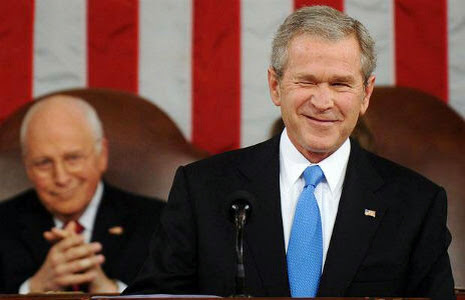
Bush and Cheney

I write this letter, my last letter, to you, Mr. Bush and Mr. Cheney. I write not because I think you grasp the terrible human and moral consequences of your lies, manipulation and thirst for wealth and power. I write this letter because, before my own death, I want to make it clear that I, and hundreds of thousands of my fellow veterans, along with millions of my fellow citizens, along with hundreds of millions more in Iraq and the Middle East, know fully who you are and what you have done. You may evade justice but in our eyes you are each guilty of egregious war crimes, of plunder and, finally, of murder, including the murder of thousands of young Americans—my fellow veterans—whose future you stole.

Your positions of authority, your millions of dollars of personal wealth, your public relations consultants, your privilege and your power cannot mask the hollowness of your character. You sent us to fight and die in Iraq after you, Mr. Cheney, dodged the draft in Vietnam, and you, Mr. Bush, went AWOL from your National Guard unit. Your cowardice and selfishness were established decades ago. You were not willing to risk yourselves for our nation but you sent hundreds of thousands of young men and women to be sacrificed in a senseless war with no more thought than it takes to put out the garbage.

I joined the Army two days after the 9/11 attacks. I joined the Army because our country had been attacked. I wanted to strike back at those who had killed some 3,000 of my fellow citizens. I did not join the Army to go to Iraq, a country that had no part in the September 2001 attacks and did not pose a threat to its neighbors, much less to the United States. I did not join the Army to “liberate” Iraqis or to shut down mythical weapons-of-mass-destruction facilities or to implant what you cynically called “democracy” in Baghdad and the Middle East. I did not join the Army to rebuild Iraq, which at the time you told us could be paid for by Iraq’s oil revenues. Instead, this war has cost the United States over $3 trillion. I especially did not join the Army to carry out pre-emptive war. Pre-emptive war is illegal under international law. And as a soldier in Iraq I was, I now know, abetting your idiocy and your crimes. The Iraq War is the largest strategic blunder in U.S. history. It obliterated the balance of power in the Middle East. It installed a corrupt and brutal pro-Iranian government in Baghdad, one cemented in power through the use of torture, death squads and terror. And it has left Iran as the dominant force in the region. On every level—moral, strategic, military and economic—Iraq was a failure. And it was you, Mr. Bush and Mr. Cheney, who started this war. It is you who should pay the consequences.

I would not be writing this letter if I had been wounded fighting in Afghanistan against those forces that carried out the attacks of 9/11. Had I been wounded there I would still be miserable because of my physical deterioration and imminent death, but I would at least have the comfort of knowing that my injuries were a consequence of my own decision to defend the country I love. I would not have to lie in my bed, my body filled with painkillers, my life ebbing away, and deal with the fact that hundreds of thousands of human beings, including children, including myself, were sacrificed by you for little more than the greed of oil companies, for your alliance with the oil sheiks in Saudi Arabia, and your insane visions of empire.

I have, like many other disabled veterans, suffered from the inadequate and often inept care provided by the Veterans Administration. I have, like many other disabled veterans, come to realize that our mental and physical wounds are of no interest to you, perhaps of no interest to any politician. We were used. We were betrayed. And we have been abandoned. You, Mr. Bush, make much pretense of being a Christian. But isn’t lying a sin? Isn’t murder a sin? Aren’t theft and selfish ambition sins? I am not a Christian. But I believe in the Christian ideal. I believe that what you do to the least of your brothers you finally do to yourself, to your own soul.

My day of reckoning is upon me. Yours will come. I hope you will be put on trial. But mostly I hope, for your sakes, that you find the moral courage to face what you have done to me and to many, many others who deserved to live. I hope that before your time on earth ends, as mine is now ending, you will find the strength of character to stand before the American public and the world, and in particular the Iraqi people, and beg for forgiveness.

Tomas Young


The open source revolution is coming and it will conquer the 1% – ex CIA spy

Robert David Steele, former Marine, CIA case officer, and US co-founder of the US Marine Corps intelligence activity, is a man on a mission. But it's a mission that frightens the US intelligence establishment to its core.


With 18 years experience working across the US intelligence community, followed by 20 more years in commercial intelligence and training, Steele's exemplary career has spanned almost all areas of both the clandestine world.

Steele started off as a Marine Corps infantry and intelligence officer. After four years on active duty, he joined the CIA for about a decade before co-founding the Marine Corps Intelligence Activity, where he was deputy director. Widely recognised as the leader of the Open Source Intelligence (OSINT) paradigm, Steele went on to write the handbooks on OSINT for NATO, the US Defense Intelligence Agency and the U.S. Special Operations Forces. In passing, he personally trained 7,500 officers from over 66 countries.

In 1992, despite opposition from the CIA, he obtained Marine Corps permission to organise a landmark international conference on open source intelligence – the paradigm of deriving information to support policy decisions not through secret activities, but from open public sources available to all. The conference was such a success it brought in over 620 attendees from the intelligence world.

But the CIA wasn't happy, and ensured that Steele was prohibited from running a second conference. The clash prompted him to resign from his position as second-ranking civilian in Marine Corps intelligence, and pursue the open source paradigm elsewhere. He went on to found and head up the Open Source Solutions Network Inc. and later the non-profit Earth Intelligence Network which runs the Public Intelligence Blog.

I first came across Steele when I discovered his Amazon review of my third book, The War on Truth: 9/11, Disinformation and the Anatomy of Terrorism. A voracious reader, Steele is the number 1 Amazon reviewer for non-fiction across 98 categories. He also reviewed my latest book, A User's Guide to the Crisis of Civilization, but told me I'd overlooked an important early work – 'A More Secure World: Our Shared Responsibility, Report of the UN High-Level Panel on Threats, Challenges, and Change.'

Last month, Steele presented a startling paper at the Libtech conference in New York, sponsored by the Internet Society and Reclaim. Drawing on principles set out in his latest book, The Open-Source Everything Manifesto: Transparency, Truth and Trust, he told the audience that all the major preconditions for revolution – set out in his 1976 graduate thesis – were now present in the United States and Britain.

Steele's book is a must-read, a powerful yet still pragmatic roadmap to a new civilisational paradigm that simultaneously offers a trenchant, unrelenting critique of the prevailing global order. His interdisciplinary 'whole systems' approach dramatically connects up the increasing corruption, inefficiency and unaccountability of the intelligence system and its political and financial masters with escalating inequalities and environmental crises. But he also offers a comprehensive vision of hope that activist networks like Reclaim are implementing today.

“We are at the end of a five-thousand-year-plus historical process during which human society grew in scale while it abandoned the early indigenous wisdom councils and communal decision-making,” he writes in The Open Source Everything Manifesto. “Power was centralised in the hands of increasingly specialised 'elites' and 'experts' who not only failed to achieve all they promised but used secrecy and the control of information to deceive the public into allowing them to retain power over community resources that they ultimately looted.”

Today's capitalism, he argues, is inherently predatory and destructive:

“Over the course of the last centuries, the commons was fenced, and everything from agriculture to water was commoditised without regard to the true cost in non-renewable resources. Human beings, who had spent centuries evolving away from slavery, were re-commoditised by the Industrial Era.”

Open source everything, in this context, offers us the chance to build on what we've learned through industrialisation, to learn from our mistakes, and catalyse the re-opening of the commons, in the process breaking the grip of defunct power structures and enabling the possibility of prosperity for all.

“Sharing, not secrecy, is the means by which we realise such a lofty destiny as well as create infinite wealth. The wealth of networks, the wealth of knowledge, revolutionary wealth – all can create a nonzero win-win Earth that works for one hundred percent of humanity. This is the 'utopia' that Buckminster Fuller foresaw, now within our reach.”

The goal, he concludes, is to reject:


“… concentrated illicitly aggregated and largely phantom wealth in favor of community wealth defined by community knowledge, community sharing of information, and community definition of truth derived in transparency and authenticity, the latter being the ultimate arbiter of shared wealth.”

Despite this unabashedly radical vision, Steele is hugely respected by senior military intelligence experts across the world. As a researcher at the US Army War College's Strategic Studies Institute, he has authored several monographs advocating the need for open source methods to transform the craft of intelligence. He has lectured to the US State Department and Department of Homeland Security as well as National Security Councils in various countries, and his new book has received accolades from senior intelligence officials across multiple countries including France and Turkey.

Yet he remains an outspoken critic of US intelligence practices and what he sees as their integral role in aggravating rather than ameliorating the world's greatest threats and challenges.

This week, I had the good fortune of being able to touch base with Steele to dig deeper into his recent analysis of the future of US politics in the context of our accelerating environmental challenges. The first thing I asked him was where he sees things going over the next decade, given his holistic take.

“Properly educated people always appreciate holistic approaches to any challenge. This means that they understand both cause and effect, and intertwined complexities,” he said. “A major part of our problem in the public policy arena is the decline in intelligence with integrity among key politicians and staff at the same time that think tanks and universities and non-governmental organisations have also suffered a similar intellectual diminishment.

“My early graduate education was in the 1970's when Limits to Growth and World Federalism were the rage. Both sought to achieve an over-view of systemic challenges, but both also suffered from the myth of top-down hubris. What was clear in the 1970s, that has been obscured by political and financial treason in the past half-century, is that everything is connected – what we do in the way of paving over wetlands, or in poisoning ground water 'inadvertently' because of our reliance on pesticides and fertilisers that are not subject to the integrity of the 'Precautionary Principle,' ultimately leads to climate catastrophes that are acts of man, not acts of god.”

He points me to his tremendous collection of reviews of books on climate change, disease, environmental degradation, peak oil, and water scarcity. “I see five major overlapping threats on the immediate horizon,” he continues. “They are all related: the collapse of complex societies, the acceleration of the Earth's demise with changes that used to take 10,000 years now taking three or less, predatory or shock capitalism and financial crime out of the City of London and Wall Street, and political corruption at scale, to include the west supporting 42 of 44 dictators. We are close to multiple mass catastrophes.”

What about the claim that the US is on the brink of revolution? “Revolution is overthrow – the complete reversal of the status quo ante. We are at the end of centuries of what Lionel Tiger calls 'The Manufacture of Evil,' in which merchant banks led by the City of London have conspired with captive governments to concentrate wealth and commoditise everything including humans. What revolution means in practical terms is that balance has been lost and the status quo ante is unsustainable. There are two 'stops' on greed to the nth degree: the first is the carrying capacity of Earth, and the second is human sensibility. We are now at a point where both stops are activating.”

It's not just the US, he adds. “The preconditions of revolution exist in the UK, and most western countries. The number of active pre-conditions is quite stunning, from elite isolation to concentrated wealth to inadequate socialisation and education, to concentrated land holdings to loss of authority to repression of new technologies especially in relation to energy, to the atrophy of the public sector and spread of corruption, to media dishonesty, to mass unemployment of young men and on and on and on.”

So why isn't it happening yet?

“Preconditions are not the same as precipitants. We are waiting for our Tunisian fruit seller. The public will endure great repression, especially when most media outlets and schools are actively aiding the repressive meme of 'you are helpless, this is the order of things.' When we have a scandal so powerful that it cannot be ignored by the average Briton or American, we will have a revolution that overturns the corrupt political systems in both countries, and perhaps puts many banks out of business. Vaclav Havel calls this 'The Power of the Powerless.' One spark, one massive fire.”

But we need more than revolution, in the sense of overthrow, to effect change, surely. How does your manifesto for 'open source everything' fit into this? “The west has pursued an industrialisation path that allows for the privatisation of wealth from the commons, along with the criminalisation of commons rights of the public, as well as the externalisation of all true costs. Never mind that fracking produces earthquakes and poisons aquifers – corrupt politicians at local, state or province, and national levels are all too happy to take money for looking the other way. Our entire commercial, diplomatic, and informational systems are now cancerous. When trade treaties have secret sections – or are entirely secret – one can be certain the public is being screwed and the secrecy is an attempt to avoid accountability. Secrecy enables corruption. So also does an inattentive public enable corruption.”

Is this a crisis of capitalism, then? Does capitalism need to end for us to resolve these problems? And if so, how? “Predatory capitalism is based on the privatisation of profit and the externalisation of cost. It is an extension of the fencing of the commons, of enclosures, along with the criminalisation of prior common customs and rights. What we need is a system that fully accounts for all costs. Whether we call that capitalism or not is irrelevant to me. But doing so would fundamentally transform the dynamic of present day capitalism, by making capital open source. For example, and as calculated by my colleague JZ Liszkiewicz, a white cotton T-shirt contains roughly 570 gallons of water, 11 to 29 gallons of fuel, and a number of toxins and emissions including pesticides, diesel exhaust, and heavy metals and other volatile compounds – it also generally includes child labor. Accounting for those costs and their real social, human and environmental impacts has totally different implications for how we should organise production and consumption than current predatory capitalism.”

So what exactly do you mean by open source everything? “We have over 5 billion human brains that are the one infinite resource available to us going forward. Crowd-sourcing and cognitive surplus are two terms of art for the changing power dynamic between those at the top that are ignorant and corrupt, and those across the bottom that are attentive and ethical. The open source ecology is made up of a wide range of opens – open farm technology, open source software, open hardware, open networks, open money, open small business technology, open patents – to name just a few. The key point is that they must all develop together, otherwise the existing system will isolate them into ineffectiveness. Open data is largely worthless unless you have open hardware and open software. Open government demands open cloud and open spectrum, or money will dominate feeds and speeds.”

On 1st May, Steele sent an open letter to US vice president Joe Biden requesting him to consider establishing an Open Source Agency that would transform the operation of the intelligence community, dramatically reduce costs, increasing oversight and accountability, while increasing access to the best possible information to support holistic policy-making. To date, he has received no response.

I'm not particularly surprised. Open source everything pretty much undermines everything the national security state stands for. Why bother even asking vice president Biden to consider it? “The national security state is rooted in secrecy as a means of avoiding accountability. My first book, On Intelligence: Spies and Secrecy in an Open World – which by the way had a foreword from Senator David Boren, the immediate past chairman of the Senate Select Committee for Intelligence – made it quite clear that the national security state is an expensive, ineffective monstrosity that is simply not fit for purpose. In that sense, the national security state is it's own worst enemy – it's bound to fail.”

Given his standing as an intelligence expert, Steele's criticisms of US intelligence excesses are beyond scathing – they are damning. “Most of what is produced through secret methods is not actually intelligence at all. It is simply secret information that is, most of the time, rather generic and therefore not actually very useful for making critical decisions at a government level. The National Security Agency (NSA) has not prevented any terrorist incidents. CIA cannot even get the population of Syria correct and provides no intelligence – decision-support – to most cabinet secretaries, assistant secretaries, and department heads. Indeed General Tony Zinni, when he was commander in chief of the US Central Command as it was at war, is on record as saying that he received, 'at best,' a meagre 4% of what he needed to know from secret sources and methods.”

So does open source mean you are calling for abolition of intelligence agencies as we know them, I ask. “I'm a former spy and I believe we still need spies and secrecy, but we need to redirect the vast majority of the funds now spent on secrecy toward savings and narrowly focused endeavors at home. For instance, utterly ruthless counterintelligence against corruption, or horrendous evils like paedophilia.

“Believe it or not, 95% of what we need for ethical evidence-based decision support cannot be obtained through the secret methods of standard intelligence practices. But it can be obtained quite openly and cheaply from academics, civil society, commerce, governments, law enforcement organisations, the media, all militaries, and non-governmental organisations. An Open Source Agency, as I've proposed it, would not just meet 95% of our intelligence requirements, it would do the same at all levels of government and carry over by enriching education, commerce, and research – it would create what I called in 1995 a 'Smart Nation.'

“The whole point of Open Source Everything is to restore public agency. Open Source is the only form of information and information technology that is affordable to the majority, interoperable across all boundaries, and rapidly scalable from local to global without the curse of overhead that proprietary corporations impose.”

It's clear to me that when Steele talks about intelligence as 'decision-support,' he really does intend that we grasp “all information in all languages all the time” – that we do multidisciplinary research spanning centuries into the past as well as into the future. His most intriguing premise is that the 1% are simply not as powerful as they, and we, assume them to be. “The collective buying power of the five billion poor is four times that of the one billion rich according to the late Harvard business thinker Prof C. K. Prahalad – open source everything is about the five billion poor coming together to reclaim their collective wealth and mobilise it to transform their lives. There is zero chance of the revolution being put down. Public agency is emergent, and the ability of the public to literally put any bank or corporation out of business overnight is looming. To paraphrase Abe Lincoln, you cannot screw all of the people all of the time. We're there. All we lack is a major precipitant – our Tunisian fruit seller. When it happens the revolution will be deep and lasting.”

The Arab spring analogy has its negatives. So far, there really isn't much to root for. I want to know what's to stop this revolution from turning into a violent, destructive mess. Steele is characteristically optimistic. “I have struggled with this question. What I see happening is an end to national dictat and the emergence of bottom-up clarity, diversity, integrity, and sustainability. Individual towns across the USA are now nullifying federal and state regulations – for example gag laws on animal cruelty, blanket permissions for fracking. Those such as my colleague Parag Khanna that speak to a new era of city-states are correct in my view. Top down power has failed in a most spectacular manner, and bottom-up consensus power is emergent. 'Not in my neighborhood' is beginning to trump 'Because I say so.' The one unlimited resource we have on the planet is the human brain – the current strategy of 1% capitalism is failing because it is killing the Golden Goose at multiple levels. Unfortunately, the gap between those with money and power and those who actually know what they are talking about has grown catastrophic. The rich are surrounded by sycophants and pretenders whose continued employment demands that they not question the premises. As Larry Summers lectured Elizabeth Warren, 'insiders do not criticise insiders.'”

But how can activists actually start moving toward the open source vision now? “For starters, there are eight 'tribes' that among them can bring together all relevant information: academia, civil society including labor unions and religions, commerce especially small business, government especially local, law enforcement, media, military, and non-government/non-profit. At every level from local to global, across every mission area, we need to create stewardship councils integrating personalities and information from all eight tribes. We don't need to wait around for someone else to get started. All of us who recognise the vitality of this possibility can begin creating these new grassroots structures from the bottom-up, right now.”

So how does open source everything have the potential to 're-engineer the Earth'? For me, this is the most important question, and Steele's answer is inspiring. “Open Source Everything overturns top-down 'because I say so at the point of a gun' power. Open Source Everything makes truth rather than violence the currency of power. Open Source Everything demands that true cost economics and the indigenous concept of 'seventh generation thinking' – how will this affect society 200 years ahead – become central. Most of our problems today can be traced to the ascendance of unilateral militarism, virtual colonialism, and predatory capitalism, all based on force and lies and encroachment on the commons. The national security state works for the City of London and Wall Street – both are about to be toppled by a combination of Eastern alternative banking and alternative international development capabilities, and individuals who recognise that they have the power to pull their money out of the banks and not buy the consumer goods that subsidise corruption and the concentration of wealth. The opportunity to take back the commons for the benefit of humanity as a whole is open – here and now.”

For Steele, the open source revolution is inevitable, simply because the demise of the system presided over by the 1% cannot be stopped – and because the alternatives to reclaiming the commons are too dismal to contemplate. We have no choice but to step up.

“My motto, a play on the CIA motto that is disgraced every day, is 'the truth at any cost lowers all other costs'”, he tells me. “Others wiser than I have pointed out that nature bats last. We are at the end of an era in which lies can be used to steal from the public and the commons. We are at the beginning of an era in which truth in public service can restore us all to a state of grace.” More

Please see orginal article for more graphics, charts etc.

Solar is here

Solar is here.

That’s right. You know the solutions to the climate crisis are available today; we simply need the public (and political) will to implement them. Clean energy is urgently necessary, abundant, and becoming increasingly more affordable. That’s why on June 21, The Climate Reality Project is joining 12 other organizations in a day of action to support clean-energy solutions and show our commitment to bringing solar power to communities around the world.

If you don’t already have plans to take part on Saturday, don’t despair! Here are a few last minute ways to get involved:

  1. Sign: Send President Obama an email thanking him for putting solar panels on the roof of the White House.
  2. Share: Take your own #PutSolarOnIt photo and share it with your social media network.
  3. Discover: Check out the Mosaic website to find out if solar is right for you.
  4. Participate: Check out OFA’s website to find an event near you, some of which are being hosted by your fellow Climate Reality Leaders.

The reality is this: solar is affordable. It’s clean. And it’s powerful. The cost of solar panels has plummeted 60 percent since early 2011, and the number of installations keeps growing. The United States now has enough installed solar capacity to power more than 2.2 million homes. In several states, solar power is now competitive with other sources of energy without emitting the dangerous greenhouse gases that cause climate change.

Climate Reality Leaders are the first responders to the climate crisis and lead action across the globe. We’re proud so many of you will be participating on Saturday by hosting presentations, organizing events, and informing others about the benefits of solar power.

The Climate Reality Leadership Corps Team

Solar Array at Caledonian Bank, George Town, Cayman Islands


Israel elected to leadership of UN committee on “Decolonization”

Just when it appeared that the United Nations could not be more ineffective in protecting Palestinian rights and holding Israel accountable for violating them, here comes the news that Israel has been elected as vice-chair of the UN Special Commitee on Decolonization – which deals among other things with matters related to Palestinian refugees.

Palestinians examine the ruins of
buildings demolished by Israeli
occupation forces in eastern Jerusalem,

According to UN minutes, the representative of Israel, the world’s last settler-colonial power, received 74 votes for the post, despite strong opposition from the Arab Group of UN member states.

Qatar, speaking on behalf of the Arab states, described Israel as a “State that violated the United Nations Charter and international law. Because its track record was rife with murder and its occupation had lasted more than 66 years, Israel was not qualified to preside over questions pertaining to Palestinian refugees, peacekeeping and the investigation of its own illegal practices.”

The Arab states had demanded a recorded vote, an unusual step, prompting objections from the ambassador of the United Kingdom which is a member of the Group of Western European and Other States that nominated Israel.

The Balfour Declaration

Canada took the opportunity to express its “unflinching support for Israel” and the United States said it “unequivocally supported Israel’s election.”

Saudi Arabia – whose own membership of the UN Human Rights Council has drawn much criticism – said that Israel’s election was “the moral equivalent of placing the apartheid regime of South Africa in charge of a committee to end racism.”

Theater of the absurd

Israel thanked its supporters, but perhaps its actions spoke louder than words. While this theater of the absurd was playing out in New York, Israeli occupation forces stepped up demolitions of Palestinian homes to make way for colonial settlements.

Its election comes just weeks after Israel announced yet another massive expansion of illegal colonies in the occupied West Bank.

On Wednesday alone, Israeli demolitions left seven Palestinian families homelessin the West Bank.

And take a look at the photostory by Silvia Boarini documenting Israel’s ongoing ethnic cleansing of Palestinian Bedouins in the southern Naqab (“Negev”) region of present-day Israel.

These latest measures of ethnic cleansing come amid Israel’s assault on West Bank cities over the past week, allegedly in search of three missing colonial settlers. Israel has so far abducted more than 300 Palestinians, raided 750 homes as well as dozens of charities and the Birzeit University campus.

If there were a UN Committee on How to Occupy and Colonize, Israel would indeed be the best candidate to lead it. More

The British are at the root of the Palestinian's problems as they, via the illegal Balfour Declaration, allowed the Jews to settle in Palestine (there was no israel then). And they did so while running the southern part of the ex-Ottoman Empire under a Mandate from the League of Nations. A mandate to govern the State of Trans-Jordan and Iraq on behalf of the citizens thereof. Editor


Climate Change: Implications for Tourism

IPCC AR5: Climate Change: Implications for Tourism

June 2014

The Fifth Assessment Report from the Intergovernmental Panel on Climate Change is the most up-to-date, comprehensive and relevant analysis of our changing climate.

The tourism industry faces profound impacts from climate change – impacts that are already being felt. It represents one of the world’s largest industries, accounting for some 9% of global GDP and generates 27 more than $6 trillion in revenues each year. This briefing reviews how climate change is already impacting the tourism industry and the challenges and opportunities that lie ahead. More

Download PDF


Tomgram: Ariel Dorfman, A Tale of Torture and Forgiveness

I’ll bet you didn’t know that June is “torture awareness month” thanks to the fact that, on June 26, 1987, the Convention Against Torture and other Cruel, Inhuman, and Degrading Treatment or Punishment went into effect internationally.

In this country, however, as a recent Amnesty International survey indicated, Americans are essentially living in Torture Unawareness Month, or perhaps even Torture Approval Month, and not just in June 2014 but every month of the year.

One simple fact of the post-9/11 era should make this clear and also boggle the mind, but has had almost no impact here. But for this you need a little background from the early years of what was once called the Global War on Terror. In addition to a stream of international kidnappings (euphemistically called “renditions”) of terror suspects, including completely innocent people the CIA snatched off the streets of global cities, as well as from the backlands of the planet and “rendered” into the hands of well-known torturing regimes (with the help of 54 other countries) and the setting up of a network of “black sites” or offshore prisons where anything went, the CIA tortured up a storm. And it did so at the behest of the top officials of the Bush administration, including the president and vice president who were convinced that it was time for Washington to “take the gloves off.” In those years, torture techniques were reportedly demonstrated in the White House to some of those officials, including the vice president and national security advisor. At the time, they went by the euphemistic, administration-approved term “enhanced interrogation techniques,” which was quickly picked up and used in the U.S. mainstream media in place of the word “torture” — though only when the enhanced interrogators were American, of course. The bad guys out there continued to “torture” in the usual fashion.

In the Obama years, torture was (at least officially) tossed out as a useful tactic. But the torturers themselves were given a pass, every last one of them, by the Justice Department, even two cases in which the CIA’s acts of enhancement had led to death. No charge was ever brought against anyone, including the Justice Department lawyers who wrote the tortured memos endorsing those techniques and redefining torture as only happening when the torturer meant it to, or the officials who green-lighted them. Think of the Obama administration then as Amnesty National. That administration did, however, have the guts to go after one man connected to the torture program, forced a plea deal from him, and sent him to jail for two years. I’m talking about former CIA agent John Kiriakou, the only person since 9/11 convicted of a torture-related crime. To be specific, his criminal act was to blow the whistle on his former employer's torture program to a journalist, revealing in the process the name of a CIA agent. That was considered such an indefensible act — in effect, an act of torture against the American security state — that justice, American-style, was done.

It’s quite a tortuous record when you think about it, not that anyone here does anymore, which is why we need TomDispatch regular Ariel Dorfman, author most recently of Feeding on Dreams: Confessions of an Unrepentant Exile, to remind us of what’s really at stake when one human being tortures another. Tom

How to Forgive Your Torturer

The River Kwai Passes Through Latin America and Washington

What a way to celebrate Torture Awareness Month!

According to an Amnesty International Poll released in May, 45% of Americans believe that torture is “sometimes necessary and acceptable” in order to “gain information that may protect the public.” Twenty-nine percent of Britons “strongly or somewhat agreed” that torture was justified when asked the same question.

For someone like me, who has been haunted by the daily existence of torture since the September 11, 1973 coup that overthrew Chilean President Salvador Allende, such percentages couldn’t be more depressing, but perhaps not that surprising. I now live, after all, in the America where Dick Cheney, instead of being indicted as a war criminal, sneeringly (and falsely) claims to anyone who asks him — and he is trotted out over and over again as the resident expert on the subject — that “enhanced interrogations” have been and still are absolutely necessary to keep Americans safe.

As for those Americans and Britons — and so many others around the world — who find such horrors justifiable, I wonder if they have ever met a victim of torture? Or do they think this endless pain is only inflicted on remote and dangerous people caught up in unfathomable wars and savage conflicts? If so, they should think again.

When I read these sorts of statistics a scene comes back to me. I remember a man I met 20 years ago, not in my native Latin America or in faraway lands where torture is endemic, but in the extremely English town of Berwick-upon-Tweed.

Everybody in the room that day was crying, except for the man who had moved us all to tears, the former prisoner of war whom my son Rodrigo and I had traveled thousands of miles to meet. We had hoped to do justice to his story in a biopic, Prisoners in Time, that the BBC wanted to make for television — based on the same autobiographical material used recently in The Railway Man, the film starring Colin Firth and Nicole Kidman now showing in theaters across America.

And what an extraordinary story it was!

Eric Lomax, a British officer in World War II, had been tortured by the Japanese in Thailand while working on the infamous Bangkok-Burma railroad, the one most people know about through another film, The Bridge on the River Kwai. Eric, like so many victims of atrocities, was plagued by the experience, his life destroyed by memories of his agony and the desire for revenge. What differentiated him from so many others persecuted worldwide was not only that, more than 40 years later, he tracked down the man he held responsible for his suffering, the anonymous interpreter at his beatings and waterboardings, but the astounding fact that this tormentor, Takashi Nagase, once found and identified, turned out to be a Buddhist monk. Nagase had spent the postwar decades denouncing his own countrymen for their crimes and trying to atone for his role in the atrocities he had helped commit by caring for innumerable orphans of the Asians who had died building that railroad. The one scorching image from the war he could not escape was that of a brave young British lieutenant over whose torture he had presided and whom he had presumed to be dead. More


Climate change will ‘cost world far more than estimated’

Lord Stern, the world’s most authoritative climate economist, has issued a stark warning that the financial damage caused by global warming will be considerably greater than current models predict.

This makes it more important than ever to take urgent and drastic action to curb climate change by reducing carbon emissions, he argues.

Lord Stern, who wrote a hugely influential review on the financial implications of climate change in 2006, says the economic models that have been used to calculate the fiscal fallout from climate change are woefully inadequate and severely underestimate the scale of the threat.

As a result, even the recent and hugely authoritative series of reports from the UN Intergovernmental Panel on Climate Change (IPCC) are significantly flawed, he said.

“It is extremely important to understand the severe limitations of standard economic models, such as those cited in the IPCC report, which have made assumptions that simply do not reflect current knowledge about climate change and its … impacts on the economy,” said Lord Stern, a professor at the Grantham Institute, a research centre at the London School of Economics.

Professor Stern and his colleague Dr Simon Dietz will today publish the peer-reviewed findings of their research into climate change economic modelling in the The Economic Journal.

Their review is highly critical of established economic models which, among other things, fail to acknowledge the full breadth of climate change’s likely impact on the economy and are predicated on assumptions about global warming’s effect on output that are “without scientific foundation”.

Professor Stern, whose earlier research said it is far cheaper to tackle climate change now than in the future, added: “I hope our paper will prompt … economists to strive for much better models [and] … help policy-makers and the public recognise the immensity of the potential risks of unmanaged climate change.”

“Models that assume catastrophic damages are not possible fail to take account of the magnitude of the issues and the implications of the science,” he said.

Professor Stern and Dr Dietz say their findings strengthen the case for strong cuts in greenhouse gas emissions and imply that, unless this happens, living standards could even start to decline later this century.

For the study, they modified key features of the “dynamic integrated climate-economy” (Dice) model, initially devised by William Nordhaus in the 1990s. The changes take into account the latest scientific findings and some of the uncertainties about the major risks of climate change that are usually omitted.

The standard Dice model has been used in a wide range of economic studies of the potential impacts of climate change, some of which have been cited in the most recent IPCC report which has been released in three parts over the past nine months.

Dr Dietz said: “While this standard economic model has been useful for economists who estimate the potential impacts of climate change, our paper shows some major improvements are needed before it can reflect the extent of the risks indicated by the science.”

Dr Dietz said his aim was to show how a new version of the model could produce a range of results that are much more representative of the science and economics of climate change, taking into account the uncertainties.

“The new version of this standard economic model, for instance, suggests that the risks from climate change are bigger than portrayed by previous economic models and therefore strengthens the case for strong cuts in emissions of greenhouse gases,” he said.

The new model differs in that it considers a wider temperature range when estimating the impact of doubling the atmospheric concentration of greenhouse gases – a measure of “climate sensitivity”.

Whereas the standard model usually assumes a single temperature for climate sensitivity of about 3C, the new model uses a range of 1.5C to 6C, which the authors say more accurately reflects the scientific consensus.

The standard model also “implausibly” suggests a loss of global output of 50 per cent would only result after a rise in global average temperature of 18C, even though such warming would likely render the Earth uninhabitable for most species, including humans, Dr Dietz contends.

The new model includes the possibility that such damage could occur at much lower levels of global warming. Standard economic models rule out the possibility that global warming of 5-6C above pre-industrial levels could cause catastrophic damages, even though such temperatures have not occurred on Earth for tens of millions of years. Such an assertion, he says, is without scientific foundation and embodies a false assumption that the risks are known, with great confidence, to be small.

The new model also takes into account that climate change can damage not just economic output, but productivity. The standard model assumes that rising levels of greenhouse gases in the atmosphere only affect economic growth in a very limited way, according to Dr Dietz. More


Iraq oil shock would kill world economic recovery, experts warn

As I have been warning people about for a number of years: Potential oil price spike in Middle East; What could this do to the Cayman Islands?

Open warfare between the government and rebels in Iraq would pose a threat to the global economic recovery should oil production from the war-torn Middle East state suffer a serious disruption, analysts have warned.

As violence threatens Iraq’s oil industry, experts fear crude at $130 per barrel would damage the global economy

Open warfare between the government and rebels in Iraq would pose a threat to the global economic recovery should oil production from the war-torn Middle East state suffer a serious disruption, analysts have warned.

Brent oil prices climbed as high as $110.25 (£65.59) on Wednesday amid concerns that 3.5m barrels per day of Iraqi exports could be knocked out of the market by the violence that has seen al-Qaeda forces seize control of Mosul, Tikrit and Samarra.

“The worst case scenario is that we see production from Iraq slip down to levels in the last Gulf war, then oil could spike $20 a barrel very quickly,” Ole Hansen, vice-president and head of commodity strategy at Saxo Bank told The Telegraph. “In that scenario, the entire economic recovery, which is still fragile, could stall and we could even slip back into recession in some regions.”

Iraq’s oil minister, Abdul Kareem Luaibi, who was attending a gathering of the 12-member Organisation of Petroleum Exporting Countries (Opec) in Vienna on Wednesday, tried to ease concerns by stressing that most of the country’s crude was pumped from fields in the Shia-Muslim dominated South, where export facilities are “very, very safe”.

Despite the deteriorating political situation in Iraq, where government forces have been seen fleeing from the Sunni-Muslim al-Qaeda insurgents, Opec decided to leave its production quotas unchanged. The cartel limits the output of its members to 30m barrels per day (bpd) of crude, roughly a third of the world’s supply.

However, the group’s ability to react to shocks to the oil market is limited, with Saudi Arabia the only producer with enough spare production capacity to cover any shortfalls. Riyadh maintains about 12.5m barrles per day (bpd) of production capacity, with 2.5m bpd – three-times Britain’s output from the North Sea – lying idle at any one time.

Although Saudi’s oil officials told reporters in Vienna on Wednesday that the kingdom and Opec could compensate for any Iraqi shortfalls, oil traders remain concerned.

In a note to Bloomberg, Helima Croft, Barclays’ head of North American commodities research, said: “The shocking escalation in violence in Iraq raises the prospect of potential output losses. It comes as other key producers, like Libya, have also seen exports ‘evaporate’ amid rising unrest.”

Helped by investment from international oil companies such as Royal Dutch Shell, BP and Lukoil, Iraq has increased its importance in the world oil market since recovering from the 2003 war.

The opening of the giant West Qurna-2 oilfield near Basra in March would allow Iraq to pump 4m bpd by the end of the year. Already the second-largest producer in Opec after Saudi Arabia, according to Reuters, Iraq has pumped an average of 3.5m bpd since the beginning of the year.

UK oil companies working in Iraq are understood to be closely monitoring the situation but at this point have no plans to withdraw workers from their fields.

Brent oil prices climbed as high as $110.25 (£65.59) on Wednesday amid concerns that 3.5m barrels per day of Iraqi exports could be knocked out of the market by the violence that has seen al-Qaeda forces seize control of Mosul, Tikrit and Samarra.

“The worst case scenario is that we see production from Iraq slip down to levels in the last Gulf war, then oil could spike $20 a barrel very quickly,” Ole Hansen, vice-president and head of commodity strategy at Saxo Bank told The Telegraph. “In that scenario, the entire economic recovery, which is still fragile, could stall and we could even slip back into recession in some regions.”

Iraq’s oil minister, Abdul Kareem Luaibi, who was attending a gathering of the 12-member Organisation of Petroleum Exporting Countries (Opec) in Vienna on Wednesday, tried to ease concerns by stressing that most of the country’s crude was pumped from fields in the Shia-Muslim dominated South, where export facilities are “very, very safe”.

Despite the deteriorating political situation in Iraq, where government forces have been seen fleeing from the Sunni-Muslim al-Qaeda insurgents, Opec decided to leave its production quotas unchanged. The cartel limits the output of its members to 30m barrels per day (bpd) of crude, roughly a third of the world’s supply.

However, the group’s ability to react to shocks to the oil market is limited, with Saudi Arabia the only producer with enough spare production capacity to cover any shortfalls. Riyadh maintains about 12.5m barrles per day (bpd) of production capacity, with 2.5m bpd – three-times Britain’s output from the North Sea – lying idle at any one time.

Although Saudi’s oil officials told reporters in Vienna on Wednesday that the kingdom and Opec could compensate for any Iraqi shortfalls, oil traders remain concerned.

In a note to Bloomberg, Helima Croft, Barclays’ head of North American commodities research, said: “The shocking escalation in violence in Iraq raises the prospect of potential output losses. It comes as other key producers, like Libya, have also seen exports ‘evaporate’ amid rising unrest.”

Helped by investment from international oil companies such as Royal Dutch Shell, BP and Lukoil, Iraq has increased its importance in the world oil market since recovering from the 2003 war.

The opening of the giant West Qurna-2 oilfield near Basra in March would allow Iraq to pump 4m bpd by the end of the year. Already the second-largest producer in Opec after Saudi Arabia, according to Reuters, Iraq has pumped an average of 3.5m bpd since the beginning of the year.

UK oil companies working in Iraq are understood to be closely monitoring the situation but at this point have no plans to withdraw workers from their fields. More

Furthermore, if the insurgencies drag Iran into the fray will Kingdom of Saudi Arabia (KSA) be tempted to respond on the side of the Wahabi / Salafi axis? Remember that KSA recently spent 60 Billion or armaments. Where may any of this leave the Cayman Islands? Editor