Egypt, Ethiopia and Sudan have agreed on a preliminary deal on a controversial dam project that Cairo feared would reduce its share of vital waters from the Nile river.
The leaders of Egypt, Ethiopia and Sudan all gathered in Khartoum on Monday to sign the agreement of principles on Ethiopia’s Grand Renaissance Dam project.
“I confirm the construction of the Renaissance Dam will not cause any damage to our three states and especially to the Egyptian people,” Ethiopian Prime Minister Hailemariam Desalegn said at the signing ceremony.
We have chosen cooperation, and to trust one another for the sake of development.
We have chosen cooperation, and to trust one another for the sake of development. Abdel Fattah el-Sisi, Egypt's President
Egypt, heavily reliant on the Nile for agriculture and drinking water, feared that the dam would decrease its water supply.
Egypt’s President Abdel Fattah el-Sisi said that “this is a framework agreement and it will be completed”.
“We have chosen cooperation, and to trust one another for the sake of development.”
Sisi said the final accord will “achieve benefits and development for Ethiopia without harming Egypt and Sudan’s interests”.
Sudan’s President Omar al-Bashir hailed the deal as “historic”.
The agreement is made up of 10 principles, Egypt’s Water Resources Minister Hussam al-Maghazi told the AFP news agency.
The countries agreed on the “fair use of waters and not to damage the interests of other states by using the waters”.
They also agreed to establish “a mechanism for solving disputes as they occur”, Maghazi said.
He gave no details as to when the final agreement would be signed.
Sudan’s deputy water resources minister, Saif al-Din Hamed, said the signing of the agreement “will not stop the current construction and building” of the dam in Ethiopia.
Ethiopia began diverting the Blue Nile in May 2013 to build the 6,000 MW dam, which will be Africa’s largest when completed in 2017.
Ethiopian officials have said the project to construct the 1,780-metre-long and 145-metre high dam will cost more than $4bn. More
Late rains were unusually heavy this year, say local farmers, affecting winter crops of wheat, oilseed and potato.
Anxious farmers in Pakistan waited for weeks for the rains to arrive – but when the skies finally opened, the downpour was so intense it destroyed crops and put the harvest in jeopardy.
“We weather scientists are really in shock, and so are farmers, who have suffered economic losses due to crop damage,” says Muzammil Hussain, a weather forecasting scientist at the Pakistan Meteorological Department (PMD).
“The wind from the southeast has carried moisture from the Arabian Sea. Normally, the northeast wind brings rain during winter, and the southeast wind brings monsoon rains in summer. But the pattern has changed this year because of what is believed to be global warming.”
Farmers across much of Pakistan plant winter crops of wheat, oilseed and potato late in the year and wait for rains to water the land.
This year, the rains arrived more than three weeks late and were unusually heavy, accompanied by violent hailstorms. Along with the rains, temperatures also dropped.
Ibrahim Mughal, chairman of the Pakistan Agri Forum, says excessive moisture due to heavy bouts of late rain is likely to lead to outbreaks of fungus on crops, and production could be halved.
“If the rains come a month ahead of the harvesting time [April to mid-May], it is always disastrous,” he says. “It can hit production for a crop such as wheat by between 20% and 30%, and if the rain is accompanied by hailstorms and winds then the losses can escalate to more than 50%.”
Arif Mahmood, a former director general at PMD, says the onset of winter across much of Pakistan is being delayed by two to three days every year, and there is an urgent need for farmers to adapt to such changes.
“Over recent years, winter has been delayed by 25 to 30 days, and also the intensity of the cold has increased, which has affected almost every field of life − from agriculture to urban life.”
This year has also been marked by abrupt changes in temperature. Ghulam Rasul, a senior scientist at PMD, says big swings in temperature are likely to add to the problems being faced by millions of farmers in Pakistan.
“The average temperature during the first two weeks [of March] was between 11 and 13 degrees Celsius, but now it’s on a continuous upward trend and has reached 26˚C over the space of two days,” he reports.
“The winter rains in the north and central area of Pakistan, and the sudden rise and fall in temperature, are related to climate change.”
Serious damage
Similar storms and late winter rains have also caused serious damage across large areas of northern India.
The states of Uttar Pradesh and Maharashtra – the two most populous states in the country – have been particularly badly hit.
In Maharashtra, snow and landslides have blocked roads and cut off towns and villages.
In Uttar Pradesh, there are fears that more than 50% of the wheat crop has been lost in the eastern part of the state. More
For the Pakistan Metorlogical Department to claim be shocked by this event says to me that they have obviously not been following the global climate change discussion. Farming methods and water control and harvesting will have to change to mitigate the changing climate. Permaculture farming methods would be a good place to start. See http://permaculturenews.org/about-permaculture-and-the-pri/ Editor
IF YOU seek his monument: look around Singapore. Prosperous, orderly, clean, efficient and honestly governed, it is not the work of Lee Kuan Yew alone. But even his severest critics would agree that Mr Lee, who died early on March 23rd (Singapore time) at the age of 91, played an enormous part. Singapore’s leader from before “self-government” from Britain in 1959, he was prime minister until 1990, and retired in stages, leaving the cabinet only in 2011, and remaining a member of parliament until his death. Under him Singapore, with no natural resources, has become one of the world’s richest countries. Many admirers look to it as a model, and Mr Lee as a sage. He did indeed have much to teach the world; but some, especially in China, draw the wrong lesson: that authoritarianism works.
Part of Mr Lee’s influence stemmed from his role as a clear-eyed, blunt-speaking geostrategist. He was an astute observer of the defining contest of our era—China’s emergence and how America reacts to it. He was also a respected interpreter of each to the other, and an important voice, with unique access in both countries, arguing for continued American engagement in Asia and for Chinese tolerance of it.
Critics mock Singapore for being like North Korea or as “Disneyland with the death penalty”, as William Gibson described it in 1993. However, Mr Lee’s defenders argue that the restrictions are a small price to pay for stability and prosperity. GDP figures do not lie: Mr Lee’s policies have worked. Singapore is a thriving city-state. Unlike North Korea or Disneyland, it offers a real challenge to the liberal notion that growth, prosperity and freedom should and do go together.
China’s leaders, especially, are fascinated by Singapore’s style of one-party rule. They see flaws in “Western-style democracy”: its short-termism; its disregard for non-voters such as children and foreigners; and its habit of throwing up unqualified leaders. Mr Lee’s “meritocracy” promises a solution.
But four peculiarities of Singapore make it look like an anomaly. First is its size. It is a city with a foreign policy, which means it has a cohesion that vast, diverse countries cannot match. Second, this cohesion is reinforced by the turbulent circumstances of its birth. After a painful divorce from Malaysia in 1965, the government has never let Singaporeans forget that a Chinese-majority island, surrounded by Muslim-majority Indonesia and Malaysia, would always be vulnerable. Geography is third. Singapore has flourished in part because of the failings of the rest of its region. Rather as Hong Kong’s prosperity was based on being Chinese but not entirely part of China, so Singapore is in South-East Asia, but not of it.
Only one Lee Kuan Yew However, the most important reason for Singapore’s singular experience is Mr Lee himself. Incorruptible himself, he kept government unusually clean. He ensured that Singapore pays its ministers and civil servants high salaries. Under today’s prime minister, his son Lee Hsien Loong, the bureaucracy has remained orderly and clean. Unlike many other independence leaders, Mr Lee designed a system to outlast him. Singapore’s government claims it has faced enough electoral competition to keep it honest but not so much that there was a high risk of losing power. So it has been able to eschew populism and take decisions in the country’s long-term interests.
But in most countries, probity requires checks, balances and an opposition that is not always condemned as unpatriotic. In China, for example, Xi Jinping, two years into an anti-corruption campaign, shows no sign of winning the battle. Across much of the developing world, those in opposition are treated as traitors whether their criticisms make sense or not.
Even in Singapore the model may not outlast its creator for long. Singaporeans are having few children and ageing fast, so the government faces demands for more generous social-welfare provisions. And growth has become dependent on high levels of immigration, angering natives who feel the influx is suppressing their wages and making it impossible to get a seat on the tube. That balance between competition and inevitable re-election is shifting uncomfortably. The Singapore model may prove unsustainable even in Singapore. More
The Eastern Caribbean Marine Managed Areas Network (ECMMAN) Project produced a local music video: This Is Who WE ARE by Ambi, J Mouse, Famus and Bridget Barkan for respecting Marine Life across 6 Caribbean Islands. Dominica, Grenada, St. Vincent and the Grenadines, St. Kitts and Nevis, Antigua and Barbuda and St. Lucia.
March 2015: The Fisheries and Aquaculture Department of the Food and Agriculture Organization of the UN (FAO) has published a number of reports addressing climate change vulnerability in fisheries and aquaculture based on six regional studies, and disaster risk management (DRM) in fisheries and aquaculture in the Caribbean Community (CARICOM) and the wider Caribbean region.
The report titled ‘Climate Change Vulnerability in Fisheries and Aquaculture: A Synthesis of Six Regional Studies' came about due to the scarcity of information on climate impacts on the sector, with FAO launching six regional case studies to fill the information gaps and provide guidance towards adaptation planning. The case studies, which were undertaken in the Lake Chad Basin, the Caribbean, the Mekong Delta, the Benguela Current, the Pacific Island countries and territories, and Latin America, aimed to: define vulnerability to climate change by understanding potential impacts, sensitivities to such changes and adaptive capacity; identify knowledge gaps in assessing vulnerability; and identify strategies for, and provide policy guidance in reducing vulnerability to climate change.
The other publications focus specifically on DRM and adaptation in the Caribbean. A regional report from a workshop held in Kingston, Jamaica, from 10-12 December 2012, on formulating a strategy, action plan and programme for fisheries and aquaculture, addresses: resilience building and the reduction of vulnerabilities; the regional trend towards adaptation; the development of a regional DRM framework; and regional initiatives in advancing DRM and adaptation. The workshop recommended finalizing and implementing a strategy, action plan and programme proposal in order to strengthen regional and national cooperation, and develop capacity in addressing climate change impacts and disasters in fisheries and aquaculture.
Another document describes a series of local, national and regional programme proposals for the Caribbean. The strategy and action plan publication discusses: mainstreaming climate change adaptation strategies into sustainable development; promoting the implementation of specific adaptation measures to address regional vulnerabilities; promoting actions to reduce emissions through fossil fuel reduction and conservation, and transitioning to renewable and cleaner energy sources; promoting actions to reduce the vulnerability to the impacts of climate change in CARICOM countries; and promoting efforts to gain social, economic and environmental benefits from managing forests in the Caribbean. More
“The cyclone, which has just struck Vanuatu — a sister Small Island State — with such catastrophic effects and the tragic loss of lives is a clear manifestation of climate change, which some persist to deny,” Seychelles President James Michel said in a statement.
“Today it is the South Pacific, tomorrow it could be us,” he added.
His comments echoed those of Vanuatu President Baldwin Lonsdale. “Climate change is contributing to the disaster in Vanuatu,” he said Monday, as relief agencies surveyed the scale of damage caused by Super Cyclone Pam.
Reports from the outer islands of Vanuatu on Monday painted a picture of utter destruction after the monster storm tore through the South Pacific island nation, flattening buildings and killing at least 24 people.
Disaster management officials and relief workers were struggling to establish contact with the islands that bore the brunt of Cyclone Pam’s winds of more than 185 mph, which destroyed homes, smashed boats and washed away roads and bridges as it struck late on Friday and into Saturday.
The official toll of 24 killed looked certain to rise as reports began to trickle from the hardest hit parts of the scattered archipelago.
“Many of the buildings and houses have been completely destroyed,” Lonsdale told Reuters. “More than 90 percent of the buildings have been destroyed.”
President James Michel blames devastating Cyclone Pam on global warming, issues warning to world
Military flights from New Zealand and Australia were bringing in water, sanitation kits, medicines and temporary shelters for the estimated 10,000 made homeless on the main island, with supplies being unloaded late into the evening at the airport. France and the United States were also sending aid.
Commercial flights resumed on Monday, bringing in more aid and taking out tourists.
Formerly known as the New Hebrides, Vanuatu is a sprawling cluster of more than 80 islands home to 260,000 people, about 1,250 miles northeast of the Australian city of Brisbane.
Perched on the geologically active Ring of Fire, Vanuatu of the world’s poorest nations suffers from frequent earthquakes and tsunamis and has several active volcanoes, in addition to threats from storms and rising sea levels.
Low-lying island nations, some of which are little more than three feet above sea level, are regarded as some of the most vulnerable to rising seas blamed on climate change.
“When will the international community wake up to reality and put our efforts and resources to get a binding agreement to reduce global warming and sustain the survival of our planet?” Michel said.
In November last year, Michel urged the planet’s small island nations to unite for an unprecedented campaign against climate change or else be treated as global “bystanders” and be allowed to drown. The Alliance of Small Island States, a group of 44 coastal and low-lying countries, repeated that goal and presented measures to keep the global temperature from rising even further at the climate change summit in Lima, Peru in December. More
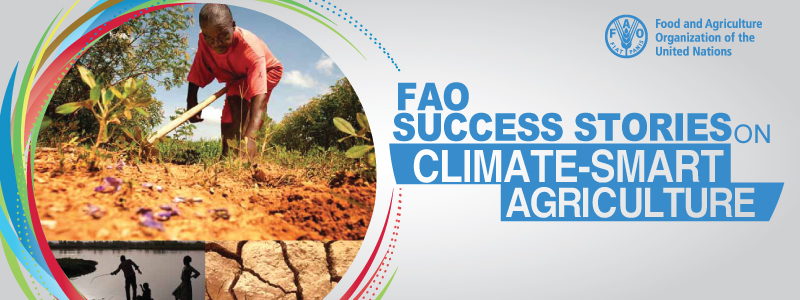
This booklet provides examples of climate-smart systems by showcasing some FAO success stories in various countries. The cases have been selected from the FAO Climate-Smart Agriculture (CSA) Sourcebook launched in 2013 to show the diversity of potential options across different regions and agricultural systems also covering subjects such as biodiversity and gender.
The UN organisation in charge of global climate change negotiations is backing the fast-growing campaign persuading investors to sell off their fossil fuel assets. It said it was lending its “moral authority” to the divestment campaign because it shared the ambition to get a strong deal to tackle global warming at a crunch UN summit in Paris in December.
“We support divestment as it sends a signal to companies, especially coal companies, that the age of ‘burn what you like, when you like’ cannot continue,” said Nick Nuttall, the spokesman for the UN framework convention on climate change (UNFCCC).
The move is likely to be controversial as the economies of many nations at the negotiating table heavily rely on coal, oil and gas. In 2013, coal-reliant Poland hosted the UNFCCC summit and was castigated for arranging a global coal industry summit alongside. Now, the World Coal Association has criticised the UNFCCC’s decision to back divestment, saying it threatened investment in cleaner coal technologies.
Several analyses have shown that there are more fossil fuels in proven reserves than can be burned if catastrophic global warming is to be avoided, as world leaders have pledged. Divestment campaigners argue that the trillions of dollars companies continue to spend on exploration for even more fossil fuels is a danger to both the climate and investors’ capital.
“Everything we do is based on science and the science is pretty clear that we need a world with a lot less fossil fuels,” Nuttall told the Guardian. “We have lent our own moral authority as the UN to those groups or organisations who are divesting. We are saying ‘we support your aims and ambitions because they are fairly and squarely our ambition’, which is to get a good deal in Paris.”
The UN secretary general, Ban Ki-moon, sent a related message to investors in November, saying: “Please reduce your investments in the coal- and fossil-fuel-based economy and [move] to renewable energy.” But he stopped short of backing the divestment campaign itself.
Many religious groups are among the 180 organisations that have already divested their funds from fossil fuels, as well as city authorities and universities. “We see the divestment of churches very much as a moral imperative for them,” Nuttall said. “If their goal is relieving the suffering of millions of people, then divestment is in line with how they want the world to be.”
A recent tweet from the UNFCCC said: “Divestment worked to free [South Africa] of apartheid. Now it can help free us of fossil fuels.” The tweet carried a quote and image of the archbishop Desmond Tutu, who in 2014 told the Guardian: “People of conscience need to break their ties with corporations financing the injustice of climate change.”
Divestment campaigners say their aim is to bankrupt fossil fuel companies morally, not financially. “No one is saying divestment by churches and universities will shift the market in a one-to-one way,” said Nuttall. “The message now is that you can get off fossil fuels without undermining your investments. It’s a different world now. You can save the world and get a good return on your investment.”
Many senior figures and institutions in the financial world, including the World Bank, Bank of England, HSBC, Goldman Sachs and Standard and Poor’s, have warned that only a fraction of known fossil fuel reserves can be safely burned and that the remainder could plummet in value posing huge risks to investors.
Benjamin Sporton, acting chief executive of the World Coal Association, rejected the linking of divestment from fossil fuels with divestment from tobacco and apartheid South Africa. “The coal divestment campaign is not comparable to any other divestment campaign,” he said. “Active and responsible investors play a vital role in encouraging investment in cleaner coal technologies. Demand for coal is not going away.”
As global warming argument moves on to politics and business, Alan Rusbridger explains the thinking behind our major series on the climate crisis
Sporton said the divestment campaign was a concern: “There are economic and social dimensions that mean divesting from fossil fuels – and in particular coal – comes with significant risks, not least when 1.3 billion people are still without access to electricity.” The UN’s Intergovernmental Panel on Climate Change said in November that global warming is set to inflict severe and irreversible impacts on people and that “limiting its effects is necessary to achieve sustainable development and equity, including poverty eradication”.
“Meeting the demand projected by the International Energy Agency will call for $18.5tn of cumulative investment between 2014 and 2035,” said a spokesman for the International Association of Oil and Gas Producers (IOGP). “This doesn’t support an argument for divestment.” Replacing coal-fired power stations with gas can halve carbon emissions, he added.
IPIECA, the global oil and gas industry association for environmental issues and “the industry’s principal channel of communication with the UN”, declined to comment. More
Should you be in Sendai attending the UN World Conference on Disaster Risk Reduction we would like to cordially invite you to attend our Pacific side event “Building Resilience to Disasters and Climate Change in the Pacific for Sustainable Development”on Monday, 16 March from 9.45am – 12pm at B104 Kawauchi-Kita Camps, Tohoku University.
If you have any queries, please do not hesitate to contact me at nanettew@sprep.org.
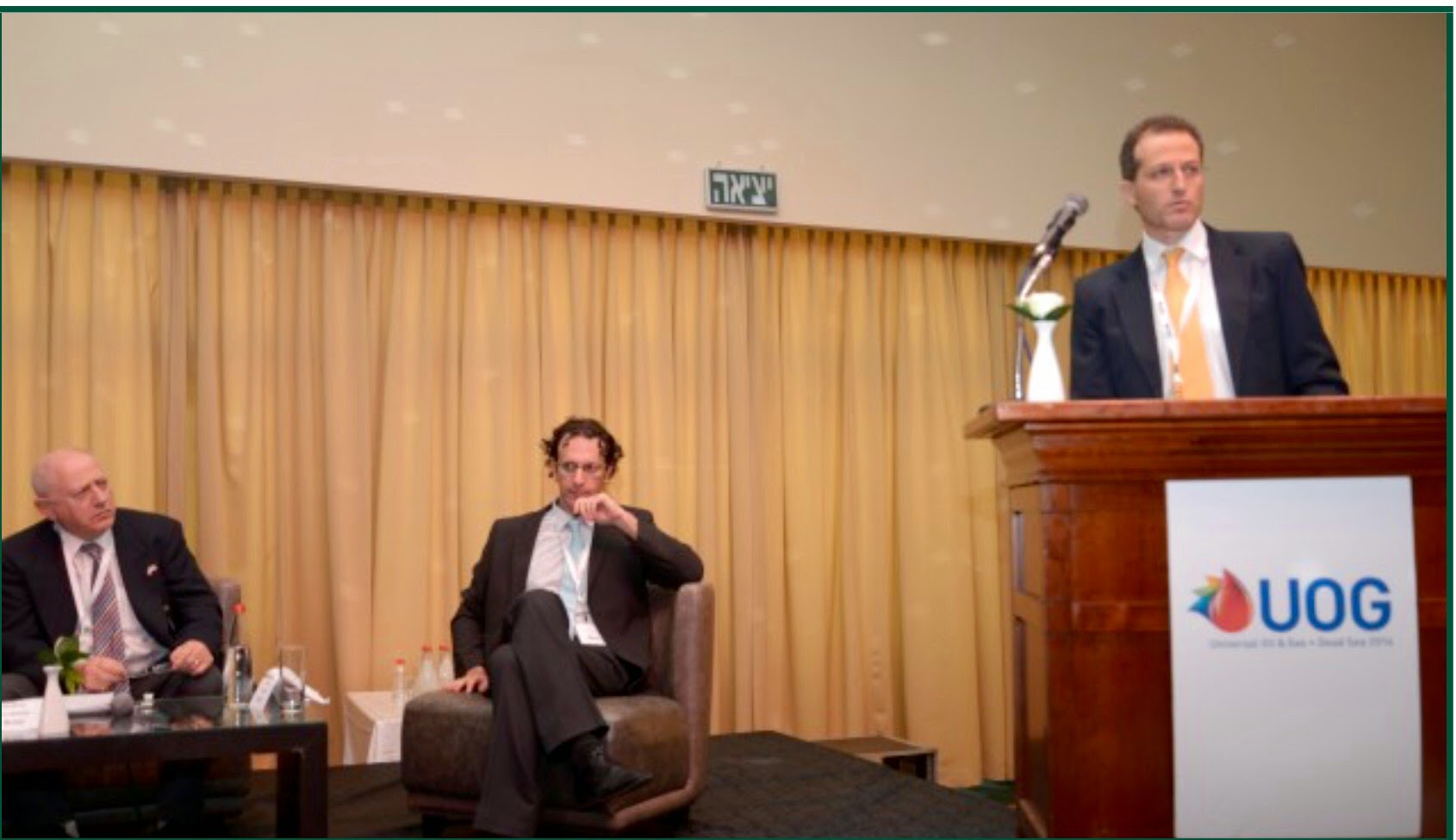
“The dynamic regional context creates opportunities for synergies between Palestinians, Israelis and other regional actors in the field of energy,” Ariel Ezrahi, Energy Advisor at the Office of the Quartet Representative told the International Oil and Gas Conference on Thursday (20 November 2014).
Ariel Ezrahi
In his presentation to the conference at the Dead Sea in Israel, Ezrahi gave an overview of the Palestinian energy sector including the current capacities, future demand, and potential opportunities for investment and development. He said that development of the Gaza Marine offshore gas field would constitute an important source of revenue for the Palestinian Authority, and fuel Palestinian power generation projects for years to come. The Gaza Marine field would not only be a cost-efficient solution for domestic power generation, but also a more environmentally friendly solution than the present sources of fuel, said Ezrahi.
He also noted that the West Bank currently has no power generation capacity whatsoever. Electricity usage is currently around 860 megawatts, but demand in the West Bank alone is expected to reach around 1,300 megawatts in 2020. Gaza currently receives between 150 to 210 megawatts, while demand is closer to 410 megawatts. By 2020, Ezrahi said, demand will hit 855 megawatts.
“There is a lot of room for cooperation in the energy sphere between Palestinian actors and Israel and other regional counterparts. I think it’s a very exciting time and that the energy sector can hopefully act as a bridge to overcome some of the political constraints. And that would be in everyone’s interest,” he told participants.
“Israel needs to see the Palestinians as an asset as they strive to join the regional power grid, and as a bridge to the Arab world.” Ezrahi emphasised that the Gaza Marine field should not be seen as a competitor to Israel’s fields, but rather, it provides a potential additional source of gas and opportunities for cooperation between the neighbouring countries. More
Related Links
Presentation on the Palestinian dimension of the regional energy landscape
‘Israel’s bridge to the Arab world: Palestinian natural gas?’ article in Haaretz English Edition
‘Gaza marine development could help deliver Israeli security,’ article in Rigzone
One has to question why Gaza and Palestine would want to give their energy generation to Israel, the occupying power, or in fact help Israel sell their gas through Egypt. Using the gas from the Gazan fields would at least give both Gaza and Palestine energy independance and insulate them from the withholding by Israel of their tax receipts, see http://is.gd/FPWOWrEditor


 ©
© 




 Democracy & Good Governance