Climate Education Week Nears – 18th – 25th April, 2015

caribbeanclimate's avatarcaribbeanclimate

The Climate Education Week Toolkit is now available! It is a free, easy-to-use, ready-to-go resource with everything you need raise awareness and boost knowledge about climate change. The Toolkit includes a week’s worth of lesson plans, activities, and contests for K-12 students that meet Next Generation Science Standards and Common Core (a curriculum in the United States). Each day covers a different theme related to climate change with two highlighted activities handpicked by Earth Day Network for your use.

This cross-disciplinary resource has a range of activities from an energy conservation action plan to reading and discussing Rachel Carson’s Silent Spring, with the goal being to educate and engage your students on climate change.

As we prepare to celebrate Climate Education Week, we invite you to also peruse the 1.5˚C Stay Alive – An Education Initiative, which was specifically developed for the Caribbean. The four unit curriculum (The Warming Climate, Sea Level Rise, Pine Forest and…

View original post 55 more words

Scientists Map Caribbean Seafloor as Part of 12-Year Project

caribbeanclimate's avatarcaribbeanclimate

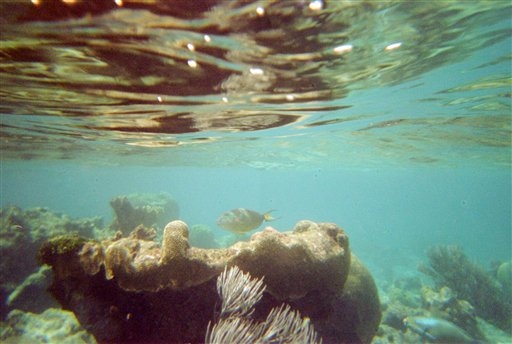
This April 6, 2005 file photo shows a coral reef and fish on a snorkeling trail off Buck Island near St. Croix, U.S. Virgin Islands. U.S. scientists on Tuesday, April 7, 2015 completed a nearly two-week mission to explore waters around the U.S. Virgin Islands as part of a 12-year project to map the Caribbean sea floor and help protect its reefs. (AP Photo/Brent Hoffman, File) This April 6, 2005 file photo shows a coral reef and fish on a snorkeling trail off Buck Island near St. Croix, U.S. Virgin Islands. U.S. scientists on Tuesday, April 7, 2015 completed a nearly two-week mission to explore waters around the U.S. Virgin Islands as part of a 12-year project to map the Caribbean sea floor and help protect its reefs. (AP Photo/Brent Hoffman, File)

U.S. scientists on Tuesday completed a nearly two-week mission to explore waters around the U.S. Virgin Islands as part of a 12-year project to map the Caribbean seafloor and help protect its reefs.

A team with the National Oceanic and Atmospheric Administration studied an area of 270 square miles (700 square kilometers), using equipment including underwater gliders and a remotely operated vehicle to help map the seafloor and locate areas where fish spawn. They focused mostly on the southern coast of St. Croix and…

View original post 256 more words

Excluding complacency in Small Island Developing States

MasterCard CEO Ajay Banga’s six lessons on leadership
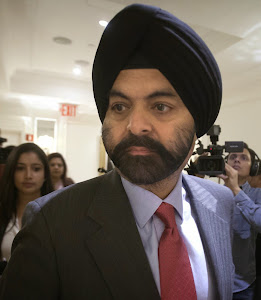
Ajay Banga

What I want to focus on is leadership. How do you take the leadership potential all of you have and cultivate it. Here are some perspectives around leadership that I can offer.

1. A sense of urgency: Today’s world of rapidly-advancing technology and ever-shortening innovation cycles have no space for procrastination. It’s that urgency that makes me say to colleagues in my company that “if you have good news for me, take the stairs. If you have bad news, take the elevator.” I need that information fast, so I can do something about it.

2. A sense of balance: A lot of people think that urgency and patience are contradictory. And they could not be more wrong. You need to be patient enough to listen to everybody, but yet, you must have a sense of urgency to take a decision and to execute.

3. Courage to take thoughtful risks: Rarely are you going to have perfect information. The willingness to take a decision at that time will depend on your ability to take a thoughtful risk. The thoughtful part depends also on your humility and realising that you don’t have all the answers—that you can learn something from everybody. You get a good dose of humility as soon as you arrive here. You come from a school where you were the top gun. You get here and everybody’s a top gun. Humility is practically a rite of passage.

4. Be competitively paranoid: I don’t mean be fearful. What I mean is constantly ask yourself if you’re missing something. Is there more to the problem? If you don’t question everything, if you’re not competitively paranoid, you will not have the sense of self-introspection that you need to be a real leader.

5. Develop a global view: Leadership attributes are tremendously facilitated if you surround yourself with people who don’t look like you, don’t walk like you, don’t talk like you, and don’t have the same experiences as you. Admittedly, when I’m in the US, I’m suddenly diverse. In India, I’m obviously not. But it’s not where you come from or what you look like that matters. What matters is what you do and how you do it. That’s the true essence of diversity.

What makes diversity so important? Diversity is essential because a group of similar people tends to think in similar ways, reach similar conclusions, and have similar blind spots. To guard against that, you need to harness the collective uniqueness of those around you to widen your field of vision—to see things differently, to fail harder, to innovate, and to question everything. Widening that field of vision means widening your worldview

Increase your connectivity to the world around you. For example, once you get acclimated to your new jobs, consider getting involved in organisations outside of your work but that connect back to it as well. Explore avenues like the World Economic Forum. The key is to go beyond looking at the world through the lens of your company or your organisation or even your country.

6. Do well and do good: It’s the highest form of leadership. It’s the idea that you can pursue what is in your best interest as well as what is in the interest of others. It’s the recognition that your success is tied to the success of others. You know the saying, it’s lonely at the top? It’s only lonely at the top when you don’t bring other people along with you.

This principle of doing well and doing good holds true for any one person or organisation, but it’s an especially powerful principle for business and the private sector today. In a business sense, it’s the idea that the private sector can be a force for growth and a force for good. That business can make money and make a difference.

Both the private and the public sector have a role to play in the following: Bring more people into the financial mainstream—at a time when half the world’s adults don’t have a bank account, guard against a future where we have the Internet of Everything, but not the Inclusion of Everyone, give women same opportunities as men.

Of course, this very school was founded, not just on the idea of public-private partnerships but literally by public-private partnerships. It was the government of Gujarat, the government of India, local businessmen, Harvard Business School, and the Ford Foundation—all coming together, not only to help build industry in India but to help build India herself.


It’s time to talk about what’s next

http://youtu.be/d6z4yDu3gco

It’s time to talk about what’s next.”

This statement also applies to the Cayman Islands, in fact is is more crucial to a Small Island Developing States (SIDS) than anywhere else. “It is time for Caymanians (Americans) to think boldly about… what it will take to move our country to a very different place, one where outcomes that are truly sustainable, equitable, and democratic are commonplace.’

Caymanians ask yourselves

‘Do we want cheaper energy generated by solar and wind’?

Ask ‘how will climate change affect us?’

Ask ‘how will sea level rise affect us?’

Ask ‘how will Cuba opening to US citizens affect us?’

These are questions that very few people or organizations in these islands are asking.

Those are the words of academic and author Gar Alperovitz, founder of the Democracy Collaborative, who—alongside veteran environmentalist Gus Speth—this week launched a new initiative called the “Next Systems Project” which seeks to address the interrelated threats of financial inequality, planetary climate disruption, and money-saturated democracies by advocating for deep, heretofore radical transformations of the current systems that govern the world’s economies, energy systems, and political institutions.

More Than Scientists – a new video campaign

caribbeanclimate's avatarcaribbeanclimate

more than scientists

A new project—More Than Scientists was launched March 15. It brings together climate scientists, advocacy organizations and the public in an innovative campaign that offers a unique glimpse into the real life stories, personal views and feelings of the experts on climate change.

From leading universities such as MIT, University of Washington and Harvard, climate experts share via video their hopes for the future and what they fear will happen if we don’t act now to reverse the impacts of climate change.

The more than 200 featured videos, created by dozens of climate scientists, are available as a resource to the climate community via their website and YouTube at www.morethanscientists.org.

In addition to sharing the resource, we want to invite climate scientists to participate in sharing their stories.

To learn more about making a video, contact:

Mary Kadzielski, Campaign Manager
More Than Scientists
e: mary@morethanscientists.org | p:  202.810.5462
w: www.morethanscientists.org

View original post 6 more words

Allan Savory: How to fight desertification and reverse climate change.

Click picture for video

Desertification is a fancy word for land that is turning to desert,” begins Allan Savory in this quietly powerful talk. And it's happening to about two-thirds of the world’s grasslands, accelerating climate change and causing traditional grazing societies to descend into social chaos. Savory has devoted his life to stopping it. He now believes — and his work so far shows — that a surprising factor can protect grasslands and even reclaim degraded land that was once desert.

Allan Savory: How to fight desertification and reverse climate change


Gallery

Growing a future – Coral restoration in Bluefields Bay, Jamaica

caribbeanclimate's avatarcaribbeanclimate

Fishers of Bluefields Bay tell stories of a time when the coral grew so high parts of the reef were impassable, when boats had to navigate around the coral tips emerging out of the Caribbean’s blue waters. Four decades later a trip underwater will show you a seafloor still covered with the skeletons of these same corals. Due to the effects of hurricanes, decline of algae grazers and climate change, the once lush thicket is only a story told around a bottle of Red Stripe beer and a cup of fish soup (since the fish is too scarce to cook any other way).

Until now. The climate isn’t the only thing changing for some communities around the Caribbean. In Bluefields Bay, Jamaica, the community has come together with the Government to establish one of the fourteen (14) fish sanctuaries island wide. Since 2009, the community based organisation, Bluefields Bay Fishermen’s…

View original post 580 more words

Why has ‘microhydro’ been neglected as a solution to energy poverty?

We live in a world of growing resource scarcity. The oft-quoted statistic is that by 2050 two thirds of the world’s population will live in areas of water stress or scarcity.

Currently, agriculture is the largest user of water, but as the World Bank’s Thirsty Energyinitiative points out, increasing demands for energy will also require increasing use of freshwater. And as populations rise, so will the need for more water and energy for food production.

Many say we need greater efficiency in order to help manage some of these difficult trade-offs between water, energy and food. Much of this debate is focused on macro-level solutions. However, the International Energy Agency has calculated that 55% of all new electricity supply will need to come from decentralised systems if we are to reach the goal of universal energy access by 2030.

So could decentralised, off-grid solutions hold the key? For many years, influencers have debated whether community-based, off-grid schemes can deliver energy sustainably. But this battle has not yet been won. Recently new lines have been drawn by Bill Gates, who called for centralised, fossil-fuel based electrification to solve energy poverty and SunEdison founder Jigar Shah who responded by putting forward the case for distributed renewable solutions.

While this debates goes on at the policy level, what do experiences on the ground tell us? At Practical Action, we have found that micro hydropower (or microhydro) systems, which produce power from streams and small rivers, provide huge potential for sustainable energy.

For example in Peru, microhydro systems installed in the mid- to late-1990s are still running today. Not only do they provide electricity for light bulbs and other small appliances, they can also supply continuous power for local clinics, allow people to use fridges and run small businesses. We found they reduced household energy expenditure by more than half, and 60% of families said their incomes had increased.

However, there is still unexplored potential for decentralised hydropower. In both Peru and Nepal (where micro-hydro schemes are widespread), there was rarely any deliberate attempt to connect the electricity generated to agricultural systems, or to make use of the channelled water for irrigation. This means missing out on a set of potentially transformational opportunities. Decentralised energy systems can not only improve energy access, but also help to maximise the relationships between water, energy and food, both now and in the future.

More recently, and learning from our experiences, we have been making the connection between agriculture and energy more directly. Together with Oxfam we have been working in Zimbabwe, for example in the Himalaya scheme which uses the electricity generated by the microhydro plant, as well as the channelled water, for much-needed irrigation.

The approach does of course have it’s challenges. Across the schemes we’ve developed in Zimbabwe familiar challenges and trade-offs emerge, particularly with a recent severe two-year drought followed by heavy rains. For example, in Chipendeke in Zimbabwe, initial planning for hydropower failed to fully accommodate existing irrigation needs. As a result during the dry season, there was insufficient water to run both the irrigation and the hydro simultaneously. Eventually the villagers reached a compromise where the microhydro plant was switched off for short periods to allow more water for irrigation.

In Ngarura, there were delays in construction of the microhydro project and farmers lost trust. They continued cultivating the steep river banks, and when the rains came there was heavy siltation of the system. The lesson there was that farmers have to be convinced of the benefit of the scheme in order to preserve the river banks.

Despite these problems, in both cases solutions were reached through dialogue and the community balancing their priorities. It is important not only to focus on the infrastructure for hydropower but also the institutions to support it and that is as much part of increasing resilience as the energy or water itself.

Development organisations can sometimes be rightly accused of being starry-eyed about the potential of community ownership and management. In the case of a microhydro plant this can impose unrealistic burdens, and in the absence of support structures from local technicians, spare parts, and a clear sense of ownership infrastructure can quickly fall into disuse. But the sector has been learning, as research shows. The right systems for decentralised energy production can be created and it can provide a sustainable solution to energy poverty. More