COP2O Week 1 Recap: Caribbean notes “small victories” and anticipates Ministerial decisions

caribbeanclimate's avatarcaribbeanclimate

Week two of COP20 is now underway in Lima, Peru. Here's a round-up of week one from  Sharon Lindo, International and Regional Policy Officer at the Caribbean Community Climate Change Centre.

The Caribbean Community continues to carve out a niche for itself in the Climate Change negotiations underway at COP 20 in Lima, Peru.  If the first week of COP20 were to be summed up in a few words, it would be one of celebrating small victories.  But any seasoned negotiator would caution against celebrating now.

The Alliance of Small Island States welcomed the call by the Subsidiary Body for Scientific and Technological Advice for the Intergovernmental Panel on Climate Change outcomes to inform the Ad-Hoc Working Group on the Durban Platform and other UNFCCC processes.  This augers well for CARICOM, who have always supported science-based methods to inform action in the negotiations.  The region looks forward to the use…

View original post 334 more words

Eleven-year-old’s ‘Talking Strike’ for Climate Change Goes Viral

Xiuhtezcatl Roske-Martinez is a 14-year-old Indigenous environmental activist and ICTMN contributor. He recently wrote to us, asking to post his story about his 11-year-old brother, Itzcuauhtli, who has pledged a “talking strike” to demand that government leaders move forward on climate change. More

Global leaders listen to these kids. Do not dissapoint them. Save their world

Finance for Climate Action Flowing Globally – Upwards of 650B in 2011-2012

caribbeanclimate's avatarcaribbeanclimate

Header Image Credit: United Nations Framework Convention on Climate Change

 Finance for Climate Action Flowing Globally stood at $650 Billion annually in 2011-2012, and possibly higher

Annual public and private flows from developed to developing countriesranged from $40 to $175 billion
Dedicated multilateral climate funds - including UNFCCC funds – represented small shares during the same period, but are set to rise with the recent pledges to the Green Climate Fundamounting to nearly $10 billion
There is relative uncertainty in the global figures in part due to data gaps and other limitations, but efforts to improve the quality of measurement and reporting of climate finance flows are under way

Hundreds of billions of dollars of climate finance may now be flowing across the globe annually according to a landmark assessment presented yesterday to governments meeting in Lima, Peru at the UN Climate Convention meeting.

The assessment – which includes…

View original post 1,153 more words

Gallery

Galleon Fish Sanctuary Video Wins at Cinefish Conference

caribbeanclimate's avatarcaribbeanclimate

A video about the Galleon Fish Sanctuary won first prize in the ‘Documentary’ category during “Cinefish” at the the Gulf and Caribbean Fisheries Institute (GCFI) conference in Barbados last month. The Galleon Fish Sanctuary is supported by the Caribbean Fish Sanctuary Partnership Initiative (C-FISH), a project aimed at strengthening community-based fish sanctuaries by providing resources, training and alternative livelihood opportunities in 5 Countries across the Caribbean. The C-FISH Initiative (£2.1 million) is funded by the UK’s Department For International Development (DFID) through the Caribbean Community Climate Change Centre (CCCCC) and is coordinated by The CARIBSAVE Partnership.

See video below:

More information on the Galleon Beach fish sanctuary is on C-FISH website at:

http://c-fish.org/where-we-work/galleon-beach/

View original post

Secrets: shining a light on hidden power

The truth can be a slippery thing. We each have a version but it slips and slides about in our minds as we deal with the constant flood of information coming at us from all sides, not to mention trying to balance this expert view against that, between what we know, what we think we know, and what we suspect.

We are all at the mercy of cognitive biases and layers of assumptions and associations built up over our lifetimes. And so we need reference points to help mark the key geographical features of our worldview. And, sometimes, we need some of those reference points visible in our world, amongst our tribes of friends, colleagues, allies and families. It’s very difficult for most of us to make our way in the world and act with the determination we often crave without some acknowledgement that we’re not the only ones seeing the world as we do. The bigger the thought, the less pleasant it is to assimilate, and the further out from the mainstream it lives, the more important that acknowledgment can be.

The 1%-99% Occupy meme was one of those markers. The reason it travelled so far and fast wasn’t because it told people something altogether new, but rather that it capped off and gave voice to thoughts they already had. It didn’t teach as much as it validated and articulated.

At /The Rules, we think its time for a new marker; one that grows very much from the 1%-99% meme, and, hopefully, adds something important. And it’s that we now all live on a One Party Planet.

This is a provocative claim, pregnant with meaning and implication. If it’s true in the way we believe it to be, it means there is an identifiable form of totalitarianism casting a shadow over the entire human race. It means that there is a force so broad, so enmeshed within the logic of modern global power, that the solutions we all work toward in the specific struggles we care most about – be that rampant inequalities in income and opportunity, widespread poverty, or climate change – are all facing it. Not a force that lives in any single person, organization or structure, but that is ephemeral in the way that all ideology is ephemeral. It transcends and thereby unites the leadership of the vast majority of political parties, governments and corporations that have any proximity to global power. But for all this, it is also specific, definable, and visible through the right lenses. Which means it can be challenged.

It’s got many names but we call it Neoliberalism, because that fits it well enough and is very common, recognizable currency. It’s not primarily an economic agenda; it’s a moral philosophy. As Margaret Thatcher, one of its seminal champions herself said, “economics are the method, the object is to change the heart and soul”.

It is defined by a circular and hermetically sealed logic, in three parts. Firstly, that survival of the fittest through eternal competition between self-interested parties is, practically speaking, the only law upon which human society can realistically be ordered; secondly, that, in the moral hierarchy, financial wealth equates with life success which equates with virtue; and thirdly that man [sic] is, if not an island, then, at most, a part of an archipelago of islands of shared interests, answerable only to himself, his peers and, possibly, his God, in that order. To see only the familiar economics – i.e. belief in small government, low taxes, the sanctity of private property and private industries, and 'free' markets, particularly in labor, all of which feed, above all else, the double-headed hydra of profit and economic growth – and not connect it back to the moral philosophy is to miss the point.

To back up this provocative claim, we have released a pamphlet today called, The One Party Planet. We start it by looking inwards, at our cognitive capacities. The world we see around us today is a reflection of human consciousness; we long since passed the point where we could say, “it wasn't us.” So whatever challenges we face—climate change, rampant inequality, endless violent conflict or vast impoverishment—are challenges, first and foremost, of and for the human mind. It helps, therefore, to spend a small amount of time reflecting on what we know about its character in a section called, How True is True?

Then we turn to what might be more familiar territory: power theories, processes and players. This breaks into six parts; The Neoliberal Heart and Soul, Fashions in Global Power, Financial Might, Concentration of Corporate Power, Active Political Projects, and In their Own Words. And finally, a few thoughts on the system's internal logic; that alignment of forces that mean none of this was really planned and no one is actually to blame. We conclude with the most human considerations in Facing Ourselves, and Where Hope Lies.

We have written it as a political pamphlet to honor all those that were written against the wishes of the ruling elite in the past, and that played some part in monumental change, from the English Civil War to the Abolition of Slavery. We’d like help spreading it around, translating it, and building on it. If it’s wrong in important ways, we want to know how. If there more that should be said, we want to help people say it. You can comment on our facebook page, or write to pamphlets@therules.org. More


President of Palau becomes Champion of the Earth for his pioneering Green Economy Policies

Bangkok, 17 November 2014 – President of Palau, Tommy Remengesau, Jr, was announced as a winner of the UN’s top environmental accolade, the Champions of the Earth award.

The Policy Leadership award, which has been won in previous years by European Commissioner for the Environment, Dr. Potocnik, and Brazil’s Environment Minister, Izabella Teixeira, will be awarded to President Remengesau by UN Secretary-General Ban-Ki-moon and UNEP Executive Director Achim Steiner at an awards ceremony attended by UNEP Goodwill Ambassador Gisele Bundchen at the Smithsonian American Art Museum and National Portrait Gallery in Washington D.C. on 19 November 2014.

Tommy Remengesau, President of Palau, said, “I am honored to receive this award on behalf of the traditional leaders, the people of Palau, and the islanders around the world, who are the stewards for the protection of our vast oceans and natural wealth.”

“As a fisherman, I have seen first-hand the devastating impacts of overfishing, climate change and pollution on our oceans. As the leader of an island country, I know we have the solutions to tackle these issues. We need to stand together to take action now to protect our oceans and our Mother Earth for our generation and future children.”

Under the leadership of President Remengesau, Palau is showing the way to protect its invaluable natural resources while balancing the needs and traditions of its people. Earlier this year the President announced the world’s first Nation-wide Marine Sanctuary that fully protects over 80 per cent of Palau’s 600,000 sq km of Exclusive Economic Zone.

The Sanctuary bans industrial and foreign fishing as well as exports, while establishing a local fishing zone for domestic use. This is a bold step to reverse degradation of the ocean and stands to ignite further global action on oceans.

The President has demonstrated the country’s capacity to successfully meet its conservation goals, having established a network of protected areas representing more than 50 per cent of marine and 20 per cent of terrestrial areas through the Micronesia Challenge. This was largely funded by a “Green Fee” where tourists pay US$30 on departure from Palau, generating more than US$1.3 million annually for conservation.

The President has spearheaded a range of local to global initiatives, from the world’s first shark sanctuary to establishing the Global Island Partnership alongside President Michel of Seychelles, which has inspired more than 30 leaders to launch major sustainable island commitments.

UN Under-Secretary-General and UNEP Executive Director Achim Steiner said, “Palau is an inspiring example of a small island nation courageously addressing the global challenges of climate change and biodiversity loss through a blue-green economy transition, and reflects the level of commitment many Small Island Developing States demonstrated earlier this year to advancing national sustainable development goals at the Third International Conference on Small Island Developing States through the S.A.M.O.A Pathway Outcome Document.”

“Supporting President Remengesau – and other leaders of other small island nations – on this journey of transition, provides an unprecedented opportunity to be part of game-changing solutions that can be applied in broader contexts and bigger economies.”

“In short, we should look upon small island nations like Palau as microcosms of our larger society, and not stand back and leave them to grapple with threats – such as climate change.”

Champions of the Earth is the United Nations’ flagship environmental award launched in 2005 that recognizes outstanding visionaries and leaders in the fields of policy, science, entrepreneurship, and civil society action. Whether by helping to improve the management of natural resources, demonstrating new ways to tackle climate change or raising awareness of emerging environmental challenges, Champions of the Earth should serve as an inspiration for transformative action across the world. Past laureates have included past laureates Mikhail Gorbachev, Al Gore, Felipe Calderon, Mohamed Nasheed, Marina Silva, Vinod Khosla, and many other such exemplary leaders on the environment and development front.

Visit http://www.unep.org/champions/ for more details.


E-Learning Course: Investment Planning Towards Low Carbon Climate Resilient Development

caribbeanclimate's avatarcaribbeanclimate

E-Learning Course 
Investment Planning Towards Low Carbon Climate Resilient Development

Last date to apply – November 17, 2014
Course Delivery Dates: December 1 – 12, 2014

http://einstitute.worldbank.org/ei/course/investment-planning-toward-low-emission-development

Introduction:
The course compiles knowledge and lessons learned during the design phase of the Climate Investment Funds (CIF) investment plans and strategic programs.

The objective of this course is to teach policy-makers, planners and climate change practitioners how to design and finance strategic plans and programs for low carbon and climate resilient development that go beyond a project-by-project approach.

Note:Preference will be given to (in the following order):

(i) national-level government policy-makers, planners and practitioners working in the fields of clean energy, sustainable transportation, energy efficiency, and climate change from the 14 countries invited to prepare SREP investment plans (Bangladesh, Benin, Cambodia, Ghana, Haiti, Kiribati, Lesotho, Madagascar, Malawi, Nicaragua, Rwanda, Sierra Leone, Uganda, Zambia);

(ii) national-level government policy-makers, planners and practitioners working…

View original post 132 more words

Global Governance: The Intersection of Human Security and Justice

caribbeanclimate's avatarcaribbeanclimate

The Hague Institute for Global Justice and The Stimson Center are co-hosting a breakfast Expert Consultation on “Global Governance: The Intersection of Human Security and Justice” on 9 December 2014 from 08:00am – 10am at the Ausan Gate Meeting Room, Hilton Lima Mirafloresin Peru, in connection with the work of the Commission on Global Security, Justice, and Governance.

The Commission is composed of a select group of eminent statespersons and public intellectuals and co-chaired by former U.S. Secretary of State Madeleine K. Albright and former Foreign Minister of Nigeria Professor Ibrahim A. Gambari. A chief goal of the Commission is to issue, in June 2015, a focused set of global policy and institutional reform recommendations in advance of the September 2015 United Nations’ 70th Anniversary Summit in New York and the December 2015 Paris Climate Change Conference.

In addition to seeking expert views from Lima Climate Change…

View original post 154 more words

Climate Policy Initiative

caribbeanclimate's avatarcaribbeanclimate

Here’s a round-up of activities by the Climate Policy Initiative that are useful in the leap up to COP.

Interactive Report & Webinar: Moving to a Low-Carbon Economy Could Free up Trillions

Some worry that a switch away from fossil fuels could have a significant cost to the global economy and undermine the financial system. New research conducted by CPI for the New Climate Economy project demonstrates that with the right policies, a transition to a low-carbon energy system could free up trillions of dollars over the next 20 years to invest in better economic growth.

Read the interactive report HERE.

Join the webinar on November 21st to learn how moving to a low-carbon economy can free up trillions.

New Animated Video: New Models for a Low-Carbon Electricity System

New finance and business models for a low-carbon electricity system in the U.S. and Europe can save consumers, investors, and…

View original post 101 more words

US and China strike deal on carbon cuts in push for global climate change pact

caribbeanclimate's avatarcaribbeanclimate

Barack Obama aims for reduction of a quarter or more by 2025, while Xi Jinping sets goal for emissions to fall after 2030

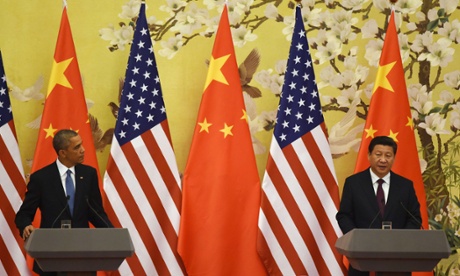
US President Barack Obama looks on as Chinese President Xi Jinping speaks during a joint press conference in the Great Hall of the People in Beijing Photograph: Greg Baker/AFP/Getty Images US President Barack Obama looks on as Chinese President Xi Jinping speaks during a joint press conference in the Great Hall of the People in Beijing Photograph: Greg Baker/AFP/Getty Images

The United States and China have unveiled a secretly negotiated deal to reduce their greenhouse gas output, with China agreeing to cap emissions for the first time and the US committing to deep reductions by 2025.

The pledges in an agreement struck between President Barack Obama and his Chinese counterpart, Xi Jingping, provide an important boost to international efforts to reach a global deal on reducing emissions beyond 2020 at a United Nations meeting in Paris next year.

China, the biggest emitter of greenhouse gases in the world, has agreed to cap its output by 2030 or…

View original post 944 more words