Climate Reality Training in Miami with Al Gore

I’m reaching out today on behalf of The Climate Reality Project, an organization started by former Vice President Al Gore focused on creating a global movement calling for action on climate. We have an upcoming training opportunity in Miami, Florida that I believe you and others who follow The Cayman Institute / The Climate War Room will be interested in.

As we are all aware, the time has come for action on climate. On September 28-30 in Miami, The Climate Reality Project and Mr. Gore will be hosting a training for new Climate Reality Leaders to help grow the movement. There has never been a better time to engage your friends and colleagues on this issue. The Miami training will not only provide attendees with cutting edge tools to most effectively communicate climate change to your community but will also enter them into a community of over 8,000 devoted individuals from 126 countries who are committed to using their voices to address the climate crisis.

Our training in Miami will highlight the unique challenges that climate change poses to the state of Florida and what some local governments are already doing to tackle them; Florida’s huge untapped solar energy generating capacity; and the role of the ever strengthening Latino voice and vote in driving climate action. At the training, Mr. Gore, and experts and influencers from across the climate sphere will present in panels, take questions, and host breakout sessions.

We encourage you to recommend outstanding leaders in your personal and professional life who would be well suited for giving presentations and helping to build strong support for action on climate change. They can apply for the Climate Leadership Corps Training here. I’ve also attached a document you can share with your network, which has a little more information about who we are and what the Miami training will cover. The deadline to apply is August 26th, 2015.

Please do not hesitate to reach out if you have any questions!

Warm regards,

Joseph Moran | Program Assistant-Climate Reality Leadership Corps

750 Ninth Street, NW, Suite 520 | Washington, DC 20001

NOTICE OF CONFIDENTIALITY & DISCLAIMER
The information contained in this e-mail and any attachments is CONFIDENTIAL and is intended only for the use of the addressee. Any unauthorized use, disclosure, distribution, dissemination, or copying is strictly prohibited and may be unlawful. If you are not the intended recipient, you are prohibited from any further viewing of the e-mail or any attachments or from making any use of the e-mail or attachments. If you believe you have received this e-mail in error, notify us immediately and permanently delete the e-mail, any attachments, and all copies thereof from any drives or storage media and destroy any printouts of the e-mail or attachments and any copies of such printouts. Although this e-mail and any attachments are believed to be free of any virus or other defect that might negatively affect any computer system into which it is received and opened, it is the responsibility of the recipient to ensure that it is virus-free and no responsibility is accepted by the sender for any loss or damage arising in any way in the event that such a virus or defect exists. Thank you for your cooperation.

July 2015 Sustainable Energy Finance Update

1 August 2015: During the month of July, the African Development Bank (AfDB), the Caribbean Development Bank (CDB), the European Bank for Reconstruction and Development (EBRD), the European Investment Bank (EIB), the Global Environment Facility (GEF), the Inter-American Development Bank (IDB) and the World Bank announced sustainable energy project funding and initiatives.


The Asian Development Bank (ADB), AfDB, the European Commission, EIB and the World Bank also released publications on financing and deploying clean energy

The announced sustainable energy initiatives are being implemented in Anguilla, Argentina, Burkina Faso, Cambodia, Chile, Denmark, France, Georgia, Guinea-Bissau, Kenya, Mali, Montenegro, Spain, Turkey, the UK, Ukraine, Uruguay, Zambia and the Middle East and North Africa (MENA) region.


In Argentina, IDB approved US$14.4 million in financing from the GEF for a housing project that integrates energy efficiency and renewable energy to improve the quality of life of residents and reduce greenhouse gas (GHG) emissions. Using renewable energy schemes adapted for each of Argentina's eight bio-climactic zones, 128 prototypes will be built and monitored for a year. US$70.7 million in local funds and a US$1 million IDB technical cooperation grant will also support the project. [IDB Press Release]


In Burkina Faso, AfDB granted €25.35 million from the African Development Fund (ADF) to support the programme for budget support in the energy sector (PASE). The funds will be largely directed to improving the electricity supply for basic social sectors, public services, the private sector and households. The funds are intended to increase reliability and energy access, as just 17.6% of the population currently has access to electricity. [AfDB Press Release]


In Cambodia, the UN Industrial Development Organization (UNIDO) launched a project promoting commercial biogas plants with US$1.5 million in funding from the GEF. The project aims to increase rural electrification and energy access by installing plants with 1.5 MW in cumulative generation capacity and mitigate climate change by avoiding 1.3 megatons carbon dioxide equivalent (MtCO2e) in emissions directly and 3.3 MtCO2e indirectly over 15 years. [UNIDO Press Release]


In Chile, the World Bank Group's International Finance Corporation (IFC) signed an agreement with Banco Consorcio in support of non-conventional renewable energy projects. Under the agreement, IFC will provide a US$60 million credit line to finance, inter alia, small hydropower, biomass, solar, geothermal and wind. [IFC Press Release]


In Denmark, EIB announced the first transaction in the country under the Investment Plan for Europe: up to €75 million in equity-like financing to Copenhagen Infrastructure Partners (CIP) for the Copenhagen Infrastructure II fund. The fund is an “innovative” renewable energy infrastructure fund focusing primarily on newly established greenfield energy-related investments, such as large-scale offshore wind, biomass and transmission projects, in Western and Northern Europe. [EIB Press Release]


In France, EIB undertook its first equity participation under the Investment Plan for Europe, providing €50 million for Capenergie 3, an investment fund dedicated to renewables and managed by Omnes Capital. It is anticipated that the investment will finance 500 MW of generating capacity. [EIB Press Release]


In Georgia, EBRD facilitated the sale of over 400,000 carbon credits from the Enguri Hydro Power Plant to Statkraft, a Norwegian electricity company. EBRD's Carbon Project and Asset Development Facility (CPADF) provided technical assistance for the sales strategy and emissions reductions verification. The project, registered under the Kyoto Protocol's Clean Development Mechanism (CDM), was able to partially recover costs associated with carbon project development through the sale of the credits. [EBRD Press Release]


In Guinea-Bissau, AfDB announced the approval of a €9 million loan and a €7.7 million grant for a three-year programme aimed at reducing daily power outages and increasing electricity access in the capital, Bissau. The funding will connect 10,500 new subscribers to electricity, rehabilitate facilities for 31,000 existing subscribers, improve the efficiency of the system's infrastructure and improve management and governance of the National Electricity and Water Corporation. [AfDB Press Release]


In Kenya, the World Bank's Climate Investment Funds (CIF) approved US$218,000 for the second tranche of the Electricity Modernization Project under the Scaling Up Renewable Energy in Low-Income Countries Program (SREP). The funds are for implementation and supervision services for the project, which is aimed at increasing electricity access and reliability in the country. [CIF Document Page] [Project Proposal]


In Mali, IFC and Scatec Solar announced a partnership to develop the US$55 million Scatec Segou solar power project in cooperation with Africa Power 1. IFC is investing US$12.5 million in the 33-MW plant, in addition to taking on a 20% equity stake in the project company for US$2.5 million. The project will support Mali's goals of increasing the share of electricity generated from renewables and enhancing energy supply and access. [IFC Press Release]


In Montenegro, EBRD is providing a senior secured loan of up to €48.5 million to Krnovo Green Energy, a subsidiary of the French company, Akuo Energy, to develop the country's first commercial wind farm. KfW Development Bank is providing an equivalent loan for the 72-MW plant through its subsidiary, KfW IPEX-Bank. [EBRD Press Release]


In Spain, EIB granted the Spanish company Abengoa a €125 million loan for research, development and innovation (RDI) activities related to, inter alia, advanced electrical systems and renewable energies. The company's RDI programme is focused on clean/green energy and environmental technology breakthroughs that significantly benefit the environment. [EIB Press Release]


In Turkey, EBRD announced US$180 million in financing for mid-sized renewable energy projects, including solar, hydropower, wind, geothermal, waste-to-energy and energy efficiency. The funds, sourced from the Turkey Mid-Size Sustainable Energy Financing Facility (MidSEFF), will be on-lent by Turkey's Garanti Bank and Yapi Kredi Bank to private sector companies. [EBRD Press Release]


Also in Turkey, IFC approved a US$75 million long-term financing package for energy efficiency investments by the Turkish flat glass manufacturer, Trakya Cam. The company will use the funds for improving waste heat recovery and rehabilitating furnaces in plants located in both Turkey and Bulgaria. In addition to significantly reducing costs, the project is expected to cut GHG emissions by over 60,000 tons annually. [IFC Press Release]


In the UK, the National Trust, a conservation charity, revealed plans to invest £30 million in renewable energy projects, including a 200-kilowatt (kW) lake source heating project, two biomass boilers and a 250-kW hydropower project. [National Trust Press Release]


In Ukraine, the Nordic Environment Finance Corporation (NEFCO) signed five grant agreements for five cities in the eastern part of the country to implement energy efficiency measures. The funding is sourced from the NEFCO-administered Nordic Energy Efficiency and Humanitarian Support Initiative (NIU), which focuses on refurbishing municipal buildings and social infrastructure, especially schools, day care centers and health centers, in vulnerable areas of eastern and southern Ukraine. [NEFCO Press Release]


Also in Ukraine, medium and large municipalities will benefit from EIB loans totaling €400 million for 25-40 public infrastructure energy efficiency projects. The funds will be directed to central, regional or local government agencies, public utilities and municipalities by the Ministry of Regional Development, Construction, Housing and Communal Services of Ukraine. EIB's financing will cover up to 50% of total costs, with supplementary financing coming from other international financial institutions (IFIs). [EIB Press Release]


In Uruguay, US$55.7 million in loans from IDB will finance six solar PV plants, totaling 69.9 MW in generating capacity. The IDB-administered China Co-Financing Fund and the Canadian Climate Fund for the Private Sector are co-financing the project with additional loans of US$19.3 million and US$10 million, respectively. Producing an estimated 154.4 gigawatt-hours (GWh) per year, the plants will reduce CO2 emissions by approximately 74,000 tons annually. [IDB Press Release]


In Zambia, IFC signed a memorandum of understanding (MoU) with the Industrial Development Corporation (IDC) of Zambia to explore development of the country's first utility scale PV projects as part of IFC's Scaling Solar programme. The two 50-MW projects would help address a hydropower shortfall caused by low rainfall. [IFC Press Release]


In the MENA region, IFC announced a US$25 million investment for renewable energy projects, especially wind and solar plants. The investment takes the form of equity in Alcazar Energy, which will develop and operate the projects in Africa, the Middle East and Turkey. [IFC Press Release]


On publications, ADB released three volumes in a series on power planning as part of the ADB project ‘Ensuring Sustainability of the Greater Mekong Subregion (GMS) Regional Power Development.' The series explains how strategic environmental assessment contributes to better policymaking in the power sector, how indicators are used to analyze power development plans, and how sustainability assessment and the consideration of wider impacts can affect decisions in power planning. [ADB Press Release, Vol 1] [Integrating Strategic Environmental Assessment into Power Planning] [ADB Press Release, Vol 2] [Identifying Sustainability Indicators of Strategic Environmental Assessment for Power Planning] [ADB Press Release, Vol 3] [How Strategic Environmental Assessment Can Influence Power Development Plans: Comparing Alternative Energy Scenarios for Power Planning in the GMS]


ADB also published a series of three reports on the potential of renewable energy and energy efficiency in the GMS. The publications are part of a study under the ADB project ‘Promoting Renewable Energy, Clean Fuels, and Energy Efficiency in the GMS.' [ADB Press Release, Report 1] [Renewable Energy Developments and Potential for the GMS] [ADB Press Release, Report 2] [Energy Efficiency Developments and Potential Energy Savings in the GMS] [ADB Press Release, Report 3] [Business Models to Realize the Potential of Renewable Energy and Energy Efficiency in the GMS]


AfDB released the Sustainable Energy Fund for Africa (SEFA) annual report, highlighting that it reached US$6.5 million in commitments in its project portfolio in 2014. The report also underscores achievements such as launching the Africa Renewable Energy Fund, distributing enabling environment grants to help attract private sector investment and co-sponsoring the Second West Africa Forum for Clean Energy Financing (WAFCEF-2) business plan competition. [AfDB Press Release] [SEFA 2014 Annual Report]


The European Commission's Joint Research Centre (JRC) issued its 2014 wind status report, finding that wind meets 8% of Europe's electricity demand and predicting a 12% electricity share by 2020. With a focus on the EU, the report outlines the state of the economics, market and technology in the wind sector, with relevant comparisons to other regions. [JRC Press Release] [2014 JRC Wind Status Report]


EIB released an information brief on Africa's energy challenges, describing EIB's financial and technical support for the continent's efforts to build accessible and efficient power generation from sustainable sources. According to the brief, almost 25% of EIB operations in Sub-Saharan Africa and more than 33% in North Africa are dedicated to the renewable energy sector. [EIB Press Release] [Tackling the Energy Challenge in Africa]


EIB also released the annual report of the EU-Africa Infrastructure Trust Fund, which highlights the significant renewable energy investments of the Fund, including €33 million for the Sustainable Energy for All (SE4All) initiative. [EIB Press Release] [EU-Africa Infrastructure Trust Fund 2014 Annual Report]


The World Bank, in partnership with Bank of America Merrill Lynch, the Brazilian Development Bank (BNDES) and the SE4All Finance Committee, published recommendations for increasing the world's investment in clean energy. The report suggests four thematic areas that could collectively mobilize US$120 billion. [World Bank Press Release] [SE4All Press Release] [UN Press Release] [Scaling Up Finance for Sustainable Energy Investments] [IISD RS Story]


The World Bank's Energy Sector Management Assistance Program (ESMAP) conducted wind resource mapping in Tanzania and published the interim results. [Wind Resource Mapping in Tanzania: Candidate Site Identification Report]


The World Bank also released a study highlighting the positive energy access outcomes that can be achieved through energy efficiency measures. The report recommends factoring energy efficiency into development projects, based on an examination of eight recent World Bank projects. [World Bank Press Release] [EA + EE: Enhancing the World Bank's Energy Access Investments Through Energy Efficiency]


On events, IDB hosted an event, titled ‘LAC2025: Water Energy Food and Mining Nexus,' on 6 July 2015. The event considered how resource-related policy decisions today will affect future generations in Latin America and the Caribbean (LAC). Topics ranged from the depletion of aquifers and water pollution to resource rights. [IDB Event Announcement]


The World Bank sponsored an Indian delegation's visit to Brazil to learn about the country's experience in scaling up renewable energy to meet growing demand. As a result of the exchange, the two countries are working toward an MoU to cooperate on matters related to integrating variable renewable energy into the grid. [World Bank Press Release]


Climate finance news and developments outside of the sustainable energy sector are published in IISD RS's monthly Climate Finance Update, available via the Climate Change Policy & Practice portal. [IISD RS Climate Finance Updates]


read more: http://larc.iisd.org/news/july-2015-sustainable-energy-finance-update/


5Cs Wins Energy Globe Award for Renewable Energy and Potable Water Project in Bequia, St Vincent and the Grenadines

The Caribbean Community Climate Change Centre (CCCCC) received the 2015 Energy Globe Award for its renewable energy and potable water work in Saint Vincent and the Grenadines.

The Cayman Islands should be emulating this initiative and moving towards potable water production for Grand Cayman, Cayman Brac and Little Cayman. Editor

Energy Globe, an internationally recognized trademark for sustainability, is one of the most important environmental prizes today with 177 participating countries. The award, which is made from a cross-section of over 1, 500 entries annually, is given in recognition of outstanding performance in terms of energy efficiency, renewable energy and resource conservation.

The CCCCC won the 2015 Energy Globe National Award for the project “Special Programme for Adaptation to Climate Change”. The project was executed on the island of Bequia in Saint Vincent and the Grenadines and focuses on the production and provision of clean drinking water for more than 1,000 people. This is being done through the acquisition and installation of a reverse osmosis desalination plant. The project is deemed highly sustainable as the water input is inexhaustible sea water and the energy used is solar, a renewable, carbon-free source.

The landmark project was also presented by Energy Globe as part of a global online campaign (www.energyglobe.info) on World Environment Day. The campaign ran under the patronage of UNESCO and in cooperation with UNEP and received significant recognition.

“To be honoured with this award is a great recognition of our work for a better environment and motivates us to continue our endeavours in the future,” – Henrik Personn, Renewable Energy Expert, CCCCC

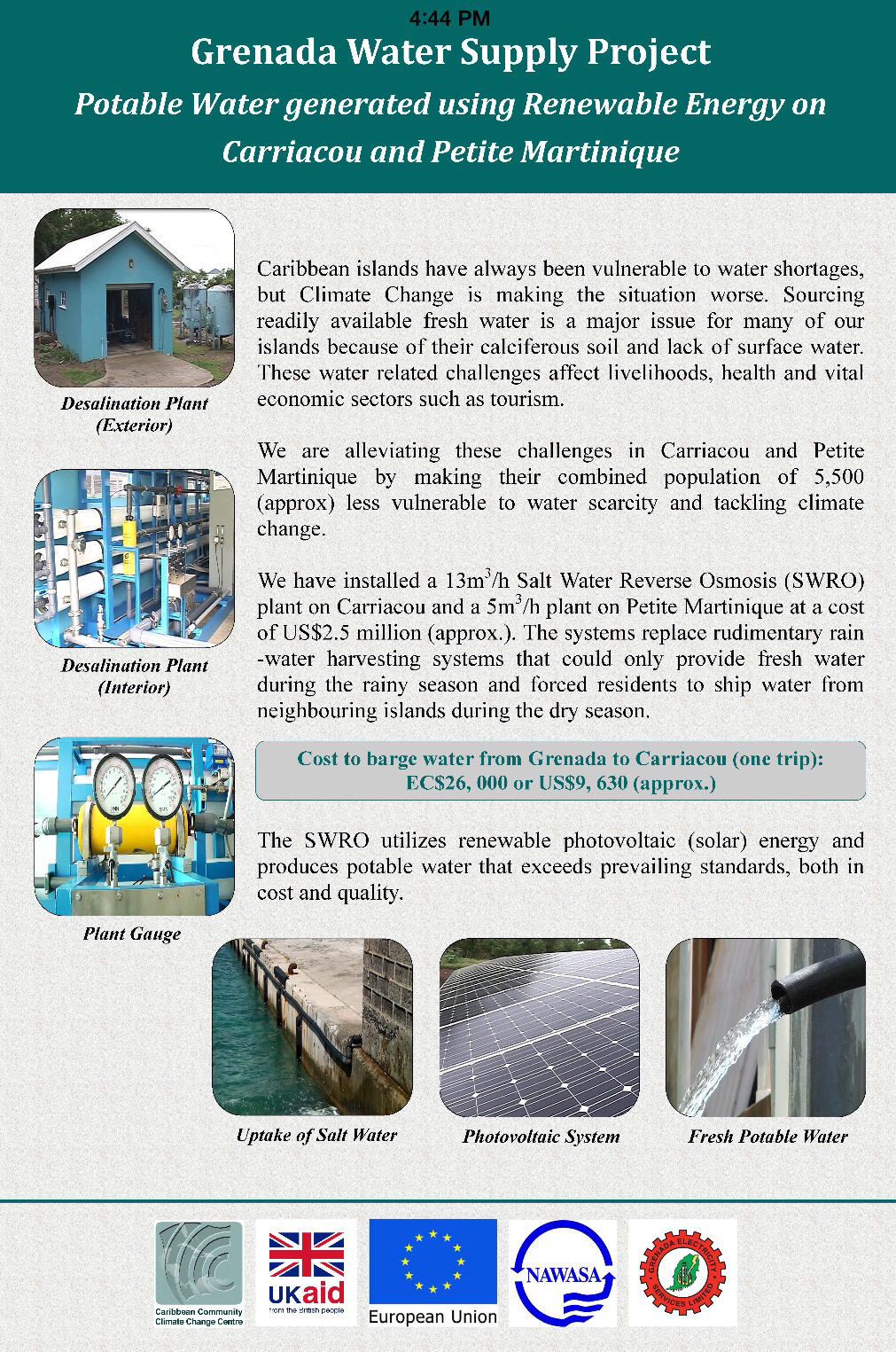
Since completing this key project, we have applied the lessons learned in Belize and on the Grenadian islands of Petite Martinique and Carriacou. Review the poster above to learn more about the progress we are making in Grenada:


Tufton Wants Laws On Water Harvesting

EFFORTS TO preserve the country’s water reserves must be supplemented by legislation that makes rainwater harvesting compulsory for all housing developments and other such major projects which put a drain on Jamaica’s limited water resources during construction.

Dr Christopher Tufton

That is the recommendation from Dr Christopher Tufton, who told The Gleaner that such legislation is overdue, given Government’s failure to examine and report back on a resolution passed in the Senate March 1, 2013 on legislating rainwater harvesting.

“This is yet another example of a country that gives lip service to sustainable development, while citizens have to experience the hardships from a water crisis each year. We have heard nothing of the resolution since then, and as is customary, we act surprised that we are in another water shortage crisis, even though we have this situation each year,” said the former government minister.

He wants to make it mandatory that developers include in their applications information on how they will harvest and store rainwater for use during the life of the project. The legislation also speaks to the incorporation of features such as guttering on individual buildings, to ensure that water conservation becomes a part the Jamaican culture going forward.

“What it would mean is that one could determine to what extent existing projects could be retrofitted or adjusted. For new projects, however, part of their design should include a rainwater harvesting process. Now, it does add to the cost of construction, but in some countries, they have done things like tax rebates, among other things, to incentivise developers,” Tufton said. “So once construction is done, you could get a tax write-off in a short period of time to keep costs to a minimum.”

Acknowledging that this additional cost might prove a deterrent for some investors, Tufton said one has to look at the much bigger picture of the emotional distress and financial fallout the country is now experiencing. More


Cuba and the Cayman Islands Concerns Grow With Prospect of U.S. Presence

Already, American corporations are poised to rush into a country only 90 miles from Florida’s shores.In March, a delegation from the U.S. Agriculture Coalition for Cuba, an agribusiness group that includes Cargill, the National Grain and Feed Association, the National Chicken Council and other companies and organizations, flew to Havana to meet with Cuban officials.

And cruise ship companies and hotel chains like Marriott and Hilton have indicated their enthusiasm. “I can’t stop thinking about it,” Frank Del Rio, chief executive officer of Norwegian Cruise Line Holdings, said in an interview. “Cuba and the cruise industry are just a match made in heaven, waiting to happen. More

The question for the Cayman Islands, who is considering constructing a new cruise ship dock, is how will the opening of Cuba affect cruise traffic to George Town?

I argue that an Economic Study is needed, in addition to the Environmental Impact Assesment (EIA), to analyse the economics of the cruise business to the Cayman Islands as a whole. This study should compare the financial benefits of stay-over tourism, with the extension of Owen Roberts International Airport (ORIA) to 10.000' feet allowing the handling of long-haul direct flights from Europe, East Asia (China, Japan, South Korea) and the Persian Gulf. It may be possible to turn ORIA into the air-hub of the Western Caribbean with Cayman Airways actually turning a profit as a regional carrier. Editor


CARICOM Countries Address Renewable Energy, SIDS’ Development, Climate Change

CARICOM 5 July 2015: The 36th Regular Meeting of the Conference of Heads of Government of the Caribbean Community (CARICOM) focused on energy, bolstering education systems, and Haiti's “looming humanitarian crisis,” among other issues. A high-level symposium on sustainable development convened on the sidelines of the Conference.

During the meeting, held on 2-4 July 2015, in Bridgetown, Barbados, leaders welcomed the establishment of a Caribbean Centre for Renewable Energy, which will be hosted by Barbados. The Centre will act as the implementation hub for sustainable energy activities and projects within the Caribbean. The Government of Trinidad and Tobago proposed creating a Caribbean Energy Fund, which participants supported.

Discussions at the Conference also addressed: access to concessional development financing for small island developing States (SIDS), with leaders advocating for a vulnerability measurement instead of gross domestic product (GDP) to determine economic health; a climate agreement that would limit warming to below 1.5°C compared to pre-industrial levels; and decision-making mechanisms in the region.

The Conference resulted in a communiqué that addresses: sustainable development; resilience building and wealth creation for Caribbean development, and the role of Caribbean universities; science and technology; and the promotion of sustainable energy. Participants also adopted 'The CARICOM Declaration for Climate Action,' which outlines the Caribbean region's priorities for the 2015 climate agreement, including loss and damage, limiting warming to below 1.5°C, a compliance mechanism, and finance measures, including improved and privatized access to funds by SIDS.

Speaking during the high-level symposium on sustainable development, UN Secretary-General Ban Ki-moon said that, by 2020, Barbados will be one of the world's top five solar energy users on a per capita basis, and Caribbean countries “are lighting the path to the future.” Noting that sustainable development and climate change are “two sides of the same coin,” Ban reiterated that this generation could be the first to end global poverty, and the last to prevent the worst impacts of climate change, “before it is too late.”

Ban underscored that the proposed Sustainable Development Goals (SDGs) must be “focused, financed and followed up,” and that partnerships must be strengthened with regard to capacity building, financing, access to technology, and improved data collection and statistics.

Ban also called on countries to: link the global agenda to regional agendas; deepen regional integration; focus on the needs and vulnerabilities of SIDS and middle-income countries (MICs), including by addressing the debt challenge; and achieve a low-carbon, climate-resilient development pathway. He said he will continue working to guarantee that SIDS and the least developed countries (LDCs) are top funding priorities of the Green Climate Fund (GCF), among other sources.

http://sids-l.iisd.org/news/caricom-countries-address-renewable-energy-sids-development-climate-change/


UN-HABITAT Report Explores Climate Change, Urbanization in SIDS

May 2015: A small island developing States (SIDS) urban agenda must reflect the cultural, economic and geographic characteristics of SIDS, in order to address sustainable urbanization in SIDS, according to a publication by the UN Human Settlements Programme (UN-HABITAT).

The report provides an overview of current trends in climate change and urbanization, describes the impact of climate change on cities in SIDS, and explores the role of urban planning and design as a tool for addressing the challenges and opportunities of climate change in relation to human settlements in SIDS.

‘Urbanization and Climate Change in Small Island Developing States' responds to SIDS' calls to enable strong, genuine and durable partnerships at all levels and to strengthen long-standing cooperation and support from the international community. The publication is part of UN-HABITAT's ‘Cities and Climate Change Series.'

Global urbanization trends are present in SIDS, where 59% of residents live in urban settlements. According to the report, the term ‘urban' in the SIDS context can refer to a small town connected by villages on a single island, along a coastal perimeter or a series of islets.

“Climate change threatens the achievement of the Sustainable Development Goals (SDGs),” particularly for SIDS, the report states. To position SIDS to achieve the SDGs and tackle climate change, the report emphasizes the importance of adapting resilience and sustainable urbanization concepts to the SIDS context and adopting innovative approaches such as the blue economy.

The report recommends promoting compact urban forms to address the ‘primacy of capitals' and resulting urban sprawl. Tools for achieving compact urban forms include smart growth principles, land use regulation, development and recognition of urban growth boundaries, and promotion of walking and cycling.

The report further recommends: adopting ecosystems-based approaches (EbA) to adaptation, such as reducing exposure to natural disasters through maintaining coastal ecosystems; incorporating an inclusive human rights-based approach; prioritizing investments and improving local capacity; and compiling adequate local data and information systems. [Publication: Urbanization and Climate Change in Small Island Developing States] More


The island states of Seychelles and Palau are set on forging closer ties and strengthening their newly-established diplomatic relations.

This follows the signing Tuesday morning of a General Cooperation Agreement and a Short Stay Visa Waiver Agreement between the two countries which seeks to allow bilateral cooperation between the two sides in several areas.

The agreements were signed by the Seychelles Minister of Foreign Affairs and Transport Joel Morgan and Palau’s Ambassador to the United States of America, Hersey Kyota.

Kyota is part of the four-member delegation which the Palauan President Tommy Esang Remengesau is leading on his official visit to Seychelles.

The signing followed a tête-à-tête between President Remengesau and Seychelles President James Michel at State House in the Seychelles capital of Victoria, after which they were joined by officials of their two countries for further discussions.

In a press statement issued this afternoon, State House said talks between Michel and Remengesau centred on their respective countries' progress in various sectors, namely fisheries, aviation, tourism, environmental protection, renewable energy, economic reforms and wider issues of sustainable development.

Seychelles and Palau only established formal diplomatic ties earlier this year, although the two heads of states have enjoyed close relations for a number of years.

Michel and Remengesau were the ones who called for the setting up of the Global Island Partnership (GLISPA) in January 2005 during the second International Meeting of the Small Island Developing States held in the neighbouring Indian Ocean island of Mauritius.

GLISPA is an open and voluntary platform for all islands and their supporters to work together to build resilient and sustainable island communities through innovative partnerships.

Both Palau and Seychelles are also members of the Alliance of Small Island States (AOSIS).

On his first visit to Seychelles, Remengesau was also the guest of honour at yesterday’s National Day Celebrations.

In a press statement issued by State House this afternoon following this morning's meeting, Michel described Remengesau’s visit to the Indian Ocean archipelago of 115 islands as “a historic milestone” in the relations between the two countries.

“His presence amongst us is not only an opportunity for him to share in our festivities, to share our joy and achievements as a nation, but also an occasion to celebrate and strengthen even further the strong island kinship between our two brotherly countries and between islands everywhere,” said Michel.

According to the statement, the two leaders have agreed that “the close cooperation between Seychelles and Palau that is planned in the future” will be an example of collaboration between individual small island developing states adding that Seychelles and Palau will encourage such cooperation between other island nations.

“This type of cooperation should be replicated in the Post-2015 era if small island countries or as we say ‘large ocean states’ are to benefit to the maximum from the implementation of the Post-2015 Development Agenda, the Sustainable Development Goals (SDGs) and the Paris Climate Change agreement as well as the SAMOA PATHWAY,” said Michel.

For the Palauan president, the visit represents an opportunity which will allow the two island nations to share experiences and learn from each other’s best practices considering they face similar challenges.

“…I am reminded that we share the same values; that the development of a nation rests on the benefits it can bring to the people and that sustainability is at the heart of our island nations. We seek to continue to bring the same message of island people to the world community and work together in close collaboration,” said Remengesau.

The Palauan President will leave Seychelles on Wednesday July 1.

During his stay, he is also paying close attention to restoration of eroded coastlines due to climate change in Seychelles which is a similar challenge faced by Palau. This is through visits to several sites in the Seychelles where such projects have been undertaken.

Palau consists of over 200 islands, out of which only eight are permanently inhabited. The western Pacific islands have a much smaller population size of only around 21,000 people when compared to Seychelles’ population of around 90,000.

Palau which is close to Southeast Asia has a rather mixed population of Malay, Melanesian, Filipino, and Polynesian ancestry. It is believed that its original settlers as early as 2500 BC were from Indonesia.

The Palau islands remained under Spanish ownership for many years before Spain sold them to Germany in 1899. The islands were also occupied by Japan during the World War 1 and the US during the World War 2.

Palau became independent in 1994 More


Informal GLISPA Meeting in Bonn to Discuss COP21

GLISPA will be holding an informal face to face meeting for interested countries and organizations currently in Bonn at the UNFCCC inter-sessional meeting on either 10 or 11 June 2015. This meeting will be hosted by Ambassador Jumeau as Chair of the GLISPA Steering Committee. The meeting will focus on opportunities to showcase island leadership in adaptation and resilience as part of the upcoming UNFCCC COP21 in Paris, France in December 2015 and specifically the interest in GLISPA coordinating events to achieve this.

Seychelles Ambassador Ronny Jumeau

Anyone interested in showcasing island leadership in adaptation and resilience is welcomed to attend this meeting. Please email Susi Menazza at smenazza@tnc.org if you are interested in participating. She will confirm the date/time/venue with those that RSVP in the near future.

Please note, GLISPA will also host a global teleconference later in June along a similar lines. More information will be available shortly. Thank you to those of you that have reached out to indicate your interest in supporting such an event.

For the best newsfeed on island issues, check http://sids-l.iisd.org/>, http://www.sidsnet.org>, http://www.globalislands.net/>


Civil Aviation Unveils Design For New Cayman Air Terminal

The Cayman Islands Airports Authority (CIAA) has unveiled the interior conceptual drawings for the multi-million dollar expansion project at Owen Roberts International Airport (ORIA).

Commenting on the design created by Florida based firm RS&H Group, CIAA’s CEO Albert Anderson said, “The interior design is very impressive and I am confident that once completed the new expanded airport will be a first-class terminal facility

The CI$55 million expansion project should take around three years to complete and will nearly triple the current space at the airport. Construction on the first phase of the project is expected to begin this summer.

Here is the Cayman Islands Government's chance to save money and show their support for alternative energy. Covering the roof and parking lots with solar panels, and using LED lighting would set an example for Caymanians and Caymanian businesses to follow. Editor