
The Next Generation Asks World Leaders at UN Climate Summit 2014: Why Not Act on Climate Change?

The Next Generation Asks World Leaders at UN Climate Summit 2014: Why Not Act on Climate Change?
This is the transcript of a video “address to the world” released by President Loeak on 18 September 2014 ahead of the UN Secretary-General's Climate Summit. The full video can be viewed here.https://www.youtube.com/watch?v=i8t7ElMPS_8
Out here in the middle of the Pacific Ocean, climate change has arrived.
In the last year alone, my country has suffered through unprecedented droughts in the north, and the biggest ever king tides in the south; and we have watched the most devastating typhoons in history leave a trail of death and destruction across the region.
Lying just two meters above sea level, my atoll nation stands at the frontline in the battle against climate change. The beaches of Buoj where I use to fish as a boy are already under water, and the fresh water we need to grow our food gets saltier every day. As scientists had predicted, some of our islands have already completely disappeared, gone forever under the ever-rising waves. For the Marshall Islands and our friends in the Pacific, this is already a full-blown climate emergency.
Some tell us that we should begin planning to leave. But how can we? And why should we? These islands are our home. They hold our history, our heritage and our hopes for the future. Are the world's polluters asking us to give up our language, our culture, and our national identity? We are not prepared to do that – we will stay and fight. If the water comes, it comes.
Brick by brick, I built the seawall behind me with my own hands. But even this is barely enough to protect my family from the encroaching waves. Last year, after returning from a visit to the United Nations in New York, I was so shocked by the damage from the rising tides that I added another foot of bricks to the wall.
In the Marshall Islands we have a saying – “Wa kuk wa jimer”. It means that we are all in the same boat together. What is happening here is a mere preview of the havoc that awaits if we continue with our polluting ways. If my country goes, others will surely follow. We are the canary in the coalmine.
The climate crisis is forcing us to take matters into our own hands, both at home and on the international stage. Last year the Marshall Islands hosted the largest-ever Pacific Islands Forum Leaders' meeting in Majuro and it remains one of the proudest moments of my Presidency.
The big outcome was the Majuro Declaration for Climate Leadership, a powerful message from the world's most vulnerable countries to the big emitters that surround us that the time for talk is over, and the time for action is now. Our efforts had an impact with the United States, the European Union, the United Kingdom, Mexico and Japan all committing to be climate leaders, and to do more to tackle climate change. At this time last year, I presented the Declaration to UN Secretary-General Ban Ki-moon, and promised to bring the spirit of Majuro to his Climate Change Leaders' Summit in New York, which is now less than a week away.
The Summit comes not a moment too soon. It is the first gathering of world leaders on climate change in nearly five years, and just over a year before our deadline to sign a new global treaty on climate change in Paris at the end of 2015.
Paris cannot be another Copenhagen. The world has changed too much. The science is more alarming, the impacts more severe, the economics more compelling, and the politics more potent. Even the world's two biggest polluters – China and the United States – are working together to find a pathway to a new global agreement.
But there are still some that seek to slow us down.
To my fellow world leaders I say “next week's Summit is a chance for all of us to be the leaders we were elected to be”. We must send a strong and united message to the world – and to the people that we represent – that we are ready to do a deal next year. And to avoid the worst impacts of a warmer world, this new deal must capture a vision for a carbon-free world by the middle of the century. Without it, no seawall will be high enough to save my country. Together, we must find the courage to rise to this challenge. It is time to build the greatest climate change alliance the world has ever seen.
My people are counting on it, as is all of humanity.
Christopher J. Loeak is the President of the Republic of the Marshall Islands
Jason Box knows ice. That’s why what’s happened this year concerns him so much. Box just returned from a trip to Greenland. Right now, the ice there is … black:

The ice in Greenland this year isn’t just a little dark—it’s record-setting dark. Box says he’s never seen anything like it. I spoke to Box by phone earlier this month, just days after he returned from his summer field research campaign.
“I was just stunned, really,” Box told me.
The photos he took this summer in Greenland are frightening. But their implications are even more so. Just like black cars are hotter to the touch than white ones on sunny summer days, dark ice melts much more quickly.
As a member of the Geological Survey of Denmark and Greenland, Box travels to Greenland from his home in Copenhagen to track down the source of the soot that’s speeding up the glaciers’ disappearance. He aptly calls his crowdfunded scientific survey Dark Snow.

There are several potential explanations for what’s going on here. The most likely is that some combination of increasingly infrequent summer snowstorms, wind-blown dust, microbial activity, and forest fire soot led to this year’s exceptionally dark ice. A more ominous possibility is that what we’re seeing is the start of a cascading feedback loop tied to global warming. Box mentions this summer’s mysterious Siberian holes and offshore methane bubbles as evidence that the Arctic can quickly change in unpredictable ways.
This year, Greenland’s ice sheet was the darkest Box (or anyone else) has ever measured. Box gives the stunning stats: “In 2014 the ice sheet is precisely 5.6 percent darker, producing an additional absorption of energy equivalent with roughly twice the US annual electricity consumption.”
Perhaps coincidentally, 2014 will also be the year with the highest number of forest fires ever measured in Arctic.
Box ran these numbers exclusively for Slate, and what he found shocked him. Since comprehensive satellite measurements began in 2000, never before have Arctic wildfires been as powerful as this year. In fact, over the last two or three years, Box calculated that Arctic fires have been burning at a rate that’s double that of just a decade ago. Box felt this finding was so important that he didn’t want to wait for peer review, and instead decided to publish first on Slate. He’s planning on submitting these and other recent findings to a formal scientific journal later this year.

Box’s findings are in line with recent research that shows the Arctic is in the midst of dramatic change.
A recent study has found that, as the Arctic warms, forests there are turning to flame at rates unprecedented in the last 10,000 years. This year, those fires produced volumes of smoke and soot that Box says drifted over to Greenland.
In total, more than 3.3 million hectares burned in Canada’s Northwest Territories alone this year—nearly 9 times the long term average—resulting in a charred area bigger than the states of Connecticut and Massachusetts combined. That figure includes the massive Birch Creek Complex, which could end up being the biggest wildfire in modern Canadian history. In July, it spread a smoke plume all the way to Portugal.
In an interview with Canada’s National Post earlier this year, NASA scientist Douglas Morton said, “It’s a major event in the life of the earth system to have a huge set of fires like what you are seeing in Western Canada.”
Box says the real challenge is to rank what fraction of the soot he finds on the Greenland ice is from forest fires, and what is from other sources, like factories. Box says the decline of snow cover in other parts of the Arctic (like Canada) is also exposing more dirt to the air, which can then be more easily transported by the wind. Regardless of their ultimate darkening effect on Greenland, this year’s vast Arctic fires have become a major new source of greenhouse gas emissions from the thawing Arctic. Last year, NASA scientists found “amazing” levels of carbon dioxide and methane emanating from Alaskan permafrost.
Earlier this year, Box made headlines for a strongly worded statement along these lines:
If even a small fraction of Arctic sea floor carbon is released to the atmosphere, we’re f’d.
— Jason Box (@climate_ice) July 29, 2014
That tweet landed Box in a bit of hot water with his department, which he said now has to approve his media appearances. Still, Box’s sentiment is inspiring millions. His “f’d” quote is serving as the centerpiece of a massive petition (with nearly 2 million signatures at last count) that the activist organization Avaaz will deliver to “national, local, and international leaders” at this month’s global warming rally in New York City on Sept. 21. More
2 September 2014: Small island developing States (SIDS) leaders “really want a climate agreement,” according to Mary Robinson, the UN Special Envoy for Climate Change. Speaking on the margins of the Third International Conference on SIDS, Robinson stressed the urgent need to build climate resilient communities and reduce greenhouse gas (GHG) emissions.
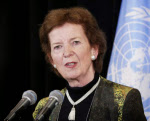
Mary Robinson UN Special Envoy
Robinson has been meeting with SIDS leaders, UN officials and donors to discuss climate change impacts at the Conference. She stated that, while SIDS leaders are engaged in actions to establish and expand partnerships, build capacity and increase financing, they also support an agreement on climate change.
Noting that climate change has traditionally been a focus for ministers of environment and energy, Robinson underscored the importance for Heads of State to address climate change. “Once you have a Head of State focused [on climate change], it becomes a holistic issue,” according to Robinson.
Looking forward, Robinson highlighted the UN Secretary-General's Climate Summit, which will take place on 23 September 2014, in New York, US. She said her role will be to “encourage the importance of the urgency of getting a climate agreement” and called for Heads of State to say what their country will do to address climate change. Robinson underscored the importance of engaging with civil society and the private sector on climate negotiations to ensure a “good, robust, fair climate agreement.” More
In her previous books The Shock Doctrine: The Rise of Disaster Capitalism (2007) and NO LOGO: No Space, No Choice, No Jobs (2000), Canadian author and activist Naomi Klein took on topics like neoliberal “shock therapy,” consumerism, globalization and “disaster capitalism,” extensively documenting the forces behind the dramatic rise in economic inequality and environmental degradation over the past 50 years.

Naomi Klein
But in her new book, This Changes Everything: Capitalism vs. the Climate (due in stores September 16), Klein casts her gaze toward the future, arguing that the dangers of climate change demand radical action now to ward off catastrophe. She certainly isn’t alone in pointing out the urgency of the threat, but what sets Klein apart is her argument that it is capitalism—not carbon—that is at the root of climate change, inexorably driving us toward an environmental Armageddon in the pursuit of profit. This Changes Everything is well worth a read (or two) in full, but we’ve distilled some of its key points here.
1. Band-Aid solutions don’t work.
“Only mass social movements can save us now. Because we know where the current system, left unchecked, is headed.”
Much of the conversation surrounding climate change focuses on what Klein dismisses as “Band-Aid solutions”: profit-friendly fixes like whizz-bang technological innovations, cap-and-trade schemes and supposedly “clean” alternatives like natural gas. To Klein, such strategies are too little, too late. In her drawn-out critique of corporate involvement in climate change prevention, she demonstrates how profitable “solutions” put forward by many think-tanks (and their corporate backers) actually end up making the problem worse. For instance, Klein argues that carbon trading programs create perverse incentives, allowing manufacturers to produce more harmful greenhouse gases, just to be paid to reduce them. In the process, carbon trading schemes have helped corporations make billions—allowing them to directly profit off the degradation of the planet. Instead, Klein argues, we need to break free of market fundamentalism and implement long-term planning, strict regulation of business, more taxation, more government spending and reversals of privatization to return key infrastructure to public control.
2. We need to fix ourselves, not fix the world.
“The earth is not our prisoner, our patient, our machine, or, indeed, our monster. It is our entire world. And the solution to global warming is not to fix the world, it is to fix ourselves.”
Klein devotes a full chapter of the book to geoengineering: the field of research, championed by a niche group of scientists, funders and media figures, that aims to fight global warming by altering the earth itself—say, by covering deserts with reflective material to send sunlight back to space or even dimming the sun to decrease the amount of heat reaching the planet. However, politicians and much of the global public have raised environmental, health and ethical concerns regarding these proposed science experiments with the planet, and Klein warns of the unknown consequences of creating “a Frankenstein’s world,” with multiple countries launching projects simultaneously. Instead of restoring an environmental equilibrium, Klein argues these “techno-fixes” will only further upset the earth’s balance, each one creating a host of new problems, requiring an endless chain of further “fixes.” She writes, “The earth—our life support system—would itself be put on life support, hooked up to machines 24/7 to prevent it from going full-tilt monster on us.”
3. We can’t rely on “well-intentioned” corporate funding.
“A great many progressives have opted out of the climate change debate in part because they thought that the Big Green groups, flush with philanthropic dollars, had this issue covered. That, it turns out, was a grave mistake.”
Klein strongly critiques partnerships between corporations and major environmental groups, along with attempts by “green billionaires” such as Bill Gates and Virgin Group’s Richard Branson to use capitalism to fighting global warming. When capitalism itself is a principal cause of climate change, Klein argues, it doesn’t make sense to expect corporations and billionaires to put the planet before profit. For example, though the Gates Foundation funds many major environmental groups dedicated to combating climate change, as of December 2013, it had at least $1.2 billion invested in BP and ExxonMobil. In addition, when Big Greens become dependent on corporate funding, they start to push a corporate agenda. For instance, organizations such as the Nature Conservancy and the Environmental Defense Fund, which have taken millions of dollars from pro-fracking corporate funders, such as Shell, Chevron and JP Morgan, are pitching natural gas as a cleaner alternative to oil and coal.
4. We need divestment, and reinvestment.
“The main power of divestment is not that it financially harms Shell and Chevron in the short term but that it erodes the social license of fossil fuel companies and builds pressure on politicians to introduce across-the-board emission reductions.”
Critics of the carbon divestment movement often claim that divestment will have minimal impact on polluters’ bottom lines. But Klein argues that this line of reasoning misses the point, quoting Canadian divestment activist Cameron Fenton's argument that “No one is thinking we’re going to bankrupt fossil fuel companies. But what we can do is bankrupt their reputations and take away their political power.” More importantly, divestment opens the door for reinvestment. A few million dollars out of the hands of ExxonMobil or BP frees up money that can now be spent developing green infrastructure or empowering communities to localize their economies. And some colleges, charities, pension funds and municipalities have already got the message: Klein reports that 13 U.S. colleges and universities, 25 North American cities, around 40 religious institutions and several major foundations have all made commitments to divest their endowments from fossil fuel stocks and bonds.
5. Confronting climate change is an opportunity to address other social, economic and political issues.
“When climate change deniers claim that global warming is a plot to redistribute wealth, it's not (only) because they are paranoid. It's also because they are paying attention.”
In The Shock Doctrine, Klein explained how corporations have exploited crises around the world for profit. In This Changes Everything, she argues that the climate change crisis can serve as a wake-up call for widespread democratic action. For instance, when a 2007 tornado destroyed most of Greensburg, Kansas, the town rejected top-down approaches to recovery in favor of community-based rebuilding efforts that increased democratic participation and created new, environmentally-friendly public buildings. Today, Greensburg is one of the greenest towns in the United States. To Klein, this example illustrates how people can use climate change to come together to build a greener society. It also can, and indeed must, spur a radical transformation of our economy: less consumption, less international trade (part of relocalizing our economies) and less private investment, and a lot more government spending to create the infrastructure we need for a green economy. “Implicit in all of this,” Klein writes, “is a great deal more redistribution, so that more of us can live comfortably within the planet’s capacity.” More
The UN is set to release a series of imagined, but probable weather forecasts to highlight how extreme weather events will increase in frequency and intensity over the next three decades.
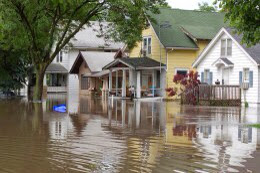
The videos, to be released ahead of a crucial UN climate summit on September 23 in New York, use fictional weather forecasts to illustrate how global warming will change the world by 2050, if mitigation action is not taken.
A teaser video has been released, to be followed by 14 ‘weather reports from the future’ from around the world.
The forecasts are described as “imaginary but realistic” if global warming continues at the pace currently seen. Scientists warn that temperatures are currently on track to increase by 4C above pre-industrial levels, double the 2C limit that scientist believe would lead to irreversible tipping points.
Weather presenters from around the world were invited to make the videos, with the US Weather Channel and ARD in Germany taking part.
“What they created are only possible scenarios, of course, not true forecasts,” the WMO said.
“Nevertheless, they are based on the most up-to-date climate science, and they paint a compelling picture of what life would be like on a warmer planet.”
The UN is calling on world leaders to make “bold pledges” regarding climate change at the summit later this month. It is hoped the summit will act as a step towards the agreement of a global deal next year in Paris.
UN general-secretary Ban Ki-Moon commented, “Climate change is affecting the weather everywhere. It makes more extreme and disturbs established patterns. That means more disasters; more uncertainty.” More
Photo: U.S. Geological Survey via Flickr
He’s traveled half a million miles over the years – enough to go around the world 12 times, or to the moon and halfway back – so it’s little wonder that writer, photographer, conservationist and educator Martin Keeley continues to find inspiration for his work.

Keeley’s latest trips are with the Marvelous Mangrove education curriculum, a program that teaches schoolchildren about the importance of mangroves and the eco-systems which they support worldwide, as well as training teachers to teach both students and other teachers.
The program was developed by Cayman Brac-based Keeley in 1999 and initially was incorporated into Cayman’s primary school curriculum. It is part of the Mangrove Action Project, a conservation group comprised of more than 300 scientists and academics spanning more than 60 nations.
The Marvelous Mangrove program is now in 11 countries, with the expansion this year to South Sulawesi, Indonesia, and Queensland, Australia.
“For me, the mangrove trips continue to stimulate the creative process,” said the writer.
“They often inspire my poetry, and I reckon that in another six months or so I’ll have enough to publish another anthology. My photography also continues to benefit from my travels and exposure to other cultures and their environments.”
In addition, he says, he gets an in-depth perspective on the countries and the cultures where he works.
“I experience and observe firsthand their societies and the common problems they face – the huge and ever growing disparity between the obscenely wealthy and the desperately poor who are barely making it,” Keeley added.
“The contrasts I observed this summer between nations like Indonesia and Australia stimulate not only sympathy and anger between the haves and have-nots, but empathy with those whose daily struggle is that of survival, while others have little or no idea how lucky they are take for granted their secure and protective social environment.”
At the Indonesian trip, 30 teachers and educators spent three days in an intense workshop that, in the words of Keeley, “introduced them to the wonderful world of mangroves through hands-on science.”
A particular highlight was the surprise introduction of 15 school kids who came in and assisted for the afternoon, Keeley said.
“The setting is perfect, with elevated cabins connected by elevated walkways and the “hall” for the workshop itself in a Roman-style amphitheater that is open to the elements – roofed, but with shutters, not glass windows,” he said.
“The accommodation, theater and restaurant operate independent of the grid on solar power with water from local wells and storage systems which is treated through solar osmosis, although it sometimes has to be topped up by water trucks during the dry season. The food is all grown locally, and mostly seafood that is caught locally on a daily basis.”
The Australian leg of the trip, he said, was slightly different.
“Australia saw the launch of ‘Mangrovia,’ a huge inflatable red mangrove that students go inside to explore and hear storytelling,” Keeley said.
“In addition, Mangrovia’s creator, international festival artist Evelyn Roth, also designed and made 28 costumes of mangrove critters that are used in conjunction with the inflatable.
“Many Cayman students [and adults] have had similar experiences with my huge inflatable shark and the 30 mangrove critter costumes which go with it during the past 15 years! It’s an exciting way to learn.”
The issue of mangrove conservation has become more and more important in recent years, Keeley says, largely because of their environmental qualities.
“It has been known for many years, and the 2004 Asian Tsunami proved it beyond doubt, that mangroves are the first line of defense against major tropical storms, be they hurricanes or typhoons,” Mr. Keeley continued.
“Recent studies during the past six or seven years have also shown that, given the opportunity, mangroves will keep pace with sea level rise thereby extending that level of protection. In addition, recent research has shown that mangroves capture CO2 from the atmosphere and store it in leaves, roots, trunks and soil.
“No maximum storage capacity has been determined as the trees continuously store carbon in the soil for centuries or millennia. Obviously ripping out mangroves releases this stored CO2 and thereby adds to the acceleration of global warming.
“National governments from Vietnam and China to Belize and Guatemala have come to understand what local communities and scientists have been telling them for many years. Mangroves are the major source of more than 75 percent of reef species of fish and invertebrates – they are the spawning and nursery grounds for these species. Thousands of communities round the world rely on these aquatic species for their livelihoods and to feed their families.”
Next up for stamps on the increasingly-packed passport pages will be trips to Bangladesh and Kenya, scheduled for summer 2015. Keeley has already visited both briefly to get the ball rolling and he told Weekender that – funding permitting – translations of the materials and teacher training workshops will be introduced.
There seems no sign of slowing down there, either, for the Brac-based whirlwind.
“World-wide at least a dozen other countries are interested in the Marvellous Mangroves curriculum,” he concluded.
“As usual, it’s just a matter of time and, of course, money, to make it happen.” More
A new assessment from Europe’s CryoSat spacecraft shows Greenland to be losing about 375 cu km of ice year.
 |
| The team has produced elevation models for the ice sheets |
Added to the discharges coming from Antarctica, it means Earth’s two big ice sheets are now dumping roughly 500 cu km of ice in the oceans annually.
“The contribution of both ice sheets together to sea level rise has doubled since 2009,” said Angelika Humbert from Germany’s Alfred Wegener Institute.
“To us, that’s an incredible number,” she told BBC News.
In its report to The Cryosphere journal, the AWI team does not actually calculate a sea-level rise equivalent number, but if this volume is considered to be all ice (a small part will be snow) then the contribution is likely to be on the order of just over a millimetre per year.
This is the latest study to use the precision altimetry data being gathered by the European Space Agency’s CryoSat platform.
The satellite was launched in 2010 with a sophisticated radar instrument specifically designed to measure the shape of the polar ice sheets.
The AWI group, led by senior researcher Veit Helm, has taken just over two years’ worth of data centred on 2012/2013 to build what are called digital elevation models (DEMs) of Greenland and Antarctica, and to asses their evolution.
These models incorporate a total of 14 million individual height measurements for Greenland and another 200 million for Antarctica.
When compared with similar data-sets assembled by the US space agency’s IceSat mission between 2003 and 2009, the scientists are able then to calculate changes in ice volume beyond just the CryoSat snapshot.
Negative shifts are the result of surface melting and ice discharge; positive trends are the consequence of precipitation – snowfall.
Greenland is experiencing the biggest reductions in elevation currently, losing about 375 cu km a year (plus or minus 24 cu km per year), with most of the action occurring at the west and south-east coast of the continent.
Significant thinning is seen also in the North East Greenland Ice Stream (NEGIS).
“This has three outlet glaciers and one of these, the Zachariae Isstrom, has retreated quite a bit and some volume loss has already been reported. But we see now that this volume loss is really propagating to upper areas, much further into the interior of the ice sheet than has been recorded before,” explained Prof Humbert.
In Antarctica, the annual volume loss is about 128 cu km per year (plus or minus 83 cu km per year).
As other studies have found, this is concentrated in the continent’s western sector, in the area of the Amundsen Sea Embayment.
Big glaciers here, such as Thwaites and Pine Island, are thinning and retreating at a rapid rate.
Some thickening is seen also, such as in Dronning Maud Land, where colossal snowfalls have been reported. But this accumulation does not offset the losses occurring in West Antarctica.
A British-led group recently reported its own Antarctica DEM, using a different algorithm to process the numbers in the CryoSat data.
The AWI outcomes look very similar, and the German team has transferred the exact same approach to Greenland so it can have confidence in comparing the two continents.
The losses also look consistent with the analysis coming out of the American Grace mission, which uses a different type of satellite to monitor gravity changes in the polar regions – to, in essence, weigh the amount of ice being dumped into the sea.
Prof Andy Shepherd, who was part of the British group that reported its findings in May, commented: “This is yet another exciting result from CryoSat, thanks to the team at AWI, charting yet more new ground by providing the first complete survey of ice volume changes in Greenland.
“However, the increased ice losses that have been detected are a worrying reminder that the polar ice sheets are still experiencing dramatic changes, and will inevitably raise concerns about future global sea-level rise.” More
A global campaign to improve weather and climate services for all small island developing states was launched today with the support of the World Meteorological Organisation (WMO), the Secretariat of the Pacific Regional Environment Programme (SPREP) and Digicel Pacific.
The Small Islands, Weather Together campaign (www.weathertogether.org) aims to show how the small island developing states of the world can work together to improve their vital weather and climate services.
In the Pacific region alone, extreme weather already accounts for 76% of all disasters with 50% directly related to cyclones. The increase in extreme weather events is also hampering the sustainable development of many small island developing states. For example, when Cyclone Evan hit Samoa in December 2012 it resulted in the loss of one third of the country’s entire annual economic output.
WMO Secretary-General Michel Jarraud stresses that small island developing states need greater investment to further strengthen their vital weather and climate services and to ensure that efforts towards sustainable development are not wasted.
“If we don’t invest in stronger weather and climate services for small island developing states then extreme weather events could simply wipe out years of development effort if they are not well prepared. It is much more cost-effective to invest in early preparedness and prevention than to focus only on rehabilitation and post-disaster action,” he asserted.
Climate change is increasing the frequency and intensity of weather and climate events – cyclones, typhoons, drought, flash floods – in many small island developing states. But many of their Meteorological Services still lack the basic infrastructure, technology and expertise they need to protect vulnerable island communities and economies.
For Mr. Jarraud, there is an urgent need to enhance the quality of early warnings for extreme weather. He pointed out that the formulation and dissemination of these warnings also need to be improved so that they can be understood and used by the island communities and government agencies.
In the Pacific islands, SPREP and other partners are working to improve communication of this type of information in partnership with national meteorological services, the media, including broadcast stations and communities.
“SPREP recognises that weather forecasts and warnings such as those given during tropical cyclones do not have a shelf life, they must be disseminated rapidly to the public or else they are useless,” says SPREP Acting Director General Kosi Latu.
He further noted, “We can improve the quality of the forecasts and warnings so that countries and communities have more lead time to take action. But we can also improve the way climate information is used over longer time scales by farmers, fishermen and by decision-makers across government. For example, when planning new infrastructure, we can say ‘this place has a high risk of tsunami, flooding or storm surge, so don’t build things here’.”
Mr. Jarraud recalls that the small developing island states stand to suffer more and more if the global community fails to agree to a limit in greenhouse gas emissions, the main human cause of climate change and global warming.
“Greenhouse gas emissions are still on the rise. We need to reach a peak of emission over the next 15–20 years, then to decrease dramatically to zero equivalent emission in about 50–60 years from now.
“This is a huge challenge. We must act now. The more we wait, the more difficult it will be, and, therefore, the more expensive it will be for countries to adapt to climate change. If we do not act now, we are agreeing to leave the small island developing states in a situation which may no longer be manageable,” he warned.
The Small Islands, Weather Together campaign was launched specifically to coincide with the lead up to the United Nations Third International Conference on Small Island Developing States, which will be held in Apia, Samoa, from 1–4 September, 2014.
For more information visit: www.weathertogether.org
In an unprecedented move that illustrates the dramatic impacts of planetary global warming, one community in the South Pacific has decided it has no choice but to pick itself up entirely and flee for higher ground.

All too aware of their vulnerability to the effects of climate change — such as rising sea levels and extreme weather events — communities in the Pacific Islands have long acknowledged that their very existence isthreatened by global warming.
But now, authorities in a town on Taro Island, a coral atoll off Choiseul in the Solomon Islands that sits less than seven feet above sea level, have decided to relocate to the mainland in response to increasing coastal hazards including tsunamis, storm surges, and erosion. The exodus from Choiseul Bay Township, the provincial capital that's currently home to about 500 people, will take place over many years. It is the first such official migration — of people, services, and facilities — in the Pacific Islands.
According to Reuters, “the groups behind the Choiseul adaptation plan said it is being hailed by the Solomon Islands national government as a model for other provinces across the nation and more broadly across the Pacific.”
The plan comes out of Choiseul Bay Township's consultation with a team of engineers, scientists and planners, funded by the Australian government, on how best to adapt to the impact of climate change. Extensive community input was solicited, Choiseul Province premier Jackson Kiloe said in a statement Friday.
“Relocation is the only option available that will keep the community safe and will allow for future growth and prosperity of the capital and the province,” said Philip Haines, project manager at BMT, an engineering firm that worked on the plan.
Land to build a new, larger settlement that could accommodate up to 5,000 inhabitants has already been acquired, Haines told Reuters. The town will essentially have to be built up from scratch, with a hospital and school expected to be constructed within five years. In the meantime, the plan prescribes detailed actions to increase the community’s resilience to climate change, including the preparation of a tsunami response plan, and the handover of a hand-wound siren to alert the local communities of a tsunami warning.
The Solomon Islands government would be looking for climate change funding from international donors to finance the relocation, Reuters reports.
Some of that funding could come from the U.S., which has millions invested in Asia-Pacific climate change adaptation, as U.S. Secretary of State John Kerry pointed out when he visited the Solomon Islands just last week.
In remarks delivered in Honolulu last week, Kerry said:
I just came from the Solomon Islands yesterday, a thousand islands, some of which could be wiped out if we don’t make the right choices. The Pacific Islands across the entire Pacific are vulnerable to climate change. And just yesterday, I saw with my own eyes what sea level rise would do to parts of it: It would be devastating — entire habitats destroyed, entire populations displaced from their homes, in some cases entire cultures wiped out. They just had flash flooding in Guadalcanal — unprecedented amounts of rainfall. And that’s what’s happened with climate change — unprecedented storms, unprecedented typhoons, unprecedented hurricanes, unprecedented droughts, unprecedented fires, major damage, billions and billions of dollars of damage being done that we’re paying for instead of investing those billions of dollars in avoiding this in the first place. More
 © 2014
 Democracy & Good Governance