WHAT’S POSSIBLE: The U.N. Climate Summit Film

WHAT'S POSSIBLE: The U.N. Climate Summit Film

Published on Sep 23, 2014 • Presented to world leaders at the United Nations Climate Summit in New York, this short inspirational film shows that climate change is solvable. We have the technology to harness nature sustainably for a clean, prosperous energy future, but only if we act now. Narrated by Morgan Freeman, it calls on the people of the world to insist leaders get on the path of a livable climate and future for humankind.

Learn more about climate change and take action at takepart.com/climate.

WHAT'S POSSIBLE was created by director Louie Schwartzberg, writer Scott Z. Burns, Moving Art Studio, and Lyn

Davis Lear and the Lear Family Foundation.

SEQUEL ALERT! Sign up at MovingArt.com to be the first to hear about the launch of the sequel to WHAT'S

POSSIBLE: movingart.com/un/

Directed by Louie Schwartzberg

Written by Scott Z. Burns

Produced by Lyn Davis Lear

Narrated by Morgan Freeman

Music by Hans Zimmer


On Low-Carbon Economies

RMI and Carbon War Room are working together to help Caribbean islands transition to lowcarbon, clean-energy economies

Former Costa Rican president and Carbon War Room head José María Figueres on islands, carbon, and global energy use

In 1994 at age 39, José María Figueres was elected president of Costa Rica, becoming the youngest president of a Central American country during modern times. A graduate of the United States Military Academy at West Point and Harvard University’s John F. Kennedy School of Government, his administration focused on sustainable development. Since then, he has served as the chair of a United Nations taskforce, CEO of the World Economic Forum and then Concordia 21, and most recently president of Sir Richard Branson’s nonprofit Carbon War Room. Fresh off travel through parts of Asia with RMI chief scientist Amory Lovins, we asked Figueres about the importance of working with islands, creating low-carbon economies, and how to accelerate transforming global energy use.

José María Figueres

Rocky Mountain Institute: Like RMI CEO Jules Kortenhorst, your background spans business and government. Looking at today’s energy and climate challenges, why are market-based solutions — even if bolstered by supportive governmental policies — so important for driving change?

José María Figueres: About 40 percent of global carbon emissions can be profitably avoided today within existing international agreements and national regulations by applying already-proven technologies. RMI and CWR are leaders in helping businesses realize this terrific market opportunity. As we get more capital to flow into financing the transition toward clean energy and lower carbon emissions, we can provide profitable example for others to follow and broaden understanding about these issues at the same time.

RMI: Looking at RMI and Carbon War Room’s collaborative work together in the Caribbean, including the Creating Climate Wealth summit earlier this year, why is focusing on islands so important, given their small contribution to climate change yet great vulnerability in the face of it?

JMF: Working with islands to shift their energy base from fossil fuels to renewables is important for at least three reasons. First, it helps improve the quality of life for island residents, who are burdened with some of the highest electricity prices in the world. Second, such a transition creates jobs, investment possibilities, and entrepreneurial opportunities that render these islands — normally dependent on tourism for the overwhelming bulk of their economies — more competitive. And third, our work with islands can yield shining examples of a successful transition to lower-carbon, clean-energy economies using existing technologies. This will hopefully inspire others to follow in their footsteps, and not only on literal islands. After all, islands need not be surrounded by water. They can be an off-grid mine, a rural community, an isolated military installation, and much more.

RMI: Costa Rica, already known as an ecotourism hot spot and global leader in environmental stewardship, has set a goal to become carbon neutral by 2021. Your energy mix is already almost entirely renewable (mostly hydro plus some geothermal and wind), with an impressively small amount of fossil fuels. As the country embraces diversification with other renewables, such as solar in the Guanacaste region, what lessons can the rest of the world learn from your successes and challenges?

JMF: The first lesson is that renewables are profitable. Powered by renewables Costa Rica has successfully diversified its economy, with a very pronounced and competitive export-oriented bias. Secondly, we are living proof it can be done even among developing nations with scarcer economic resources than the developed world. Thirdly, our experience shows that systemic thinking in addressing these challenges is much better than a “silo” focus.

RMI: What do you see as the most significant barriers that stand in the way of transforming global energy use? With renewables making an increasingly compelling economic case — garnering billions of dollars of global investment, while their costs keep declining, making that investment go further — how can we accelerate their adoption and topple incumbent fossil fuels?

JMF: There is nothing harder than changing cultural attitudes. Most of the world grew up on fossil fuels without thinking of their unintended consequences: increasing carbon emissions driving climate change. Now we must change our habits and practices, and do so within a ten- to fifteen-year window to avoid temperature changes from escalating beyond two degrees Celsius. This requires broadening our understanding with respect to the business opportunities it entails, strong leadership to change present business models, and public-private partnerships to make progress in the short time we have to act.

RMI: With China and the U.S. dominating global oil imports, fossil fuel consumption (especially coal), and carbon emissions, how do smaller countries such as Costa Rica and the Caribbean’s island-nations perceive their place in that landscape?

JMF: Smaller nations face both a great challenge and a great opportunity. The challenge — and it’s not an easy one to come to terms with — is that even if we do everything we can in the smaller nations and reduce our carbon footprint to zero, the world still needs China, the U.S., Brazil, India, and other large players to do more and move faster. The opportunity, though, is for smaller nations to set an example in the transition to low-carbon economies, which hopefully inspires others to follow. Then, the issue becomes one of scaling solutions, rather than proving them in the first place. Smaller nations can become early-adopters proving the case that paves the way for other major world energy powers to follow.

Follow José María on Twitter.

This article is from the Summer 2014 issue of Rocky Mountain Institute’s Solution Journal. To read more from back issues of Solutions Journal, please visit the RMI website.


The state of the climate — and what we might do about it

Today, the UN begins its Climate Summit, enlisting the world to work together on a problem that’s too big for any one country to solve. Lord Nicholas Stern helped write the delegates’ report that outlines where we are now — and what we could do next. It’s a big vision for cooperation, with a payoff that goes far beyond averting disaster. He asks: How can we use this crisis to spur better lives for all?


Commentary: Christopher Jorebon Loeak – President of the Republic of the Marshall Islands


This is the transcript of a video “address to the world” released by President Loeak on 18 September 2014 ahead of the UN Secretary-General's Climate Summit. The full video can be viewed here.https://www.youtube.com/watch?v=i8t7ElMPS_8

Out here in the middle of the Pacific Ocean, climate change has arrived.

In the last year alone, my country has suffered through unprecedented droughts in the north, and the biggest ever king tides in the south; and we have watched the most devastating typhoons in history leave a trail of death and destruction across the region.

Lying just two meters above sea level, my atoll nation stands at the frontline in the battle against climate change. The beaches of Buoj where I use to fish as a boy are already under water, and the fresh water we need to grow our food gets saltier every day. As scientists had predicted, some of our islands have already completely disappeared, gone forever under the ever-rising waves. For the Marshall Islands and our friends in the Pacific, this is already a full-blown climate emergency.

Some tell us that we should begin planning to leave. But how can we? And why should we? These islands are our home. They hold our history, our heritage and our hopes for the future. Are the world's polluters asking us to give up our language, our culture, and our national identity? We are not prepared to do that – we will stay and fight. If the water comes, it comes.

Brick by brick, I built the seawall behind me with my own hands. But even this is barely enough to protect my family from the encroaching waves. Last year, after returning from a visit to the United Nations in New York, I was so shocked by the damage from the rising tides that I added another foot of bricks to the wall.

In the Marshall Islands we have a saying – “Wa kuk wa jimer”. It means that we are all in the same boat together. What is happening here is a mere preview of the havoc that awaits if we continue with our polluting ways. If my country goes, others will surely follow. We are the canary in the coalmine.

The climate crisis is forcing us to take matters into our own hands, both at home and on the international stage. Last year the Marshall Islands hosted the largest-ever Pacific Islands Forum Leaders' meeting in Majuro and it remains one of the proudest moments of my Presidency.

The big outcome was the Majuro Declaration for Climate Leadership, a powerful message from the world's most vulnerable countries to the big emitters that surround us that the time for talk is over, and the time for action is now. Our efforts had an impact with the United States, the European Union, the United Kingdom, Mexico and Japan all committing to be climate leaders, and to do more to tackle climate change. At this time last year, I presented the Declaration to UN Secretary-General Ban Ki-moon, and promised to bring the spirit of Majuro to his Climate Change Leaders' Summit in New York, which is now less than a week away.

The Summit comes not a moment too soon. It is the first gathering of world leaders on climate change in nearly five years, and just over a year before our deadline to sign a new global treaty on climate change in Paris at the end of 2015.

Paris cannot be another Copenhagen. The world has changed too much. The science is more alarming, the impacts more severe, the economics more compelling, and the politics more potent. Even the world's two biggest polluters – China and the United States – are working together to find a pathway to a new global agreement.

But there are still some that seek to slow us down.

To my fellow world leaders I say “next week's Summit is a chance for all of us to be the leaders we were elected to be”. We must send a strong and united message to the world – and to the people that we represent – that we are ready to do a deal next year. And to avoid the worst impacts of a warmer world, this new deal must capture a vision for a carbon-free world by the middle of the century. Without it, no seawall will be high enough to save my country. Together, we must find the courage to rise to this challenge. It is time to build the greatest climate change alliance the world has ever seen.

My people are counting on it, as is all of humanity.

Christopher J. Loeak is the President of the Republic of the Marshall Islands


Whether We Engage or Do Nothing… This Changes Everything

The following is an excerpt taken from the introduction of Naomi Klein's newly published book, This Changes Everything: Capitalism vs. the Climate, and appears at Common Dreams with permission from the book's publisher Simon & Shuster. All rights reserved.

“Most projections of climate change presume that future changes—greenhouse gas emissions, temperature increases and effects such as sea level rise—will happen incrementally. A given amount of emission will lead to a given amount of temperature increase that will lead to a given amount of smooth incremental sea level rise. However, the geological record for the climate reflects instances where a relatively small change in one element of climate led to abrupt changes in the system as a whole. In other words, pushing global temperatures past certain thresholds could trigger abrupt, unpredictable and potentially irreversible changes that have massively disruptive and large-scale impacts. At that point, even if we do not add any additional CO2 to the atmosphere, potentially unstoppable processes are set in motion. We can think of this as sudden climate brake and steering failure where the problem and its consequences are no longer something we can control.” —Report by the American Association for the Advancement of Science, the world’s largest general scientific society, 2014

“I love that smell of the emissions.” — Sarah Palin, 2011

I denied climate change for longer than I care to admit. I knew it was happening, sure. Not like Donald Trump and the Tea Partiers going on about how the continued existence of winter proves it’s all a hoax. But I stayed pretty hazy on the details and only skimmed most of the news stories, especially the really scary ones. I told myself the science was too complicated and that the environmentalists were dealing with it. And I continued to behave as if there was nothing wrong with the shiny card in my wallet attesting to my “elite” frequent flyer status

Climate change is… hard to keep it in your head for very long. We engage in this odd form of on-again-off-again ecological amnesia for perfectly rational reasons. We deny because we fear that letting in the full reality of this crisis will change everything. And we are right.”

A great many of us engage in this kind of climate change denial. We look for a split second and then we look away. Or we look but then turn it into a joke (“more signs of the Apocalypse!”). Which is another way of looking away.

Or we look but tell ourselves comforting stories about how humans are clever and will come up with a technological miracle that will safely suck the carbon out of the skies or magically turn down the heat of the sun. Which, I was to discover while researching this book, is yet another way of looking away.

“Climate change is… hard to keep it in your head for very long. We engage in this odd form of on-again-off-again ecological amnesia for perfectly rational reasons. We deny because we fear that letting in the full reality of this crisis will change everything. And we are right.”

Or we look but try to be hyper-rational about it (“dollar for dollar it’s more efficient to focus on economic development than climate change, since wealth is the best protection from weather extremes”)—as if having a few more dollars will make much difference when your city is underwater. Which is a way of looking away if you happen to be a policy wonk. Or we look but tell ourselves we are too busy to care about something so distant and abstract—even though we saw the water in the subways in New York City, and the people on their rooftops in New Orleans, and know that no one is safe, the most vulnerable least of all. And though perfectly understandable, this too is a way of looking away.

Or we look but tell ourselves that all we can do is focus on ourselves. Meditate and shop at farmers’ markets and stop driving—but forget trying to actually change the systems that are making the crisis inevitable because that’s too much “bad energy” and it will never work. And at first it may appear as if we are looking, because many of these lifestyle changes are indeed part of the solution, but we still have one eye tightly shut.

Or maybe we do look—really look—but then, inevitably, we seem to forget. Remember and then forget again. Climate change is like that; it’s hard to keep it in your head for very long. We engage in this odd form of on-again-off-again ecological amnesia for perfectly rational reasons. We deny because we fear that letting in the full reality of this crisis will change everything. And we are right.

We know that if we continue on our current path of allowing emissions to rise year after year, climate change will change everything about our world. Major cities will very likely drown, ancient cultures will be swallowed by the seas, and there is a very high chance that our children will spend a great deal of their lives fleeing and recovering from vicious storms and extreme droughts. And we don’t have to do anything to bring about this future. All we have to do is nothing. Just continue to do what we are doing now, whether it’s counting on a techno-fix or tending to our gardens or telling ourselves we’re unfortunately too busy to deal with it.

All we have to do is not react as if this is a full-blown crisis. All we have to do is keep on denying how frightened we actually are. And then, bit by bit, we will have arrived at the place we most fear, the thing from which we have been averting our eyes. No additional effort required.

There are ways of preventing this grim future, or at least making it a lot less dire. But the catch is that these also involve changing everything. For us high consumers, it involves changing how we live, how our economies function, even the stories we tell about our place on earth. The good news is that many of these changes are distinctly un-catastrophic. Many are downright exciting. But I didn’t discover this for a long while.

“All we have to do is not react as if this is a full-blown crisis. All we have to do is keep on denying how frightened we actually are. And then, bit by bit, we will have arrived at the place we most fear, the thing from which we have been averting our eyes. No additional effort required.”

I remember the precise moment when I stopped averting my eyes to the reality of climate change, or at least when I first allowed my eyes to rest there for a good while. It was in Geneva, in April 2009, and I was meeting with Bolivia’s ambassador to the World Trade Organization (WTO), who was then a surprisingly young woman named Angélica Navarro Llanos. Bolivia being a poor country with a small international budget, Navarro Llanos had recently taken on the climate portfolio in addition to her trade responsibilities. Over lunch in an empty Chinese restaurant, she explained to me (using chopsticks as props to make a graph of the global emission trajectory) that she saw climate change both as a terrible threat to her people—but also an opportunity.

A threat for the obvious reasons: Bolivia is extraordinarily dependent on glaciers for its drinking and irrigation water and those white-capped mountains that tower over its capital were turning gray and brown at an alarming rate. The opportunity, Navarro Llanos said, was that since countries like hers had done almost nothing to send emissions soaring, they were in a position to declare themselves “climate creditors,” owed money and technology support from the large emitters to defray the hefty costs of coping with more climate-related disasters, as well as to help them develop on a green energy path.

She had recently given a speech at a United Nations climate conference in which she laid out the case for these kinds of wealth transfers, and she gave me a copy. “Millions of people,” it read, “in small islands, least developed countries, landlocked countries as well as vulnerable communities in Brazil, India and China, and all around the world—are suffering from the effects of a problem to which they did not contribute. . . . If we are to curb emissions in the next decade, we need a massive mobilization larger than any in history. We need a Marshall Plan for the Earth. This plan must mobilize financing and technology transfer on scales never seen before. It must get technology onto the ground in every country to ensure we reduce emissions while raising people’s quality of life. We have only a decade.” More


At Climate March in New York, a Clarion Call for Action

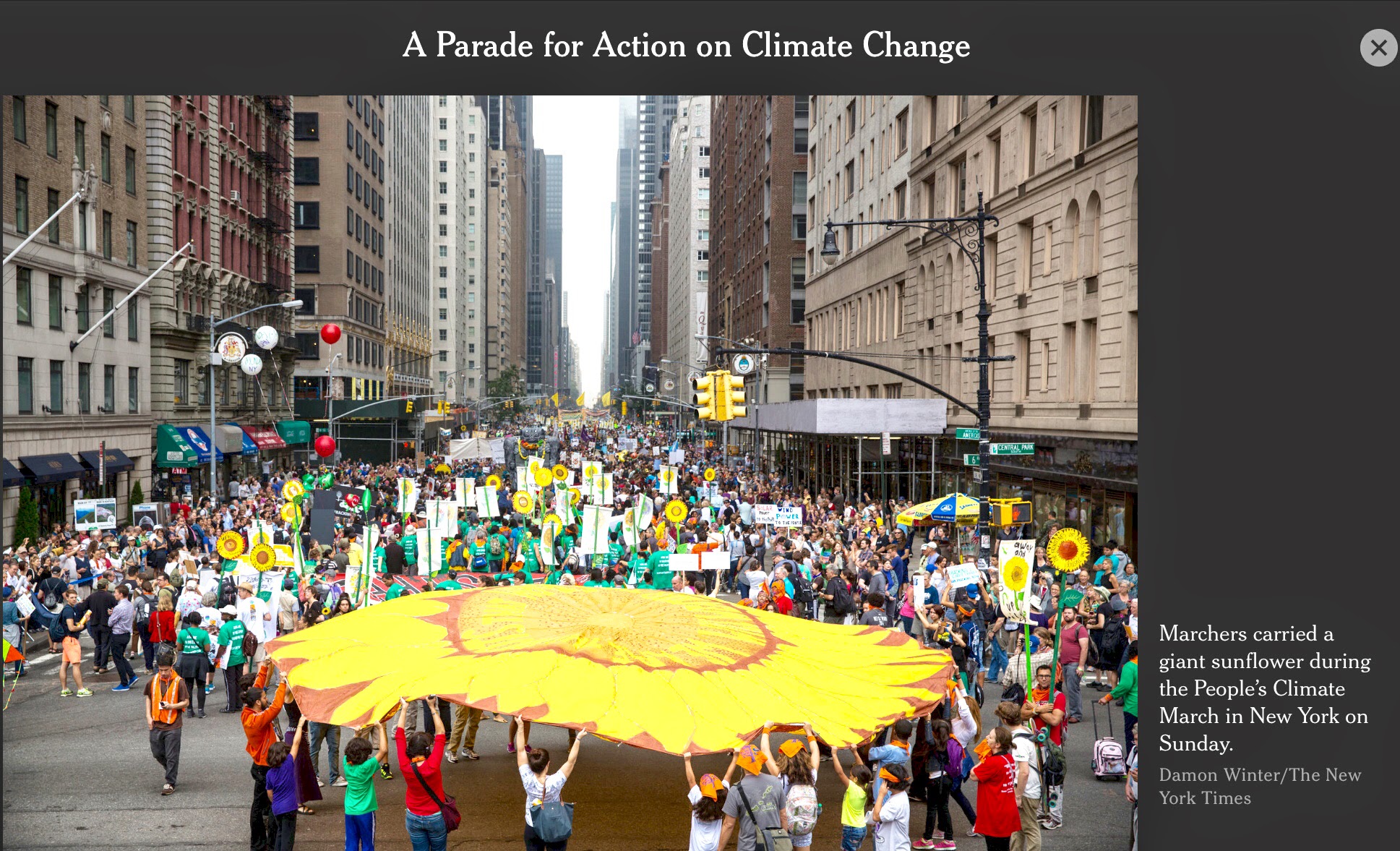
After months of planning, the People’s Climate March began rolling through a large swath of Midtown Manhattan on Sunday, taking public frustration over stalled efforts to curb carbon emissions to the streets in a noisy, vivid display of unity.

At 11:30 a.m., the march began moving east along 59th Street from Columbus Circle, proceeding along a circuitous, two-mile route, and drawing labor and immigrant groups, students and politicians, scientists and religious leaders. The march will turn south on Avenue of the Americas, head west on 42nd Street to 11th Avenue and finish at 34th Street.

The protest comes two days before a climate summit at the United Nations, which will be attended by President Obama. The meeting is expected to create a framework for a potential global agreement on emissions late next year in Paris.

The timing of the march is significant in another regard. Last week, meteorologists at the National Oceanic and Atmospheric Administration announced that this summer — the months of June, July and August — was the hottest on record for the globe, and that 2014 was on track to break the record for the hottest year, set in 2010.

“Climate change is no longer an environmental issue; it’s an everybody issue,” Sam Barratt, a campaign director for the online advocacy group Avaaz, which helped plan the march, said on Friday.

“The number of natural disasters has increased and the science is so much more clear,” he added. “This march has many messages, but the one that we’re seeing and hearing is the call for a renewable revolution.”

Mayor Bill de Blasio of New York, whose administration announced this weekend a sweeping plan to overhaul energy efficiency standards in all city-owned buildings, is among the high-profile participants expected to join the march, including the United Nations secretary general, Ban Ki-moon; former Vice President Al Gore; the actors Leonardo DiCaprio and Mark Ruffalo; at least two United States senators; and one-third of the New York City Council.

Additionally, nearly 2,700 climate events are planned in more than 150 countries to coincide with the march, considered the centerpiece of the international protest. They range from a small rally in Tanzania, to major demonstrations from Berlin to Bogata.

On Sunday morning, participants from across the country began to arrive at the staging area near the American Museum of Natural History. Rosemary Snow, 75, stretched her legs after a nearly 14-hour bus drive from Georgia.

“I thought we’d have a lot of younger people on the bus,” said Ms. Snow, who made the trip with her grandson. “There’s a really great mix of people.”

Ms. Snow had traveled with dozens of others who came from different parts of the state, including Valdosta, Savannah and Atlanta.

A professor at the University of Georgia, Chris Cuomo, from Decatur, Ga., said the group was organized by the Georgia Climate Change Coalition.

She said she hoped their presence at the rally would “let the rest of the world know that people from small-town America, urban America, rural America care about climate change.”

Nearby, Ahni Rocheleau of Santa Fe, N.M., was seated while eating a breakfast of organic yogurt and buckwheat pancakes. She is a member of the Great March for Climate Action, a cross-country walk to raise awareness for alternative and sustainable energy practices.

“We hope the heart and mind of the people will be awakened,” she said. “Coal is not the way to go.”

The march was expected to tie up traffic across a broad area of Manhattan, from the Upper West Side through Midtown. In a traffic advisory, the police braced the public for the closing of dozens of streets along the route. A lane for emergency vehicles, however, was kept open.

Nearly 500 buses have been bringing marchers from South Carolina, Kansas, Minnesota and Canada, while a “climate train” transported participants from California.

Marchers assembled before 11:30 a.m. north of Columbus Circle, specifically along Central Park West between 65th and 86th Streets, which the police planned to use as a staging area. A number of pre-march events were planned in the vicinity of Columbus Circle, including a labor event on Broadway, an interfaith religious service on West 58th Street and a rally by scientists outside the Hayden Planetarium on West 81st Street.

At 12:58 p.m., a moment of silence will be followed by a blare of noise — a symbolic sounding of the alarm on climate change — from horns, whistles and cellphone alarms. More than 20 marching bands and tolling church bells will contribute to the cacophony.

There will be no speeches, but the march will end with a block party on 11th Avenue between 34th and 38th Streets. There, participants can get a closer look at many of the floats and other artwork created for the march, including a 30-foot inflatable life preserver, 100 sunflowers and a model of the New York City skyline with bicyclists powering its lights.

New York’s political establishment was set to come out in force. On Friday, Mayor de Blasio announced on Twitter his intention to join the protest. “Proud to walk in #PeoplesClimate March on Sunday,” he wrote. “It’s everyone’s responsibility to leave a livable planet for the next generation.”

At least 17 council members planned to march. In a nod to the event, the Council announced a related package of bills on Friday aimed at reducing the city’s carbon footprint by connecting unemployed New Yorkers to green jobs, making buildings more energy-efficient and promoting low-carbon transportation. The legislation seeks an 80 percent reduction in the city’s greenhouse gas emissions by 2050.

With its bands and colorful floats, the march offers a festive atmosphere, but organizers said that the underlying message was somber. “We are trying to celebrate our lives and this planet in order to show that this is what we are fighting for,” said Leslie Cagan, the logistics coordinator for People’s Climate March. “It’s the human spirit — and everything else on this planet — that is in danger.”

The march was organized by a dozen environmental, labor and social justice groups, including the Sierra Club, Avaaz, New York City Environmental Justice Alliance, 350.org, the Transport Workers Union Local 100 and 1199 S.E.I.U. In addition, more than 1,570 “partner organizations” have signed on to march.

Organizers were hoping that the warm weather forecast for the day would yield a large turnout.

“Our biggest problem is the financial power of the fossil fuel industry,” said Bill McKibben, co-founder of 350.org and author of “The End of Nature.”

“We can’t match that money,” he said. “So we have to work in the currency of movements — passion, spirit, creativity and bodies — and it will all be on display on Sunday.” More


Curbing climate change: The deepest cuts

ON SEPTEMBER 23rd 120-odd presidents and prime ministers will gather in New York for a UN meeting on climate change. It is the first time the subject has brought so many leaders together since the ill-fated Copenhagen summit of 2009.


Now, as then, they will assert that reining in global warming is a political priority. Some may commit their governments to policies aimed at reducing greenhouse-gas emissions. What few will say is how many tonnes of carbon dioxide these will save—because they almost never do.

According to scientists, cutting carbon-dioxide emissions is an essential part of reducing catastrophic risks from climate change. Yet governments are persistently averse to providing estimates of how much carbon a policy saves. That may be because, in countries where climate change is controversial, it makes more sense to talk about the other benefits a scheme offers rather than its effect on carbon. Or it may be that, in countries which are enthusiastic about renewable energy, pointing out that it may not save that much carbon is seen as unhelpful. Or perhaps governments think climate change is so serious that all measures must be taken, regardless of cost (though their overall lacklustre record suggests this is not the case).

Whatever the reason, the end result is that while the world’s governments have hundreds of policies for tackling climate change, some of them very expensive—China, America and the European Union spend $140 billion a year on subsidising renewable energy—it is hard to say which policies are having the greatest effect.

So The Economist has made a stab at a global comparison of carbon-mitigation efforts. Chart 1 is the result. It ranks 20 policies and courses of action according to how much they have done to reduce the atmosphere’s stock of greenhouse gases. We have used figures from governments, the EU and UN agencies. As far as we know, this exercise has not been carried out before.

Apples, meet oranges

First, a health warning: the policies and actions on our list are not strictly comparable. Some are global, some regional and some national. Some are long-standing; some new. A couple are not policies at all, such as the collapse of the Soviet Union, which led to the closure of polluting factories and to inefficient state farms reverting to grassland, locking up carbon.

And the numbers almost all come with caveats. It is fairly easy to estimate how much carbon a new field full of solar cells or a nuclear-power plant saves by looking at the amount of electricity it produces in a year and how much carbon would have been emitted if fossil fuels had been used instead, based on the local mix of coal, gas and oil. But as Paul Joskow of the Massachusetts Institute of Technology has pointed out, the standard “levelised” calculations, which divide the total amount of power a plant will produce over its lifetime by its total lifetime cost, are a poor way to compare fossil fuels and renewable energy.

Other measures have problems, too. Take the effects of fuel-efficiency standards. Would companies have curtailed their cars’ emissions anyway to sell more of them to cost- and mileage-conscious drivers? And how much has better fuel efficiency encouraged drivers to drive farther?

A further complication is that many policies have benefits beyond—or indeed closer to hand than—those they offer in terms of climate. Burning less coal saves lives in the near future as well as reducing climate risks in decades to come. Saving forests preserves wildlife, not just carbon.

So our table should be treated with caution. It is only safe to say that one policy is better than another in climate terms if it beats it by a wide margin.

As it happens, though, there are some very wide margins to be found. One policy stands head and shoulders above all others. And it is one that few people other than climate-policy specialists will have thought of in this context: the Montreal protocol, a 1987 agreement to phase out substances such as chlorofluorocarbons (CFCs) used in air conditioners, refrigerators and so on. It was enacted to limit the damage such substances were doing to the ozone layer, a goal which it has achieved.

Like carbon dioxide and many other gases emitted by industry and agriculture—methane and nitrous oxide, for example—CFCs are greenhouse gases. And they are extremely potent ones, causing thousands of times more warming per molecule than carbon dioxide does. That means stopping CFC production, which was in the range of millions of tonnes a year, delivered a climate benefit equivalent to cutting carbon-dioxide emissions by billions of tonnes.

Collateral benefits

Guus Velders of the Dutch National Institute for Public Health and the Environment has compared the warming effect that would have come about if the emissions of such chemicals had continued to grow at the rate they were growing before the protocol with what has come about thanks to their banning. The net effect is equivalent to that of a whopping 135 billion tonnes of carbon dioxide. That is more than twice today’s total annual greenhouse-gas emissions, which are equivalent to about 50 billion tonnes of carbon dioxide (carbon dioxide itself makes up about three-quarters of that, with methane, nitrous oxide and some gases used in industry making up the rest). Durwood Zaelke of the Institute for Governance and Sustainable Development, a think-tank, says that if CFCs were uncontrolled the annual figure would be 8 billion tonnes higher. The Montreal protocol has had nearly as big an effect as all the rest of our list put together.

Trailing some way behind the Montreal protocol is a small group of measures—not really climate policies—that have been responsible for avoiding between 4% and 7% of greenhouse-gas emissions. According to the International Atomic Energy Agency, nuclear power avoided the production of 2.2 billion tonnes of carbon dioxide in 2010—that is, emissions would have been 2.2 billion tonnes higher if the same amount of electricity had been produced by non-nuclear plants. Energy from dams and other hydroelectric sources avoided 2.8 billion tonnes (though emissions of methane from the reservoirs behind some of those dams mean the net effects were less than that). Between them they generated 6,000 terawatt-hours of electricity in 2011, compared with 450TWhrs for wind and less than 60TWhrs for solar. The high rate at which new wind and solar capacity is being built will eat into this lead, but it will take some time to overturn it.

The other item in this group is something of a cheat. In 2007 Su Wei of China’s foreign ministry said that his country’s one-child policy, by reducing the number of births between the late 1970s and the mid-2000s by 300m, had reduced carbon emissions by 1.3 billion tonnes in 2005 (because there were fewer people to consume goods which generated greenhouse gases in their production). Taking this argument further, one could say that the fall in global fertility since 1960 cut emissions even more. That is not exactly a climate policy. But it is a reminder that greenhouse gases are powerfully influenced by factors far beyond the scope of climate-change policies.

Three other lessons emerge. First, policies to slow or reverse deforestation are more important than one might expect. Trees absorb carbon as they grow and release it when they are cut down. According to a recent study in Science, declining deforestation in Brazil meant that the country produced 3.2 billion tonnes less atmospheric carbon dioxide between 2005 and 2013 than it would have if the tree-felling had continued unabated. That is 400m tonnes a year. The slowdown in deforestation in tropical countries is one of the reasons that the conversion of forests to farmland now accounts for only 11% of greenhouse-gas emissions globally, much less than 20 years ago.

The other reason for deforestation’s dramatically reduced share of total emissions, though, is that industrial emissions of carbon dioxide have continued to grow rapidly. The rise is not as fast as it might have been. Rules that make vehicles more efficient and improve the energy efficiency of buildings and appliances have done more than might be expected. America has been setting standards for vehicle greenhouse-gas emissions and fuel efficiency since the mid 1970s; the current rules are forecast to reduce carbon-dioxide emissions by 6 billion tonnes in 2012-25, meaning by about 460m tonnes a year. America’s Department of Transportation reckons that overall such rules have reduced carbon-dioxide emissions by a cumulative 14 billion tonnes. Europe’s equivalent regulations for passenger cars and light trucks do less (European vehicles were more efficient to start with) but are still respectable; being adopted by overseas manufacturers who want to sell cars in Europe gives them an unquantified extra clout. More


Climate Injustice – Excerpt from Disruption

‘When it comes to climate change, why do we do so little when we know so much?’

Through a relentless investigation to find the answer, Disruption takes an unflinching look at the devastating consequences of our inaction.

The exploration lays bare the terrifying science, the shattered political process, the unrelenting industry special interests and the civic stasis that have brought us to this social, moral and ecological crossroads.The film also takes us behind-the-scenes of the efforts to organize the largest climate rally in the history of the planet during the UN world climate summit.

This is the story of our unique moment in history. We are living through an age of tipping points and rapid social and planetary change. We’re the first generation to feel the impacts of climate disruption, and the last generation that can do something about it. The film enlarges the issue beyond climate impacts and makes a compelling call for bold action that is strong enough to tip the balance to build a clean energy future. More